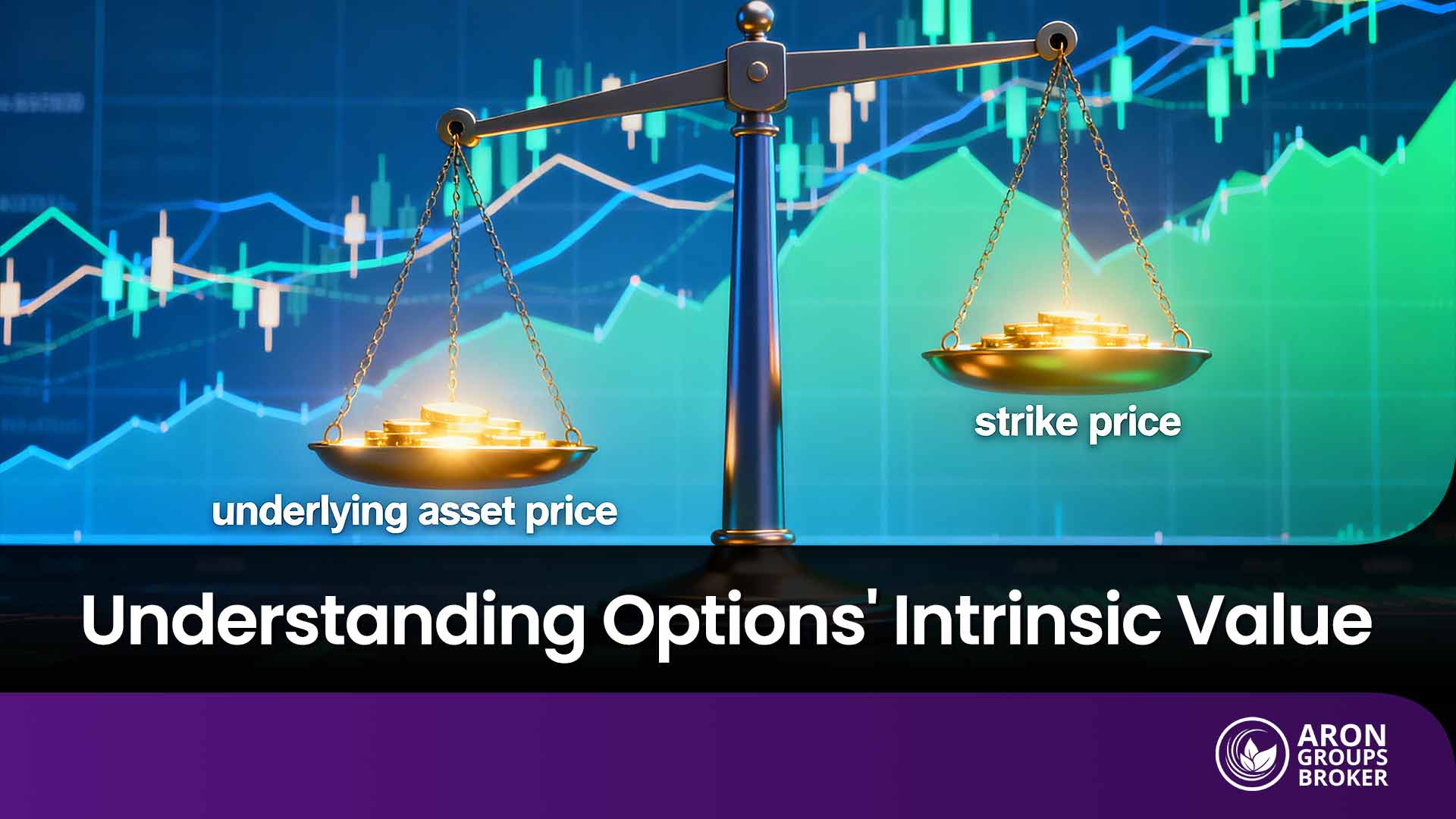

An intrinsic value option is a simple way to check whether an option has any “real” value right now. It compares the strike price vs market price to show if a call or put is in the money, or if it has zero intrinsic value.
This idea is the starting point for understanding option payoffs at expiration and why some contracts can expire worthless.
If you stay with us to the end, you will be able to use the intrinsic value option formula confidently and avoid common beginner mistakes when comparing option prices.
- Understanding the intrinsic value option helps traders distinguish between a measurable price advantage and speculative premium movements in volatile global markets.
- Applying the intrinsic value option formula consistently improves decision-making, especially when evaluating entry timing and expiration risk.
- Monitoring call and put intrinsic value supports smarter capital allocation by clarifying when real market positioning outweighs temporary pricing noise.
- Even with advanced calculators and AI tools, intrinsic value remains a foundational metric that grounds option strategies in objective price relationships.
What Is Intrinsic Value in an Option?
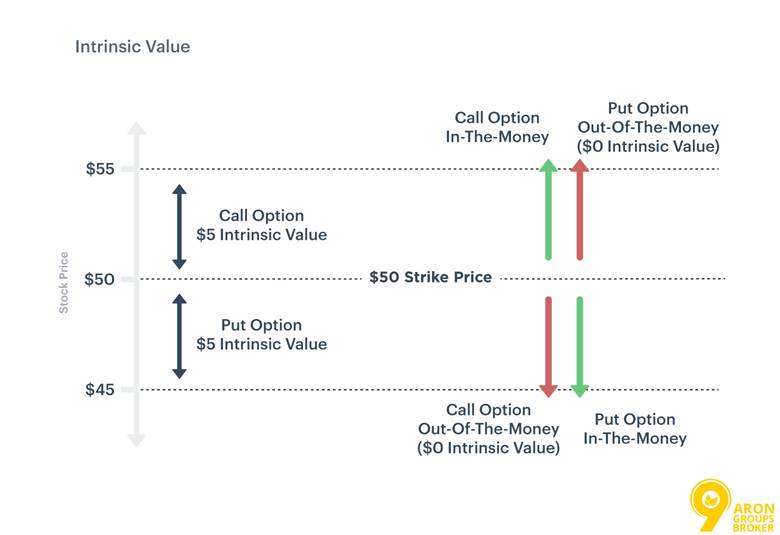
The intrinsic value option represents the immediate profit potential in an options contract, calculated as the positive difference between the underlying asset’s current market price and the strike price when the option is in the money.
For at-the-money or out-of-the-money options, this value drops to zero, focusing solely on the tangible benefit if exercised right away.
| Moneyness State | Definition | Value Example (Assuming Stock at £50) |
|---|---|---|
| ITM (In-the-Money) | Option with positive intrinsic value due to favourable price difference. | Call with £45 strike: £5 intrinsic value. |
| ATM (At-the-Money) | Strike equals market price; no intrinsic value. | Call or put with £50 strike: £0. |
| OTM (Out-of-the-Money) | The option lacks intrinsic value as exercise would not profit. | Call with £55 strike: £0. |
According to Investopedia, ATM options have no intrinsic value but may carry extrinsic value influenced by volatility.
Key Point:
Intrinsic value ignores time decay, focusing solely on immediate exercise profitability—crucial for short-term trades.
Q: How does intrinsic value fit into overall option strategy?
A: It anchors decisions in concrete market realities, complementing tools like RSI for momentum analysis; beginners should practise on demo accounts to see real-time impacts.
Defining the Intrinsic Value Option and Its Core Concept
At its core, the intrinsic value option definition highlights the non-negative profit from exercising an ITM option, ensuring only positive differences count toward the real value of the option contract.
This component remains unaffected by speculative elements, providing a straightforward measure of built-in worth.
- Non-speculative component that reflects current market conditions.
- Increases with favourable price moves toward deeper ITM status.
- Dominant near expiry when other factors diminish.
More Info:
In volatile markets, intrinsic value can spike, but remember, options can expire worthless if OTM.
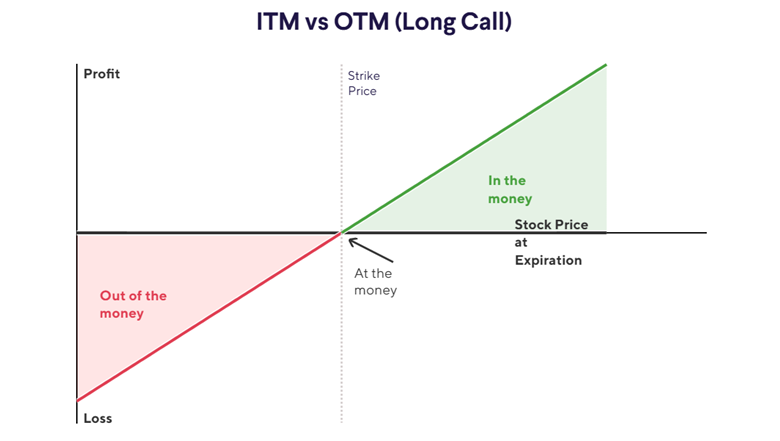
Intrinsic value for calls involves subtracting the strike from the market price, always resulting in zero or a positive value. While intrinsic value indicates profit, market reversals can erode it—always consider volatility.
Difference Between Intrinsic and Extrinsic Value in Option Pricing
Intrinsic value captures the tangible ITM amount within option pricing components, whereas extrinsic value, or time value of the option, accounts for remaining time, implied volatility, and potential future shifts.
This distinction helps explain why premiums often exceed pure profit potential.
| Component | Description | Factors |
|---|---|---|
| Intrinsic | Immediate exercise profit for ITM options. | Underlying price vs strike. |
| Extrinsic | Additional premium beyond intrinsic. | Time to expiry, volatility, and interest rates. |
According to SoFi, the total premium equals intrinsic plus extrinsic, with OTM options relying entirely on the latter.
High extrinsic can lure with potential, but heightens the risk.
Q: Why separate them?
A: Extrinsic value erodes over time (theta decay), while intrinsic value can hold if the option stays ITM.
This matters in strategies such as covered calls, where the premium spread between strikes often reflects changing extrinsic value.
A high extrinsic premium can look attractive, but it increases the chance of loss if the move never happens.
Why Intrinsic Value Matters for Traders
Intrinsic value helps traders judge whether a premium is supported by real ITM value or mainly by time value.
For beginners, it demystifies pricing by linking option value directly to strike price vs market price behaviour.
It also supports clearer planning around the option payoff at expiration, where extrinsic value tends toward zero. The strike price determines whether an option has intrinsic value.
This is why moneyness checks are often the first step before evaluating any premium.
Benefits for traders
- Identifies whether the premium is mostly intrinsic or mostly time value.
- Improves payoff forecasting, especially close to expiry.
- Encourages rule-based decisions instead of impulse buying.
Key Insight:
Traders who monitor intrinsic value often protect their risk-reward structure, especially under pressure from emotions and trading psychology.
How to Calculate Intrinsic Value in Options
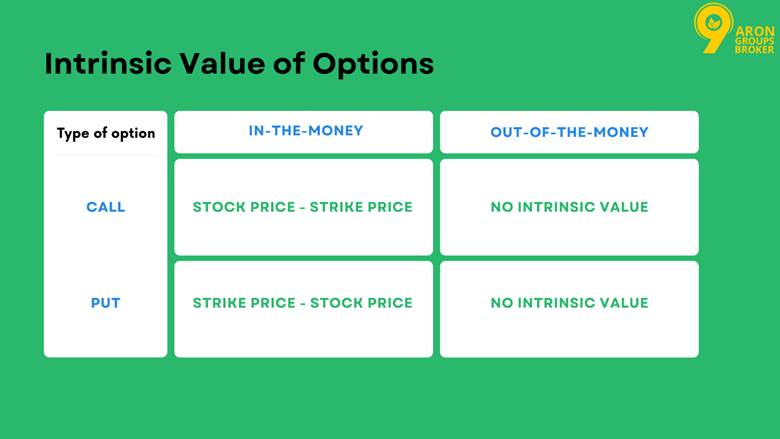
Calculating the intrinsic value in options involves a straightforward process that compares the strike price vs market price to determine immediate profitability, using specific formulas for calls and puts.
Begin by identifying whether it’s a call or put, obtain the current asset price and strike, then apply the appropriate intrinsic value option formula for precise results.
Tools like an intrinsic value option calculator enhance accuracy, especially for beginners navigating dynamic markets. Calculations assume no transaction costs; actual profits may vary due to market risks.
Q: When should you recalculate intrinsic value?
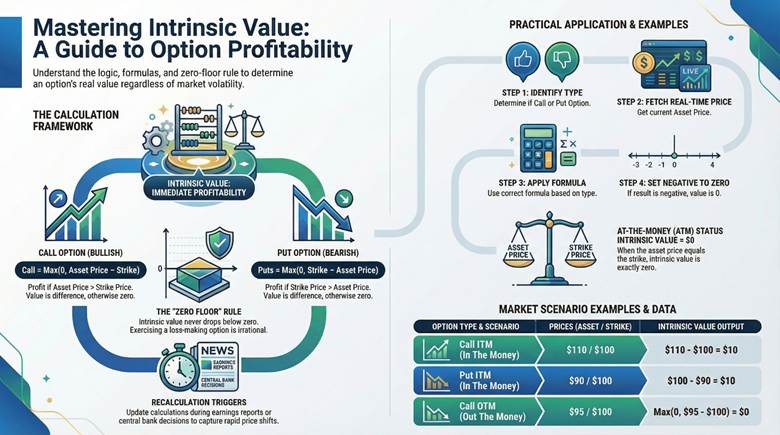
A: Recalculate frequently in fast markets, especially around scheduled news that moves the underlying. Earnings reports, central bank decisions, and guidance updates can shift prices quickly and alter intrinsic value within seconds.
Step-by-Step Intrinsic Value Option Formula
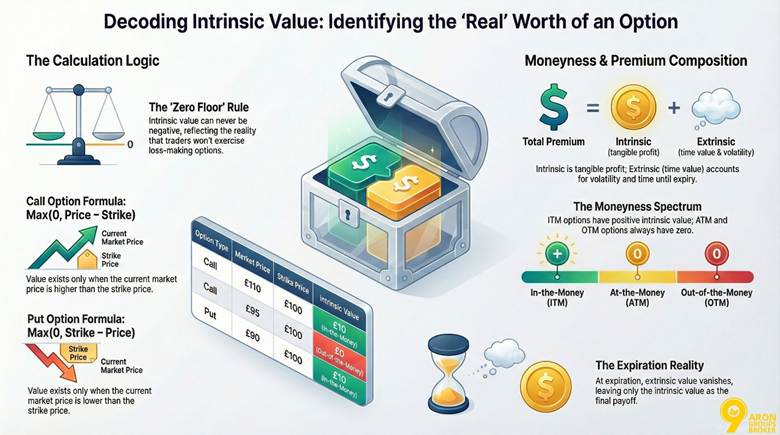
The intrinsic value option formula uses a “zero floor” to prevent negative values. This reflects real exercise logic, because exercising a loss-making option is irrational.
According to Macroption, intrinsic value is calculated differently for calls and puts:
- Call intrinsic value = Max(0, Asset Price − Strike Price)
- Put intrinsic value = Max(0, Strike Price − Asset Price)
Use these steps for the intrinsic value options formula:
- Fetch the underlying’s real-time market price.
- Identify the option type: call or put.
- Subtract correctly using the formula above.
- If the result is negative, set the intrinsic value to zero.
Did You Know:
The Max(0, …) rule guarantees intrinsic value never goes below zero, matching real-world exercise decisions.
| Scenario | Option type | Asset price | Strike price | Output |
|---|---|---|---|---|
| A | Call | 110 | 100 | Max(0, 110−100) = 10 |
| B | Call | 95 | 100 | Max(0, 95−100) = 0 |
| C | Put | 90 | 100 | Max(0, 100−90) = 10 |
| D | Put | 105 | 100 | Max(0, 100−105) = 0 |
Using an Intrinsic Value Option Calculator for Accurate Results
An intrinsic value option calculator can reduce mistakes when markets move quickly. Most brokers and charting platforms compute intrinsic value automatically from live prices. You typically input the underlying price, strike, option type, and contract size.
An option’s premium consists of intrinsic value and time value. That is why calculators help isolate the “real value” portion from the rest.
Benefits of calculator-based checks
- Reduces manual errors during fast price updates.
- Integrates with platforms, so prices update in real time.
- Helps compare the real value of an option contract versus the quoted premium.
Note:
Calculators measure current value, but they do not forecast future direction. Combine outputs with fundamental analysis to judge whether price drivers support your thesis.
Practical Examples for Call and Put Options
Examples make the formulas easier to trust, especially near the strike. Small moves can flip an option from zero intrinsic value to a meaningful number.
Example 1: Call option intrinsic value
- Underlying: £50
- Strike: £45
- Intrinsic value = Max(0, 50 − 45) = £5
Example 2: Put option intrinsic value
- Underlying: £40
- Strike: £45
- Intrinsic value = Max(0, 45 − 40) = £5
Inputs and outputs table:
| Example | Type | Underlying price | Strike | Intrinsic value |
|---|---|---|---|---|
| 1 | Call | £50 | £45 | £5 |
| 2 | Put | £40 | £45 | £5 |
| 3 | Call (ATM) | £45 | £45 | £0 |
| 4 | Put (OTM) | £48 | £45 | £0 |
Q: What if the option is at-the-money?
A: ATM options have zero intrinsic value, so the premium is entirely extrinsic. Monitor price closely, because small changes can move the contract into ITM quickly.
Key Point:
These examples show how small price changes can rapidly alter intrinsic value when the underlying trades near the strike.
Call Option Intrinsic Value Explained
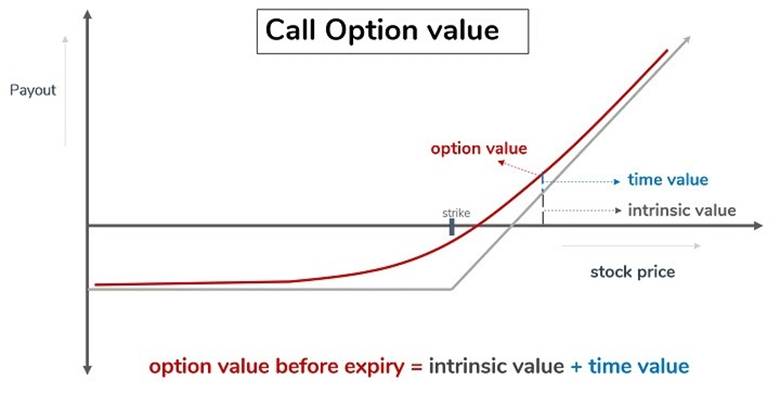
Call option intrinsic value arises when the underlying asset’s price surpasses the strike, offering immediate profit potential upon exercise.
This becomes particularly dominant as expiration approaches, where extrinsic factors fade, leaving only the core worth.
Imagine a payoff diagram: a horizontal line at a negative premium for prices below strike, then a 45-degree upward slope starting at the strike, crossing zero at breakeven (strike plus premium), illustrating unlimited upside.
call intrinsic value equals current stock price minus strike when in-the-money, highlighting exercise benefits.
Determining ITM (In-the-Money) Call Option Value
An ITM call occurs whenever the asset price exceeds the strike, with in the money option value directly equalling that positive gap. Deeper ITM levels enhance reliability against minor fluctuations.
- Depth ITM boosts stability by cushioning against small drops.
- Shallow ITM remains vulnerable to quick reversals.
According to Merrill Edge, this value reflects the underlying’s superiority over strike, essential for assessing true profitability.
Strike Price vs Market Price: How It Drives Call Option Value
Wider gaps between strike price vs market price elevate the value, while narrower ones yield minimal or zero returns. For instance, a £60 market with a £50 strike gives £10 value; a £52 market drops it to £2.
More Info:
Favourable gaps signal buying opportunities, but assess premiums to ensure overall cost-effectiveness.
Call Option Payoff at Expiration and Dominance of Intrinsic Value Near Expiry
At expiration, the option payoff at expiration mirrors pure intrinsic value, as time-related elements vanish entirely. If OTM, total loss of premium ensues, underscoring the need for careful monitoring.
Calls settle based on asset minus strike if positive, otherwise zero, emphasising expiry’s focus on fundamentals.
Put Option Intrinsic Value Explained
A put option gives the holder the right to sell an underlying asset at a predetermined strike price before expiration. Unlike calls, puts gain value when the underlying asset declines.
The put option intrinsic value represents the immediate exercise benefit available when the asset’s market price falls below the strike price.
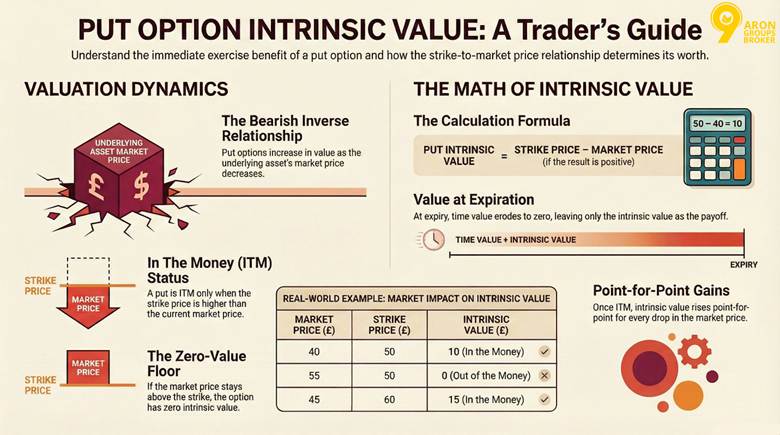
In practical terms, intrinsic value exists only when the put is in the money, meaning the strike price is higher than the current market price.
According to Investopedia, a put option increases in value as the underlying asset’s price decreases. That relationship forms the foundation of bearish strategies and portfolio hedging.
However, if the asset remains above the strike, the put holds no intrinsic value and may expire worthless. This makes understanding OTM risk essential for disciplined trading.
Determining ITM Put Option Value
A put is considered in the money when the asset price trades below the strike price. The ITM intrinsic value is calculated using the formula:
Put intrinsic value = Strike price − Market price (if positive)
If the result is negative, intrinsic value is zero.
For example, if a stock trades at £40 and the strike price is £50, the in-the-money option value equals £10. Conversely, if the stock trades at £55, the intrinsic value becomes zero because exercising the right to sell at £50 would not provide a benefit.
Intrinsic value reflects the amount an option is in the money and represents its immediate exercise value. The deeper the underlying price falls below the strike, the greater the intrinsic component of the put.
Strike Price vs Market Price: Effect on Put Options
The relationship between strike price and market price fully determines the intrinsic value of a put. As the market price declines further below the strike, intrinsic value rises point-for-point. A widening gap strengthens the contract’s real exercise advantage.
For instance, with a strike of £60:
- If the asset trades at £55 → intrinsic value = £5
- If the asset drops to £45 → intrinsic value = £15
- If the asset rises above £60 → intrinsic value = £0
This dynamic means that sustained downtrends can significantly enhance the value of puts.
However, traders must also consider overall exposure and position sizing, especially during volatile conditions. Tools such as a position size calculator can help align risk with account capital.
Key impacts of falling prices on put value:
- Strong downtrends increase intrinsic value steadily.
- Rapid sell-offs can quickly shift near-the-money puts into ITM territory.
- Reversals can erase intrinsic gains if the price climbs back above the strike.
Q: Are put options suitable for bearish traders?
A: Yes, puts are commonly used by traders expecting price declines. They are also valuable for portfolio protection against sudden downturns.
Put Option Payoff at Expiration and Risk of OTM Worthless Expiry
As expiration approaches, an option’s time value declines. At expiry, only intrinsic value remains.
An option’s premium consists of intrinsic value plus time value, but time value erodes to zero at expiration.
The option payoff at expiration for a put follows a clear structure:
- If market price < strike → payoff equals strike − market price.
- If market price ≥ strike → payoff equals zero.
Key Insight:
Puts are often used for hedging portfolio downside risk rather than pure speculation. Their protective value becomes evident during market stress, but timing remains critical.
Factors Influencing Intrinsic Value
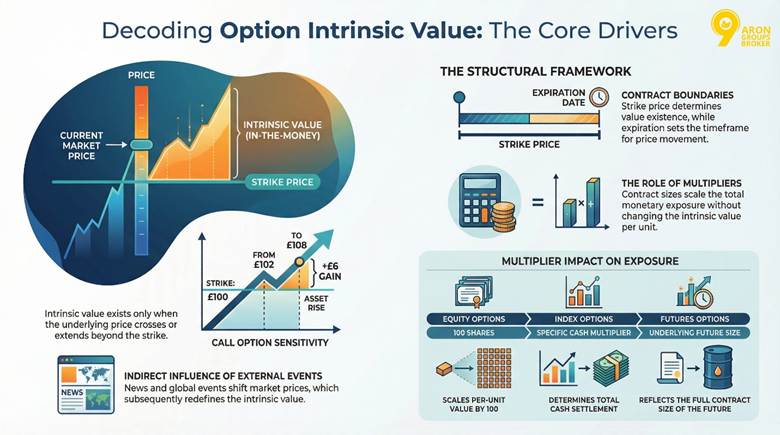
Intrinsic value is primarily driven by the relationship between the underlying asset’s current price and its strike price.
While broader option pricing components such as volatility and time to expiry shape the overall premium, intrinsic value itself depends directly on measurable price differences.
Secondary influences, including contract specifications and market structure, determine how that value translates into actual monetary exposure.
Understanding these factors helps traders distinguish between temporary premium fluctuations and genuine changes in exercise value.
By focusing on how strike price vs market price interact, investors can evaluate whether an option’s value reflects real positioning or short-term sentiment.
Market Price Movements and Impact on Option Value
The most immediate factor influencing intrinsic value is movement in the underlying asset’s price. When price shifts, the gap between the strike and the market adjusts accordingly, directly affecting intrinsic value.
For example, consider a call option with a strike of £100. If the underlying rises from £102 to £108, intrinsic value increases from £2 to £8. Conversely, if the price drops below £100, the intrinsic value falls to zero. The same principle applies inversely to put options.
Intrinsic value in options reflects the in-the-money portion determined by the underlying asset’s current price relative to the strike. This highlights that intrinsic value changes only when price crosses or extends beyond the strike threshold.
Q: Do external events influence intrinsic value directly?
A: Events do not alter intrinsic value on their own, but they move prices. News and global developments can shift markets rapidly, thereby changing the strike-to-price relationship. Staying informed across global markets is essential for anticipating such movements.
Option Contract Specifications and Their Role
While price determines intrinsic value, contract specifications define its framework. Strike price and expiration date establish the structural boundaries of the contract. The strike determines whether intrinsic value can exist, while expiration defines the timeframe within which price movements must occur.
Contract multipliers also affect the real value of option contract exposure. For instance:
- Equity options often represent 100 shares per contract.
- Index options may use specific cash multipliers.
- Futures options reflect the contract size of the underlying future.
These multipliers do not change intrinsic value per unit, but they scale total monetary impact.
Note:
Even a small intrinsic value per unit can represent significant exposure when the contract size is large.
Intrinsic Value vs Real Value of an Option Contract
Distinguishing between intrinsic value and the real value of an option contract clarifies how premiums reflect both immediate profitability and future potential, with the real value encompassing the total market price paid, while intrinsic value forms only a portion through intrinsic vs extrinsic value dynamics.
Understanding the Real Value of an Option Contract
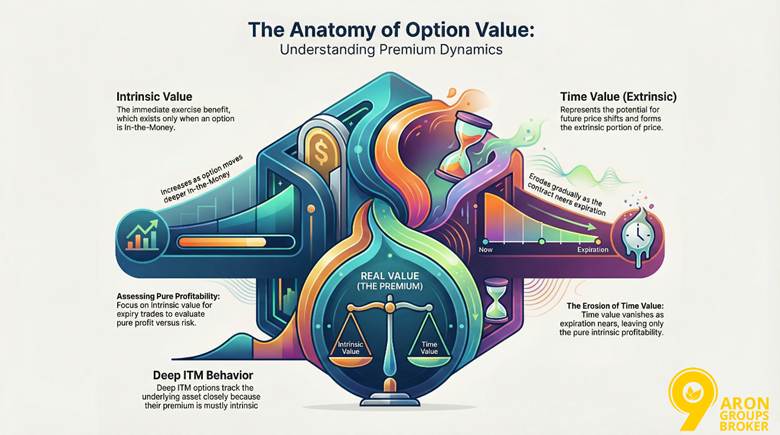
The real value of an option contract equates to its premium, which traders pay in the market, comprising the sum of intrinsic and extrinsic elements that together determine overall worth.
| Component | Role in Pricing |
|---|---|
| Intrinsic Value | Immediate exercise benefit |
| Time Value | Future price potential |
Recognising In-the-Money Option Value and Deep ITM Behaviour
An in-the-money option value exists when the intrinsic value is positive. The deeper the contract moves ITM, the larger the ITM intrinsic value becomes.
Deep ITM options tend to track the underlying asset more closely because most of their premium is intrinsic.
Traders often use tools such as a risk-to-reward indicator to manage exposure when intrinsic value forms a large portion of the price.
How Time Value Relates to Intrinsic Value Without Affecting It
The time value of the option contributes exclusively to the extrinsic portion of the premium, representing potential for future price shifts, yet it leaves the intrinsic untouched, gradually eroding as expiration nears without altering the core exercise profit.
Key Point:
Focus on intrinsic for expiry trades, as time value vanishes, leaving only the Sharpe ratio-like efficiency in assessing pure profitability versus risk.
Common Questions and Misconceptions
Many traders misunderstand how an intrinsic value option fits into overall pricing. A common myth is that intrinsic value represents the full worth of a contract.
In reality, an option’s market price includes both intrinsic and time value, and confusing the two can distort risk expectations. Intrinsic value only reflects immediate exercise benefit, while the premium also captures probability and uncertainty.
Can an Option Have Zero Intrinsic Value?
Yes. An option can have zero intrinsic value if it is at-the-money (ATM) or out-of-the-money (OTM). In these cases, exercising the contract would not produce a profit.
For example, a call with a strike of £100 and a market price of £98 has zero intrinsic value. The same applies to a put with a strike of £100 if the asset trades at £103. Only contracts with positive ITM intrinsic value contain an immediate exercise benefit.
Q: What are the implications of zero intrinsic value?
A: When intrinsic value is zero, the premium depends entirely on extrinsic factors. If time runs out before the option moves ITM, it may expire worthless, resulting in a full loss of the premium paid.
Warning:
OTM contracts often appear inexpensive, but their probability of expiring without value is significantly higher.
ITM, ATM, and OTM – How They Affect Intrinsic Value and Premiums
The relationship between strike and market price determines whether an option is in the money, at the money, or out of the money. This classification directly affects intrinsic value and influences premium behaviour.
| Moneyness | Intrinsic Value | Premium Composition | Risk Profile |
|---|---|---|---|
| ITM | Positive ITM intrinsic value | Intrinsic + time value | Lower probability of total loss |
| ATM | Zero | Mostly time value | Sensitive to price shifts |
| OTM | Zero | Entirely time value | High probability of expiring worthless |
An in-the-money option value increases as the asset moves further beyond the strike. ATM options sit near the threshold and can quickly gain or lose intrinsic value. OTM options rely entirely on future price movement.
Tip:
Before trading short-dated contracts, consider practising with a forex demo account to observe how moneyness shifts affect pricing in real time.
Understanding these classifications prevents the common mistake of equating low premiums with low risk.
In options markets, zero intrinsic value often means higher uncertainty rather than better value.
Conclusion
Mastering the intrinsic value option concept allows traders to separate real exercise value from speculative pricing noise. By applying the intrinsic value option formula consistently, investors can better interpret movements in both calls and puts, especially when analysing call option intrinsic value in rising markets.
Modern calculators and AI-driven analytics platforms can support faster evaluation, but they rely on assumptions and cannot predict unpredictable shocks. Use them as aids, not substitutes for judgment.