





Power hour stocks usually refers to trading during the final hour of the regular US session, when activity often picks up and order flow becomes more aggressive; in trader slang, some people also use power hour for the opening hour, but the close is the one most traders mean because the NYSE core session ends at 4:00 p.m. ET and closing auctions concentrate a lot of volume into that window.

- Power hour means 3:00–4:00 p.m. ET (the last hour before the 4:00 p.m. ET close). The regular session itself runs 9:30 a.m. to 4:00 p.m. ET.
- The close behaves differently because exchanges run a closing auction and publish imbalance information late in the session (e.g., around 3:50 p.m. ET on NYSE/Nasdaq workflows).
- Power hour trading works best in liquid names (tight spreads, strong volume), not random low-float stocks. ETF liquidity can also be checked by spread and average volume.
- Use clear entries, hard stops, and predefined targets. In fast conditions, limit orders are often better than chasing with market orders.
- Treat power hour as an execution window, not a prediction contest. You are trading flow and momentum, not forcing a setup.
Understanding Power Hour Stocks
Power hour matters because the final hour often attracts a mix of active traders, algorithms, and end-of-day positioning. That combination can produce cleaner momentum in some sessions, but it can also create sharp reversals. The key is to understand what makes the close structurally different before placing a trade.
What Power Hour Means in the Stock Market
Power hour is a market term for periods of elevated activity, usually around the open and close. In practice, many stock traders use it specifically for the last hour of the regular US equity session.
For this article, the focus is on the closing power hour:
- 3:00–4:00 p.m. ET
- The final 10–15 minutes can be especially fast because auction-related flow increases into the close. NYSE and Nasdaq both have formal closing auction processes, and Nasdaq disseminates closing imbalance information between 3:50 and 4:00 p.m. ET.
Timing of Power Hour Across US Time Zones
According to the NYSE, US equity trading is anchored to Eastern Time (ET). The New York Stock Exchange core session ends at 4:00 p.m. ET, so the closing power hour is the hour before that.
Here is the same window in other US time zones:
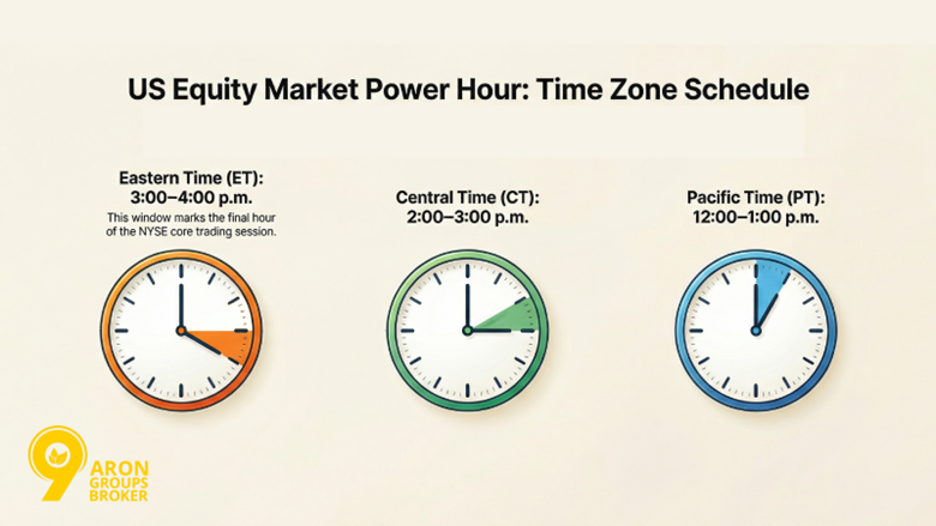
This is why you will often see searches like Power hour stocks Central time and Power hour stocks Pacific time. The window is the same market phase, just translated by timezone.
Key Differences Between Opening and Closing Market Power Hours
Both the open and close can be volatile, but they are not the same trade environment.
Opening power hour (first hour)
- Price is digesting overnight news and pre-market positioning.
- Direction can be messy in the first minutes.
- False starts are common.
Closing power hour (final hour)
- More end-of-day positioning appears.
- Closing auction mechanics become important.
- MOC/LOC and imbalance data can influence the final move and fill quality. NYSE and Nasdaq both publish close-related timing rules, and Nasdaq’s closing process includes NOII dissemination into the close.

Important note: The last 10 minutes are not just more volatility. They are also in a different microstructure regime because auction logic starts to matter more than normal intraday flow.
How to Trade Power Hour Stocks
Power hour trading should be rule-based. If you improvise in the final hour, you will often end up chasing candles. Build a short checklist, define your setup, and execute only when price and volume agree.
Step-by-Step Trade Plan for Power Hour Stocks
Use a simple plan you can repeat every day.
- Build a watchlist before power hour
- Pick stocks/ETFs already active during the day.
- Prioritise names with a clean intraday structure (trend or range edge).
- Mark key levels
- Day high / day low
- VWAP (if you use it)
- Midday consolidation highs/lows
- Pre-close breakout or breakdown levels
- Check volume and participation
- Is volume rising into 3:00 p.m. ET?
- Is the price moving with momentum, or just drifting?
- Choose your setup type.
- Momentum continuation
- Breakout from a tight range
- Reversal from a failed late breakout
- Define the trade before entry
- Entry price
- Stop level
- First target
- Maximum risk per trade
- Manage into the close
- Reduce size if spread widen
- Avoid emotional re-entries
- Decide in advance whether you will hold past 4:00 p.m. ET
This matters because trading near the close can involve order-type and execution timing issues. FINRA (Financial Industry Regulatory Authority) also notes time-based order qualifiers such as MOC/MOO and explains that some orders near the close have restrictions on modification/cancellation.
Choosing Liquid Stocks and ETFs for the Final Hour
Liquidity is not optional in Power Hour. It is the difference between a controlled trade and a bad fill.
For ETFs, practical liquidity checks include:
- Average bid/ask spread (narrower is generally better)
- Average trading volume (higher is generally better)
- Whether the ETF trades close to its NAV (helps assess pricing quality)
For stocks, keep it simple:
- Higher average daily volume
- Tight spreads
- Consistent tape activity (not sporadic prints)
FINRA also highlights bid-ask spreads as a core cost/liquidity factor, which is exactly why low-liquidity names are dangerous in the final hour.
Remember: If a chart looks exciting but the spread is wide, skip it. A clean setup on a liquid name usually beats a perfect setup on a thin one.
Setting Entries, Stops, and Targets with Closing Hour Momentum
This is where most traders lose discipline. They see acceleration and enter too late.
A better approach:
1) Entry
Use a trigger, not a feeling:
- Break and hold above a marked level
- Pullback retest after breakout
- Rejection candle at a failed breakout level
If the price is moving too fast, use a limit order rather than panic-clicking a market order. FINRA notes that limit orders are commonly used when price control matters more than immediate execution.
2) Stop
Place the stop where the setup is invalid, not where it feels safe:
- Below breakout base (for longs)
- Above rejection wick (for shorts)
- Beyond the structure level that created the trade idea
Keep the stop tight enough to protect capital, but not so tight that normal noise takes you out.
3) Target
Use realistic power-hour targets:
- Next intraday liquidity level
- Day high/day low retest
- Measured move from the breakout range
A practical rule:
- Scale partial profits at 1R
- Hold the rest only if momentum remains strong into the final minutes
If you plan to use market-on-close style execution, remember that exchange-specific cut-offs and closing auction rules matter. NYSE and Nasdaq both publish explicit close timelines, including 3:50 p.m. milestones for imbalance/order handling.
Advanced Strategies for Power Hour Trading
Power Hour is where execution quality matters most. The final hour often combines trend continuation, failed breakouts, and large closing flows. A good approach is to use one framework and then apply strict filters, instead of reacting to every fast move.
Combining VWAP with Trend Analysis
VWAP is a strong anchor in the final hour because it combines price and volume, not price alone. Schwab’s guide defines VWAP as the intraday average price weighted by volume, and notes that both institutional and retail traders use it as a benchmark and guide for entries/exits.
How to use it during Power Hour:
A practical rule:
- Use VWAP to define the side (long/short).
- Use price structure (higher highs / lower lows) to define the entry.
- Use the latest swing plus VWAP position to define the stop.
If VWAP and trend structure disagree, skip the trade. That single filter removes many late-session mistakes.
Using Volume, Breadth, and Liquidity Sweeps to Filter Trades
Volume alone is not enough in the last hour. You also want to know whether the move is broad-based or being pushed by a few names. Schwab’s breadth explanation is useful here: breadth tracks how many stocks are participating, and weakening breadth during an index rally can signal internal weakness.
A simple filter stack for Power Hour:
- Volume: Is participation increasing in the move?
- Breadth: Is the index move supported by broad participation?
- Liquidity sweep: Did price run obvious highs/lows and then reject or continue cleanly?
This helps you separate:
- real closing momentum (broad participation + sustained flow), from
- late stop runs (brief push through a level, then reversal).
Important note: In the final hour, many false moves look strong for a few minutes. Wait for confirmation after the sweep, not during the sweep.
Reading Institutional Order Flow Near Market Close
The close is not just retail volatility. It is a major auction event. NYSE publishes the regular session close at 4:00 p.m. ET, with a closing auction imbalance freeze just before the close (3:59–4:00 p.m. ET). Nasdaq’s Closing Cross materials also show how closing information is disseminated before 4:00 p.m. ET, including imbalance-related data, and explain that the closing auction is used for benchmark pricing.
Why this matters for Power Hour trades:
- Closing price formation is often driven by auction mechanics, not just chart patterns.
- MOC/LOC activity can distort short-term price movement.
- Late moves can be fast because participants are forced to finish execution before the close.
FINRA also notes that MOC orders are designed to execute as close as possible to the 4:00 p.m. ET close and typically cannot be modified/cancelled close to the deadline. That is one reason the tape can feel one-sided near the bell.
A cleaner read of closing flow:
- Mark the day’s key high/low and VWAP.
- Watch whether the price is trending into the close or whipsawing.
- If possible, monitor imbalance/closing flow tools on your platform.
- Avoid assuming every late spike is a breakout. Some are just auction-related positioning.
Common Mistakes in Power Hour Stock Trading
Power Hour can be very profitable. It can also punish poor execution. Most losses in this window come from timing, slippage, or forcing trades in unstable conditions.
Avoiding Chasing Late Breakouts
This is the most common mistake.
A breakout at 3:52 p.m. can look ideal, then fail hard by 3:58 p.m. The reason is simple: late moves often include:
- liquidity sweeps above/below obvious intraday levels,
- closing order imbalances,
- short-covering or profit-taking before the bell.
Instead of chasing:
- Wait for a retest of the breakout level.
- Confirm that volume stays supportive.
- Check whether breadth is improving with the move (not weakening).
If you miss the first push, that is fine. A bad fill in Power Hour is often worse than no trade.
Accounting for Spreads, Slippage, and Thin Liquidity
Many traders focus only on direction. Power Hour trading also requires attention to execution quality.
Use this checklist before entry:
- Is the stock/ETF liquid enough for your size?
- Has the spread widened in the last 10–15 minutes?
- Are you using a limit order where appropriate?
- Is your target realistic after costs and slippage?
FINRA’s investor guidance on stock orders is a useful reminder that order timing and order type matter, especially around the close, and that some order types have restrictions near the auction.
Reading Institutional Order Flow Near Market Close
The close is not just retail volatility. It is a major auction event. NYSE publishes the regular session close at 4:00 p.m. ET, with a closing auction imbalance freeze just before the close (3:59–4:00 p.m. ET). Nasdaq’s Closing Cross materials also show how closing information is disseminated before 4:00 p.m. ET, including imbalance-related data, and explain that the closing auction is used for benchmark pricing.
Why this matters for Power Hour trades:
- Closing price formation is often driven by auction mechanics, not just chart patterns.
- MOC/LOC activity can distort short-term price movement.
- Late moves can be fast because participants are forced to finish execution before the close.
FINRA also notes that MOC orders are designed to execute as close as possible to the 4:00 p.m. ET close and typically cannot be modified/cancelled close to the deadline. That is one reason the tape can feel one-sided near the bell.
A cleaner read of closing flow:
- Mark the day’s key high/low and VWAP.
- Watch whether the price is trending into the close or whipsawing.
- If possible, monitor imbalance/closing flow tools on your platform.
- Avoid assuming every late spike is a breakout. Some are just auction-related positioning.
Common Mistakes in Power Hour Stock Trading
Power Hour can be very profitable. It can also punish poor execution. Most losses in this window come from timing, slippage, or forcing trades in unstable conditions.
Avoiding Chasing Late Breakouts
This is the most common mistake.
A breakout at 3:52 p.m. can look ideal, then fail hard by 3:58 p.m. The reason is simple: late moves often include:
- liquidity sweeps above/below obvious intraday levels,
- closing order imbalances,
- short-covering or profit-taking before the bell.
Instead of chasing:
- Wait for a retest of the breakout level.
- Confirm that volume stays supportive.
- Check whether breadth is improving with the move (not weakening).
If you miss the first push, that is fine. A bad fill in Power Hour is often worse than no trade.
Accounting for Spreads, Slippage, and Thin Liquidity
Many traders focus only on direction. Power Hour trading also requires attention to execution quality.
Use this checklist before entry:
- Is the stock/ETF liquid enough for your size?
- Has the spread widened in the last 10–15 minutes?
- Are you using a limit order where appropriate?
- Is your target realistic after costs and slippage?
FINRA’s investor guidance on stock orders is a useful reminder that order timing and order type matter, especially around the close, and that some order types have restrictions near the auction.
Trader’s note: In this session, a good idea with a bad fill can become a bad trade. Power Hour rewards discipline more than speed.
Managing Risk Around News, Halts, and Market Events
The final hour is also when news risk and halt risk can hurt unprepared traders.
FINRA explains that trading halts can occur to allow the market to absorb important news or because of a significant order imbalance. Investor.gov also outlines market-wide circuit breakers and their thresholds (7%, 13%, 20% on the S&P 500), including how timing affects whether a halt is triggered late in the day. NYSE’s halt page explicitly tracks News Pending/News Dissemination and LULD-related halts.
Risk Management rules for this heading:
- Reduce the size if a stock has scheduled news or unusual headline risk.
- Avoid holding a fresh Power Hour breakout through a volatility event unless it is part of your plan.
- Know your platform’s halt behaviour (orders, cancellations, fills after reopen).
- Do not widen stops impulsively after a halt or violent move.
Best Practices for Friday Power Hour Stocks
Friday Power Hour behaves differently. Traders adjust positions before the weekend, and options-related flows can create unusual movement in the final hour.
Managing Weekend Gap Exposure
Friday closes carry overnight + weekend risk. If you hold into the close, your next chance to react is usually the next session.
Best practice:
- Treat every Friday close as a separate risk decision.
- Ask: Would I still want this position if the market gaps against me on Monday?
For short-term Power Hour setups, many traders do one of these:
- close fully before the bell,
- scale down into strength/weakness,
- hold only a reduced runner with a defined thesis.
Adjusting Position Size for Lower Liquidity
Not every Friday is thin. But many Fridays feel less stable in the last hour, especially in weaker names. That is why position sizing should be dynamic.
Reduce risk when:
- spreads widen,
- breadth is mixed,
- price is moving on low relative volume,
- The setup appears late and extended.
Also, remember that options expiration dynamics can amplify volume and volatility around certain Fridays. Schwab notes that expiration has historically been associated with heavier volume and volatility, and now occurs frequently because of weekly and other expiries.
Reviewing Trades with a Closing Hour Checklist
A closing-hour checklist is one of the fastest ways to improve.
Use a short review after each Friday session:
- Setup quality: Was it trend continuation, reversal, or sweep-reversal?
- Context: Did breadth support the move?
- Execution: Did I chase, or did I wait for confirmation?
- Risk: Was position size appropriate for late-session conditions?
- Outcome: Did the trade work because of skill, or because of luck?
Keep the checklist simple. The goal is pattern recognition, not journaling every tick.
Conclusion
Power Hour stocks can offer excellent opportunities, but the edge comes from structure and execution, not excitement. Use VWAP and trend alignment for direction, breadth and volume for confirmation, and closing-flow awareness to avoid getting trapped by auction-driven noise. Close strong, trade small when conditions are messy, and let discipline do the heavy lifting.