






The Strat trading strategy is a price-action framework that classifies every candle into a simple 1, 2, or 3 relationship to the prior candle, then uses multi-timeframe alignment to decide direction and timing. It’s designed to remove guesswork—but can you actually follow its rules in real time without reverting to gut-feel trades?

Key Takeaways
- The Strat is commonly credited to Rob Smith (@RobInTheBlack) and focuses on objective candle relationships plus timeframe continuity.
- Every candle is categorised as: 1 (Inside Bar), 2 (Directional), or 3 (Outside Bar) based on whether it breaks the prior bar’s high/low.
- The language matters: 2U means a directional bar that breaks the previous high; 2D breaks the previous low.
- Strat edge comes from structure + MTFA: you use higher timeframe direction to filter lower timeframe signals and avoid chop.
- Patterns like 3-1-2 and setups like PMG are best treated as context + trigger, not automatic entries.
The Strat Trading Strategy Overview
The Strat aims to make price action measurable. Instead of this looking bullish, you label what each candle did versus the prior candle, then you trade only when the multi-timeframe story is aligned.
Who Is Rob Smith and His Role in The Strat Strategy
According to TrendSpider, Rob Smith is widely referenced as the creator of The STRAT (often under the handle @RobInTheBlack) and is credited with building the method around objective candle classification and multi-timeframe continuity.
In plain terms, his contribution is a shared price-action language that lets traders describe the same chart in the same way.
Key Principles That Define The Strat Trading Strategy
Three principles show up repeatedly across Strat explanations:
- Universal candle scenarios (1/2/3): every bar fits one of three definitions.
- Actionability and triggers: You don’t trade every bar; you trade specific combos and breaks of prior highs/lows.
- Timeframe continuity / MTFA: higher timeframe direction filters lower timeframe entries to reduce conflicting signals.
Why The Strat Strategy Remains Relevant in 2026
It stays relevant because the core problem hasn’t changed: most traders still lose money from inconsistency and emotional decision-making. The Strat’s structure is built to reduce that by giving you:
- A consistent way to read candles (1/2/3).
- A built-in bias tool (timeframe continuity / MTFA).
- A repeatable approach that applies across markets and timeframes (stocks, forex, crypto, etc.).
Understanding The Strat Candlestick Scenarios
This is the core skill. If you cannot label bars cleanly, everything else becomes fuzzy.
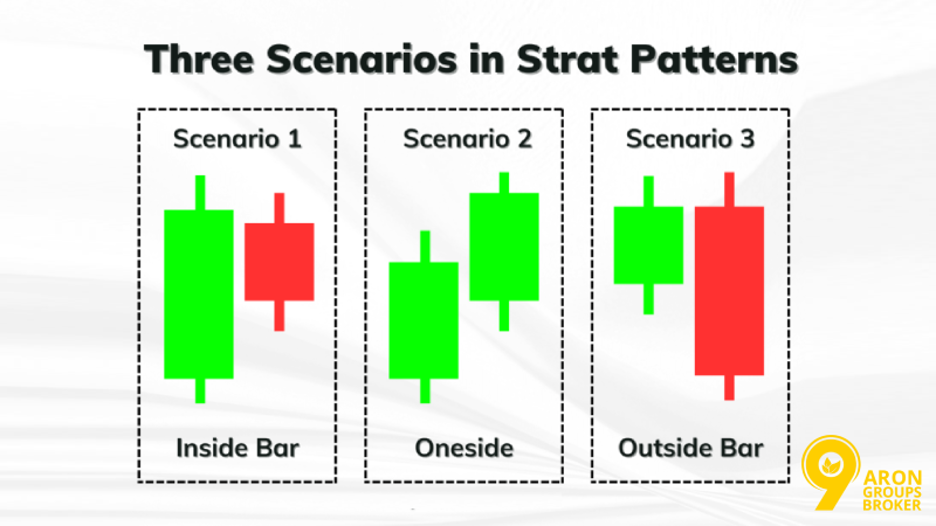
Scenario 1: Inside Bar
A 1 (Inside Bar) forms when the current bar stays inside the prior bar’s range:
- High < previous high and Low > previous low.
Meaning in practice:
- Compression.
- Indecision.
- Potential coil before expansion.
Scenario 2: Directional Bar or One Side
A 2 (Directional) bar breaks only one side of the prior bar:
- 2U: breaks the previous high, does not break the previous low.
- 2D: breaks the previous low, does not break the previous high.
Meaning in practice:
- One side is in control of that bar.
- Directional intent is clearer than a 1 bar.
Scenario 3: Outside Bar
A 3 (Outside Bar) breaks both sides of the prior bar:
- It takes out the previous high and the previous low.
Meaning in practice:
- Expansion and volatility.
- Often shows conflict (both sides were forced).
Using Scenario Insights to Trade Inside Bars with The Strat
Inside bars are common. The mistake is treating every inside bar as tradable.
A practical How to trade inside bars Strat routine:
- Label the inside bar (1).
- Check higher timeframe direction (are you aligned?).
- Only take the break that matches the higher timeframe bias.
- Use the opposite side of the inside bar as invalidation logic (tight and structural).

Remember: A 1 bar in the middle of chop is usually just chop. Location matters. |
Advanced Patterns and Combos in The Strat Strategy
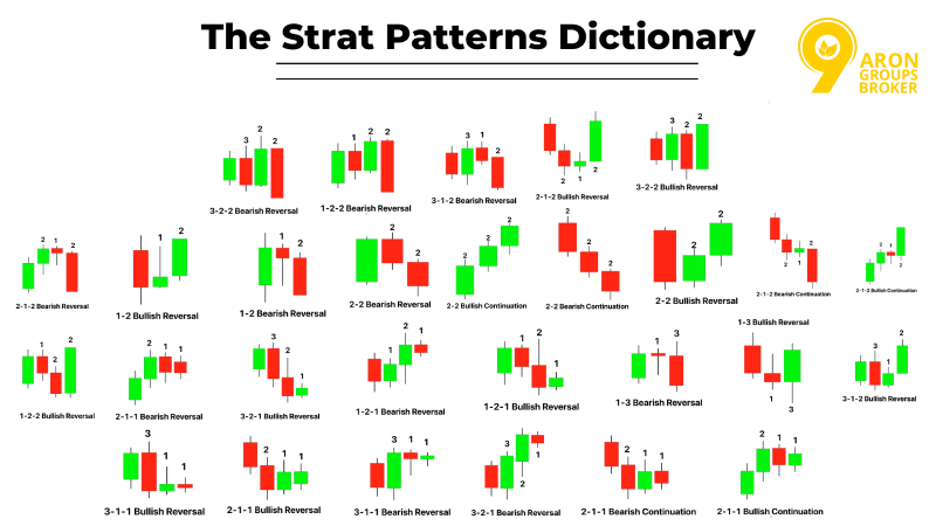
Once you can label 1/2/3 automatically, combos become easier. The goal is not to memorise dozens. It’s to recognise a few that repeat and fit your style. Save these patterns:
Pivot Machine Gun (PMG): Explosive Multi-Bar Moves
SmoothSTRAT explains that Pivot Machine Gun (PMG) describes a move that breaks through multiple nearby pivot levels quickly, often triggering a chain reaction. It’s commonly explained as stops getting hit in sequence, fuelling speed.
How traders use it:
- As a momentum warning (moves can accelerate fast).
- For targets (multiple pivots can get taken rapidly).
- To avoid standing in front of a speeding move.
Broadening Formations: Recognising Price Expansion
Broadening formations are expansion patterns where ranges widen, and swings get larger. Strat materials often discuss the role of outside bars and expansion behaviour in these contexts, especially around 3-bar sequences.
Practical read:
- If the range keeps expanding, tighten the risk.
- Expect failed breakouts more often.
- Demand clearer confirmation before entry.
Directional Bars Up (2U) and Down (2D): Trend Confirmation
2U and 2D are the Strat directional language. They are also a simple trend confirmation tool:
- In stronger uptrends, you tend to see more 2U closes and cleaner follow-through.
- In downtrends, you tend to see more 2D behaviour.
They’re not magic. They’re a clean way to describe who won that bar.
3-1-2 Continuation Pattern: Aligning with Prevailing Trends
A commonly taught Strat combo is 3-1-2 (outside bar, then inside bar, then directional bar). It’s frequently described as a three-bar sequence that can signal continuation or shift depending on context and trigger direction.
A practical continuation filter:
- Use MTFA: only treat it as a continuation when higher timeframe bias supports it.
- Wait for the 2 bar trigger to break in the direction you want.
- Invalidate logically (beyond the structure that makes the pattern fail).
Tip: The combo is the setup. The trigger is the break. The context is the edge.
Multiple Timeframe Analysis (MTFA) in The Strat Trading Strategy
MTFA is the glue in The Strat. If you only trade 1/2/3 bars on one timeframe, you will get chopped up. The Strat’s strength comes from aligning the trigger timeframe with a higher timeframe direction (often called timeframe continuity).
Aligning Trades Across Timeframes for Higher Probability
A simple MTFA workflow looks like this:
- Pick your base timeframe (your chart of execution).
- Check one or two higher timeframes for direction and location.
- Only take triggers that align with the higher timeframe bias.
How to define bias in Strat terms:
- More 2U behaviour on the higher timeframe suggests bullish continuity.
- More 2D behaviour suggests bearish continuity.
- A sequence of inside bars (1s) suggests compression—wait for resolution.
Don’t forget: MTFA is how you stop trading every signal and start trading the right signals.
Avoiding Conflicting Signals Using MTFA
Conflicts usually happen when the higher timeframe is compressing or reversing, while the lower timeframe is firing triggers.
Common conflict situations:
- Higher timeframe prints a 1 (inside) bar (compression), while lower timeframe prints multiple 2U/2D triggers.
- Higher timeframe is in a broadening / volatile phase (more than 3 bars), while a lower timeframe keeps giving fake breaks.
Practical conflict rules:
- If HTF is a 1, trade smaller or wait. It’s a coil.
- If HTF is a 3, be stricter with confirmation. Expect whipsaw.
- If HTF direction is unclear, treat LTF triggers as lower probability.
MTFA Examples with Inside and Directional Bars
Here are three simple examples you can practise on any market.
Example 1: HTF 1-bar coil, then LTF breakout
- Higher timeframe prints a 1 (compression).
- On a lower timeframe, you wait for a 2U or 2D trigger that breaks the coil direction.
- You enter on the break and use the opposite side of the structure as an invalidation.
Example 2: HTF bullish continuity, then LTF 2U continuation
- HTF shows more 2U behaviour and higher closes.
- LTF prints a pullback and then a 2U trigger.
- You take the long only because HTF is aligned.
Example 3: HTF broadening (3s), then LTF patience
- HTF prints multiple 3 bars (expansion).
- LTF gives frequent arrows/triggers.
- You wait for a cleaner structure and only take high-quality breaks with tight risk.
Optimising Trade Entries in The Strat Trading Strategy
The Strat is simple on paper. Execution is where it becomes profitable or painful. You optimise entries by being strict about triggers, location, and risk—then repeating the same process.
Managing Risk in The Strat Trading Strategy
Risk rules should be structural, not emotional.
Practical Strat risk structure:
- Risk is defined at the setup bar or pattern boundary (inside bar range, outside bar range, or pattern high/low).
- Stops go beyond the point where the Strat read is invalid, not a few ticks.
- Position size adjusts to volatility: wider bar, smaller size.
Two simple rules that keep you alive:
- Don’t size up because you feel confident.
- Don’t widen stops because you feel right.
Remember: The Strat removes emotion from entries. You must remove emotion from risk, too.
Identifying High-Probability Entries
High probability in The Strat usually means:
- Timeframes are aligned (MTFA continuity).
- The setup is clean (clear 1/2/3 classification).
- The trigger is decisive (breaks and holds, not a wick).
- The location makes sense (near a pivot, range boundary, or after compression).
A practical yes/no filter:
- If you cannot name the trigger level (high/low of the setup), you don’t have a Strat trade.
- If you cannot explain the higher timeframe direction, you don’t have continuity.
Combining Inside Bars, Directional Bars, and PMG for Precision
This is where Strat becomes fast without becoming random.
A common precision sequence:
- Compression forms (a 1 or a cluster of 1s).
- A 2U/2D triggers the break.
- If momentum builds through multiple pivots, you may see PMG-like behaviour (rapid multi-level travel).
How to trade it cleanly:
- Enter on the valid trigger break (the 2 bar).
- Take partials into the first pivot.
- Trail the rest only if pivots are being taken quickly (PMG effect).
Important note: PMG is not guaranteed continuation. It is a warning that speed can increase. Trade management matters more, not less.
Timing Your Trades: When to Enter and When to Exit
The Strat gives you mechanical entry timing. The challenge is not entering too early or exiting too late.
Entry timing (cleanest approach):
- Enter on the trigger break (e.g., break of inside bar high/low, or directional bar continuation).
- Avoid pre-empting. If it hasn’t broken, it hasn’t triggered.
Exit timing (simple, repeatable):
- First target: nearest pivot / prior day level/structure point.
- If you’re trading continuity, hold until you see a clear loss of continuity (e.g., opposing 2 bar, or failure to break).
- If you’re trading expansion (3s), be quicker. Volatility cuts both ways.
Conclusion
The Strat trading strategy works because it turns price action into a shared language: 1 (inside), 2 (directional), 3 (outside)—then uses MTFA to avoid trading against the bigger story. The edge is not the numbers. It’s the process: label the candle, check continuity, trigger the break, and manage risk like a professional. If you treat MTFA as non-negotiable and keep risk structural, the Strat remains one of the cleanest ways to trade price action in 2026.