

How does de-dollarization affect gold? Directly, and more than any other single force this decade. As central banks trim dollar exposure, they buy gold as the neutral, sanction-proof alternative, and that official bid has underwritten a historic gold bull market.
The standard explanation stops at weak dollar, strong gold. That inverse link is real but incomplete. Gold set records through 2024 and 2025 even when the dollar was firm and real yields were positive, because reserve demand rewrote the old playbook.
This guide quantifies the de-dollarization impact on gold. It covers the three transmission channels, the verified 2025 to 2026 data and the limits of the gold-dollar correlation. It ends with a practical framework for trading the theme, and with the risks that could stall it.
- De-dollarization is a structural tailwind for gold: reserve managers replacing dollar assets overwhelmingly choose bullion.
- Central banks bought 863 tonnes in 2025 and an estimated 244 tonnes in Q1 2026; the World Gold Council expects about 850 tonnes for the full year.
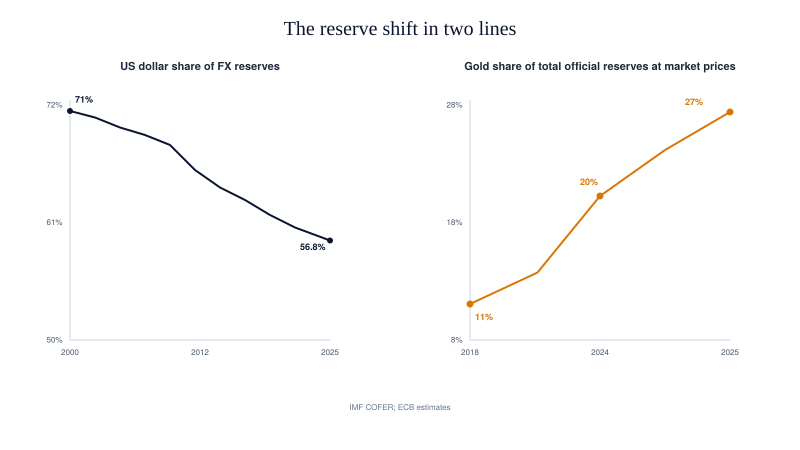
- Gold reached about 27 percent of global official reserves at end-2025, overtaking US Treasuries, while the dollar's share of FX reserves slipped to 56.8 percent.
- The gold-dollar link is usually inverse, but real yields and Fed policy can dominate it for months at a time.
- The 2026 correction, gold's worst quarter in 13 years, proves the theme is structural, not a one-way price guarantee.
- Active traders express the theme most directly through XAU/USD CFDs, where leverage demands strict risk control.
How Does De-Dollarization Affect Gold?
De-dollarization lifts gold through reserve demand. When central banks reduce reliance on the US dollar, they replace it mainly with gold, because gold is the only major reserve asset that is nobody’s liability and cannot be frozen abroad. That buying places a persistent, price-insensitive bid underneath the market.
Risk Disclosure
CFDs are complex instruments and come with a high risk of losing money rapidly due to leverage. You should consider whether you understand how CFDs work and whether you can afford to take the high risk of losing your money. Past performance is not indicative of future results. This content is provided for educational purposes only and does not constitute investment advice.
What De-Dollarization Actually Means
De-dollarization is the gradual decline of the dollar’s share in reserves, trade settlement and finance, not its collapse. IMF COFER data put the dollar at 56.8 percent of allocated foreign exchange reserves at end-2025, down from about 71 percent in 2000. Meanwhile the dollar still sits on one side of almost 90 percent of global FX turnover, according to the Bank for International Settlements, so this is erosion measured in decades. Two nuances keep the analysis honest. Part of the falling share is exchange-rate arithmetic rather than active selling, as the IMF itself notes. And COFER counts currencies only; gold’s rise happens outside that measure, inside total reserves.
Why Gold Is the Default Alternative
Gold wins the substitution because every currency alternative has a flaw. The euro sits on fragmented capital markets, the yuan is not freely convertible, and smaller currencies lack depth. Gold is neutral, liquid in every regime and immune to sanctions when vaulted at home. That is why, in practice, reserve diversification has meant gold accumulation.
The Mechanism: Three Channels From Reserves to the Gold Price
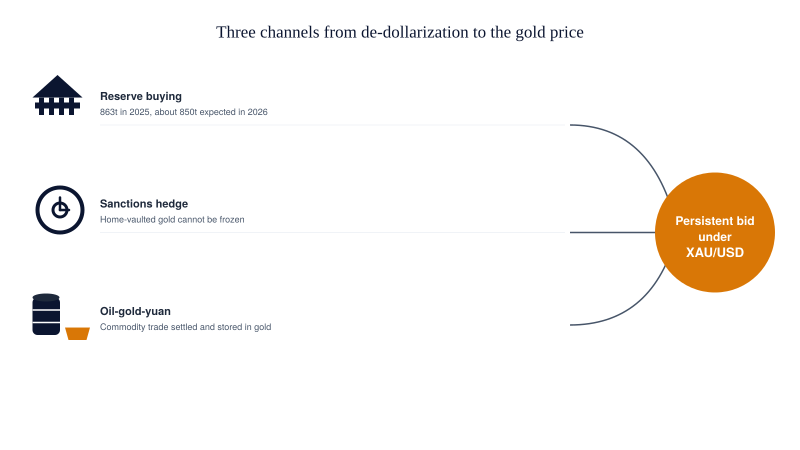
The impact travels through three distinct channels, and each one keeps working even when the others pause.
Channel 1: Record Central-Bank Buying
The first channel is direct demand. Central banks bought a record 1,136 tonnes in 2022, stayed above 1,000 tonnes in 2023 and 2024, and added 863 tonnes in 2025, the fourth largest year on record according to the World Gold Council. An estimated 244 tonnes followed in the first quarter of 2026, ahead of the five-year average. Reported numbers understate the flow: roughly 57 percent of 2025 buying was never promptly disclosed to the IMF, so the World Gold Council fills the gap with over-the-counter and refinery flow data. The People’s Bank of China reported only 27 tonnes for 2025, while Chinese net gold imports hit 317 tonnes in Q1 2026 alone. This bid is strategic rather than price-driven, and it has tended to absorb supply on every deep dip.
Channel 2: Gold as a Sanction-Proof Reserve
The second channel is insurance against weaponised finance. The 2022 freeze of some 300 billion dollars of Russian reserves showed that offshore dollar assets are conditional. ECB researchers observe that the biggest jumps in a country’s gold share tend to follow sanctions on that country. Domestic vaulting completes the logic: surveys show a sharp rise in central banks storing gold at home, and repatriation has continued into 2026. Sanctions risk turned gold from a portfolio preference into a strategic necessity for many emerging-market reserve managers.
Channel 3: The Oil-Gold-Yuan Triangle
The third channel runs through trade settlement. Since Shanghai launched yuan-denominated crude contracts, energy exporters have been able to accept yuan and convert proceeds into bullion through the Shanghai Gold Exchange, keeping value outside the dollar system. Reports point to sharply higher delivery volumes on the exchange and new offshore vaulting as this loop scales. The oil-gold-yuan triangle matters less for its current size than for its direction: it creates recurring physical gold demand tied to commodity flows rather than investor sentiment.
Did You Know?: The ECB estimates gold ended 2025 at roughly 27 percent of global official reserves at market prices, overtaking US Treasuries at about 22 percent for the first time. Total official holdings, near 36,000 tonnes, sit close to the 1965 record. |
The Gold-Dollar Relationship: Inverse, but Not Mechanical
Gold and the dollar usually move in opposite directions, but the relationship is a tendency, not a law. Treat the DXY as one input alongside real yields and official demand.
Why Gold Usually Rises When the Dollar Weakens
The inverse link starts with arithmetic. Gold is priced in dollars, so a weaker dollar makes an ounce cheaper in every other currency and lifts non-US demand. A falling US Dollar Index (DXY) also signals easier financial conditions and reserve outflows, both of them gold-friendly. The correlation is strongest during clear dollar trends and weakest during risk shocks, when gold and the dollar can rally together as competing safe havens.
Real Yields, the Fed, and the Post-2022 Anomaly
For decades, rising real yields reliably pressured gold, since bullion pays no interest. That model cracked after 2022: gold set records despite positive real yields, because official buyers do not discount cash flows. They buy insurance. The old forces still bite, though. In the second quarter of 2026, fears of renewed Federal Reserve tightening, with policy at 3.50 to 3.75 percent under a new chair, helped produce gold’s worst quarterly fall in 13 years. The synthesis is simple: de-dollarization sets the floor and the trend, while Fed interest rates and real yields set the path and the corrections.
The table contrasts the two frameworks traders now have to hold at once.
| Driver framework | What it implies for gold |
|---|---|
| Traditional model (pre-2022) | Gold falls when real yields and the DXY rise; private investor flows dominate |
| Reserve model (post-2022) | Official buying supports gold across rate regimes; deep dips attract sovereign demand |
| Practical blend for 2026 | Trade Fed policy and the DXY for direction over weeks; respect the structural bid at major supports |
Q: If the Fed keeps raising rates in 2026, does the de-dollarization case for gold fail?
A: No, but it pauses the price. Higher rates raise the opportunity cost for private investors and can lift the dollar, exactly as Q2 2026 showed. Central-bank demand is driven by sanctions risk and diversification, not yield, so the structural bid persists beneath the cyclical pressure. Expect deeper pullbacks, not a broken thesis, unless official buying itself stops.
The Data in 2026: Where Gold and Reserves Stand
Numbers keep this story honest, so here is the verified state of play as of July 2026.
The Bull Market in Numbers
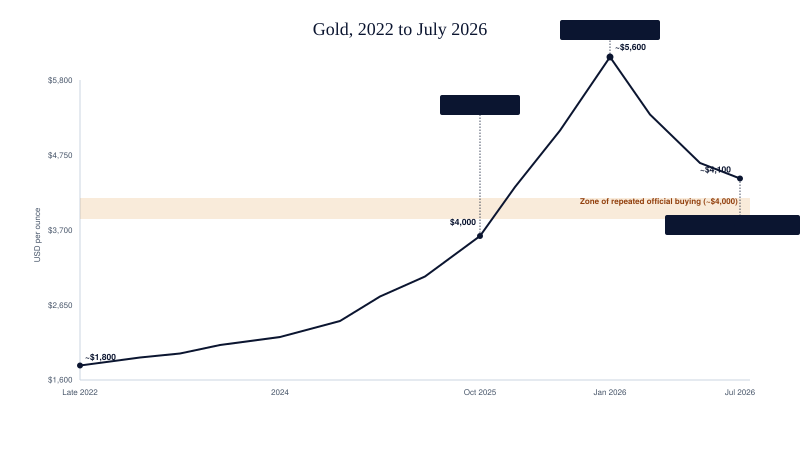
Spot gold roughly tripled from its late-2022 base near 1,800 dollars. It crossed 4,000 in October 2025 and peaked just under 5,600 an ounce in late January 2026. The LBMA quarterly average set a record of 4,873 dollars in Q1 2026. Then came the stress test: energy-driven inflation fears and rate-hike bets produced the worst quarterly drop in 13 years in Q2, and price now consolidates near 4,100. Bank desks still publish targets around 6,000 dollars for late 2026, but every such forecast quietly assumes the official bid holds.
Latest Gold Drivers (July 2026)
These are the live drivers to monitor, kept in one list so this section can be refreshed as the data updates.
- Official demand: Q1 2026 net purchases of about 244 tonnes; the World Gold Council expects roughly 850 tonnes for the year, within a 700 to 900 range.
- Policy: markets price possible Fed tightening into September 2026, and a new Fed chair adds communication risk.
- Geopolitics: the Middle East conflict cuts both ways, feeding safe-haven bids and inflation-driven rate fears at the same time.
- Reserve shift: a record 45 percent of surveyed central banks plan to add gold this year, and 74 percent expect a smaller dollar share within five years.
- Watch next: quarterly IMF COFER releases and the BRICS summit in New Delhi on 12 and 13 September 2026.
Together these drivers explain the current regime: a structural uptrend punctuated by violent policy-led corrections.
How to Trade the De-Dollarization Theme
The cleanest expression of the theme is gold itself, and for active traders that means XAU/USD. Choose the vehicle to match the job, then let written risk rules run the position.
Your Instrument Options Compared
Four vehicles carry gold exposure, and they behave very differently in practice.
| Route | What you hold and the trade-offs |
|---|---|
| XAU/USD CFD | Leveraged exposure in both directions; no ownership of metal; margin and overnight costs; suited to active trading |
| Physical bullion | Direct ownership; storage, insurance and wide dealing spreads; suited to long-term holding |
| Gold ETF | A fund share tracking the price inside a brokerage account; management fee; no leverage by default |
| Gold-backed tokens (PAXG, XAUT) | Each token is a claim on one vaulted ounce, transferable like crypto; issuer and custody risk apply |
Aron Groups provides the first route: gold and metals CFDs on MetaTrader 5, not physical bullion, gold ETF products, gold IRAs or token custody. A gold-backed token works like a stablecoin pegged to metal rather than dollars, so assess the issuer as carefully as the asset.
A Practical XAU/USD Framework
A durable framework has three parts: a macro filter, a technical trigger and fixed risk. The macro filter sets bias from official-demand data, the DXY trend and real yields. The trigger only fires at pre-marked levels, either reclaimed support in the trend direction or a confirmed breakout. The risk layer caps each trade at a fixed fraction of equity, lets position sizing set the lot, respects a written drawdown limit and targets at least a 1:2 risk-to-reward ratio. Turning that routine into a durable trading edge takes testing, not headlines.
Read More: risk-to-reward indicator in MetaTrader
Rule: The theme sets the bias; the level and the stop set the trade. |

Mini Example: Fading a Dollar Spike (text-only scenario)
Mid-2026. A hawkish Fed headline lifts the DXY sharply and knocks XAU/USD into a well-tested weekly support zone near 4,000 dollars, an area that has capped every sell-off since spring.
The trader waits for a daily close back above the zone instead of catching the fall. Entry on the reclaim, stop below the week’s low, one percent of equity at risk, first target near prior consolidation at roughly twice the risk.
If the close never reclaims the zone, there is no trade. The de-dollarization thesis argues for patience at supports; it never argues for buying every dip blind.
Respect the base rates before adding leverage. ESMA found that 74 to 89 percent of retail CFD accounts lose money, which is why European rules cap leverage and mandate negative balance protection, and the CFTC publishes similar warnings for retail forex. If you are newer to leveraged markets, review how to trade forex first and rehearse with small size on a Nano account before scaling.
Q: Should I simply stay long gold at all times if de-dollarization is structural?
A: No. Structural themes still deliver 20 percent drawdowns, as Q2 2026 proved, and leverage turns those into account-ending events. Hold a core view if you like, but trade defined setups with stops. A theme tells you which side deserves patience; it never removes the need to protect capital.
What Could Go Wrong: The Balanced View
Gold is not guaranteed to rise, and honest analysis lists the ways this thesis stalls before asking you to trade it.
- A hawkish Fed cycle: sustained hikes raise real yields and the dollar, pressuring gold for quarters at a time.
- Price-sensitive pauses: 2025 already showed reserve managers slowing purchases into records; 863 tonnes was a deceleration, not an acceleration.
- Reserve sales under stress: Turkiye sold heavily in early 2026 to defend its currency, and others could follow in a crisis.
- Statistical mirage: part of the dollar’s falling share is exchange-rate arithmetic, as the IMF cautions, rather than active selling.
- Supply response: higher prices lift mine output and recycling, gradually easing the physical squeeze.
None of these breaks the long-term case on its own. Two of them arriving together broke the price for a full quarter in 2026, so size every position as if that can happen again. That mindset is simply capital preservation applied to a macro theme.
Conclusion
The de-dollarization impact on gold is measurable, mechanical and still unfolding. A falling dollar share of reserves has translated into four years of exceptional official demand, a 27 percent reserve share for gold and a price that tripled in under four years.
Respect both halves of the story. The structural bid argues for treating major supports seriously; the 2026 correction argues against confusing a theme with a guarantee. Direction comes from the Fed and the DXY. Durability comes from the vaults.
Trade it like a professional: defined levels on XAU/USD, fixed fractional risk and a written plan that survives being wrong.
FAQ
What is the US dollar's share of global reserves in 2026?
About 56.8 percent of allocated foreign exchange reserves at end-2025, according to IMF COFER, versus roughly 71 percent in 2000. Counting gold at market prices, the dollar’s share of total reserves is materially lower.
Which central banks are buying the most gold?
Poland led 2025 with about 102 tonnes, followed by steady buyers such as Kazakhstan, Brazil, China and the Czech Republic. New names including Guatemala, Indonesia and Malaysia appeared in 2026, while Turkiye bought through 2025 before selling in early 2026.
Does de-dollarization mean the dollar will collapse?
No. The dollar remains dominant in trade invoicing, debt markets and FX turnover, and its reserve share has eroded at roughly half a point a year. De-dollarization is a rebalancing that benefits gold, not a dollar crisis.
Is gold still an inflation hedge if the Fed raises rates?
Over long horizons gold has preserved purchasing power, but over months rate rises usually hurt it. In 2026, inflation fears and rate fears arrived together, which is why gold whipsawed. Hedge with a position size you can hold through that volatility.