





Non-Fungible Tokens (NFTs) are often mistakenly recognized only as expensive digital images, but they actually represent a fundamental shift in the concept of “digital ownership.” This blockchain-based technology enables the creation of a unique, tamper-proof certificate of ownership for any type of asset, whether digital or physical.
In this article, we will explore the practical and real-world applications of NFTs beyond their initial hype, showing how this technology is influencing the future of art, entertainment, business, and our digital lives. If you’ve ever wondered, “What is an NFT?” This article will provide deeper insights into how it is transforming various industries.

- NFTs provide proof of authenticity and ownership history for luxury goods, a key benefit of non-fungible tokens.
- They serve as access keys or tickets to exclusive content and events, making NFT marketplaces a hub for new opportunities.
- In fashion, NFTs enable ownership and display of virtual clothing in the Metaverse, creating a new market for NFT Art.
- NFTs can issue immutable digital certificates for academic records and qualifications, ensuring their authenticity.
What is an NFT, and why is it More Than Just a Digital Image?
What is an NFT? NFT stands for “Non-Fungible Token.” To understand this concept, we first need to grasp what “fungible” means. Fungible assets are those where each unit is exactly the same as the next. For example, a 10,000 dollar banknote has the same value as another 10,000 banknote and can be exchanged freely. Cryptocurrencies like Bitcoin are also fungible—one Bitcoin is interchangeable with another.
According to wikipedia, NFTs are non-fungible, meaning each NFT is unique and cannot be exchanged directly for another NFT, just like two different pieces of art. This uniqueness is a key feature of NFTs and sets them apart from other digital assets.
Simply put, an NFT is a certificate or proof of digital ownership, recorded on the blockchain. Blockchain is a highly secure, transparent, and tamper-proof system for storing information, ensuring that ownership and transaction details of non-fungible tokens are secure and verifiable.
Real-World Applications of Non-Fungible Tokens
NFTs have created new ways to manage asset ownership, generate income, and interact in both the digital and physical worlds. But what is an NFT? Let’s explore how NFTs are revolutionizing various industries, from art to gaming and beyond.
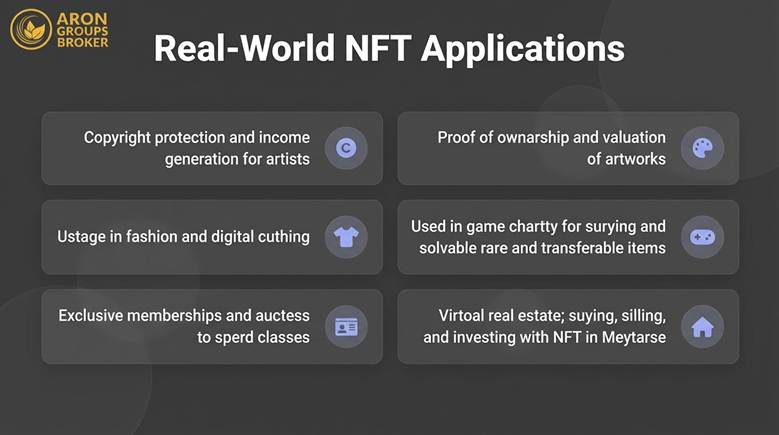
NFTs for Provenance and Valuation in Art
One of the most significant applications of NFTs is in the digital art world. Artists can transform their digital creations, such as paintings, music, or videos, into NFTs. This has two primary benefits:
- Proof of Authenticity and Ownership: In the digital world, copying files is easy. NFTs serve as a digital certificate of ownership that’s registered on the blockchain, indicating who created the work and who currently owns it. This resolves the issue of distinguishing the original from a copy.
- Valuation and Sale: NFTs allow digital art to be valued, bought, and sold in much the same way as physical art.
NFTs also offer artists a sustainable income stream through royalties, allowing creators to receive a percentage every time their work is resold. This feature ensures that artists can continue earning from their creations long after the initial sale.

The sale of Beeple’s "Everydays: The First 5000 Days" for $69 million at Christie's is a prime example of NFTs proving ownership and establishing the value of digital art.
NFTs: A New Way for Artists to Manage Copyright and Monetize Their Work
NFTs directly help artists manage their intellectual property rights and generate income:
- Registering Intellectual Property: Converting a work into an NFT creates a valid digital document that proves an artist’s intellectual property over the piece.
- Direct Monetization: Artists can sell their works directly to buyers and fans without relying on intermediaries like galleries or distribution companies.
- Valuing the “Original” Version: While digital files (like images) can still be copied, NFTs confirm which version is the “original” and valuable. The NFT owner has exclusive ownership of this original version.
NFTs in Gaming: Transforming In-Game Item Ownership
NFTs have had a significant impact on the gaming industry by enabling real ownership of in-game items:
| Feature | Traditional Gaming | Blockchain Gaming (NFTs) |
|---|---|---|
| Ownership | Game developer owns everything | Player truly owns items (NFTs) |
| Transferability | Locked within one game | Can be sold on open marketplaces |
| Value | Zero real-world value | Can be sold for real money/crypto |
| Control | Account bans lose all items | Assets are safe in your wallet |
- True Ownership of In-Game Items: In traditional gaming models, all assets like skins, weapons, and rare items are essentially owned by the game developer, and players only have usage rights. With NFTs, each rare item is registered as a unique token on the blockchain, ensuring permanent and verifiable ownership for players.
- Creating Marketplaces Outside the Game: Players can sell or trade their NFTs in independent marketplaces outside of the game environment.
- Play-to-Earn (P2E) Models: New types of games have emerged where players can earn valuable NFTs through gameplay and sell them for real-world profits.
- True Rarity: Game developers can release limited-edition items as NFTs, increasing their scarcity and value.
NFTs in Fashion and Virtual Clothing: The Future of Fashion with NFTs and the Metaverse
The fashion industry is also entering the digital world with NFTs:
- Digital Clothing: Brands are selling virtual clothing and accessories as NFTs. Users purchase these items for their avatars in virtual worlds, also known as the Metaverse.
- Proof of Authenticity for Physical Goods: NFTs can be linked to luxury physical goods, such as handbags or watches, acting as a digital certificate of authenticity. This assures the buyer that the item is genuine and makes counterfeiting much more difficult.
- Digital Collectibles: By releasing limited NFT collections, brands can create valuable collections for fans, blending fashion with digital ownership.
NFTs in Virtual Real Estate: Buying, Selling, and Investing in the Metaverse
In blockchain-based virtual worlds (the Metaverse), land is traded as NFTs:
- Virtual Land Ownership: Every parcel of land in a Metaverse is an individual NFT. Purchasing this NFT means acquiring legal ownership of that piece of virtual land.
- Transparent Real Estate Market: All transactions for buying, selling, or renting virtual land are transparently recorded on the blockchain.
- Investment and Development: Owners can build on their virtual land (such as creating shops, art galleries, or advertising spaces) and monetize it or sell the land for a profit.
NFTs and Digital Identity: Exclusive Membership and Access to Special Services
NFTs can also be used for managing identity and access:
- Membership and Access Tokens: Owning a specific NFT can act as an exclusive membership card, granting the holder access to private groups, special discounts, or exclusive events.
- Smart Digital Tickets: NFTs can serve as secure, counterfeit-proof tickets for events like concerts or conferences. These tickets may also come with additional perks, such as digital gifts.
- Verification and Certifications: NFTs can be used to issue digital certificates, such as academic diplomas or completion certificates for courses. The authenticity of these certificates can be easily verified thanks to the blockchain.
Innovative Applications of Non-Fungible Tokens in the Economy and Modern Business
Beyond art and gaming, NFTs are transforming critical sectors of the economy and business methods.
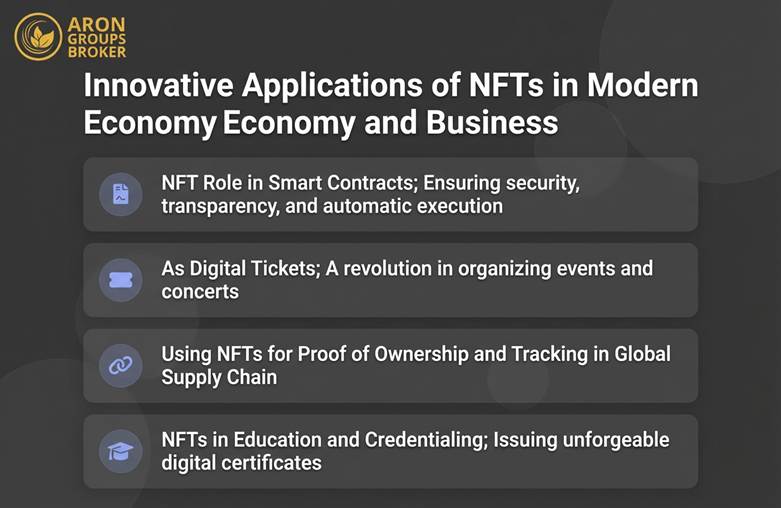
The Role of NFTs in Smart Contracts: Ensuring Security, Transparency, and Automation
NFTs are closely connected with smart contracts on the blockchain. A smart contract is a digital and automated agreement with important commercial applications:
- Automated Execution of Obligations: A smart contract can be set up so that once a condition is met (e.g., full payment), ownership of the NFT (representing an asset) is automatically transferred to the buyer.
- Complete Transparency: All contract details and execution history (such as payments) are recorded transparently and immutably on the blockchain, preventing disputes.
- Reduced Costs and Intermediaries: This automated system eliminates the need for many intermediaries (e.g., notaries or banks) for contract verification and execution, lowering costs.
NFTs as Digital Tickets: Revolutionizing Events and Concerts
Using NFTs instead of traditional tickets offers many advantages beyond simple entry passes:
- Anti-Fraud: Each NFT ticket is unique and registered on the blockchain, making it nearly impossible to copy or counterfeit.
- Control and Tracking: Organizers can track the purchase and sale of tickets. They can also define rules (e.g., setting resale price limits) in the smart contract to prevent scalping.
- Added Value: An NFT ticket can be preserved as a digital souvenir (collectible) after the event ends. Organizers can also offer exclusive perks (e.g., discounts) to ticket holders.
- Revenue from Resale: Organizers can set up automatic payments from secondary market sales of tickets, ensuring they earn a percentage from future resales.
Using NFTs for Ownership Proof and Traceability in the Global Supply Chain
NFTs can bring great transparency to the supply chain (from production to product delivery):
- Proof of Authenticity and Origin: For every product (from raw materials to the final product), an NFT can be created. This NFT stores all product information (such as production location, date, and specifications). This feature is especially important for sensitive goods like pharmaceuticals, food, or luxury items.
- Transparent Traceability: Customers can scan a code and see the entire product journey (from factory to store) transparently on the blockchain.
- Combating Fraud: Since the information recorded on the blockchain is tamper-proof, counterfeiting goods or documents becomes extremely difficult, ensuring that customers can trust the product’s authenticity.
- Increased Efficiency: Automated information recording reduces human error and paperwork, cutting costs.
NFTs in Education and Credential Verification: Issuing Tamper-Proof Digital Certificates
NFTs can transform the process of issuing and verifying educational credentials:
- Issuing Tamper-Proof Certificates: Educational institutions (e.g., universities) can issue degrees, certificates, and transcripts as NFTs. These documents are stored in the individual’s digital wallet, and their authenticity can be easily verified.
- Combating Credential Forgery: Because NFT information is stored on the blockchain, forging certificates is nearly impossible. This helps employers easily verify credentials.
- Complete Ownership by the Individual: Students are the true owners of their NFT degrees and have full control over them. They can easily send them to any organization or employer for verification.
- Creating a Permanent Educational Record: Individuals can collect all the certificates and skills they acquire throughout their lives as a series of NFTs, creating a complete and verifiable digital education history.
Earning from Non-Fungible Tokens and the Challenges Ahead
There are various ways to earn from NFTs, but these paths come with their own challenges and risks.
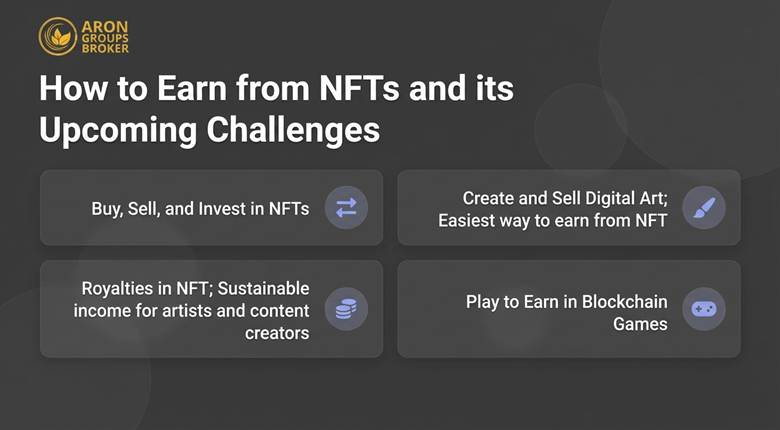
Creating and Selling Digital Artwork: The Easiest Way to Earn from NFTs
This method is the most direct for artists and creators to enter the NFT ecosystem:
- Minting Process: The artist uploads their digital artwork (such as an image, music, or video) to a specialized platform and converts it into an NFT. This process is called minting, during which the NFT is officially registered on the blockchain.
- Setting Terms: The artist sets the price, the number of available editions (to create rarity), and the royalty percentage for future sales.
- Selling on Marketplaces: The minted NFT is listed for sale on a marketplace, and buyers purchase it using digital currencies (such as Ethereum).
Advantages: This method gives the artist full control over their work, access to a global marketplace, and the potential for ongoing earnings through royalties.
Buying, Selling, and Investing in NFTs: From Short-Term Trading to Long-Term Holding
Like other assets, NFTs can also be a platform for trading and investment:
- Short-Term Trading: This involves buying NFTs to quickly resell them for profit. This strategy carries high risk and requires a deep understanding of the market and trends.
- Long-Term Investment: This involves buying NFTs with growth potential (such as works from well-known artists or rare in-game items) and holding them for a longer period. This strategy requires research and patience.
Risks: The NFT market includes risks such as extreme price volatility, the possibility of scams or fake projects, and low liquidity (difficulty selling some NFTs quickly).
Play-to-Earn Models in Blockchain Games: Earning Through Blockchain-Based Games
The Play-to-Earn model allows players to earn by engaging in blockchain-based games:
- How It Works: Players earn in-game tokens or valuable NFTs (such as items, characters, or land) by completing activities in the game (like fighting, missions, or building).
- Converting to Earnings: These tokens and NFTs can be sold in specialized marketplaces and converted into other digital currencies or real money (like USD).
Challenges: Starting these games often requires an initial investment (to buy entry-level NFTs). Additionally, the value of in-game tokens can fluctuate, and economic success depends on the game’s popularity and sustainability.
Royalties in NFTs: Sustainable Income for Artists and Content Creators
One of the most attractive economic advantages of NFTs for creators is the royalties feature:
- Mechanism: When an artist creates an NFT, they can define a royalty percentage (e.g., 5 to 15%) in the smart contract.
- Outcome: Every time that NFT is resold in secondary markets, the defined percentage is automatically deducted from the sale price and transferred to the artist’s wallet.
Advantage: This creates a sustainable, long-term revenue stream for artists and content creators.
Risks and Challenges in Earning from NFTs
Entering the NFT world to earn income is not without risks:
- Market Volatility: The value of NFTs can rise or fall rapidly and drastically.
- Scams: Fake projects (like Rug Pulls) exist, where creators collect funds from investors and then disappear.
- Legal Challenges: The laws surrounding NFTs are still developing and unclear in many countries.
- Technical Risks: Digital wallet hacks and high transaction fees on blockchain networks can pose risks.
- Technical Complexity: Entering the NFT space requires basic knowledge of blockchain, digital wallets, and cybersecurity principles.
Before investing, understanding the tokenomics of a project is crucial. Tokenomics refers to the design, distribution, supply, and demand of tokens and NFTs within a project. A poorly designed economic model can lead to the project's failure and the devaluation of its assets in the long term.
The Future of Non-Fungible Tokens: Emerging Trends, Converging Technologies, and Global Growth
The NFT technology is still growing and continues to find new applications as it converges with other emerging technologies.
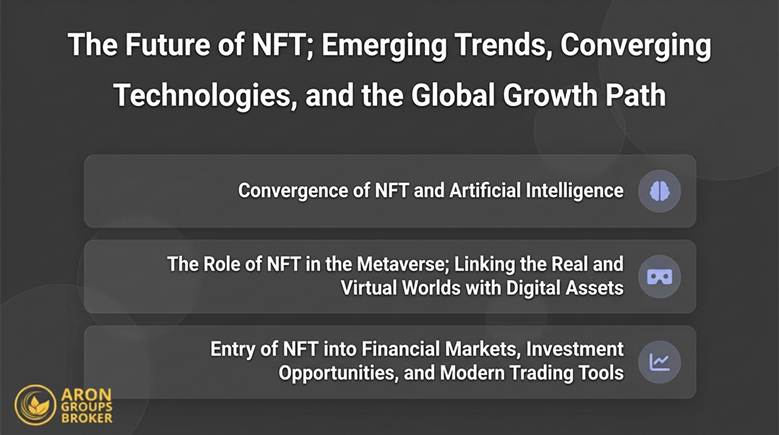
Convergence of NFTs and Artificial Intelligence
The combination of NFTs and Artificial Intelligence (AI) could lead to the creation of entirely new assets and experiences:
- AI-Generated Art: AI can create unique pieces of art, which can then be minted as NFTs. AI can also customize artworks based on a buyer’s preferences.
- Dynamic NFTs: The appearance or characteristics of dynamic NFTs are not fixed. AI can automatically alter them based on external data (e.g., weather or sports results) or how the user interacts with the NFT.
- AI for Discovery and Analysis: AI can help users find their favorite NFTs and analyze market trends more effectively.
According to Chain.link, a Dynamic NFT (dNFT) is a type of non-fungible token that uses smart contracts to automatically change its metadata based on external conditions. This allows the NFT to evolve and adapt, making it different from traditional, static NFTs.
The Role of NFTs in the Metaverse: Bridging the Real and Virtual Worlds with Digital Assets
NFTs will form the foundation of ownership and economics in virtual worlds (the Metaverse):
- Ownership of Virtual Assets: All assets in the Metaverse, such as land, avatar clothing, buildings, and even a person’s digital identity, will be verified and represented through NFTs.
- Transferability of Assets: New NFT standards enable users to move their NFT assets across different virtual worlds, creating an integrated virtual economy.
- Bridging the Real and Virtual Worlds: NFTs can connect the real world with the virtual. For example, an NFT can serve as both a ticket to a real-world concert and access to an exclusive event in the Metaverse.
- Creator-Based Economy: In the Metaverse, designers and artists can sell their digital creations (e.g., clothing or art) directly to other users as NFTs.
NFTs in Financial Markets: Investment Opportunities and New Trading Tools
NFTs are finding serious applications in both traditional finance and decentralized finance (DeFi):
- Tokenizing Physical Assets: Expensive physical assets, such as real estate or fine art, that are difficult to sell can be converted into NFTs. This allows the ownership of these assets to be divided into smaller fractions (fractional ownership), making it easier to trade them and increasing their liquidity.
- Using NFTs as Collateral for Loans: Holders of valuable NFTs can use them as collateral for loans on decentralized financial platforms (DeFi), allowing them to access funds without selling their NFT.
- New Financial Instruments: New tools, like futures contracts, are emerging, enabling investors to trade on the future price of NFTs or hedge their risks.
- NFT Investment Funds: These funds pool capital from different investors to buy a diverse range of NFTs (e.g., in art, gaming, etc.). The returns from these investments are distributed among the fund members, making it easier for average investors to get involved in the NFT market.
Conclusion
Ultimately, earning from NFTs comes with significant challenges. These obstacles include price volatility, the risk of fraud, legal uncertainties, and technical difficulties. To succeed in this space, thorough research, a clear understanding of the risks, and awareness of future trends, such as analyzing the economic model of projects, are essential. In the end, NFTs are not just a passing trend; they represent a fundamental shift in the concepts of “ownership” and “value” in the digital age. This technology will dramatically reshape the economy and online interactions in the years to come.