
Pyramiding is the practice of adding to a trade that is already in profit, so that one correct read on direction ends up carrying a larger position than the one you opened. Each addition is deliberately smaller than the one before it. Each is paired with a stop move that keeps the total money at risk at or below what you accepted on the very first entry. That pairing is the whole technique. Without it, adding to a position is simply leverage with better marketing.
The distinction that matters is not mechanical. Adding lots is easy. The question is what the market has already told you before you add. A trader who scales into a winner is risking open profit the market has handed over. A trader who averages down is risking capital that is still fully their own. The two look identical in a trade log and behave nothing alike in a drawdown, which is why sound position sizing treats them as opposite instructions rather than variations on a theme.
This guide covers the arithmetic behind the inverted pyramid, the stop ladder that caps total exposure while the position grows, the entry triggers that genuinely earn a new tranche, and the costs and failure modes that most explanations of pyramiding leave out. Every figure used here is worked through on a modest account so the numbers can be checked rather than taken on trust.
- Pyramiding means adding to a winning position; averaging down means adding to a losing one. Only the first has a risk ceiling.
- Each tranche must be smaller than the last, so the weighted average entry stays well behind the current price.
- Every add is paired with a stop move. If total open risk rises above the original 1 percent, the add was not a pyramid.
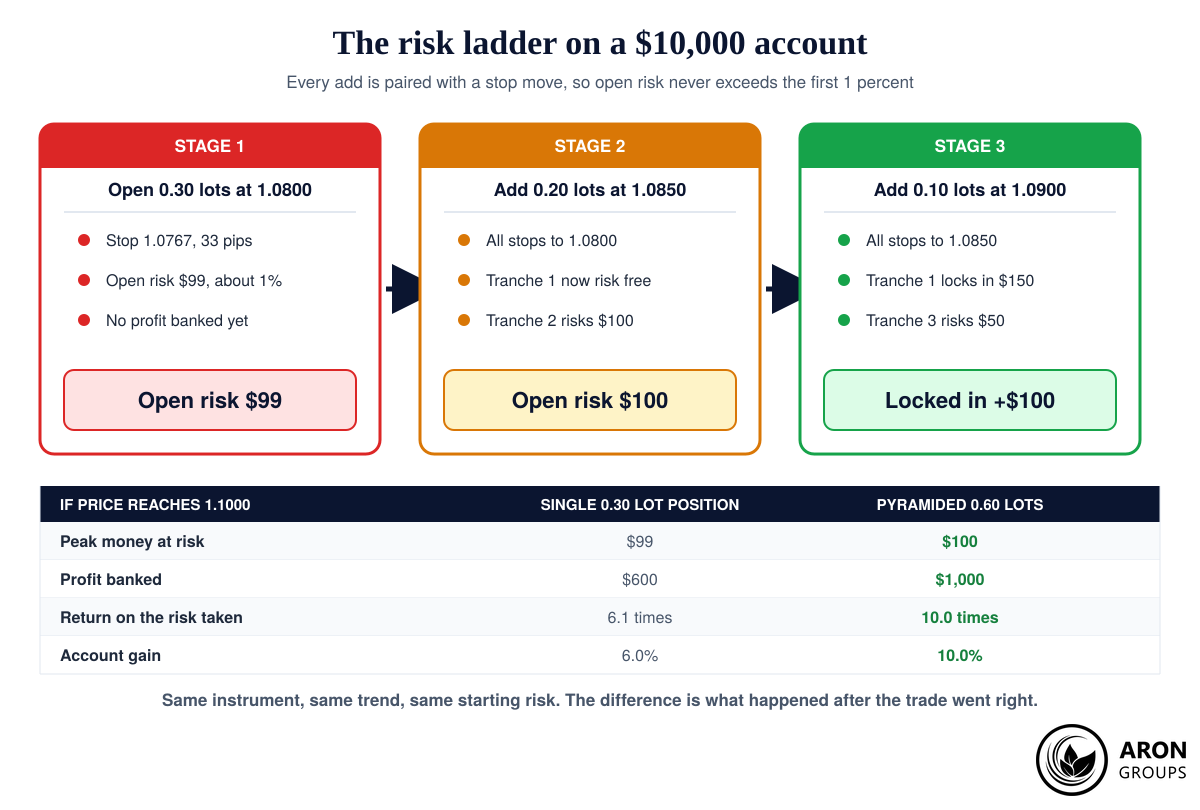
- In the worked example, a pyramided position returns 10 times its risk where a single position returns 6.1 times.
- Pyramiding needs a real trend, multiplies transaction costs, and offers no protection against gaps.
What Is Pyramiding in Trading?
Pyramiding is a position building method in which a trader opens a starting position, waits for the market to confirm the idea by moving in their favour, and then adds further, smaller positions at higher prices in an uptrend or lower prices in a downtrend. The name comes from the shape the position sizes make when stacked: broad at the base, narrow at the top. The starting tranche is the largest because it is the only one taken before the market had said anything.
Risk Disclosure
Trading forex and CFDs carries a high level of risk and can result in the loss of all your capital. This content is educational and is not investment advice. Never risk money you cannot afford to lose.
The Core Mechanic: Risking Money the Market Already Gave You
When you add to a position that is 50 pips in profit, the unrealised gain on the original tranche acts as a buffer. Move the stop up at the same time and that buffer becomes real: part of the open profit is converted into a guaranteed floor. The new tranche is then financed by the trade itself rather than by fresh capital from the account. This is why pyramiding sits comfortably inside a capital preservation framework instead of fighting against it.
Why Traders Reach for It
A trend follower faces a structural problem. The setups with the cleanest risk are the earliest, when confirmation is weakest and position sizes are therefore smallest. By the time the trend is obvious, the sensible entry has gone. Pyramiding is one answer to that problem. It lets a trader start small on limited evidence and grow the position as the evidence accumulates, which is a more honest reflection of how confidence actually builds than a single fixed bet placed at the outset.
Pyramiding Versus Averaging Down
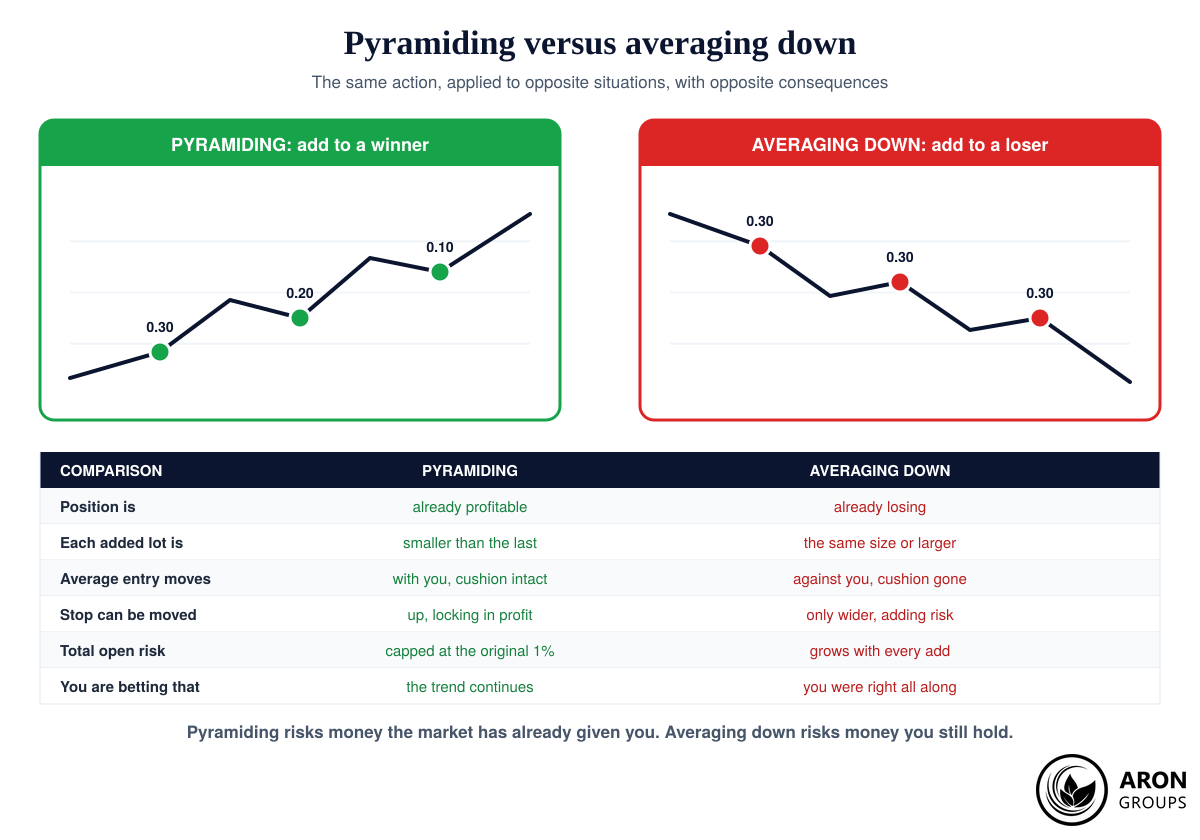
These two are confused constantly, and the confusion is expensive. Averaging down means buying more of something that has fallen since you bought it, in order to lower your average cost. Pyramiding means buying more of something that has risen since you bought it. The mechanical action is the same. The information that triggers it is the exact opposite, and so is what happens to your risk.
The asymmetry is easiest to see in the stop. When you pyramid, every add lets you raise the stop, because there is profit behind it to protect. When you average down, the stop can only move wider, because the original level now sits far too close to a position that has grown. One method lets the risk shrink as the position grows. The other forces the risk to grow with it. A workable risk management strategy cannot treat both as acceptable.
| Factor | Pyramiding | Averaging down |
|---|---|---|
| Trigger | The position is already profitable | The position is already losing |
| Tranche size | Smaller with each add | Equal or larger with each add |
| Average entry | Moves with you, cushion intact | Moves against the market, cushion gone |
| Stop direction | Tightens, locking in profit | Widens, adding risk |
| Total open risk | Capped at the original amount | Grows with every addition |
| Implied bet | The trend will continue | The market is wrong and you are right |
The same action, judged by what the market said before you took it.
The Inverted Pyramid Rule and Your Average Entry Price
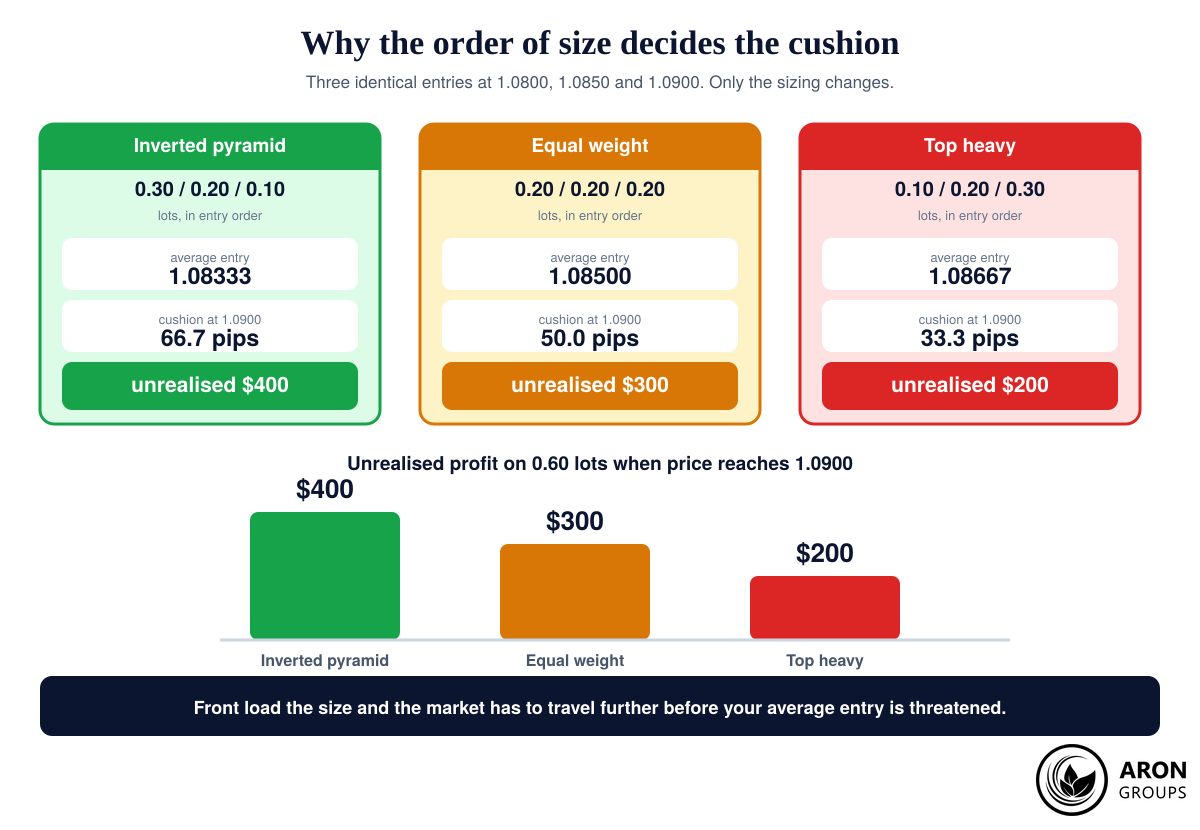
The rule that each tranche must be smaller than the last is not an aesthetic preference. It controls where your weighted average entry sits, and the average entry is what the market has to travel back through before an open profit becomes an open loss. Front loading the size keeps that average low in a long trade and high in a short one, which buys the position room to breathe.
The Arithmetic, Worked Through
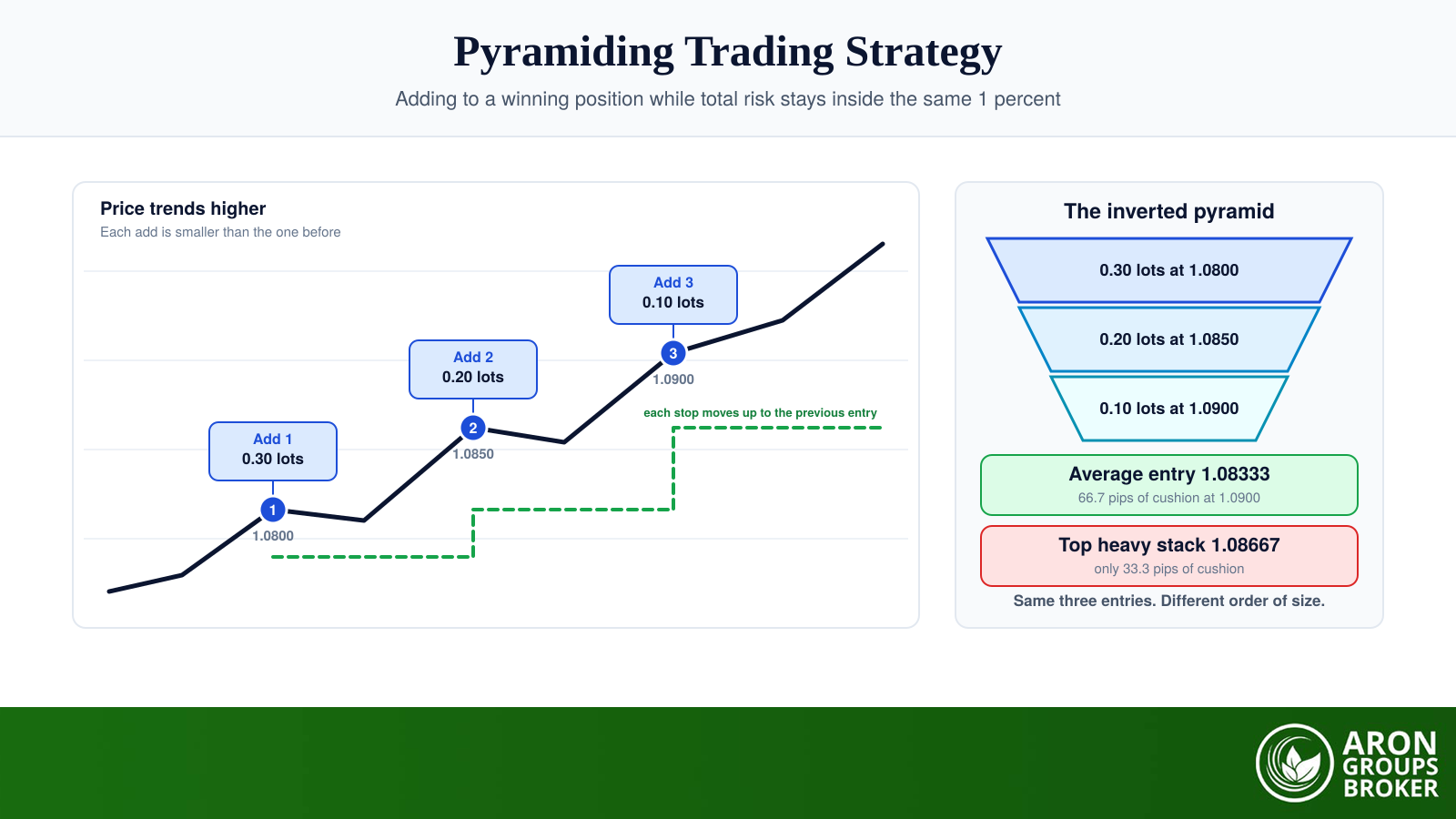
Take three entries on EUR/USD at 1.0800, 1.0850 and 1.0900, with 0.60 lots deployed in total. Sized as a proper inverted pyramid at 0.30, 0.20 and 0.10 lots, the weighted average entry is 1.08333. Sized equally at 0.20 lots each, it is 1.08500. Sized the wrong way round at 0.10, 0.20 and 0.30 lots, it is 1.08667. At a market price of 1.0900 those three averages leave cushions of 66.7, 50.0 and 33.3 pips respectively.
Translated into money on the same 0.60 lots, the unrealised profit is 400 dollars, 300 dollars and 200 dollars. Nothing changed except the order in which the size was deployed. That is a 200 dollar spread on a position that took the same three decisions at the same three prices, and it is reproducible on any instrument once you check the numbers against a risk-to-reward ratio you already use.
Q: Should the ratio always be 3:2:1?
A: No. The ratio is a guide, not a law. What matters is that each tranche is materially smaller than the last and that the weighted average stays far enough from price to survive a normal pullback. Some traders use halves, so 0.40, 0.20 and 0.10. On a volatile instrument, a steeper taper is usually safer than a shallow one.
Managing Risk While You Scale
Pyramiding is a risk management technique that happens to increase position size, not a position sizing technique that happens to involve risk. If total open risk rises when you add, you have not pyramided; you have simply taken a larger bet. The stop ladder is what keeps that from happening, and it is the part most often skipped.
The Stop Ladder in Practice
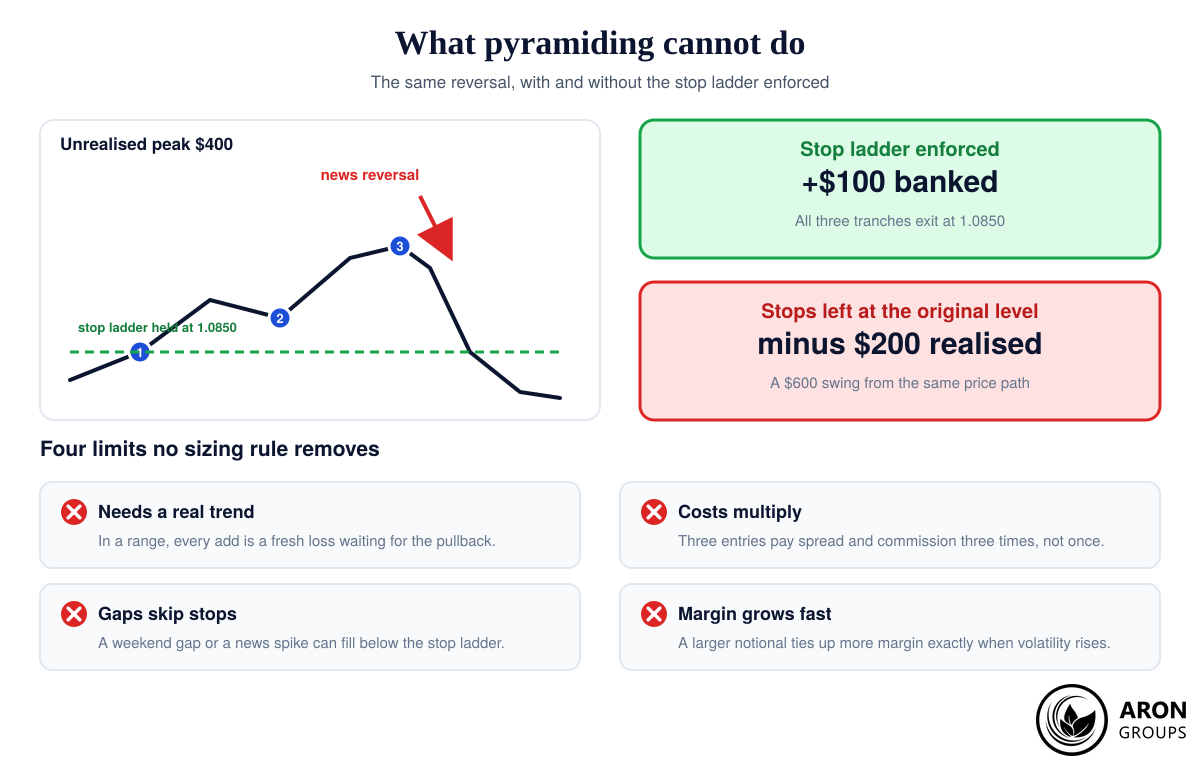
On a 10,000 dollar account risking 1 percent, the first tranche is 0.30 lots at 1.0800 with a stop at 1.0767, which is 33 pips and 99 dollars of risk. When price reaches 1.0850, add 0.20 lots and move every stop to 1.0800. Tranche one is now risk free and tranche two risks 100 dollars, so total open risk is unchanged. When price reaches 1.0900, add 0.10 lots and move every stop to 1.0850. Tranche one now locks in 150 dollars, tranche three risks 50, and the position guarantees a 100 dollar profit even if it is stopped immediately.
Count Exposure, Not Lots
Traders new to this method watch the lot size climb and assume the risk is climbing with it. It is not, provided the ladder is enforced. What does climb is margin usage and sensitivity to slippage, and both matter when volatility rises. Regulators have repeatedly warned that leveraged strategies carry losses that scale faster than most retail traders expect, which is worth reading before assuming a larger notional is harmless.
Rule
If adding a tranche does not come with a stop move, it is not a pyramid. It is a bigger position.
When to Add: Triggers That Earn a New Tranche
A tranche should be earned by market structure, not by an open profit figure. Adding because the trade is up 50 pips is arbitrary; adding because the market has produced a fresh structural signal is a decision you can test. The three triggers below are the ones that survive scrutiny in most trend systems.
Structural Triggers Worth Acting On
- A clean break of the previous swing high in a long, with the close holding above it rather than wicking through.
- A pullback into a rising trendline or a moving average that holds, giving a tight stop for the new tranche.
- A consolidation range that resolves in the direction of the trend, with the range boundary as the new stop.
Each of these shares one property: it provides a new invalidation level close to the new entry. That is what makes the added tranche cheap to protect. The third trigger is the logic behind the Darvas Box method, where a resolved consolidation supplies both the entry and the level that proves it wrong. A trigger without a nearby invalidation forces a wide stop, and a wide stop on a late entry is exactly the trade that turns a good pyramid into a bad one. If you cannot say where the add is wrong, do not take it.
Triggers That Look Valid but Are Not
A round number being reached is not a trigger. Nor is a news release that agrees with your bias, nor a burst of momentum on a one minute chart, nor the fact that your platform shows a large floating gain. These feel like confirmation and provide none. The test is simple: would the same signal have made you open a fresh trade with no existing position? If not, it does not justify adding to one.
Mini Example: Adding Into a Trend That Was Already Finishing
A trader is long GBP/USD from a session low and the pair has run 90 pips without a meaningful pullback. The move is now stretched well above the session’s average range, and the last three candles have progressively smaller bodies with longer upper wicks.
The floating profit says add. The structure says otherwise. There is no recent swing high to break and no pullback to lean on, so any new tranche would need a stop 60 pips away, wider than the stop on the original entry. The correct action is to hold, move the stop to the last higher low, and wait for a consolidation that offers a real invalidation level.
How to Pyramid a Trade Step by Step
The sequence below assumes a trend following entry with a defined invalidation. Work through it on historical data before risking capital on it, because the method changes the shape of your returns and you should see that shape before you live with it.
Step 1: Define the total risk before the first entry
Decide what the whole campaign may cost, not what the first tranche may cost. If the answer is 1 percent, that figure covers every tranche you will ever add. Writing it down first prevents the common failure of treating each add as a fresh 1 percent trade.
Step 2: Open the largest tranche on the weakest evidence
The base of the pyramid is taken at the original setup, before confirmation. Size it so a stop at your invalidation level costs the full planned risk. This tranche is the largest precisely because it has the best entry price.
Step 3: Wait for a structural trigger, then add smaller
Do not add on time or on profit. Add when the market produces a new signal with its own nearby invalidation, and size the new tranche at roughly two thirds or half of the previous one.
Step 4: Move every stop, not just the new one
This is the step that makes the method safe. All tranches move to a common level, usually the previous entry or the last higher low. Recalculate total open risk after the move and confirm it has not risen.
Step 5: Stop adding before the trend does
Set a maximum number of tranches in advance, commonly three or four. Beyond that, the average entry creeps too close to price and the position becomes fragile. Manage what you have rather than reaching for one more add.
Running this sequence over historical data with out-of-sample backtesting will show you something a live account cannot: how the method behaves across the trends you did not personally trade. It is also worth stress testing the sequencing with Monte Carlo simulations, because pyramiding concentrates returns into fewer, larger trades and that concentration changes the shape of the equity curve considerably.
The Honest Limits of Pyramiding
Pyramiding is often presented as a way to compound gains with no downside, which is not true. The method has specific failure modes, and knowing them is the difference between using it and being used by it.
It Needs a Trend, and Most Sessions Do Not Have One
In a range, every add is taken near the top of the range and stopped out on the return to the middle. A method that is excellent in a trending market and poor in a ranging one is not a universal edge; it is a conditional one. Before adopting it, you need evidence about how often your instrument actually trends, which is a question for your own data rather than for a general article. Building that evidence is part of developing a trading edge worth trading.
The Costs Nobody Models
Three entries pay spread and commission three times. On a 33 pip stop, a 1.2 pip round turn cost per tranche is close to 4 percent of the risk on that tranche, and it compounds across a campaign. Wider spreads during news, swap charges on positions held overnight, and slippage on the added entries all reduce the theoretical advantage. The 10 times return in the worked example is a gross figure. Net of costs it is meaningfully lower.
Gaps Do Not Respect the Ladder
A stop ladder protects you against a normal reversal, not against a market that reopens far below your level. Weekend gaps, central bank surprises and thin holiday sessions can all fill a stop well past where it sat. This is the same category of risk that led European regulators to require margin close out and negative balance protection on retail CFD accounts, and it applies with more force to a position that has grown to three times its original size.
Where the Framing Is a Viewpoint, Not a Fact
The claim that pyramiding is strictly safer than a single large position deserves scrutiny. It is safer in terms of the capital committed before confirmation. It is not safer in terms of the capital exposed at the moment of maximum position size, when a gap can hit the whole stack at once. Both statements are true, and which one dominates depends on how your instrument gaps. Treat the safety claim as conditional rather than settled.
Where Aron Groups Fits
Pyramiding depends on being able to add in small increments. A trader on a 2,000 dollar account who can only trade in 0.01 lot steps has almost no room to taper, because the smallest tranche is already a large share of the position. The Nano account at Aron Groups addresses that directly by supporting volumes from 0.0001 lots, which makes a genuine 3:2:1 taper possible on a small balance. It is also commission free, with the cost carried in the spread, so a three tranche campaign does not pay a separate commission line three times.
Execution matters just as much when you are adding into a moving market. All accounts run on MetaTrader 5 with market execution, meaning added tranches fill at the next available price without requotes, and spreads float with real conditions rather than being fixed and then widened. For traders who want to test a scaling method against a rulebook before committing their own capital, the prop trading route provides an evaluation environment with defined loss limits, which is a useful discipline for a method that grows position size by design.
Conclusion
Pyramiding is not a way to trade bigger. It is a way to let a correct read on direction earn a bigger position, at the market’s expense rather than the account’s. The three components are inseparable: a tapered size sequence that keeps the average entry back, a structural trigger that earns each add, and a stop ladder that holds total exposure flat while the position grows. Remove any one of them and what remains is ordinary leverage.
The technique also carries real costs. It multiplies transaction expenses, it depends on trends that many sessions do not deliver, and it concentrates a larger notional into the moments when gap risk is highest. None of that makes it unusable. It makes it a conditional tool that belongs in a tested plan rather than in a live account on the strength of a worked example.
If you take one thing from this guide, make it the stop ladder. Everything else in pyramiding is optional refinement. That single discipline is what separates a position that compounds a good trade from a position that turns one into a bad one. Regulators publish plain guidance on the risks of leveraged currency trading, and it is worth reading alongside any scaling method you intend to use.
Frequently Asked Questions
Four questions that come up most often once traders start testing this method on their own charts.
Is pyramiding suitable for beginners?
Not as a first method. It requires that you can already size a single position correctly, place a stop at a genuine invalidation level and follow a plan without improvising. Add pyramiding once those three are consistent, ideally on a demo or a very small live balance first.
How many tranches should I add?
Most systematic approaches cap it at three or four, including the original entry. Beyond that, the weighted average entry sits so close to price that a normal pullback threatens the whole structure, and the marginal size added is too small to justify the extra transaction cost.
Can I pyramid a short position?
Yes, and the logic is identical in mirror image. Each add is placed at a lower price, each is smaller than the last, and stops move down rather than up. The practical difference is that downtrends in many instruments move faster than uptrends, so triggers appear and expire more quickly.
Does pyramiding work on indices and commodities as well as forex?
It works anywhere that trends persist, which includes indices, metals and energy. What changes is the gap behaviour and the cost structure. Instruments with wide overnight gaps punish a large stacked position harder than spot currency pairs do, so the maximum number of tranches should usually be lower. A risk-reward indicator on the platform makes it easier to check each tranche before committing to it.