
icon icon Home
icon icon Accounts
icon icon Quick start
icon icon Symbols

What Is Restaking? EigenLayer, Liquid Restaking, and the 2026 Reality

Author
Abe Cofnas
Abe Cofnas
calendar Last update: 19 November 2026
watch Reading time: 9 min

Restaking reuses ETH that is already staked, or a liquid staking token, to secure extra services in return for extra rewards. EigenLayer pioneered it on Ethereum. Those services, called AVSs, can cut the restaked ETH if their rules are broken. So the extra income comes with extra risk on top of ordinary staking.

It matters now because 2026 tested the model hard. On 18 April 2026, an attacker drained 116,500 rsETH, worth about $292 million, from Kelp DAO’s bridge. The panic that followed was a lesson in liquidity risk. Users pulled a net $6.2 billion from the lending market Aave by early 19 April, Decrypt reported. By 30 October 2026, EigenLayer’s total value locked (TVL) was 74% below its peak, on DefiLlama data.

This guide explains how restaking works, the three ways to do it and where its yield came from in 2026. It then sets out the stacked risks, the Kelp DAO exploit, the limits of the evidence and how an ETHUSD CFD differs.

bookmark
Key Takeaways
  • Restaking reuses staked ETH or liquid staking tokens to secure extra services called AVSs. EigenLayer pioneered it on Ethereum.
  • There are three routes: native restaking from a 32 ETH validator, LST restaking, and liquid restaking through tokens such as ezETH and rsETH.
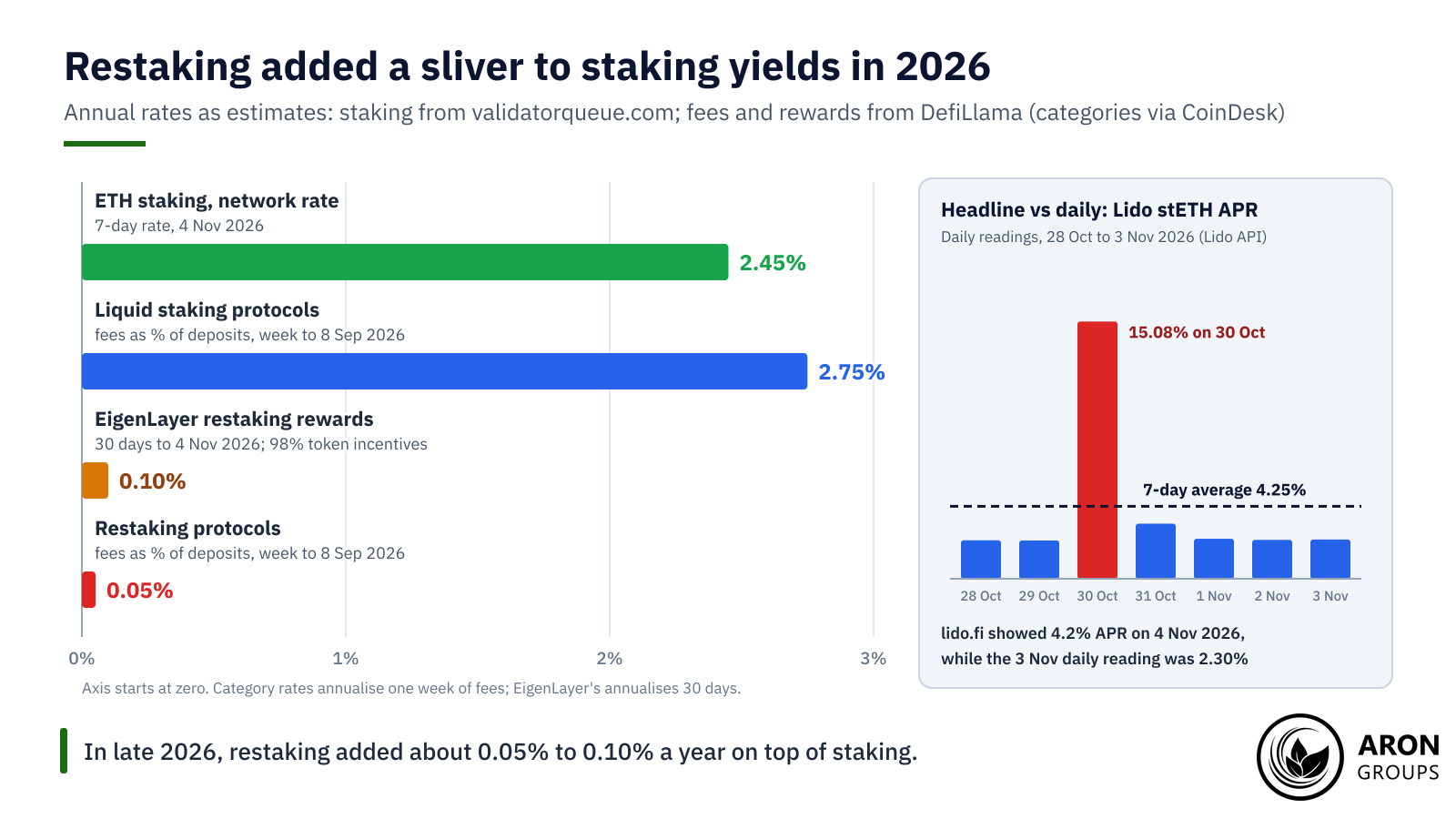
  • On DefiLlama data, restaking added about 0.05% to 0.10% a year in late 2026. Ethereum's network staking rate was 2.45% on 4 November 2026.
  • Slashing has been live on EigenLayer since 17 April 2025 and redistributable since 22 July 2025. EigenLayer withdrawals wait 14 days.
  • Kelp DAO lost 116,500 rsETH, about $292 million, on 18 April 2026. EigenLayer's TVL was 74% below its August 2025 peak on 30 October 2026.

What Is Restaking?

Restaking means pledging the same staked ETH to more than one job. Under Ethereum’s proof of stake, staked ETH already secures the network and earns staking rewards, Ethereum’s version of a block reward. A restaker opts in to extra rules set by other services and accepts that breaking them can cost part of the stake. Those services pay extra rewards in return. The Block has described EigenLayer as Ethereum’s first restaking protocol.

sms-star

Risk Disclosure
Trading forex and CFDs carries a high level of risk and can result in the loss of all your capital. This content is educational and is not investment advice. Never risk money you cannot afford to lose.
What Is EigenLayer?

EigenLayer is the protocol that turned restaking into a market. It was built by Eigen Labs, founded by Sreeram Kannan, whom Fortune described in 2023 as an associate professor at the University of Washington. Restakers deposit ETH or LSTs into its contracts and delegate them to operators. At the end of September 2024, EigenLayer was one of the three largest DeFi protocols by value locked, with €10.6 billion. That ranking comes from a joint report by the EBA and ESMA, published in January 2025. Eigen Labs now markets a wider EigenCloud platform, and rivals include Symbiotic, which accepts a wider range of tokens.

AVS (Actively Validated Services)

An AVS is a service that borrows security from restaked ETH, such as a price oracle, a token bridge or a data system. Operators run each AVS’s software, and the AVS sets the rules for slashing. EigenDA, Eigen Labs’ data availability service for rollups, went live on mainnet on 9 April 2024. That launch did not yet include AVS payments or slashing, The Block reported.

How Ethereum Restaking Works

Ethereum restaking works as a yield stack. First, ETH is staked in a validator or through a liquid staking protocol. On 4 November 2026, the network staking rate was 2.45% a year, according to validatorqueue.com. Next, the staker opts into EigenLayer and delegates to an operator. The operator runs software for one or more AVSs, so the same stake backs them too. AVS rewards then arrive on top of staking rewards.

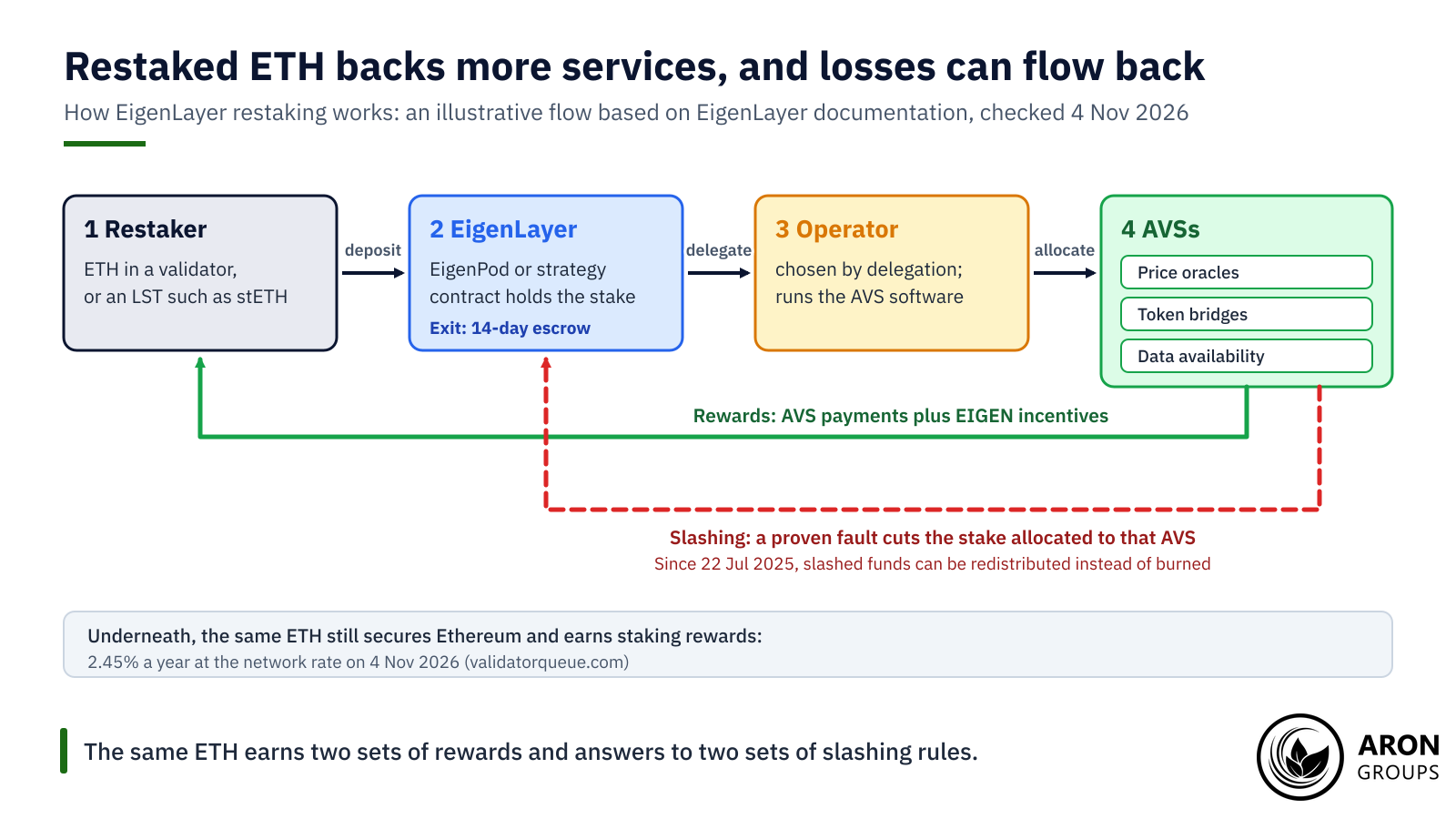
Restaked ETH backs extra services through an operator; rewards flow back to the restaker, and so can slashing losses.

Operators, Delegation and Rewards

Most restakers do not run AVS software themselves; they delegate to operators who do. Operators are usually professional service providers, ethereum.org notes. The operator picks which AVSs to serve and how much delegated stake to allocate to each. Since April 2025, each allocation can be slashed by the AVS that receives it and by no other. Rewards come from AVS payments and EIGEN incentives, shared between operators and their delegators.

Native Restaking, LST Restaking and Liquid Restaking

There are three ways to restake ETH. Native restaking points a validator’s withdrawal credentials to an EigenPod, a contract on EigenLayer, so the staker must run a validator. On Ethereum that takes at least 32 ETH. LST restaking deposits a liquid staking token, such as Lido’s stETH or Rocket Pool’s rETH, into EigenLayer instead. In both cases the staker chooses the operator.

What Is Liquid Restaking?

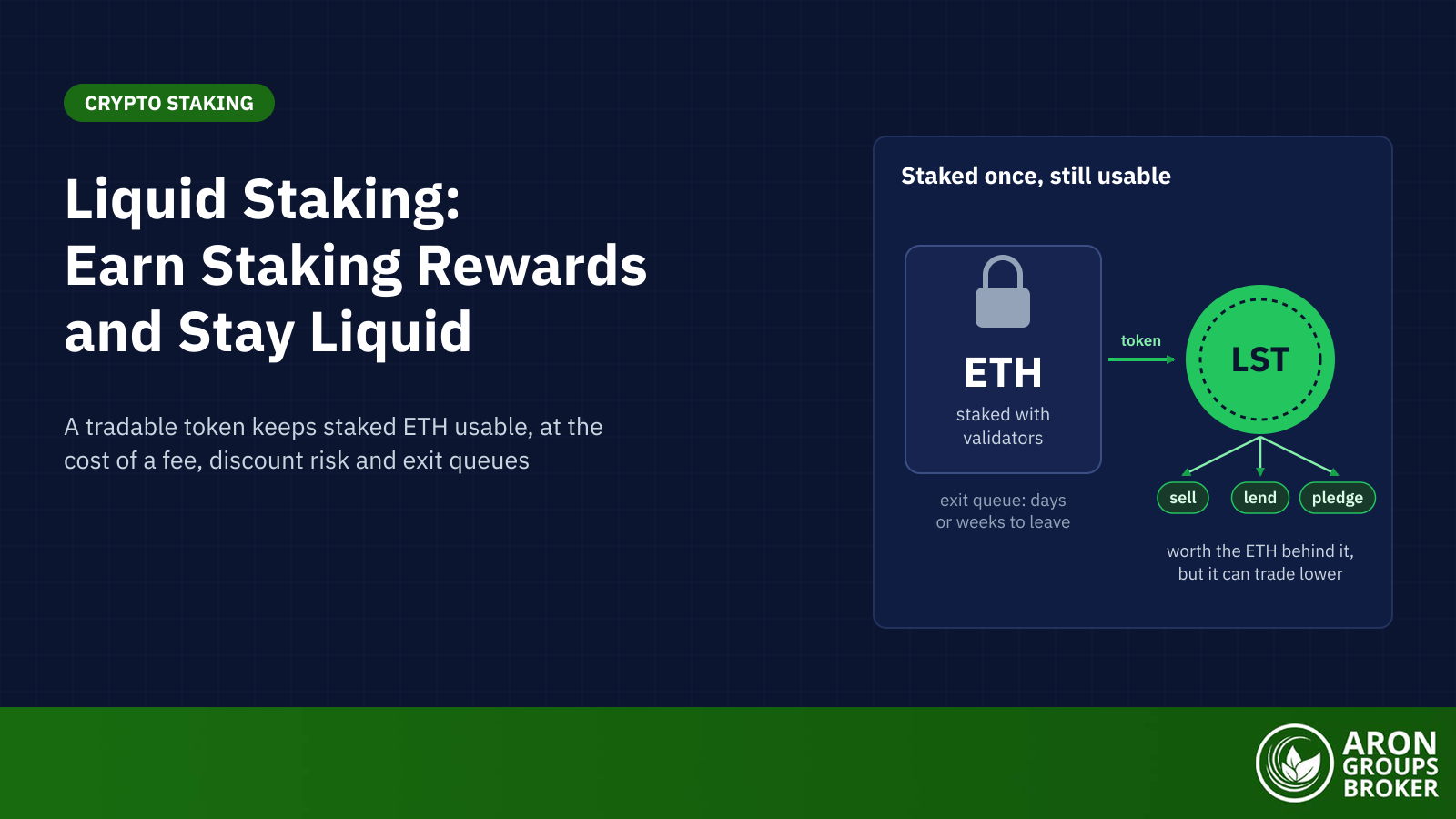
Liquid restaking hands the whole job to a protocol. The user deposits ETH or LSTs and receives a liquid restaking token (LRT), such as Renzo’s ezETH or Kelp DAO’s rsETH. The protocol stakes, restakes and picks the operators. The LRT stays tradable across DeFi, so it can be sold, lent or posted as collateral. Each of those uses adds risk, from impermanent loss in trading pools to liquidation on lending markets.

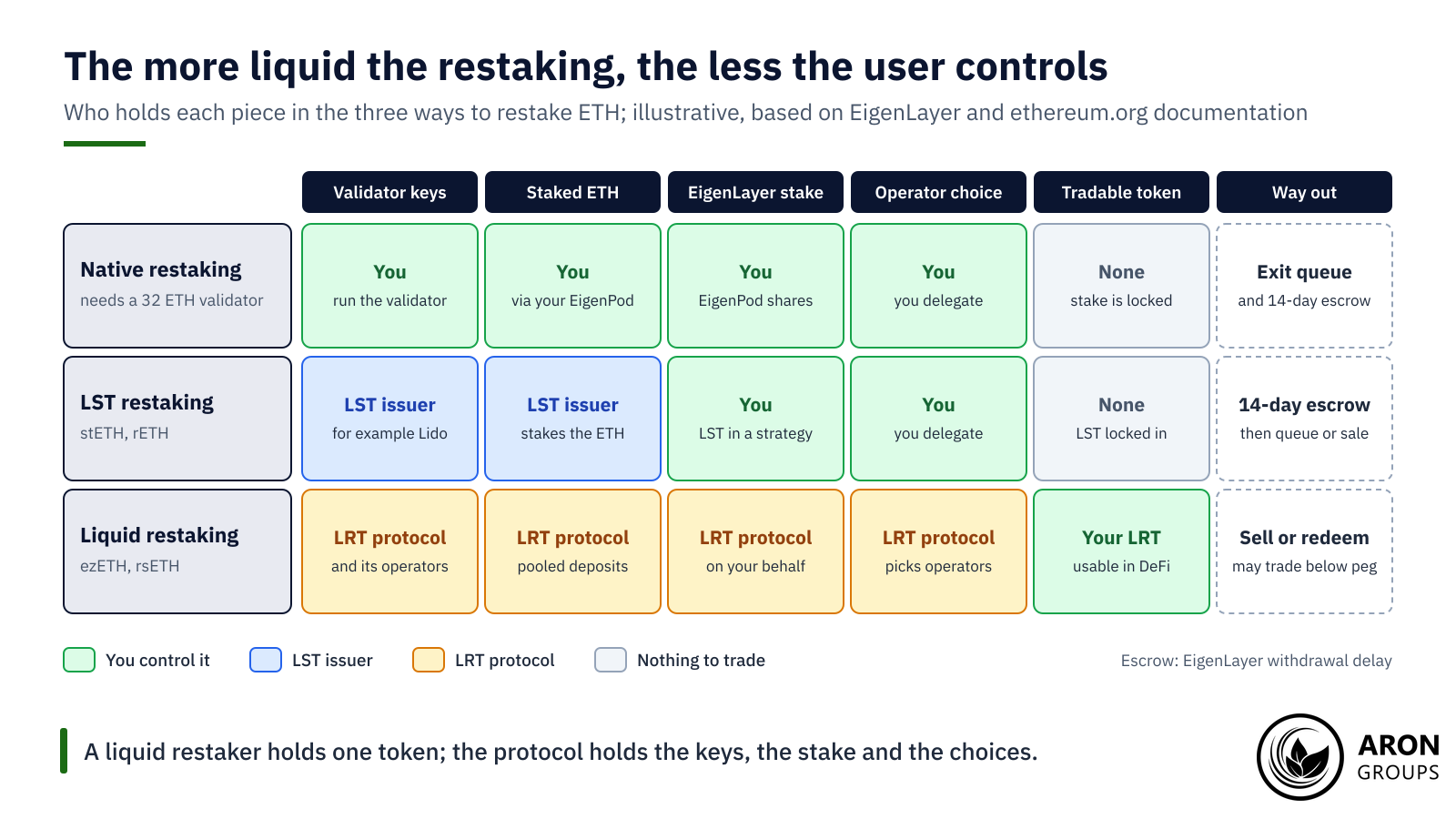
Native restakers keep the keys and the choices; a liquid restaker holds one token, and the protocol controls what sits behind it.

Liquid Restaking Tokens vs Liquid Staking Tokens

Liquid restaking tokens look like liquid staking tokens but carry more exposure. An LST such as stETH represents staked ETH and its staking rewards. An LRT represents ETH that is staked and restaked, so it adds AVS rewards, AVS slashing and another protocol’s contracts. The protocol ether.fi built its eETH as an LRT. In August 2026, ether.fi stripped restaking out of its wrapped weETH, CoinDesk reported. Restaking there now needs a separate opt-in token built on Symbiotic.

FeatureLiquid staking token (LST)Liquid restaking token (LRT)
ExamplesLido stETH, Rocket Pool rETHRenzo ezETH, Kelp DAO rsETH
What it representsStaked ETH and its staking rewardsStaked and restaked ETH, with staking and AVS rewards
Who can slash itEthereum, for validator faultsEthereum and each AVS its operators serve
Contract layersEthereum and the LST protocolEthereum, EigenLayer, the AVSs, the LRT protocol and often a bridge
Way outIssuer's withdrawal queue or a market saleLRT queue, behind EigenLayer's 14-day escrow, or a market sale
Extra yield in late 2026None beyond stakingAbout 0.05% to 0.10% a year (estimate)

LSTs vs LRTs; the late 2026 restaking yield is annualised from DefiLlama fee and reward data, so it is an estimate.

The Yield Reality in 2026

In 2026, almost all of a restaker’s return came from ordinary staking. DefiLlama’s restaking category earned $99,977 in fees in the week to 8 September 2026, on $10.02 billion of deposits, CoinDesk reported. Annualised, that is about 0.05% a year. The liquid staking category earned about 53 times as much per dollar, or about 2.75% a year on the same basis.

EigenLayer’s own figures tell the same story. DefiLlama counted $479,312 of rewards on EigenLayer in the 30 days to 4 November 2026. Annualised on its $5.74 billion TVL, that is about 0.10% a year. It counted $470,425 of token incentives over the same 30 days, or 98% of the rewards. Payments from AVSs made up a small remainder at most.

Headline rates can mislead even for plain staking. Lido’s seven-day average stETH rate was 4.25% on 3 November 2026, lifted by one 15.08% reading on 30 October. Its daily reading for 3 November was 2.30%.

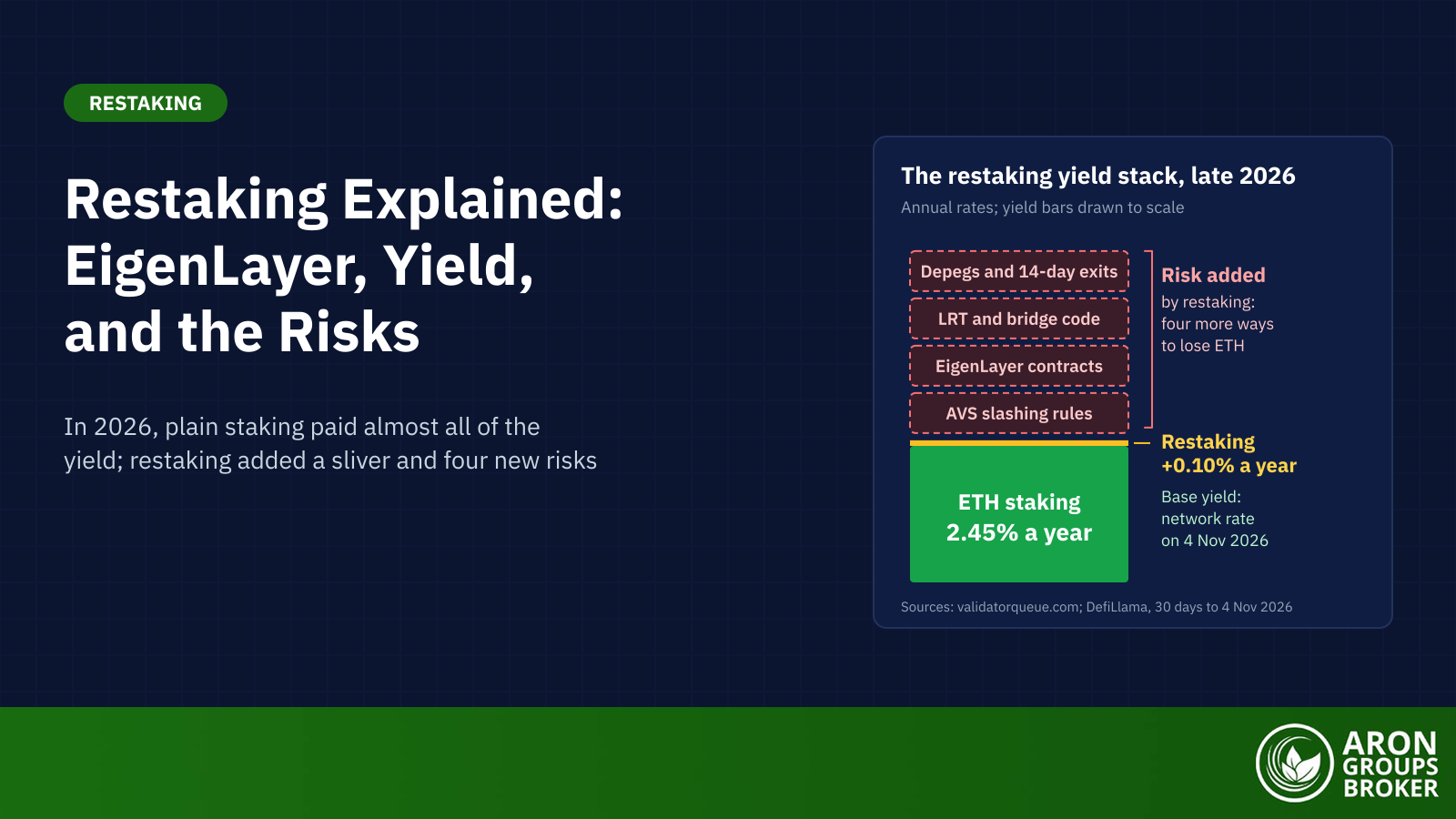
Restaking added about 0.05% to 0.10% a year in late 2026, against 2.45% for plain staking, mostly as token incentives.

The EIGEN Token

The EIGEN token pays for EigenLayer’s programmatic incentives. The Eigen Foundation distributes it to restakers and operators that support AVSs, and EIGEN can itself be restaked. Its price shows how far expectations fell. On CoinGecko and CoinLore data, EIGEN closed at $0.1795 on 3 November 2026, 96.8% below its $5.65 peak of 17 December 2024. Rewards paid in a token this volatile can lose value before they are sold.

Mini Example: What Restaking Adds to 10 ETH

The example places an illustrative 10 ETH with a liquid restaking protocol for one year, using the rates above as inputs. Staking at 2.45% earns 0.245 ETH. Restaking at 0.10% adds 0.010 ETH, for 0.255 ETH in total.

If the protocol keeps an illustrative 10% of rewards, or 0.0255 ETH, 0.2295 ETH is left: a 2.295% return. Restaking’s share after the fee is 0.009 ETH.

One bad event changes the picture. An illustrative 1% slash costs 0.1 ETH, about 11 years of restaking income at 0.009 ETH a year. Selling the LRT at an illustrative 2% discount costs 0.2 ETH, about 22 years.

The Risks of Restaking

Restaking keeps every risk of staking and adds new ones. Each layer can fail on its own: Ethereum’s staking rules, EigenLayer’s contracts, each AVS, the LRT protocol and any bridge that carries its token.

Slashing Is Live and Redistributable

Slashing went live on EigenLayer’s mainnet on 17 April 2025, according to Eigen Labs. It is opt-in: operators allocate stake to an AVS and accept its slashing conditions. Since 22 July 2025, an AVS can redirect slashed funds to a chosen recipient instead of burning them. Eigen Labs warned that, without robust safeguards, stakers face a higher risk of loss to a malicious, negligent or compromised AVS. Penalties can also compound, because a restaked validator answers to Ethereum and to each AVS it serves.

Stacked Smart Contract and Bridge Risk

Code risk stacks too. A liquid restaker relies on Ethereum, EigenLayer, each AVS’s slashing logic, the LRT protocol and often a cross-chain bridge. A flaw in one layer can hurt holders even when the others work. In April 2026, the weak point was the bridge. Chainalysis found that Kelp’s rsETH route relied on a single verifier, so one forged message released the tokens.

Depegs, Withdrawal Queues and Contagion

An LRT can trade below the value of its ETH when sellers outnumber buyers. On 24 April 2024, Renzo’s ezETH briefly fell to $688 on Uniswap after its first airdrop season ended, Cointelegraph reported. Leveraged positions holding it were liquidated. Redemption takes time. EigenLayer holds withdrawals for 14 days, or 100,800 blocks, up from 7 days before slashing. Native restakers also queue to leave Ethereum, and LRT holders wait in the protocol’s own queue. Ethereum limits how many validators can exit at a time, so that wait varies. It was 1 day, 4 hours on 4 November 2026, according to validatorqueue.com.

Lending markets spread the shock. The Kelp attacker posted 89,567 of the stolen rsETH on Aave and borrowed 82,650 WETH against it, Aave’s service providers reported. They put Aave’s possible bad debt at up to $230.1 million, depending on how losses were shared. Losses on collateral can set off a liquidation cascade, and fear of bad debt can drain pools even where no code fails.

Q: Did the Kelp DAO exploit break EigenLayer?
A: Not on Kelp’s account. On 19 April 2026, Kelp said all underlying EigenLayer deposits were intact. The breach was in the bridge that carried rsETH between chains, so the losses fell on rsETH and on lenders that accepted it.

Concentration, Ethereum's Consensus and Regulation

Concentration adds a systemic layer. On 30 March 2026, node operators linked to ether.fi held 71% of the native ETH restaked on EigenLayer, by Bitquery’s on-chain count. A BIS bulletin appendix of July 2026 lists EigenLayer under shared security. It says such layers cut duplicated infrastructure but create “shared dependencies that could become systemic risks”.

Ethereum co-founder Vitalik Buterin addressed the idea in a 21 May 2023 essay, “Don’t overload Ethereum’s consensus”. He wrote that dual-use of validator staked ETH, “while it has some risks, is fundamentally fine”. What he opposed was recruiting Ethereum’s social consensus for an application’s own purposes.

Regulation adds uncertainty. The SEC staff’s statement on liquid staking of 5 August 2025 says it does not address restaking, and staff statements have no legal force. So it gives no view on how US securities law applies to restaking or to LRTs.

The 2026 Reality Check: Kelp DAO and Its Aftermath

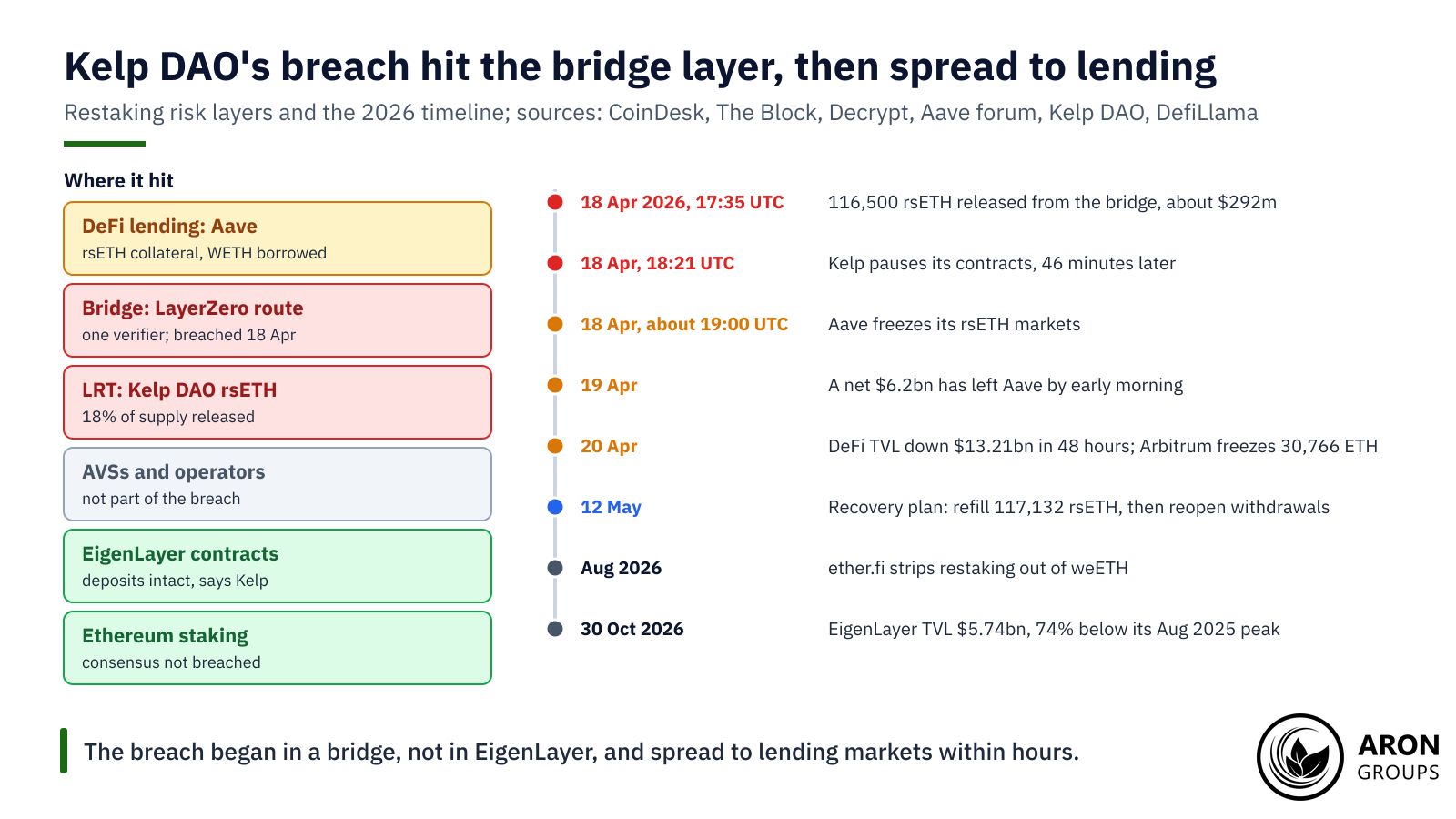
The Kelp DAO exploit turned restaking’s stacked risks into real losses. At 17:35 UTC on 18 April 2026, an attacker released 116,500 rsETH, about 18% of supply, from Kelp’s LayerZero-based bridge. CoinDesk and The Block valued it at about $292 million. Kelp paused its contracts 46 minutes later.

Aave froze its rsETH markets within hours, but fear of bad debt spread. A net $6.2 billion left Aave by early 19 April, according to a DefiLlama co-founder. Across DeFi, TVL fell by $13.21 billion in 48 hours, CoinDesk reported. Those were lending and DeFi-wide figures, not restaking withdrawals. On 20 April, Arbitrum’s Security Council froze 30,766 ETH held by the attacker.

The April 2026 breach hit a bridge, then lending pools; ether.fi's exit and a 74% fall in EigenLayer's TVL followed.

The longer damage was to restaking’s economics. A plan to refill 117,132 rsETH was announced on 12 May, and Kelp later sued LayerZero, arguing that LayerZero had endorsed its set-up. In August 2026, ether.fi stripped restaking out of weETH, leaving under 1% of its assets restaked. By 30 October 2026, EigenLayer’s TVL was $5.74 billion, 74% below its August 2025 peak.

ETH’s slide accounts for part of that fall, not all of it. Between 31 December 2025 and 30 October 2026, ETH fell 24% while EigenLayer’s TVL fell 54%. A CoinDesk headline of 28 September 2026 declared the restaking gold rush over.

The Honest Limits of Restaking

Restaking’s case rests on a forecast that services will pay real fees for Ethereum-grade security. That is a viewpoint, not a finding. AVS payments were small in 2026, but a thin market so far does not prove that demand cannot grow. Supporters and critics read the same data differently. Slashing has been live on EigenLayer since April 2025, a short history for judging how often AVSs will use it.

The figures here have limits too. TVL mixes price moves with deposits and withdrawals. DefiLlama’s fee and incentive counts follow its own methods, and the annual rates in this guide are estimates from one week or 30 days. An LRT’s price can also drift from its backing while redemptions are paused, as rsETH redemptions were from 18 April until the May recovery.

sms-star

Key Point
In late 2026, restaking's extra yield was about 0.05% to 0.10% a year. The extra risks were slashing, code, bridges, depegs and 14-day exits.


Trading ETH Price Exposure Without Restaking

Aron Groups does not offer staking, restaking, liquid staking tokens, LRTs or DeFi access, so none of the yields above are available through it. It offers crypto CFDs such as ETHUSD and BTCUSD on MetaTrader 5, alongside forex, gold and indices. An ETHUSD CFD tracks ETH’s price and nothing else. It pays no staking or restaking rewards, and positions held overnight carry overnight swaps that are added to or subtracted from the account.

A CFD avoids slashing, bridge and depeg exposure, but not market risk. Leverage magnifies losses as well as gains. Fast moves can trigger a margin call at a 100% margin level and a stop-out at 50%, or 40% on Islamic and VIP accounts. A stop-loss does not ensure an exit at the chosen price, because prices can gap. A demo account with virtual funds lets traders practise ETHUSD first, and the Nano account keeps live sizes small.

Conclusion

Restaking reuses staked ETH to secure extra services through EigenLayer and its rivals, for extra rewards. In 2026 those rewards were close to zero, while the extra risks proved real.

The useful comparison for any LRT is the plain staking rate against the full stack of slashing, contract, bridge, depeg and queue risks. Headline yields that bundle points or token incentives deserve the same test.

Frequently Asked Questions

Short answers to common questions about restaking and EigenLayer.

What is the difference between staking and restaking?

Staking locks ETH to help secure Ethereum and earns protocol rewards. Restaking reuses that staked ETH, or a liquid staking token, to secure extra services through a protocol such as EigenLayer. It adds rewards and new slashing rules.

How much does EigenLayer restaking pay in 2026?

Very little beyond staking. DefiLlama data put restaking rewards at about 0.05% to 0.10% a year in late 2026, mostly as token incentives. The network staking rate was 2.45% on 4 November 2026.

Can you lose ETH by restaking?

Yes. Restaked ETH can be slashed under Ethereum’s rules or an AVS’s rules. Contract and bridge failures can hit LRT holders, as the Kelp DAO exploit showed. Selling an LRT below its backing also locks in a loss.

Do ETHUSD CFDs pay staking or restaking rewards?

No. A CFD gives exposure to the price and nothing more. It holds no ETH for the trader, so it earns no staking or restaking rewards. Overnight swaps, leverage and price gaps bring their own costs and risks.

Continue Reading
not-found
calendar 19 November 2026
Rate this article

Leave a Reply

Your email address will not be published. Required fields are marked *

No thanks