
icon icon Home
icon icon Accounts
icon icon Quick start
icon icon Symbols

Herd Behavior in Trading: Why We Follow the Crowd, How It Creates Bubbles and Crashes, and How to Resist It

Author
Abe Cofnas
Abe Cofnas
calendar Last update: 12 November 2026
watch Reading time: 10 min

Herd behaviour, also called herd mentality, is the tendency to follow the crowd and copy the majority instead of relying on one’s own analysis. In markets, it means buying because others are buying and selling because others are selling. Emotion and social pressure drive it more than independent judgement.

The American Association of Individual Investors (AAII) runs a weekly sentiment survey. In the week ending 28 October 2026, 41.4% of respondents expected the stock market to fall over the next six months. That was about 10 points above the survey’s long-run bearish average of roughly 31%, and down from 45.8% in the week ending 21 October. Gauges such as the fear and greed index track swings like these.

This guide explains why traders herd, from social proof to information cascades, and how herding can inflate an asset bubble and deepen a crash. It covers tulip mania, the dot-com bubble, bitcoin and GameStop, then the rules traders use against the crowd.

bookmark
Key Takeaways
  • Herd behaviour, or herd mentality, means copying what the crowd does instead of relying on one's own analysis.
  • Social proof, FOMO, information cascades and regret aversion all pull traders towards the crowd, sometimes for rational reasons.
  • In BIS data from 95 countries, almost three quarters of crypto app users downloaded their app when bitcoin was above $20,000.
  • Bitcoin's daily close fell 76.7% from 8 November 2021 to 21 November 2022. The Nasdaq Composite fell 77.9% from March 2000 to October 2002.
  • Written plans and exits set in advance limit the damage, and sentiment gauges help traders spot crowd extremes. None of them reliably times a top or a bottom.

What Is Herd Mentality?

Herd mentality is the urge to act as a group acts, on the assumption that so many people cannot all be wrong. Traders feel it as pressure to join a rally others are discussing, or to sell because others are. Psychologists study it as conformity; economists study it as herding.

sms-star

Risk Disclosure
Trading forex and CFDs carries a high level of risk and can result in the loss of all your capital. This content is educational and is not investment advice. Never risk money you cannot afford to lose.
Herd Mentality Definition in Psychology and Economics

A simple herd mentality definition is copying a group’s choices instead of weighing the evidence oneself. The bandwagon effect is a close cousin: adopting something because it is popular. In economics, a formal herd behavior definition comes from Abhijit Banerjee’s 1992 paper in the Quarterly Journal of Economics.

In his model, people decide in turn, and copying earlier choices can be rational because others may know more. The result is people “doing what others are doing rather than using their information”, and an inefficient outcome.

How Herd Behaviour Shows Up in Markets

Herding shows up at both ends of a move. On the way up, traders chase a rally after much of it has happened. On the way down, it becomes panic selling and capitulation, as holders give up together. Positions that many traders share are crowded trades, and they can reverse sharply when the crowd heads for the exit.

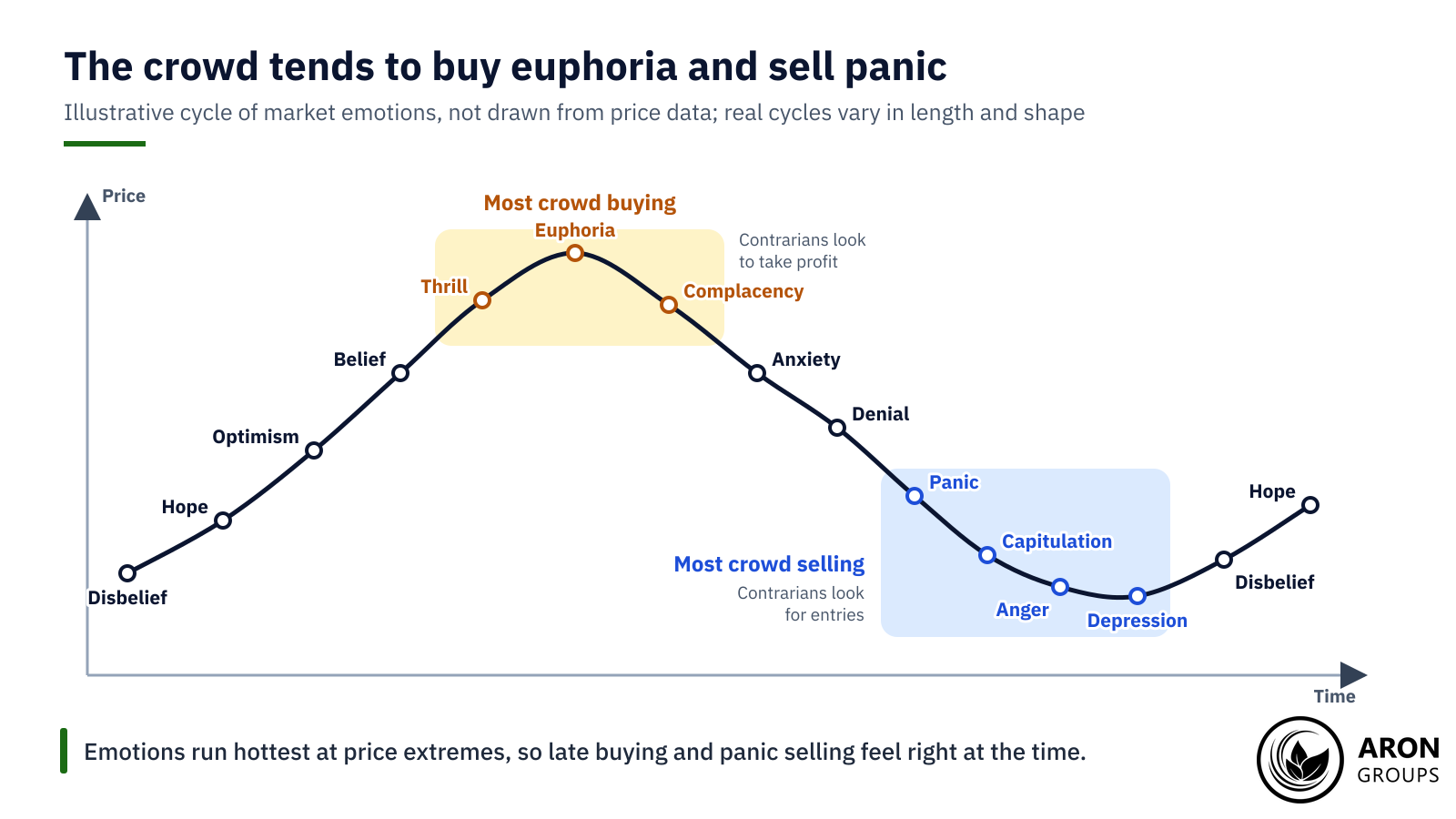
The emotional side of a market cycle is often drawn like the Wall Street cheat sheet, running from disbelief to euphoria, panic and back. The herd tends to buy most near the top and sell near the bottom, the reverse of what a disciplined plan aims for. That is a tendency, not a law.

In this illustrative cycle, crowd buying peaks around euphoria and crowd selling peaks around panic and capitulation.

Why Traders Follow the Crowd

Several forces push traders towards the crowd, and they often reinforce each other.

Social Proof and Safety in Numbers

Psychologist Robert Cialdini described the principle of social proof in his 1984 book Influence. People judge an action as more correct the more they see others taking it, especially when they feel uncertain. Markets are uncertain by nature, so rising prices and busy chat rooms can work as social proof.

Solomon Asch showed how strong group pressure can be. In line-matching experiments described in Scientific American in 1955, people judging alone erred less than 1% of the time. When a unanimous group gave wrong answers, Asch’s 123 subjects went along in 36.8% of those trials. About a quarter never yielded.

FOMO on the Way Up, Fear on the Way Down

FOMO, the fear of missing out, is the pull on the way up: watching others profit makes standing aside feel like losing. In an FCA survey of 2,000 UK investors aged 18 to 40 in August 2024, 51% had invested more than intended because of FOMO. On the way down, fear takes over, and selling with everyone else can feel like safety.

Information Cascades: When Copying Looks Rational

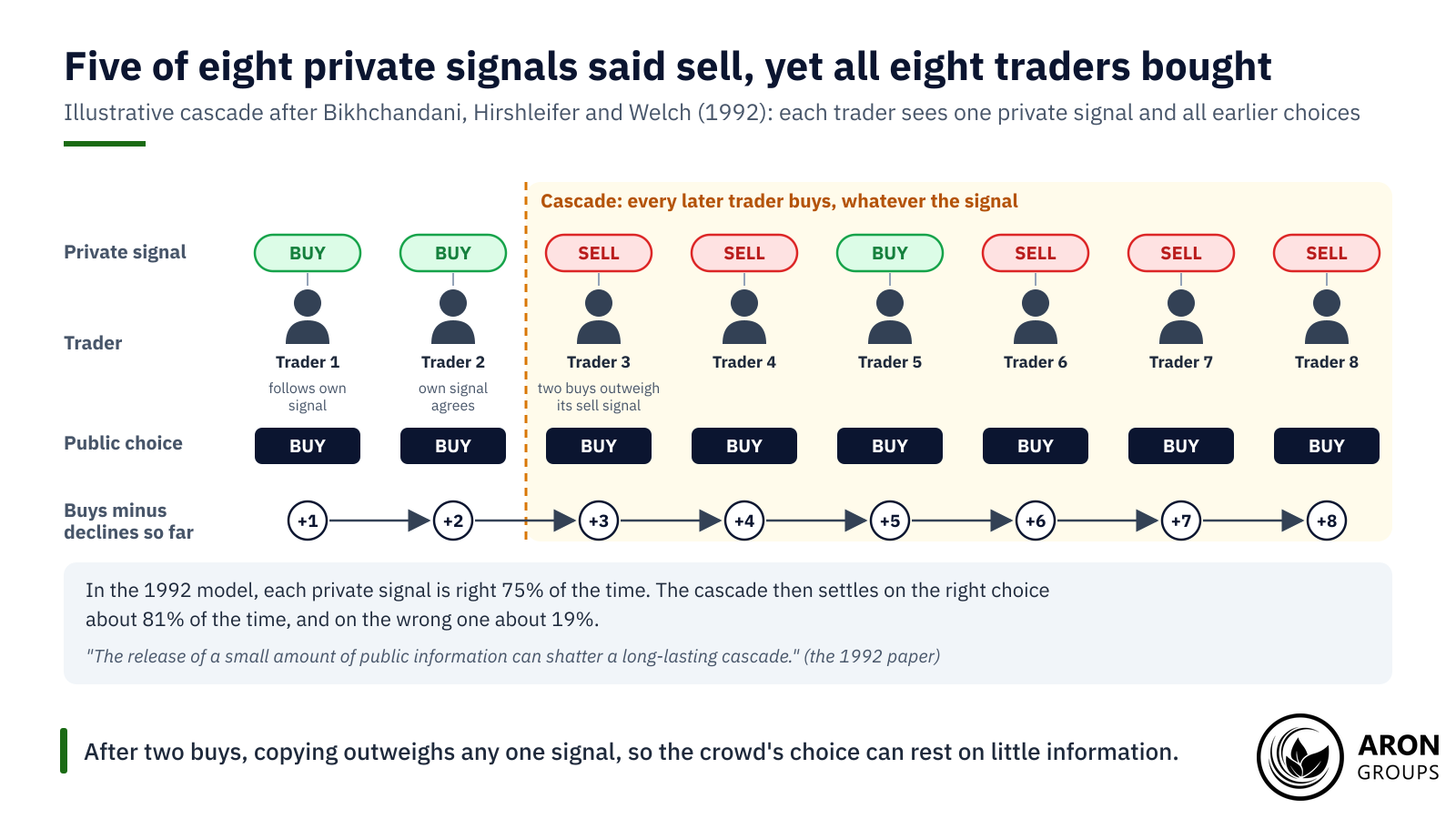
An information cascade happens when people assume the crowd knows something they do not and copy it, ignoring their own information. Sushil Bikhchandani, David Hirshleifer and Ivo Welch modelled it in the Journal of Political Economy in 1992. Each person gets a private signal and sees all earlier choices. Once buyers outnumber those who declined by two, the next person buys whatever their own signal says.

When private signals are right 75% of the time, the paper’s model ends in the right cascade about 81% of the time. About 19% of the time, the crowd locks onto the wrong choice. The paper notes: “The release of a small amount of public information can shatter a long-lasting cascade.”

In this illustrative cascade, five of eight private signals say sell, yet all eight traders buy.

Regret Aversion and Failing Conventionally

Regret aversion adds a social twist: being wrong with the crowd tends to hurt less than being wrong alone. John Maynard Keynes made the point in The General Theory in 1936. “Worldly wisdom teaches that it is better for reputation to fail conventionally than to succeed unconventionally,” he wrote. In 1990, economists David Scharfstein and Jeremy Stein modelled the same reputational herding among managers.

Famous Examples of Herd Behaviour

Herding appears across centuries and asset classes, but the evidence is stronger for recent episodes.

Tulip Mania, 1637: A Story With Caveats

Prices for Dutch tulip bulb contracts soared over the winter of 1636 to 1637 and peaked in February 1637, before collapsing. Historian Anne Goldgar’s 2007 study found that a fairly small group of merchants and craftsmen did the trading. She traced very few bankruptcies to it. Economist Peter Garber argued that high prices for rare bulbs were less irrational than the legend suggests.

The Dot-Com and Housing Bubbles

The late-1990s internet boom is far better documented. In 1999, 476 US IPOs rose an average of 71.2% on their first trading day, against 14.0% in 1997, Jay Ritter’s data show. The Nasdaq Composite closed at a peak of 5,048.62 on 10 March 2000. By 9 October 2002 it had closed at 1,114.11, a fall of 77.9%.

Housing went through a slower boom and bust. In Karl Case and Robert Shiller’s 2003 survey, San Francisco buyers expected home values to rise 15.7% a year for a decade, on average. The S&P Cotality Case-Shiller U.S. National Home Price Index peaked at 184.608 in July 2006 and bottomed 27.4% lower in February 2012, FRED data show.

Bitcoin's Bull Runs of 2017 and 2021

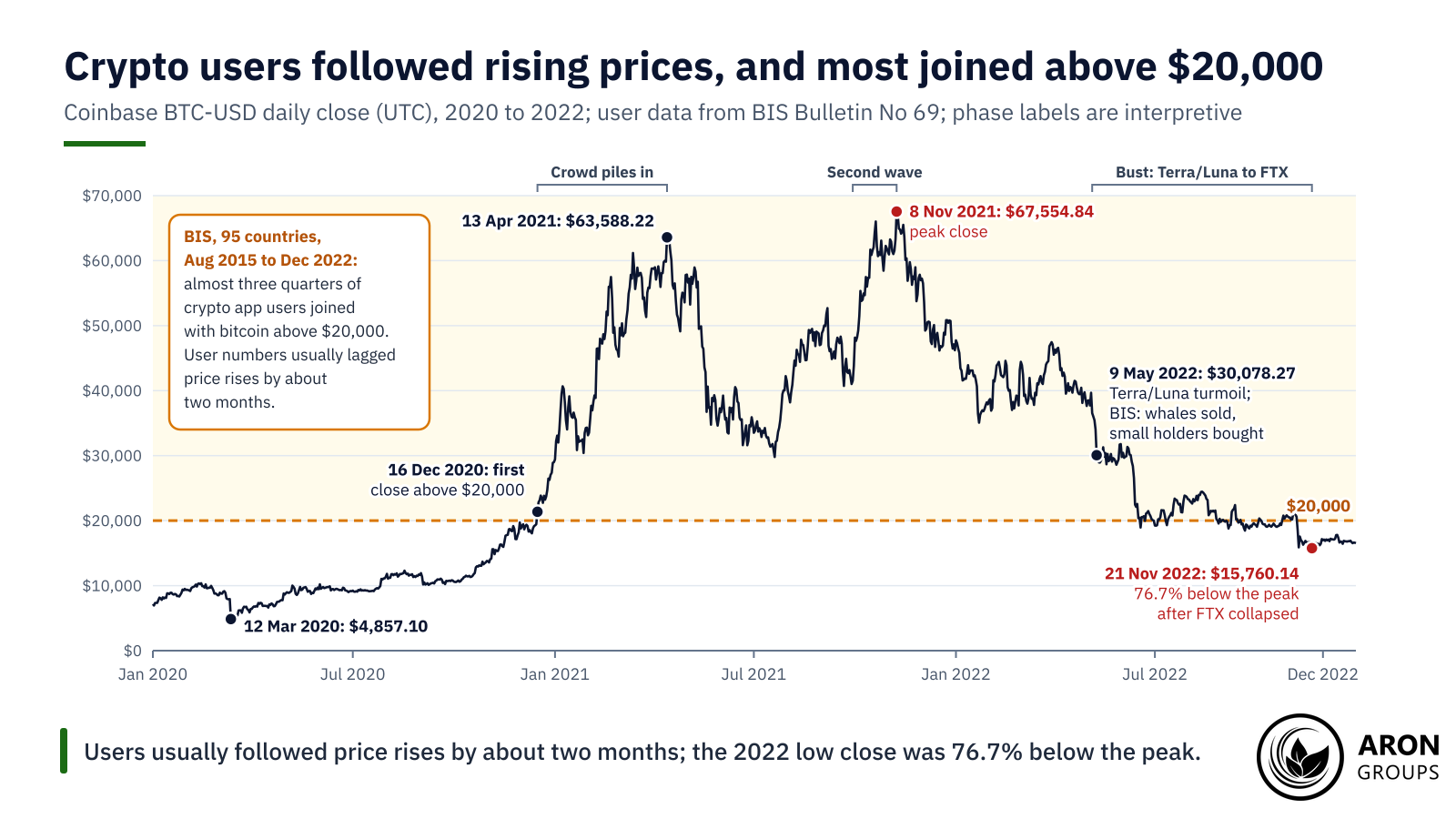
Crypto bull runs show modern herding at speed. On Coinbase daily closes, bitcoin peaked at $19,650.01 on 16 December 2017, then fell 83.8% to $3,183.00 on 15 December 2018. The next cycle peaked at $67,554.84 on 8 November 2021. It closed at $15,760.14 on 21 November 2022, 76.7% lower.

A BIS bulletin of February 2023 tracked more than 200 crypto exchange apps in 95 countries from August 2015 to mid-December 2022. “As prices rose, more and more users entered the crypto system,” it found. User numbers usually lagged price rises by about two months, and almost three quarters of users downloaded an app when bitcoin was above $20,000.

In its simulation, each new user bought $100 of bitcoin a month from download. By December 2022, the median investor would have lost $431 of $900 invested.

Almost three quarters of crypto app users joined with bitcoin above $20,000; the 2022 low close was 76.7% below the peak.

GameStop and the Meme Stocks of 2021

Meme stocks showed herding at internet speed. In the SEC staff report on early 2021, accounts trading GameStop each day rose from fewer than 10,000 to nearly 900,000 by 27 January. That day the shares closed at $347.51, more than 1,600% above their 12 January close of $19.95. These prices predate the four-for-one split of July 2022.

The staff concluded that “the positive sentiment, not the buying-to-cover” by short sellers sustained the weeks-long rise. By 19 February the price had fallen as low as $40.59, the report notes, about 88% below the closing high.

EpisodeMeasurePeakLowFall
Dot-com bubbleNasdaq Composite, daily close5,048.62 on 10 Mar 20001,114.11 on 9 Oct 200277.9%
US housing bubbleCase-Shiller US National index, monthly, not seasonally adjusted184.608 in Jul 2006133.987 in Feb 201227.4%
Bitcoin, 2017 cycleCoinbase daily close (UTC)$19,650.01 on 16 Dec 2017$3,183.00 on 15 Dec 201883.8%
Bitcoin, 2021 cycleCoinbase daily close (UTC)$67,554.84 on 8 Nov 2021$15,760.14 on 21 Nov 202276.7%
GameStopShare price before the 2022 split$347.51 close on 27 Jan 2021$40.59 by 19 Feb 2021 (low cited by the SEC)About 88%

Five herd episodes from peak to low. Sources: AP and CNN Money (Nasdaq), FRED, Coinbase, SEC staff report (October 2021).

The Dangers of Following the Crowd

Buying euphoria tends to mean paying near the cycle’s highs, and panic selling can lock in losses near the lows. When many traders share a position, forced exits by some can push prices against the rest, as in a leveraged liquidation cascade. Herding can add to volatility in both directions.

Smart Money vs Retail: What the Evidence Shows

A popular framing in smart money concepts trading says professionals exploit predictable crowds. The evidence is narrower. The BIS found that after the Terra/Luna collapse of May 2022 and FTX’s failure that November, the largest holders cut their bitcoin holdings. Small holders added to theirs. The BIS judged that larger investors “probably cashed out at the expense of smaller holders”.

Brad Barber and Terrance Odean found in 2008 that individual investors are net buyers of attention-grabbing stocks, such as those in the news. In a 2022 study of Robinhood users by Barber and colleagues, the top stocks bought each day had average 20-day abnormal returns of -4.7%. These are timing patterns, not proof that anyone deliberately exploited the crowd.

Mini Example: Two Late Buyers, One Plan

These numbers are illustrative and ignore costs. After a rally from $80 to $125, two traders with $10,000 each buy at $125. Trader A has no plan and puts in the whole account: 80 units.

Trader B’s plan risks 1%, or $100, with a stop at $120, so the $5 distance allows 20 units, a $2,500 position. The crowd then sells, and the price gaps from $121 to $117 overnight, so B’s stop fills at $117. B loses 20 × $8 = $160, or 1.6% of the account.

Trader A sells at $75 in the panic, losing 80 × $50 = $4,000, or 40%. Both entered late; size and a pre-set exit made the difference. Even so, B lost 60% more than planned, because a stop is not a guaranteed exit.

Q: Is following the crowd always a mistake?
A: No. A trend reflects many traders acting in the same direction, and following one with defined risk is a common strategy. The danger is joining late, at emotional extremes, without an exit plan.

How Traders Resist Herd Mentality

No rule makes a trader immune to the crowd. The common defences work by moving decisions to a calmer moment.

A Written Plan, a Journal and Position Limits

A trading plan written before entry sets the markets, the signals that count, the risk per trade and the exit. A trading journal that logs why each trade was taken shows how often social media or a fast move was the real reason. A fixed entry rule and a maximum position size are common answers to FOMO. Position sizing limits how much any one trade puts at risk.

Independent Analysis Before the Feed

Many traders form their own view before reading forums or social media, since social proof is strongest under uncertainty. A busy chat thread then prompts a check of the plan rather than a trade. Copy trading deserves the same scrutiny: copying a trader means inheriting any herding in their decisions.

Thinking Like a Contrarian at Extremes

Contrarian investing means fading the crowd at emotional extremes, not on every move. Warren Buffett set out the idea in Berkshire Hathaway’s chairman’s letter for 1986. He described a modest goal: “we simply attempt to be fearful when others are greedy and to be greedy only when others are fearful.” In the same letter he warned: “The timing of these epidemics will be unpredictable.”

Sentiment Gauges: Fear and Greed Index and Put/Call Ratio

Sentiment gauges try to show how far the herd has gone. CNN’s Fear & Greed Index turns seven market indicators into a 0 to 100 reading, where higher means greedier. The put/call ratio compares put options traded with calls; contrarians read unusually high readings as fear and low ones as complacency. The AAII survey is a third gauge.

sms-star

Key Point
Sentiment extremes describe the crowd's mood, not the date of a turn. Buffett called the timing of fear and greed unpredictable.
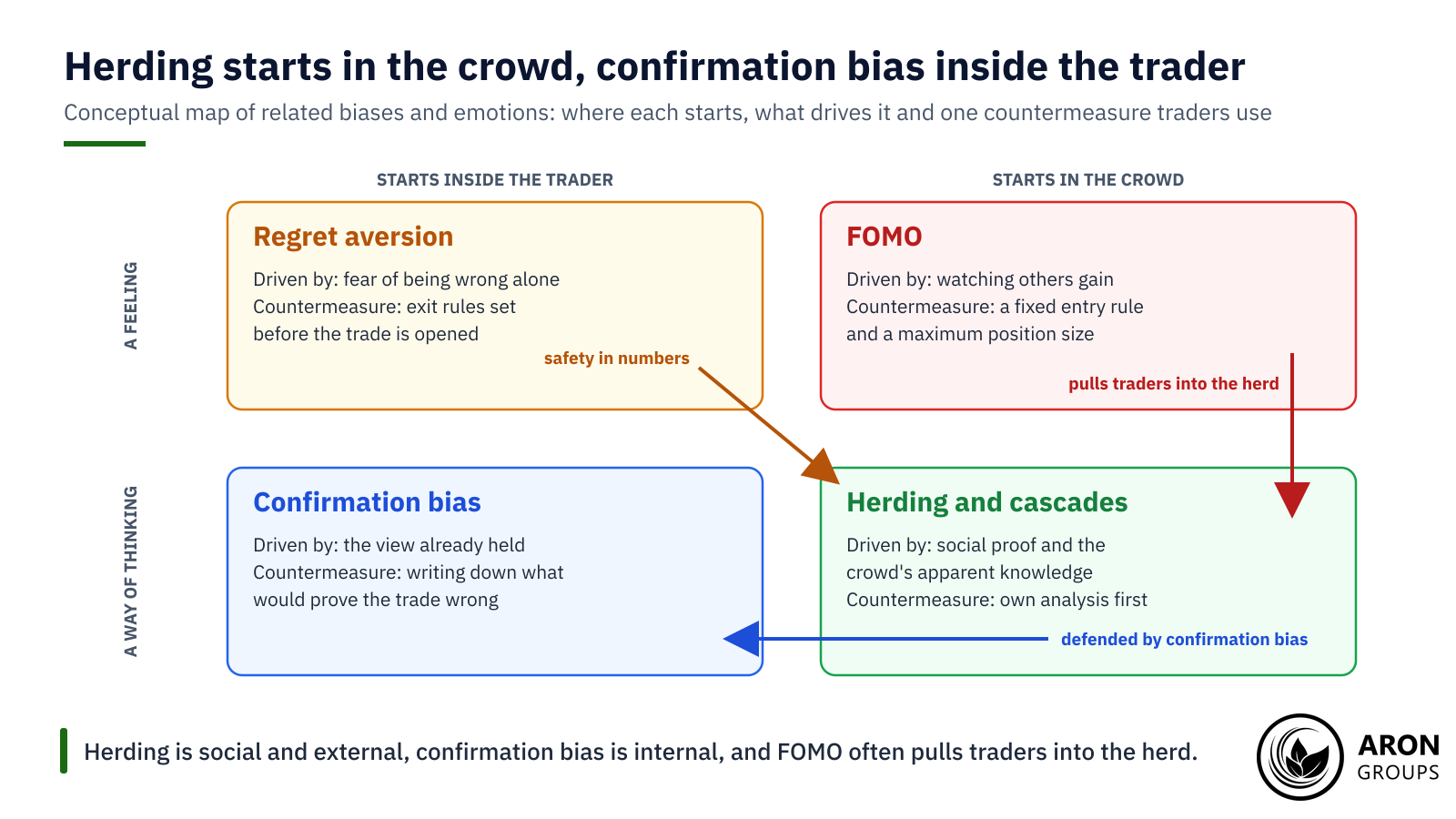

Herd Behaviour vs Confirmation Bias and FOMO

Herd behaviour, confirmation bias and FOMO overlap, but they start in different places. Herding is external and social: copying what others do. Confirmation bias is internal: favouring evidence that supports a view already held. FOMO is the emotion that often triggers herding, and regret aversion makes being wrong alone feel worse.

FOMO pulls a trader into a crowded trade, and confirmation bias then filters the news to defend it. A common countermeasure for confirmation bias is writing down, before entry, what would prove the trade wrong. An information cascade differs from the bandwagon effect in motive: copying for presumed information rather than for popularity.

Herding starts in the crowd and confirmation bias in the trader's own beliefs; FOMO often pulls traders into the herd.

The Honest Limits of the Herd Story

Following the crowd is not always a mistake. In 1993, Narasimhan Jegadeesh and Sheridan Titman found that buying recent winners and selling recent losers paid off over three to twelve months. Part of those returns faded over the following two years. Trend followers try to ride the herd deliberately, with exits defined in advance.

Herding can also be rational, as the cascade models show. A trader who buys a strong trend with a stop is not necessarily herding. Much of the market evidence is also correlational: the BIS and Robinhood findings describe timing patterns, not proof that herding caused the losses.

Contrarian calls carry their own risk. Buffett’s letter called the market aberrations of fear and greed unpredictable “both as to duration and degree”. A trader who sells a mania early can lose money while the crowd keeps buying.

Where Aron Groups Fits

Aron Groups offers forex, gold, index and crypto CFDs on MetaTrader 5, where exit decisions can be set before the crowd gets loud. Stop-loss and take-profit levels can be attached to a position, and price alerts can flag a level without screen-watching. A stop is not a guaranteed exit: in a gap it can fill at a worse price. Aron’s guide to stop-loss techniques covers how traders place them.

The economic calendar lists releases that can set off sharp moves, such as inflation data and central bank decisions. A demo account with virtual funds lets a trader test plan rules without real money. A Nano account trades from 0.01 nano lots, or 0.0001 lots. Leverage magnifies losses as well as gains, so neither a plan nor a small size removes the risk.

Conclusion

Herd behaviour is the pull to do what others are doing. Social proof, FOMO, information cascades and regret aversion explain its strength, and why it is sometimes rational.

The history of bubbles, from the dot-com era to bitcoin and GameStop, shows the cost of joining late at emotional extremes. Written plans, exits set in advance and sentiment gauges cannot time the crowd, but they can limit what following it costs.

Frequently Asked Questions

Short answers on herd behaviour and herd mentality.

What is herd behavior?

It is the tendency to copy what a group does instead of relying on one’s own information or analysis. In trading, it means buying rallies and selling slumps mainly because others are doing so.

What is an example of herd mentality in trading?

GameStop in January 2021 is a modern example. Accounts trading it each day rose from fewer than 10,000 to nearly 900,000. The shares then fell about 88% in just over three weeks.

Is herd mentality the same as FOMO?

No. FOMO is the emotion, the fear of missing gains that others are making. Herd mentality is the behaviour of copying the crowd, which FOMO often triggers.

How do traders spot herd extremes?

Many watch sentiment gauges such as CNN’s Fear & Greed Index, the put/call ratio and the AAII survey. Extreme readings show a crowded mood but do not time a turn.

Continue Reading
not-found
calendar 12 November 2026
Rate this article

Leave a Reply

Your email address will not be published. Required fields are marked *

No thanks