
A diagonal spread is an options strategy that pairs two calls or two puts with different strike prices and different expiration dates. It combines a calendar spread with a vertical spread. Usually you buy the longer-dated option and sell the shorter-dated one, which adds a directional lean to a time-decay trade.
It matters now because implied volatility jumped in mid October while rates stayed high. The VIX, the market’s volatility gauge, closed at 19.99 on Friday 16 October 2026, up from 14.84 a week earlier. The one-year Treasury yield stood at 4.46%, an interest cost built into every long-dated call.
This guide builds a diagonal from its two parts and prices a poor man’s covered call on the real SPY chain. It also shows what rolling does in quiet, rising and falling markets.
- A diagonal spread pairs two calls or two puts with different strikes and different expiries. It is a calendar plus a vertical spread: in the teaching example, a 2.41 calendar and a 1.85 vertical make a 4.26 diagonal.
- Bull call and bear put diagonals are usually debits; bear call and bull put diagonals are often credits, but strikes and tenor decide. The teaching bear call diagonal collects 0.69 with a 60-day long leg but costs 0.29 with a 90-day one.
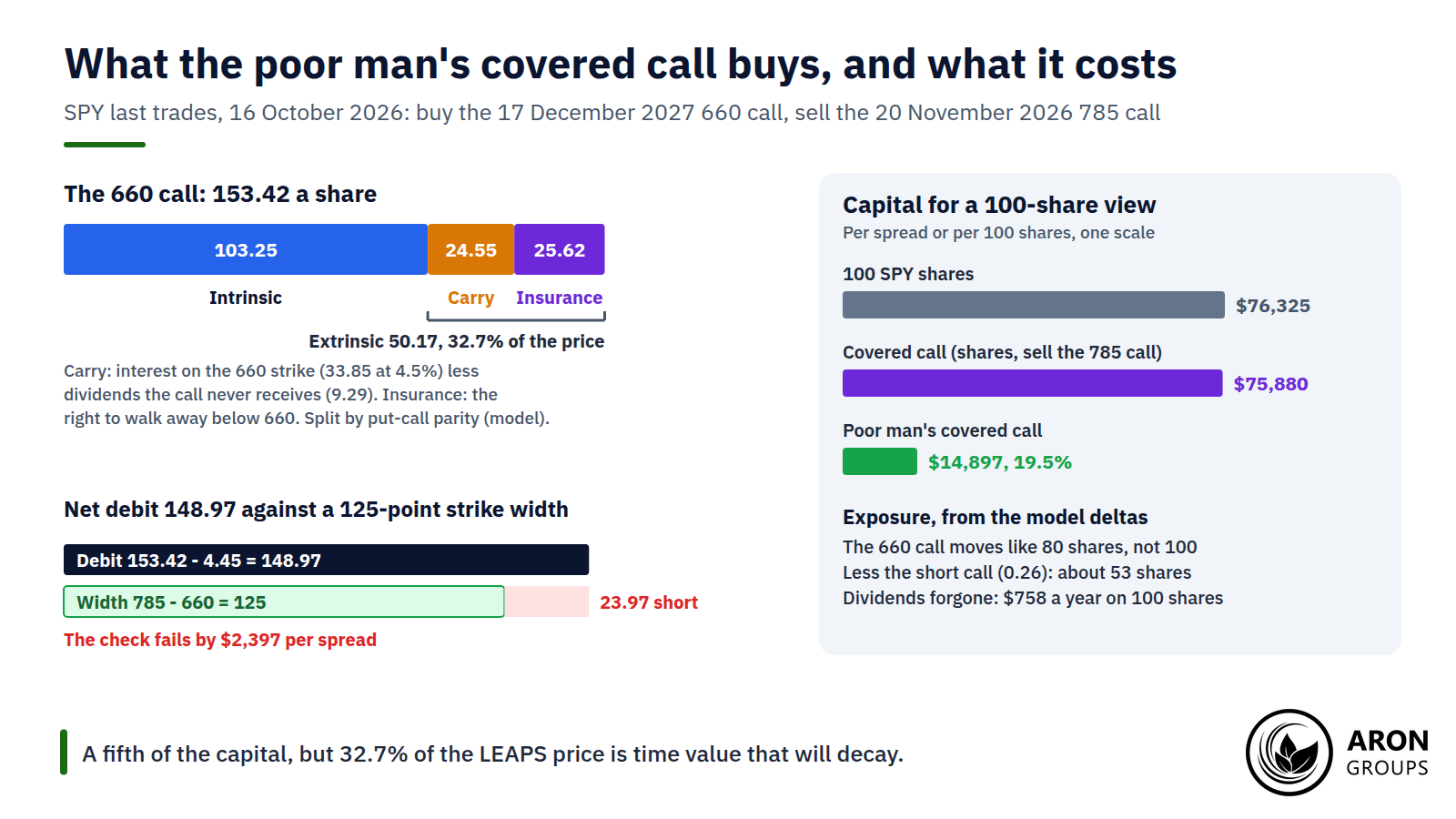
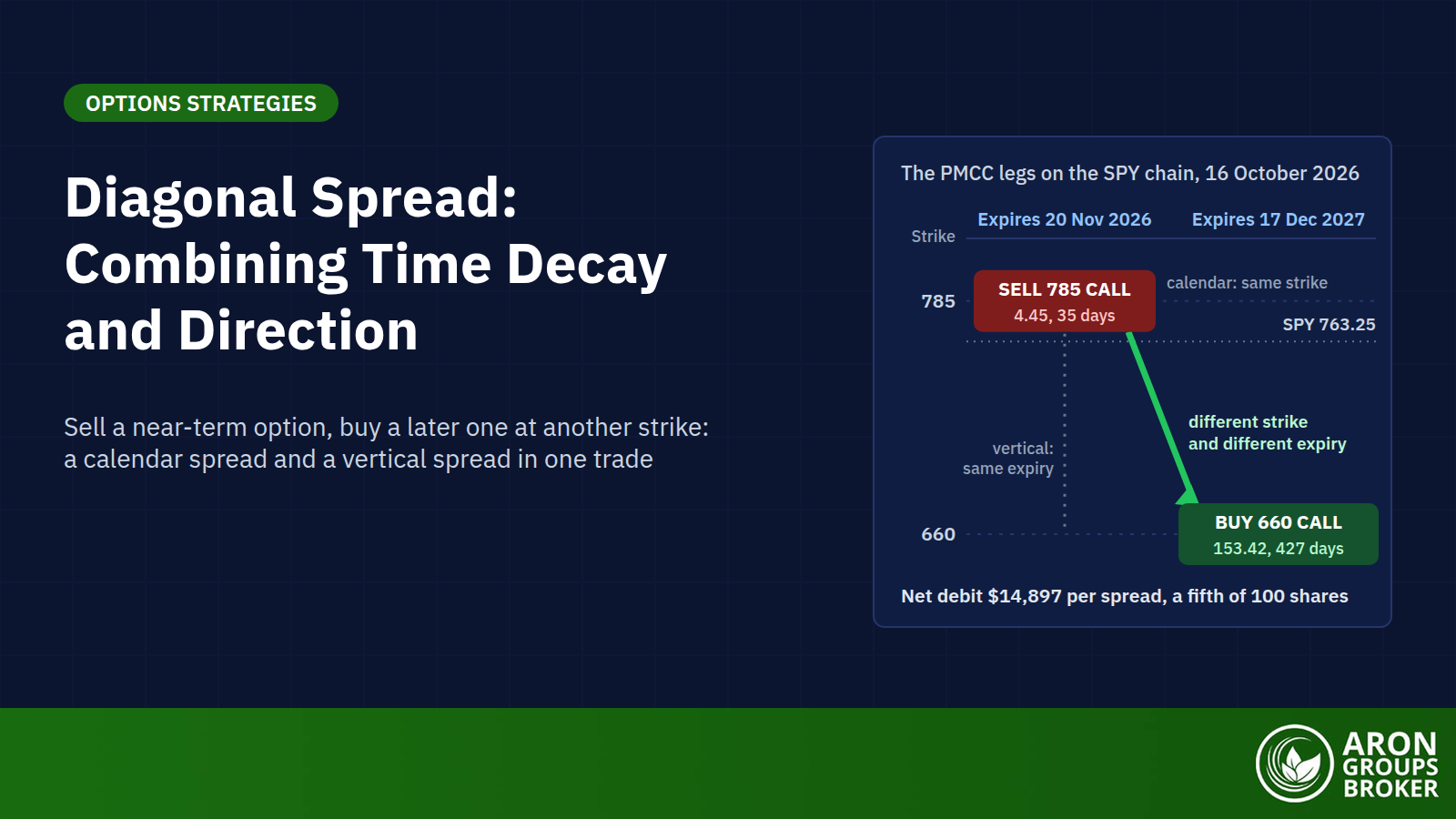
- On 16 October 2026 a poor man's covered call on SPY cost $14,897, a fifth of the $76,325 for 100 shares. It bought the December 2027 660 call at 153.42 and sold the 20 November 785 call at 4.45. The LEAPS moves like about 80 shares and earns no dividends.
- Of the LEAPS price, 50.17 was extrinsic value, so the 148.97 debit exceeded the 125-point strike width and failed the usual check. In the model it breaks even near 763.08 on 20 November and makes at most $1,788.
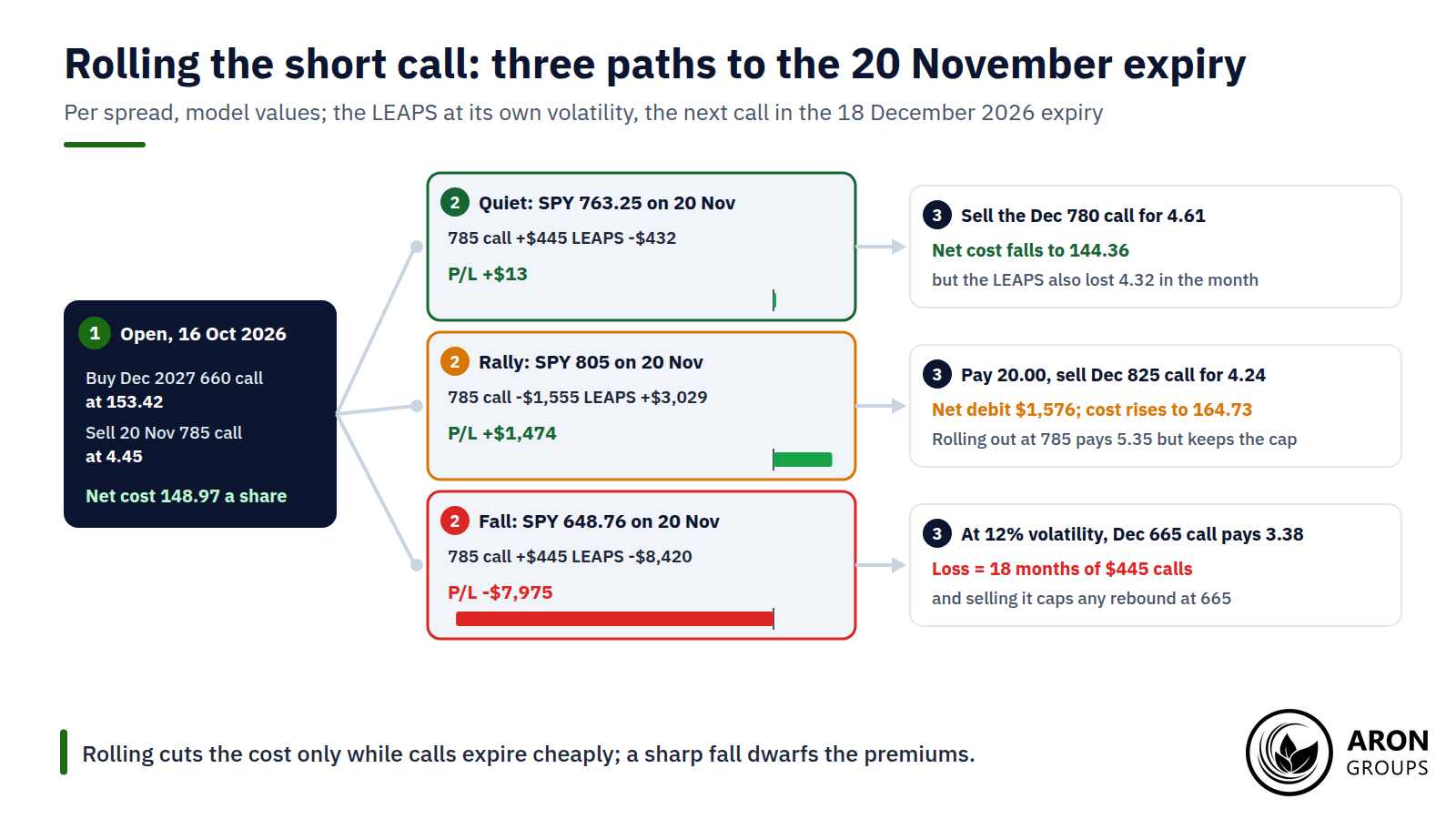
- Rolling lowers the cost only while calls expire cheaply. In the model, a rally to 805 costs a $1,576 debit to roll up; a 15% fall loses $7,975, about 18 months of premiums. Aron Groups offers no options.
What Is a Diagonal Spread?
The CFTC’s glossary defines a diagonal spread as a spread between two calls or two puts with different strike prices and different expiration dates. The nearer expiry is the front month and the later one the back month. A long diagonal, the common form, buys the back-month option and sells the front-month one.
Risk Disclosure
Trading forex and CFDs carries a high level of risk and can result in the loss of all your capital. This content is educational and is not investment advice. Never risk money you cannot afford to lose.
A Calendar Spread Plus a Vertical Spread
A calendar spread, also called a horizontal or time spread, uses one strike and two expiries. A vertical spread, or price spread, uses one expiry and two strikes. A diagonal differs from the first because its strikes differ, and from the second because its expiries differ. On a chain laid out by strike and month, its legs sit on a diagonal.
How a Diagonal Spread Makes Money
The vertical part gives a diagonal its directional lean. The calendar part earns from time, because a near-term option decays faster than a later one. Together they make a long diagonal earn most if the price ends at the short strike on the front expiry. A Cboe Options Institute strategy guide notes that this best case is not fixed, because the long option’s value then depends on volatility.
Delta, the share-equivalent exposure, carries the directional lean. Theta, the daily time decay, is positive while the short leg decays faster. Vega is usually positive because the later option is more sensitive to implied volatility, so an IV crush hurts. Gamma is usually negative, so sharp moves hurt too.
Mini Example: A 100/105 Bull Call Diagonal
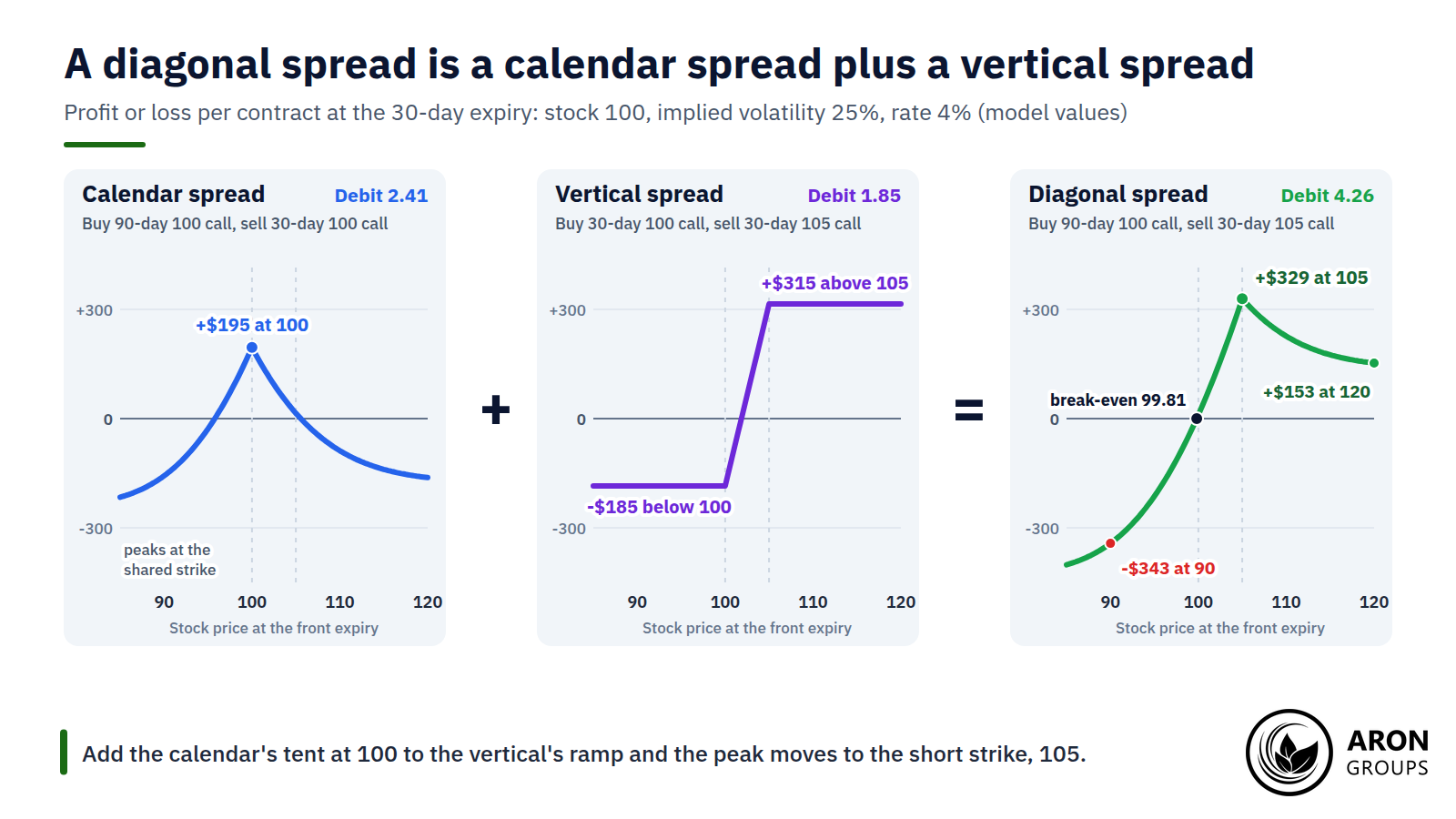
This diagonal spread example takes a stock at 100 with implied volatility of 25% and a 4% interest rate. Black-Scholes, the standard pricing model, values the 90-day 100 call at 5.43 and the 30-day 105 call at 1.17. Buying the first and selling the second costs a debit of 4.26 a share, $426 a contract.
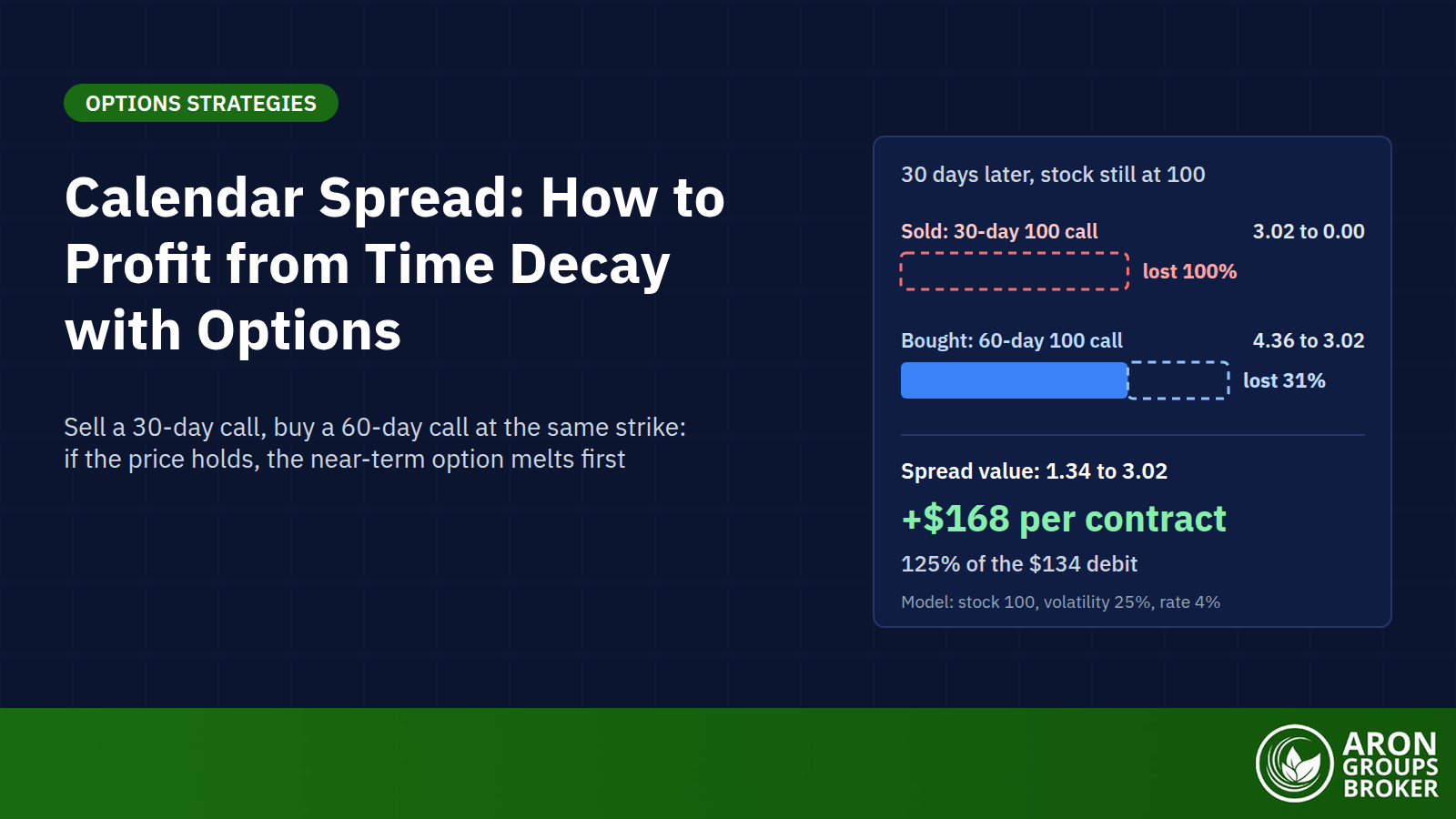
That diagonal is exactly a calendar plus a vertical. The calendar, long the 90-day 100 call and short the 30-day 100 call at 3.02, costs 2.41. The vertical, long that 30-day 100 call and short the 30-day 105 call, costs 1.85. The 30-day 100 calls cancel, so 2.41 + 1.85 = 4.26.
At the 30-day expiry, with volatility unchanged, the model shows +$329 at 105, +$10 at 100 and -$343 at 90, breaking even at 99.81. If the stock sits still, the short call’s 1.17 of decay just beats the long call’s 1.07. If it soars, the gain shrinks towards +$139, the 5-point width less the debit plus leftover time value.
Bull, Bear, Debit or Credit: The Four Diagonal Spreads
A diagonal call spread, or call diagonal spread, uses two calls and a diagonal put spread two puts. Bull call and bear put diagonals buy the back-month option nearer the money, so they usually cost a net debit. Bear call and bull put diagonals sell the front-month option nearer the money and often bring in a net credit. Strike distance and tenor decide which.
| Type | View | Sell (front month) | Buy (back month) | Usually | Net, 90-day long leg | Net, 60-day long leg |
|---|---|---|---|---|---|---|
| Bull call diagonal | Moderately bullish | 30-day 105 call | 90-day 100 call | Debit | Debit 4.26 | Debit 3.19 |
| Bear put diagonal | Moderately bearish | 30-day 95 put | 90-day 100 put | Debit | Debit 3.55 | Debit 2.81 |
| Bear call diagonal | Neutral to bearish | 30-day 100 call | 90-day 105 call | Credit | Debit 0.29 | Credit 0.69 |
| Bull put diagonal | Neutral to bullish | 30-day 100 put | 90-day 95 put | Credit | Credit 0.28 | Credit 0.95 |
Teaching stock at 100, implied volatility 25%, rate 4%; Black-Scholes values per share.
The flip comes from interest as well as time: a later call costs more partly because its buyer delays paying the strike. With a 90-day long leg the bear call diagonal costs 0.29, while the bull put diagonal still collects 0.28. So these trades are usually, not always, credits.
The Double Diagonal Spread
A double diagonal combines a call diagonal and a put diagonal. It sells an out-of-the-money put and call in the front month and buys further out-of-the-money options in a later month. That makes it a cousin of the iron condor and the double calendar: a short strangle whose protective wings outlive it. It is a roughly neutral, income-style trade that earns from time decay inside a range.
On the teaching stock, selling the 30-day 95 put and 105 call and buying the 90-day 90 put and 110 call costs 0.94. At the front expiry the model profits between about 93.71 and 107.94. Like an iron condor, its loss is roughly capped at the gap between short and long strikes plus the debit, about $594 here. Unlike an iron condor, its loss at each price depends on implied volatility then: the model shows -$410 at 120 and -$593 at 80.
The Poor Man's Covered Call (PMCC)
The poor man’s covered call is a bull call diagonal that mimics a covered call with far less capital, a form of leverage. Instead of owning 100 shares, you buy a deep in-the-money LEAPS call, a long-dated option, and sell a near-term out-of-the-money call against it.
The Trade on SPY, 16 October 2026
On Friday 16 October 2026 SPY closed at 763.25. According to Optionistics’ free end-of-day data, the 17 December 2027 660 call last traded at 153.42 that day. The 20 November 2026 785 call, 35 days out and 2.8% above the close, last traded at 4.45. Together they cost a net 148.97 a share, or $14,897 per spread.
Those are last trades, not quotes, and they were not simultaneous: SPY ranged from 760.64 to 773.25 that day. Paying an assumed 0.50 more for the LEAPS and taking 0.05 less for the short call, a cautious fill, costs 149.52, or $14,952. Either way that is about a fifth of the $76,325 for 100 shares, or of the $75,880 a covered call ties up.
The LEAPS Is Not 100 Shares
A deep in-the-money LEAPS call is often said to act like 100 shares. It does not: at its own implied volatility of 24.4%, the model gives the 660 call a delta of 0.80, about 80 shares. The short call’s delta of 0.26 cuts the position to about 53.
The call also earns none of SPY’s dividends, $7.58 a share over the last four payments. Of its 153.42 price, 103.25 is intrinsic value and 50.17, or 32.7%, is extrinsic value. Put-call parity at a 4.5% rate splits that roughly in half: 24.55 of carry (interest on the strike, less dividends) and 25.62 of crash insurance. The prints were not simultaneous, so this split is approximate.
The Width Versus Debit Check
A widely taught PMCC rule is that the strike width, the short strike minus the LEAPS strike, should exceed the net debit. Some broker education guides go further, capping the debit at 75% of the width. They warn that a bad setup can lose money if the stock moves your way too fast.
Here the check fails: the width is 785 − 660 = 125 but the debit is 148.97, a $2,397 gap per spread. Passing with this LEAPS would need a short strike of 813 or higher, paying about 0.69 in the model. At today’s rates a 14-month deep in-the-money call carries too much extrinsic value.
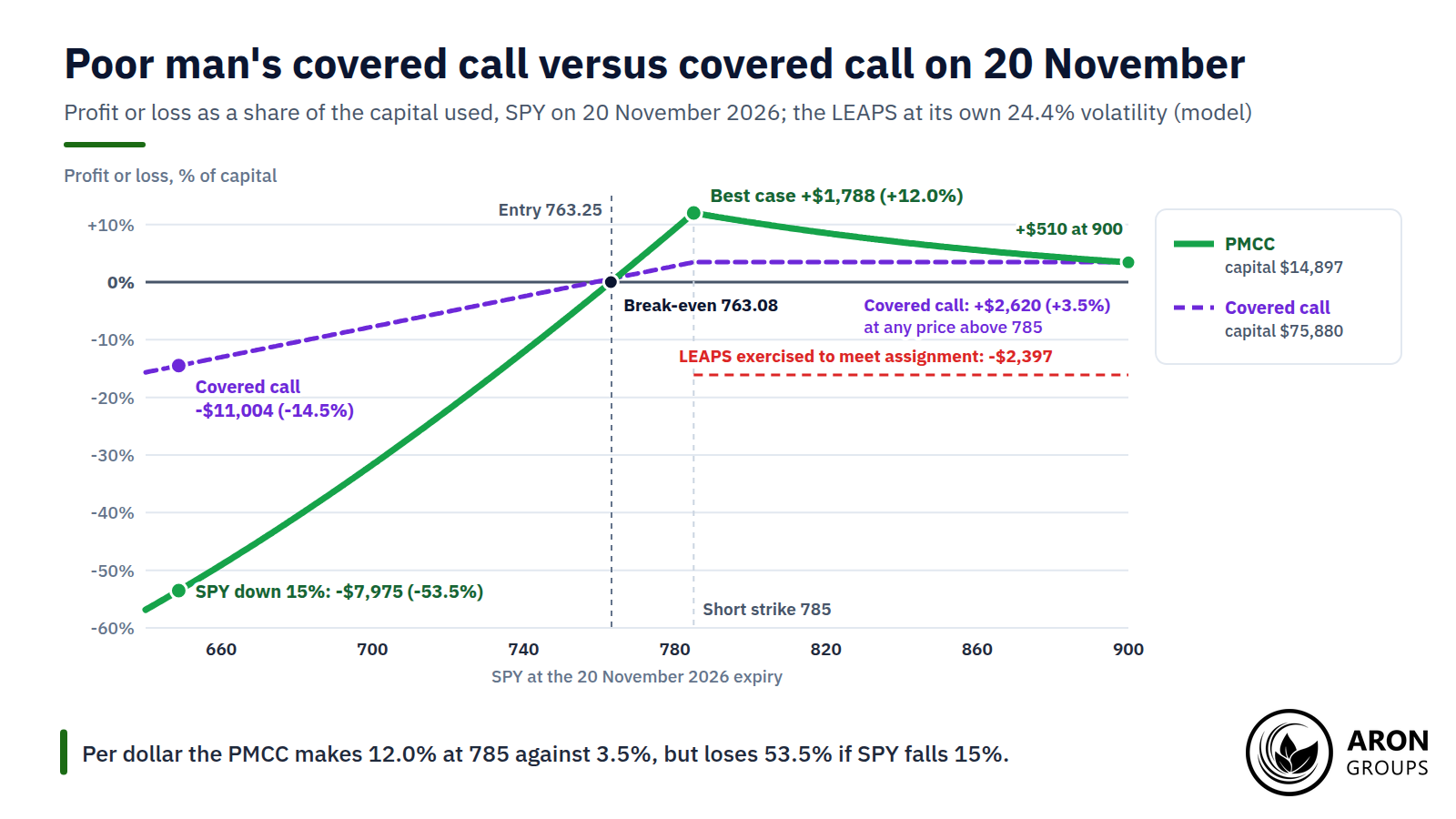
What the failure costs depends on the exit. If SPY runs to 900 by 20 November, selling the LEAPS, which the model still credits with 29.07 of time value, leaves about +$510. Exercising it to meet an assignment instead locks in width minus debit: -$2,397.
Break-Even and Best Case at the Front Expiry
With the LEAPS valued by Black-Scholes at its own 24.4% volatility, the trade breaks even on 20 November at about 763.08, almost where SPY started. The best case is SPY at 785: +$1,788, or 12.0% of the debit. Above 785 the gain fades, because the short call then rises dollar for dollar and the LEAPS does not.
The thin margin comes from decay on both legs. With SPY unchanged, the short call’s 4.45 falls to zero, but the LEAPS loses about 4.32 in the same 35 days. Skew adds to the drag: the LEAPS is priced at 24.4% volatility and the short call at 12.0%. A covered call breaks even lower, at 758.80, and makes $2,620 above 785, only 3.5% of its capital.
Key Point
A LEAPS call is partly a loan. In the model, about $5.53 of its $12.08 daily time decay per contract is interest on the strike the buyer has not yet paid. Over 35 days that is about $194. The $60,983 saved against a covered call would earn a similar $235 in four-week Treasury bills at 4.02%. More time costs more carry: the December 2028 660 call last traded at 190.10, with 86.85 of extrinsic value. The PMCC is cheaper to enter, not free.
Rolling the Short Leg
Rolling means buying back the short call, or letting it expire, and selling another in a later month. Each premium kept lowers the cost basis of the LEAPS, as with a covered call run month after month. One month’s 4.45 is 3.0% of the debit, but the saving holds only while calls expire cheaply.
If SPY holds at 763.25 until 20 November, the 785 call expires worthless; the model prices a December 780 call at about 4.61. The net cost falls to 144.36, but the LEAPS has lost about 4.32 of value, so the position is only $13 ahead.
In a rally to 805, buying back the 785 call costs 20.00. In the model, rolling up and out to the December 825 call brings in only 4.24. That $1,576 net debit lifts the net cost to 164.73, though the position is still $1,474 ahead. Rolling out at 785 instead collects 5.35 but keeps the cap and an in-the-money call into the 18 December ex-dividend date.
A sharp fall is worse. If SPY drops 15% to 648.76 and volatility holds, the model LEAPS loses $8,420 and the position $7,975, about 18 months of $445 premiums. A fall that size usually lifts implied volatility, which would soften the LEAPS loss and raise the next premium. At the short call’s 12.0% volatility, the next call, at the 665 strike, pays only 3.38, and selling it would cap any rebound.
Diagonal vs Calendar vs Vertical Spread
A calendar uses one strike and bets on time and volatility, with little direction. A vertical uses one expiry and bets on direction alone. A diagonal, sometimes called a diagonal calendar spread, blends the two, as the table shows.
| Spread | Strikes | Expiries | Teaching example | Net at entry | Main bet | At the front expiry (model) |
|---|---|---|---|---|---|---|
| Calendar (horizontal or time spread) | Same | Different | Buy 90-day 100 call, sell 30-day 100 call | Debit 2.41 | Price stays near the strike; volatility holds up | +$195 at 100, losses on either side |
| Vertical (price spread) | Different | Same | Buy 30-day 100 call, sell 30-day 105 call | Debit 1.85 | Direction | +$315 above 105, -$185 below 100 |
| Diagonal | Different | Different | Buy 90-day 100 call, sell 30-day 105 call | Debit 4.26 | Direction plus time decay | +$329 at 105, -$343 at 90 |
Teaching stock at 100, volatility 25%, rate 4%; entry values per share, front-expiry results per contract (model).
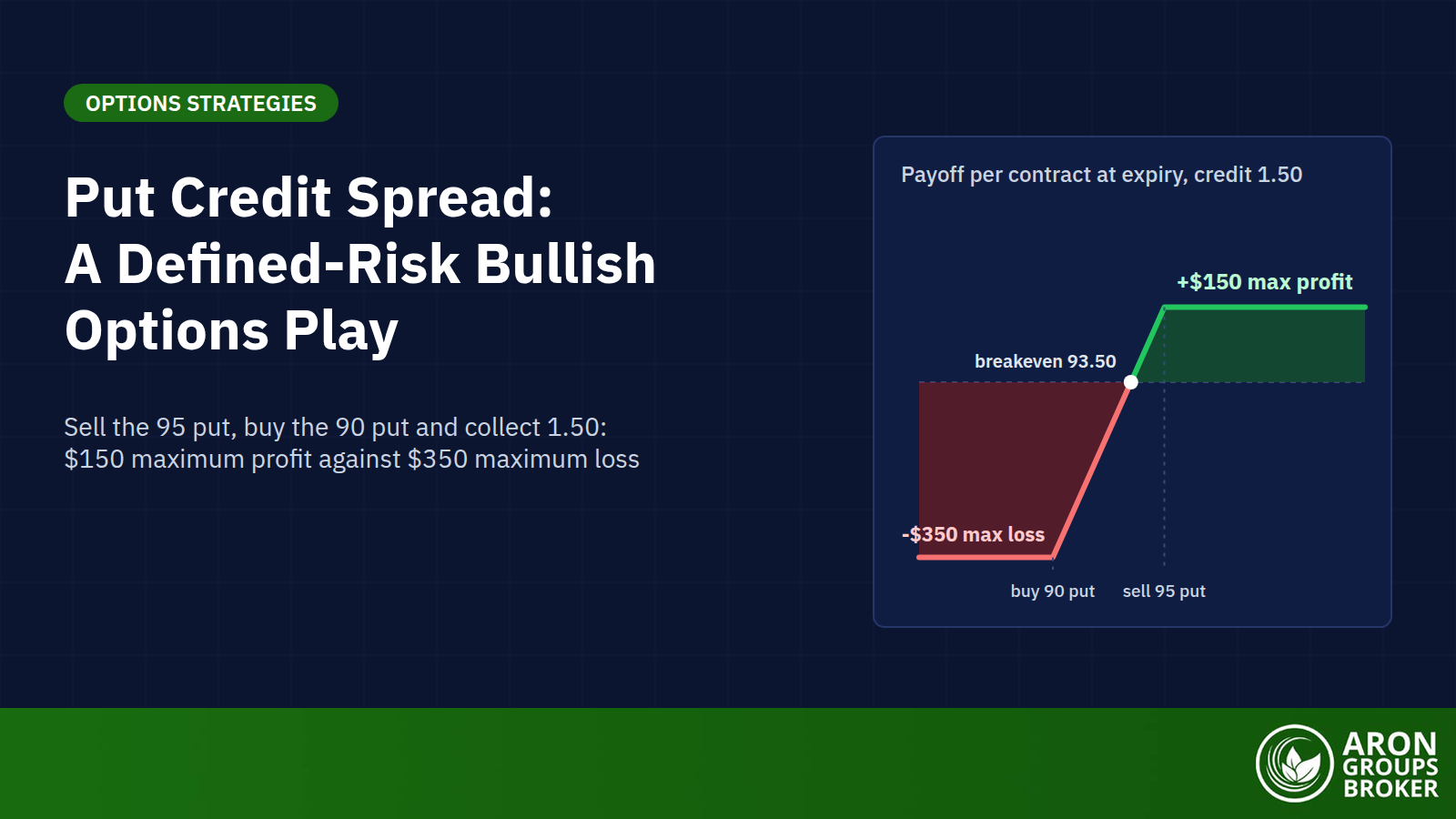
A put credit spread, a vertical sold for a credit, fixes its maximum loss at entry. A bull call diagonal’s loss is also capped at its debit. Its best case and break-even are not: both depend on implied volatility at the front expiry.
Margin, Early Assignment and Dividends
An SEC order approving Cboe’s spread margin rules says that, for spread treatment, the long option may not expire before the short option. A PMCC qualifies: the debit is paid in full, with no further margin requirement because its long strike is below its short strike. A pair whose long leg expires first does not qualify.
SPY options are American-style, so FINRA warns that a short option can be assigned on any day the market is open. The Cboe guide adds that early assignment usually comes the day before an ex-dividend date, when the call’s time value is below the dividend. SPY’s next ex-dividend date is 18 December 2026, the day December options expire. The 20 November call is clear of it, but an in-the-money December call is exposed on 17 December.
Q: What should I do if my short call is assigned early?
A: You are then short 100 shares, and you owe the dividend if the assignment came before the ex-date. Exercising the LEAPS to deliver them throws away its time value. In the model that is about $3,222 if a December 825 call is assigned with SPY at 830 on 17 December. Buying 100 shares to close the short and then selling the LEAPS, as the Cboe guide suggests, keeps that value.
The Honest Limits of the Diagonal Spread
Except the covered call’s, every break-even here is a model output, not a market price. If the LEAPS volatility is 3 points lower on 20 November, the best case falls from $1,788 to $1,207 and the break-even rises to 770.72. The long leg’s large vega, about $229 per volatility point at entry, makes any fall in implied volatility costly.
Capital efficiency cuts both ways. An SEC investor bulletin on leveraged investing notes that options create leverage through their terms, and shows a 364% gain becoming a 100% loss. Here a 15% fall costs the PMCC 53.5% of its capital and the covered call 14.5%.
Long-dated options trade less often, so open interest and the bid-ask spread matter more. An assumed $1.00-wide LEAPS quote costs $100 a round trip, 22.5% of one month’s premium, and two legs double the commissions.
Early assignment can force a decision at the worst moment, and tax treatment differs from shares; this article does not cover it. Access to US-listed options also varies by country, and users in restricted regions face added legal, access and custody risk.
Where Aron Groups Fits
Aron Groups does not offer options, so there is no diagonal spread or PMCC to trade. The PMCC’s goal of stock-like exposure for less capital maps only partly onto an index CFD such as SPXUSD, NDXUSD or DJIUSD on MetaTrader 5. A CFD needs only a margin deposit, but it pays no premium income. It also has no built-in maximum loss, and a stop-loss can limit losses without guaranteeing the exit price.
Positions held overnight can incur swaps. A margin call comes at a 100% margin level and stop-out at 50%, or 40% on Islamic and VIP accounts. A demo account or a Nano account, from 0.01 nano lots, lets you test an index view before risking more.
Conclusion
A diagonal spread is a calendar and a vertical spread in one position, earning from time on one leg and from direction on the other. Its payoff depends on price, time and implied volatility at once.
On 16 October 2026 the poor man’s covered call bought SPY exposure for about a fifth of the capital. With rates near 4.5%, though, its LEAPS carried 50.17 of extrinsic value, so it failed the width check and needed SPY to hold its level. The fall, not the income, decides how much it can lose.
Frequently Asked Questions
Short answers to common questions about diagonal spread options and the PMCC.
What is a poor man's covered call?
It is a bull call diagonal that replaces 100 shares with a deep in-the-money LEAPS call and sells a near-term call against it. On SPY on 16 October 2026 it cost $14,897 per spread instead of $76,325 for the shares.
Is a diagonal spread bullish or bearish?
It depends on the build. Bull call and bull put diagonals lean bullish, bear put and bear call diagonals lean bearish, and a double diagonal is roughly neutral.
What is the maximum loss on a diagonal spread?
For a bull call or bear put diagonal, the loss is capped at the debit: $426 in the teaching example. Bear call, bull put and double diagonals can lose more, up to roughly the strike gap plus any debit or less any credit.
Can a poor man's covered call lose money if the stock rises?
Yes, if the debit exceeds the strike width and the LEAPS loses its time value. In the SPY example, exercising the LEAPS to meet an assignment turns a rally into a $2,397 loss.