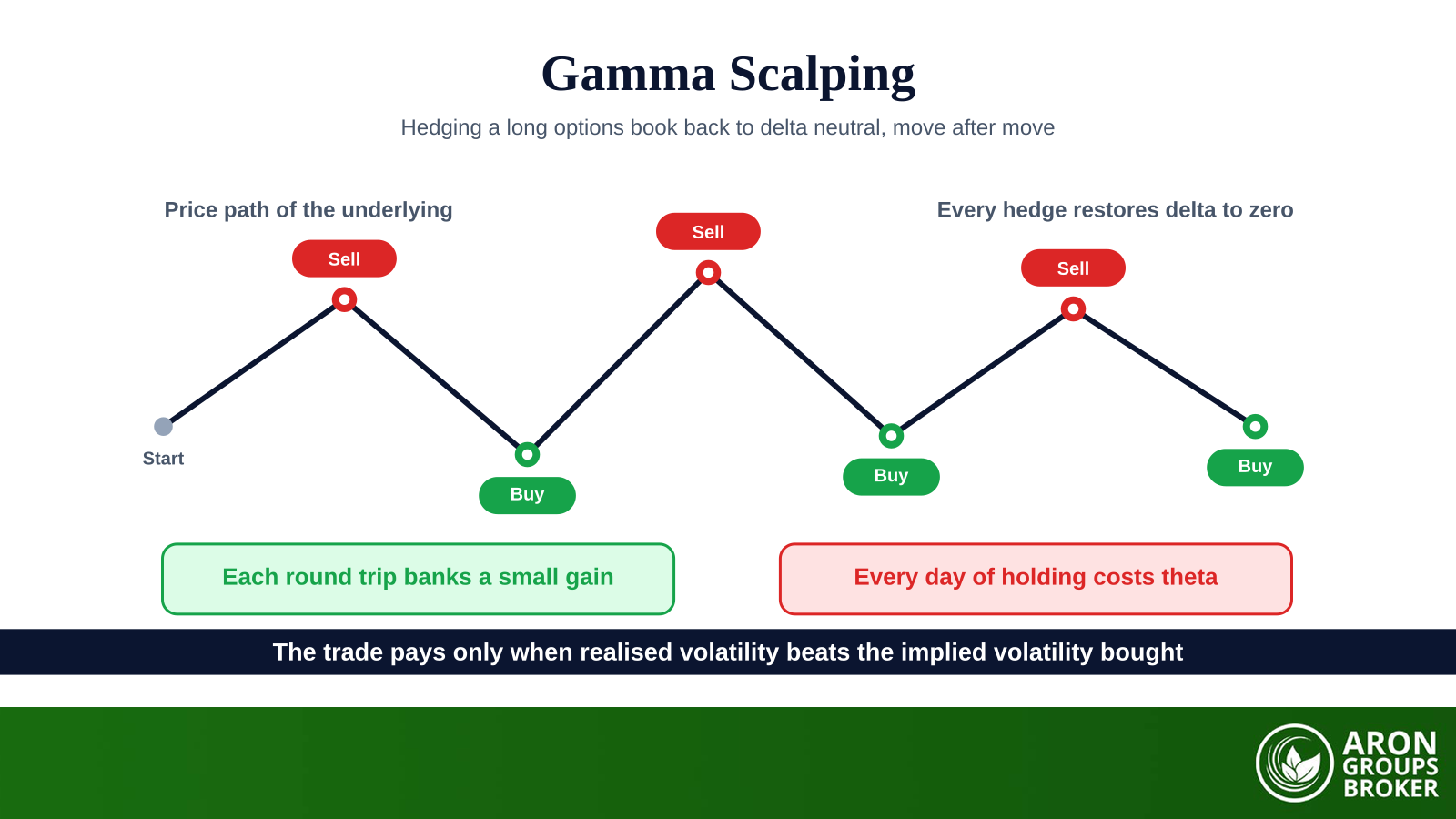

Gamma scalping is an options strategy that converts movement in the underlying into cash. The trader holds long options, which gives positive gamma and negative theta, then trades the underlying repeatedly to hold total delta at zero. Each re-hedge sells into a rally or buys into a fall, and each one banks a small gain. The strategy pays only when the underlying moves more than the option premium assumed it would.
It belongs to market makers and systematic desks rather than to retail accounts. It needs an options book, execution cheap enough that small gains survive, and a hedging rule that is never skipped. Most traders meet the idea second hand instead, through dealer gamma charts and talk of price pinning near an expiry.
This guide sets out the mechanics of the re-hedge loop, the volatility condition behind any profit, and the mirror image case of short gamma. It then covers dealer gamma and what that hedging does to the underlying. That part matters even to someone who never buys an option.
- Gamma scalping keeps a long options position delta neutral by selling the underlying as it rises and buying it as it falls.
- A long options book is long gamma and short theta, so the scalps have to out-earn the daily decay.
- The position profits only when realised volatility exceeds the implied volatility paid for the options.
- Dealers who are short gamma hedge with the trend and amplify moves; dealers who are long gamma hedge against it and dampen them.
- Dealer positioning is inferred from open interest, never observed, and vendors do not all sign gamma exposure the same way.
What gamma scalping actually is
Gamma scalping is the practice of holding long options and trading the underlying against them to harvest movement. The options supply positive gamma, so the position’s delta grows as price rises and shrinks as it falls. The trader restores delta neutrality after each meaningful move, selling the underlying into rallies and buying it back on dips. Those repeated round trips are the scalps.
Risk Disclosure
Trading forex and CFDs carries a high level of risk and can result in the loss of all your capital. This content is educational and is not investment advice. Never risk money you cannot afford to lose.
The Greeks that make the engine run
Four Greeks matter here and each does a separate job. Delta is directional exposure, the rate at which the option’s value moves with the underlying. Gamma is the rate at which delta itself changes, so it measures how quickly a hedge goes stale. Theta is the daily cost of holding the option, and vega measures sensitivity to implied volatility.
The position that supplies the gamma
The usual vehicle is a long straddle or a long strangle bought at or near the money. Both start close to delta neutral, and both hold their largest gamma where the underlying is trading now. A strangle costs less premium because its strikes sit further out, but it needs a bigger move before its gamma does any real work.
How the re-hedge loop works
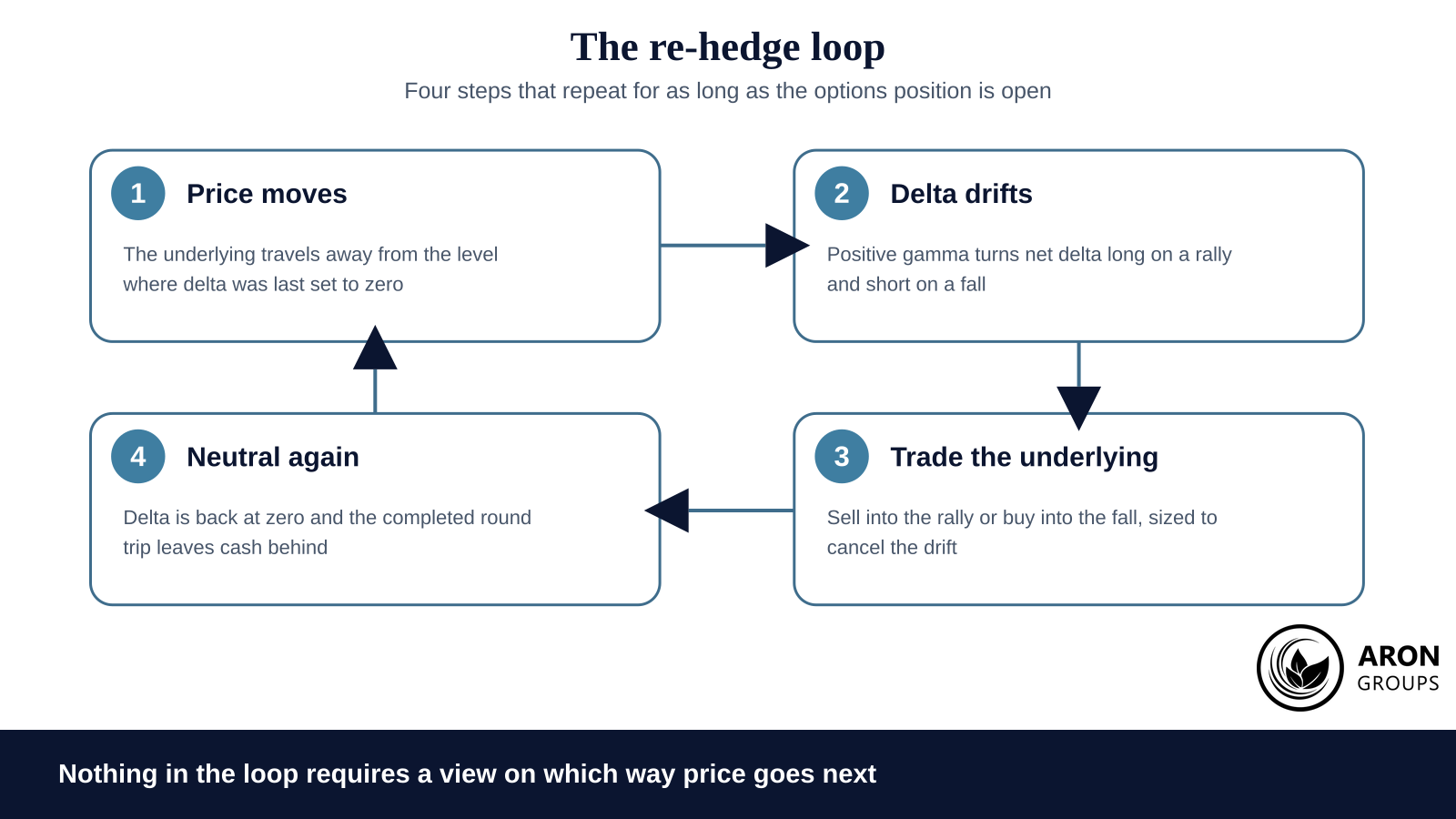
The loop has four steps and it repeats for as long as the position is open. Price moves, delta drifts away from zero, the trader trades the underlying to bring it back, and the cycle starts again. None of it is discretionary. The only judgement is how far price must travel before the trader acts.
That threshold is the one real design decision. Hedging after every tick captures the most movement and pays the most in spread and commission. Hedging only after large moves saves cost but leaves the book directionally exposed in between. Desks resolve it by writing the rule down and letting an automated system apply it.
Key Point
The scalps are not a forecast. The trader does not need to know which way price goes next, only that it keeps going somewhere.
Why realised volatility has to beat implied
Gamma scalping is profitable only when realised volatility exceeds the implied volatility paid for the options. Implied volatility is the price the market charged for expected movement. The scalps are what actual movement pays back. If the second number falls short of the first, theta wins and the position bleeds.
This makes the trade a view on volatility rather than on direction. A trader can be right that the underlying will move and still lose money. The options were simply too expensive on the day they were bought. Movement alone is not the test; movement relative to its price is.
What vega actually measures
Vega is the change in an option’s price for a one percentage point change in implied volatility, which is one hundred basis points. It is not the change for a one per cent relative move in the volatility number, and readers get this wrong constantly. The distinction changes the answer by an order of magnitude.
The Options Industry Council illustrates it cleanly. Take a stock at 50 and a twelve month call worth 4.00, with implied volatility of 30 per cent and a vega of 0.15. Implied volatility rising two points, from 30 to 32, adds about 0.30 and lifts the option to roughly 4.30.
Realised volatility is the opposite kind of number. It is measured after the fact from the path the underlying actually took, so it is history rather than a price. Volatility bands and similar tools describe the recent regime, but the gap between that history and the forward price is the entire trade.
Long gamma against short gamma
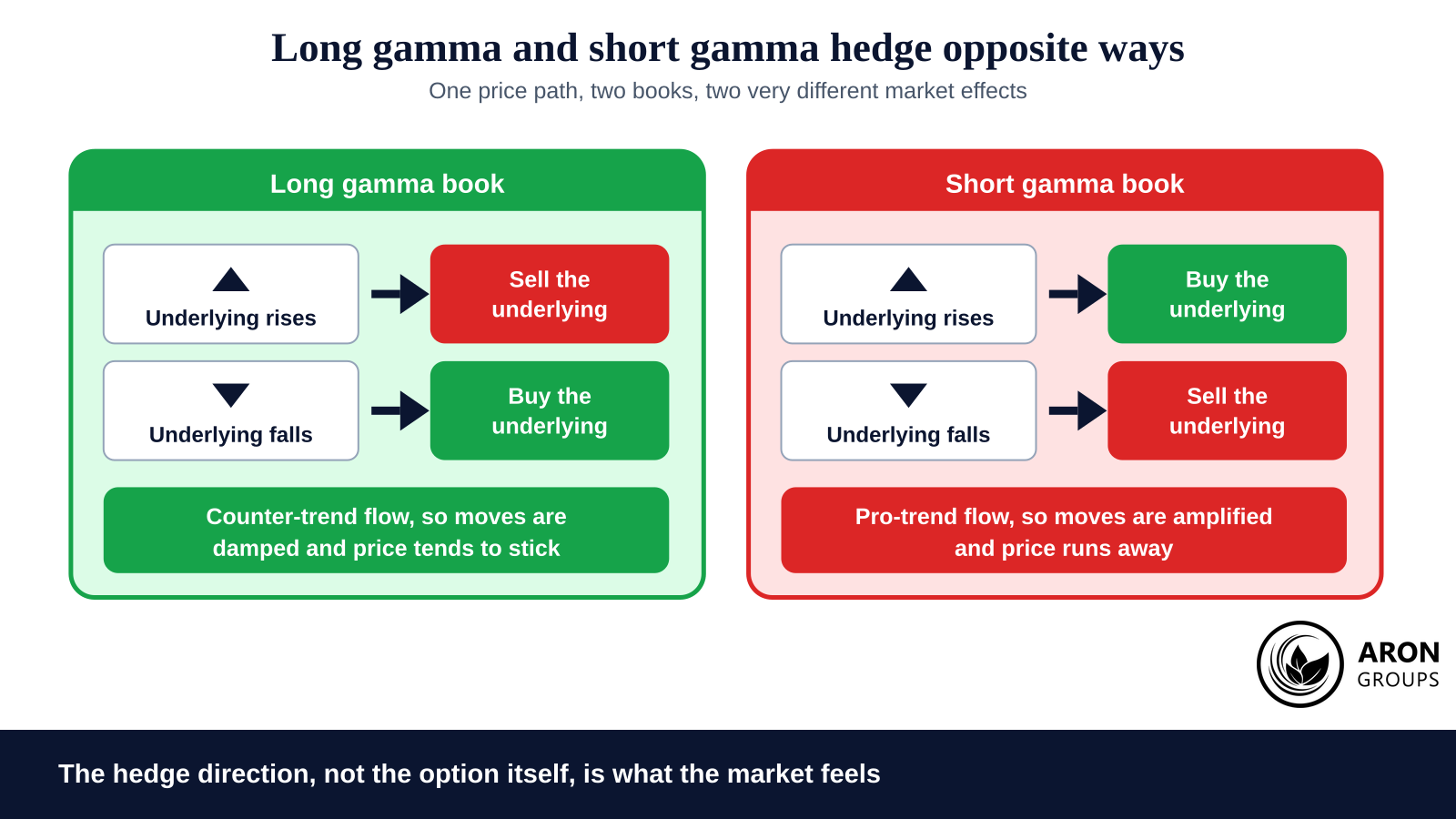
Long gamma and short gamma are mirror images, and the difference decides who fears movement. A long gamma book pays theta and earns from the re-hedges, so it wants a busy market. A short gamma book collects theta, but its hedging runs the wrong way: it buys after price rises and sells after it falls.
That asymmetry explains a great deal of market behaviour. The option seller earns a steady, small income and carries a rare, large loss. The option buyer pays a steady, small cost and owns a rare, large gain. Neither side is getting something for nothing; the risk simply sits in opposite tails.
| Feature | Long gamma | Short gamma |
|---|---|---|
| Options position | Net long options | Net short options |
| Theta | Paid every day | Collected every day |
| Hedging direction | Sells rallies, buys dips | Buys rallies, sells dips |
| Effect on price | Counter-trend, dampens moves | Pro-trend, amplifies moves |
| Wants | Realised volatility above implied | Realised volatility below implied |
| Feared outcome | A market that never moves | One large, fast move |
The two books are mirror images, so the conditions that pay one of them are the conditions that damage the other.
The arithmetic of a single day
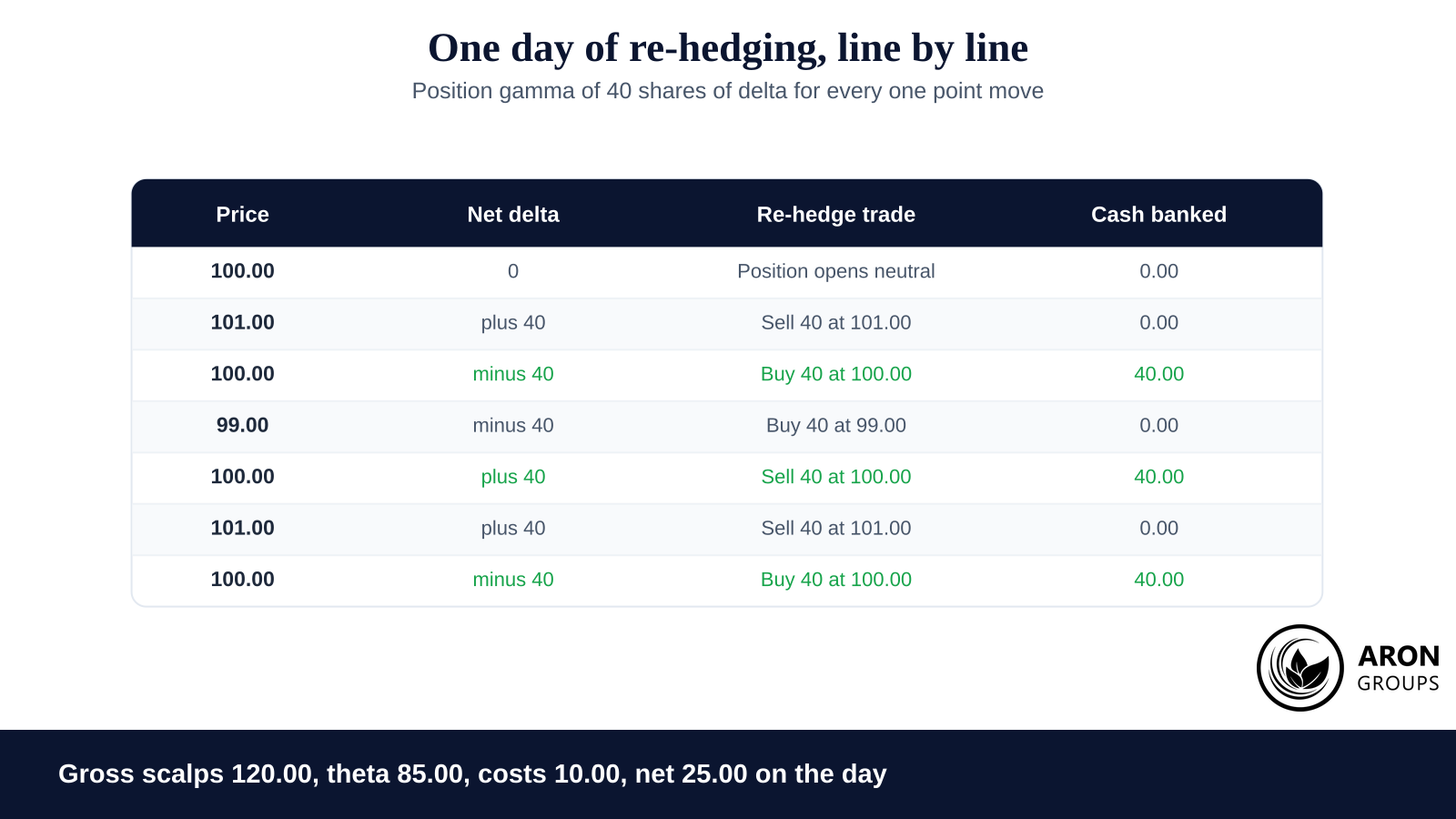
Numbers make the trade-off concrete. Assume a long straddle whose position gamma is forty shares of delta for every one point the underlying moves. The underlying opens at 100 and the trader re-hedges each time it travels a full point in either direction.
The ladder completes three round trips and banks 120 across six re-hedge trades. The straddle costs 85 in theta over the same session, and the six trades pay roughly 10 in spread and commission. The day nets about 25, which is a thin margin for a position that needed constant attention.
Mini Example: a day the loop earns nothing
The underlying opens at 100, drifts up to 100.40 by lunch and closes at 100.20. The hedge threshold is a full point, so no re-hedge ever triggers. Nothing is sold, nothing is bought back, and no cash is banked.
The theta bill arrives anyway. The position loses a full day of decay in a market that technically moved but never travelled far enough to pay for the privilege. Realised volatility came in below implied, and that is the entire result.
Sessions like that are ordinary rather than exceptional, which is why the strategy needs an edge in pricing rather than in prediction. The trader is buying options they believe are cheap relative to the movement ahead. Everything after that purchase is execution.
Dealer gamma and the regime it creates
The same hedging runs at industrial scale on options desks, and it shows up in the price of the underlying. When dealers are net short gamma their hedging is pro-trend: they buy as the market rises and sell as it falls. That flow amplifies moves, and it is the destabilising case.
When dealers are net long gamma the flow reverses. They sell into strength and buy into weakness, which dampens moves and tends to pin price near heavily traded strikes. The market feels slow and range bound for reasons that have nothing to do with the news.
Gamma exposure, usually written GEX, puts a number on this. It is the dollar value of the underlying that market makers must trade per one per cent move to stay delta neutral. A large reading means the hedging flow is big enough to matter next to the ordinary turnover of the day.
Q: Does a gamma squeeze need a short squeeze in the shares?
A: No. The gamma mechanism works on its own. Heavy call buying leaves dealers short gamma and short delta, so they buy the underlying as it rises, which pushes it higher still. A short squeeze can run alongside it, but the hedging spiral does not require one.
Foreign exchange has its own version of this. It is an enormous over the counter network whose turnover the Bank for International Settlements measures every three years. The largest dealers there run options books against their spot flow. A retail trader never sees that positioning directly, only its effect on how price behaves.
The honest limits of gamma scalping
Transaction costs are the practical killer at retail scale. Every scalp is small by design, and every re-hedge pays a spread and, on most accounts, a commission. A rule that looks profitable on mid prices can turn negative the moment realistic costs are applied to each leg.
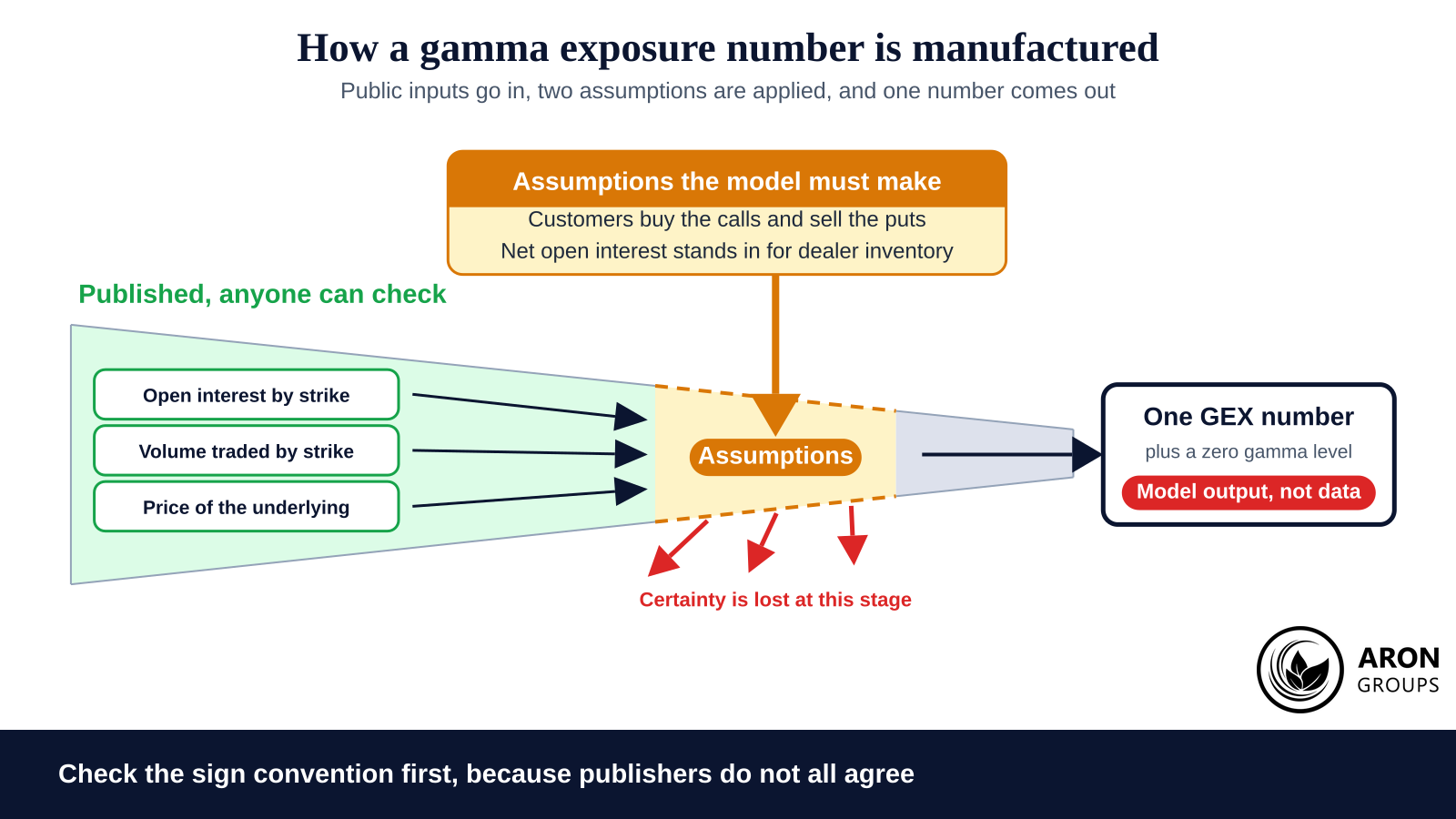
Dealer positioning is the second limit, and it is inferred rather than observed. Standard models assume customers buy calls and sell puts, then use net open interest by strike as a proxy for dealer inventory. Real dealer books are not public, so the widely quoted zero gamma flip level is a model output, not a market fact.
The sign convention is a trap on top of that. In most vendor conventions a negative gamma exposure reading means dealers are short gamma. Some publishers sign the number from the customer’s side instead, which inverts it. Check the convention before reading any chart, because the two versions give opposite instructions.
Then there is the plain access constraint. The strategy needs an options book and the ability to hedge the underlying continuously, which is not a retail set-up. Regulators group options-based tactics among advanced tools and tell retail investors to understand the risks first. A delta neutral position still carries a real drawdown when volatility is mispriced.
Risk Warning
Delta neutral does not mean low risk. Neutral delta removes the directional exposure; it does nothing about the cost of being wrong on volatility.

Where Aron Groups fits
Aron Groups offers spot and CFD instruments only, so gamma scalping is not a strategy you can run here. What the topic gives a spot trader is context. Dealer hedging helps explain why an instrument grinds inside a narrow range for days and then breaks out with no obvious news. That regime is readable on a MetaTrader 5 chart.
If you want to trade the regime rather than the options, keep execution simple and size small. The Nano account is commission free with the cost carried in the spread, and it supports micro volumes from 0.0001 lots. That lets position sizing be tested properly before it costs anything. Treat a volatility regime as one input into a risk plan, never as a signal on its own.
Conclusion
Gamma scalping is a clean idea with a hard economic constraint. Long options give positive gamma, the re-hedges turn movement into cash, and the book stays directionally neutral throughout. The constraint is that every day of holding costs theta, so realised volatility has to beat the implied volatility that was paid.
For a spot or CFD trader the value is not the strategy but the market structure it exposes. Hedging flow is one reason ranges hold and one reason they break, and it is invisible on the chart itself. Size that uncertainty properly, because regulators have imposed leverage caps, margin close-out and negative balance protection on leveraged retail products for good reason.
Frequently asked questions
Four questions come up whenever traders meet gamma for the first time.
Is gamma scalping profitable?
Only when realised volatility comes in above the implied volatility paid, and after costs. The edge lives in buying options that are cheap relative to the movement that follows. Frequent hedging on an expensive straddle loses money in a perfectly active market.
Can I gamma scalp with a small account?
Realistically no. The method needs an options position, the capital to hedge around it, and per-trade costs low enough that small gains survive. Retail commission and spread usually consume the scalps before anything reaches the account.
What is the difference between gamma scalping and delta hedging?
Delta hedging is the mechanical act of returning a position to neutral. Gamma scalping is delta hedging run deliberately on a long gamma book so the hedges themselves become the source of profit. One is maintenance, the other is a strategy built on that maintenance.
Does gamma exposure predict the next move?
No. It describes a hedging flow that may dampen or amplify whatever else is happening. The positioning behind it is only estimated from public open interest. Treat it as one conditional input, test it out of sample like any other, and accept that macro events override it completely.