
icon icon Home
icon icon Accounts
icon icon Quick start
icon icon Symbols

Max Pain in Options: The Strike Where Buyers Lose Most, and Why Price Drifts There

Author
Abe Cofnas
Abe Cofnas
calendar Last update: 20 September 2026
watch Reading time: 9 min

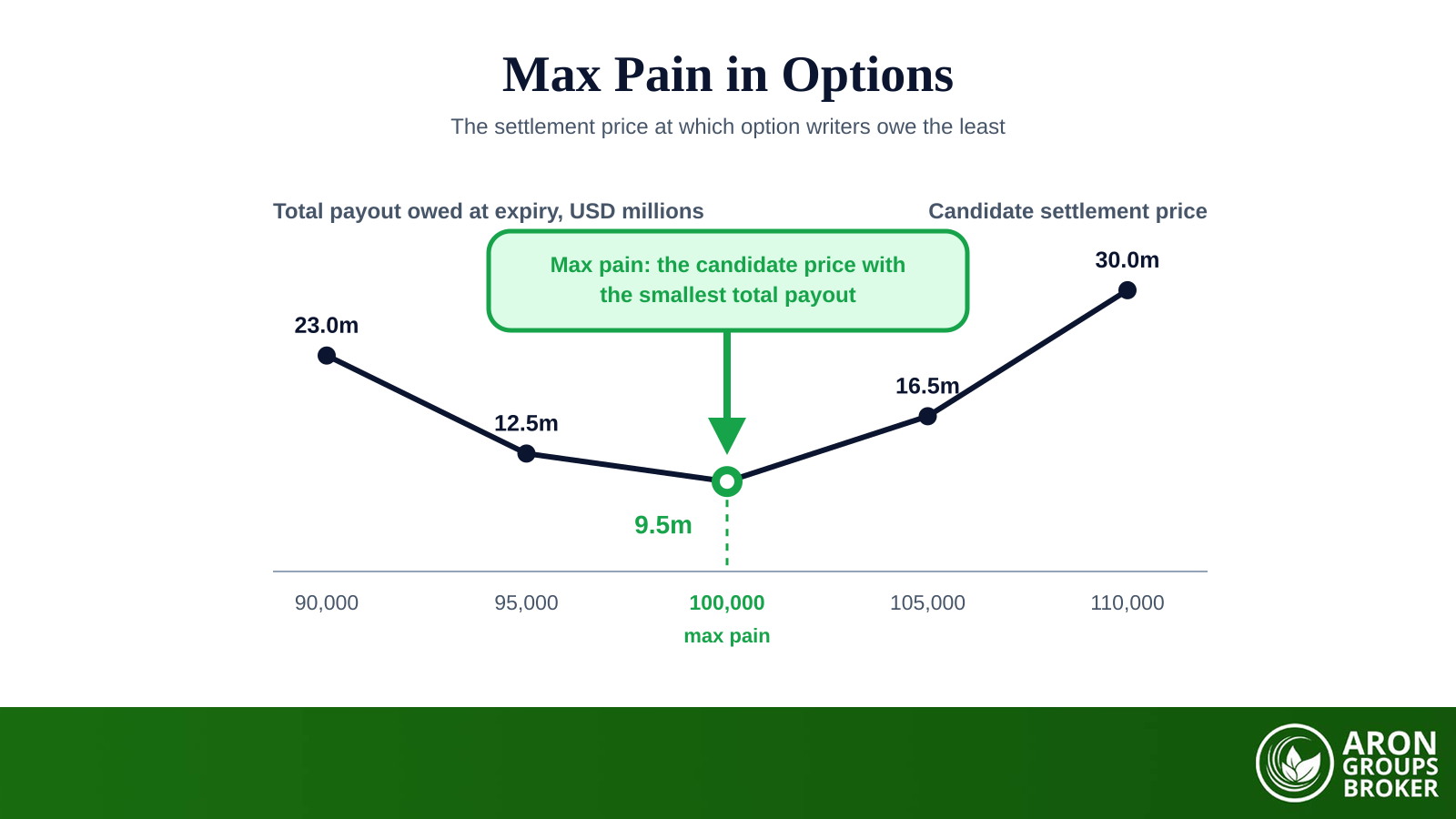
Max pain is the settlement price that minimises the total intrinsic value of all open options for one expiry. At that price the writers of those contracts owe the least. Buyers as a group collect the least too, which is where the name comes from. The theory attached to it says price tends to drift toward that strike into expiry.

The calculation is simple arithmetic over open interest, which is why so many dashboards publish it. What the number means is far less settled. A max pain level describes where positioning sits today, and positioning changes every session until the contracts expire. Traders who read it as a destination are extending a descriptive statistic past what it can carry.

This guide sets out the exact calculation, the hedging mechanism said to produce pinning, and what the research supports. It covers the crypto version of the idea, where open interest concentrates on a small number of venues. It also states plainly where the popular story runs ahead of the evidence. A level you cannot verify is a poor input to position sizing.

bookmark
Key Takeaways
  • Max pain is the settlement price that minimises the combined intrinsic value of all open calls and puts for one expiry.
  • It is found by testing every strike as a candidate settlement price and taking the smallest total payout.
  • The pinning story rests on dealer hedging, and hedging only dampens moves when dealers are net long gamma.
  • Dealer positioning is inferred from open interest rather than observed, so the whole chain is a heuristic.
  • No public dataset supports the claim that Bitcoin reliably settles near max pain, because strike level history is not published.

What max pain actually is

Max pain is the settlement price at which the combined intrinsic value of all open calls and puts is lowest. It is defined for one underlying and one expiry, and rebuilt whenever open interest changes. Seen from the other side, it is the price that costs option buyers most. The largest quantity of option value expires worthless there.

sms-star

Risk Disclosure
Trading forex and CFDs carries a high level of risk and can result in the loss of all your capital. This content is educational and is not investment advice. Never risk money you cannot afford to lose.
The two sides of every contract

Every option has a buyer and a writer, and the payout at expiry moves between them. A call pays its holder the amount by which settlement exceeds the strike. A put pays the reverse. Max pain asks which settlement price makes the sum of all those payments smallest. Options are advanced instruments, and regulators publish guidance on the risks of leveraged strategies built with them.

Why the level is quoted per expiry

Open interest is a grid rather than a number: every strike, every expiry, calls and puts held separately. A weekly expiry can carry a max pain strike a long way from the monthly one. Quoting a level without naming its expiry is meaningless.

How the max pain price is calculated

The calculation is a search rather than a single formula. Each strike on the board is treated as a candidate settlement price. You total what every open contract would pay at that price. The candidate with the smallest sum is the max pain strike.

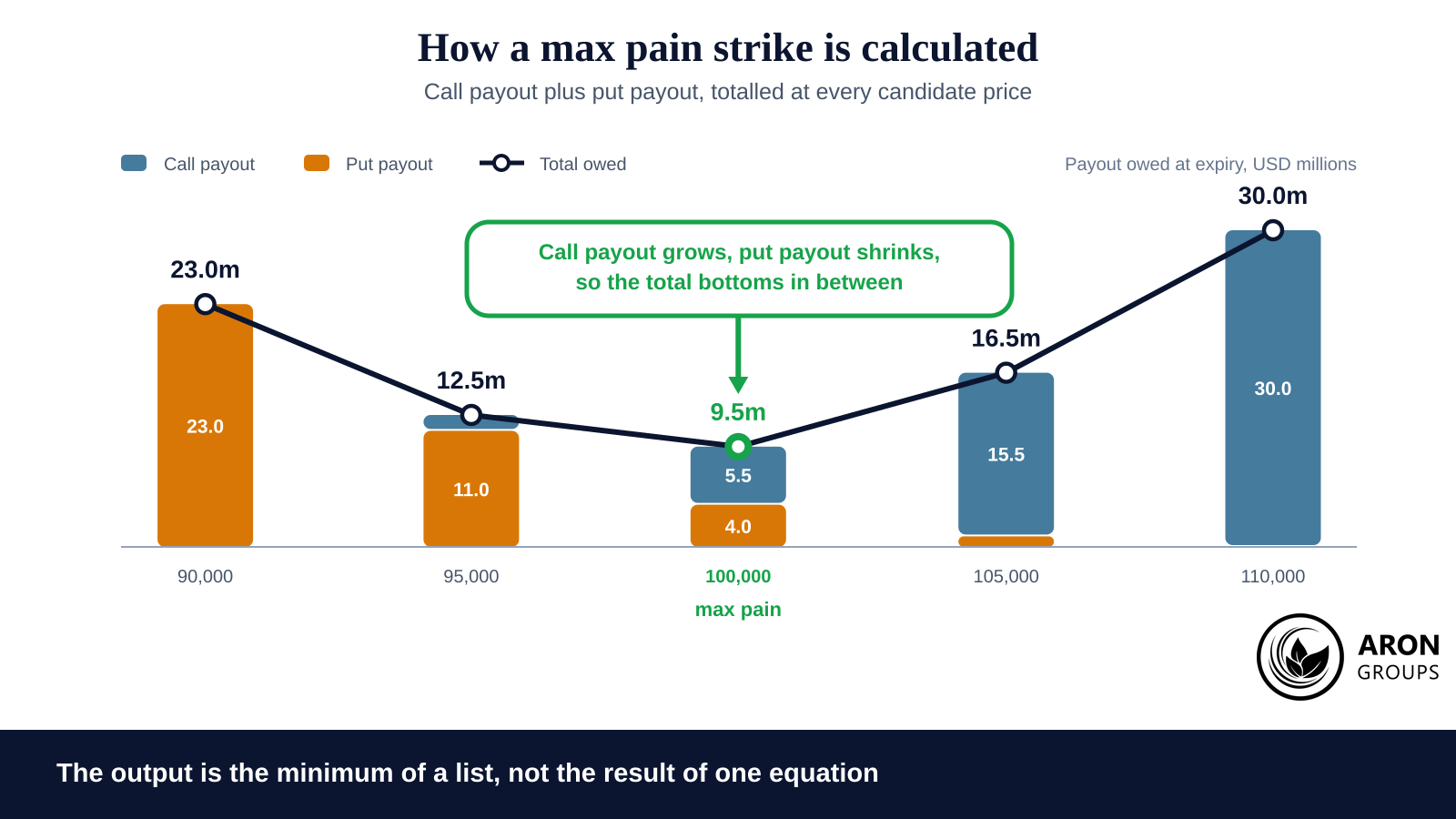
Each strike is tested as a settlement price in turn, so the output is the minimum of a list, not the result of one equation.

For a candidate price K, the call side contributes max(0, K minus strike) multiplied by call open interest at that strike. The put side contributes max(0, strike minus K) multiplied by put open interest. Sum both legs across every strike and multiply by the contract size. Repeat for every candidate and take the minimum.

Three details decide whether the output is usable. Open interest must be current, because stale data moves the minimum. The grid has to cover the full strike range, since truncating the tails biases the result.

sms-star

Key Point
Max pain is the output of a minimisation over today's open interest. Change the open interest and the answer changes, with no new information about price.
A worked example across five strikes

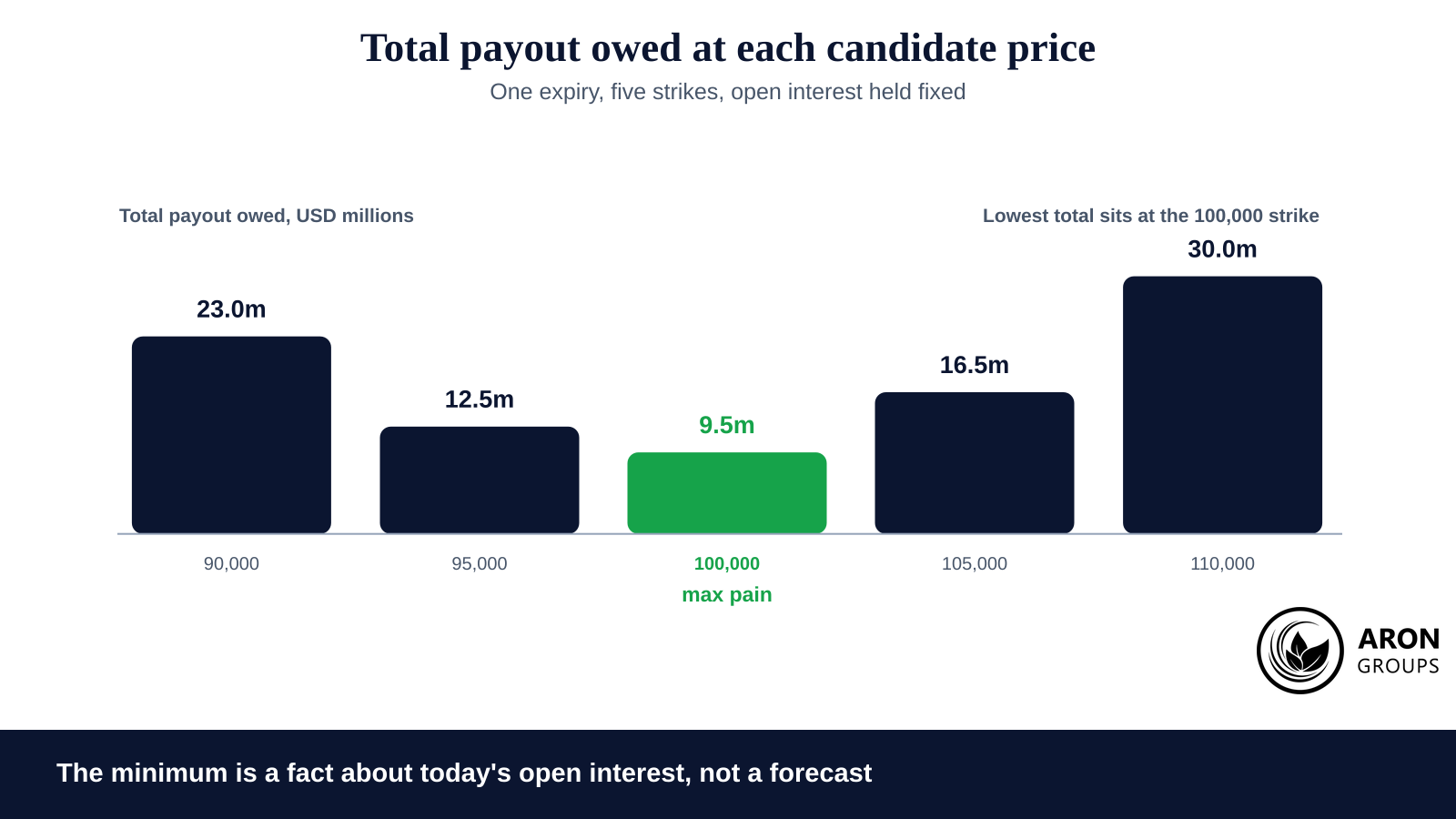
Arithmetic makes the concept concrete. Take one expiry with open interest at five strikes, where each contract covers one unit of the underlying. The figures are illustrative.

Settlement priceCall payoutPut payoutTotal owed
90,000023.0m23.0m
95,0001.5m11.0m12.5m
100,0005.5m4.0m9.5m, the lowest
105,00015.5m1.0m16.5m
110,00030.0m030.0m

The minimum total marks the max pain strike, and it sits where the two payout legs come closest to balancing.

The open interest behind those totals is uneven, and that is what creates the shape. Calls cluster above the market, puts cluster below it. At 90,000 every call expires worthless while the puts are deep in the money.

The payout curve is a V, so the minimum is a real feature of the data rather than an artefact of the current price.

The 100,000 strike wins because it leaves the fewest contracts with intrinsic value. Note what the exercise did not use: no price history, no volatility estimate, no view on direction.

Why price is said to pin near expiry

The pinning argument rests on dealer hedging rather than on anything mystical. Market makers who write options hedge the directional exposure they take on, usually under systematic rules. As expiry approaches, that hedge becomes very sensitive to price, and the trading it generates can dampen or amplify moves.

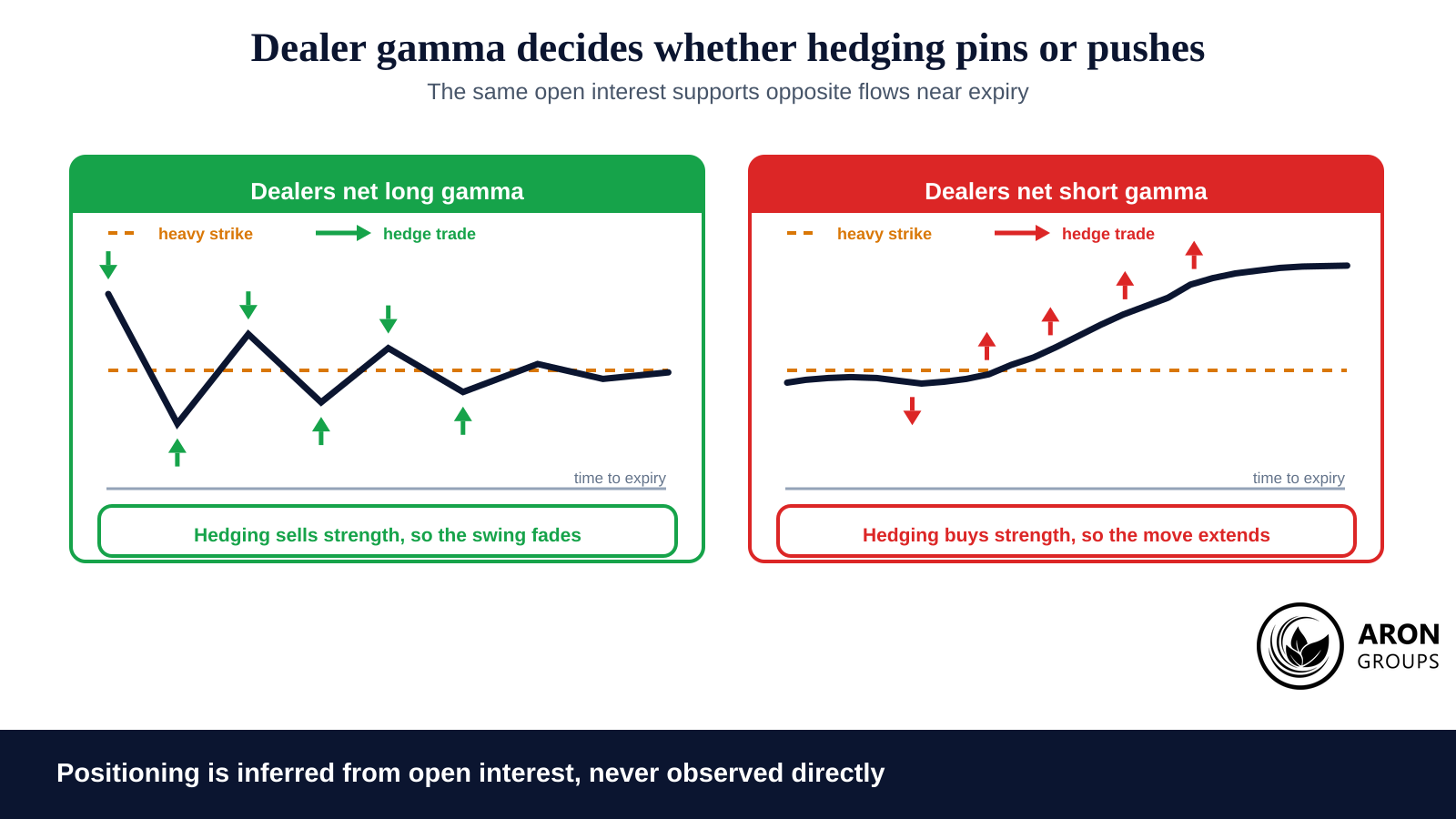
The same open interest supports opposite hedging flows, so the sign of dealer gamma decides whether price sticks or runs.

When dealers are net long gamma their hedging is counter-trend. They sell as price rises and buy as it falls, which pulls the market back toward heavily traded strikes. That is the gravitational level people describe.

When dealers are net short gamma the flow reverses. Hedging then buys strength and sells weakness, which is pro-trend and amplifies the move away from those strikes. A gamma squeeze is the extreme version of that case, and it is the opposite of pinning.

Dealer positioning is inferred, never observed. Nobody outside a dealer sees its book, so the sign of the gamma exposure is a guess built from open interest. Anyone building a trading edge on that chain should test both regimes.

Max pain in crypto options

Crypto is where max pain gets the most attention, and the reason is concentration. A large share of listed Bitcoin and Ethereum option open interest sits on one venue, Deribit. Quarterly expiries in March, June, September and December draw the most commentary.

The settlement mechanics matter more than most commentary admits. Deribit’s Bitcoin options are European style and cash settled, so they cannot be exercised early. The delivery price for an 08:00 UTC expiry is a time weighted average of the Deribit Bitcoin index. That average runs from 07:30 to 08:00 UTC and samples every four seconds.

That averaging window is the practical detail. Settlement is a half hour mean, not the last print before the bell. A max pain level into a crypto expiry therefore settles against an average rather than a tick.

sms-star

Did You Know
Listed Bitcoin and Ethereum option open interest is dominated by one venue. The max pain level quoted in crypto is usually that exchange's number, not the market's.
How traders read the level in practice

In practice the level is used as context into an expiry, not as an entry trigger. Large open interest at a strike marks a zone where hedging flow concentrates. That makes those strikes plausible places for price to hesitate, which is far weaker than a target.

One number rarely carries an argument on its own. Max pain is read alongside the open interest distribution, the put to call ratio and implied volatility. Dashboards from Deribit, Coinglass and Glassnode publish these together for the same expiry.

Data pointWhat it measuresWhat it cannot tell you
Max pain strikeThe settlement price that minimises total payoutWhere price will actually settle
Open interest by strikeContracts outstanding at each levelWhether holders are long or short
Put to call ratioPut activity relative to call activityWhether the puts are hedges or bets
Implied volatilityThe size of move the market has pricedThe direction of that move

The right hand column is the reason each metric is context rather than a signal.

The put to call ratio, often shortened to PCR, is the most abused of the four. A reading above one is called bearish and below one bullish. That assumes puts are directional bets, when much put open interest is insurance.

Mini Example: reading a quarterly expiry without trading it

A quarterly Bitcoin expiry sits three days out. The max pain strike is 100,000 and spot is 96,500. Open interest is heaviest at the 100,000 calls and the 90,000 puts.

The useful conclusion is not that price will travel to 100,000. It is that hedging flow is densest between spot and that strike, so moves through the zone may be slower. A trader already long might tighten the exit plan rather than add to it.

What the research actually shows

The academic evidence is thinner than the popularity of the idea suggests. The most cited work is a 2022 SSRN working paper by Ilias Filippou, Pedro Angel Garcia-Ares and Fernando Zapatero. Its title is ‘No Max Pain, No Max Gain: A Case of Predictable Reversal’. It is a working paper, not a peer reviewed journal article.

Its findings cut against the usual summary. The authors report that the effect is real and tradable, and that it is mostly a reversal effect. It appears in stocks that had already fallen substantially over the preceding period.

Two qualifications matter. The authors say they cannot rule out stock price manipulation as a factor. It would explain why the reversal begins so regularly around options expiration. They also find the effect is stronger in small, illiquid stocks, which they treat as consistent with that conjecture.

The paper also reports that the pattern does not hold for index options. That matters for anyone extending the idea to broad market products. It should temper any attempt to port the finding to crypto, where no equivalent published test exists.

Q: Does max pain hold for index options?
A: The most cited study on the subject reports that it does not. The predictable reversal the authors document appears in single stocks, and it is strongest in small, illiquid names. Index options attract a different mix of hedgers and a far deeper market.

The honest limits of max pain

Max pain describes positioning, and describing positioning is not forecasting price. The number says where the smallest total payout would fall if settlement happened now, on today’s open interest. It contains nothing about the flow that will arrive between now and expiry.

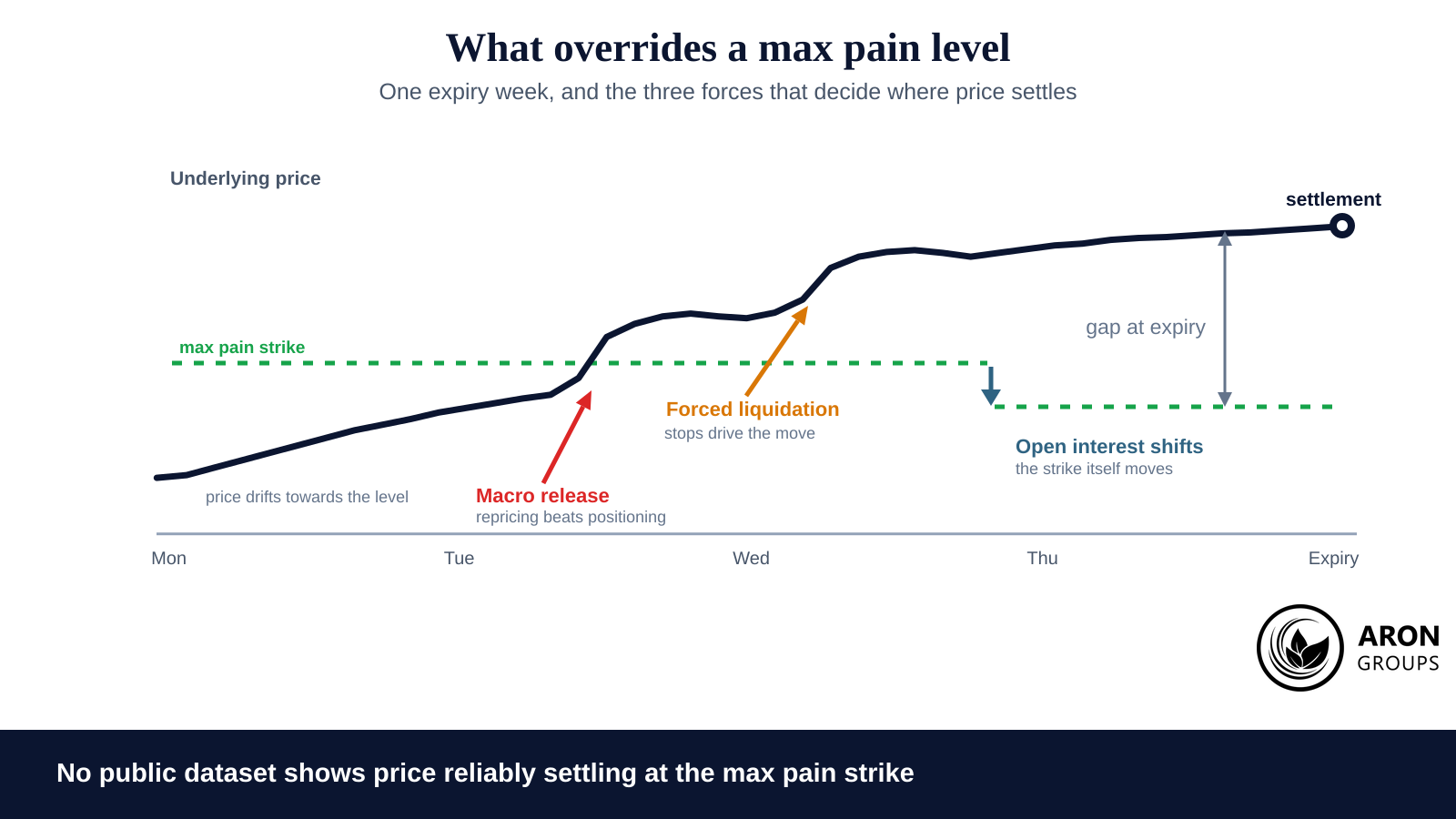
Each of these overrides the level completely, and each is far more common than the pin the theory predicts.

The model underneath it is a simplification that nobody defends when pressed. It treats all open interest as though one delta hedging short had written it. In reality every contract has a long and a short. Many sit inside spreads, and a large share is never hedged in the underlying at all.

A second limit is evidential. The popular claim that Bitcoin reliably settles near max pain is not supported by any public dataset. Deribit does not publish historical open interest by strike, so no independent backtest of that claim can be reconstructed. Any percentage quoted for it should be treated as an assertion.

Third, the level is routinely overridden. Three kinds of event do it most often:

· Macro releases and central bank decisions, which reprice the underlying whatever the open interest says.

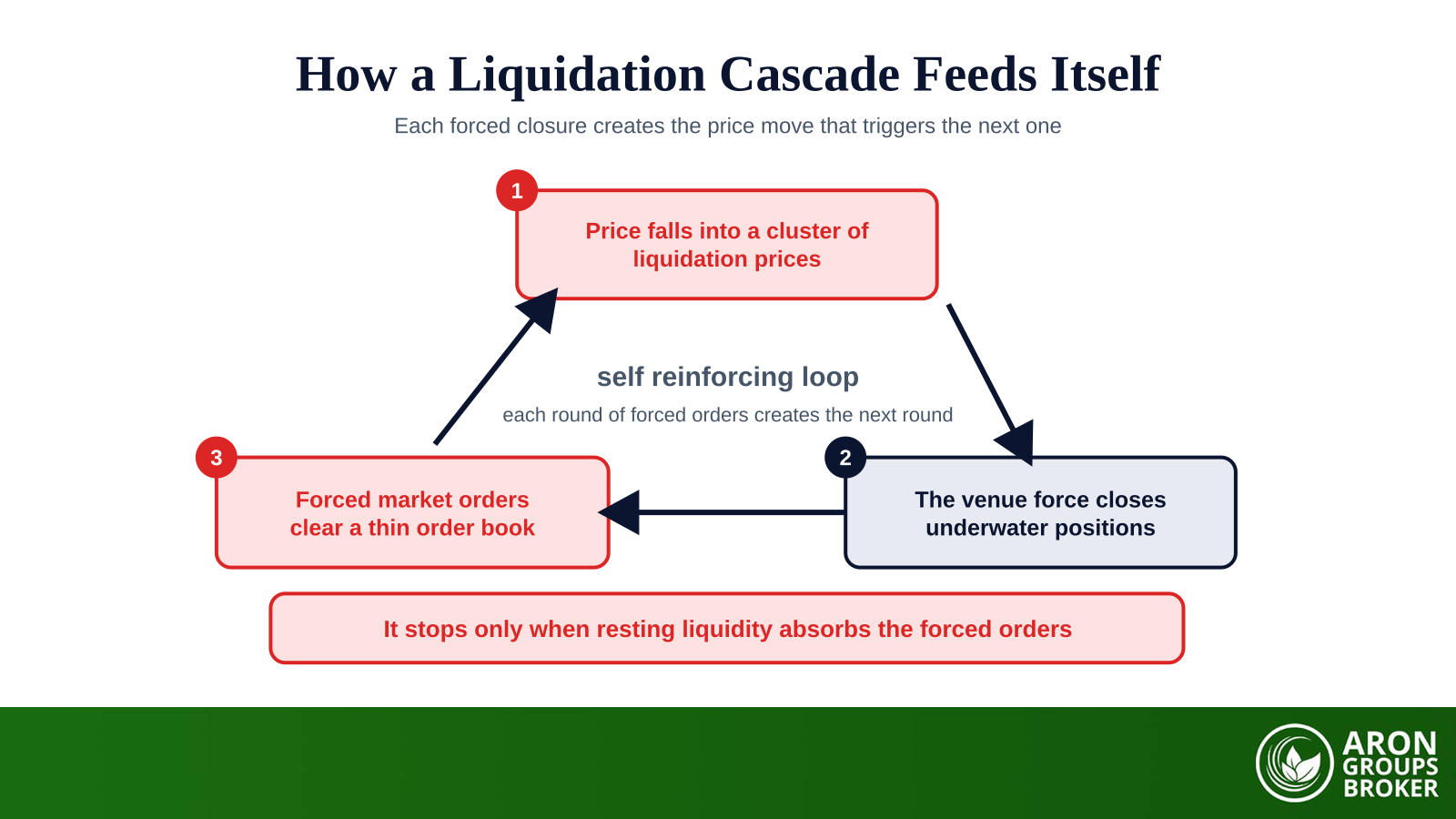
· Forced liquidation, where stop cascades create flow no hedging book will lean against.

· Open interest shifting before the date, which moves the max pain strike itself.

None of that makes the number useless. It describes standing positioning rather than marking a level to trade toward. Trading a narrow window into an expiry is short-term trading, and the risks of that are well documented.

sms-star

Risk Warning
A level derived from open interest is not a risk control. If you trade into an expiry, the plan has to survive the level being wrong by a wide margin.


Where Aron Groups fits

Aron Groups does not offer options, so max pain is not something you trade here. It is context that can inform a spot or CFD position taken into a major expiry. The platform is MetaTrader 5, with market execution and floating spreads, so a fill reflects available liquidity rather than a fixed dealing desk price. The MT5 toolbox is where the resulting exposure and its running cost are monitored.

If you want to test whether an options derived level adds anything, do it at a size that cannot hurt. The Nano account is commission free, with the cost carried in the spread, and supports micro volumes from 0.0001 lots. Keep capital preservation ahead of curiosity, and size the trade so that a wrong read never shows up in the drawdown.

Conclusion

Max pain is a precise answer to a narrow question. It identifies the settlement price that would minimise the total payout owed on one expiry, given the open interest visible today. That is a real fact about positioning, and it is worth knowing before a large expiry.

It is not a forecast. The evidence for pinning is weaker and more qualified than the popular version admits. Read it alongside the open interest distribution and treat it as one input among several. Build the risk management around the possibility that price ignores the level. Margin close-out rules and negative balance protection exist because leveraged trading punishes confident inferences. Trading discipline is what keeps an account intact.

Frequently asked questions

Four questions come up whenever a max pain level is quoted ahead of a large expiry.

What is the max pain price in simple terms?

It is the price at which option writers, taken together, would owe the smallest amount at settlement. Equivalently, the largest quantity of option value expires worthless there. The two descriptions are the same arithmetic seen from opposite sides.

How do you calculate max pain?

Take every strike in turn as a candidate settlement price. For each candidate, add the intrinsic value of all open calls and puts across the ladder. Multiply by the contract size, then compare the totals. The smallest one is the max pain strike, and an expert advisor can automate the sweep.

Does Bitcoin really close near max pain?

There is no public dataset that settles the question. Deribit does not publish historical open interest by strike, so the percentages circulating on social media cannot be reproduced. Treat any such claim as an assertion until someone publishes the data behind it.

Is max pain the same as a gamma squeeze?

No, and the two point in opposite directions. Max pain describes a level where hedging flow may dampen movement. A gamma squeeze describes hedging that amplifies movement, and it happens when dealers are short gamma and chase price. One is a brake, the other an accelerator.

Continue Reading
not-found
calendar 20 September 2026
Rate this article

Leave a Reply

Your email address will not be published. Required fields are marked *

No thanks