
A single stock ETF is an exchange-traded fund that gives leveraged or inverse exposure to one company’s shares rather than to a basket or an index. A 2x fund aims to deliver twice the stock’s return on a single day, and a -1x fund the opposite of it, usually through swaps that reset every day.
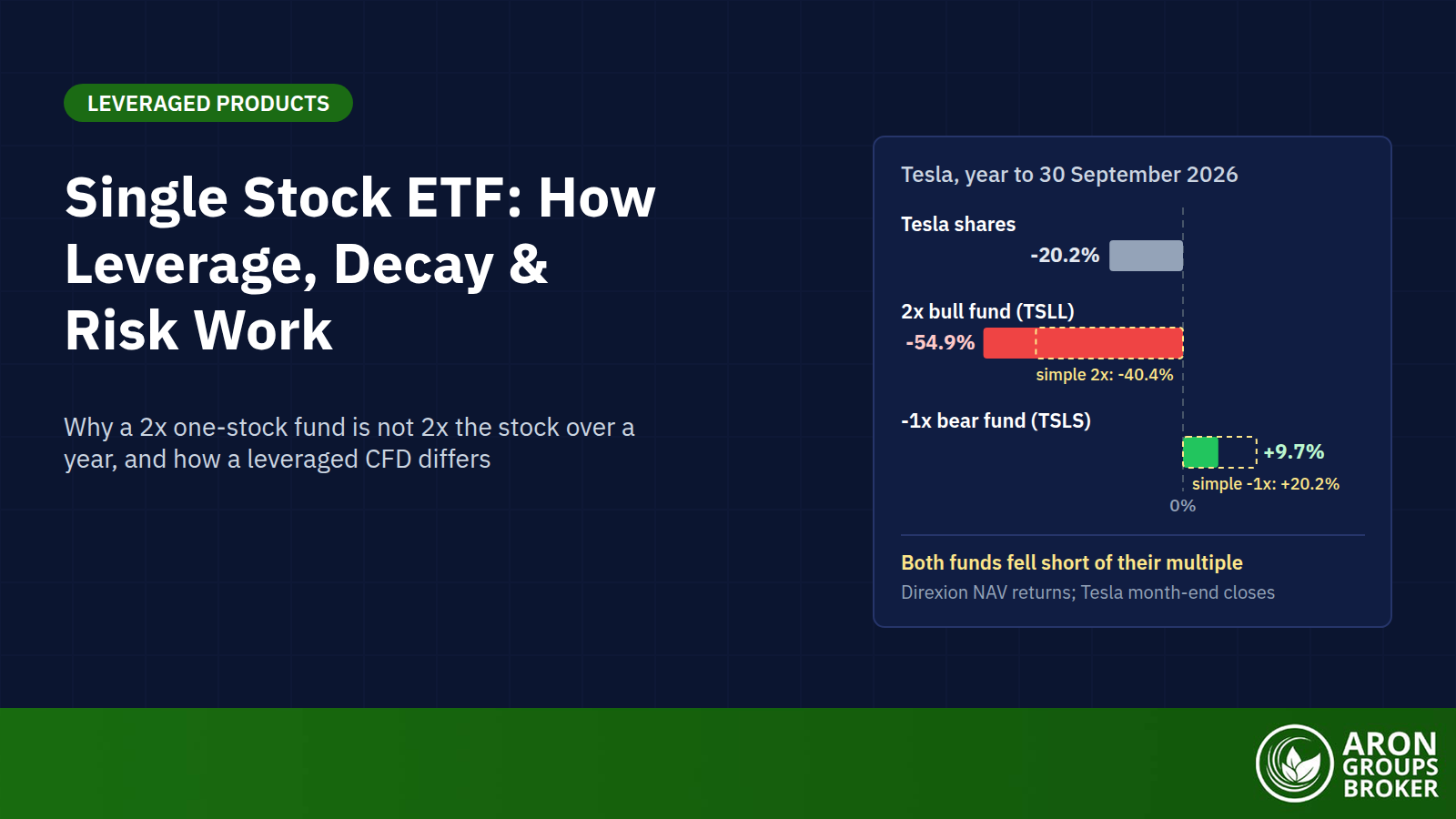
It matters now because the category has outgrown the understanding of it. Industry tallies in 2026 count roughly 400 of these funds on US exchanges, and Morningstar data reported in August 2026 showed 63 had already closed this year. The leverage cuts both ways: Direxion’s 2x Tesla fund lost 54.85% in the year to 30 September 2026 while Tesla fell 20.2%. That drawdown is far deeper than twice the stock’s.
This guide explains what these funds hold, why the daily reset makes them drift from the stock, and how large that volatility decay gets. It uses the SEC’s own arithmetic and a worked week, then compares the funds with a leveraged CFD and a plain share.
- A single stock ETF holds swaps on one company, not a basket, so it carries all of that company's risk multiplied by its leverage factor.
- The funds reset exposure at every close. In the SEC's example an index fell 1% over two days while the 2x fund fell 4%.
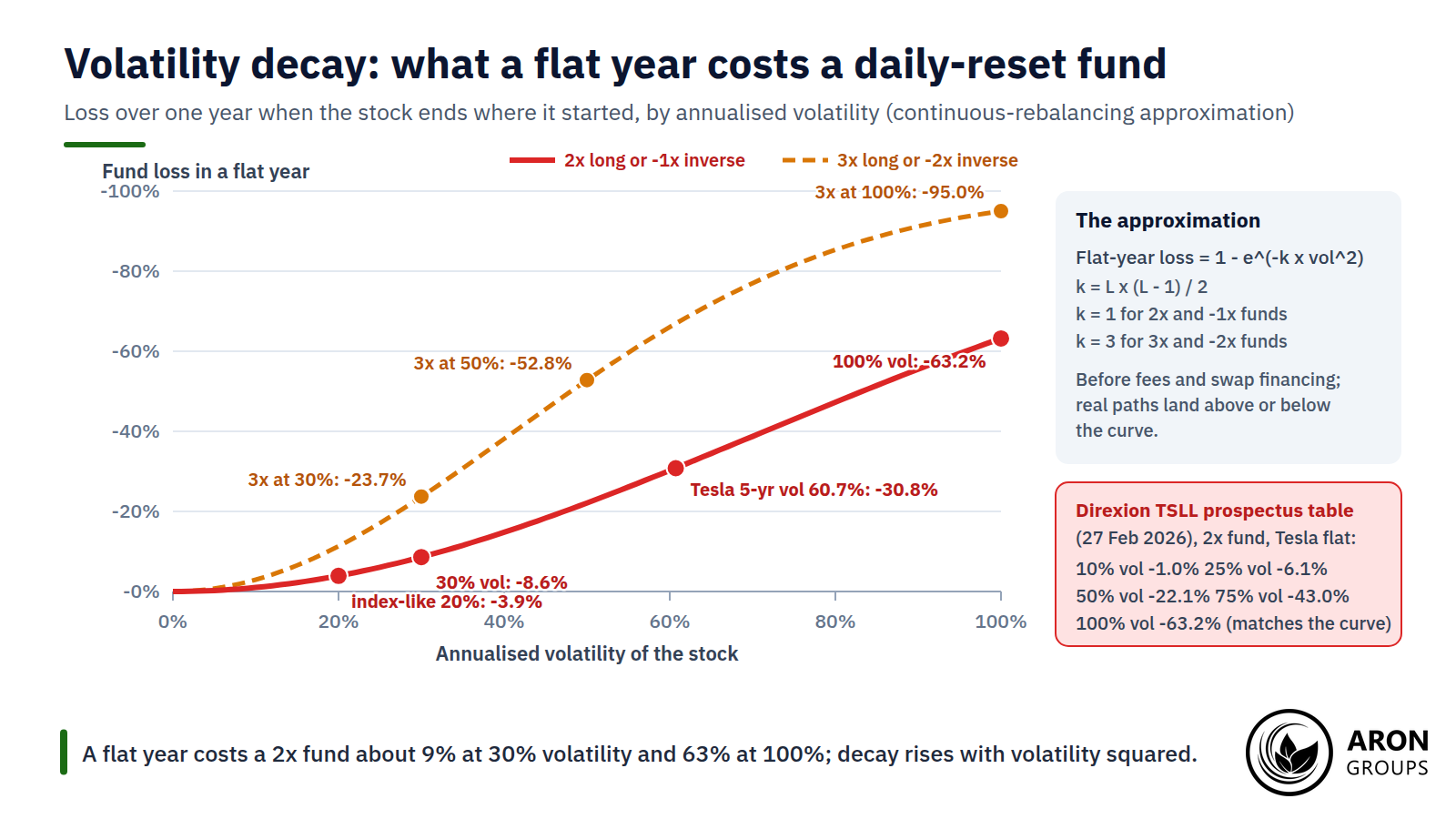
- Decay rises with volatility squared: a flat year costs a 2x fund about 9% at 30% volatility and 63% at 100%, before fees and financing.
- In the year to 30 September 2026 Direxion's 2x Tesla fund lost 54.85% and its -1x fund gained only 9.69%, while Tesla fell 20.2%; neither delivered its multiple.
- A leveraged CFD keeps a fixed position with no reset, but adds overnight swap, a margin call at 100% and a stop-out at 50% (40% on Islamic and VIP accounts).
What Is a Single Stock ETF?
A single stock ETF is a listed fund that seeks a positive or negative multiple of the daily performance of one stock, as the SEC’s investor glossary puts it. GraniteShares’ NVDL targets twice Nvidia’s daily move, Direxion’s TSLL twice Tesla’s, and the T-REX fund MSTU twice Strategy’s (formerly MicroStrategy). Each trades like a share, but owns a derivative, not the stock.
Risk Disclosure
Trading forex and CFDs carries a high level of risk and can result in the loss of all your capital. This content is educational and is not investment advice. Never risk money you cannot afford to lose.
How it differs from a traditional ETF
A conventional fund spreads money across a stock index or a bond basket, so one company’s bad quarter moves it by a fraction of a percent. A single stock ETF has nothing to spread. A profit warning in earnings season hits the fund with the full force of the stock’s fall, and the leverage then doubles it.
The three types
Leveraged long funds target 1.25x, 1.5x or 2x the stock’s daily return. Inverse funds target -1x or -2x, rising when the stock falls, with the same daily reset. Nothing above 2x exists for US single stocks. The SEC’s derivatives rule caps a fund’s value at risk at 200% of its reference stock’s, and in December 2025 it told nine issuers to revise or withdraw filings for 3x to 5x products.
The third type sells call options to pay income. YieldMax’s TSLY holds no Tesla shares; it builds exposure with options and sells calls on top. That is why it quoted a 55.75% distribution rate on 30 September 2026 against a 30-day SEC yield of 3.17%, and why it captures only part of Tesla’s gains.
How the Funds Work: Swaps and the Daily Reset
The fund does not borrow money to buy twice as many shares. It signs total-return swaps with banks that pay it twice the stock’s daily move on an agreed notional, and holds cash and Treasury bills as collateral. NVDL describes exactly this structure; TSLL’s prospectus allows swaps, options and the shares in combination, rebalanced daily.
Why the reset is built in
Leverage drifts the moment the price moves. Picture a fund with $100 of assets and $200 of swap exposure. If the stock rises 10%, exposure becomes $220 on assets of $120, only 1.83x, so the fund adds $20 of exposure at the close. If the stock falls 10%, exposure is $180 on $80, or 2.25x, and the fund cuts $20.
The fund therefore buys exposure after up days and sells after down days: in a choppy market it buys high and sells low by design. Each day’s return is correct on its own; the trouble starts when days are chained together.
Mini Example: A Choppy Week in a 2x Fund
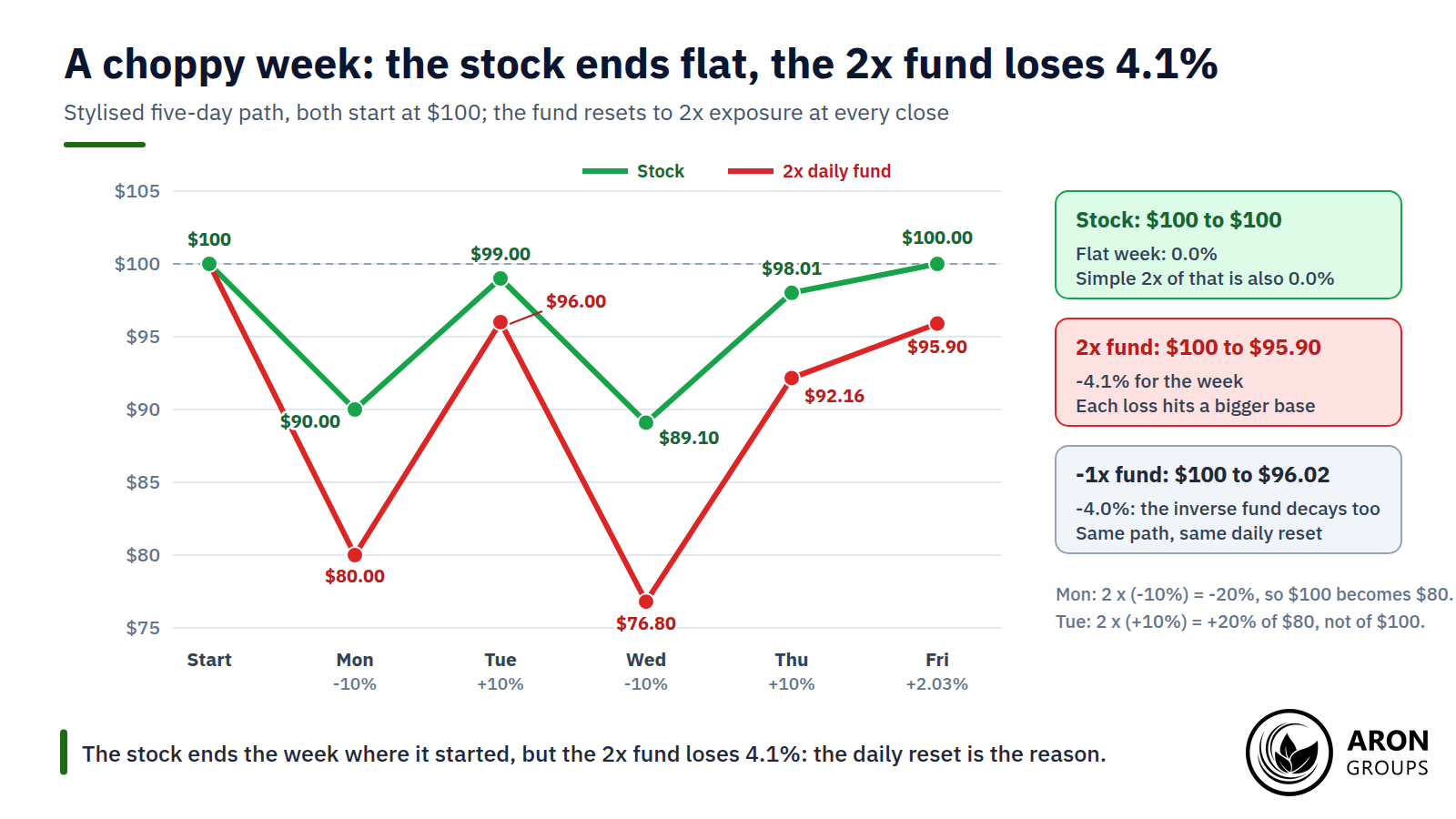
Say a volatile stock and a 2x fund both start the week at $100. On Monday the stock falls 10% to $90.00 and the fund falls 20% to $80.00. On Tuesday the stock gains 10% to $99.00; the fund gains 20%, but 20% of $80 is only $16, so it reaches $96.00.
Wednesday repeats the fall: the stock drops to $89.10 and the fund to $76.80. Thursday repeats the rise: $98.01 and $92.16. On Friday the stock gains 2.03% to finish exactly where it started, at $100.00, while the fund gains 4.06% to $95.90.
The stock’s week is flat, so a simple 2x of it is also flat, yet the fund lost 4.1%. A -1x fund on the same path ends at $96.02, down 4.0%, so inverse funds decay just as hard.
Volatility Decay: Why 2x Over a Year Is Not 2x
Regulators have used the same arithmetic since 2009. In the SEC and FINRA investor bulletin on leveraged and inverse ETFs, an index starts at $1,000, falls 10% to $900 and rises 10% to $990. That is a two-day loss of 1%. The 2x fund falls 20% to $800, then rises 20% to $960, a loss of 4%: four times the index’s loss, not twice. The bulletin calls the products generally unsuitable for buy-and-hold investors.
This gap is volatility decay, also called beta slippage: the cost of resetting leverage on a path that goes up and down. It grows with the size of the daily swings, not the direction of the trend.
The approximation behind the 9% and 63% figures
Take a fund that rebalances continuously on a stock with annualised volatility v. Its multi-period return is roughly the stock’s return raised to the power of the leverage, times a decay factor. That factor is e to the power of minus k times v squared. Here k is the leverage times the leverage minus one, halved: 1 for a 2x fund and also for a -1x fund. A flat year then costs about 8.6% at 30% volatility, 30.8% at Tesla’s five-year volatility of 60.73%, and 63.2% at 100%.
These are approximations, and real funds land above or below them, but issuers publish the same curve. The Direxion TSLL summary prospectus of 27 February 2026 shows a 2x fund losing 1.0% in a flat year at 10% volatility, 22.1% at 50% and 63.2% at 100%. That matches the formula to the decimal.
What the real funds did in the year to 30 September 2026
Tesla closed September 2025 at $444.72 and September 2026 at $354.81, a fall of 20.2%. A simple 2x would be -40.4% and a simple -1x +20.2%. Direxion’s tables for the same year show TSLL at -54.85% and TSLS, the -1x fund, at +9.69%. No single stock return explains both numbers; the reset cost each fund more than ten points.
Nvidia tells the same story in a rising market: the shares gained 22.4%, a simple 2x was +44.8%, yet Direxion’s 2x fund NVDU returned 17.84%. The extreme case is Strategy: its T-REX 2x fund MSTU lost 98.14% in the year to 30 June 2026 while the stock fell about 78%.
Why These Funds Are Not for Buy-and-Hold
Every prospectus in the category says the fund does not seek its objective for any period other than a single trading day. The SEC’s Investor Advisory Committee reported in June 2023 that retail accounts made up 92% of holders across 26 of the most popular single stock ETFs. FINRA’s Regulatory Notice 22-08 of March 2022 had already flagged leveraged and inverse products as complex products that retail investors pick without grasping the risks.
What a 2x fund does on a bad day
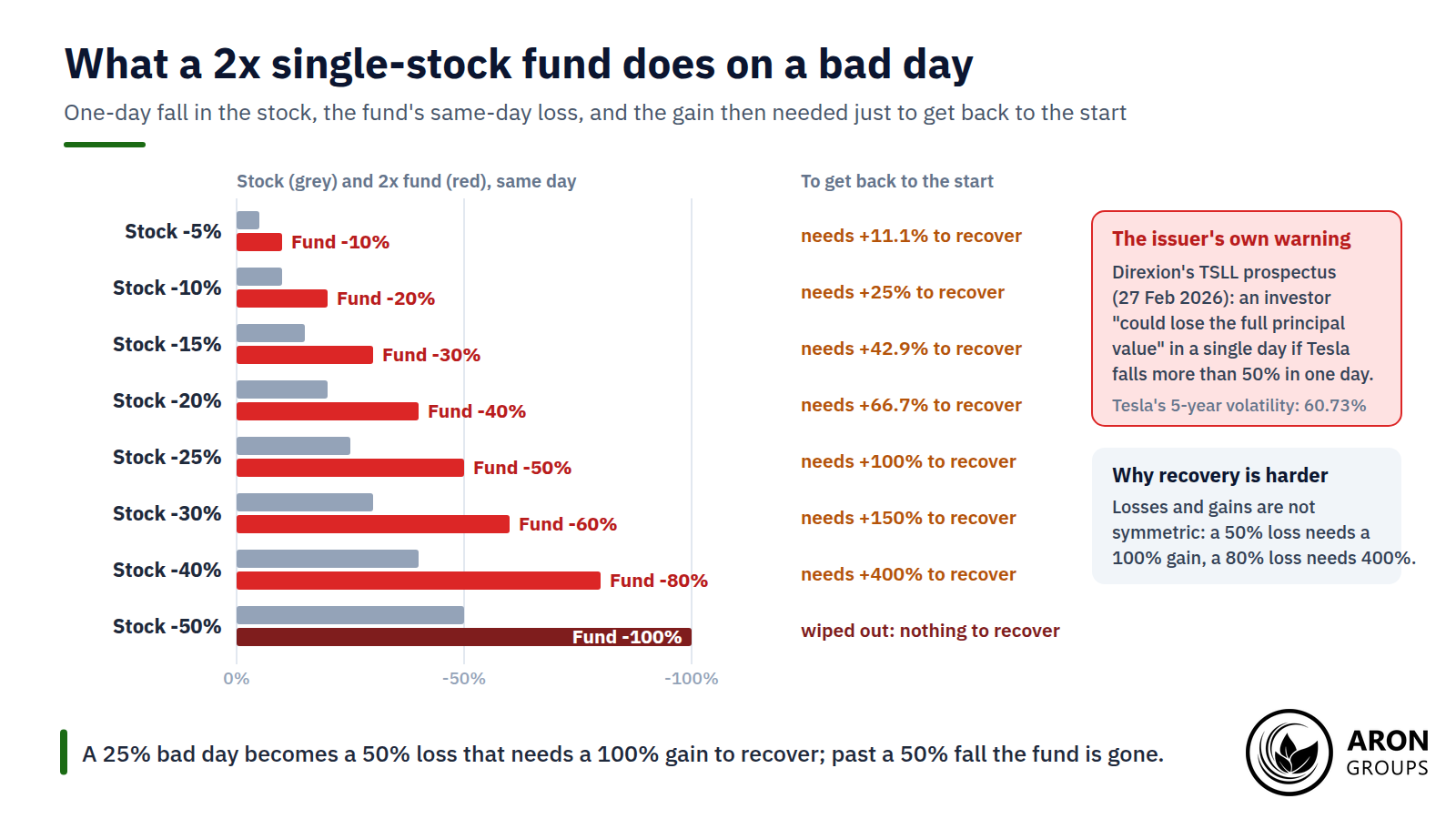
Decay is the slow problem; a single bad session is the fast one. A 2x fund turns a 10% fall into 20%, a 25% fall into 50% and a 40% fall into 80%. Recovery is not symmetric: a 50% loss needs a 100% gain, an 80% loss needs 400%. Direxion’s TSLL prospectus warns that an investor could lose the full principal value in a single day if Tesla falls more than 50%.
Key Point
A daily-reset fund's holding period is one day. Every extra day adds path risk that the stated multiple does not describe, so size and time the trade as you would a leveraged position, not an investment.
From July 2022 to 2026: Launch, Reservations and Growth
The first US single stock ETFs listed on 14 July 2022. AXS Investments launched eight funds on Tesla, Nvidia, PayPal, Nike and Pfizer, long and inverse, with multiples of up to 2x. They arrived through Rule 6c-11, the 2019 rule that lets qualifying ETFs list without case-by-case approval, so the SEC voiced reservations rather than blocking them.
Commissioner Caroline Crenshaw’s statement of 11 July 2022 warned that daily rebalancing and compounding “may cause returns to diverge quite substantially” from the one underlying stock. She added that an adviser would struggle to recommend one under Regulation Best Interest.
Who issues them now
Direxion lists 54 single stock funds on 27 companies. GraniteShares runs NVDL, which held $3.66 billion on 30 September 2026 at a 1.05% fee. REX Shares and Tuttle Capital issue the T-REX range, Leverage Shares by Themes entered the US in December 2024 at 0.75%, and YieldMax covers income. None is available through Aron Groups.
Tallies published between April and August 2026 put the category at about 400 funds with $37.5 billion to $65 billion of assets, depending on what is counted. Morningstar data showed half of all leveraged ETFs holding under $7 million.
Q: If the stock gains 50% over a year, does a 2x fund make 100%?
A: Only on a calm path. Direxion’s own prospectus table shows a 2x fund gaining 122.8% when Tesla rises 50% at 10% volatility, 75.2% at 50% volatility and losing 17.2% at 100% volatility. The stock’s destination matters less than the route it takes to get there.
What It Costs to Hold One
The visible cost is the expense ratio: 0.83% net for TSLL, 1.05% for NVDL and MSTU, and 0.75% for the cheapest entrants. An August 2025 survey put the median leveraged ETF at 0.96%. The hidden cost is financing. The swap counterparty charges a short-term rate plus a spread on the borrowed half of a 2x exposure, and that never appears in the expense ratio.
A leveraged CFD carries the same charge as an overnight swap, but it is printed on the statement each night. A 2025 study by Hendrik Bessembinder of 33 single stock funds found they lagged a simple multiple by 0.88% a month: 0.45% from the reset and 0.43% from costs.
Single Stock ETF vs Leveraged CFD vs Plain Stock
The three routes to the same company look alike on a screen and behave very differently over a month. Share contracts are the most common of the types of CFDs, so the table below matters to CFD traders.
| Feature | 2x single stock ETF | Leveraged share CFD | Plain stock |
|---|---|---|---|
| What you hold | Fund shares backed by swaps and T-bills | A contract with the broker on the price | The shares themselves |
| Leverage source | Fixed 2x inside the fund | Margin set by the account and symbol | None, unless you borrow |
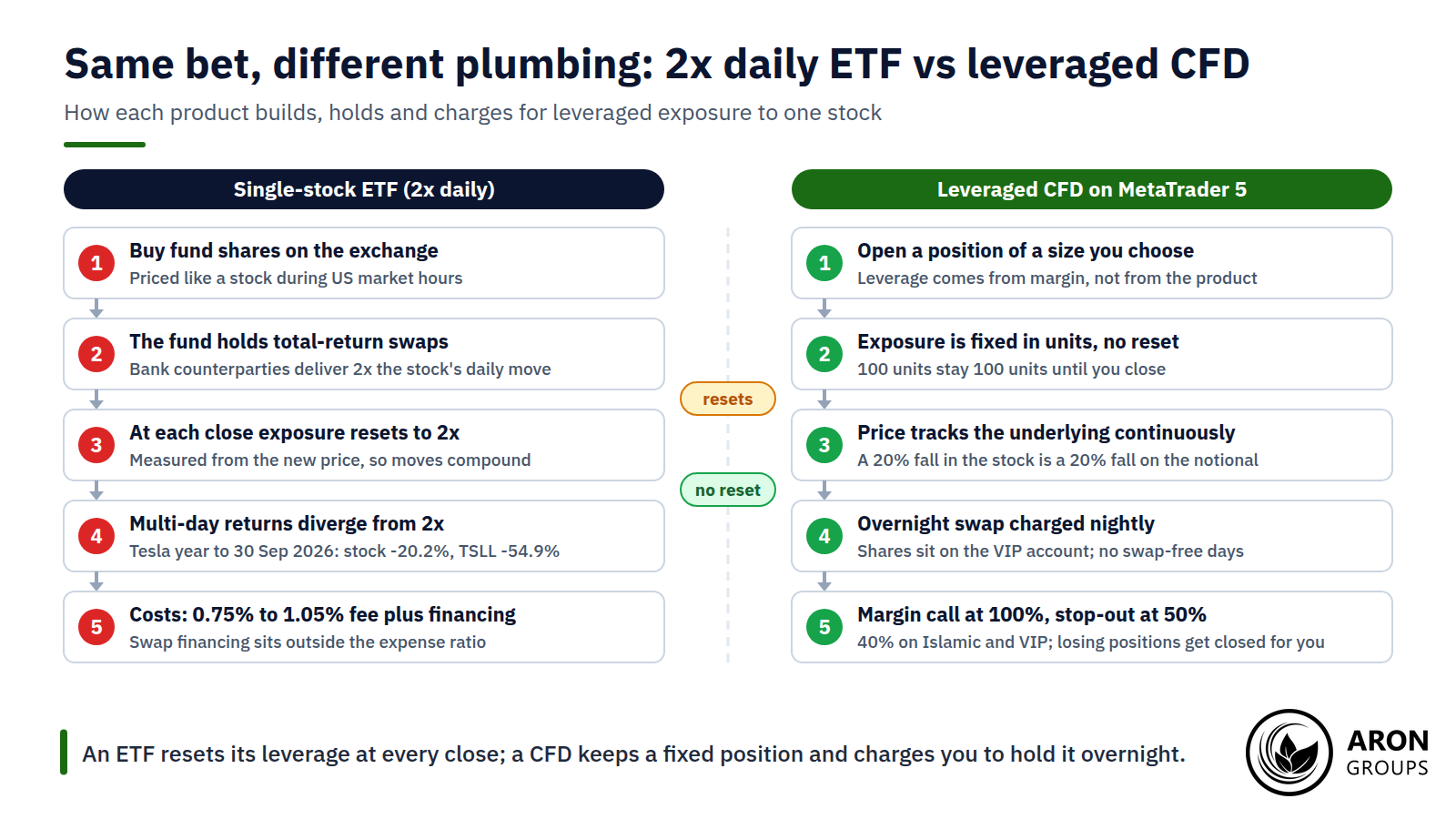
| Reset | Every close, to 2x of the new price | No reset; units stay fixed until you close | None |
| Multi-day tracking | Diverges with volatility (TSLL -54.85% vs Tesla -20.2%) | Tracks the price point for point on the notional | Exact |
| Holding cost | 0.75% to 1.05% fee plus swap financing | Overnight swap for every night held | Usually none |
| Worst case | Fund value can reach zero on a 50% day; decay over time | Margin call at 100%, stop-out at 50% or 40% | Loss limited to the price fall |
| Trading hours | US exchange hours | Broker's session for the symbol | Exchange hours |
How a 2x single stock ETF, a leveraged share CFD and direct ownership differ; fund figures from issuer documents, September 2026, CFD terms from Aron Groups.
Overnight swap versus daily reset
A CFD position is a fixed number of units. If you buy 100 units and the stock falls 20% over the next week, your loss is 20% of the notional, whatever path the price took. No rebalancing means no decay. Instead the broker charges a nightly swap to finance the position, a cost that is explicit before you hold.
Liquidation risk versus decay
The price of avoiding decay is that a CFD can be closed for you. At Aron Groups a margin call arrives when the margin level reaches 100%, and a stop-out closes losing positions at 50%, or 40% on Islamic and VIP accounts. A 2x fund down 40% in a week is still open; a CFD at 5:1 leverage down 10% has lost half its margin.
Regulators treat the two risks differently. ESMA’s 2018 rules for retail CFDs in the EU cap leverage on individual equities at 5:1 and require a close-out at 50% of minimum required margin. The ETF never margin-calls you, because the leverage lives inside the fund; it decays instead.
The Honest Limits of Single Stock ETFs
These funds do what they promise for one day, and for a one-day trade or a short hedge they can be the cleanest tool available. The limits begin on day two: returns depend on the path, the swap counterparty can fail, financing is opaque, and all of a company’s news lands on one position. The decay formula ignores fees, so treat 9% and 63% as orders of magnitude.
CFDs are not the safe alternative. ESMA’s national regulators found that 74% to 89% of retail CFD accounts lose money, which is why position sizing matters more than the product. Platform access to both ETFs and CFDs varies by country, and users in restricted regions face added legal, access and custody risk.
Where Aron Groups Fits
Aron Groups does not offer ETFs of any kind, leveraged, inverse or income. What it offers is leveraged CFDs on MetaTrader 5, across forex, gold, indices, crypto and shares. A CFD position tracks its underlying continuously rather than resetting at the close, and the cost of holding is the overnight swap. Share CFDs sit on the VIP account, where that swap applies for every night the position stays open.
The margin rules replace decay with a hard stop: margin call at 100% margin level, stop-out at 50%, or 40% on Islamic and VIP accounts. A demo account lets you watch a leveraged position through a volatile week before risking money, and the Nano account allows volumes from 0.0001 lots.
Conclusion
A single stock ETF is a one-day instrument that trades like a share. It delivers its multiple of one company’s daily move through swaps, then resets, and that reset turns a choppy path into a steady loss. The SEC’s example of -1% becoming -4% is the small version; Tesla’s 2x fund losing 54.85% against a 20.2% fall in the stock is the full-year version.
Decay rises with volatility squared, so the most exciting stocks are where the funds disappoint most. A leveraged CFD swaps that decay for explicit swap costs and a stop-out level. Neither is a buy-and-hold vehicle; both reward traders who size positions for the worst day.
Frequently Asked Questions
Short answers to common questions about single stock ETFs.
What is the difference between a single stock ETF and buying the stock?
The stock gives you the company’s return for as long as you hold it. The fund gives you a multiple of each day’s return, reset daily, so over weeks the two drift apart, and it charges a fee plus swap financing.
Are single stock ETFs good for long-term investing?
No. Issuers state that the funds target a single day, and the SEC and FINRA bulletin calls them unsuitable for buy-and-hold investors. Over a year a 2x fund can trail badly even when the stock rises, as Nvidia’s did in the year to September 2026.
What is volatility decay in a leveraged ETF?
It is the loss created by resetting leverage on a price that moves up and down. A 10% fall followed by a 10% rise leaves the stock down 1% but a 2x fund down 4%, and the effect grows with the square of volatility.
Is a leveraged CFD safer than a single stock ETF?
It carries a different risk, not a smaller one. A CFD keeps a fixed position with no decay. You pay overnight swap instead, and face a stop-out at a 50% margin level, or 40% on Islamic and VIP accounts. The fund cannot be margin-called, but it decays while you hold it.