
icon icon Home
icon icon Accounts
icon icon Quick start
icon icon Symbols

The Poor Man’s Covered Call: How to Run a Covered Call With a LEAPS Diagonal for Less Capital

Author
Abe Cofnas
Abe Cofnas
calendar Last update: 7 November 2026
watch Reading time: 9 min

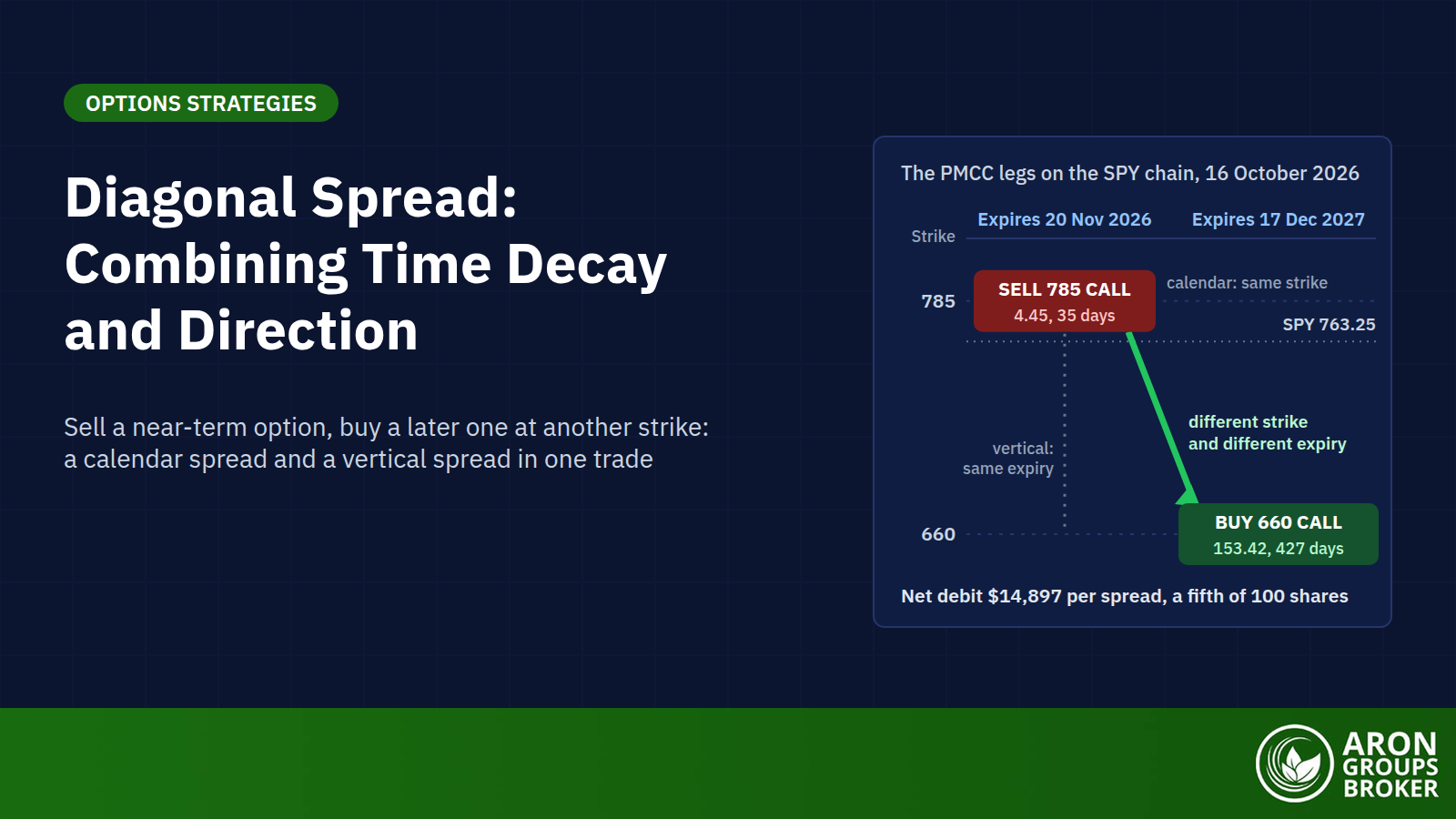
A poor man’s covered call (PMCC) is an options strategy that mimics a covered call without owning 100 shares. It buys a deep in-the-money, long-dated call, often a LEAPS, and sells a near-term out-of-the-money call against it. Technically, it is a long call diagonal debit spread, a bullish position that needs far less capital.

It matters in October 2026 because both shares and time are dear. SPY, a fund that tracks the S&P 500, closed at 769.05 on 20 October 2026, so 100 shares cost $76,905. The Fed’s target for the federal funds rate stands at 3.75% to 4.00%, and long-dated calls price in interest at rates near 4.5%.

This guide prices a PMCC on the 20 October 2026 SPY chain and tests four long calls against the width rule. It then covers the calculator, rolling and risks.

bookmark
Key Takeaways
  • A poor man’s covered call buys a deep in-the-money, long-dated call and sells a near-term call against it: a long call diagonal debit spread.
  • On 20 October 2026 the SPY version cost $18,662, 24.3% of the $76,905 for 100 shares. In the model, its long call moved like about 90 shares.
  • The width test asks for a strike width above the net debit, so a rally cannot lock in a loss at the short expiry. Of four long calls tested, one passed.
  • Premium is not profit: in the model, a flat first month nets about $2, as the long call loses 4.01 against the 4.03 premium kept.
  • Capital efficiency is leverage. In the model, with volatility unchanged, a 10% fall by 20 November costs the PMCC 35.3% of its capital and a covered call 9.5%. Aron Groups offers no options.

What Is a Poor Man’s Covered Call?

A poor man’s covered call pairs a deep in-the-money call expiring months out with an out-of-the-money call expiring within weeks. The CFTC’s glossary describes LEAPS, the usual long leg, as long-dated, exchange-traded options, short for Long-term Equity Anticipation Securities.

sms-star

Risk Disclosure
Trading forex and CFDs carries a high level of risk and can result in the loss of all your capital. This content is educational and is not investment advice. Never risk money you cannot afford to lose.
A Long Call Diagonal Debit Spread

The legs differ in strike and expiry, making it a diagonal spread. The dearer long call means it opens for a net debit. Formally, LEAPS are listed up to 39 months out on Cboe; this article uses the name loosely, even at 240 days.

Why It Is Called “Poor Man’s”

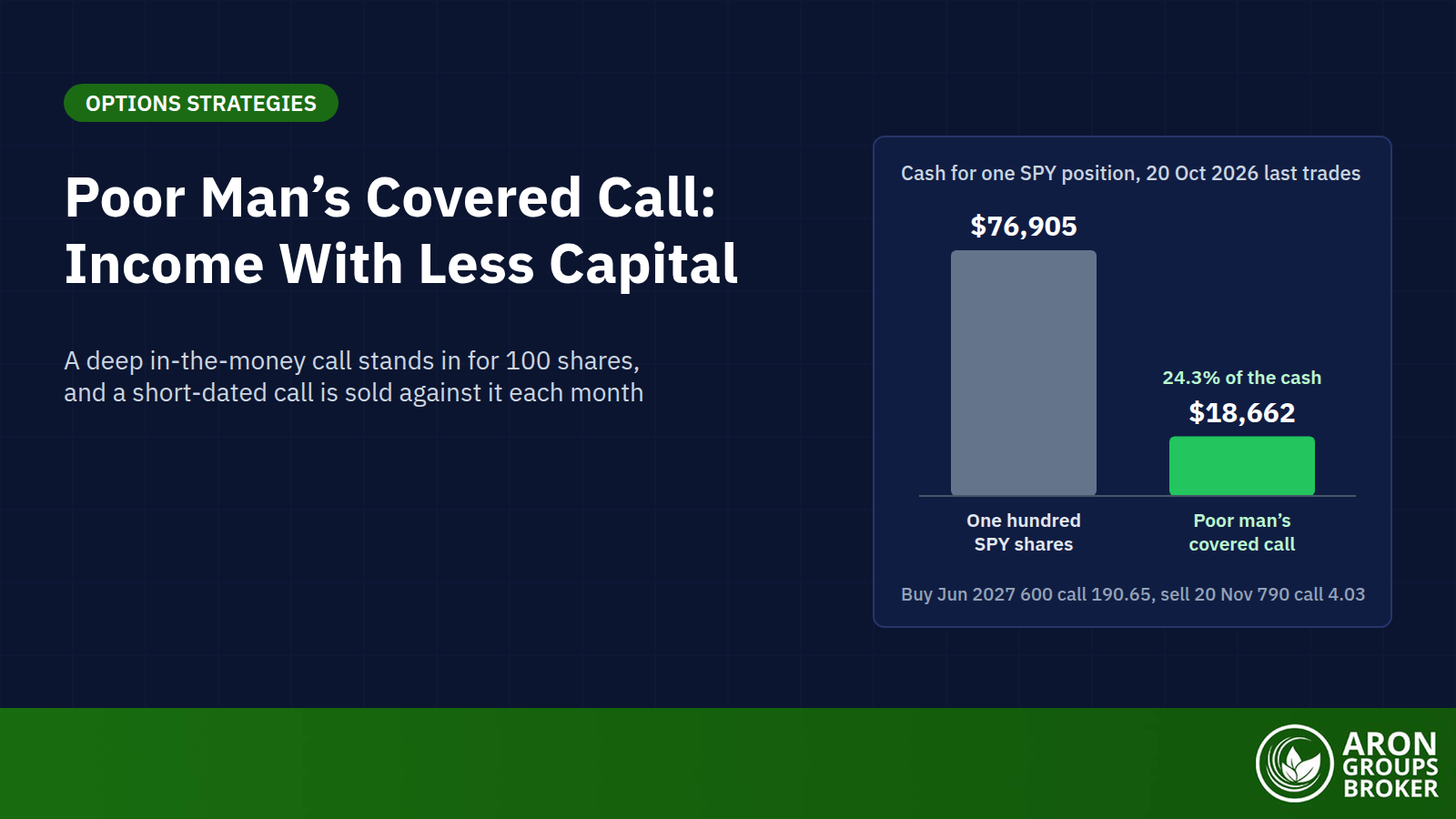
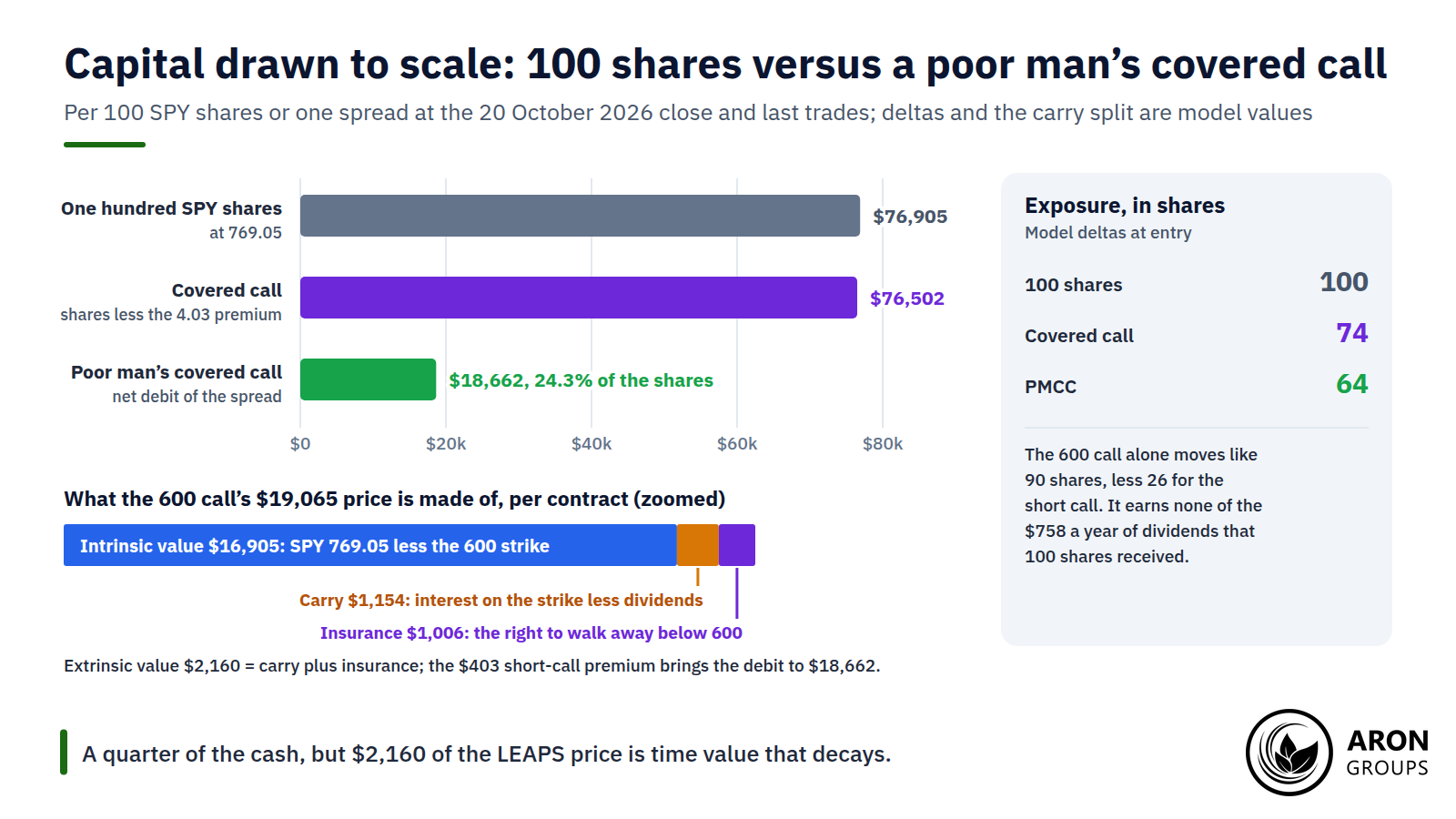
A real covered call ties up the cost of 100 shares, $76,502 after the premium. The PMCC replaces the shares with a call that cost $19,065, so the spread needed $18,662, 24.3% of the $76,905 the shares cost. That capital efficiency, a form of leverage, is the whole appeal.

The PMCC needs 24.3% of the cash of 100 shares, but $2,160 of its long call’s price is time value that decays.
sms-star

Key Point
The saving is not free: a deep in-the-money call is partly a loan. In the model, about $1,714 of the June 600 call’s price is interest on its strike over 240 days. The $57,840 not spent on shares would earn a similar $1,658 at the 4.36% six-month Treasury yield.
How the PMCC Strategy Works

The poor man’s covered call strategy runs like a covered call written month after month. Each short call brings in premium, and every premium kept lowers the cost basis. It is often called a capital-efficient, bullish income strategy, though leverage does most of the work.

The LEAPS Is Not 100 Shares

A deep in-the-money call is often said to behave like the stock, but it behaves like most of it. The June 2027 600 call used below had a model delta of 0.90. In the model, a $10 rise in SPY adds about $900 to it, against $1,000 for 100 shares.

The call also earns no dividends, about $569 a contract over its life on projected payments. Its delta shifts with price, a gamma effect, and drops to 0.79 after a 10% fall in the model. And 21.60 of its 190.65 price is extrinsic value that decays; the other 169.05 is intrinsic value.

A model split by put-call parity gives 11.54 of carry, interest on the strike less dividends, and 10.06 of insurance against a fall below 600. The matching June 600 put last traded lower, at 7.07. The insurance part moves with implied volatility, giving a vega of about $112 per point per contract.

Setup Rules and the Width Test

Common practice has three rules. The long call is deep in the money, with a delta near 0.80 or higher and six to twelve months or more left. The short call is out of the money, 30 to 45 days out, with a delta near 0.20 to 0.30. The third is the width test.

The short-call rule is a convention, not the way to collect the most decay. Theta, the daily time decay, is largest for at-the-money options near expiry. Model decay per contract is $24.42 a day for the 31-day 770 call, $16.01 for the 790 and $12.80 for the long call. The convention gives up premium for a lower chance of being called away, about 24% in the model.

Why the Width Rule Exists

The width test asks for a strike width, short strike minus long strike, above the net debit. It is often taught as keeping the risk defined, but the structure’s loss is capped at the debit either way. The test exists for rallies: if the short call is exercised, delivering shares by exercising the long call locks in the width minus the debit. A width below the debit makes that a loss.

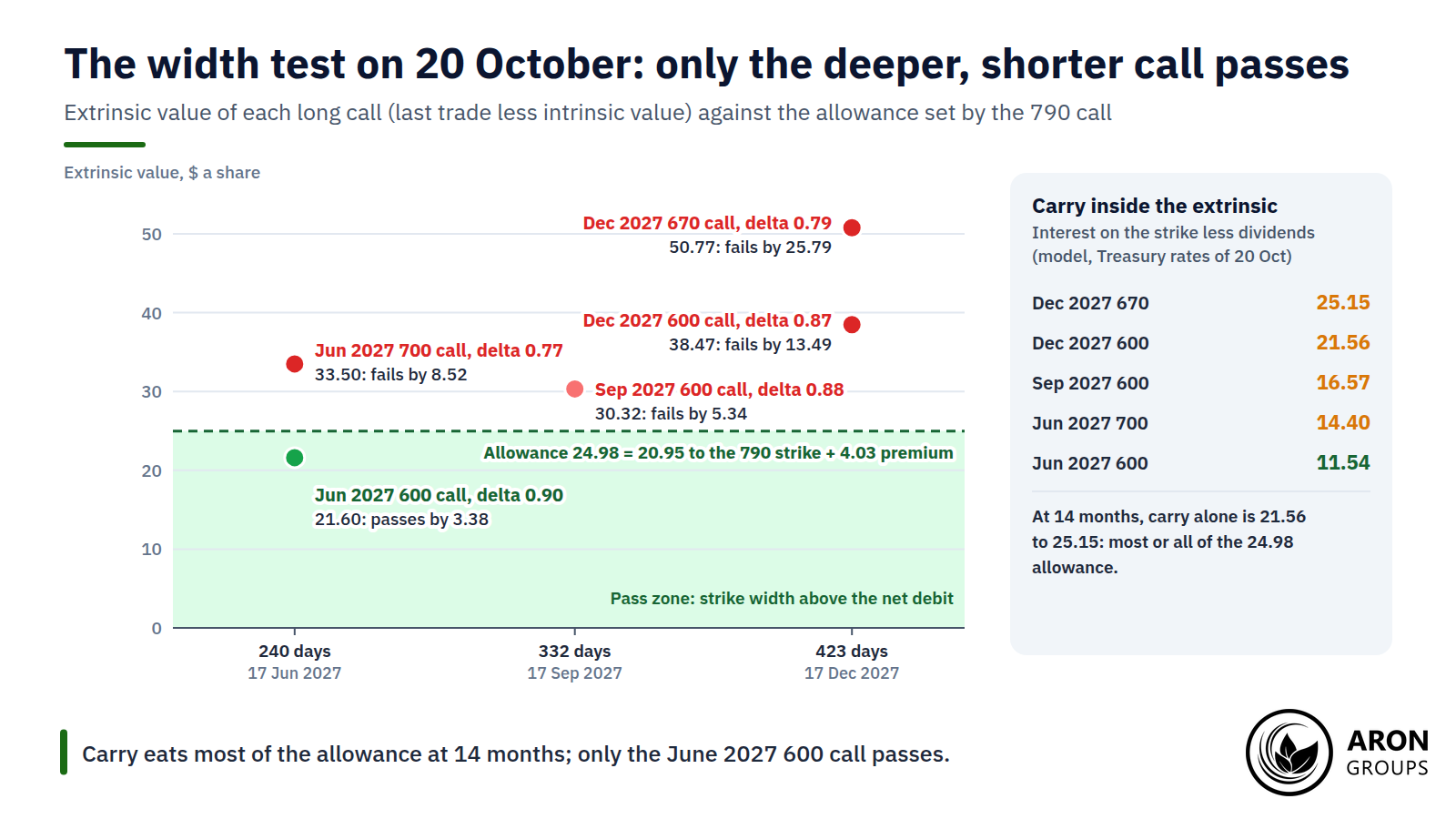
Put simply, the long call’s extrinsic value must be below the short strike’s distance above the price plus the short premium. On 20 October that allowance was 24.98: 20.95 points to the 790 strike plus the 4.03 premium.

Four LEAPS Choices on 20 October 2026

The table tests four long calls against one short call, the 20 November 2026 790 call, last traded at 4.03 (model delta 0.26). Prices are last trades from Optionistics’ free end-of-day data, not bid and ask quotes. The prints were not simultaneous: SPY ranged from 764.25 to 772.29 that day.

Long callDays leftLast tradeDelta (model)Extrinsic valueNet debitStrike widthWidth test
December 2027 670423149.820.7950.77145.79120Fails by 25.79
December 2027 600423207.520.8738.47203.49190Fails by 13.49
June 2027 700240102.550.7733.5098.5290Fails by 8.52
June 2027 600240190.650.9021.60186.62190Passes by 3.38

Last trades on 20 October 2026, each paired with the 20 November 790 call at 4.03; deltas are model values.

The textbook 14-month call fails by the widest margin, and going deeper alone, or shorter at a similar delta, still fails. The reason is interest: at Treasury yields near 4.5%, 14 months of carry alone is 21.56 to 25.15 in the model. Skew adds to deeper calls’ time value: the prints imply 29.3% volatility for the June 600 call and 21.5% for the June 700.

Carry, interest on the strike less dividends, eats most of the 24.98 allowance at 14 months; only the June 2027 600 call passes.

What the Passing Choice Costs

The June 600 spread needed $18,662, $4,083 more than the $14,579 textbook spread, and its model net delta is 64 shares against 54. In the model, a 10% fall by 20 November, volatility unchanged, costs it $6,587, against $5,597 for the textbook spread.

It also expires sooner, on 17 June 2027, after at most eight monthly short calls. Replacing it costs another debit; the December 2027 600 call cost 16.87 more at the 20 October prints.

Poor Man’s Covered Call Calculator: The SPY Trade in Numbers

A poor man’s covered call calculator needs two prices, two strikes and the dates for its basic outputs. Model values below also use Black-Scholes, each call’s implied volatility, projected dividends and 20 October Treasury yields.

Mini Example: The SPY Trade of 20 October 2026

This poor man’s covered call example buys the 17 June 2027 600 call at 190.65 and sells the 20 November 2026 790 call at 4.03. The net debit is 186.62 a share, or $18,662 per spread, against a strike width of 790 − 600 = 190.

A cautious fill pays an assumed 0.50 more for the long call and gets 0.05 less for the short call. That lifts the debit to 187.17, and the trade still passes, by 2.83.

The calculator outputs are:

  • Net debit: 190.65 − 4.03 = 186.62 a share.
  • Maximum loss: the $18,662 debit, if SPY ends below 600 on 17 June 2027; later premiums reduce it.
  • Width test: 190 − 186.62 = 3.38 to spare, a pass.
  • Called away on 20 November: exercising the long call to deliver shares locks in +$338.
  • Break-even on 20 November (model): 769.02; at the long call’s expiry, 786.62 before later premiums.
  • Premium yield: 4.03 is 2.16% of the debit for 31 days, 25.4% a year if repeated, against 0.53% and 6.2% for a covered call.

Payoff at the Short Expiry

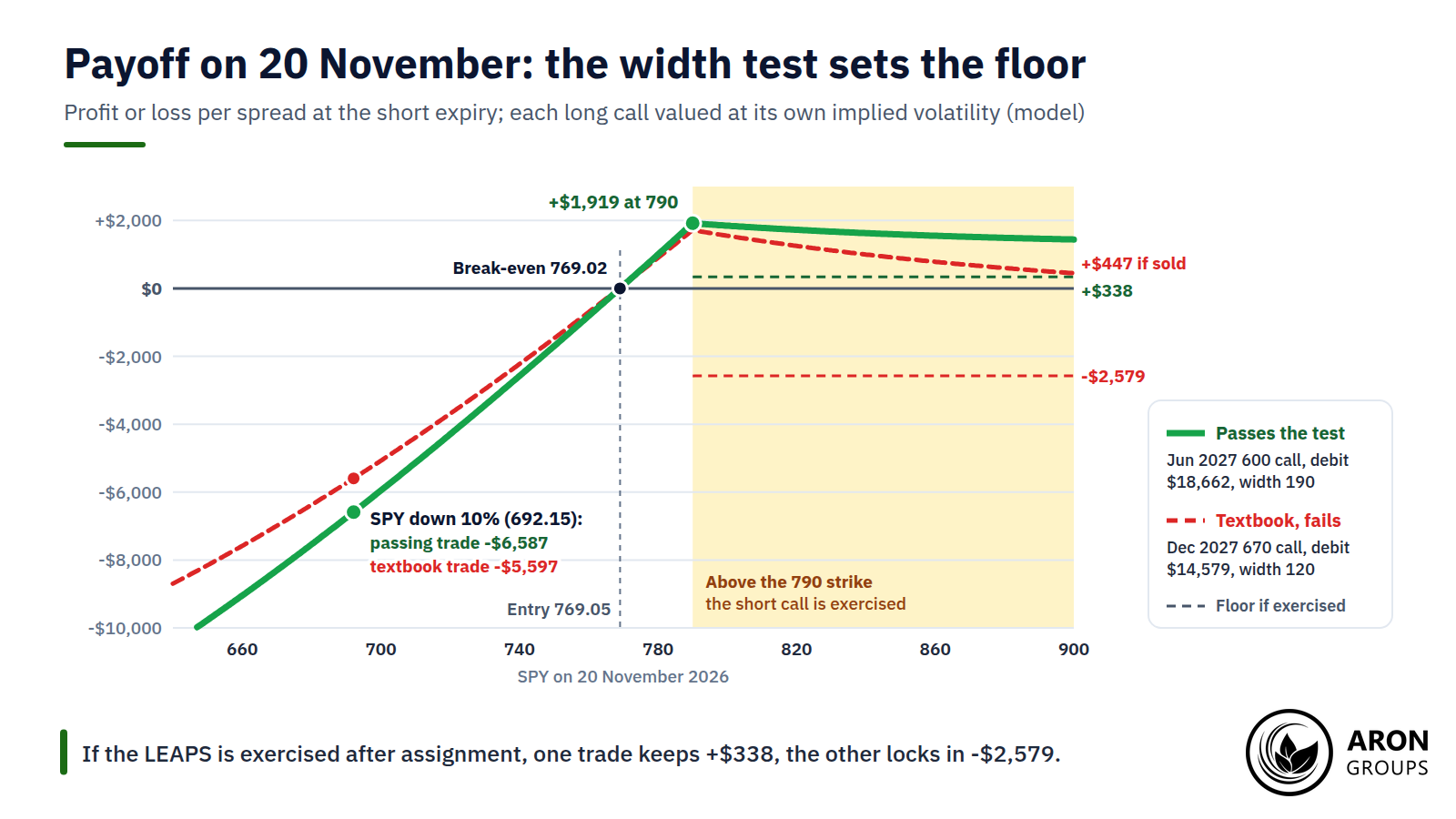
In the model, the trade makes its most on 20 November, +$1,919 or 10.3% of the debit, at 790. Above 790 the gain fades slowly, as the short call’s cost rises dollar for dollar and the long call gains less.

The textbook spread shows why the test matters: exercising its December 2027 670 call to meet an assignment locks in -$2,579. Selling that call instead would still leave +$447 at 900 in the model, from leftover time value.

Exercised to meet an assignment, the passing spread keeps +$338 and the textbook spread locks in -$2,579 (model payoff on 20 November).

Rolling the Short Call

Rolling means buying back the short call, or letting it expire, and selling the next one. Each premium kept lowers the cost basis, but that is no profit guarantee: the long call’s value moves too.

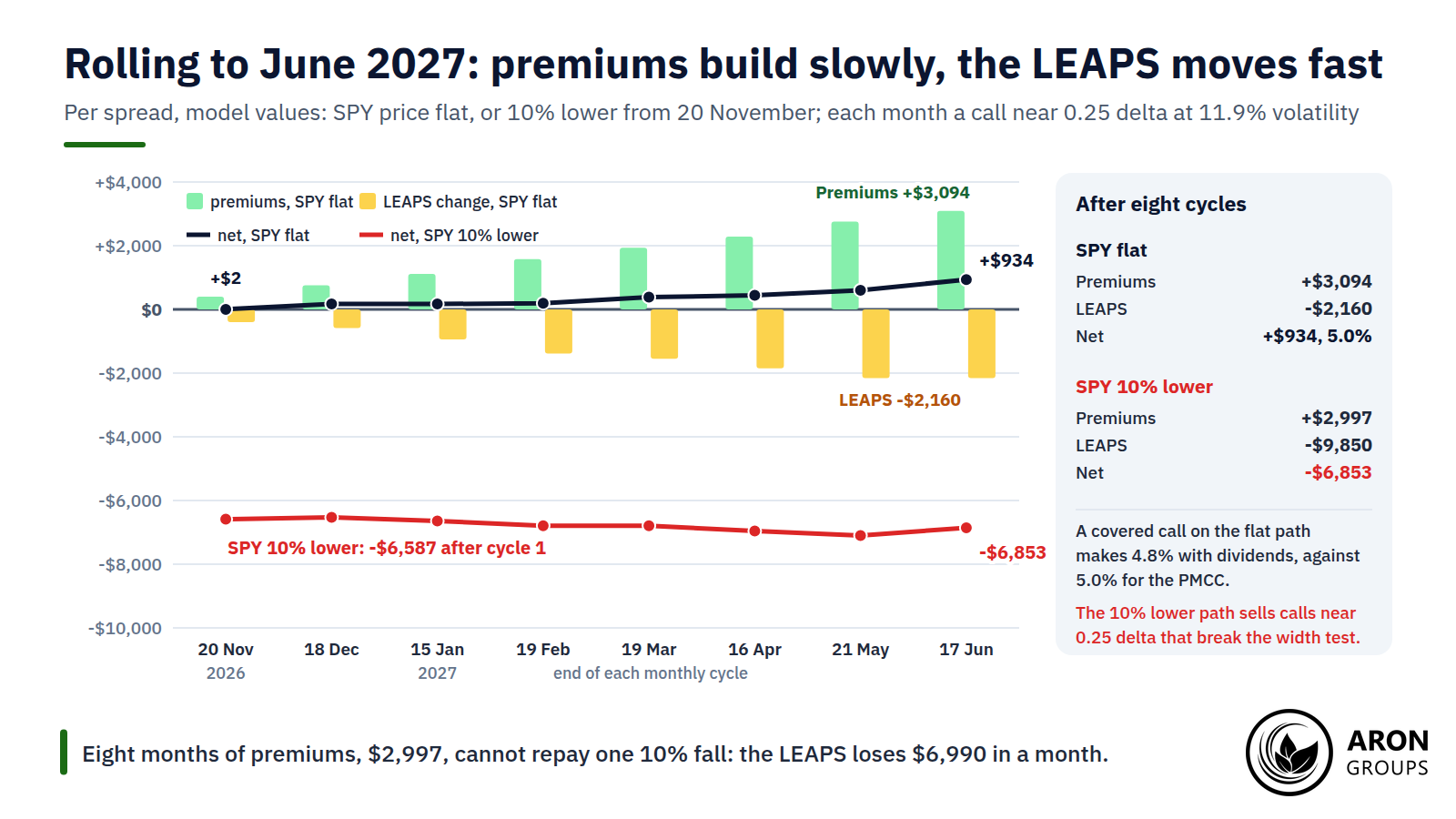
In the model, with SPY’s price flat until 17 June 2027, eight short calls bring in $3,094 while the long call loses $2,160. The $934 net gain is 5.0% of the capital, about 7.6% a year; a covered call on the same path makes 4.8%, with dividends. If the price fell by each dividend, the model PMCC would make about 2.2%, a covered call 4.1%.

A Quiet Month

If SPY holds at 769.05 until 20 November, the 790 call expires worthless. Selling the December 790 call for about 3.55 in the model cuts the net cost to 183.07. But the model long call loses about 4.01 that month, so the position is up just $2.

A Rally: Rolling Up and Out for a Debit

If SPY is at 805 on 20 November, buying back the 790 call costs 15.00. The next call near 0.26 delta, the December 825, brings in about 4.18 in the model. The $1,082 net debit lifts the net cost to 197.44, though the model position is $1,814 ahead and the new width, 225, still passes.

A Fall: Smaller Premiums and a Broken Width Test

A 10% fall to 692.15 by 20 November costs the position $6,587 in the model, volatility unchanged, about 16 months of $403 premiums. The long call alone loses $6,990. A fall that size usually lifts implied volatility: 5 points more on the long call would trim the loss to $5,827.

The next call near 0.25 delta, the December 710, pays 3.43 in the model at 11.9% volatility, or 6.72 at 16.9%. But its 110-point width is far below the 183.19 net cost, so selling it breaks the width test. A strike that keeps the test, 787 or higher, pays about 0.04 at most in the model.

In the model, eight months of premiums add $3,094 with SPY flat, but a 10% fall costs the long call $6,990 in the first month.

Poor Man’s Covered Call vs Covered Call

Both positions sell the same short call; they differ in what sits underneath. The table compares them.

FeatureCovered callPoor man’s covered call
Long leg100 SPY shares at 769.05June 2027 600 call at 190.65
Capital per position$76,502$18,662 (24.3% of the $76,905 in shares)
Exposure (model delta)74 shares64 shares
DividendsReceived ($758 a year on 100 shares)None
Time decay on the long legNoneAbout $12.80 a day at first (model)
Long leg expiresNever17 June 2027; sell, exercise or roll it before then
Break-even on 20 November765.02769.02 (model)
Best case on 20 November+$2,498 (3.3%)+$1,919 (10.3%, model)
SPY 10% lower on 20 November-$7,287 (-9.5%)-$6,587 (-35.3%, model)
Maximum loss$76,502 if SPY went to zero$18,662 debit, plus any roll debits

Per position at 20 October 2026 prices; PMCC outcomes are model values with volatility unchanged.

The PMCC’s higher return on capital is leverage, and it works both ways. In the model, with volatility unchanged, a 15% fall by 20 November costs it 50.9% of its capital, against 14.6% for a covered call. That is why position sizing matters more than the income figure.

Q: Is a poor man’s covered call a low-risk strategy?
A: No. It caps the loss at the debit, but its percentage swings are several times a covered call’s. In the model, with volatility unchanged, a 10% fall by 20 November costs 35.3% of the capital, against 9.5% for a covered call.

Margin, Early Assignment and Dividends

An SEC order approving Cboe’s spread margin rules sets the minimum treatment; brokers may add stricter house rules. The long option may not expire before the short one, and a spread opened for a net debit must be paid in full. When the long call’s strike is at or below the short call’s, no further margin requirement applies.

An SEC investor bulletin on margin accounts notes that brokers generally do not allow buying options on margin. It also warns that selling options may lead to significant losses.

SPY options are American-style, and FINRA notes that a short option can be assigned on any day the market is open. Early assignment mainly threatens an in-the-money short call, often just before an ex-dividend date, when its time value is below the dividend. SPY’s next ex-dividend date is 18 December 2026, the day December options expire.

The 20 November call is clear of that date, but a rolled December call is not. In the rally case, the December 825 call would hold about 0.44 of time value on 17 December with SPY at 830 (model). That is below the December dividend, undeclared but 1.993 a year earlier, so assignment is likely.

The trader would then be short 100 shares over the ex-date, owing about $199 that the debit does not show. Exercising the long call to deliver them would also discard about $1,042 of time value (model).

The Honest Limits of the PMCC

The main poor man’s covered call risks are leverage, time and volatility. Most figures here are model outputs, labelled as such. In the model, a 5-point fall in the long call’s volatility by 20 November, a mild IV crush, cuts the best case to $1,563. The break-even rises to 773.52.

Liquidity is thinner far out: several long-dated strikes did not trade on 20 October. Open interest signals liquidity; the bid-ask spread sets the real cost. An assumed $1.00-wide quote costs $100 a round trip, 24.8% of one month’s premium.

The long call also expires: it must be sold, exercised or rolled by 17 June 2027, and a roll costs a new debit. Tax treatment differs from shares and is not covered here. Access to US-listed options also varies by country, and users in restricted regions face added legal, access and custody risk.

Where Aron Groups Fits

Aron Groups does not offer options, so a PMCC cannot be traded with Aron. The goal behind it, bullish index exposure for less capital, maps partly onto an index CFD such as SPXUSD, NDXUSD or DJIUSD on MetaTrader 5. Unlike the PMCC, a CFD has no loss capped at a debit, and a stop-loss can limit losses without guaranteeing the exit price.

A CFD needs only a margin deposit, and long positions held overnight can pay swaps. A margin call comes at a 100% margin level and stop-out at 50%, or 40% on Islamic and VIP accounts. A demo account or a Nano account, from 0.01 nano lots, lets traders test an index view at small size.

Conclusion

A poor man’s covered call swaps 100 shares for a deep in-the-money call and sells short-dated calls against it. On 20 October 2026 that cut the cash for a SPY position from $76,905 to $18,662.

The width test, not the income, decides whether exercising after a rally locks in a loss. At rates near 4.5%, the textbook 14-month choice failed it. Premiums lower the cost slowly, while a fall moves the long call fast. The PMCC is best read as leveraged exposure to SPY with a capped loss, not as income.

Frequently Asked Questions

Short answers to common questions about the PMCC strategy.

Is a PMCC better than a covered call?

Neither is better in general, though the PMCC needs about a quarter of the capital. With SPY’s price flat, its model return is 5.0% against 4.8%, but 2.2% against 4.1% if the price drops by each dividend. In falls, its percentage losses are several times larger.

Can you lose more than the debit on a PMCC?

Not on the structure alone, since the spread is worth at least zero and, if the short call is exercised, at least the width. Roll debits, a replacement long call and a dividend owed after early assignment add to the capital at risk.

What delta should the LEAPS call have?

Common practice is about 0.80 or higher, but delta alone does not decide the width test. On 20 October 2026 the December 2027 600 call failed at a model delta of 0.87; the June 2027 600 call passed at 0.90.

How often is the short call rolled?

Usually once a month, when the short call expires or is bought back. Between 20 October 2026 and 17 June 2027 that allows eight short calls, worth $3,094 in the model with SPY flat.

Continue Reading
not-found
calendar 7 November 2026
Rate this article

Leave a Reply

Your email address will not be published. Required fields are marked *

No thanks