
icon icon Home
icon icon Accounts
icon icon Quick start
icon icon Symbols

Risk Reversal: The Options Strategy, the Volatility-Skew Signal, and Its Real Risks

Author
Abe Cofnas
Abe Cofnas
calendar Last update: 12 August 2026
watch Reading time: 8 min

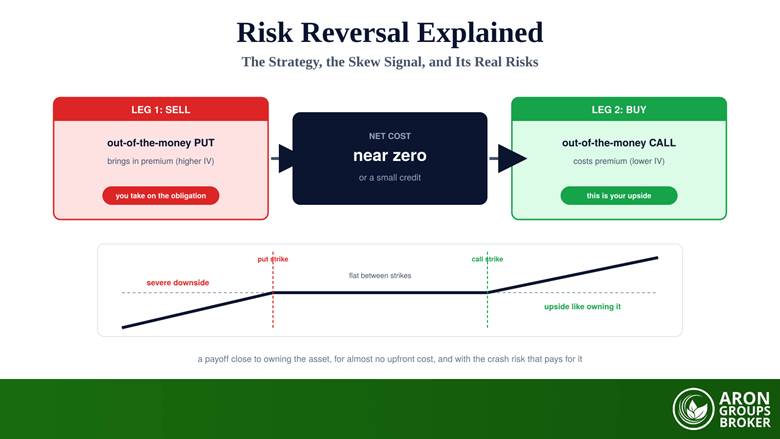
In finance, risk reversal means two related things. As an options strategy, it is selling an out-of-the-money put to finance buying an out-of-the-money call, producing a low-cost bullish position, or the reverse legs for a bearish one. As a market measure, it is the volatility skew reading, usually the 25-delta risk reversal, that compares the implied volatility of out-of-the-money calls against puts to gauge sentiment.

Both meanings come from the same underlying fact: puts and calls are rarely priced symmetrically. Understand that asymmetry and you understand why the strategy can be opened for nearly nothing, why the skew reading works as a fear gauge, and why the whole structure carries a downside that has ended accounts. Treated carelessly it looks like free exposure; treated honestly it is a concentrated bet that needs the same risk management as any leveraged position.

This guide covers the long and short constructions, the skew logic that makes them cheap, why the payoff behaves like a synthetic long, the payoff diagram and break-even, the honest risk warning that belongs at the centre rather than the footnotes, the difference from a collar, and how spot and CFD traders can read the 25-delta reading as a sentiment input without touching options at all.

bookmark
Key Takeaways
  • A long risk reversal sells an out-of-the-money put and buys an out-of-the-money call; the short version reverses the legs.
  • The option sold finances the option bought, so the position often opens for little cost or a small net credit.
  • It works because out-of-the-money puts usually carry higher implied volatility than calls, so you sell the expensive side and buy the cheaper one.
  • The payoff resembles owning the underlying at a fraction of the upfront cost, and it carries the matching downside: selling the put obliges you to buy at that strike.
  • As a metric, a negative 25-delta risk reversal signals demand for downside protection and a positive reading signals bullish skew.

What Is a Risk Reversal?

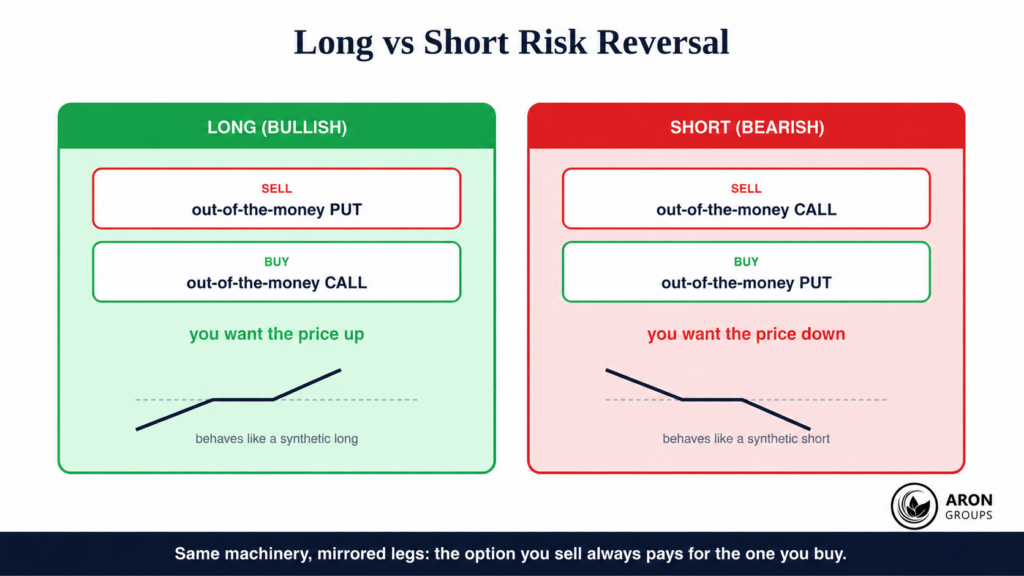
Start with the strategy. A long, or bullish, risk reversal has two legs opened at the same time: you sell an out-of-the-money put below the current price, collecting premium, and you buy an out-of-the-money call above it, paying premium. Because the two premiums roughly offset, the net cost is small, sometimes zero, occasionally a credit. That is the entire appeal: directional exposure without paying full price for a call, and without the capital required to buy the asset outright.

sms-star

Risk Disclosure

CFDs are complex instruments and come with a high risk of losing money rapidly due to leverage. You should consider whether you understand how CFDs work and whether you can afford to take the high risk of losing your money. Past performance is not indicative of future results. This content is provided for educational purposes only and does not constitute investment advice.

Long and Short Constructions

The short, or bearish, risk reversal is the exact mirror: sell an out-of-the-money call and buy an out-of-the-money put. You collect premium from the call, spend it on the put, and profit if price falls far enough. The sold leg always sits on the side you do not expect to be tested, which is precisely why being wrong about direction is expensive rather than merely disappointing.

Long vs Short: The Two Setups Side by Side

Traders describe these positions by what they sell first, which is a useful habit because the sold leg is where the obligation lives. The comparison below sets out both constructions and what each one implies.

Long vs Short: The Two Setups Side by Side

Same machinery, mirrored legs: the option you sell always pays for the one you buy.

ElementLong risk reversalShort risk reversal
Directional viewBullishBearish
Option soldOut-of-the-money putOut-of-the-money call
Option boughtOut-of-the-money callOut-of-the-money put
Typical net costNear zero or a small creditNear zero or a small credit
Behaves likeA synthetic long positionA synthetic short position
Obligation if wrongYou must buy at the put strikeYou must sell at the call strike
Worst caseA sharp crash below the put strikeA sharp rally above the call strike

The rows that matter most are the last two: the obligation and the worst case define the position.

Why It Works: The Volatility Skew

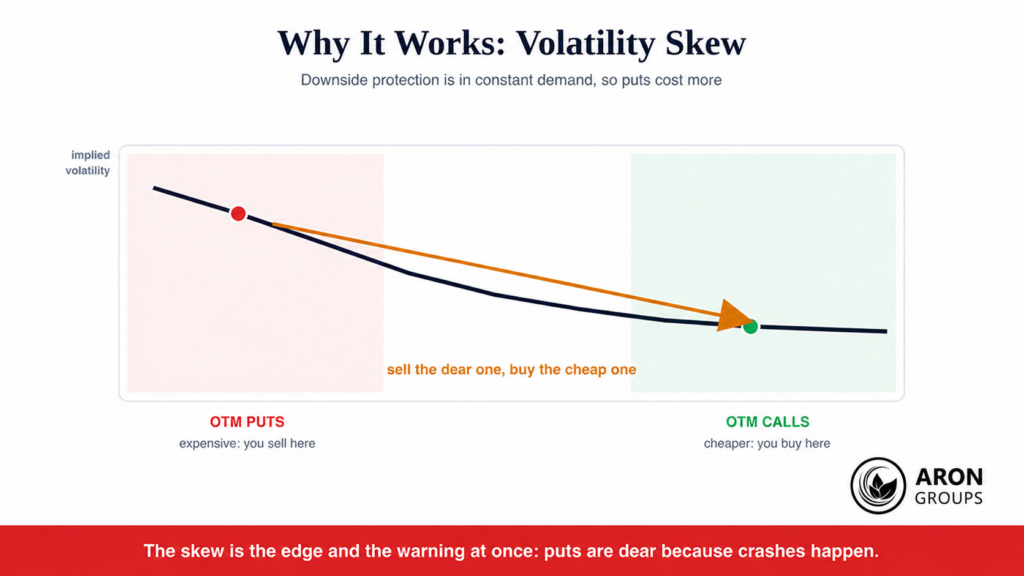
The structure is not free money, it is a trade on pricing asymmetry. In most markets, out-of-the-money puts carry higher implied volatility than equivalently distant calls, because demand for downside protection is close to permanent: funds and corporates buy puts as insurance whether or not they expect a fall. That persistent bid makes puts relatively dear and calls relatively cheap, and the risk reversal simply takes the other side of it, selling the expensive option and buying the discounted one. This is what improves the break-even compared with buying a call outright, and it is a genuine structural edge rather than a pattern someone spotted on a chart.

Why It Works: The Volatility Skew

Implied volatility is not flat across strikes: the risk reversal sells the dear side and buys the cheap one.

The reason the skew exists is also the reason the trade is dangerous, and the two cannot be separated. Puts are expensive because markets fall faster than they rise, and because the losses when they fall are correlated across everything an investor owns. Selling that insurance collects a premium for accepting exactly the risk everyone else is paying to avoid.

It Behaves Like a Synthetic Long

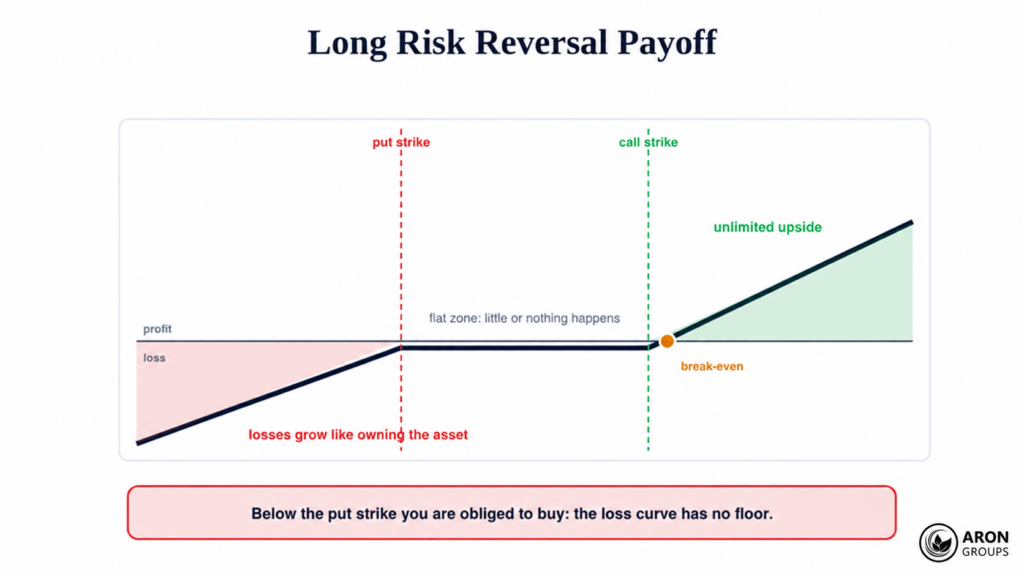
The key intuition is that a long risk reversal produces a payoff close to owning the underlying asset. Above the call strike you gain roughly point for point as price rises. Below the put strike you lose roughly point for point as price falls. Between the strikes, very little happens. That profile is why the position is described as a synthetic long, and why it appeals to anyone who wants equity-like exposure without committing the capital, which is the same trade-off that makes any leveraged strategy attractive and hazardous at once.

It Behaves Like a Synthetic Long

Flat between the strikes, uncapped above the call strike, and unfloored below the put strike.

Mini Example: A Worked Long Risk Reversal

A stock trades at $100. The trader sells the $90 put for $3 and buys the $110 call for $3.20, a net debit of $0.20 per share, or $20 on a standard one-hundred-share contract pair. Between $90 and $110 at expiry, the position is worth almost nothing either way and the trader loses the $20.

Above $110 the call gains value and the break-even sits just above the call strike, at roughly $110.20. Below $90 the sold put is exercised and the trader must buy at $90 regardless of where price actually is. If the stock falls to $60, the obligation to buy at $90 produces a loss of about $3,000 on a position that cost $20 to open. That ratio is the whole risk profile in one sentence.

The Honest Risk Warning

This is not a beginner strategy, and the reason is specific rather than general. Selling the put is not a bet, it is an obligation: if price finishes below that strike you are required to buy the underlying there, and the loss grows without a floor as price falls further. A structure that cost almost nothing to open can produce a loss many multiples of the account it sits in, which is why position sizing has to be calculated from the put strike rather than from the premium paid. The European regulators’ finding that the large majority of retail accounts lose money on leveraged products applies with particular force to structures whose low entry cost disguises their true exposure.

sms-star

Risk Warning: The only defensible test: open a long risk reversal only if you would genuinely be willing, and financially able, to buy the underlying at the put strike with cash. If that sentence is uncomfortable, the position is too large or the strategy is not for you.

Q: Is a risk reversal safer than buying a call, because it costs less?

A: No, it is considerably more dangerous. Buying a call risks only the premium, and your maximum loss is known the moment you open it. A risk reversal reduces the cost by selling insurance, which replaces a capped loss with an open-ended one. Cheaper to open is not the same as smaller risk.

Risk Reversal vs Collar: The Common Confusion

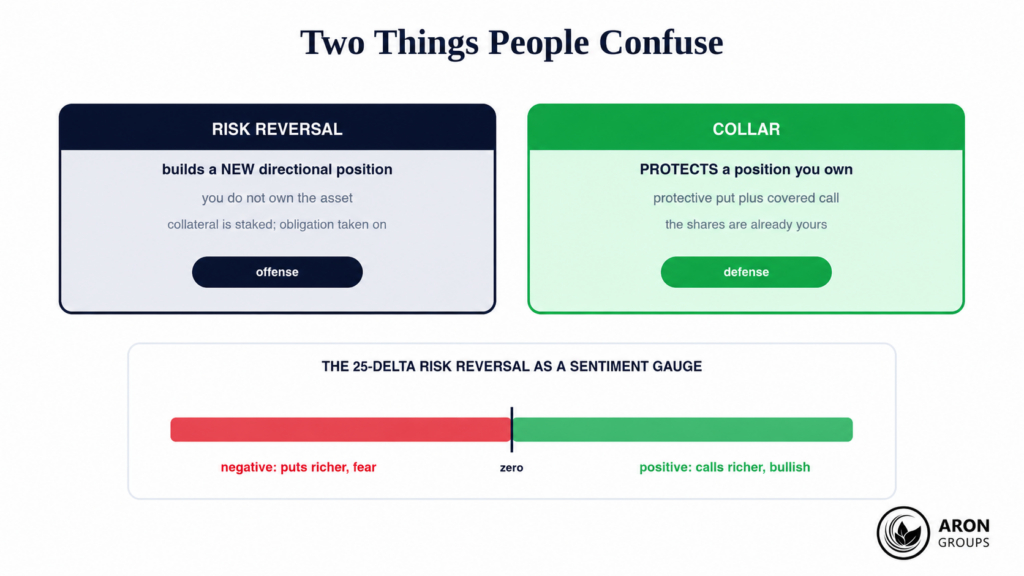
These two structures use the same option types and mean nearly opposite things, which is why they get muddled constantly. A collar is defensive: you already own the shares, you buy a protective put to limit the downside, and you sell a covered call to pay for it. Your risk was already there, and the collar caps it at both ends. A risk reversal is offensive: you own nothing, and you are building fresh directional exposure by staking collateral and accepting an obligation. One reduces existing risk; the other creates new risk.

Risk Reversal: The Options Strategy, the Volatility-Skew Signal, and Its Real Risks

A collar defends a position you already hold; a risk reversal creates one you do not.

The 25-Delta Risk Reversal as a Sentiment Gauge

Beyond the strategy, desks track risk reversal as a number. The 25-delta risk reversal is the difference in implied volatility between a 25-delta call and a 25-delta put, and it summarises which side of the market is paying up for protection. A negative reading means puts are richer than calls, which signals fear and a bearish skew; a positive reading means calls are richer, which signals bullish positioning. Currency desks watch it across the majors, and crypto desks watch Bitcoin and Ether risk reversals on venues such as Deribit, where the readings often move before spot does. Given the scale of the currency options market documented by the BIS, these are not fringe numbers.

Reading It Without Trading Options

Most retail forex and crypto traders will never run an options book, and they do not need to in order to use this. The skew reading is one more sentiment input alongside positioning data and volatility measures: a sharply negative risk reversal tells you the market is paying heavily for downside protection, which is context for a long spot position rather than a signal against it. Treat it exactly as you would treat any sentiment gauge, as one weight on the scale, confirmed by structure and validated through out-of-sample backtesting before it changes a single entry.

Where This Leaves Spot and CFD Traders

The practical translation is short. If you trade spot currencies, metals, or crypto, the risk reversal reading is sentiment information you can add to your process for free, best used alongside volatility context from tools such as Keltner Bands. The strategy itself belongs to traders with options access, the capital to honour an assignment, and a clear reason to prefer it over simply taking a position in the underlying.

If your goal is directional exposure with defined risk, a plain position with a hard stop and a fixed risk-to-reward ratio is more transparent than any structure that hides its worst case in a strike price. That is the version of this trade a systematic process can actually measure.

Where Aron Groups Fits

Aron Groups offers spot and CFD instruments rather than an options book, so the useful application here is the skew reading, not the structure. Track the risk reversal numbers as sentiment for the pairs and coins you trade, then execute on the MetaTrader 5 platform with hard stops and defined risk, and rehearse any new sentiment input on a demo account before it earns a place in your rules.

When it goes live, a small account keeps the cost of learning proportionate while you judge whether the input actually improves your equity curve over months. The foundations of entries and exits are covered in our guide on how to trade forex.

Conclusion

A risk reversal is one idea wearing two hats. As a strategy, it sells the expensive side of the volatility skew to finance the cheap side, delivering a payoff close to owning the asset for almost no upfront cost, with an obligation attached that has no floor beneath it. As a measure, the 25-delta reading turns that same asymmetry into a sentiment gauge anyone can read.

The honest summary is that the metric is useful to almost everyone and the structure is appropriate to very few. If you cannot comfortably buy the underlying at the put strike in cash, you are not trading a low-cost bullish view, you are underwriting someone else’s insurance. Keep capital preservation ahead of cleverness, and the discipline of a professional trader ahead of both.

Frequently Asked Questions

Quick answers to the questions traders ask most about risk reversals, both the strategy and the skew reading.

What is a risk reversal in options?

It is a two-leg position: for a bullish view you sell an out-of-the-money put and buy an out-of-the-money call, so the premium collected pays for the premium spent. The bearish version reverses the legs. The result behaves much like owning or shorting the underlying at a fraction of the upfront cost.

What is the difference between a risk reversal and a collar?

A collar protects shares you already own using a protective put and a covered call. A risk reversal creates a new directional position in something you do not own, staking collateral and taking on an obligation. One is defensive and caps existing risk; the other is offensive and adds risk.

What does a negative 25-delta risk reversal mean?

It means out-of-the-money puts carry higher implied volatility than out-of-the-money calls, so the market is paying more for downside protection. Traders read that as fear or bearish skew. A positive reading means the opposite, with calls bid up and positioning tilted bullish.

Is a risk reversal suitable for beginners?

No. The sold leg is an obligation, not a bet, so a sharp move against you produces losses far larger than the cost of opening the position. It should only be used by traders who could and would take delivery at the sold strike, and who size the position from that strike rather than from the premium.

Continue Reading
not-found
calendar 12 August 2026
Rate this article

Leave a Reply

Your email address will not be published. Required fields are marked *

No thanks