
icon icon Home
icon icon Accounts
icon icon Quick start
icon icon Symbols

AI Stock Prediction Tools: The Types, What They Actually Do, and Why AI Is Not a Crystal Ball

Author
Abe Cofnas
Abe Cofnas
calendar Last update: 16 October 2026
watch Reading time: 9 min

AI stock prediction tools are software products that use machine learning to scan markets, score stocks or forecast price moves from large amounts of data. They range from real-time scanners such as Trade Ideas to rating systems such as Danelfin and TipRanks. They can process far more information than any person, but none of them can reliably predict prices.

Interest has never been higher. Brokers are building AI assistants into their apps, and Interactive Brokers added ChatGPT and Grok integrations in June 2026. Regulators are just as busy: the SEC, the CFTC and ESMA have all warned investors about exaggerated AI claims.

This guide explains the main types of AI stock tools, how they work, what the evidence says about AI prediction and how to use these tools without being misled. Note that AI tools are different from AI stocks, the shares of companies that build or sell AI.

bookmark
Key Takeaways
  • AI stock prediction tools use machine learning to scan, score or forecast stocks; they are research aids, not crystal balls.
  • The main types are scanners, pattern and trend engines, scores and ratings, and research assistants, and each looks over a different horizon.
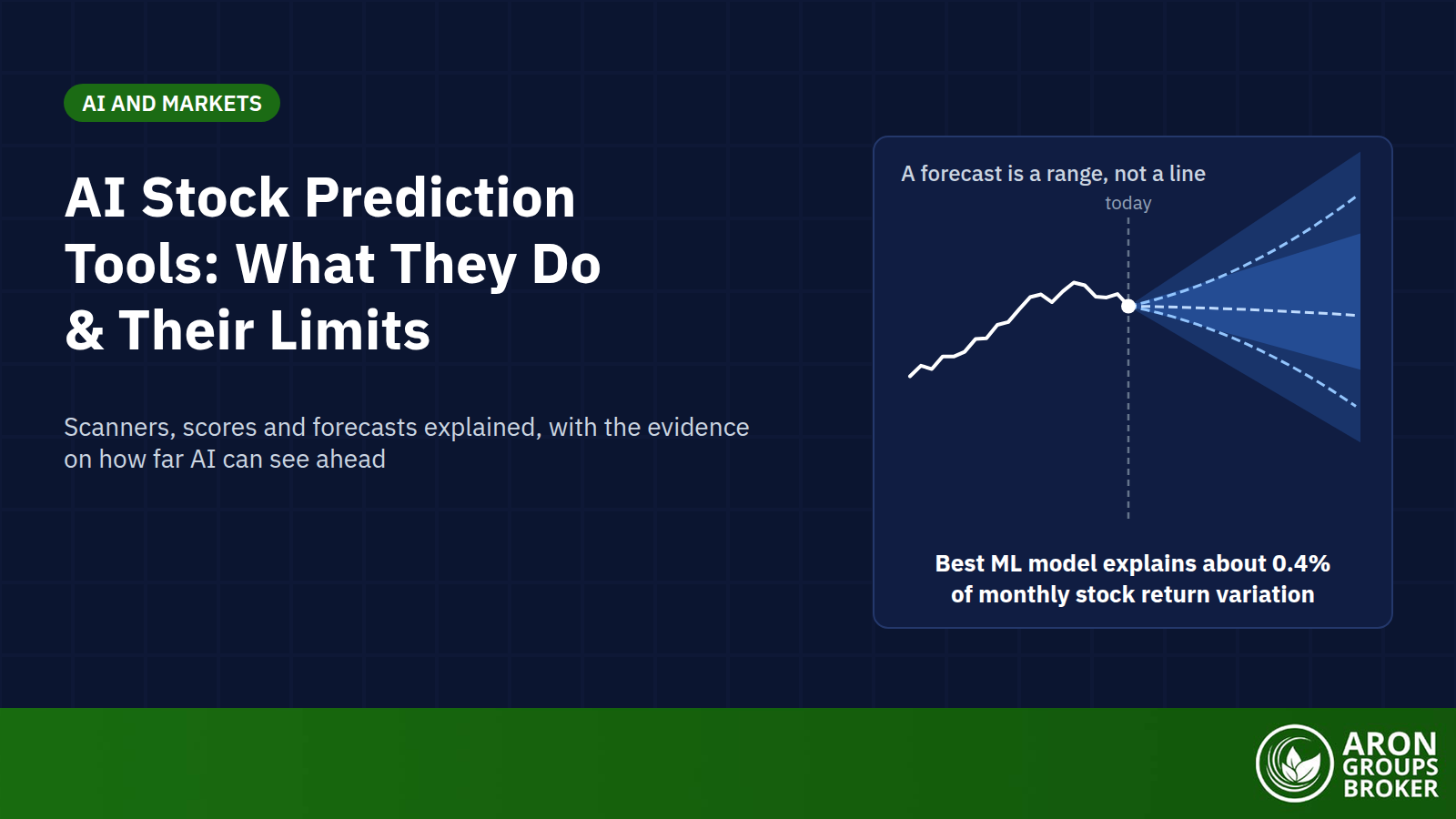
  • In a major academic test, the best machine-learning model explained about 0.4% of monthly stock return variation, and published signals fade once widely known.
  • Vendor accuracy figures are the vendors' own claims; regulators have fined firms for false AI claims and warn that AI cannot predict sudden market changes.
  • Use AI output as one input: check the horizon, test it out of sample and on paper, and make sure any edge can beat the fee and trading costs.

What Are AI Stock Prediction Tools?

AI stock prediction tools apply machine learning, the branch of AI that finds patterns in data, to financial markets. They digest prices, volumes, company fundamentals, news and social media sentiment, then turn the result into an alert, a pattern signal, a score or a written summary.

sms-star

Risk Disclosure
Trading forex and CFDs carries a high level of risk and can result in the loss of all your capital. This content is educational and is not investment advice. Never risk money you cannot afford to lose.
AI Tools Versus AI Stocks and AI Trading Bots

Three terms often get mixed up. AI tools help you research or time trades, while AI stocks are the shares of companies that build or sell AI. AI trading software and bots go a step further and place orders automatically, which adds execution risk on top of prediction risk.

The Main Types of AI Stock Tools

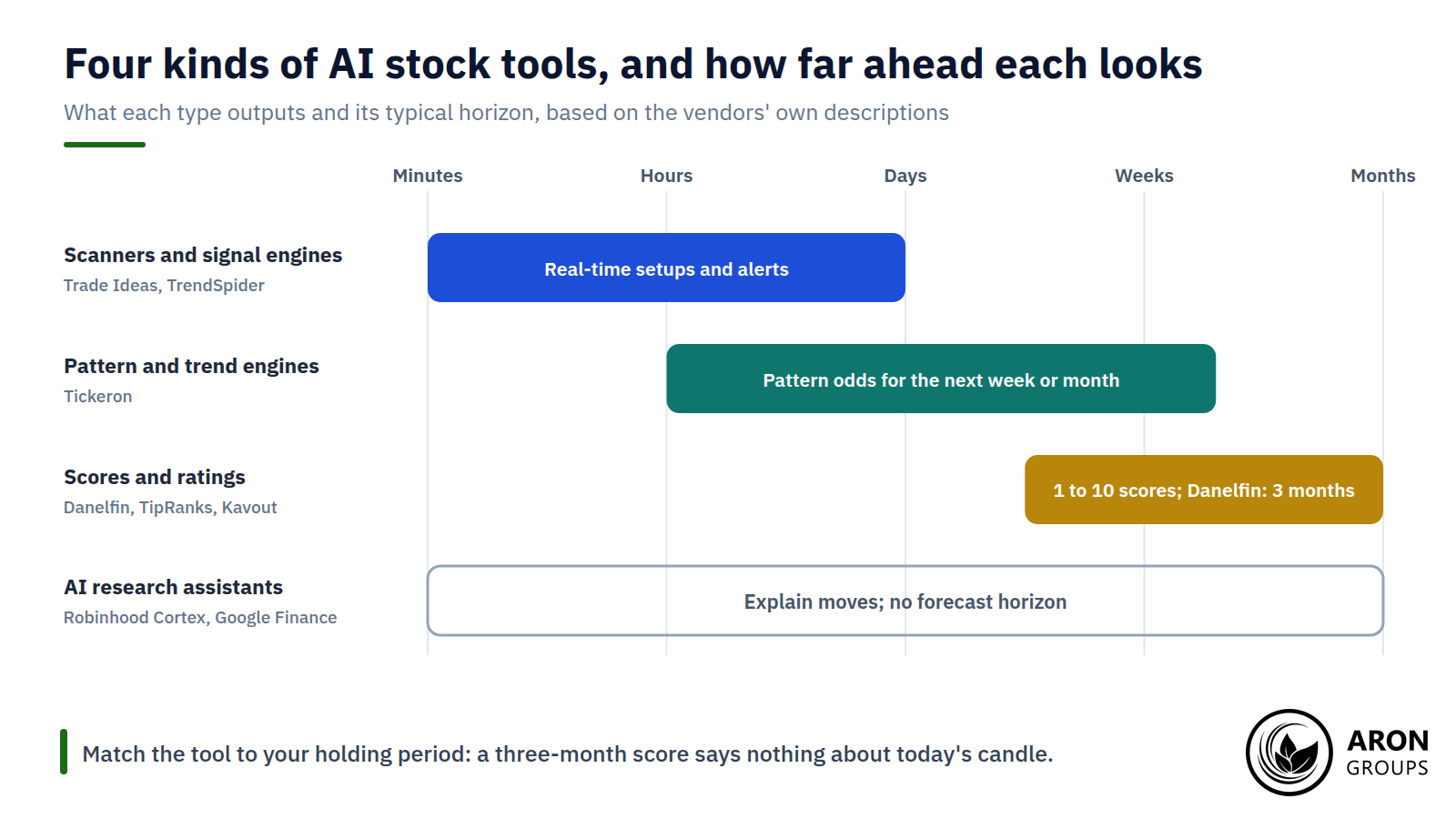
Most products fall into four groups, and each answers a different question over a different horizon:

  • Scanners and signal engines: Trade Ideas and TrendSpider scan the market in real time for setups. Trade Ideas’ Holly assistant re-optimises its strategies every night using simulated backtests.
  • Pattern and trend engines: Tickeron detects chart patterns and trends and attaches a confidence level, which users can set anywhere up to 80%.
  • Scores and ratings: Danelfin rates stocks from 1 to 10 by their probability of beating the market over three months. TipRanks’ Smart Score combines eight factors, and Kavout’s Kai Score runs from 1 to 9.
  • Research assistants: tools such as Robinhood’s Cortex and the AI version of Google Finance summarise why a stock is moving rather than forecasting where it goes.

The horizon matters as much as the output. A three-month outperformance score says nothing about tomorrow’s candle, and an intraday scanner alert says nothing about next quarter.

Scanners work in minutes to days, pattern engines over days to a month and scores over months, while research assistants explain moves without forecasting them.

Screeners Versus Predictors

A scanner is closer to a filter than a forecast. It narrows thousands of stocks to a short list that matches your rules, much as a momentum stock scanner does. Predictors go further by attaching probabilities, and that is where claims deserve the most scrutiny. Pricing reflects the split: Trade Ideas reserves its Holly AI assistant for Premium subscribers at $2,268 a year, while its $1,068 Standard plan offers scanning without Holly.

ToolMain outputHorizonFree optionPaid from (Sep 2026)
DanelfinAI Score, 1 to 10Next 3 monthsYes, limited$264 a year
TipRanksSmart Score, 1 to 10, from 8 factorsNot statedYes, limited$360 a year
KavoutKai Score, 1 to 9Not statedYes, 10 credits a month$192 a year
TickeronPattern and trend signals with confidence levelsNext week or monthSome tools free to trySubscription for signals
Trade IdeasReal-time scans; Holly AI ideas on PremiumIntradayNone shown$1,068 a year
TrendSpiderCharting, scans and no-code ML signal modelsIntraday to weeksPaid 14-day trialAbout $629 a year

Popular AI stock tools compared. Sources: each vendor’s website, accessed 24 September 2026; TipRanks pricing from a May 2026 review. Prices change often, so check before you subscribe.

New Entrants in 2025 and 2026

Brokers and big tech firms are building AI straight into trading apps. Robinhood announced its Cortex research assistant for Gold members in March 2025, and Google began testing an AI version of Google Finance that August. In June 2026 Interactive Brokers added ChatGPT and Grok to its existing Claude integration. The AI drafts orders, but clients must approve each one before it reaches the market.

How AI Stock Prediction Works

Under the hood, most tools follow the same pipeline: collect data, turn it into features, train a model on past outcomes and output a probability or score. A 2024 review of the research found that support vector machines, long short-term memory networks and other neural networks are the most common models. Past closing prices are the most common input.

Commercial tools add far more. TipRanks, for example, blends analyst ratings, insider transactions, hedge fund activity, blogger and investor sentiment, news sentiment, technicals and fundamentals into its Smart Score. Other tools add earnings data, valuations and alternative data such as social media activity.

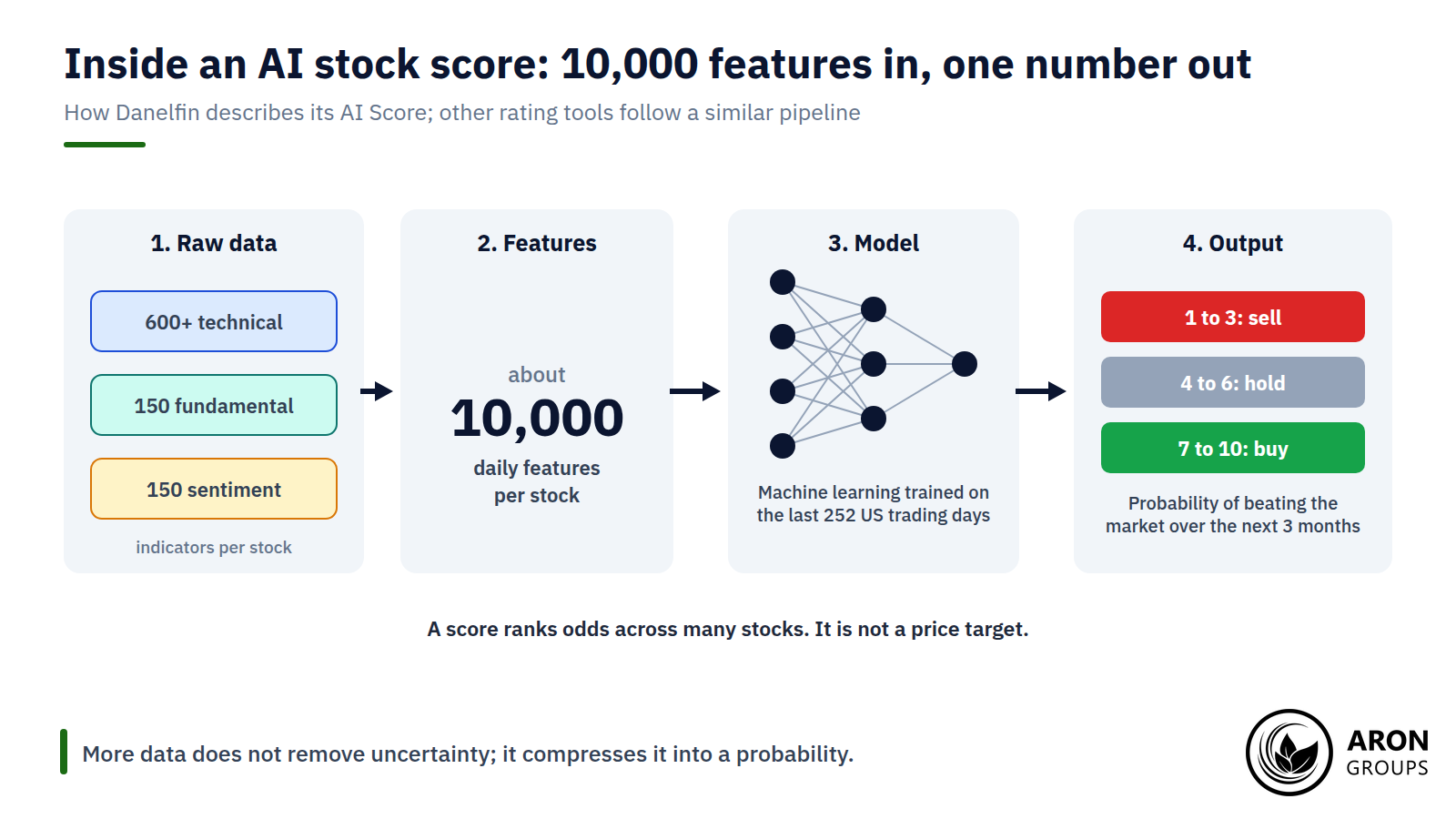
Danelfin is a useful example because it publishes its method. It calculates about 10,000 features per stock each day from more than 600 technical, 150 fundamental and 150 sentiment indicators. Its model learns from the latest 252 trading days of US data and outputs a single score.

Danelfin's description of its AI Score: about 10,000 daily features per stock feed a model that outputs the probability of beating the market over three months.

What a Score Really Means

A score is a ranking, not a price target. A Danelfin score of 7 to 10 means its model sees a higher probability of beating the market over three months, not that the stock will rise. TipRanks labels scores of 8 to 10 Outperform and says its backtests do not indicate future results.

Sentiment Analysis

Sentiment tools score the tone of news, social media and analyst commentary, much as the fear and greed index summarises market mood. Research suggests the signal is real but fragile. One study found that ChatGPT’s news scores predicted returns, especially for small stocks and bad news, but that the gains shrank as more investors adopted such tools.

Can ChatGPT Predict Stocks?

General chatbots such as ChatGPT can summarise filings, explain indicators and help write code, but they are not built to forecast prices and can state wrong numbers confidently. ESMA warns that public AI tools are not authorised or supervised, and that nobody and nothing, AI included, can accurately predict markets.

Can AI Really Predict Stock Prices?

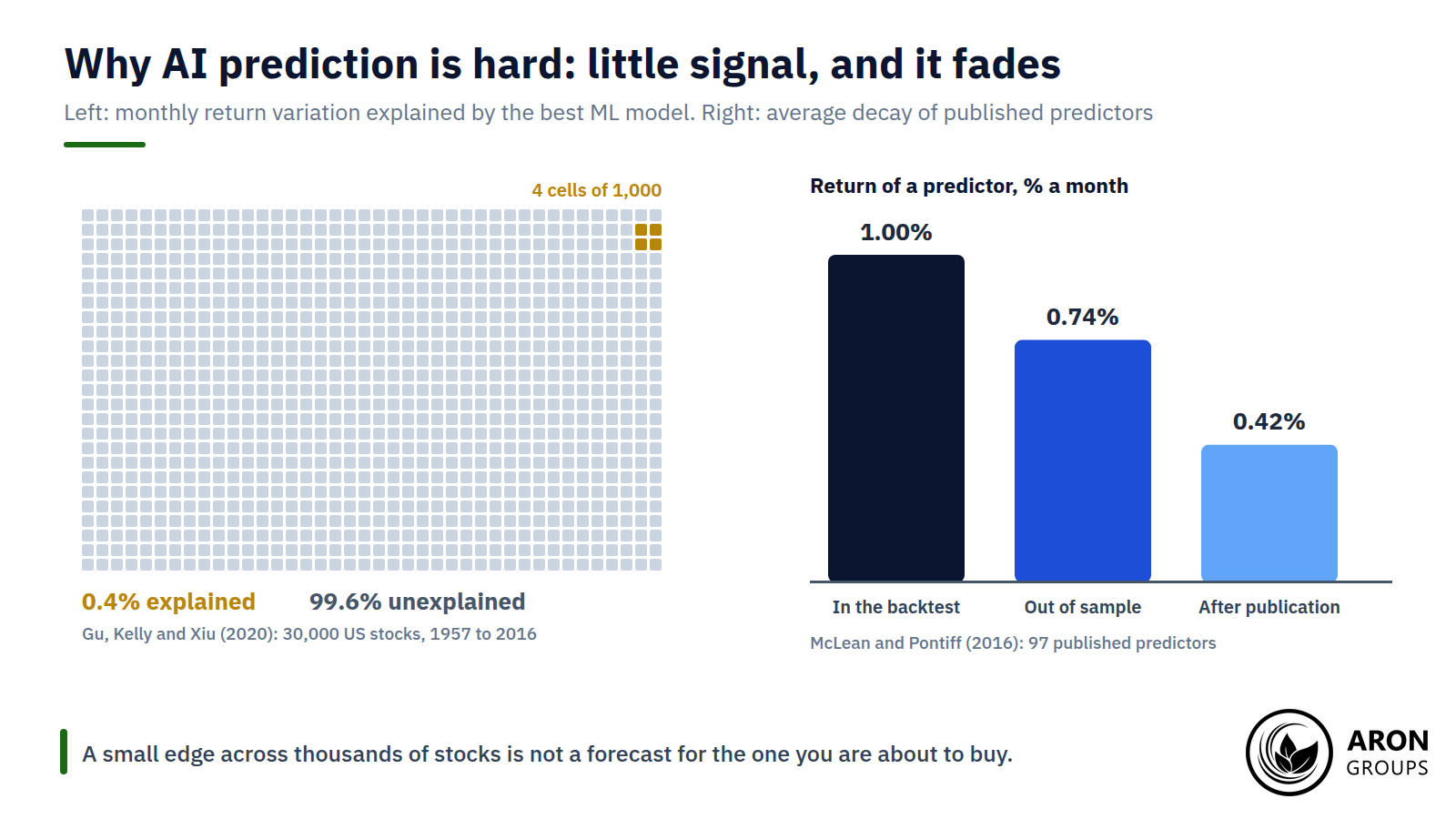
The honest answer is: a little, on average, across many stocks, and not reliably for any single trade. A major academic study covered about 30,000 US stocks from 1957 to 2016. Its best machine-learning model explained about 0.4% of the monthly variation in individual stock returns, leaving about 99.6% unexplained.

That small edge still mattered for diversified portfolios. A long-short portfolio built from the neural network’s forecasts reached a Sharpe ratio of 1.35, against 0.61 for a simple linear model, before trading costs. But a statistical edge spread over thousands of stocks is very different from a tool that tells you where one share is heading.

The best model explained about 4 in every 1,000 units of monthly return variation, and published predictors lost 26% of their return out of sample and 58% after publication.

Why Edges Fade

Markets adapt. A study of 97 published return predictors found their returns were 26% lower out of sample and 58% lower after publication. The authors put the extra fall after publication down to investors trading on the findings. On those averages, a signal earning 1.00% a month in a backtest would earn about 0.74% out of sample and 0.42% once widely known.

Mini Example: What a Backtest Might Really Be Worth

Suppose a vendor’s backtest shows a strategy earning 1.2% a month. Applying the average decay from the study of 97 predictors, you might expect about 0.89% a month out of sample and 0.50% once the signal is widely known.

On a $5,000 account, 0.50% a month is about $300 a year before trading costs. That is barely more than a $264 annual subscription, which would leave you with almost nothing for the risk you took.

The 2% of Traders Myth

You may see the claim that only about 2% of retail traders predict moves well. We could not find a study that says this, and the research measures profitability rather than prediction. The real numbers are harsher. Fewer than 1% of Taiwanese day traders reliably earned positive returns after fees, and in Brazil 97% of persistent day traders lost money, while only 0.4% earned more than a bank teller. In Europe, ESMA found that 74% to 89% of retail CFD accounts typically lose money.

The Traps: Overfitting, Black Boxes and Hype

The biggest technical trap is overfitting: a model that memorises past noise looks brilliant in a backtest and fails live. Researchers have shown that very good simulated performance is easy to achieve after testing relatively few strategy variants, which is why out-of-sample testing matters.

Black Boxes and Small Samples

Many scores are black boxes, so you cannot see why a stock ranks highly or whether the logic still holds. Watch sample sizes too: Tickeron’s own guide shows 75% odds derived from just four past instances, three of which worked.

Vendor Claims and AI Washing

Treat accuracy figures as marketing until proven otherwise. Danelfin reports that its Best Stocks strategy returned 376% from January 2017 to June 2025, against 166% for the S&P 500. Tickeron claims up to 70% accuracy for select securities. Neither figure is an independent audit.

Regulators have acted against false claims. In March 2024 the SEC fined two investment advisers a combined $400,000 for exaggerating their use of AI, a practice known as AI washing. The CFTC warns that AI cannot predict the future or sudden market changes, and cites a bot scheme that took more than $1.7 billion in bitcoin.

Red Flags to Watch For

Walk away, or at least dig deeper, if a tool or promoter shows any of these signs:

  • Guaranteed returns: no legitimate tool can promise profits, whatever its model.
  • Accuracy without context: a figure such as 90% means little unless you know the period, the horizon and how success is measured.
  • No regulatory status: check whether the provider is authorised where you live, and search regulators’ warning lists before paying.
  • Pressure to deposit or join a private chat group: in December 2025 the SEC charged operators of fake AI investment clubs that cost US investors at least $14 million.
  • A perfect predictor for a small fee: anyone with a reliable edge could earn far more by trading it than by selling it.

How to Use AI Stock Prediction Tools Wisely

Used well, AI tools save time and widen your search. The key is to treat their output as one input in a process you control.

Step 1: Know What the Output Predicts

A 1 to 10 score for the next three months is not an entry signal for today, and a scanner alert is not a view on the business. Match the tool’s horizon to how long you hold positions.

Step 2: Test It Out of Sample

Record the tool’s signals before you act on them, then compare the results with a simple benchmark over several months. Walk-forward optimisation, which retrains and tests on rolling windows, is a disciplined way to check a strategy.

Step 3: Paper Trade First

Following signals on a paper trading account costs nothing and shows how they behave in live conditions, including slippage and gaps. Keep a simple log of each signal, your decision and the outcome.

Step 4: Price In the Fee

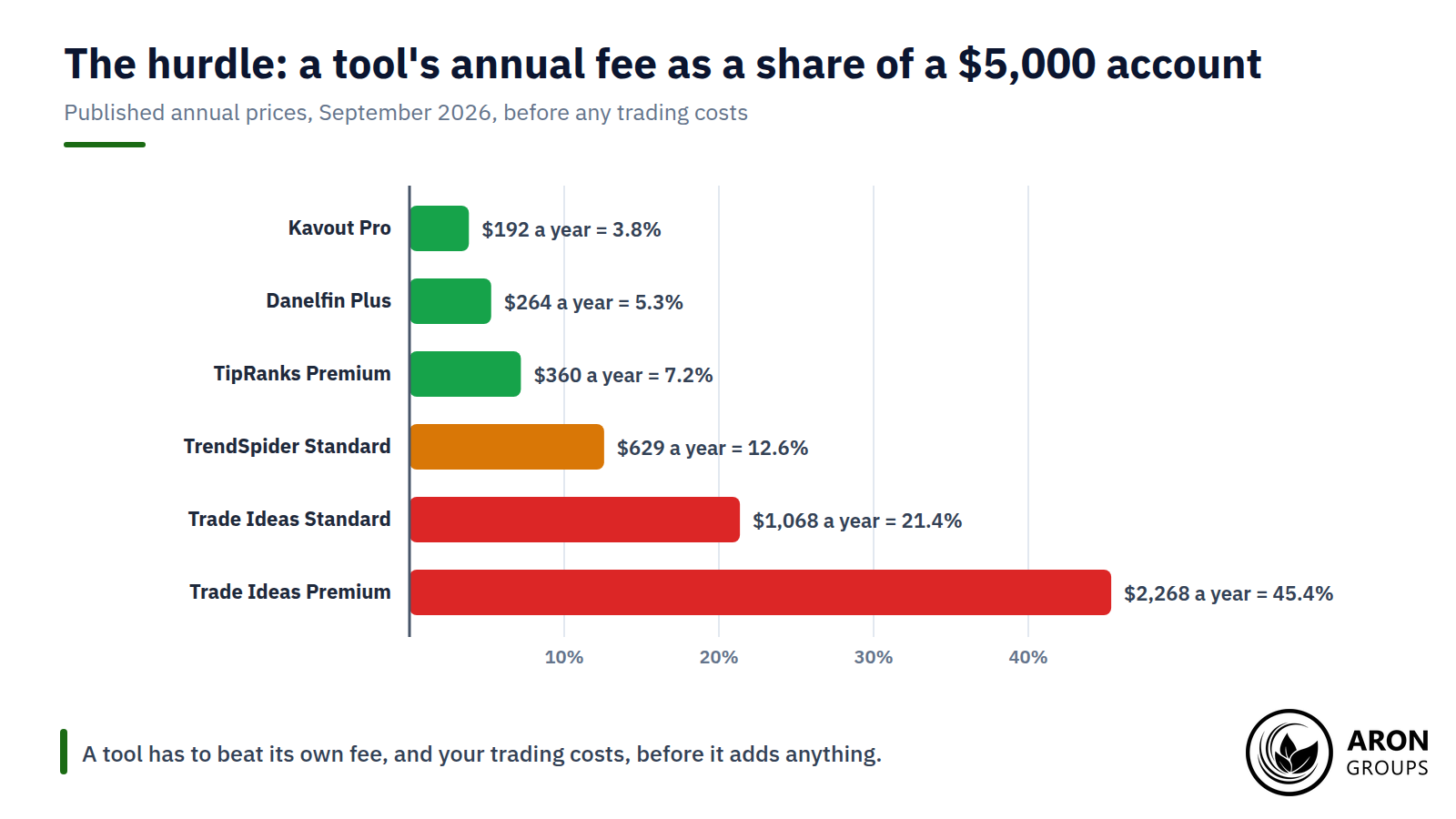
On a $5,000 account, a $264 annual plan is a 5.3% hurdle and a $2,268 plan is a 45% hurdle, before any trading costs. The tool must clear that hurdle before it adds anything.

Annual subscription prices as a share of a $5,000 account range from 3.8% for Kavout Pro to 45.4% for Trade Ideas Premium.

Beyond Stocks: AI Tools for Forex, Gold and Crypto

The same ideas reach other markets. Machine-learning signals, sentiment models and pattern engines are used on currency pairs, gold and crypto, and indicator-based tools such as GainzAlgo market buy and sell signals across these assets.

The lessons carry over too. No indicator reliably predicts the next candle, so check the horizon, test out of sample and size positions for the times the model is wrong. Leverage makes that last point even more important.

The Honest Limits of AI Prediction

AI cannot foresee shocks that are absent from its training data, such as wars, pandemics or sudden policy changes. Markets also adapt, so a pattern that worked can vanish once many traders exploit it. Black-box scores make it hard to know when a model has stopped working. The Bank for International Settlements has also warned that many firms using similar algorithms could amplify herding and fire sales.

The realistic promise of AI is speed and breadth: scanning more stocks, reading more news and testing more ideas than you could alone. Judgement, risk control and patience remain your job.

Where Aron Groups Fits

Aron Groups offers forex, gold and crypto CFDs through MetaTrader 5, where you can run your own indicators and automated strategies. If you are exploring AI trading bots, test them on historical data there before you trust them with money.

A demo account lets you forward-test AI signals in live market conditions without risking capital. Use it to check whether a tool genuinely adds to your trading edge before you commit real funds.

Conclusion

AI stock prediction tools are powerful research aids. Scanners find setups faster, scores rank thousands of stocks and research assistants summarise the news. None of them can see the future, and the evidence shows how small and fragile market-beating signals are.

Treat every score and signal as one input. Check what it predicts and over what horizon, test it out of sample and on paper, and weigh the fee against any edge it offers. The traders who get the most from AI use it to sharpen a process they already understand.

Frequently Asked Questions

Quick answers to common questions about AI stock prediction.

Is there any AI that can predict stocks?

No tool predicts stock prices reliably. Some models find small statistical edges across many stocks, and tools such as Danelfin, TipRanks and Tickeron turn them into scores or signals, but their accuracy figures are the vendors’ own claims.

Can ChatGPT give stock predictions?

It can discuss stocks and summarise news, but it is not built to forecast prices and can be confidently wrong. Use it for research and coding help, and check every number it gives you.

What is the best AI stock picker?

It depends on your horizon and budget. Score-based tools such as Danelfin, TipRanks and Kavout rank stocks and offer free plans, while Trade Ideas targets active day traders. Test any tool on paper before paying.

Are there free AI stock pickers?

Yes. Danelfin, TipRanks and Kavout have free plans with limited features, and Tickeron lets you try some of its tools for free. Trade Ideas shows no free plan, and TrendSpider offers only a paid trial.

Continue Reading
not-found
calendar 16 October 2026
Rate this article

Leave a Reply

Your email address will not be published. Required fields are marked *

No thanks