
icon icon Home
icon icon Accounts
icon icon Quick start
icon icon Symbols

Liquid Staking Explained: How to Earn Staking Rewards Without Locking Up Your Crypto

Author
Abe Cofnas
Abe Cofnas
calendar Last update: 11 November 2026
watch Reading time: 9 min

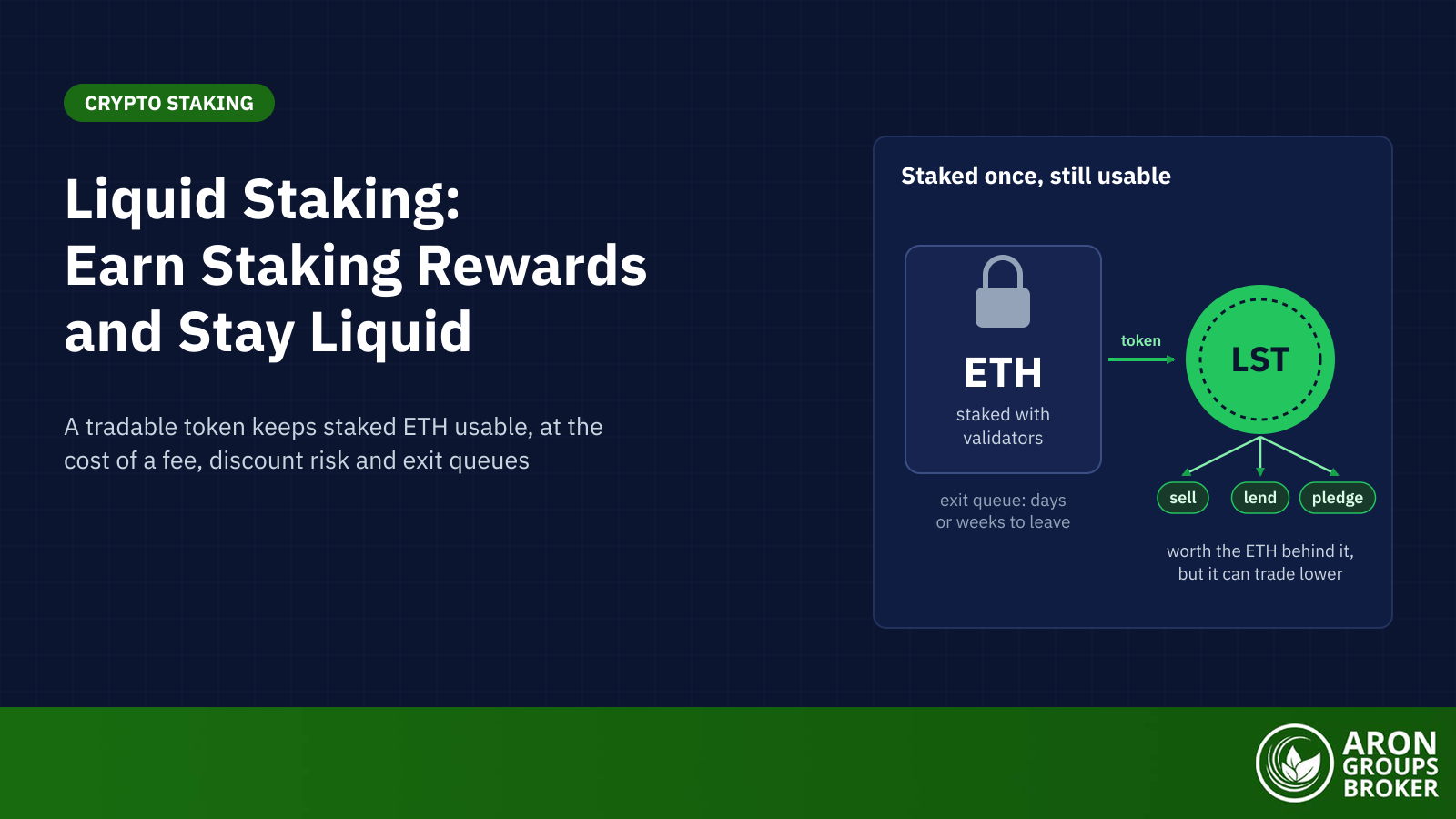
Liquid staking is a way to stake a proof-of-stake coin such as ETH and still hold a usable asset. A protocol stakes the deposit and issues a liquid staking token in return. That token stands for the staked ETH plus its rewards. It can be sold or used in decentralised finance (DeFi) while the ETH stays staked.

Over a third of Ethereum’s supply is staked. On 20 October 2026, validatorqueue.com data reported by CryptoTicker showed 44.1 million ETH staked, 36.07% of circulating supply. That stake secures Ethereum’s proof of stake network. Leaving can be slow: on 10 October 2026, CryptoTicker put the exit queue at 964,365 ETH, a wait of 16 days and 18 hours.

This guide explains how liquid staking works, how rebasing and value-accruing tokens differ and how the main tokens compare. It then covers DeFi uses and dated risks, from stETH in 2022 to ezETH in 2024. It ends with restaking, regulation and how an ETHUSD CFD differs.

bookmark
Key Takeaways
  • Liquid staking turns staked ETH into a tradable token. The token represents the stake plus rewards, so it can be sold or used in DeFi.
  • Staking rewards are variable and not guaranteed. The FCA put ETH staking at about 1.5% to 4% APY on August 2025 data.
  • Rebasing stETH adds tokens as rewards arrive. wstETH, rETH and cbETH keep a fixed balance whose ETH value rises instead.
  • Liquid staking tokens can trade below the ETH behind them. On DefiLlama daily prices, stETH fell to 0.934 ETH on 19 June 2022.
  • An ETHUSD CFD earns no staking rewards. Overnight swaps can be charged or credited, and leverage magnifies losses.

What Is Liquid Staking?

Liquid staking is staking through a protocol that hands back a token for the staked deposit. The protocol pools deposits, assigns them to node operators who run validators, and passes on rewards after a fee. In the FCA’s July 2026 market description, liquid staking users receive a liquid staking token (LST) “which represents the value of their staked assets”. Liquid staking is an on-chain DeFi activity, not the same as CFD trading.

sms-star

Risk Disclosure
Trading forex and CFDs carries a high level of risk and can result in the loss of all your capital. This content is educational and is not investment advice. Never risk money you cannot afford to lose.
Liquid Staking Tokens and Liquid Staking Derivatives

Liquid staking tokens were often called liquid staking derivatives (LSDs), and both names describe the same receipt. In 2025, staff at the US Securities and Exchange Commission (SEC) called them “Staking Receipt Tokens”. Widely used Ethereum examples include Lido’s stETH and its wrapped form wstETH, Rocket Pool’s rETH and Coinbase’s cbETH. Each is a form of tokenisation: a token that stands for assets held elsewhere.

Liquid Staking Crypto Beyond Ethereum

Liquid staking is not limited to ETH. Other proof-of-stake networks support it too, and Ankr’s aBNBc, discussed below, was a liquid staking token for BNB. Staking rates differ by network: the FCA’s August 2025 ranges were about 3% to 6% for Solana and 2% to 5% for Cardano. This guide focuses on Ethereum, where the tokens above are issued.

How Liquid Staking Works

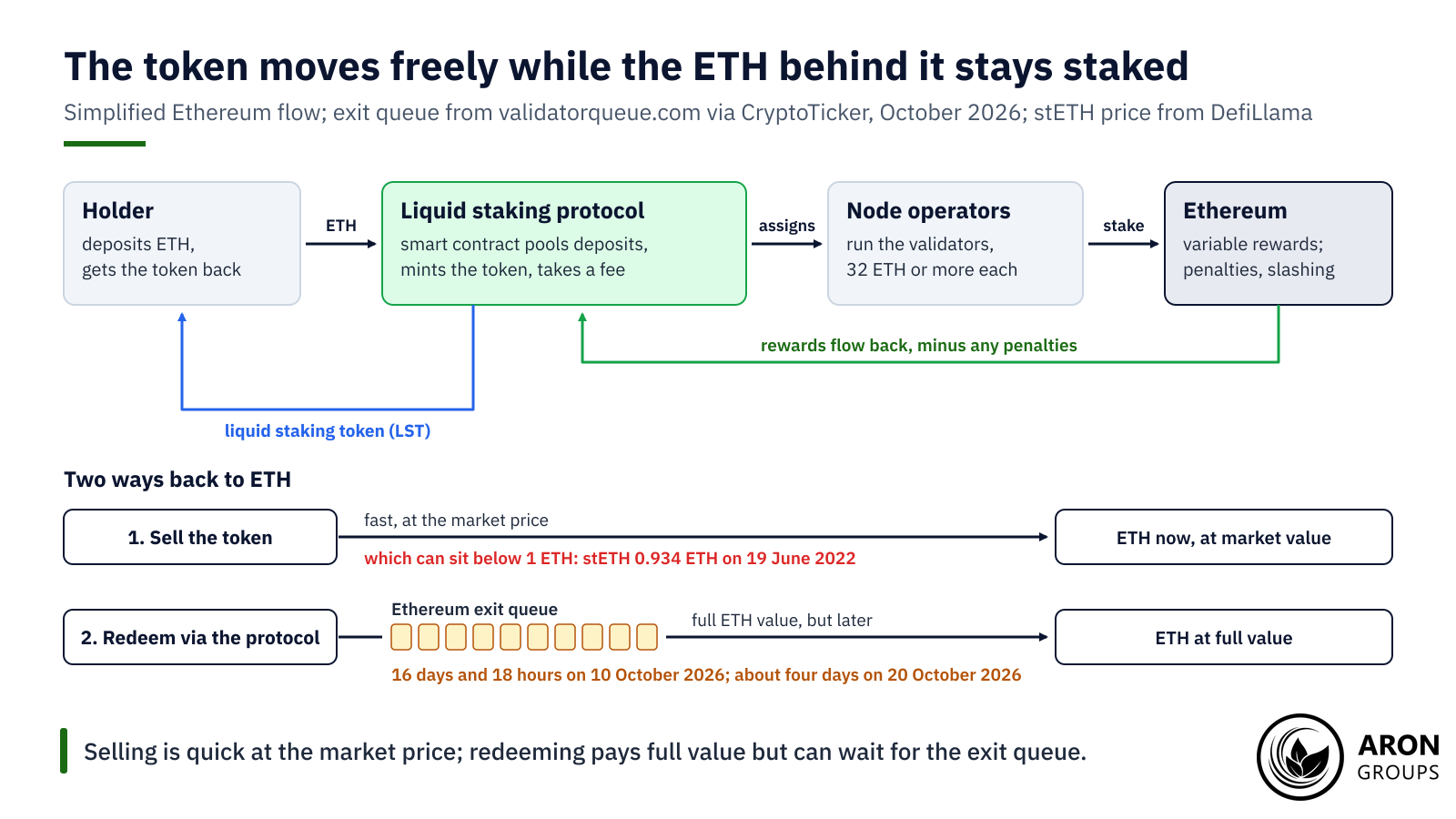
A holder deposits ETH into a liquid staking protocol’s smart contract. The protocol groups deposits into validators, which need at least 32 ETH each, and node operators run them. Validators earn rewards for proposing and attesting to blocks, and face penalties or slashing for faults. The protocol mints the token to the depositor and takes a fee from rewards; Lido’s is 10%.

Rewards are variable. The FCA’s July 2026 description of the UK cryptoasset market put ETH staking at about 1.5% to 4% a year on August 2025 data. It notes that rewards vary by platform, asset, network and market conditions.

There are two ways back to ETH. Selling the token is fast but happens at the market price, which can sit below the ETH the token represents. Redeeming through the protocol returns the token’s full ETH value, but can mean waiting for validators to clear Ethereum’s exit queue.

Rewards flow back into the token, and holders leave either by selling it or by redeeming through the exit queue.

Rebasing vs Value-Accruing Tokens

Protocols show rewards in one of two ways. A rebasing token such as stETH is designed to trade near one ETH and raises every holder’s balance; Lido’s oracle updates balances daily. A value-accruing token such as wstETH, rETH or cbETH keeps the balance fixed, while the ETH value of each token rises.

Mini Example: One Year of Rewards in Two Token Designs

These numbers are illustrative: 10 ETH staked for a year at a 3.0% gross reward, a 10% fee and steady market prices.

Gross rewards are 10 × 3.0% = 0.30 ETH. The fee takes 0.30 × 10% = 0.03 ETH, leaving 0.27 ETH, or 2.7%. A rebasing balance grows from 10.00 to 10.27 tokens, each still worth about one ETH.

A value-accruing token priced at 1.25 ETH on deposit gives 10 ÷ 1.25 = 8 tokens. A year later each is worth 1.25 × 1.027 = 1.28375 ETH, so the 8 tokens are worth 10.27 ETH. The reward is the same, and the difference lies in the bookkeeping.

A discount changes the result for a seller. At 0.99 ETH per token, 10.27 stETH fetch 10.1673 ETH. A 1% discount therefore removes 38% of the year’s 0.27 ETH reward.

The Problem It Solves: Staked ETH Is Slow to Unwind

Native staking ties ETH to a validator, so the capital cannot be traded while it is staked. Before the Shapella upgrade of 12 April 2023, staked ETH could not be withdrawn at all. Since then it can, but exits pass through a queue whose length varies. A liquid staking token lets a holder sell instead of waiting.

How Long the Exit Queue Takes

Ethereum caps exits at about 57,600 ETH a day to prevent sudden changes to its security, CoinDesk noted on 5 October 2026. The queue therefore swings with demand. After CryptoTicker’s 964,365 ETH reading of 10 October 2026, it fell to 174,282 ETH, about four days, by 20 October. In September 2025 it peaked near 2.67 million ETH, CoinCentral reported. Lido’s help centre says withdrawals take 1 to 5 days in normal conditions.

Smaller Amounts, No Validator to Run

A validator needs at least 32 ETH; since the Pectra upgrade of 7 May 2025, its effective balance can reach 2,048 ETH. Liquid staking lets holders stake far smaller sums without running hardware. Since 18 February 2026, Rocket Pool node operators can bond 4 ETH per validator, with the other 28 ETH coming from depositors.

DeFi Composability: Stacking Yield on the Same Deposit

Because a liquid staking token is an ordinary token, it can be used across DeFi while it keeps earning. It can be lent, posted as collateral or supplied to a liquidity pool on an exchange such as Uniswap, where impermanent loss applies. Some synthetic dollar designs also hold staked ether in their hedged backing. Stacked yields do not simply add up: lending interest depends on borrower demand, and pool fees depend on trading volume. Each extra yield is variable, and each adds another protocol’s risks.

The Leverage Loop and How a Discount Triggers Liquidations

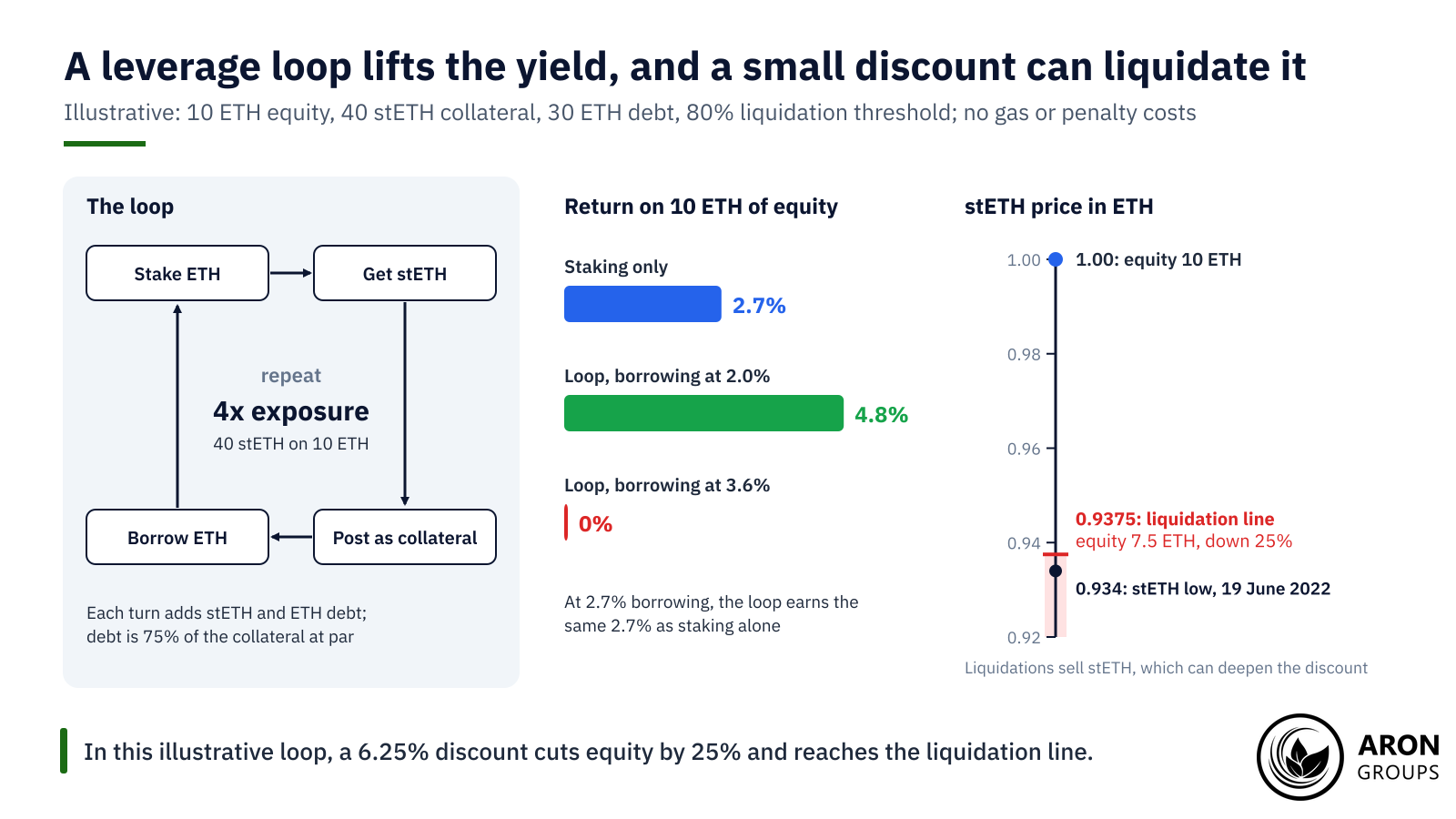
A leverage loop stakes ETH, posts the token as collateral, borrows more ETH and stakes that too. In June 2022, Nansen, a blockchain analytics firm, said a number of traders had built high-leverage stETH positions. CoinDesk’s report on its findings described the loop on the lending protocol Aave. Nansen warned that such positions could be liquidated if stETH traded at a significant discount, risking a liquidation cascade.

An illustrative loop has 10 ETH of equity, 40 stETH of collateral and 30 ETH of debt. At a 2.7% staking reward and 2.0% borrowing cost, it earns 1.08 − 0.60 = 0.48 ETH, or 4.8% on equity. At 2.7% borrowing it earns no more than staking alone, and at 3.6% it earns nothing.

With an 80% liquidation threshold, the loop reaches its liquidation line when stETH falls to 30 ÷ (40 × 0.80) = 0.9375 ETH. That is a 6.25% discount. Equity is then 40 × 0.9375 − 30 = 7.5 ETH, a 25% loss. Whether a discount triggers liquidation depends on how the lending market prices the token.

In the illustrative 4x loop, a 6.25% discount cuts equity by 25% and reaches the liquidation line, which June 2022's low went past.

The Main Liquid Staking Tokens and Protocols

Lido tops the ranking of staking entities in its own H1 2026 report, with 21.18% of all staked ETH at 30 June 2026. BitMine, a digital asset treasury company, had 11.5%, and Coinbase 10.9%. On that ranking, Lido’s stETH, with its wrapped form wstETH, is the largest liquid staking token by staked ETH. Lido’s stake still rose to 9.13 million ETH as total staking grew. The table compares the main tokens.

TokenIssuer and modelHow rewards showFee on rewardsRoute back to ETH
stETHLido: pooled deposits, curated and community node operatorsBalance adjusts at each daily rebase10%: 5% to operators, 5% to the DAO (curated module)Lido withdrawal queue since 15 May 2023, or a market sale
wstETHLido's wrapper for stETHBalance fixed; stETH per token risesAs for stETHLido withdrawal queue directly, or a market sale
rETHRocket Pool: operators bond 4 ETH per validator since 18 February 2026Balance fixed; ETH value per token risesUp to 14% commission, paid by rETH holdersProtocol redemption when ETH is available, or a market sale
cbETHCoinbase: issued by a custodial exchangeBalance fixed; conversion rate rises10% commission (Coinbase page, 29 October 2026)Unwrap through Coinbase, or a market sale

Main Ethereum liquid staking tokens compared; fees from Lido’s and Coinbase’s own pages on 29 October 2026 and Rocket Pool’s February 2026 description.

Lido's Share and the One-Third Line

Concentration matters because of how Ethereum finalises blocks, as its developer documentation explains. If a third or more of staked ether attests maliciously or fails to attest, “a 2/3 supermajority cannot exist and the chain cannot finalize”. Lido held almost a third of staked ETH in June 2022, The Block reported. A token holder vote then ran over 99% against capping its share.

In the first half of 2026 Lido’s share fell from 23.93% to 21.18%. Lido spreads its stake across several node operator modules, including a community staking module. The online appendix to a July 2026 BIS Bulletin still lists staking concentration as a risk for proof of stake. Control of over half the stake would raise the risks set out in a 51% attack.

The Risks of Liquid Staking

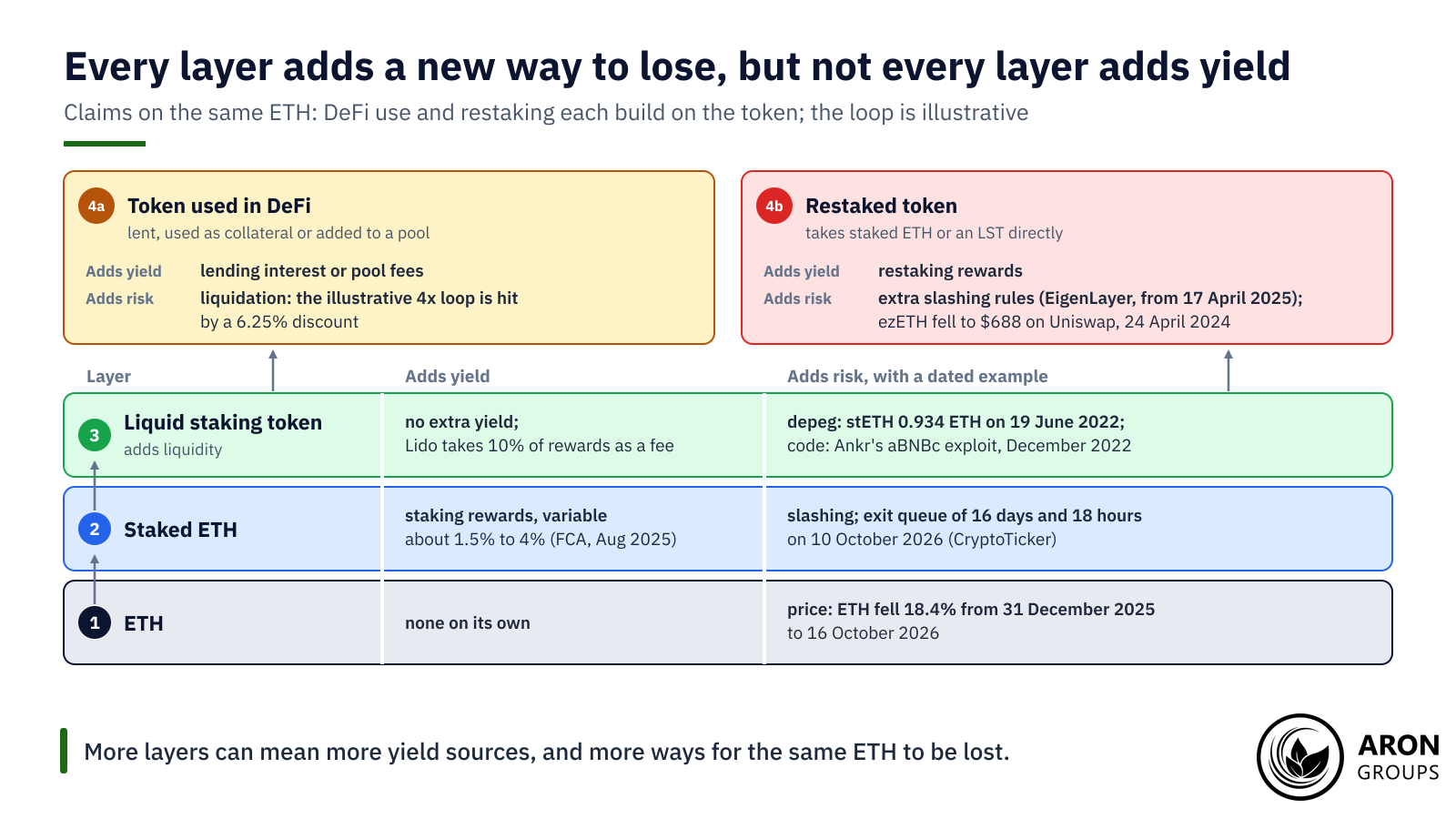
Liquid staking adds risks on top of ETH’s own price swings. The table sets out the main ones with dated examples; the sections below cover depegs and code risk in more detail.

RiskWhat can happenDated example
DepegThe token trades below the ETH behind it, so sellers lose against ETHstETH at 0.934 ETH on 19 June 2022 (DefiLlama daily data)
Exit queue (unbonding)Redemptions can wait for validators to leave Ethereum964,365 ETH queued, 16 days and 18 hours, on 10 October 2026 (CryptoTicker)
SlashingValidator penalties reduce the pool and can cut balances20 Lido validators slashed on 11 October 2023; the operator covered the losses
Smart contractA bug or stolen key can let an attacker mint or drain tokensAnkr's aBNBc, December 2022: about $5 million lost
Concentration (centralisation)One provider can gain enough stake to affect the networkLido: almost a third in June 2022; 21.18% at 30 June 2026
LeverageA discount or dearer borrowing can force loops to unwindJune 2022: Nansen warned leveraged stETH positions could be liquidated

Main risks of liquid staking with dated examples; restaking adds further layers, covered below.

Depeg Risk: What Happened to stETH in 2022

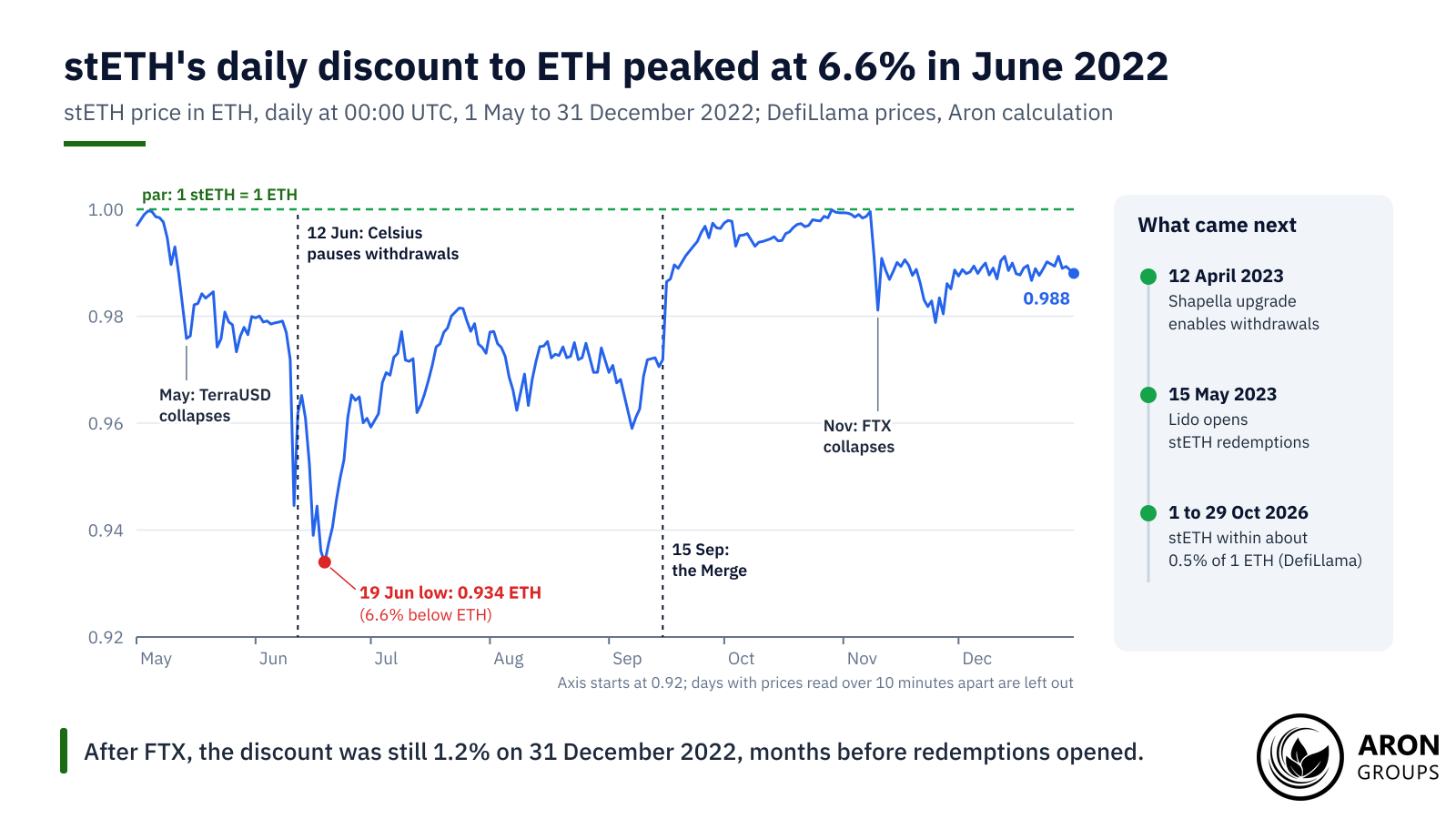
Before Shapella, stETH could not be redeemed, so its price rested on market demand. On DefiLlama’s 00:00 UTC prices, stETH fell from 0.997 ETH on 1 May 2022 to 0.934 ETH on 19 June 2022, a 6.6% discount. The slide came as the algorithmic stablecoin TerraUSD collapsed in May and Celsius paused withdrawals on 12 June 2022.

Nansen named Celsius and Three Arrows Capital as the biggest influences on the Curve stETH/ETH pool, after both withdrew liquidity on 12 May 2022. Intraday trades went lower still: CNBC reported a low of 0.92 ETH on 17 June 2022. The discount narrowed after the Merge, Ethereum’s switch to proof of stake on 15 September 2022. It widened again when FTX collapsed in November and stayed between about 1% and 2% to the year’s end.

On daily prices, stETH's discount peaked at 6.6% on 19 June 2022 and was 1.2% on 31 December, months before redemptions opened.

Lido opened stETH withdrawals on 15 May 2023, giving holders a route back at one ETH per stETH. From 1 to 29 October 2026, stETH stayed within about 0.5% of one ETH on the same daily data. Redemption narrows depeg risk but does not remove it, because a seller who needs ETH at once takes the market price.

Slashing and Smart Contract Risk

Penalties pass to holders: Lido’s documentation says stETH balances “can decrease according to penalty sizes” if its validators are slashed or penalised. Code adds a separate risk. In December 2022 an attacker obtained the deployer key for Ankr’s aBNBc, a BNB liquid staking token, and minted unbacked tokens. Ankr put the damage at about $5 million.

Q: Does liquid staking remove the wait to get ETH back?
A: Not entirely. Selling the token is fast but happens at the market price. Redeeming at full value can still mean waiting for Ethereum’s exit queue and withdrawal sweep. On 29 October 2026, validatorqueue.com put the sweep delay after the exit queue at 7.1 days.

Liquid Staking vs Restaking

Restaking goes a step further, pledging staked ETH or a liquid staking token again to secure other services for extra rewards. EigenLayer launched on Ethereum on 14 June 2023, accepting stETH, rETH and cbETH. Slashing went live on its mainnet on 17 April 2025, for operators that opt into slashable sets. In June 2025 Eigen Labs added EigenCloud, a developer platform built on EigenLayer.

Restaking stacks claims on the same ETH. The same BIS appendix notes that shared security, where several networks rely on one validator set, reduces duplication but increases interdependencies and correlated risk. The SEC staff statement of August 2025 does not address restaking.

Liquid restaking tokens add one more layer. On 24 April 2024, Renzo’s ezETH briefly fell to $688 on Uniswap, Cointelegraph reported. It had traded above $3,000 before the drop, according to Unchained. Renzo was not yet allowing withdrawals, and Gauntlet counted 146 ezETH liquidations on two Morpho lending markets.

Each extra layer can add yield and a risk of its own, so a deeper stack leaves more that can go wrong.

The Honest Limits of Liquid Staking

Staking rewards are paid in ETH, so they do not protect against falls in ETH’s dollar price, which is volatile. ETH fell 18.4% from its 2025 close of $2,967.04 to $2,420.56 on 16 October 2026, on CoinMarketCap and CoinGecko data. Offsetting that fall needs 22.6% more ETH: about eight years of rewards at 2.63% a year, compounded. That rate was validatorqueue.com’s network estimate on 5 October 2026, before provider fees.

Popular framing treats the staking rate as the return. In practice the return also depends on fees, discounts, borrowing costs and ETH’s price. Regulation is unsettled too. In a staff statement of 5 August 2025, the SEC’s Division of Corporation Finance gave its view on liquid staking. It said liquid staking activities, as it defined them, “do not involve the offer and sale of securities”. That view excludes cases where a provider sets or guarantees the rewards.

The statement has no legal force and followed a staff statement on protocol staking of 29 May 2025. Other countries take their own approach. Deposits, swaps and rewards can be taxable events in some countries; this is not tax advice.

Where Aron Groups Fits

Aron Groups does not offer staking, liquid staking tokens or DeFi access. It offers crypto CFDs such as BTCUSD and ETHUSD on MetaTrader 5, alongside forex, gold and indices. An ETHUSD CFD tracks ETH’s price but earns no staking rewards, because the trader owns no ETH to stake. A position kept open past the trading day can incur overnight swaps, which can be charged or credited.

A CFD has no token to depeg and no exit queue. It carries full price exposure instead, often with leverage, which magnifies losses as well as gains. Prices can gap past a stop-loss, so a stop is not a guaranteed exit. Aron’s margin call comes at a 100% margin level and stop-out at 50%, or 40% on Islamic and VIP accounts. A demo account with virtual funds lets traders test ETHUSD first, and the Nano account keeps live sizes small.

Conclusion

Liquid staking keeps staked ETH usable by issuing a token for it, at the cost of a fee and new risks. For the same pool and fee, rebasing and value-accruing tokens deliver the same reward in different bookkeeping.

The risks are concrete and dated. stETH’s daily discount reached 6.6% in June 2022, and ezETH fell to $688 in April 2024. On CryptoTicker’s figures, Ethereum’s exit queue went from 16 days and 18 hours to about four days between 10 and 20 October 2026. Rewards are variable, and they are paid in a volatile asset.

Frequently Asked Questions

Short answers to common questions, from what is liquid staking crypto to how stETH and wstETH differ.

What is liquid staking crypto?

It is staking a proof-of-stake coin such as ETH through a protocol that returns a tradable token. The token tracks the staked coins plus rewards and can be used in DeFi.

Are liquid staking derivatives the same as liquid staking tokens?

Yes. LSD was an earlier name for the same receipt tokens, and SEC staff call them Staking Receipt Tokens. Each one is a claim on staked coins and their rewards.

What is the difference between stETH and wstETH?

stETH is a rebasing token whose balance is recalculated daily as rewards arrive. wstETH wraps it with a fixed balance, so its value in stETH rises instead.

Do ETHUSD CFDs pay staking rewards?

No. The trader holds a contract on ETH’s price, not ETH, so nothing is staked. Holding overnight can cost or earn a swap, and leverage adds risk.

Continue Reading
not-found
calendar 11 November 2026
Rate this article

Leave a Reply

Your email address will not be published. Required fields are marked *

No thanks