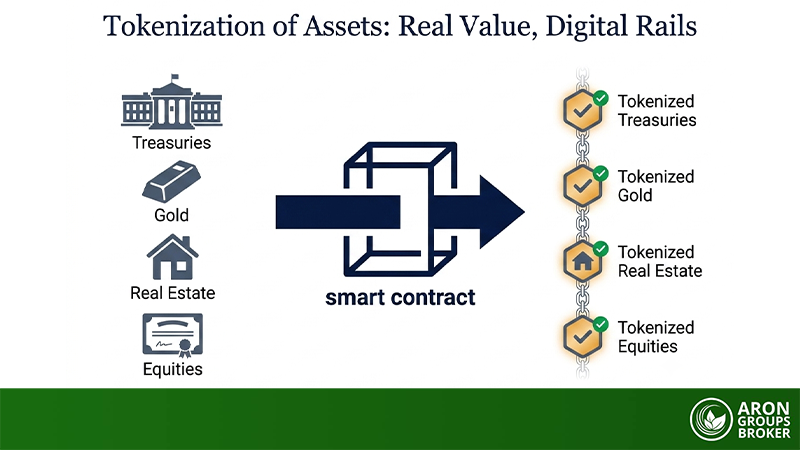

Tokenization of assets means representing ownership of a real-world asset, a Treasury bill, a bar of gold, a share, a building, as a digital token on a blockchain. The idea is old, securitisation with better plumbing, but the numbers are new: on-chain real-world assets have grown more than 250% in roughly fifteen months, and the world’s largest asset managers are now issuers.
The headlines sell a future where everything trades around the clock in fractional pieces. They under-report the liquidity paradox: most tokenized assets barely trade, and a token wrapper does not make an illiquid building liquid. Between BlackRock’s on-chain fund and the trillion-dollar forecasts sit unsolved problems of custody, legal enforceability, and distribution.
This guide defines asset tokenization, walks through how it works, surveys what is being tokenized, from Treasuries to real estate, sizes the 2026 market, and weighs benefits against risks. It ends with a practical comparison, tokenized assets versus CFDs versus ETFs, so you can match the tool to the job.
- Tokenization of assets records ownership of real-world assets (RWAs) such as Treasuries, gold, stocks, and property as blockchain tokens.
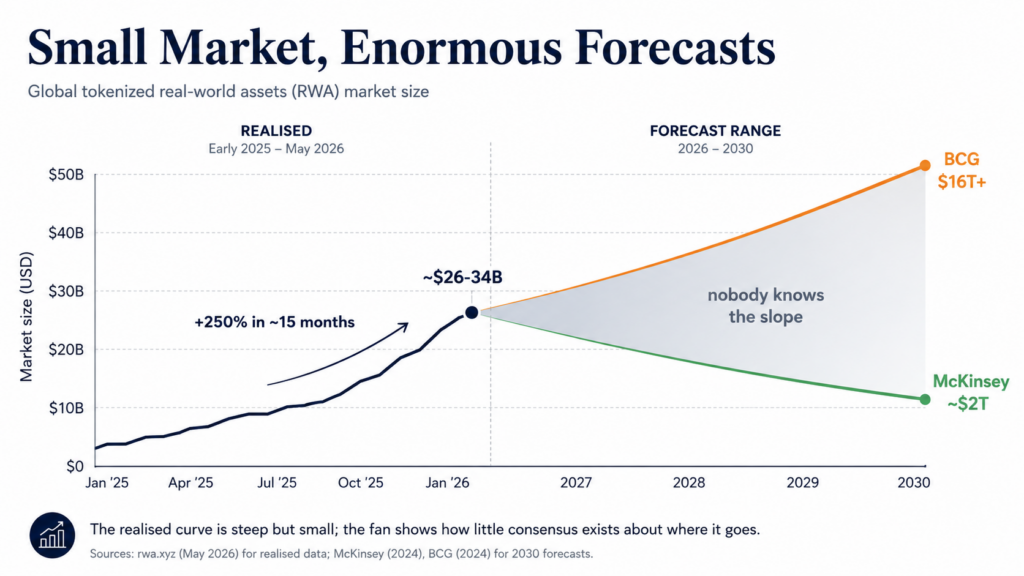
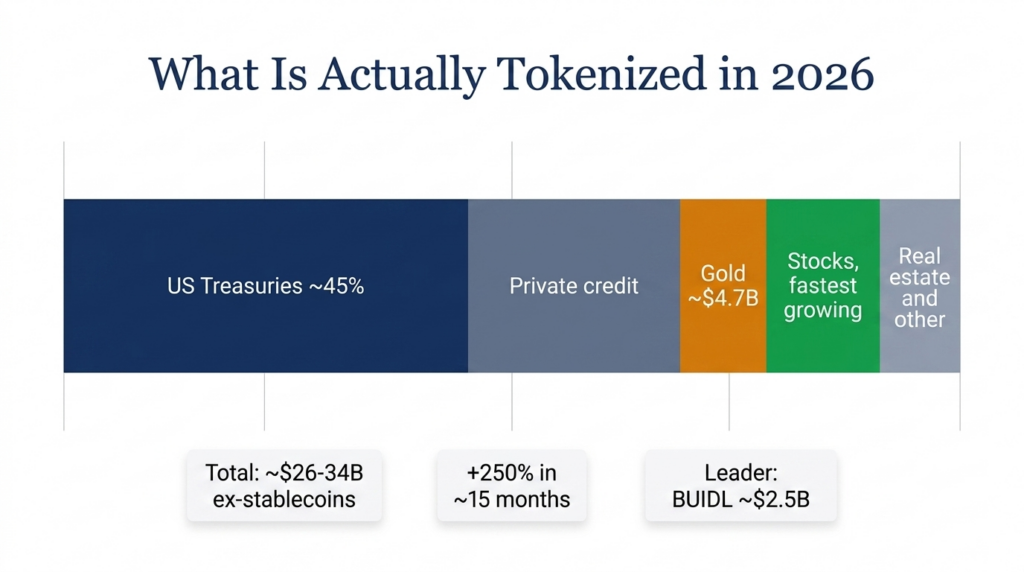
- Excluding stablecoins, the on-chain RWA market reached roughly $26 to $34 billion in 2026, led by tokenized US Treasuries at about 45% of the total.
- The benefits are concrete: fractional entry from about $50, 24/7 transferability, near-instant atomic settlement versus T+2, and programmable collateral.
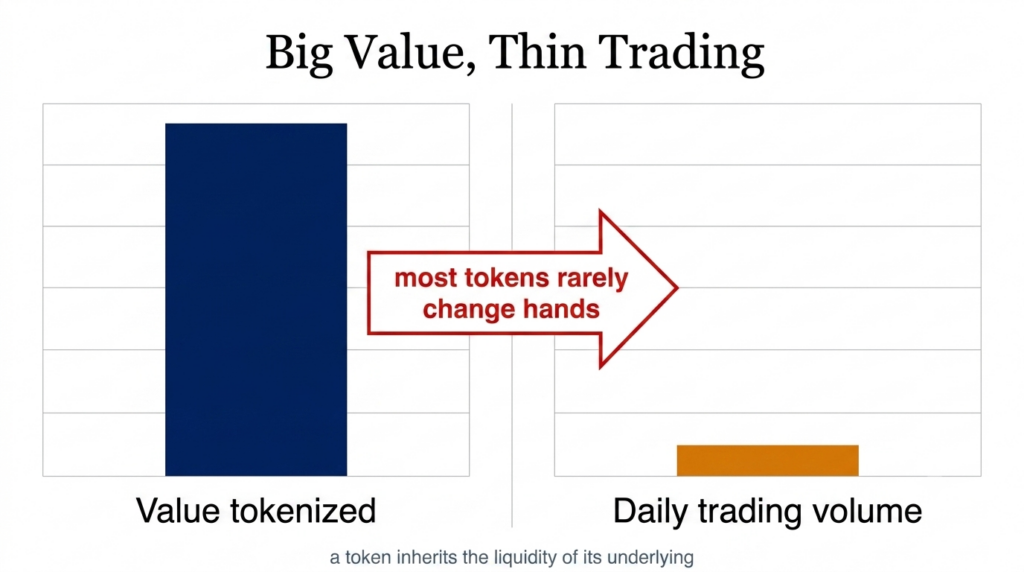
- The liquidity paradox is real: most tokenized assets show low trading volumes, because a token inherits the liquidity of its underlying.
- For pure price speculation on gold, stocks, indices, or crypto, CFDs and ETFs remain different tools with different risk profiles.
What Is Tokenization of Assets?
Tokenization of assets is the process of representing ownership of a real-world or traditional financial asset, such as US Treasuries, bonds, gold, equities, real estate, or fund units, as a digital token on a blockchain. The token is a claim on the underlying asset, enforced through a legal structure, while the blockchain records who holds it and settles transfers. The Bank for International Settlements describes tokenisation as recording claims that exist on traditional ledgers onto programmable platforms, and calls it a transformative innovation for settlement.
Risk Disclosure
CFDs are complex instruments and come with a high risk of losing money rapidly due to leverage. You should consider whether you understand how CFDs work and whether you can afford to take the high risk of losing your money. Past performance is not indicative of future results. This content is provided for educational purposes only and does not constitute investment advice.
Token vs Cryptocurrency: The Distinction That Matters
A tokenized asset derives its value from something off-chain; a cryptocurrency derives its value from its own network. Digital asset tokenization borrows crypto’s rails, the wallets, smart contracts, and exchanges, but the investment case remains the underlying asset. A tokenized Treasury is still a Treasury: the blockchain changes how it moves, not what it is.
How Asset Tokenization Works, Step by Step
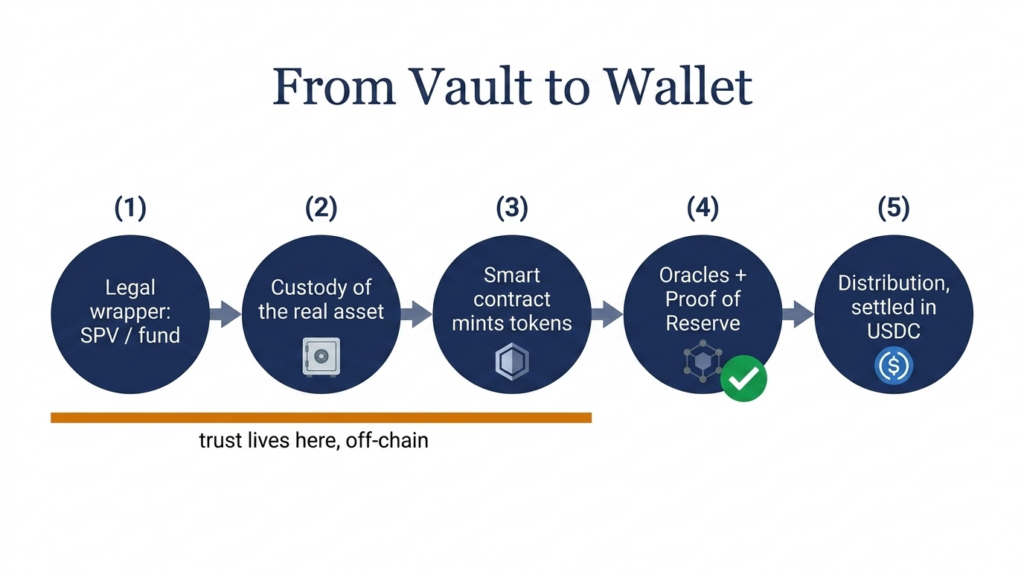
Five steps take an asset from a vault or a registry into a wallet.
Step 1: Establish the Legal Wrapper
An issuer creates the legal structure, commonly a special purpose vehicle (SPV), a regulated fund, or an on-chain registry entry, that ties each token to an enforceable claim on the asset. This wrapper, not the blockchain, is what a court will read.
Step 2: Secure Custody of the Underlying
The real asset sits with a qualified custodian: Treasuries at a custodian bank, gold bars in insured vaults, property titles with a trustee. Token holders depend on this layer completely.
Step 3: Mint Tokens via Smart Contract
A smart contract, usually on Ethereum or a compatible chain, mints tokens representing the claims and encodes the transfer rules. Where the law requires it, platforms such as Securitize restrict holding to verified investors and act as transfer agent.
Step 4: Connect Oracles and Proof of Reserve
Oracle networks such as Chainlink publish prices on-chain and run Proof-of-Reserve checks confirming the backing exists, while cross-chain protocols such as Chainlink’s CCIP let tokens move between chains without breaking the claim.
Step 5: Distribute and Settle in Stablecoins
Investors subscribe, trade, and redeem, with cash legs typically settled in a stablecoin such as USDC, and because both legs live on-chain, delivery and payment settle atomically in one transaction.
Rule: A token is only as strong as the weakest link between it and the asset: the law, the custodian, and the code must all hold at the same time.
What Can Be Tokenized: From Treasuries to Real Estate
Almost anything with a claim attached can be tokenized; what has actually worked follows the liquidity of the underlying.
Tokenized US Treasuries: The Anchor
Tokenized US Treasuries are the largest category at roughly 45% of the market, because they pair the world’s most liquid asset with on-chain yield. BlackRock’s BUIDL fund, issued through Securitize, holds about $2.5 billion, while Circle’s USYC, Ondo Finance’s products, and Franklin Templeton’s BENJI compete in the same lane. Private credit is the second institutional pillar on the same rails.
Tokenized Gold and Tokenized Stocks
Tokenized gold, led by PAXG and XAUT, has grown to roughly $4.7 billion, with each token redeemable against vaulted bullion. Tokenized stocks, popularised by products such as xStocks, are the fastest-growing new category, offering round-the-clock exposure to listed shares, though jurisdiction rules still fence off many buyers.
What Is Tokenized Real Estate?
Tokenized real estate divides ownership of a property, or of the entity holding it, into blockchain tokens so investors can buy fractions of a building. Platforms such as RealT distribute rental income to token holders automatically. It is also where the model strains hardest: property is illiquid, legally local, and slow to transact; a token changes none of that.
Did You Know?: Some tokenized Treasury funds distribute yield daily as new tokens in holders' wallets, turning a money market fund into something closer to an interest-bearing balance. |
The Benefits: Why Institutions Are Moving On-Chain
The efficiency case is measurable, which is why the largest names in finance have stopped piloting and started issuing.
| Dimension | Traditional rails | Tokenized rails |
|---|---|---|
| Settlement | T+2, with counterparty gap | Near-instant atomic settlement |
| Access | Market hours, regional gatekeepers | 24/7 transferability, global venues |
| Minimums | Often high, whole units only | Fractional entry from about $50 |
| Post-trade cost | Layers of intermediaries | Estimated reductions of up to about 30% |
| Collateral | Slow to mobilise across systems | Programmable, pledgeable in minutes |
Fractionalisation deserves its billing: entry near $50 opens institutional products to savers who could never buy a whole Treasury lot. Atomic settlement removes the two-day window in which a counterparty can fail, and programmable yield turns coupons into code-executed transfers. Cost studies suggest post-trade savings of up to roughly 30%, the number that moves chief operating officers.
The 2026 Market: Size, Leaders, and Regulation
The market is small next to the forecasts and large next to its own recent past.
How Big Is It Really?
Excluding stablecoins, on-chain real-world assets reached roughly $26 to $34 billion in 2026, up more than 250% in about fifteen months. The forecasts diverge wildly: McKinsey’s cautious path lands near $2 trillion by 2030, while BCG’s optimistic scenario exceeds $16 trillion. The honest reading: nobody knows the slope, only the direction, and issuance is compounding faster than secondary trading.
Institutions and the Regulatory Green Lights
The institutional signal is unambiguous. BlackRock, JPMorgan, and Franklin Templeton run live products, NYSE and Nasdaq have moved on tokenized-securities venues, and the DTCC, custodian of over $100 trillion in securities, launched a tokenized-securities pilot in May 2026. Regulation is crystallising alongside: the GENIUS Act of 2025 gave payment stablecoins a federal framework, a January 2026 joint SEC statement signalled a path for compliant tokenized securities, and the proposed Clarity Act aims to settle which tokens answer to which regulator.
Q: Does tokenization make an asset safer?
A: No. It changes settlement speed and access, not the asset’s risk. A tokenized Treasury still carries interest-rate risk, tokenized real estate still carries property risk, and both add technology and custody layers on top. Better plumbing is not a better investment.
The Risks: The Liquidity Paradox and Other Hard Problems
The gap between market value and market activity is the real story of 2026.
The Liquidity Paradox
Most tokenized assets barely trade. Billions sit dormant, a handful of products hold most of the value, and many RWA tokens show low volumes, long holding periods, and thin participation. The cause is simple: a token inherits the liquidity of its underlying, plus whatever market makers choose to add. Tokenization digitises already-liquid assets such as Treasuries far better than illiquid ones such as real estate or art, and 24/7 tradability is a property of the venue, never a guarantee of a bid.
Custody, Enforceability, and Silos
Beyond liquidity, four structural risks dominate, and US regulators urge caution with crypto asset platforms for exactly these reasons:
- Custody risk: the token is a claim on assets someone else holds, so custodian failure or fraud breaks the chain of value no matter what the ledger says.
- Legal enforceability: courts, not blockchains, decide ownership disputes, and in many jurisdictions token-holder rights remain untested.
- Regulatory divergence: securities treatment varies by country and token design, so access is often geoblocked or restricted to accredited investors.
- Distribution silos: tokens issued on one platform frequently cannot move to another, recreating the walled gardens tokenization promised to remove.
Before buying any tokenized asset, a careful investor reads the structure rather than the marketing. Who is the issuer, and what happens to holders if that issuer fails? Which custodian holds the underlying, and is there an independent Proof-of-Reserve attestation? What legal claim does the token actually confer, and in which jurisdiction is it enforceable? How, and how quickly, can it be redeemed for the underlying asset or for cash? A tokenized Treasury from a regulated issuer with a named custodian is a very different proposition from a tokenized building on an obscure platform, even when both are described with the same word.
Risk Warning: A daily-priced token on an illiquid underlying can gap severely in stress. The exit price is set by the thinnest market between you and the asset, not by the oracle's last print. |
Q: If tokenized assets barely trade, why does the market keep growing?
A: Because growth is issuance-driven, not turnover-driven. Institutions mint tokens to modernise settlement and collateral movement, which raises the value on-chain without creating retail-style volume. Value locked measures adoption of the rails, not the depth of the secondary market.
Tokenized Assets vs CFDs vs ETFs: Picking the Right Tool
A tokenized asset is on-chain ownership, a CFD is leveraged two-way price speculation with no ownership, and an ETF is a regulated fund wrapper. They solve different jobs.
| Dimension | Tokenized asset | CFD | ETF |
|---|---|---|---|
| Ownership | Claim on the underlying | None; a price contract | Fund units |
| Direction | Long, buy and hold | Long or short | Mostly long |
| Leverage | Rare | Built in, capped for retail | Rare |
| Trading hours | 24/7, venue dependent | Nearly round the clock on many markets | Exchange hours |
| Main risks | Custody, code, liquidity | Leverage, spreads, counterparty | Tracking, market |
For investors who want yield-bearing ownership, tokenized Treasuries or gold may fit. For traders who want to speculate on price moves in gold, stocks, indices, or crypto, in both directions and with leverage, CFDs are built for that job: Aron Groups offers CFDs on those same underlying markets through MetaTrader 5. Leverage cuts both ways, which is why ESMA caps retail CFD leverage and mandates negative balance protection. Whatever the wrapper, the method is constant: apply effective risk management, size trades through deliberate position sizing, demand a favourable risk-to-reward ratio, know your tolerable drawdown, and treat capital preservation as the first objective. If leveraged products are new to you, prove the process on a small account first.
Read More: How to Trade Forex
Mini Example: Three Ways to Own the Same Gold Move (text-only scenario)
An investor expects gold to rise over the coming quarter. Route one: buy PAXG, taking on-chain ownership of vaulted metal, with no leverage, custody and code risk, and an exit that depends on a live bid. Route two: a gold ETF in a brokerage account, simple and regulated, tradable in exchange hours.
Route three belongs to a trader rather than an investor: a long XAU/USD CFD sized to risk 1% of the account, protected by a stop, reversible to short if the thesis flips. Same metal, three different risk machines. The mistake is not choosing any one of them; it is choosing by hype instead of by job.
Conclusion
Tokenization of assets is genuine infrastructure change. Settlement compresses from days to seconds, access widens from institutions to anyone with $50, and the arrival of BlackRock, the DTCC, and federal legislation says the rails are being adopted, not merely admired.
But wrappers do not transmute assets. The liquidity paradox, custody dependence, and untested legal claims travel with every token, and the winners so far are deliberately boring: Treasuries, gold, and funds, the assets that were liquid before anyone tokenized them.
For traders, the practical conclusion is a question of jobs: own it, wrap it, or trade it. Whichever answer fits, the same trading discipline applies, because no technology has yet tokenized the consequences of oversized risk.
Frequently Asked Questions
What is tokenization of assets in simple terms?
It is turning ownership of a real asset, such as a Treasury bill, gold, or property, into a digital token on a blockchain, so the claim can be held in fractions and transferred in seconds.
What is the difference between asset tokenization and cryptocurrency?
A tokenized asset is a claim on something off-chain, and its value follows that underlying. A cryptocurrency is native to its own network and has no external asset behind it.
Is tokenized real estate a good investment?
It depends entirely on the property and the legal wrapper. Fractional entry and automated rental income are genuine advantages, but the underlying remains illiquid and legally local, so read the structure before the yield.
Can I trade tokenized assets at Aron Groups?
Aron Groups does not offer tokenized assets. It offers CFD trading on the underlying markets, including gold, indices, shares, and major cryptocurrencies, through MetaTrader 5.