
The best forex pairs to trade during the Asian session are the ones whose home markets are actually open: USD/JPY, AUD/USD and NZD/USD first, then the yen crosses AUD/JPY, EUR/JPY and GBP/JPY, with USD/CNH for traders who want direct exposure to Chinese flow. Everything else tends to drift sideways on thin volume until Europe arrives.
That is the whole logic of session-based trading forex. A currency moves when the people who need it are at their desks, and between midnight and 09:00 GMT those people are in Tokyo, Sydney, Singapore, Hong Kong and Shanghai. Trading EUR/GBP at 02:00 GMT is not wrong so much as pointless: you are paying a wider spread to watch a pair that nobody is currently pricing.
This guide sets out the exact session hours in several time zones, why they shift twice a year, which pairs carry the flow and what drives each of them, the event calendar that produces most of the session’s movement, the cost problem nobody mentions, and the two strategy styles that actually fit these hours.
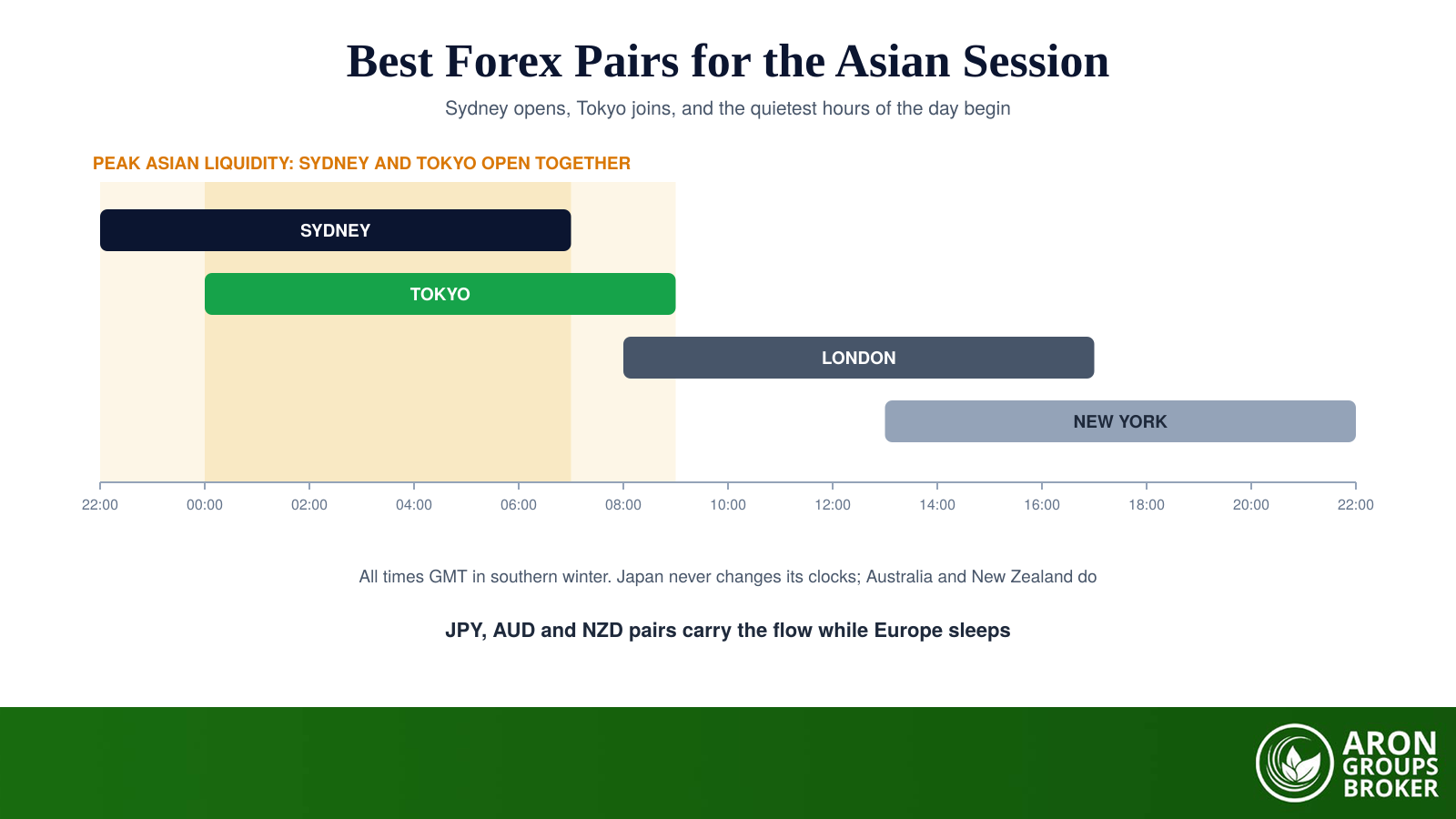
- The Asian session runs roughly 00:00 to 09:00 GMT for Tokyo, with Sydney opening a couple of hours earlier and overlapping until 06:00 or 07:00 GMT.
- Japan does not observe daylight saving but Australia and New Zealand do, so the GMT window shifts twice a year in the opposite direction to Europe.
- USD/JPY, AUD/USD and NZD/USD are the core pairs; AUD/JPY, EUR/JPY, GBP/JPY and USD/CNH add range at a higher cost.
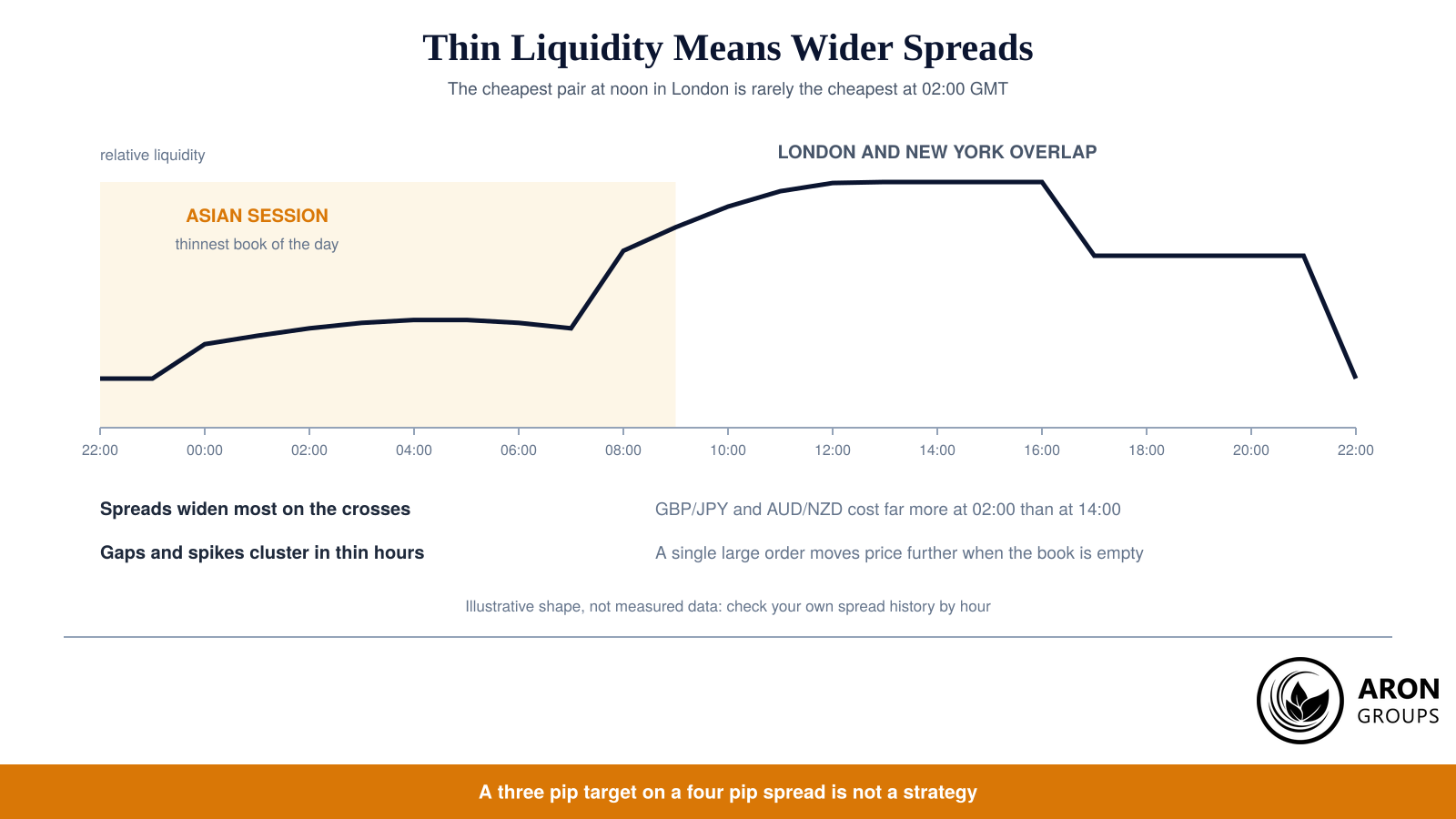
- Ranges are narrower and spreads wider than in London, so a target that works at 14:00 GMT can be uneconomic at 02:00.
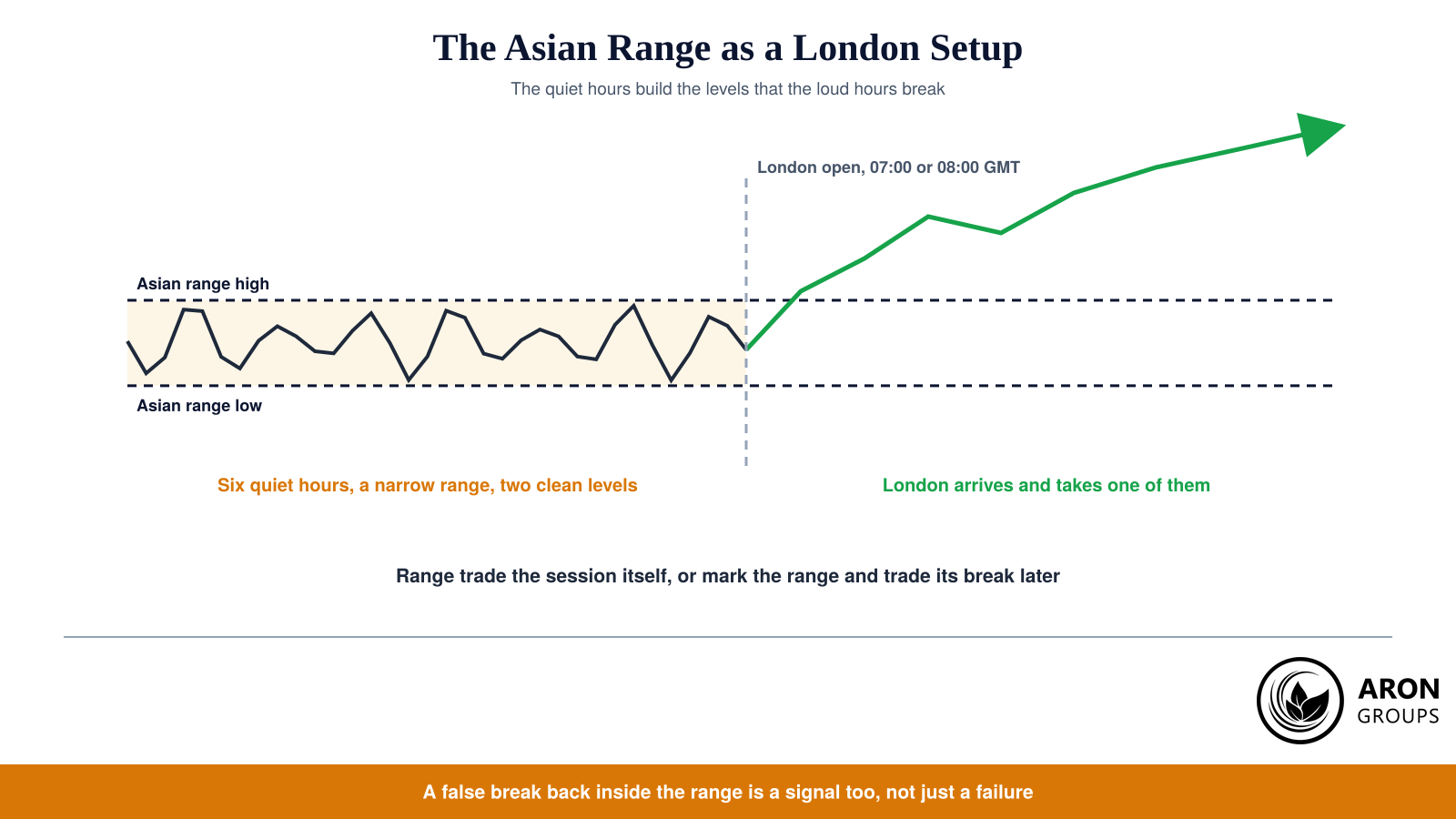
- Range and mean reversion setups suit the session, while the Asian range itself is most useful as the level set for the London breakout.
When the Asian Session Runs, and Why the Times Move
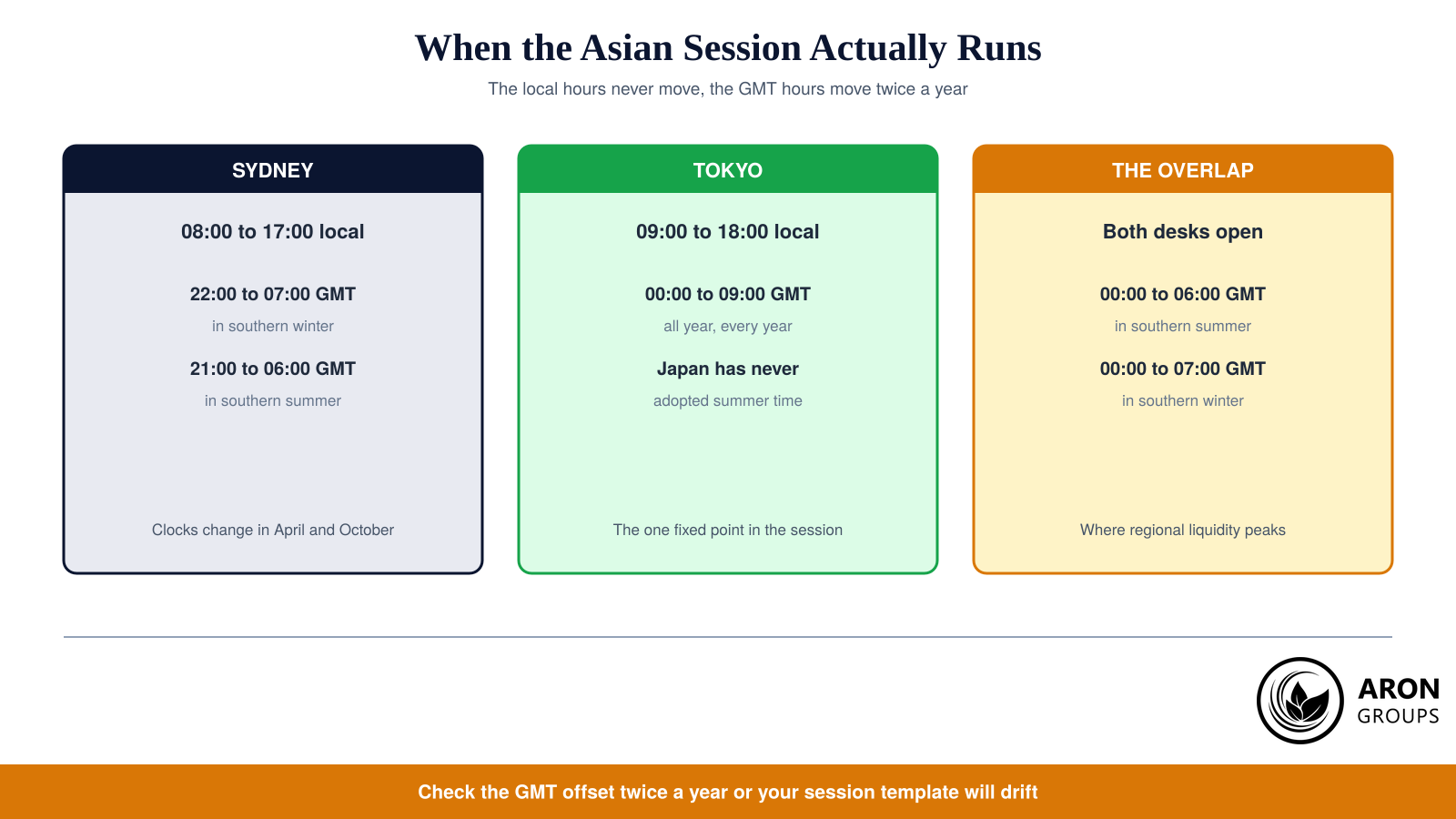
The Asian session is really two markets that overlap. Tokyo trades 09:00 to 18:00 local time, which is 00:00 to 09:00 GMT, and because Japan has never adopted summer time that window is fixed all year. Sydney opens earlier in GMT terms and closes in the middle of the Tokyo morning, and Australia does change its clocks, so the Sydney hours move by one hour twice a year. The result is a session whose start drifts while its centre stays put.
Risk Disclosure
Trading forex and CFDs carries a high level of risk and can result in the loss of all your capital. This content is educational and is not investment advice. Never risk money you cannot afford to lose.
| Centre | Local hours | GMT, southern winter | GMT, southern summer |
|---|---|---|---|
| Sydney | 08:00 to 17:00 | 22:00 to 07:00 | 21:00 to 06:00 |
| Tokyo | 09:00 to 18:00 | 00:00 to 09:00 | 00:00 to 09:00 |
| Sydney and Tokyo overlap | The busiest window | 00:00 to 07:00 | 00:00 to 06:00 |
| London opens | The session ends | 08:00 | 07:00 |
Table 1: Asian session hours across the year, with the London handover that closes it.
Rule
Australia and New Zealand move their clocks in the opposite direction to Europe and North America. For a few weeks each spring and autumn the gap between Sydney, Tokyo and London is unusual, so verify your platform's server time rather than assuming last month's schedule.
What the Session Feels Like to Trade
Compared with London, the Asian session is quieter in every measurable way. Ranges are narrower, moves are slower, and price spends much of its time consolidating inside levels set overnight. The 2025 BIS triennial survey puts the United Kingdom at roughly 38 per cent of global FX turnover against Singapore at 11.8 per cent and Hong Kong at 7 per cent, and that concentration is exactly why the European hours feel so different from the Asian ones.
There is a nuance worth knowing. Regional turnover has been shifting away from Tokyo towards Singapore and Hong Kong for years, and the 2025 survey continued that trend. In practice this means Asian session liquidity is no longer only a Tokyo story, and a good deal of yen volume now changes hands offshore. For a retail trader the practical consequence is simple: the session is deeper than its reputation suggests around the Tokyo morning, and genuinely thin either side of it.
That last point matters for anyone in Europe or the Americas. The two hours after Sydney opens, before Tokyo joins, are the emptiest of the entire trading day: the previous session has closed, the region has barely started, and a single sizeable order can move price further than the news justifies. Many traders treat that window as a dead zone and simply wait for midnight GMT, when the Tokyo desks arrive and the spread on the yen pairs narrows noticeably.
The Tokyo Fixing at 09:55
One event inside the session deserves its own paragraph. At 09:55 Tokyo time, which is 00:55 GMT, Japanese banks set the reference rate they use for customer transactions, the equivalent of the London 4pm fix for the Japanese market. Academic work on the Tokyo fixing finds a concentration of dealing in that single minute that appears nowhere else in the day, along with frequent short-lived price spikes as banks cover customer orders beforehand.
Researchers have also documented a calendar pattern around it. On so-called gotobi days, those falling on dates divisible by five, Japanese importers settle invoices and their dollar buying tends to push USD/JPY higher into the fix before the pressure fades. Treat that as a documented tendency rather than a rule: anomalies of this kind weaken once enough traders act on them, and the spike around the fix cuts both ways for anyone holding a tight stop through it.
The Pairs That Actually Move
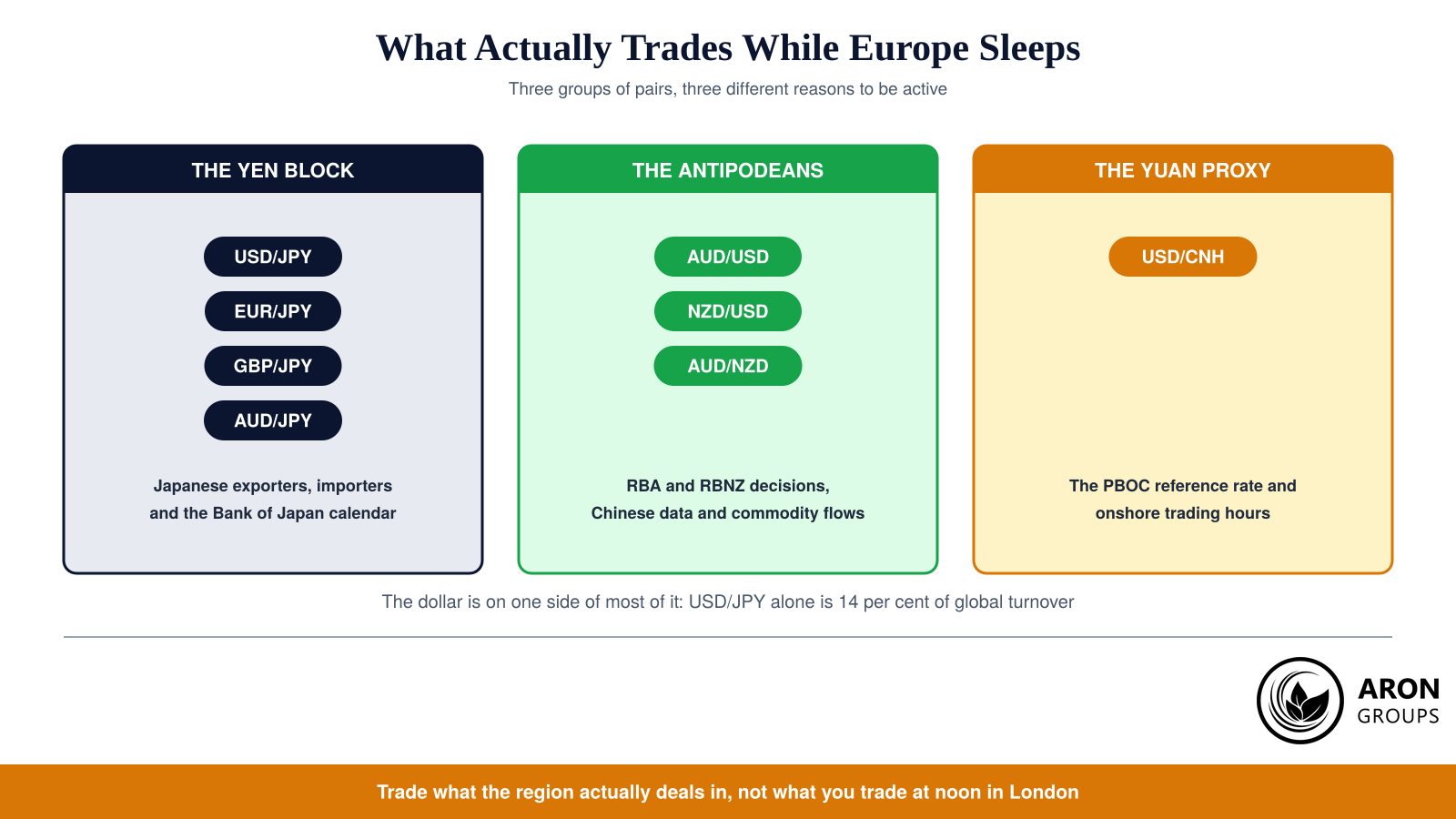
Candidates fall into three groups, and the reason each group is active differs. The yen block moves because Japanese corporates, funds and the central bank are transacting. The Antipodeans move because Australia and New Zealand publish their data in these hours and because China, their largest trading partner, is open. USD/CNH moves because the onshore market is trading.
The Yen Block
USD/JPY is the natural first choice. It is the single most traded pair after EUR/USD, at roughly 14 per cent of global turnover in the 2025 survey, and it is at its most responsive while Tokyo is dealing. It moves on the Bank of Japan, on US yields, and on the exporter and importer flow that clusters around the Tokyo fixing in the morning. EUR/JPY and GBP/JPY carry more range but only really wake up as London approaches, and AUD/JPY sits between the two blocks, behaving like a risk sentiment gauge for the region.
The Antipodeans
AUD/USD and NZD/USD are the cleanest expressions of Asian session data. Australian employment and inflation figures, New Zealand releases, and Chinese PMI, trade and activity numbers all land inside this window, and both currencies are sensitive to commodity prices and to Chinese demand. AUD/NZD is a specialist pair that reacts to the difference between the two central banks rather than to the dollar, which makes it useful when you have a view on relative policy and useless when you do not.
The Yuan Proxy
USD/CNH is the offshore, freely traded version of the Chinese yuan, and it is the most direct way for a retail trader to express a view on China during Asian hours. It responds to the People’s Bank of China reference rate published each morning in Beijing and to onshore session flow. Treat it with respect: the spread is wider than any major, the pair can sit motionless for hours and then move sharply on policy, and it is not a beginner’s instrument.
| Pair | Relative range in the session | Spread behaviour | Main driver |
|---|---|---|---|
| USD/JPY | Moderate and steady | Tightest of this group | Bank of Japan, US yields, Tokyo flow |
| AUD/USD | Moderate, event driven | Tight | RBA, Australian data, Chinese releases |
| NZD/USD | Moderate, thinner book | Slightly wider than AUD | RBNZ, dairy and risk sentiment |
| AUD/JPY | Wider | Wider than either leg | Regional risk appetite |
| EUR/JPY | Wider, builds towards London | Moderate | Yen flow plus early European positioning |
| GBP/JPY | Widest of the group | Widest of the majors and crosses | Volatility itself, not local news |
| USD/CNH | Variable, policy driven | Wide | PBOC reference rate and onshore trading |
Table 2: The practical candidates for Asian session trading and what moves each one.
The Calendar That Drives the Session
Most of the session’s real movement comes from a short list of scheduled events, and knowing when they land turns a quiet range into a tradeable day. The Reserve Bank of Australia announces its cash rate decision at 14:30 Sydney time, followed by a press conference an hour later, and the Reserve Bank of New Zealand publishes the Official Cash Rate at 14:00 New Zealand time. Chinese data typically arrives in the Beijing morning, inside the Tokyo session.
| Event | Local timing | Pairs most affected |
|---|---|---|
| Bank of Japan decision | No fixed time, usually Tokyo late morning or early afternoon | USD/JPY and all yen crosses |
| RBA cash rate | 14:30 Sydney, eight times a year | AUD/USD, AUD/JPY, AUD/NZD |
| RBNZ official cash rate | 14:00 Wellington | NZD/USD, AUD/NZD |
| Chinese PMI, trade and activity data | Beijing morning | AUD, NZD and USD/CNH |
| PBOC reference rate | Before the onshore open | USD/CNH, then AUD and NZD |
Table 3: The scheduled events that generate most Asian session volatility.
Why is the Bank of Japan timing so awkward?
Unlike the Federal Reserve, the Bank of Japan does not commit to a fixed release time, so its statement can appear anywhere across a window of an hour or more. The wait itself moves the market, because a late release is often read as a sign of disagreement in the committee, and yen pairs can gap when it finally lands.
The Cost Problem Nobody Advertises
Thin conditions mean wider spreads, and this is where most Asian session strategies quietly fail. The pair that costs half a pip during the London afternoon can cost several times that at 02:00 GMT, and crosses such as GBP/JPY and AUD/NZD widen the most because both legs are thin at once. Regulators warn about the costs and risks of retail forex trading for exactly this reason: the advertised spread is rarely the spread you get at the quietest hour of the day.
The arithmetic follows directly. If your Asian session plan targets eight pips and the spread is two, you are giving away a quarter of the move before the trade starts, and that is before commission. Position sizing has to account for the wider stop that thin conditions require, and leverage magnifies the damage when a thin book gaps, which is why regulators cap it on these products in several jurisdictions. The practical habit is to log your broker’s spread by hour for a fortnight and only then decide which pairs are viable.
Strategies That Fit These Hours
The session’s character points clearly at one style and away from another. Because price tends to consolidate, mean reversion inside a defined range works more often than it should, while momentum breakout systems fire repeatedly and fail. That does not make breakouts useless here; it makes them a London trade that is set up during Asian hours.
Range Trading the Session Itself
Mark the high and low once the first two hours have printed, then fade the edges back towards the middle while the range holds. Volatility bands such as Keltner Bands work well as a visual for this, because they widen and narrow with the session rather than assuming a fixed distance. Targets should be modest, stops should sit just beyond the range extreme, and the whole approach should be abandoned the moment a scheduled event is due.
The Asian Range as a London Setup
The more popular use of these hours needs no trading during them at all. Mark the high and low of the Asian session, then wait for the London open to break one of them, which is a classic breakout strategy applied to a level set the market built for you overnight. The false break, where price takes one side and closes straight back inside, is a signal in its own right and often points at the day’s true direction.
Mini Example: A Typical Overnight into London
AUD/USD spends the Tokyo morning inside a twenty five pip range with no scheduled data due. A range trader fades the edges twice for small targets, accepting that the spread eats a meaningful share of each one, and stops trading when the range narrows further after 06:00 GMT.
A breakout trader does nothing at all overnight. They mark the range high and low, wait for the London open, and take the first candle that closes decisively outside it in the direction the wider trend supports, placing the stop back inside the range. Two traders, one chart, and the session serves both of them differently.
Honest Limits
Three cautions belong on any page recommending session trading. The first is that quiet does not mean safe: thin books gap harder on surprise headlines, and the Asian session has produced some of the most violent flash moves in modern currency history precisely because there was nobody on the other side. The second is that the session’s edge is small and cost sensitive, so a strategy that looks profitable before spread often is not after it, which is what honest out-of-sample backtesting is for.
The third is personal rather than technical. For most traders outside Asia these hours fall in the middle of the night, and trading tired is a reliable way to turn a workable plan into an erratic one. If the session suits your time zone, it offers structure and predictability that London does not. If it does not, marking the range and trading the London break is the better use of it, and your equity curve will show the difference within a couple of months.
Where Aron Groups Fits
Session trading rewards a broker whose costs stay sane when the book thins. Aron Groups quotes the yen pairs, the Antipodeans and gold on MetaTrader 5 with market execution on ECN accounts, so orders around the Tokyo morning fill at the next available price rather than being requoted, and floating spreads mean you can see the cost of the hour rather than a headline number.
If you are testing whether these hours suit you, do it cheaply. A demo evaluation costs nothing and lets you sit through a full fortnight of Asian sessions before committing, while the commission-free Nano account trades from 0.0001 lots for live work at a size where a wide spread is a lesson rather than a loss. Pair either with a written risk management strategy before you trade the overnight.
Conclusion
The Asian session rewards traders who match the instrument to the hour. USD/JPY, AUD/USD and NZD/USD are active because their home markets are open, the yen crosses add range at a higher cost, and USD/CNH offers direct Chinese exposure for those who can handle its spread. The session’s quieter character is not a defect: it produces the cleanest ranges of the day and the levels that Europe then trades against.
Get the practical details right and the rest follows. Know the exact hours in your own time zone and recheck them when the clocks change, keep the regional calendar in front of you, measure your broker’s spread at the hour you actually trade, and choose between fading the range and trading its break rather than doing both badly. That combination is a genuine trading edge for anyone in a compatible time zone, provided drawdown and capital preservation come before ambition.
Frequently Asked Questions
Short answers to the questions traders ask most about the Asian session.
What time is the Asian forex session in GMT?
Tokyo runs 00:00 to 09:00 GMT all year because Japan does not use daylight saving. Sydney runs 22:00 to 07:00 GMT during the southern winter and 21:00 to 06:00 GMT during the southern summer. The busiest window is the overlap, from midnight GMT until Sydney closes.
Which pair is the most volatile during the Asian session?
GBP/JPY usually posts the widest ranges, followed by the other yen crosses such as AUD/JPY and EUR/JPY. That range comes with the widest spreads of the group, so the extra movement is not free. For most traders USD/JPY offers a better balance of movement and cost.
Is the Asian session good for beginners?
It can be, because slower price action gives you time to think and the ranges are easier to read than a London breakout. The trade-offs are wider spreads and small targets, which punish over-trading, and the antisocial hours for anyone outside the region. Start on a demo, keep the size small and treat it as a study in patience rather than a shortcut to becoming a professional forex trader.
Should I trade the Asian range breakout or fade the range?
It depends on when you are awake. If you can only watch these hours, fading a well defined range with tight targets fits the conditions. If you trade the European morning, marking the Asian range and trading the London break of it is the higher reward version, because the volatility you need arrives with the European desks rather than during the overnight.