
icon icon Home
icon icon Accounts
icon icon Quick start
icon icon Symbols

Maintenance Margin: The Minimum Equity to Keep a Trade Open, and How to Avoid a Margin Call

Author
Abe Cofnas
Abe Cofnas
calendar Last update: 18 September 2026
watch Reading time: 8 min

Maintenance margin is the minimum equity your account must hold to keep a leveraged position open. If losses pull equity below that floor, the broker issues a margin call, and continued decline brings forced liquidation. The requirement protects both sides of the account: it stops your losses growing beyond the deposit, and it spares the broker from funding them.

Most traders discover the concept only when the warning arrives, because platforms track it silently in the background. The margin call feels sudden, yet the countdown started when floating losses began consuming free equity. That is why sound risk management has to begin before the position does.

This guide explains what maintenance margin is and how it differs from initial margin. It follows the breach sequence through stocks, forex, futures and crypto, then works a numbered example from first warning to stop-out. It closes with a prevention routine you can apply the next time you are trading forex.

bookmark
Key Takeaways
  • Maintenance margin is the minimum equity needed to keep a leveraged position open.
  • Initial margin opens the trade; the lower maintenance floor is what keeps it open.
  • US stocks carry a FINRA floor of 25% of market value, and brokers often demand more.
  • Forex platforms track margin level, with warnings near 100% and stop-outs between 20% and 50%.
  • Free margin cushions, stop-losses and moderate leverage keep accounts clear of forced liquidation.

What Is Maintenance Margin?

Maintenance margin is the equity floor beneath every open leveraged position. Equity means balance plus or minus floating profit and loss, so the figure moves with every tick. A position can satisfy the requirement at entry and breach it an hour later without any new trade being placed.

sms-star

Risk Disclosure
Trading forex and CFDs carries a high level of risk and can result in the loss of all your capital. This content is educational and is not investment advice. Never risk money you cannot afford to lose.
Why Brokers Enforce a Floor

The floor exists because leverage lets losses outrun deposits. A leveraged trader controls far more exposure than the cash posted, so an unchecked drawdown could leave the account owing money rather than merely losing it.

Forcing intervention while equity remains does two jobs at once. It caps the client’s worst outcome near the deposited amount, and it keeps the broker from carrying debts that clients may never repay. Every margin regime in every market is a variation on that single idea.

The Maintenance Margin Formula

In US stocks the maintenance margin formula is direct: required equity equals market value multiplied by 25%. A position worth USD 12,000 therefore needs at least USD 3,000 of equity behind it at all times.

Forex platforms run the same test through a live margin level percentage rather than a fixed dollar figure. The mechanics of that version, and the thresholds attached to it, are covered in the forex section below.

Initial Margin vs Maintenance Margin

Initial margin is what you post to open a position; maintenance margin is the lower minimum that keeps it open. Initial margin is about starting a trade, maintenance margin is about surviving it, and the initial figure is always the higher of the two.

The two-tier design gives positions breathing room. If the opening requirement were also the ongoing requirement, the first tick against you would create a breach. The gap between the tiers is the buffer your trade lives inside, and the comparison below shows how differently the two numbers behave.

QuestionInitial marginMaintenance margin
What it doesOpens the positionKeeps the position open
When it is checkedOnce, at order entryContinuously, tick by tick
Typical US stock level50% under Regulation TAt least 25% under FINRA rules
Typical forex treatmentDeposit set by leverage, for example 1% at 1:100Tracked live as the margin level
What a breach meansThe order is rejectedMargin call, then stop-out

Initial margin is a one-time entry gate; maintenance margin is a live test that never stops running.

The Breach Sequence: Margin Call to Stop-Out

A maintenance margin call is a warning, not a penalty. It tells you equity has fallen close to the minimum and asks you to add funds or reduce exposure. What happens next depends entirely on how quickly you act, and the sequence below runs the same way on almost every platform.

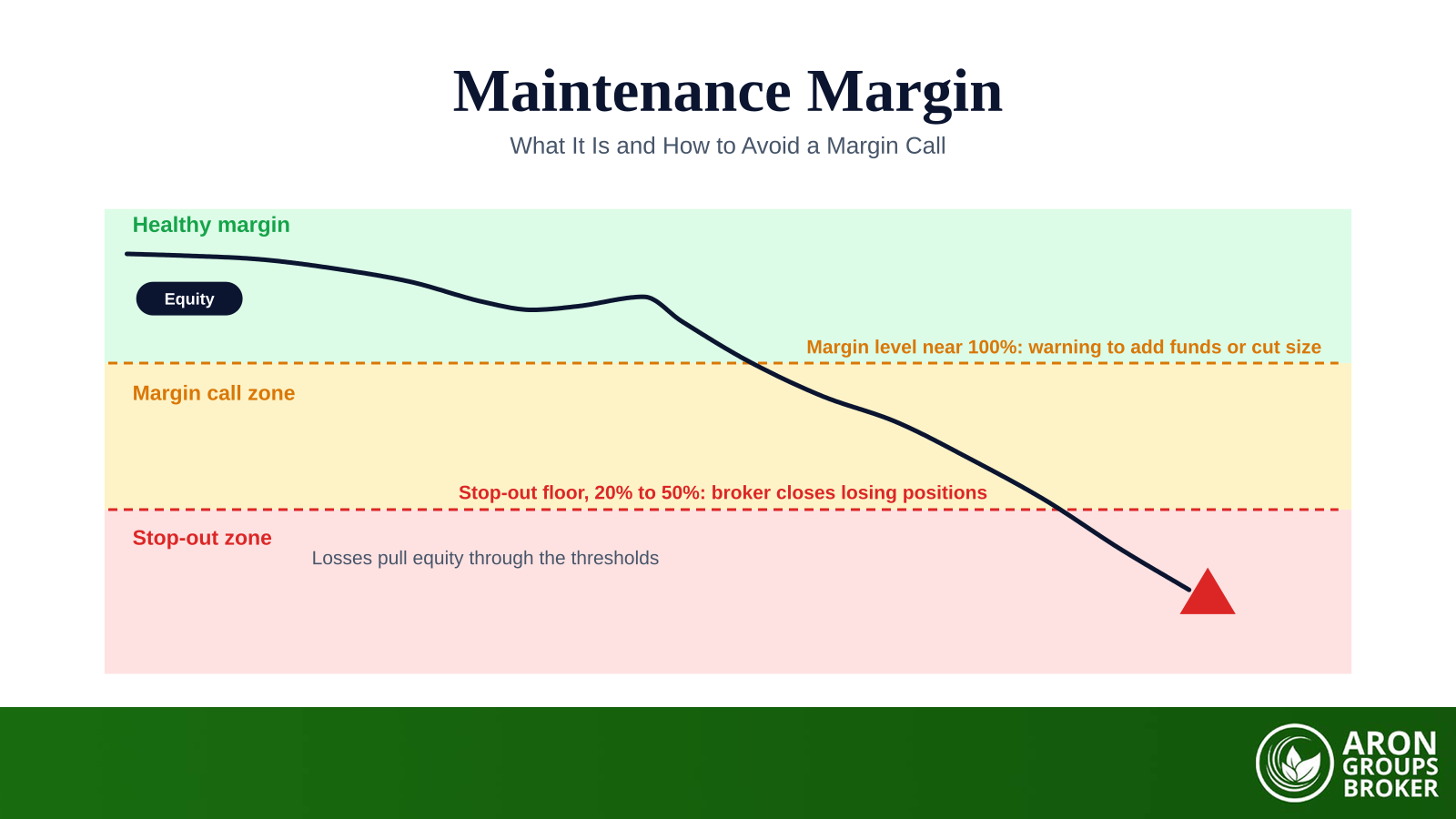
The margin level slides through the 100% warning line and the server closes the trade at the stop-out level; only the stretch before the bell belongs to the trader.

Stage One: The Warning

The platform flags the account through notifications and a highlighted margin figure in the terminal. At this stage you still control the outcome. Depositing funds lifts equity directly, while closing part of the position releases used margin, which raises the margin level immediately.

Adding money is not automatically the right cure. Topping up an account to defend a broken trade often converts one margin call into a larger one, so experienced traders usually cut size first and judge the position afterwards.

Stage Two: Automatic Liquidation

If equity keeps falling, the broker liquidates positions without asking. A common misconception is that a margin call always buys time to wire money. On most retail forex platforms the stop-out is automatic and instant once the threshold is hit, and no phone call precedes it.

sms-star

Key Point
Treat the margin call as the final decision point. The stop-out that follows it is executed by the server, at machine speed, with no negotiation.

Maintenance Margin Requirements in Stocks

FINRA sets the maintenance margin requirement for US equities at a minimum of 25% of the position’s market value. Brokers are free to demand more, and house levels of 30% to 40% are common on volatile shares. Regulators repeatedly warn that leveraged strategies amplify both outcomes, which is exactly why the floor exists.

The two thresholds carry different names when breached. Falling below the Regulation T initial level of 50% produces a fed call, while falling below the maintenance level produces a house call. A broker can sell holdings to cure either one if the investor fails to respond in time.

sms-star

Did You Know?
A fed call points to Regulation T, written by the Federal Reserve. A house call points to the broker's own maintenance rules, and it usually arrives first because house levels sit above the FINRA minimum.
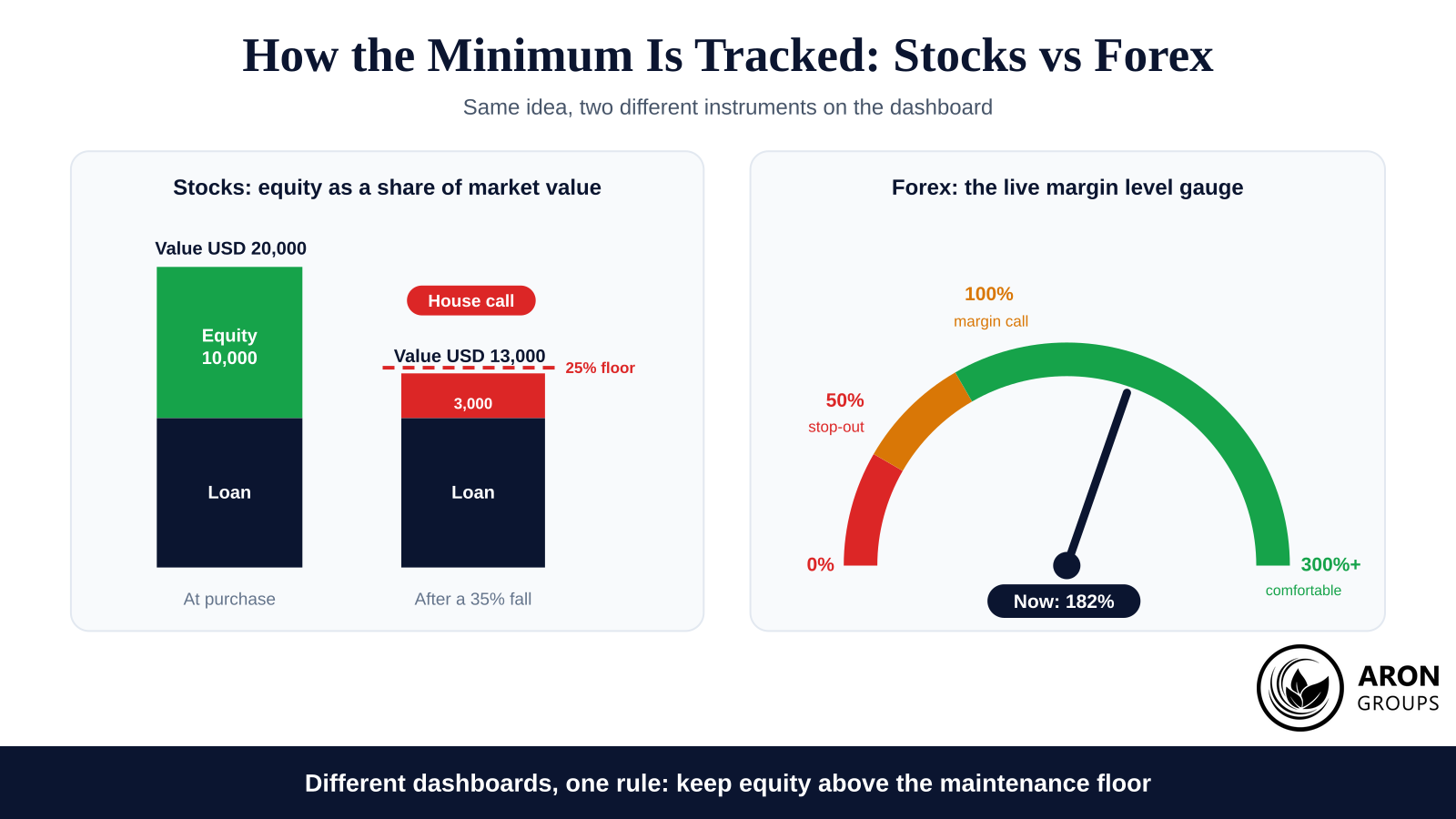
A quick case shows the gap in practice. Buy USD 20,000 of shares with USD 10,000 of your own money and the Regulation T deposit is satisfied. If the holding slides to USD 13,000, your equity is USD 3,000, or roughly 23% of market value, and the account has slipped beneath the 25% floor.

Margin Level in Forex and CFDs

Forex and CFD platforms run the maintenance test as margin level: equity divided by used margin, multiplied by 100. A margin call warning commonly appears near 100%, and the stop-out typically triggers between 20% and 50% depending on the broker’s specification.

When the stop-out fires, the platform closes the largest losing position first and repeats until the margin level recovers. In fast markets the exit can fill beyond the trigger price, so the realised loss can exceed the calculated one. In the European Union, ESMA’s product intervention measures standardised a 50% close-out for retail CFD accounts alongside negative balance protection.

Stocks test equity against a 25% share of position value, while forex reads the same health as a live margin level gauge; both punish the same mistake.

The practical difference is visibility. A stock investor may only hear about a breach when the broker writes to them, while a forex trader watches the margin level move in real time. That visibility is an advantage, but only for traders who actually look at it.

Equity, Balance and Free Margin

Balance counts only closed trades, while equity adds the floating result of open ones, and the maintenance test always reads equity. Free margin is equity minus used margin, and it is the fuel available both for new positions and for absorbing losses.

Once free margin reaches zero, every further tick against you erodes the used margin itself and drags the margin level under 100%. Traders who monitor free margin as routinely as they monitor price almost never see the warning at all.

A Worked Example: The Distance to Stop-Out

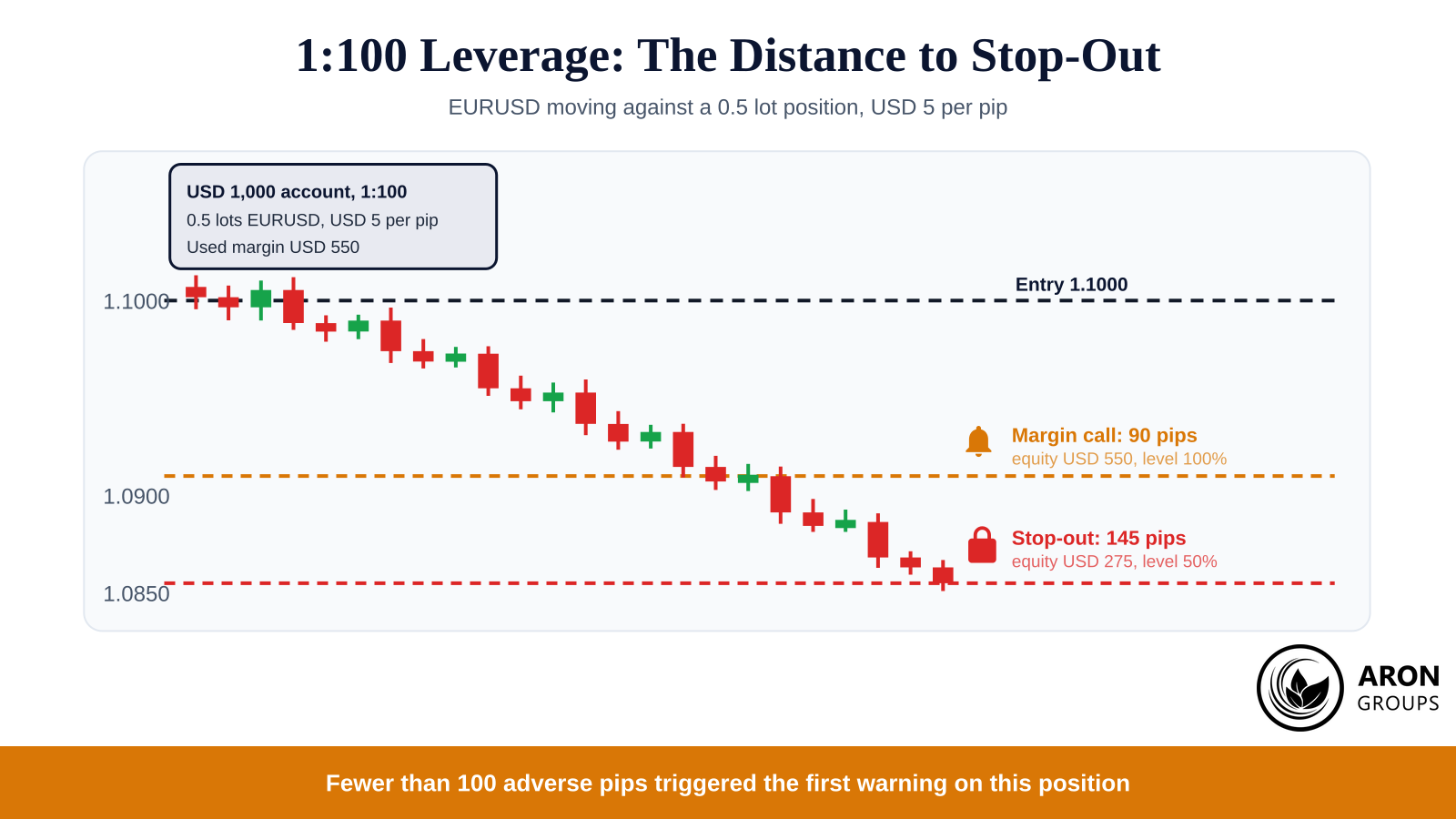
Numbers make the mechanics concrete faster than definitions do. Take a USD 1,000 account at 1:100 leverage, holding 0.5 lots of EURUSD with USD 550 of used margin. Each pip is worth USD 5, and the distance to trouble is shorter than most traders expect.

Ninety adverse pips reach the warning and 145 reach the stop-out; leverage did not create the loss, it removed the room.

Mini Example: Watching the Margin Level Fall

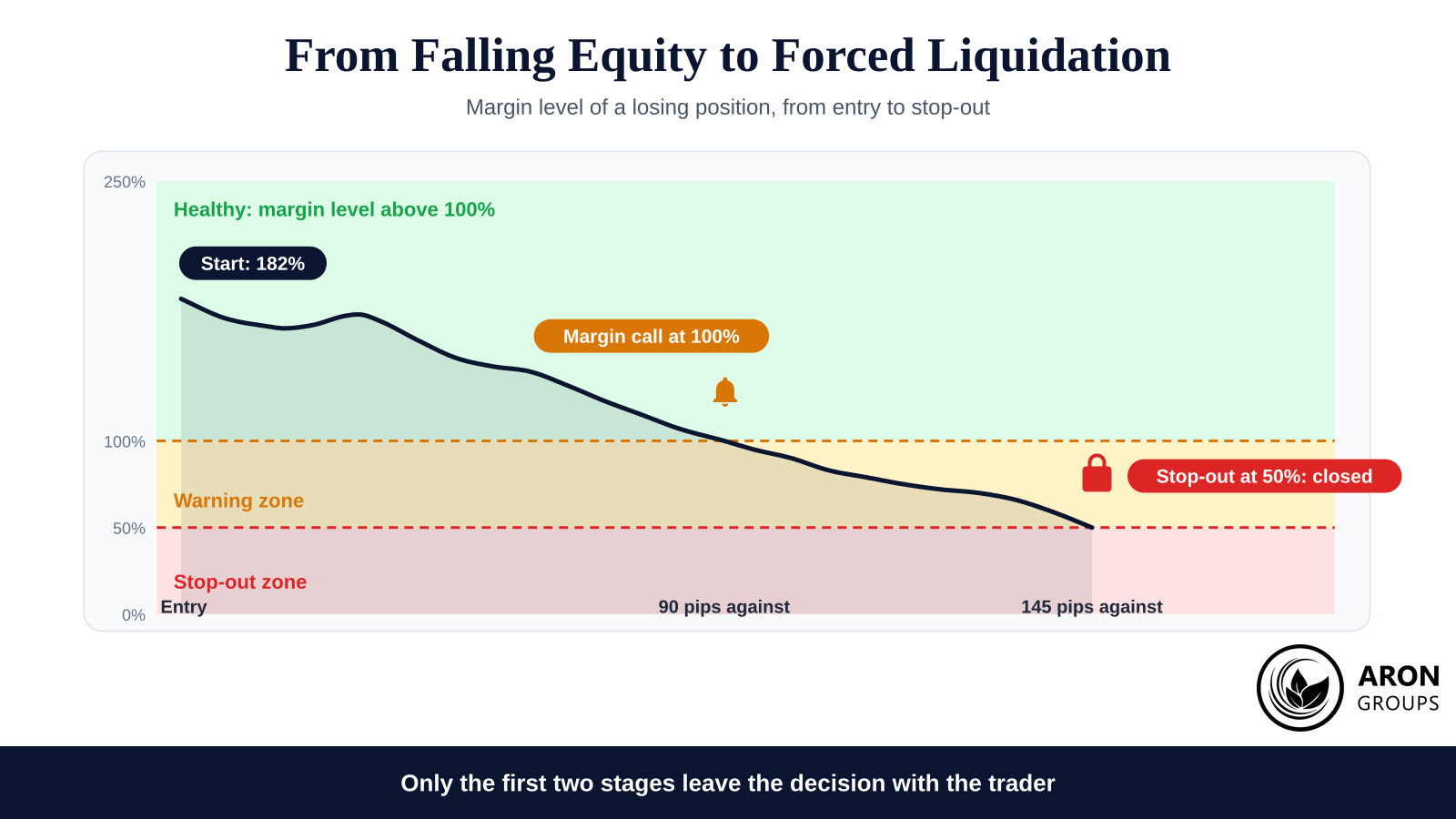
The account starts at a margin level of 182%, which is equity of USD 1,000 divided by used margin of USD 550. A 90 pip move against the position costs USD 450, cutting equity to USD 550 and the margin level to exactly 100%. The margin call appears.

Another 55 pips cost a further USD 275. Equity now sits at USD 275, the margin level reads 50%, and the platform closes the trade automatically. The same position at half the size would have doubled both distances before either threshold was touched.

Raising leverage makes the picture worse in a way many traders misread. Higher leverage does not change the pip value of a fixed position, but it invites larger positions on the same deposit, and size is what shortens the distance to the floor.

How to Avoid a Margin Call

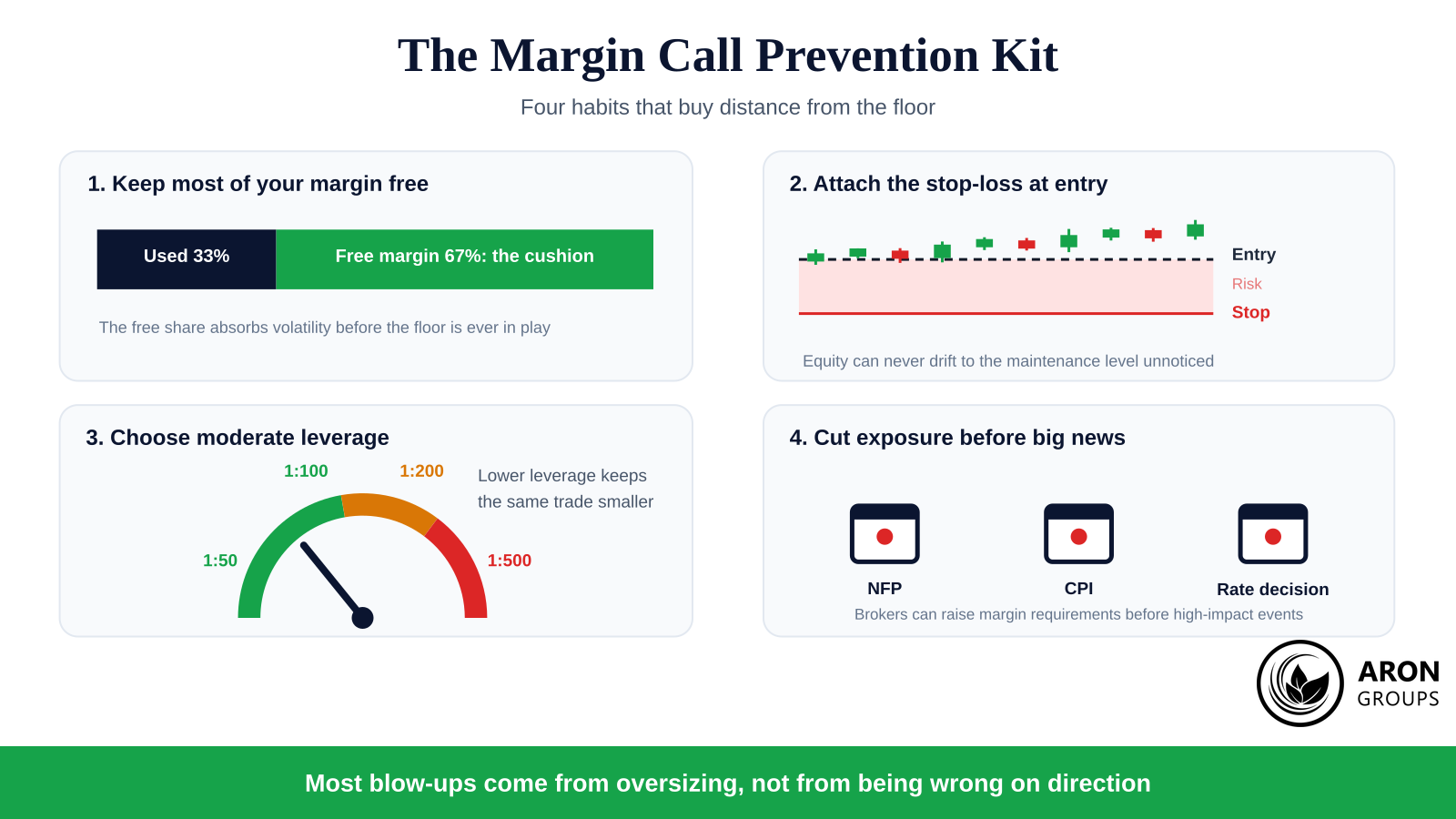
Avoiding a margin call is mostly a sizing decision made before entry. Traders who commit a small share of margin and define the risk on every trade rarely meet the stop-out engine, whatever the market does. Five habits do most of the work.

· Keep at least two thirds of your margin free as a volatility cushion.

· Attach a stop-loss at entry so equity never drifts near the maintenance floor.

· Prefer moderate leverage; a 1:100 cap leaves far more room than 1:500.

· Size positions from a fixed risk percentage of equity, not from available margin.

· Reduce exposure before NFP, CPI and rate decisions, when requirements and spreads can rise.

The habits compound because each one buys distance. Careful position sizing sets the pip cost, the stop caps the damage, and a sensible risk-reward ratio makes the winners pay for the losers. The CFTC’s guidance on retail forex presses the same points from the regulator’s side of the desk.

None of these habits predicts direction; all of them decide how long you can be wrong and remain in the trade.
sms-star

Trading Tip
Rehearse the response before you need it. Know exactly how to close half a position and how to move funds quickly, because decisions invented during a margin call are usually the worst ones.


Maintenance Margin in Futures and Crypto

Futures exchanges publish an initial and a maintenance margin for every contract, with maintenance commonly set close to 10% below initial. Accounts are marked to market daily, so gains and losses settle every evening and a breach demands a prompt top-up rather than a debate. Anyone asking what maintenance margin means in futures should therefore start with the contract specification, because figures shift with volatility.

Crypto derivatives use a maintenance margin rate that rises with position size, so larger books face stricter floors. The label changes from market to market, but the test never does. Equity must stay above the minimum, or the venue reduces the position for you.

Q: Is a margin maintenance calculator worth using?
A: Yes, as a pre-trade habit. Working out required equity, pip cost and the exact stop-out price before entry turns an abstract threshold into a number you can plan around, and it takes less than a minute.

Where Aron Groups Fits

Aron Groups runs the maintenance test through MetaTrader 5, which displays balance, equity, used margin and the live margin level in the terminal window. Watching those four figures through one losing session teaches the mechanics faster than any definition can.

Traders who want to feel a margin call without real damage can rehearse at micro size on a Nano account. The broker’s drawdown calculator and its material on capital preservation then turn that rehearsal into a permanent sizing routine.

Conclusion

Maintenance margin is the minimum equity that keeps a position open, and every market enforces it with the same escalation: a warning first, liquidation second. Stocks phrase the floor as 25% of value, forex as a margin level, futures and crypto as their own published rates. The vocabulary differs; the arithmetic does not.

The traders who never meet the stop-out engine are rarely the best forecasters. They are the ones whose sizing leaves the equity curve room to breathe, and whose trading discipline treats the margin call as a line never to visit. Build those habits while the account is healthy, because the platform will not wait once it is not.

Frequently Asked Questions

Quick answers to the questions traders ask most often about maintenance margin.

What triggers a maintenance margin call?

Equity falling to the maintenance threshold triggers it. That can happen through adverse price movement, requirements raised before major news, or widening spreads on open positions. No new trade is needed; an existing one deteriorating is enough.

Is maintenance margin the same in every market?

No. US stocks use the 25% FINRA floor, forex brokers use margin level thresholds, futures exchanges publish per-contract figures, and crypto venues apply tiered rates. Always read the specification for the exact instrument you trade.

What margin level should I maintain in forex?

Keep the margin level comfortably in the hundreds of percent. Many disciplined traders treat 300% as a working floor because it absorbs ordinary volatility without drama. Reaching the 100% warning reflects a planning failure, not bad luck.

Can I lose more than my deposit at stop-out?

The stop-out usually prevents that, but price gaps and slippage can push an account negative in extreme moves. Some brokers offer negative balance protection that resets such an account to zero. Check the policy before you rely on it.

Continue Reading
not-found
calendar 18 September 2026
Rate this article

Leave a Reply

Your email address will not be published. Required fields are marked *

No thanks