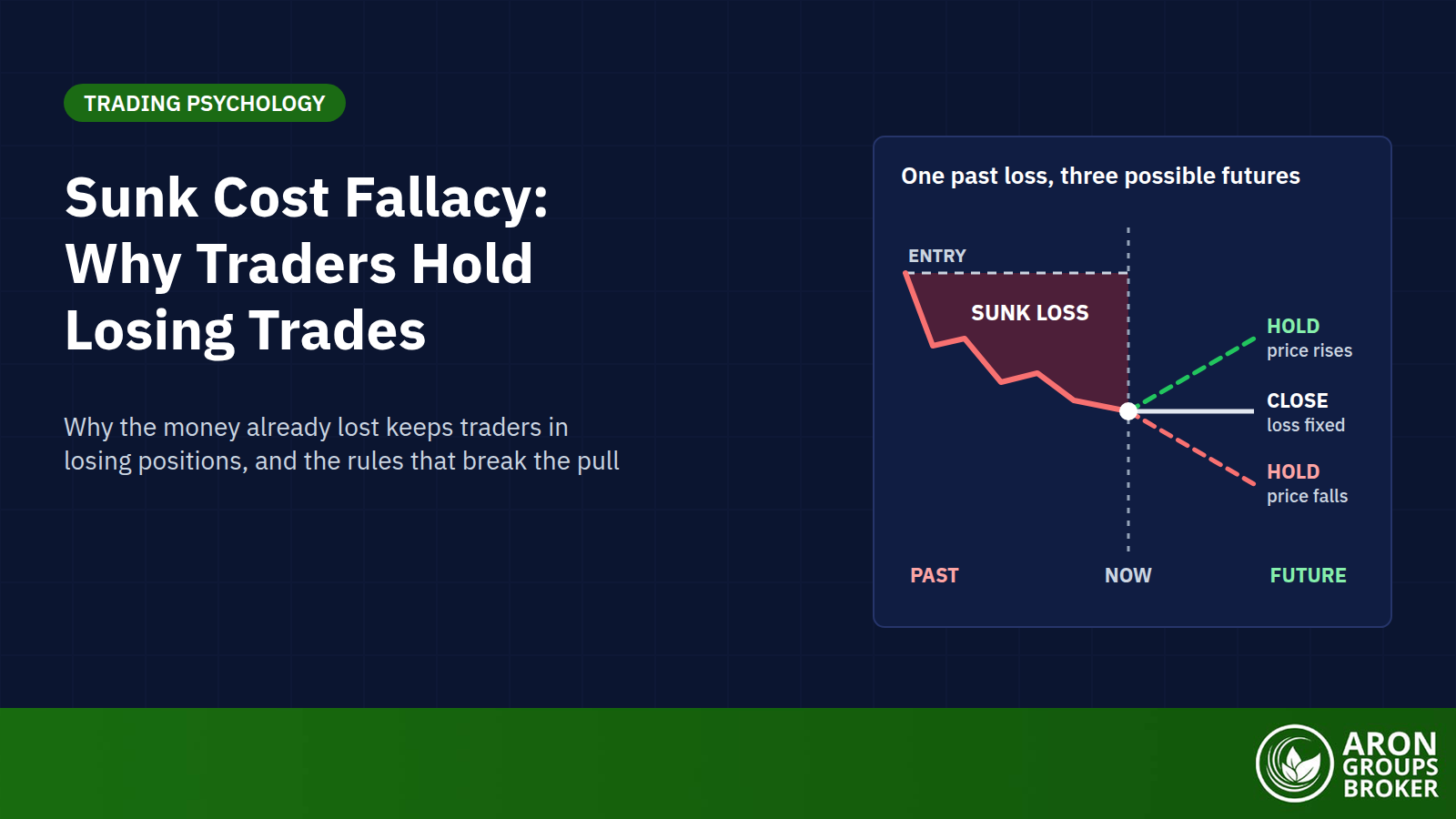

The sunk cost fallacy is the urge to continue something because of what has already been invested, even when stopping is the better choice. A sunk cost is money, time or effort already spent that cannot be recovered. In trading, the fallacy shows up as holding a losing position to avoid taking the loss.
Fast markets raise the cost, because an open loser can grow quickly. In the week to Friday 16 October 2026 the Nasdaq Composite fell 4.5% and the S&P 500 1.9%. That Friday alone, the VIX volatility index jumped from 16.46 to 19.99, according to FRED data. Weeks like that test trading psychology as much as analysis.
This guide covers the psychology and evidence behind the fallacy and how it drives holding losers. It ends with the rules traders use against it, and their limits.
- A sunk cost is already spent and cannot be recovered. The fallacy is letting that cost, rather than future value, decide whether to continue.
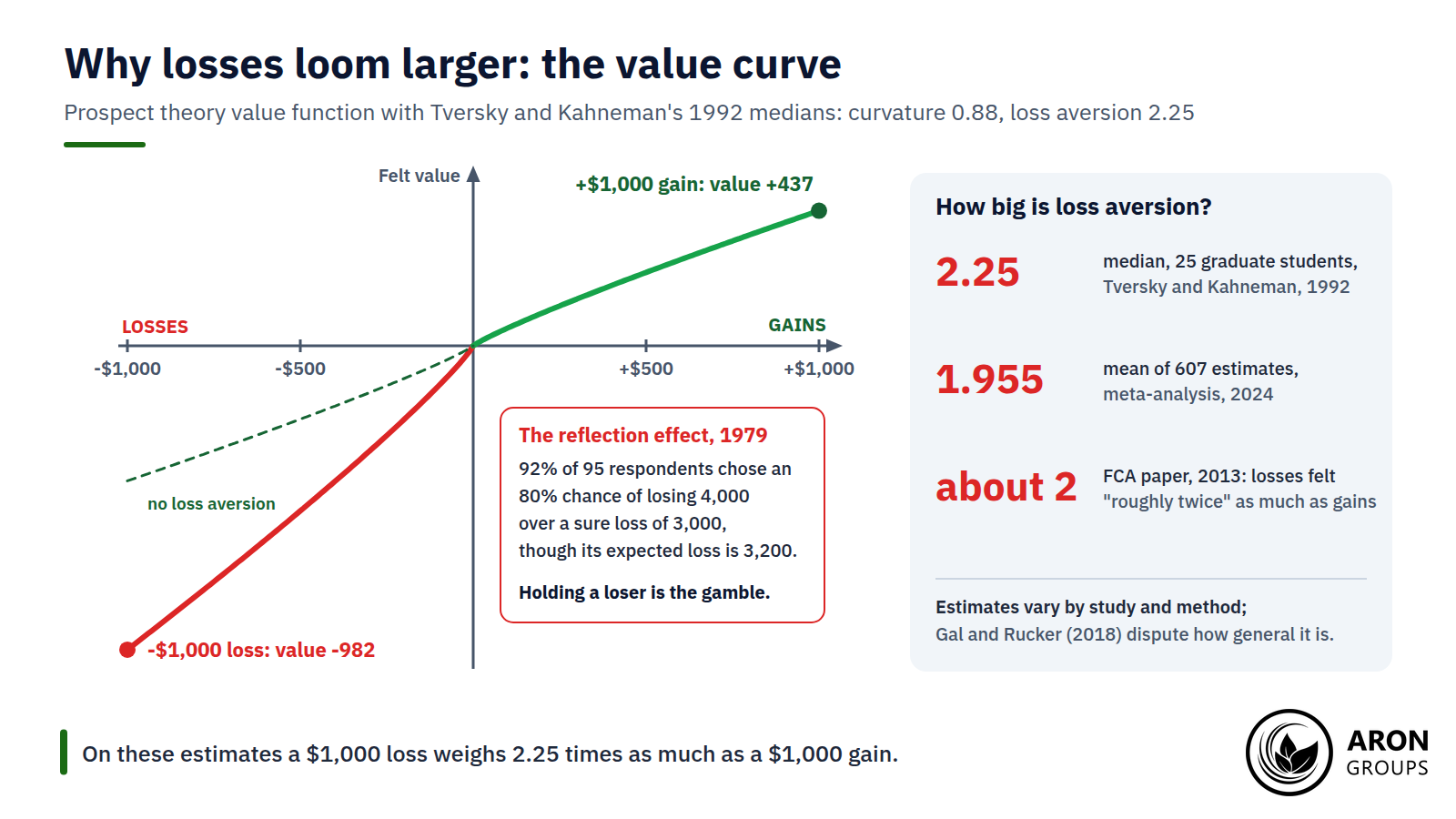
- Tversky and Kahneman's 1992 median loss-aversion estimate was 2.25. A 2024 meta-analysis of 607 estimates put the mean at 1.955.
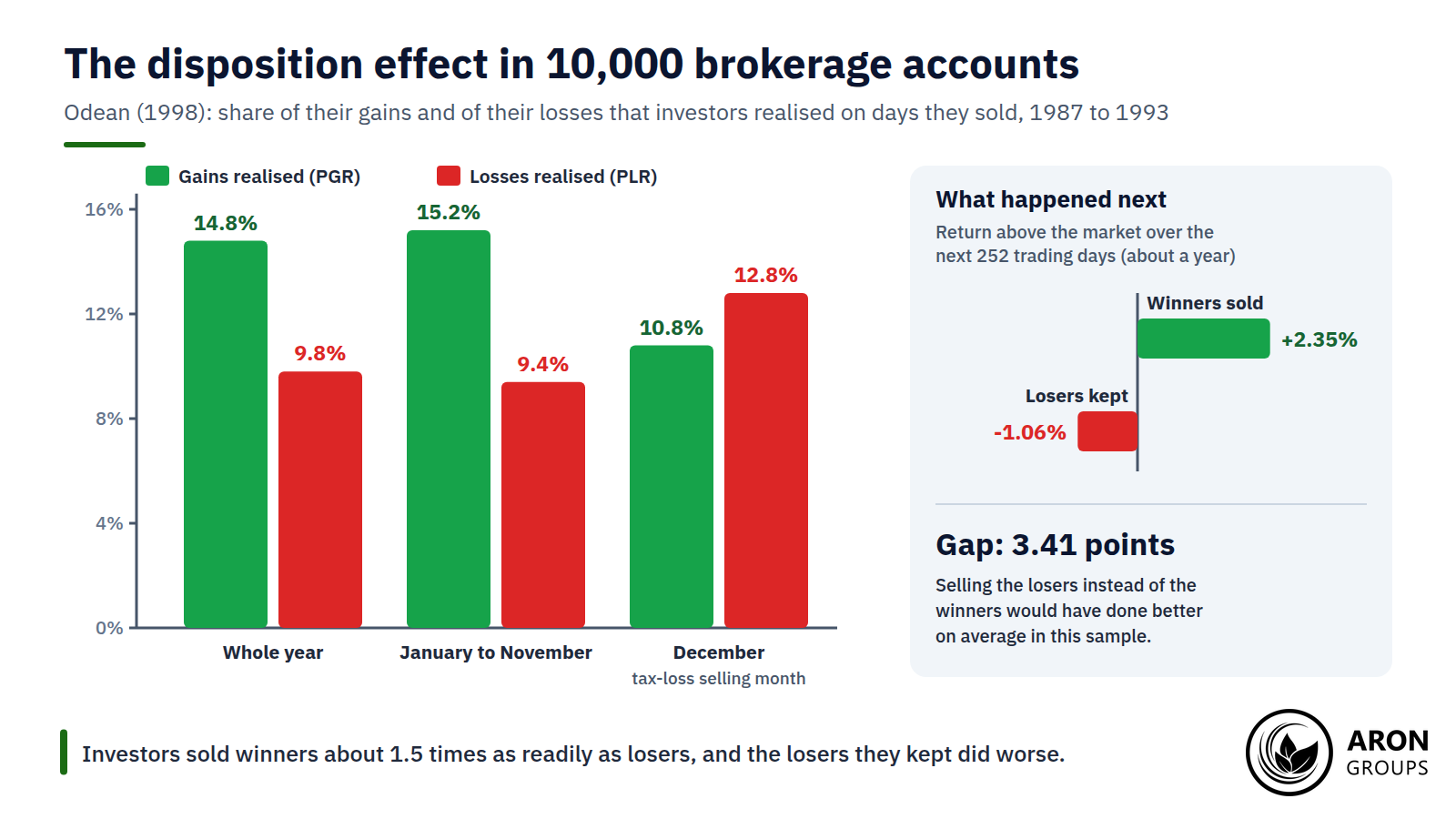
- In Odean's 1998 study of 10,000 brokerage accounts, investors realised 14.8% of their gains but only 9.8% of their losses on days they sold.
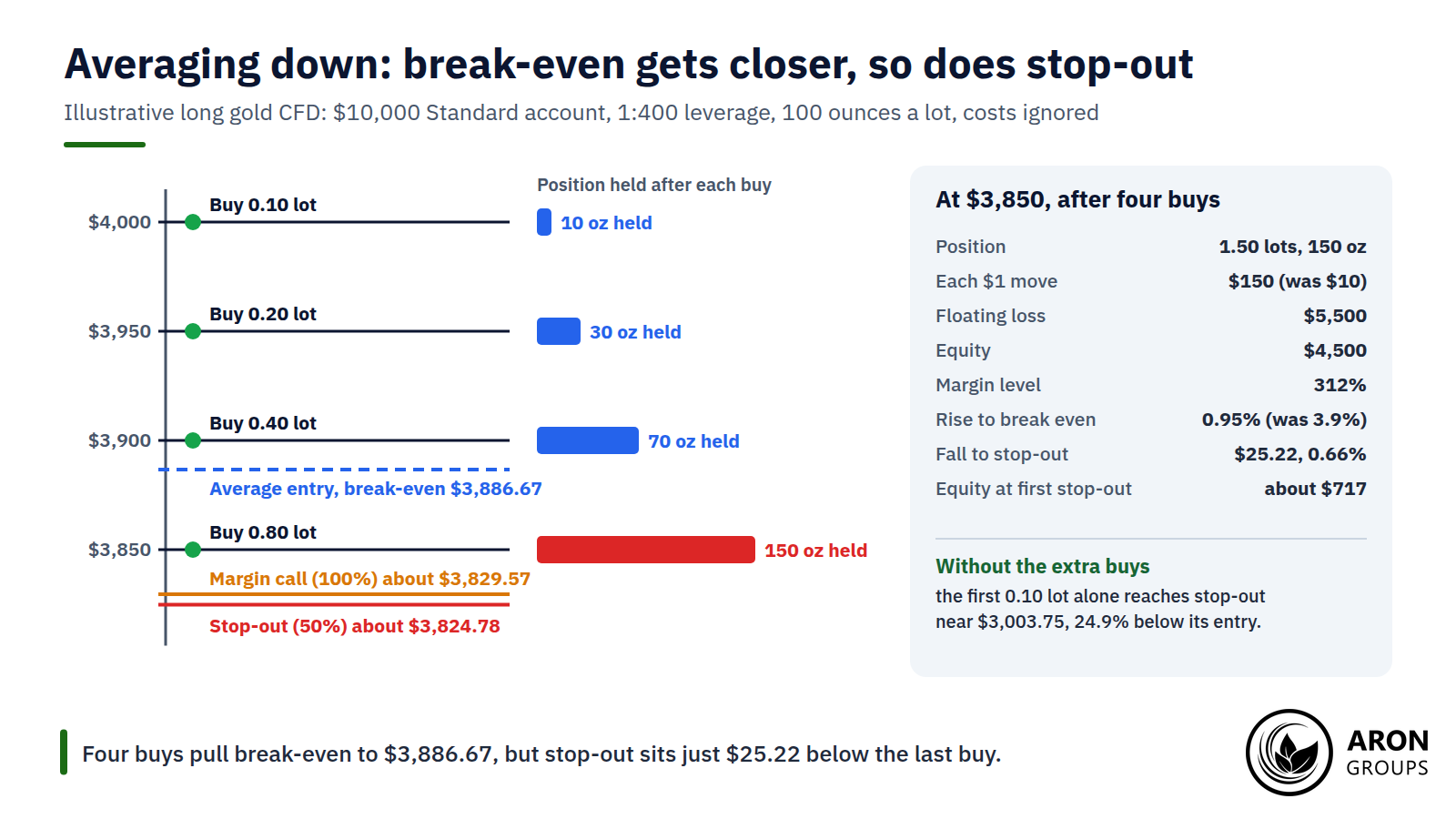
- In the article's illustrative gold example, three added buys lift the position from 10 to 150 ounces and leave stop-out $25.22 below the last buy.
- A stop-loss set before entry removes the in-the-moment decision. It is not a guaranteed exit, because a gap can fill it at a worse price.
What Is the Sunk Cost Fallacy?
A sunk cost is an unrecoverable cost: already paid, and lost whatever is decided next. The sunk cost fallacy is letting that cost decide whether to carry on. It is often described as throwing good money after bad: the past spending is lost either way, while new spending is still at risk.
Risk Disclosure
Trading forex and CFDs carries a high level of risk and can result in the loss of all your capital. This content is educational and is not investment advice. Never risk money you cannot afford to lose.
Sunk Cost Meaning: Past Cost vs Future Value
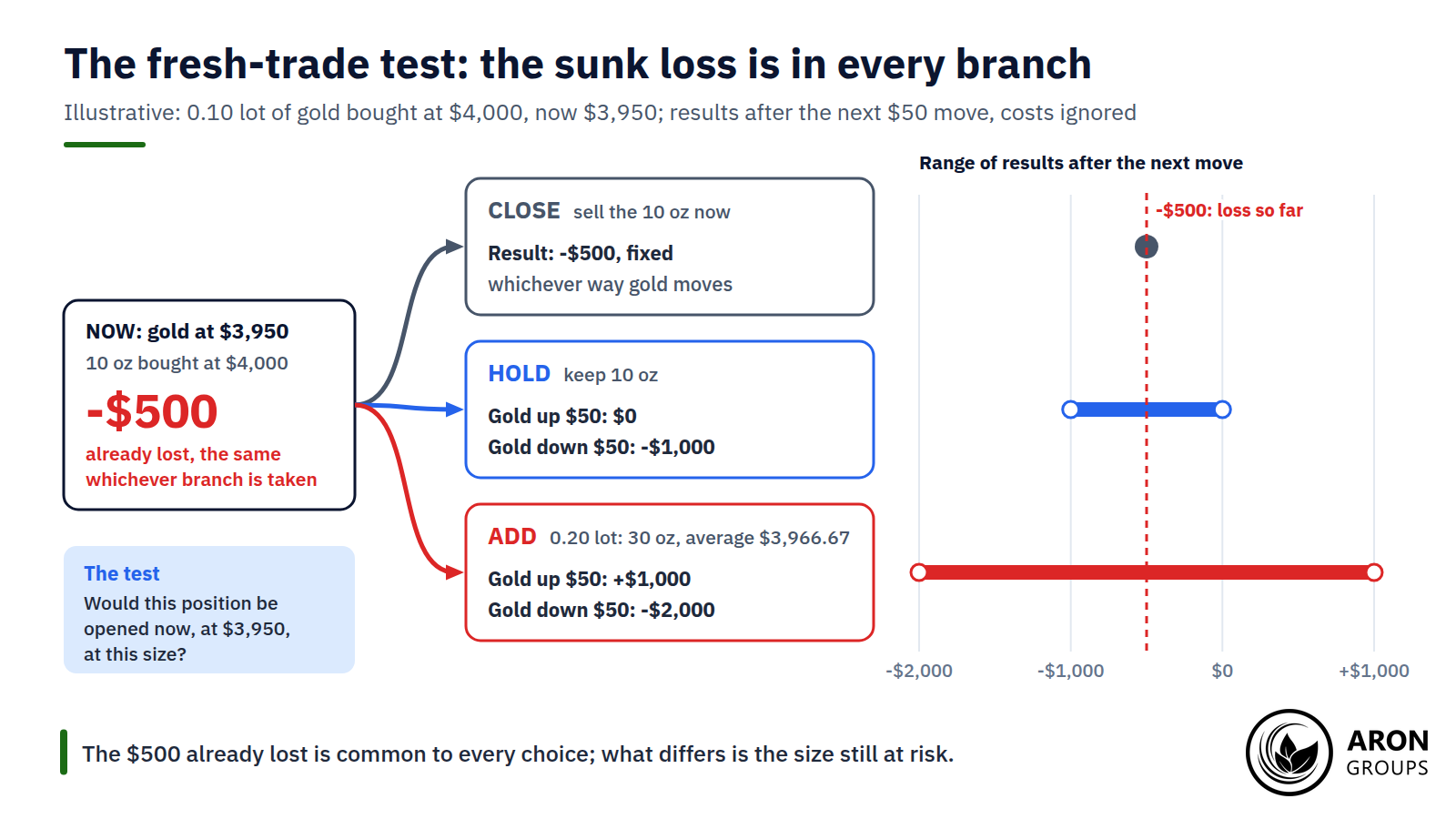
Standard decision theory says only future costs and benefits should drive a choice, because sunk costs are the same whichever option is taken. Take a trader who bought 10 ounces of gold at $4,000; gold now trades at $3,950. The $500 loss is the same whether the position is kept or closed; what differs is the exposure to the next move.
Everyday Sunk Cost Fallacy Examples
The textbook case is sitting through a film you dislike because the ticket was paid for. Hal Arkes and Catherine Blumer tested the pull in studies published in 1985. In one question, students imagined holding tickets for a $100 ski trip and a $50 trip they expected to enjoy more, on the same weekend. Of 61 college students who answered, 33 chose the dearer trip.
A field test at the Ohio University Theater sold 1982 to 1983 season tickets at $15, $13 or $8. Full-price buyers used an average of 4.11 tickets for the first five plays, against 3.32 and 3.29 for the discounted groups. The gap did not persist into the second half of the season.
The Concorde Fallacy
In biology it is known as the Concorde fallacy. Richard Dawkins and T. R. Carlisle set out the idea in Nature in 1976, writing about parental investment in animals. Their example was a government reluctant to abandon a supersonic airliner. Dawkins cited Concorde by name in The Selfish Gene that year, and later papers used the label.
A UK government history blog puts the real project’s cost at over £1.3 billion, against an original estimate of £70 million. Concorde entered service on 21 January 1976, and British Airways retired its fleet on 24 October 2003.
Why the Sunk Cost Fallacy Happens
Behavioural finance points to several forces. Loss aversion is a main driver; researchers also cite the wish not to look wasteful, self-justification and regret.
Loss Aversion and Prospect Theory
Daniel Kahneman and Amos Tversky’s 1979 prospect theory judges outcomes as gains and losses from a reference point, where “losses loom larger than gains”. In their 1992 follow-up with 25 graduate students, the median loss-aversion coefficient was 2.25: a loss weighed 2.25 times an equal gain.
That figure is an estimate, not a law. A 2024 meta-analysis of 607 estimates by Brown, Imai, Vieider and Camerer put the mean at 1.955. That is close to the “roughly twice” cited in an FCA paper on behavioural economics. Some researchers, notably David Gal and Derek Rucker in 2018, dispute how general loss aversion is.
The curve’s shape matters too. In the 1979 paper, 92% of 95 respondents preferred an 80% chance of losing 4,000 to a sure loss of 3,000. The gamble’s expected loss was larger, at 3,200.
Closing a losing trade is the sure loss; holding it is the gamble. Kahneman and Tversky illustrated the point with a business venture that had already lost money. In their words, “a person who has not made peace with his losses is likely to accept gambles that would be unacceptable to him otherwise”.
The Wish Not to Waste
Arkes and Blumer argued that the motive is “the desire not to appear wasteful”. In their studies, having taken economics courses did not reduce the effect.
In 1980 Richard Thaler, who named the endowment effect, imagined a family driving through a snowstorm to a basketball game they had paid for. His later theory of mental accounting explains why: staying home would close the account at a loss. A losing trade is a mental account too: closing it books the loss.
Escalation of Commitment and Regret
Barry Staw’s 1976 study of 240 business students, “Knee-deep in the big muddy”, showed escalation of commitment. Students who had personally chosen a division that did badly put an average of $13.07 million of a new $20 million budget into it. That was the most of any group.
Regret avoidance adds to the pull. Closing a loser confirms that the original decision was wrong, while holding keeps alive the hope of being proved right.
The Sunk Cost Fallacy in Trading
In trading, the most expensive form is often holding a losing position because closing it would make the loss real. The usual reasoning is that too much is already lost to sell, or that the price has to come back to break even.
The entry price becomes an anchor, the reference point for every judgement, although the market takes no account of one trader’s entry. Holding is in effect a fresh decision to keep the same exposure at the current price. The sunk cost fallacy works directly against the old trading rule to cut losses short and let profits run.
Deep losses are also hard to recover. As Aron’s guide to drawdown notes, an account that falls 50% needs a 100% gain to get back to break-even.
Key Point
The economic test of a losing position is its prospects from here, not the price paid. The loss so far is the same whether it is held or closed.
The Disposition Effect in Real Accounts
Hersh Shefrin and Meir Statman named this pattern the disposition effect in 1985: selling winners too early and riding losers too long. They linked it to prospect theory, mental accounting, regret aversion and self-control, alongside tax.
Terrance Odean’s 1998 study in the Journal of Finance measured it in 10,000 accounts at a nationwide discount broker from 1987 to 1993. On days they sold, investors realised 14.8% of their gains but only 9.8% of their losses. A stock that was up was more than 50% more likely to be sold than one that was down.
December was the exception: tax-motivated selling lifted the share of losses realised to 12.8%, above 10.8% for gains. The losers investors kept also did worse. Over the next 252 trading days, winners sold beat the market by 2.35% while losers held trailed it by 1.06%, a gap of 3.41 points.
A Library of Congress report prepared for the SEC in 2010 lists the disposition effect among counterproductive patterns in investor behaviour. It notes that winners sold went on to outperform the losers still held.
Sunk Cost vs Loss Aversion, Anchoring and the Disposition Effect
Loss aversion is the broad tendency to weigh losses more heavily than equal gains. The sunk cost fallacy is one behaviour it helps produce, alongside other drivers such as the wish not to waste. The table compares them with four close relatives.
| Bias | What it is | How it shows up in trading | A countermeasure traders use |
|---|---|---|---|
| Sunk cost fallacy | Continuing because of what has already been spent | Holding a loser because too much is already lost to sell | The fresh-trade test; a stop set before entry |
| Loss aversion | Losses weigh more than equal gains; average estimates near 2 | Reluctance to take any loss at all | A fixed risk per trade, sized in advance |
| Anchoring bias | Leaning on a reference number when judging value | Treating the entry price as fair value | Judging from the current price and new information |
| Disposition effect | Selling winners too early and riding losers too long | Small profits taken quickly, large losses kept | Exit levels set in the plan; journal reviews |
| Escalation of commitment | Adding resources to justify a failing choice | Averaging down; raising size after losses | No unplanned adds; a maximum position size |
| Endowment effect | Valuing something more because you own it | Seeing an open position as worth more than the cash it would release | Comparing holding with buying the same position afresh |
Related biases compared: loss aversion is one of the main drivers, and the sunk cost fallacy is a specific behaviour.
Averaging Down: Adding to a Loser
Averaging down means adding to a losing position to lower its average entry price. When it is unplanned, it is often the sunk cost fallacy with leverage: new money goes in to justify the original trade. It pulls break-even closer but multiplies the size exposed to the next move.
Mini Example: Doubling Down on a Gold Trade
These numbers are illustrative: margin is based on the current price, and spreads, commissions and swaps are ignored. A trader with $10,000 in a Standard account buys 0.10 lot of gold at $4,000, which is 10 ounces at the usual 100-ounce contract. Each time gold falls $50, the trader doubles: 0.20 lot at $3,950, 0.40 at $3,900 and 0.80 at $3,850.
The position is now 1.50 lots, or 150 ounces, with an average entry of $3,886.67. Gold needs to rise only 0.95% to break even, against 3.9% for the first trade. But each $1 move is now worth $150, not $10, and the floating loss is already $5,500.
On Aron’s Standard account the margin call comes at a 100% margin level and stop-out at 50%. At 1:400 leverage, the margin call arrives near $3,829.57 and stop-out near $3,824.78, only $25.22 below the last buy. Stop-out would first trigger with about $717 of the $10,000 left, before any slippage. The first 10 ounces alone would not reach stop-out until about $3,003.75.
Exact levels depend on leverage and costs, but each add shrinks the room left before a margin call and stop-out. It can turn a survivable loss into an account-ending one.
Martingale: Doubling by Design
Doubling after every loss is the logic of the martingale, a betting system. In theory one win recovers every earlier loss; in practice capital and margin can run out first, and a long enough trend ends the sequence.
Q: Is averaging down always the sunk cost fallacy?
A: No. A scale-in planned before entry, with total size and risk fixed in advance, is a strategy. Adding to rescue a losing trade, with no limit set beforehand, is the fallacy at work.
Failing Systems and Ignored Stops
The same pull keeps traders running a strategy that has stopped working, because of the hours spent backtesting it. Those hours are sunk; what matters is whether the system still has an edge on data it has not seen. Aron’s guide to why most trading strategies are fake notes that overfitting comes from testing many variations and keeping the luckiest.
It also explains ignoring a breached mental stop because of the analysis already done. That analysis is sunk whether the trade is closed or not.
How Traders Counter Sunk Cost Thinking
No rule removes losses. Several, though, support trading discipline by fixing the exit before emotions take hold, pointing the choice at future value rather than money already lost.
Stops Set Before Entry
A stop-loss placed when the trade opens takes the in-the-moment decision away. That holds only while the stop is not widened: moving it away or removing it without new information is the fallacy at work. Position sizing completes it, so that the distance to the stop risks a set share of the account.
A stop is not a guaranteed exit either. As an SEC investor bulletin warns, “The stop price is not the guaranteed execution price for a stop order.” In a gap, a stop can fill well beyond its level.
The Fresh-Trade Test
A widely used test asks whether the trader would open the same position now, at the current price and size. If the answer is no, holding is a bet the trader would not otherwise place. Applied to the gold trade at $3,950, the $500 already lost is the same in every branch.
The test has a blind spot. It ignores the cost of closing and reopening, such as a second spread, so it works best when the answer is clear.
Journals and Fixed Rules
A trading journal that records the planned stop, the actual exit and the reason for any change makes sunk cost decisions visible afterwards. Written rules in a trading plan, such as no adds to losing positions or a maximum daily loss, leave less to decide in the moment. They are part of wider risk management, not a guarantee.
The Honest Limits of the Sunk Cost Rule
Ignoring sunk costs is sound as a rule, but it is easy to misapply. Costs still to be paid are not sunk: any commission on closing, and overnight swaps on holding, belong in the decision. Tax treatment of realised losses can also matter in some countries; this is not tax advice.
New information is relevant even though the entry price is not. A position held because its original reason still stands, inside a planned strategy with defined risk, is not the fallacy. The label is sometimes misapplied to that kind of rational persistence.
Concorde itself is less clear-cut than the label suggests. When Britain’s Labour government tried to cancel it in 1964, officials found the agreement had treaty force and possible heavy penalties for withdrawal. According to historians Johnman and Lynch, cancelling was argued likely to cost more than continuing: a future cost, not a sunk one.
Some research suggests the effect is smaller and less universal than popular writing implies. An experiment published in 2007 by Friedman and colleagues found “a surprisingly small sunk cost effect”. A 1999 review by Arkes and Ayton argued there were no unambiguous cases in animals other than humans.
Where Aron Groups Fits
Aron Groups offers forex, gold, indices and crypto CFDs on MetaTrader 5, where exit decisions can be set in advance. Stop-loss and take-profit levels can be attached to a position, and price alerts can notify a trader by sound, email or push message. Trailing stops run in the platform rather than on the server, so they stop trailing when it is closed.
Aron’s margin call at a 100% margin level and stop-out at 50%, or 40% on Islamic and VIP accounts, are backstops, not a plan. As the gold example shows, at high leverage they can act only after most of the account has gone. A demo account with virtual funds, or a Nano account trading from 0.0001 lots, lets a trader practise exit rules at small size. Neither removes the risk of loss in live trading.
Conclusion
The sunk cost fallacy turns a past loss, which no decision can change, into a reason to risk a bigger one. In trading it shows up as holding losers, averaging down without a plan and moving stops.
Loss aversion, the wish not to waste, self-justification and regret all feed it, and real account data show the pattern. The rules that help share one idea: judging a position on its prospects from the current price, with the exit set before emotion builds.
Frequently Asked Questions
Short answers on the sunk cost fallacy meaning, with examples.
What is a sunk cost?
A sunk cost is money, time or effort already spent that cannot be recovered, whatever happens next. A non-refundable ticket is a simple sunk cost example; so is the spread paid to open a trade.
What is an example of the sunk cost fallacy?
Sitting through a film you dislike because the ticket was paid for is the everyday case. In trading, it is holding a loser to avoid booking the loss.
What is the sunk cost fallacy in relationships?
It describes staying in a relationship mainly because of the years already invested. Those years cannot be recovered either way, although shared commitments and future plans are real, forward-looking reasons.
How do traders avoid the sunk cost fallacy?
Common rules include setting the stop and position size before entry, applying the fresh-trade test to open positions and logging rule breaks in a journal. None removes losses; they move the exit decision to a calmer moment.