
TD Sequential® is Tom DeMark’s trend exhaustion indicator, and it counts bars instead of smoothing price. It runs in two phases: a nine bar Setup and a thirteen bar Countdown. A completed 9 marks a move that may be running out of participants. A completed 13 is the later and rarer version of the same message. Neither one promises a reversal.
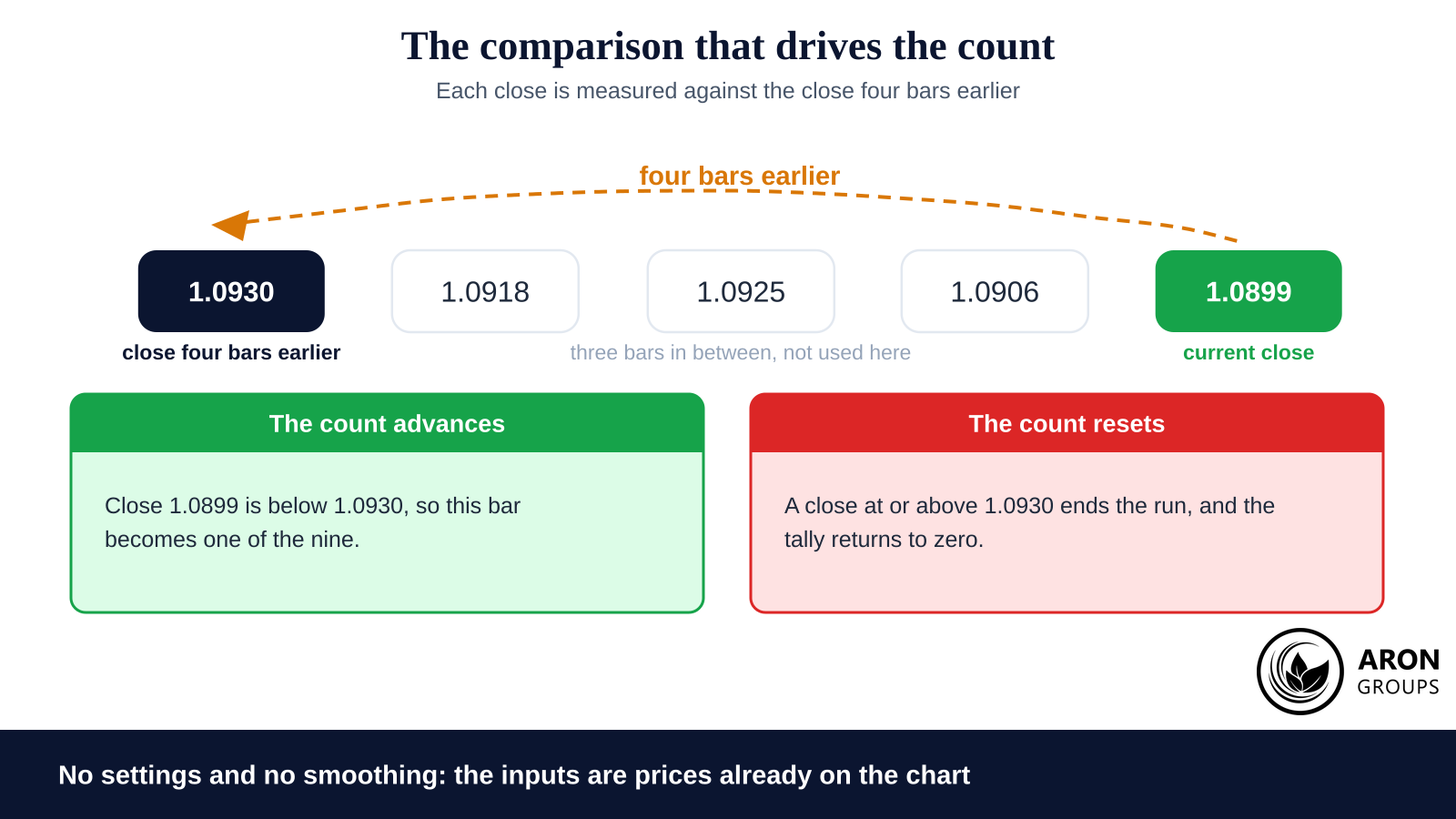
The comparison at its heart is unusually plain. Each close is measured against the close four bars earlier, and nothing else enters the calculation. There are no periods to tune and no averages to fit, so two traders running the rules on one chart see the same count. That makes it a genuinely systematic tool.
This guide sets out the exact rules of both phases, and corrects three details that free write-ups get wrong. The first is which price flip starts which Setup. The second is why Countdown bars need not be consecutive, and the third is where the TDST® lines are drawn. It also separates the study from TD Combo® and from the DeMarker oscillator.
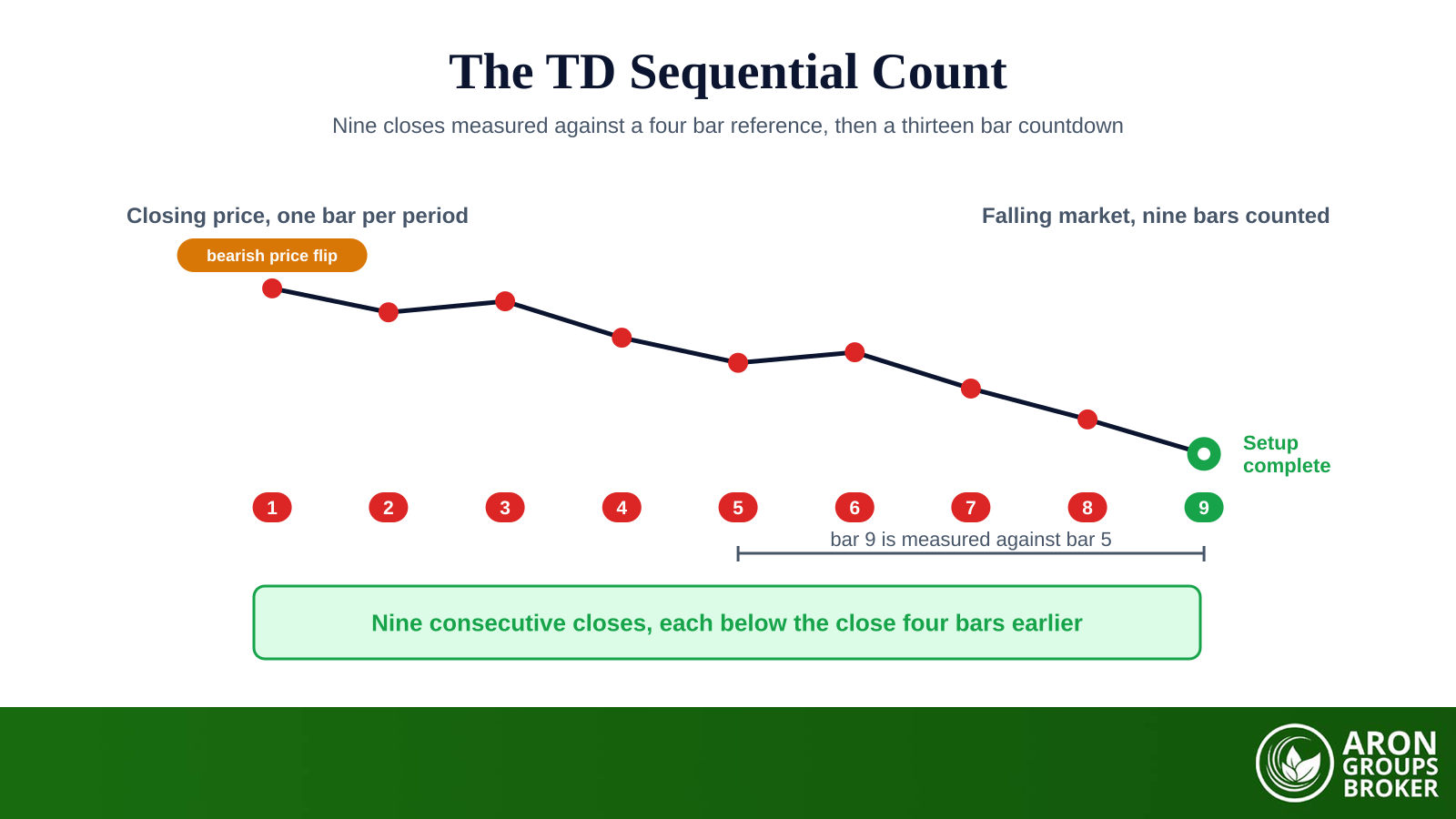
- A TD Buy Setup is nine consecutive closes, each below the close four bars earlier; the Sell Setup mirrors it.
- A bearish price flip starts a Buy Setup and a bullish flip starts a Sell Setup, which inverts what many sources claim.
- The Countdown runs to thirteen only after a Setup completes, and its qualifying bars need not be consecutive.
- TDST lines come from the extreme of the whole nine bar series, not from the extreme of its first bar.
- A completed count marks where a turn is more likely than it was, never that a turn will happen.
What TD Sequential actually is
TD Sequential is a bar counting indicator that flags where a trend may be exhausted. DeMark designed it to find the point at which a move has lost its marginal buyer or seller. Every input already sits on the chart, so the study adds no lag of its own.
Risk Disclosure
Trading forex and CFDs carries a high level of risk and can result in the loss of all your capital. This content is educational and is not investment advice. Never risk money you cannot afford to lose.
The two phases, in order
The Setup always comes first, and the Countdown cannot begin without it. The Setup uses nine bars to establish that a directional move exists. The Countdown then runs a separate thirteen bar test for the point at which that move is spent. A 13 quoted without a preceding 9 is not an indicator output.
Why the comparison looks four bars back
The four bar reference is the fixed lookback DeMark chose, and it turns the count into a momentum test. A close below the close four bars earlier says the market sits lower than it did recently. Nine of those in a row say the condition has persisted.
The price flip that starts a Setup
A Setup does not begin on its own. It begins with a price flip, which is a pair of consecutive closes that switch sides of the four bar reference. Until that flip appears, nothing on the chart is numbered.
The naming is counter-intuitive, and it is the detail secondary write-ups botch most often. A bearish TD price flip starts a TD Buy Setup. In full: one close greater than the close four bars earlier, immediately followed by a close less than the close four bars earlier. A bullish price flip starts a TD Sell Setup.
The flip is named for the momentum shift it registers, not for the setup it launches. A bearish flip marks the moment downward pressure takes over, and a Buy Setup is a count of exactly that pressure.
Key Point
A bearish price flip starts a buy setup, and a bullish price flip starts a sell setup. If a source tells you otherwise, it has the inversion the wrong way round.
The nine bar Setup, buy and sell
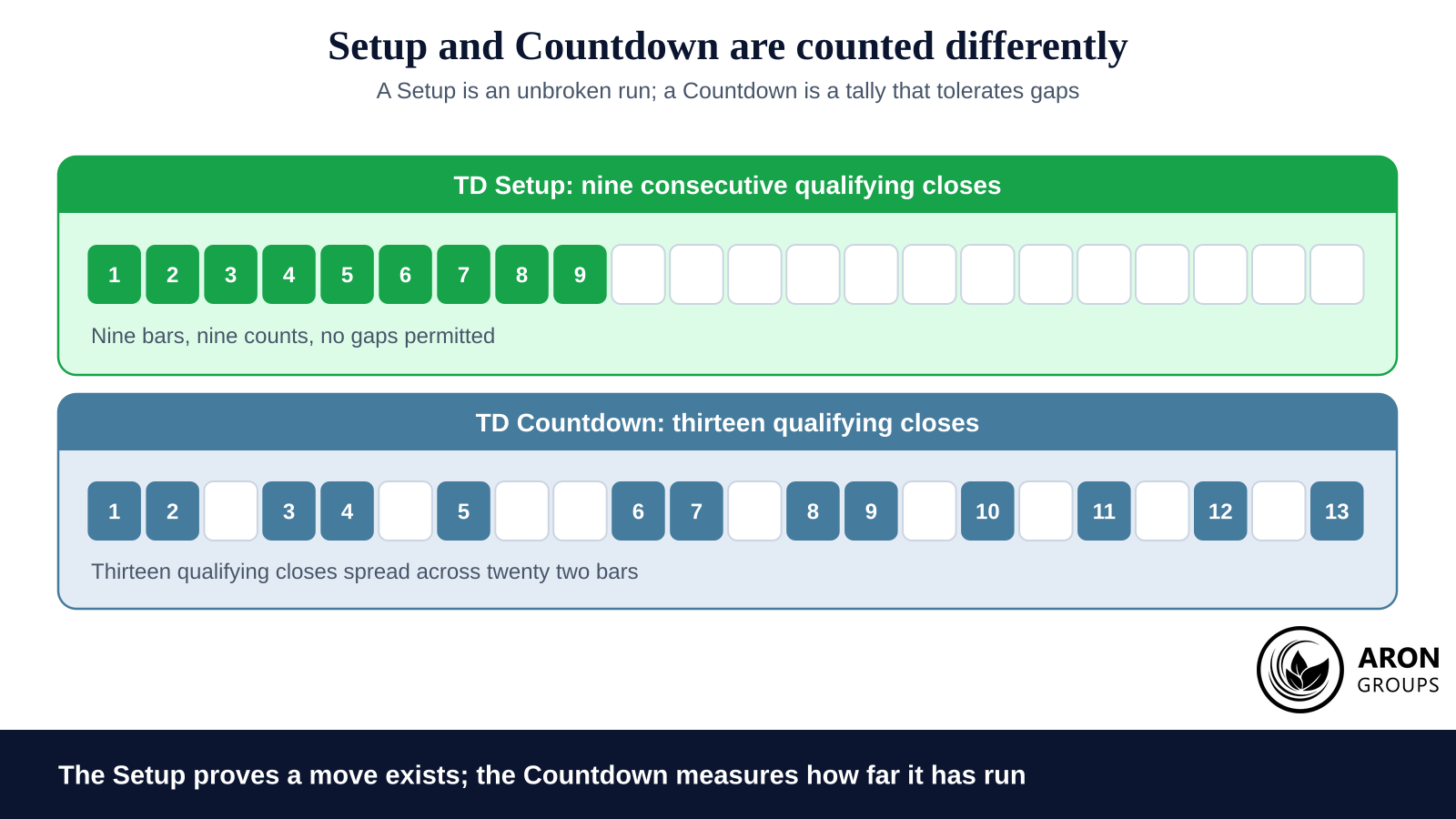
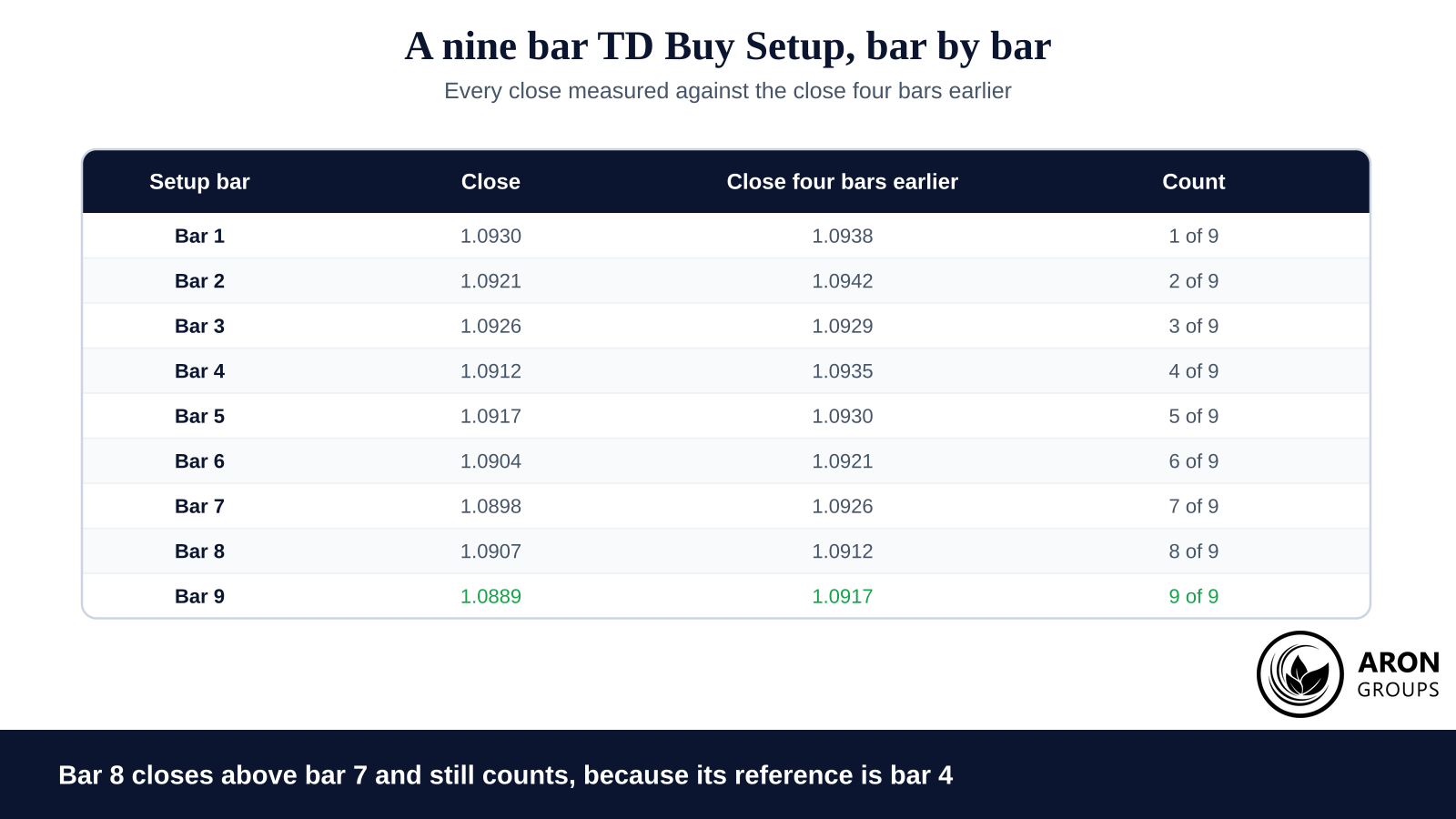
A TD Buy Setup is nine consecutive closes, each less than the close four bars earlier. A TD Sell Setup is nine consecutive closes, each greater than the close four bars earlier. Consecutive is the operative word. Any bar that fails the test resets the count to zero.
The buy version hunts a bottom and the sell version hunts a top. By bar nine of a buy setup, sellers have won nine straight comparisons against the reference. DeMark treats that as potentially exhausted, and a fresh price flip is needed once a run breaks.
The comparison is always against the reference bar, never against the previous close. A bar can close above the one before it and still advance the count, provided it closes below its four bar reference. Reading the nine as nine falling bars is a common error.
Setup perfection
Perfection is a quality filter applied to a completed nine. For a buy setup, the low of bar 8 or bar 9 must sit at or below the lows of bars 6 and 7. A low on a subsequent bar can satisfy the condition instead. The sell setup mirrors that using highs, and many implementations drop the clause about a subsequent bar.
TDST lines, and the detail most versions get wrong
A TDST line is drawn from the extreme of the whole nine bar series, not from its first bar. DeMARK Analytics specifies TDST resistance as the highest true high of a completed Buy Setup. TDST support is the lowest true low of a completed Sell Setup. A true high incorporates the prior close when a gap leaves it outside the bar’s own range.
The wrong version circulates because it is usually right by accident. In a buy setup prices are falling, so bar one normally does hold the highest true high. A spike on bars two to four can beat it. Where the line sits changes the stop, the target and therefore the risk-reward ratio.
The Countdown to thirteen
The Countdown begins only once a Setup has completed. A buy countdown looks for thirteen closes less than or equal to the low two bars earlier. A sell countdown looks for thirteen closes greater than or equal to the high two bars earlier. The reference is a low or a high, not a close.
The structural difference is the one most readers miss. Countdown bars need not be consecutive. A qualifying close can arrive, three bars can then fail the test, and the next qualifying close takes the tally forward. The 13 therefore lands well after the 9.
| Feature | TD Setup | TD Countdown |
|---|---|---|
| Length | Nine bars | Thirteen qualifying bars |
| Compared with | The close four bars earlier | The low or high two bars earlier |
| Consecutive | Yes, any failure resets it to zero | No, gaps between counts are allowed |
| Needs first | A price flip in the opposite direction | A completed Setup in the same direction |
| Reads as | A directional move is established | That move may now be spent |
The Setup proves a move exists; the Countdown measures how far it has run.
One further qualifier is routinely dropped from free versions. For a buy countdown, the low of bar 13 must sit at or below the close of countdown bar 8. If it does not, bar 13 is deferred. Anyone automating the count with an expert advisor should check the code for it.
Q: What happens after a completed 13?
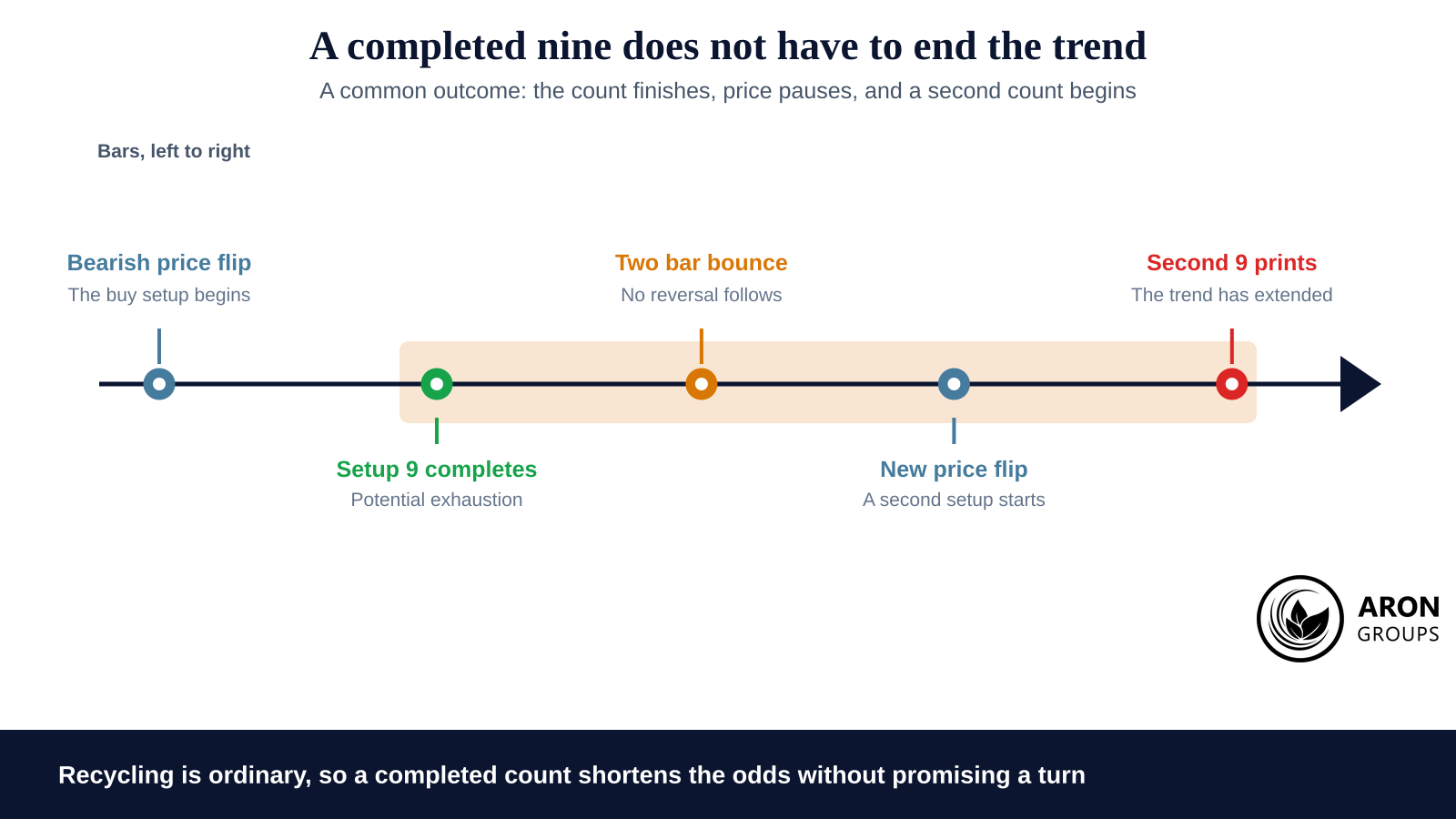
A: DeMark documents a twelve bar rule. If a reversal has not occurred within twelve bars of a completed 13, the existing trend is likely to continue. A Countdown can also be cancelled outright, and a new Setup in the same direction recycles the sequence from the beginning.
TD Combo, the DeMarker and the genuine study
TD Combo is a stricter sibling in the same family. It applies tighter conditions and lets its countdown begin earlier, so a Combo 13 and a Sequential 13 rarely land on the same bar. They are related studies, not two names for one thing.
The DeMarker, often written DeM, is a different instrument entirely. It is an overbought and oversold oscillator built from recent price extensions, and it produces a bounded line rather than a bar count. Conflating the two is common in forum posts.
Sequential, Combo, Setup Trend, Setup, Countdown, Price Flip, Perfected, 9 and 9-13 are registered trademarks of DeMARK Analytics. The official studies run on Bloomberg and on a paid TradingView offering branded DeMARK 9-13. Many free scripts only approximate the rules.
Checking which version you are running takes about five minutes. Load the script, count a recent nine by hand, and see whether the numbers agree. The platform training material covers where custom indicators live.
Practical filter
Before trusting a 13, confirm that your script implements the bar 8 close qualifier and the perfection rule. A great many free versions implement neither.
Why the counts travel so well in crypto
Crypto is where TD Sequential has its largest retail following. These markets trend hard, trade around the clock and print clean daily candles, which suits a study built on closes. Searches for an XRP TD Sequential buy signal are common.
Two cautions apply. Majors quoted against a stablecoin trade on venues with very different liquidity, so one daily close is not the same event everywhere. Traders also stack a completed 9 with Fibonacci levels, MACD, RSI and CCI, and agreeing oscillators are not independent confirmation.
Mini Example: reading a daily 9 on a trending chart
A daily chart completes a TD Buy Setup after a long slide. The nine is unperfected, because no low on bar 8 or bar 9 undercuts the lows of bars 6 and 7. TDST resistance sits well above price.
The disciplined reading is that selling pressure has persisted for nine bars and may be tiring. That is not a buy signal. A trader waits for a reversal bar or for the Countdown to progress, and sizes the position as though the read will fail.
The honest limits of TD Sequential
The 9 and the 13 are exhaustion cues, not guaranteed reversals. A completed count marks a place where a turn is more likely than it was, which is a modest and probabilistic statement. Strong trends print several counts on the way.
Counts also recycle and extend. A Setup can complete and a new Setup in the same direction can begin almost at once. A signal that looked decisive becomes one of a series. Mechanical methods share this weakness, which is why a Darvas Box breaks out repeatedly in a choppy market.
Four limits deserve stating plainly, because each one changes how the count should be used.
· A completed 9 says nine comparisons went one way, and nothing about why they did.
· The count is blind to the calendar, so a scheduled release can override it immediately.
· Free implementations often omit the perfection rule and the bar 8 close qualifier.
· Bar counts are easy to overfit, because the rules invite small discretionary tweaks.
Treat a completed count as context and size the trade accordingly. A run of failed counts produces a peak to trough loss like any other losing sequence. The drawdown limits you set in advance keep it survivable. Position sizing matters more than the count.
Test the rules before trading them, and test them honestly. An out of sample run on data the rules never saw is the minimum standard. Leveraged retail foreign currency trading is unforgiving of a confident read.
Risk Warning
A completed 9 against a strong trend is the most expensive trade in this study. Counting correctly and trading it without a stop are entirely different failures.

Where Aron Groups fits
TD Sequential runs on your chart rather than on the broker’s servers, so the platform’s job is clean data and predictable fills. Aron Groups runs MetaTrader 5, where ECN execution is market execution with no requotes and spreads float. Aron Groups does not ship the official DeMARK studies.
Aron offers spot and CFD instruments only. A count read on a crypto or index chart therefore informs a spot or CFD position, never an options or futures trade. The Nano account is commission free with the cost carried in the spread and supports micro volumes from 0.0001 lots. That suits capital preservation while a rule is still unproven.
Conclusion
TD Sequential is a precise instrument that is widely described imprecisely. The Setup is nine consecutive closes against a four bar reference. The Countdown is thirteen qualifying closes against a two bar reference, and those need not be consecutive. TDST lines come from the extreme of the whole series.
None of that precision converts a count into a forecast. The indicator marks where a trend has run long enough to be worth doubting, and the trader still decides what to do. Confirmation and a defined stop carry the outcome, which is why risk management matters more than the count. Regulators have restricted how leveraged CFDs are sold to retail clients.
Frequently asked questions
Four questions come up repeatedly once traders start counting bars.
What does a TD Sequential 9 mean?
It means nine consecutive closes have each finished beyond the close four bars earlier, in the same direction. That marks a move which has persisted long enough to be worth questioning. It is a cue to pay attention, not an instruction to trade against the trend.
Is the 13 stronger than the 9?
It is the later and rarer signal, and most practitioners treat it as the more significant. A 13 requires a completed Setup first, then thirteen qualifying closes against a two bar reference. It still fails often enough to need a stop.
Can TD Sequential be used on any timeframe?
The rules are identical on every timeframe, from one minute bars to monthly candles. Lower timeframes produce far more completed counts and far more failures, because noise satisfies the comparisons easily. Many practitioners favour daily and weekly charts.
Does TD Sequential work on XRP and other crypto assets?
The rules apply to any instrument with an open, high, low and close, so an XRP chart counts exactly like a currency chart. Popularity is not evidence of accuracy. Use the same confirmation and risk limits you would use anywhere else.