






Currency markets are often viewed as fast-moving and unpredictable, but beneath the surface lies a rhythm that can provide strategic advantages for traders: seasonality.
Seasonal adjustments in currency trading reflect recurring patterns tied to global economic cycles, fiscal-year schedules, tourism, commodity flows, and so on. Recognising these patterns can help traders anticipate periods of strength or weakness in specific currencies, improving entry and exit timing.
In this guide, we’ll explore how seasonal adjustments affect currency markets, identify recurring patterns, and show how traders can use this knowledge to improve their strategies.

- While currencies often display recurring behaviours, traders must combine seasonality with technical and fundamental analysis to increase reliability.
- Analysing several years of exchange rate data helps identify repeatable seasonal trends.
- Seasonal adjustments should be confirmed using RSI, MACD, trendlines, and key macro drivers, such as central bank policies.
- Align seasonal adjustments with market context and technical confirmation to optimise entries, exits, and risk.
Understanding Seasonal Adjustments in Currency Trading
Seasonal adjustments in currency trading are systematic shifts in exchange rates that tend to occur at predictable times of the year. Unlike random market movements, these trends emerge due to recurring economic, financial, or institutional factors. Traders who recognise these patterns can better align their strategies with periods of historically higher probability for gains or losses.
Why Seasonal Patterns Develop in the Forex Market
Seasonal patterns in Forex arise from a combination of economic cycles, fiscal calendars, and market participants’ behavioural tendencies. For instance:
- Export and import cycles: Countries with significant agricultural or commodity exports often see currency strength during harvest or production peaks.
For example, the Canadian dollar (CAD) often strengthens in late summer due to high oil exports and commodity activity. - Fiscal-year adjustments: Corporations and institutional investors may rebalance portfolios or hedge currency exposure at quarter-end or fiscal-year boundaries.
- Holiday and travel effects: Increased consumer spending and tourism in specific months can temporarily shift currency demand.
All these factors align to create patterns that traders can identify and use to their advantage.
The Difference Between Seasonality and Random Market Fluctuations
Seasonality is based on predictable patterns tied to specific times of the year, such as economic cycles or fiscal events, and occurs regularly. In contrast, random market fluctuations are unpredictable and don’t follow any clear pattern.
Seasonal movements can be forecast using historical data, whereas random fluctuations are driven by unexpected events or news.
Recognising this difference is crucial:
- Seasonal adjustments provide a framework for strategic planning,
- Random fluctuations require risk management tools such as stop-loss orders or hedging.
Structural Drivers of Seasonality in Currency Markets
Seasonal adjustments in Forex don’t just happen by chance; they are often driven by structural, repeatable forces in the global economy. Understanding these drivers allows traders to anticipate potential currency movements and plan strategies with higher confidence.
Global Economic Cycles and Their Impact on Currency Demand
Global economic cycles—including periods of expansion, contraction, and recovery—directly affect currency demand. For example:
- During economic expansions, investors tend to favour riskier currencies of higher-growth economies, such as the Australian dollar (AUD) and the New Zealand dollar (NZD).
- During slowdowns, safe-haven currencies such as the USD and CHF often strengthen due to capital inflows.

Key Insight: |
Institutional Portfolio Rebalancing and Fiscal-Year Effects
Large institutions, such as hedge funds, banks, and pension funds, often adjust their portfolios at specific times throughout the year. This typically happens at the end of the fiscal quarter or fiscal year.
- Quarter-end adjustments: Funds rebalance positions to meet reporting requirements, often causing short-term currency fluctuations.
- Fiscal-year effects: Japanese institutions, for instance, frequently adjust holdings in March, which is the end of Japan’s fiscal year, creating a recurring pattern in USD/JPY movements.
These portfolio rebalancing events can lead to a surge or drop in demand for certain currencies, depending on the asset allocations or economic conditions driving these moves
Commodity Production Cycles and Commodity-Linked Currencies
Commodity-linked currencies, such as CAD and AUD, are highly sensitive to the production cycles of the commodities they are linked to, like oil and iron ore.
These commodity cycles create a clear seasonal pattern, as production peaks and declines at certain times of the year, offering traders an opportunity to profit by anticipating these shifts.
Pro Tip: |
Recurring Seasonal Patterns in the Forex Market
Recurring seasonal patterns provide traders with actionable insights into how major currencies often behave at predictable times of the year. By studying these patterns, traders can anticipate likely currency movements and align trades with historically favourable periods.
Monthly and Quarterly Seasonality in Major Currencies
According to market bulls, currency pairs often follow predictable seasonal patterns, influenced by economic cycles, central bank policies, corporate earnings, and fiscal events. For instance:
- Monthly Patterns: Major currencies show specific behaviours at the beginning and end of each month, particularly due to central bank meetings, economic data releases, and market positioning.
Early in the month, key data reports can increase volatility, while the end of the month typically sees more stability as traders close positions. - Quarterly Patterns: The end of fiscal quarters often triggers capital flows due to portfolio rebalancing and earnings reports.
Additionally, central bank monetary policy changes often occur quarterly, which can directly impact currency movements.
Read More: Quarterly Earnings Sessions and Their Impact on Currency Volatility
For Example:
USD: Historically, the US dollar tends to strengthen in the first quarter, reflecting capital inflows at the start of the fiscal year and institutional rebalancing.
GBP: The British pound often experiences mid-year weakness during summer months when trade deficits peak due to seasonal imports and tourism spending.
JPY: Quarterly adjustments, especially at March-end, can lead to predictable appreciation or depreciation depending on corporate repatriation flows.
Read More: New York Session Dynamics: Seasonal Patterns in USD Volatility
Seasonal Behaviour of EUR/USD and Transatlantic Capital Flows
According to Axiory, EUR/USD seasonality is strongly influenced by transatlantic capital flows, reflecting how investments move between Europe and the US throughout the year:
- In Q1, increased capital inflows into European markets tend to lift the euro against the dollar.
- During Europe’s low-volume summer months (July–August), reduced capital movement weakens the euro.
- September often sees a rebound as transatlantic flows pick up again.
- By late Q4, global risk-off behaviour channels funds toward the dollar, giving it seasonal strength, unless major US policy developments shift investor behaviour.
Monitoring these cross-Atlantic capital shifts can help traders anticipate likely periods of euro appreciation or depreciation, making seasonal analysis actionable for FX strategies.
USD/JPY Seasonality and Japan’s Fiscal-Year Structure
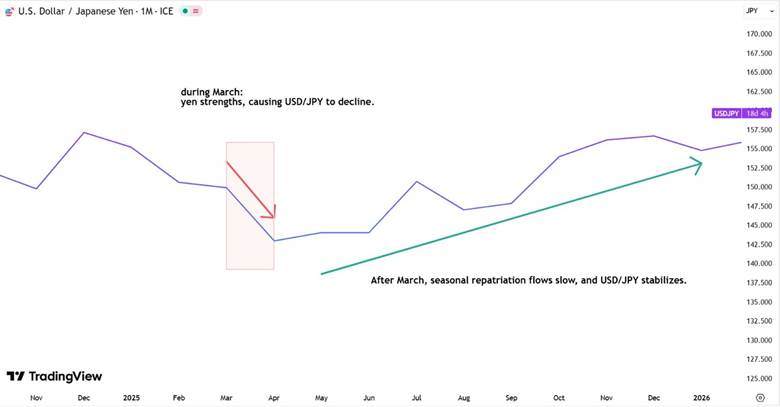
Japan’s fiscal year ends in March, triggering seasonal FX flows.
According to Forexgdp, Japanese companies and institutions repatriate overseas earnings, converting USD and other currencies into JPY. This repatriation typically strengthens the yen, driving USD/JPY lower.
After March, seasonal repatriation flows slow, and USD/JPY stabilises.
Note:
Global risk sentiment can amplify or offset this seasonal effect (e.g., safe-haven flows during market uncertainty).
Tools for Analysing Seasonal Adjustments in Currency Trading
Understanding seasonal patterns is only useful if traders can identify and quantify them effectively. A combination of historical data analysis, quantitative techniques, and visual tools allows traders to turn recurring market tendencies into actionable insights.
Using Historical Price Data to Identify Seasonal Forex Trends
Historical price data is the foundation for recognising seasonal trends. Traders typically analyse several years of daily, weekly, or monthly exchange rates to detect recurring patterns.
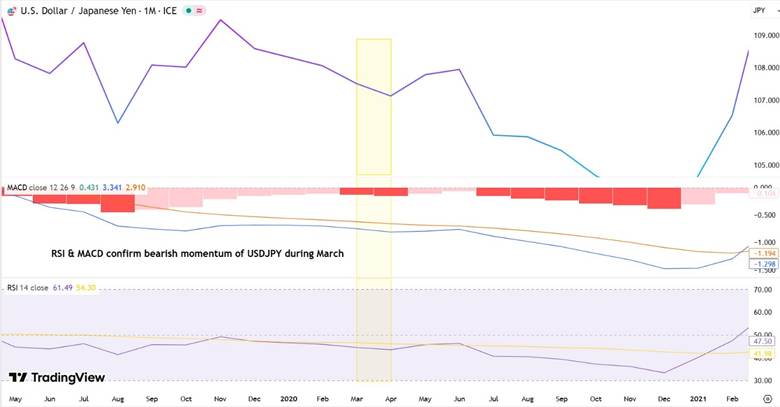
For example, by examining USD/JPY over the past 10 years, a trader may notice a consistent JPY strength in March due to fiscal-year repatriation.
Comparing the same calendar period across multiple years helps filter random noise and highlights repeatable movements.
Q: How many years of data are enough?
A: Generally, 5–10 years provides a balance between reliability and relevance, as older data may reflect outdated market structures.
Quantitative Techniques for Measuring Currency Seasonality
After identifying historical patterns, traders can use quantitative tools to assess their reliability and strength:
- Seasonal indices: Calculate the average monthly return relative to the yearly average to pinpoint periods of consistent outperformance. For example, EUR/USD may show an average return of +0.5% in January, highlighting a seasonal uptrend.
- Volatility analysis: Measuring standard deviation helps determine whether observed seasonal movements are statistically significant or likely due to random fluctuations.
Visualising Seasonal Patterns with Forex Seasonality Charts
Charts make seasonal patterns easier to understand and act upon:
- Line charts: Overlay monthly or quarterly averages across years to highlight repeatable trends.
- Heatmaps: Colour-coded visualisation of monthly returns can quickly show months of strength or weakness.
- Overlay with events: Adding central bank announcements or major economic events helps distinguish seasonal trends from random shocks.
Integrating Seasonal Adjustments into Trading Analysis
Seasonal adjustments in currency trading provide valuable context, but their true power lies in their combination with technical and fundamental analysis. This integration allows traders to identify higher-probability setups rather than relying solely on calendar trends.
Combining Seasonal Adjustments in Currency Trading with Technical Analysis
Technical indicators can confirm seasonal tendencies, improving timing and risk management.
For example, in March as USD/JPY tends to decline and strengthening the yen:
Traders can use RSI or MACD signals to confirm momentum before entering a short USD/JPY position.
Pro Tip: |
Q: Should seasonal trends override technical signals?
A: No. Use seasonality as a guide, but let technical confirmation reduce the risk of entering during false moves.
Aligning Seasonal Patterns with Fundamental Market Drivers
Seasonal currency movements often reflect macroeconomic and institutional forces:
- EUR/USD typically strengthens in Q1, coinciding with European capital inflows and business cycle activity.
- Commodity-linked currencies, such as AUD and CAD, may rise during peak production or export months.
- Monitoring central bank policy, fiscal-year events, and global risk sentiment helps validate seasonal trends.
Identifying High-Probability Trade Setups Using Seasonality
An integrated approach combines seasonality, technicals, and fundamentals:
- Identify the seasonal window (e.g., JPY strength in March).
- Confirm with technical indicators (e.g., trendline support, MACD crossover).
- Check alignment with fundamental factors (e.g., corporate repatriation or commodity cycles).
- Set entries, stops, and take-profit levels based on seasonal and technical cues.
By combining these tools, traders can filter noise, reduce risk, and take advantage of predictable seasonal FX patterns.
Practical Approaches to Trading Currency Seasonality
Seasonal adjustments provide valuable guidance, but turning them into profitable trades requires practical strategies, understanding market conditions, and careful risk management.
Designing Trading Strategies Based on Seasonal Adjustments
Successful seasonal strategies combine historical patterns, technical confirmation, and fundamental context.
Strategy approach:
- Identify recurring seasonal windows using historical data.
- Align trades with technical signals, such as moving averages or MACD crossovers.
- Consider fundamental drivers, e.g., fiscal-year repatriation or commodity export peaks.
Pro Tip:
Use smaller position sizes at the start of a seasonal window and scale in as the pattern confirms.
Market Environments Where Seasonal Trading Is Most Effective
Seasonal strategies perform best under predictable market conditions:
- Stable or low-volatility periods: Seasonal tendencies are more likely to play out.
High liquidity months: For example, EUR/USD often shows reliable strength in September after the summer holidays.
Read More: How the London Session Behaves Differently in Summer vs. Winter
Caution
Extreme volatility, unexpected central bank actions, or major geopolitical events can override historical patterns.
Risk Management Considerations for Seasonal Forex Strategies
Even high-probability seasonal trades require robust risk controls:
- Stop-loss orders: Protect against sudden reversals.
- Position sizing: Limit exposure based on historical trend reliability and market volatility.
- Diversification: Don’t rely on a single seasonal pattern; combine multiple currencies or timeframes.
- Ongoing monitoring: Macro events, central bank policies, or global risk sentiment can disrupt expected seasonal trends.
Limitations of Seasonal Adjustments in Currency Trading
Seasonal patterns are tendencies, not guarantees, and can be disrupted by unexpected events or structural changes. Understanding these constraints is crucial for realistic and risk-aware trading.
Why Seasonal Currency Patterns Do Not Always Repeat
- Market anomalies: Political events, central bank interventions, or unexpected economic data can override historical patterns.
- Volatility spikes: During crises, even strong seasonal tendencies can fail as risk sentiment drives flows unpredictably.
- Short-term vs long-term: Seasonal patterns may be reliable in longer-term averages but can be inconsistent in daily or weekly timeframes.
Structural Market Changes That Can Disrupt Forex Seasonality Conclusion
Traders must monitor structural changes continuously to avoid relying solely on historical seasonality:
- Regulatory changes: New currency controls or capital flow restrictions can alter historical FX behaviour.
- Globalisation effects: Increasingly integrated financial markets mean that seasonal capital flows may be diluted or redirected.
- Technological and algorithmic trading: High-frequency trading can magnify or neutralise expected seasonal movements.
- Commodity cycles: Unexpected shifts in commodity demand or production can disrupt patterns in commodity-linked currencies like AUD or CAD.
Conclusion
Seasonal adjustments are a powerful tool for Forex traders when combined with technical and fundamental analysis. They highlight recurring opportunities and help anticipate likely currency movements.
However, seasonality is not foolproof. Market anomalies, structural changes, and unexpected events can disrupt even the most consistent patterns. By integrating seasonal insights with disciplined strategy design, technical confirmation, and risk management, traders can enhance their decision-making and increase the probability of profitable trades.