

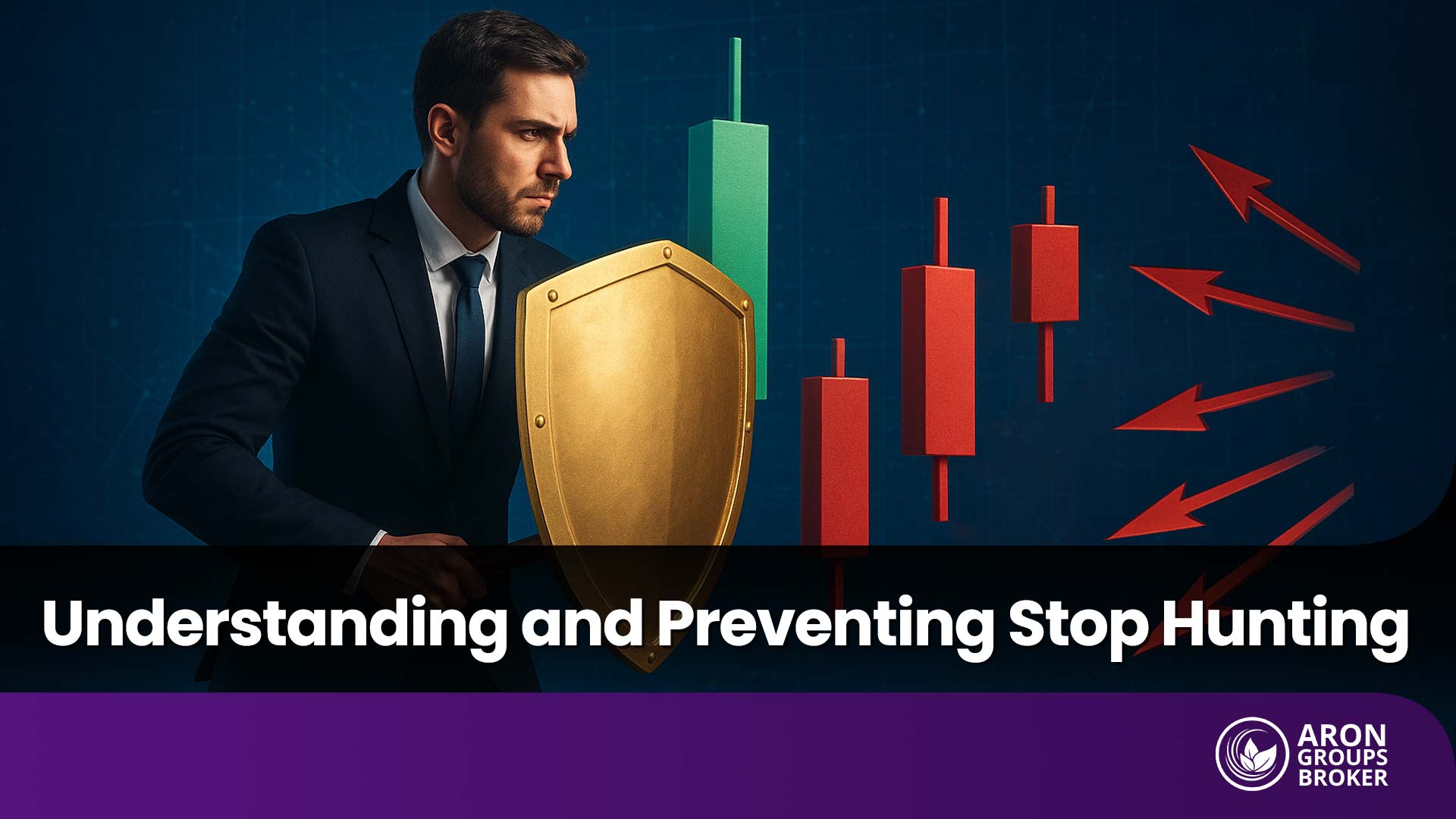




Stop hunting is a common phenomenon in financial markets, and many traders, especially in Forex and cryptocurrencies, have experienced painful losses from it. This strategy, often referred to simply as “stop hunt” among traders, occurs when large market participants deliberately push prices to trigger retail traders’ stop-loss orders and then profit from the volatility that follows.
These price traps can put your capital at serious risk. The good news is that with the right knowledge and tools, you can detect them and protect yourself. In this article, you will see what stop hunting is, how to recognise it, how to stay away from it, and even how to turn it to your advantage.

- Stop hunting occurs when price and volume move in a way that triggers clusters of stop-loss orders, which then amplify short-term volatility.
- According to Investopedia, once these stops are hit, additional orders enter the market, making prices even more volatile.
- This volatility can create opportunities for traders to open long positions at a discount or to scale into short positions.
What Is Stop Hunting?
Stop hunting is a controversial strategy in financial markets in which large market participants, such as financial institutions or “whales”, deliberately move prices to trigger stop-loss orders from retail traders. In markets like Forex and cryptocurrencies, stop hunting is especially frequent because of high liquidity and the heavy presence of retail traders.
This strategy usually plays out around key technical levels, such as support and resistance zones, where retail traders tend to place most of their stop-loss orders. When those stops are triggered, the market experiences short-term volatility that larger players attempt to exploit.
For example:
In the Forex market, the price may suddenly fall to a key level, sweep through an obvious support zone where many stops are placed, and then quickly reverse. Understanding how stop hunting works helps traders avoid these price traps.
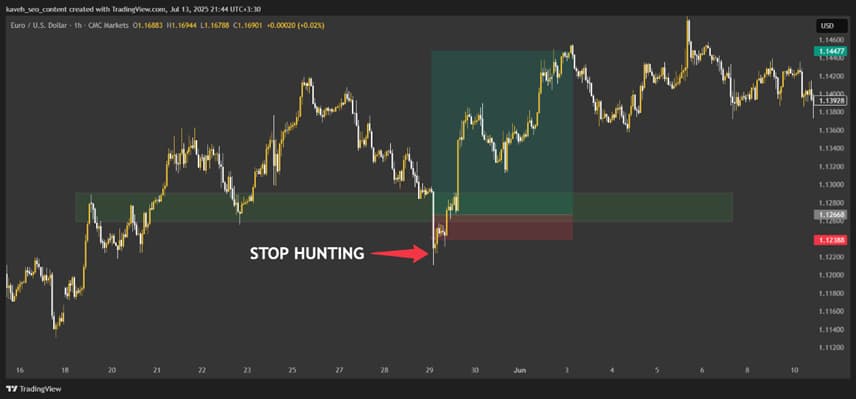
Why Are Stops “Hunted”?
The main reason for the stop hunting is the constant need for liquidity among large players. Banks, investment funds, or market “whales” look for locations where many stop-loss orders are clustered, typically around support and resistance levels or round numbers.
Because these areas are highly predictable for retail traders, they become easy targets for manipulation. By triggering a sharp price move, for instance, via heavy selling, these players activate stop-loss orders, which leads to forced selling and a surge in liquidity.

From a psychological perspective, stop hunting feeds on fear and emotional decision-making among retail traders. It shapes overall market sentiment in a way that allows large participants to enter or exit positions at better prices and with lower cost.
Who Are the Main Players Behind Stop Hunting?
The stop-hunting game is usually driven by large, well-capitalised participants rather than small retail traders. The main groups are:- Investment banks
- Control large order flow in the Forex market.
- Can place sizable orders to nudge price toward obvious support/resistance levels.
- Hedge funds and proprietary trading firms
- Use algorithmic trading and high-frequency trading systems.
- Scan for zones with clustered stops and exploit short-term liquidity gaps.
- Crypto “whales”
- Hold large amounts of Bitcoin or major altcoins.
- Use the order book, liquidations data, and liquidity maps to find where retail stops and leverage are concentrated.
- Execute heavy market or stop orders to sweep those levels, then ride the reversal.
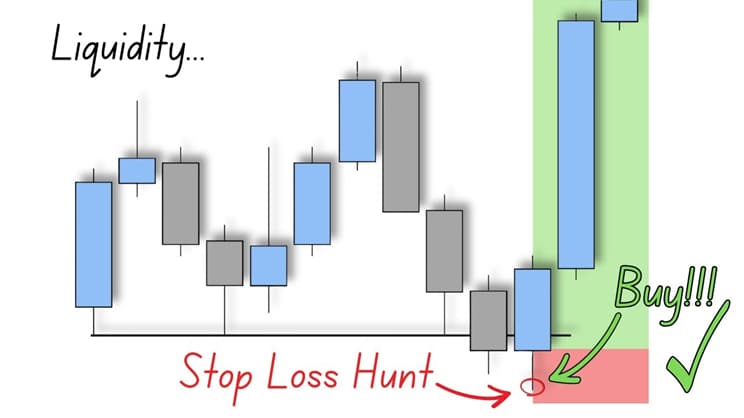
How Does Stop Hunting Work?
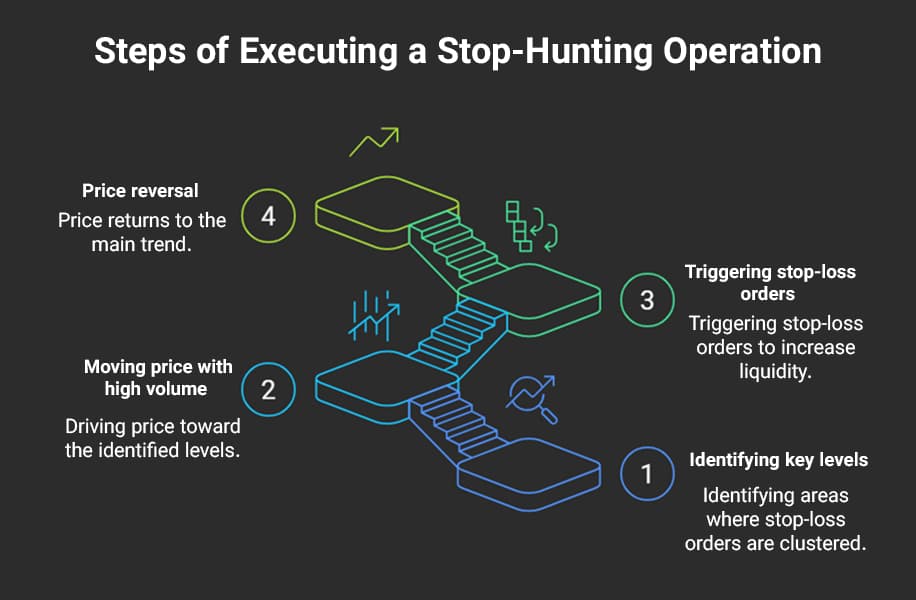
Stop hunting is a four-step process in which large market participants identify clusters of retail traders’ stop-loss orders and then push the price toward key levels to trigger them. According to an analysis by Forex.com, this behaviour is especially common in the Forex and cryptocurrency markets. Once the stops are activated, the price usually snaps back in the original direction, allowing institutions to profit from the volatility created.
Steps to Stop Hunting in the Market
- Identifying key levels:
Large players analyse the order book and key technical areas such as support and resistance to locate zones where many stop-loss orders are concentrated. - Driving price with high volume:
They place large orders to push prices toward these zones, often creating false breakouts to sweep through obvious levels. - Triggering stop-loss orders:
When the price reaches the targeted level, stop-loss orders are activated, causing forced buying or selling and a spike in liquidity. - Price reversal:
After the stops are cleared, the price typically returns to the prevailing trend, and the large players profit from the resulting price swing.
These steps illustrate deliberate market manipulation designed to exploit the structural and psychological weaknesses of retail traders.
Real-World Example of Stop Hunting in Forex and Crypto
You can clearly see stop hunting in a simple EUR/USD scenario:
- Market context: EUR/USD is trading just below a key resistance at 1.2000.
- Stop placement: Many retail traders place their stop-loss orders slightly above resistance, e.g. at 1.2010.
- Stop hunt move: Price suddenly jumps to 1.2015, sweeps all those stops.
- Reversal: After the stops are triggered, the price quickly falls back below 1.2000.
On TradingView, this shows up as a candlestick with a long upper wick, which is a classic sign of a false breakout.
A similar pattern can occur in crypto. For example, Bitcoin might approach a key level like $50,000. Large holders (“whales”) can push the price slightly beyond that level to trigger clustered stop-loss orders and then let the price snap back.
In both Forex and crypto, these patterns are typical examples of stop hunting through deliberate short-term price manipulation.
Difference Between Stop Hunting and Natural Market Volatility
To understand stop hunting properly, it helps to compare it with normal market volatility:
| Aspect | Natural Market Volatility | Stop Hunting |
|---|---|---|
| Main cause | Economic news (jobs data, rate decisions), supply-demand shifts | Deliberate actions by large players around obvious price levels |
| Time frame | Often, longer-term moves can drive multi-session trends | Very short-term price spikes around key levels |
| Typical location on the chart | Can occur anywhere in the trend | Usually near support or resistance |
| Candlestick behaviour | More “normal” candles, smoother swings | Pin bars/candles with long wicks, fake breakouts |
| Effect on trend | Can start or confirm a new trend | Price usually snaps back to the existing trend |
| Purpose | Market’s reaction to information and order flow | Temporary liquidity grab is hitting clustered stop-loss orders |
In short, natural volatility reflects genuine reactions to new information, while stop hunting is a short-lived, engineered move designed to trigger stop-loss orders and harvest liquidity before price returns to its original path.

How to Identify Stop Hunting
Stop hunting occurs when the price moves toward support or resistance levels, triggering clustered stop-loss orders, and then quickly returns to the main trend.
Traders can spot this behaviour using three main clues:
1. Suspicious Candlestick Patterns
Look for:
- Pin bars;
- Candles with long wicks/shadows.
These patterns often:
- Form right at support or resistance;
- Show rejection of the price from that level.
Example: a bearish pin bar at resistance can signal that the price briefly pushed higher to trigger stop-loss orders and then reversed.
2. Price Behaviour Around Support and Resistance
Abnormal price moves near key levels are another warning sign:
- Fake breakouts through support or resistance;
- Price pierces a key level and then quickly returns inside the prior range.
Volatility indicators such as ATR (Average True Range) can help confirm that the move is unusually sharp. If price briefly breaks a key level and then snaps back, there is a strong chance it was a liquidity trap rather than a genuine breakout.
3. Role of Volume in Detecting Stop Hunting
Volume often tells the story behind the move:
- A sudden spike in volume near a key level can indicate stop hunting.
- Tools such as Volume Profile on TradingView can highlight zones where many stop-loss orders are likely clustered.
When you see:
- High volume;
- A fast price move into a key level;
- Followed by a quick reversal.
You are likely looking at a stop-hunt move rather than normal trading activity.
How to Avoid Stop Hunting
The first line of defence is risk management and choosing smarter locations for your stop-loss.
Stop hunting usually occurs when large players (banks, funds, whales) push price against retail positions, triggering obvious, poorly placed stops.
Where Should You Place a Stop-Loss So It Won’t Be Hunted?
Avoid placing your stop-loss:
- Exactly on obvious support or resistance lines;
- At round numbers such as 1.2000.
These levels are prime targets for large players.
A more defensive approach:
- Set your stop at a safe distance from key levels, for example, around 2 × ATR.
- If the ATR for a currency pair is 20 pips, place your stop-loss roughly 40 pips away from the support or resistance level.
This extra buffer helps protect you from short-term stop hunts and random noise.
What Confirms a Good Entry?
To reduce the risk of being trapped by stop hunting, wait for strong price-action confirmation before entering:
Use:
- Valid candlestick patterns (e.g. pin bar, strong confirmation candle after a breakout);
- A confirmed breakout, not just a quick spike.
Example: after price breaks above resistance, a bullish confirmation candle closing firmly above that level provides a safer entry signal.
Waiting for the pattern to complete and avoiding early entries near key levels, combined with a price-action-based trading strategy and indicators such as RSI, improves entry accuracy and reduces the likelihood of falling into price traps.
The Secret of Professional Traders: Managing Loss and Surviving the Market
Professional traders protect themselves from stop hunting mainly through disciplined risk management:- Use a favourable risk-reward ratio (e.g. 1:2 or better) so winners can offset inevitable losses.
- Avoid excessive leverage in margin or futures trading to reduce the risk of liquidation.
- Trade during high-liquidity sessions, and diversify strategies so that no single setup can ruin the account.
- Use mental stops (manual exits) instead of visible hard stops for some setups, making it harder for algorithms to target exact levels.

Stop Hunting Across Different Markets
Stop hunting is common in many financial markets, but how it appears and how intense it is can differ from one market to another. Below is a breakdown for Forex, cryptocurrencies, and equities to see where stop-losses are most at risk.
| Market | Exposure to Stop Hunting | Main Drivers |
|---|---|---|
| Forex | High | Deep liquidity, presence of banks and large investment funds |
| Cryptocurrencies | Very high (esp. some pairs) | Lower liquidity, crypto whales moving price with large orders |
| Stock market (equities) | Lower overall | Tighter regulation; mostly an issue in thinly traded small-cap stocks |
Stop Hunting in the Forex Market
The Forex market is the primary arena for stop hunting because:
- It has very high liquidity.
- It is dominated by large players such as banks and investment funds.
These participants locate levels where retail traders have placed their stop-loss orders, push the price toward those levels to trigger the stops, and then profit from the volatility that follows. Pairs such as EUR/USD and GBP/USD are classic examples where this behaviour is frequently observed.
Stop Hunting in the Cryptocurrency Market
The cryptocurrency market is even more exposed to stop hunting than Forex in many cases, mainly because:
- Liquidity is lower, especially on some exchanges and altcoins.
- Crypto whales can move the price with relatively large orders.
With sizeable orders, whales can drive Bitcoin or altcoins like Ethereum toward key levels.
For example:
- Bitcoin may approach $50,000,
- Form a candlestick with a long wick that triggers clustered stop-losses,
- Then quickly reverse.
These types of moves are particularly common on low-liquidity exchanges.
Does the Stock Market Also Suffer from Stop Hunting?
Stop hunting in the stock market is:
- Less common overall, because:
- Many shares and indices have high liquidity.
- Strict regulation makes price manipulation more difficult.
However, it can still occur in:
- Low-liquidity stocks, where large players can target stop-losses near technical levels.
For example, a small-cap stock may experience a sudden volume spike, leading to sharp price swings that trigger nearby stops. That said, this behaviour is rare in major indices and highly liquid blue-chip stocks.
Professional Traders’ Strategies for Dealing with Stop Hunting
Professional traders use a set of advanced strategies focused on detailed analysis, risk management, and a deep understanding of market behaviour. These methods help them resist attempts by large market participants to trigger retail stop-loss orders and instead profit from the ensuing volatility.
1. Using Mental Stops
Mental stops help traders stay off the radar of algorithms and large players.
- A mental stop means defining an exit level in your trading plan, without placing a visible stop-loss on the platform.
- Because no stop order is registered in the order book, it is harder for algorithms to “see” and target it.
However, this approach requires:
- High discipline and strict adherence to the trading plan.
- Closing the trade immediately when the price reaches the pre-defined mental stop, based on:
- Clear price action signals;
- Or a confirmed break of key levels.
Used correctly, mental stops reduce the chance of having your stop-loss mechanically triggered by a stop-hunt move.
2. Combining Price Action with Stop-Loss Management
Price action helps traders identify safer entry and exit zones.
Key patterns that can signal potential stop hunting:
- Pin bar;
- Inside bar;
- False breakout (Fake Breakout).
Example:
- Price approaches a resistance level;
- Then reverses with weak or rejecting candles.
This may indicate a stop-hunt trap rather than a real breakout. In such cases, professional traders:
- Avoid placing stops exactly where the majority of traders cluster them;
- Use a safer distance for the stop-loss, beyond the obvious liquidity pool.
3. Liquidity Analysis to Find Safer Entry and Exit Zones
Liquidity tools help locate areas where stop hunting is less likely:
- Volume Profile shows price zones with high traded volume.
- Order Book reveals where large orders are resting.
Characteristics of these zones:
- Often used by financial institutions for executing large orders.
- Less prone to aggressive stop-hunt spikes.
To further defend against stop hunting, professionals also use advanced order types such as buy stop limit orders, which give more control over the exact fill level and reduce slippage during sharp moves.
Conclusion
Stop hunting is a challenge that traders in financial markets must face with vigilance. Understanding what stop hunting is and how large players use it to manipulate prices is the first step in protecting your capital. Instead of falling into price traps, traders can focus on continuous education, strengthening their technical analysis skills, and adhering to sound risk management principles to trade more intelligently.
Patience in decision-making and avoiding emotional reactions are key to success. With practice and experience, you can improve your ability to spot traps, choose appropriate strategies, and protect yourself from losses caused by stop hunting. Start, learn, and move forward with confidence toward professional trading.