





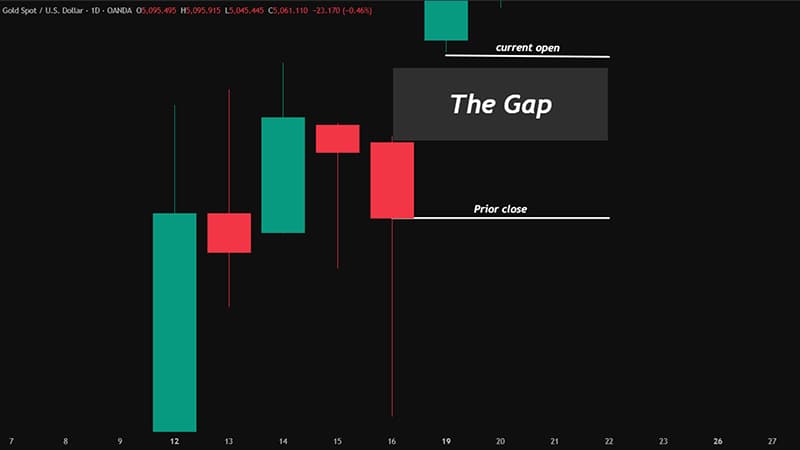
When the price jumps from one session to the next without trading through the levels in between, traders call it a market gap. On the chart, it appears as an empty price zone with little or no trading.
A gap fill strategy focuses on finding opportunities where the price reverses back into the gap as the market re-enters and tests the new level. The aim is not to assume a fill. The aim is to trade the scenarios where rejection is clear, risk is defined, and a partial or full reversal is possible.
In the stock market, gaps are most likely to be seen at the open as overnight news is digested before the market opens, and price discovery is seen in the opening process, where initial gap fill dynamics are observable. In the forex market, weekend gaps may be seen at the market reopen, but they are different and may need tighter risk management.
This article will help you identify what the tradable gaps are, create an easy-to-follow set of Opening Gap Trading Rules and how to use Risk Management when the market is moving much faster than your planned trades.

- A gap occurs when the price jumps from the previous session’s close to the next session’s open, leaving a visible price range with no trades recorded. In some cases, apparent gaps can also be caused by session boundaries, thin liquidity, or data feed issues.
- "Filled" refers to when the price goes back to the previous closing price; however, partial fills occur frequently.
- The likelihood of a gap being "filled," as well as how it will be filled, will depend on both the type of gap and what was responsible for the gap.
- Most stock gapping occurs at the beginning of the day because of how auctions operate and how thin the books are during the pre-open period before the start of the regular session.
- Weekend gap trading in Forex works differently than in stocks and requires tighter controls on risk management.
How to Profit from Market Gaps: Gap Fill Trading Explained
Market gaps occur where there is a price jump, resulting in an untraded region. The price jump is normally a result of news, low liquidity, or a change in market orders.
Gap fill is one of those trading strategies that looks at what follows the event. If the event was imbalanced, then the price will revert to the region of the gap as the imbalance corrects.
A Gap Fill Trading Strategy is not about assuming that every gap has to be filled. It is about trading the opportunities where a fill is more likely to happen with tight risk management.
What Is Gap Fill Trading?
Gap fill trading is a strategy that aims for a retracement into the gap area.
The clean workflow is: define the gap, wait for confirmation, enter with an invalidation point, and manage the trade in stages.

A “fill” can be partial or full, depending on momentum and context.
Understanding Gap Fill Trading in Stocks
In stocks, gaps occur most often at the open because pre-market liquidity and the opening auction are different from regular market trading.
The gap fill stocks’ meaning is very simple. You are buying the market’s attempt to retest prices that were skipped.
Price Retracement Explained Simply
Price retracement is a pullback against the most recent push. In gap setups, this pullback will often target the gap because it is a zone of low information.
If the price is unable to sustain the new level, it will often “check” the gap to see where value is.
Why Candlestick Closing Price Matters
The closing price of the candlestick indicates where the buyers and sellers agreed to meet for that particular candle. Closes that are far away from the gap indicate acceptance.
Closes that are weak, especially those that return to the gap, indicate rejection. This is usually the first sign that a fill is on the table.
Types of Gaps in the Market
The kinds of gaps in technical analysis are important because the narrative associated with the gap is not the same. A gap from real repricing is different from a gap from dislocation.
Classify first. Trade second.
Common Gaps You Should Know
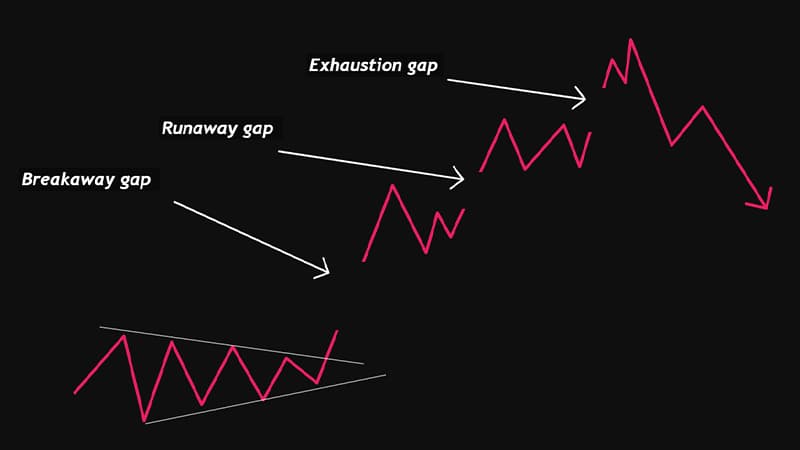
Traders usually classify gaps into four categories. These categories are common gaps, breakaway gaps, runaway gaps, and exhaustion gaps.
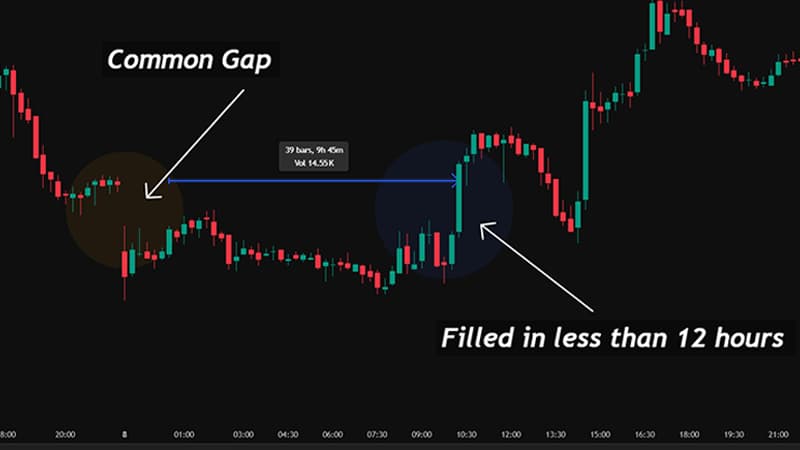
Common gaps are the type of gaps that usually fill; These gaps form commonly in the range markets and are usually filled within the same trading day.
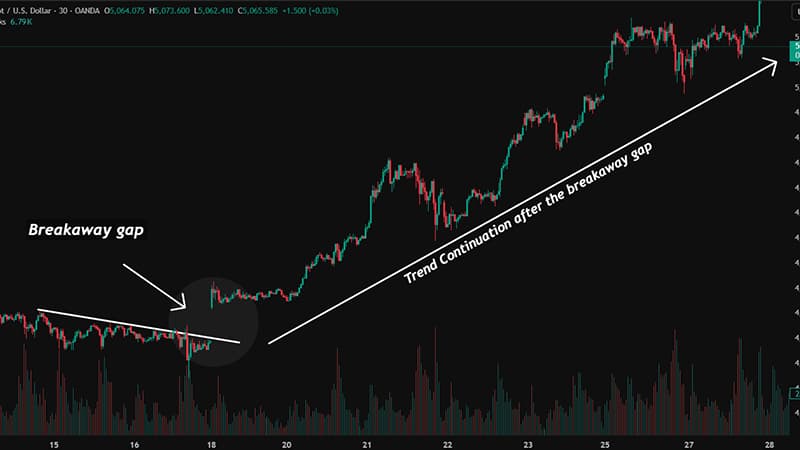
Breakaway gaps, on the other hand, are the type of gaps that usually don’t fill, at least not right away. It usually takes more than a week for a breakaway gap to fill.
Breakaway Gaps and How to Spot Them
A breakaway gap typically follows through on a clear range or level. It is often accompanied by good participation and quick follow-through.
This type of gap is the market’s way of saying, “The old price is no longer fair.”
Q: How can I avoid fading a breakaway gap?
A: If the price is able to hold above the gap with strong closes and increasing participation, then it is a sign of acceptance, and you should stay out of the market.
Runaway (Continuation) Gaps Explained
This kind of gap appears when there is a strong trend. It usually appears in the middle of the trend when late buyers chase and squeeze shorts.
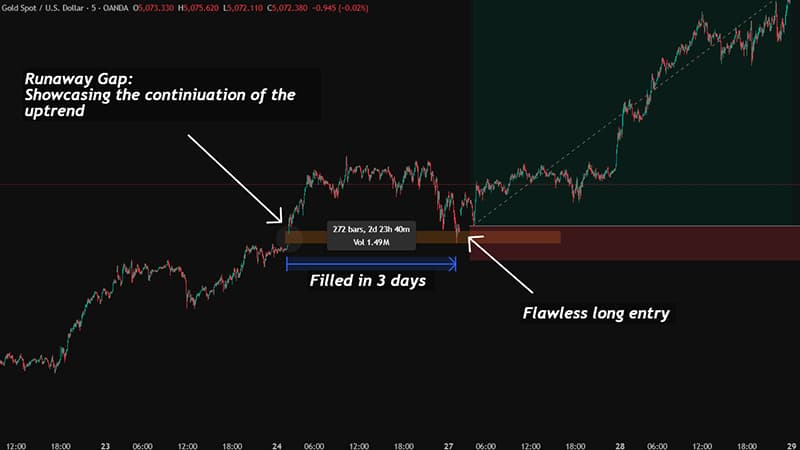
As you can see in the example above, the uptrend has paused for a 3-day period, attempting to gain enough strength or in other words, grab the liquidity, in order to continue rising.
Keep in mind that gap fill setups can look attractive at first, but you should only trade them with clear confirmation. Give the market time to react, and plan the trade around a realistic profit target.
Exhaustion Gaps and Key Signals
The exhaustion gap usually shows up late in the action. It usually accompanies large candles, emotional involvement, and then a failure to hold.
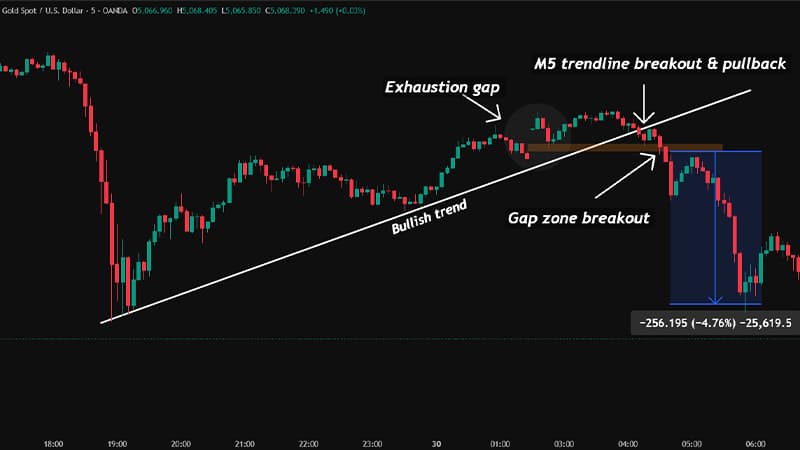
Breakaway vs exhaustion gap is more about timing and follow-through.
A breakaway gap is likely to emerge early in a move and often marks acceptance, so entries will usually make more sense in the direction of the gap. An exhaustion gap emerges late in a move and is likely to reverse, so if momentum is clearly exhausted, reversal trades will be taken against the gap.
Core Gap Fill Trading Techniques
The basic gap fill trading strategies are structured to close in on market gaps with discipline and risk management in mind. A price gap is a temporary market condition where there is a mismatch between supply and demand, but it is not a guarantee of a market retracement.
Fade the Gap Strategy: Step-by-Step
The fade the gap strategy involves trading in the opposite direction of the initial gap movement. Rather than following the initial strong movement after the open, you can wait to see if that initial strong movement loses steam and if the price begins to return to the area of the gap.
In other words, the market opens with a strong movement. Many traders act on emotion and enter a trade immediately. The gap fade trader acts in the opposite way. The idea is to wait for evidence that the initial strong movement is losing steam.
Here is the reasoning in a more logical order:
- Mark the area of the gap: Determine the distance from the close of the previous market session to the open of the current market session. This is your reference area.
- Watch for the initial push: The price will often make a strong move higher or lower in the initial minutes of trading. Do not enter a trade during this strong move. Volatility, spreads, and slippage costs are usually high.
If price tries to continue in the same direction as the gap but is unable to stay above the opening high or below the opening low, that is your first warning sign.
- Enter after confirmation: The cleanest trigger is a failed break of the opening extreme, followed by a candle close back inside the early range.
This indicates that the buyers or sellers were unable to gain and maintain control.
- Target a partial fill: Do not expect the whole gap to fill. A move to the midpoint of the gap may be a reasonable first target. Then, reassess.
Q: What is the main trigger of a gap fade?
A: A break of the opening high or low that fails quickly, followed by a strong close back inside the initial range. This indicates exhaustion rather than continuation.
Important note:
The largest error in gap fading is to presume that every gap will fill. Breakaway gaps can be a sign of real repricing. Always determine your level of invalidation before entering the trade.
Best Conditions to Fade a Gap
Fades are most effective when the appearance is of temporary distortion rather than actual repricing. You want to see hesitation, not acceleration.
Use one checklist and keep it simple.
- The gap size is not extreme compared to ATR
- First push fails to stay above opening highs or lows
- Pre-market liquidity was light, and the gap looks extended
- Early candles have wicks and poor closes
- A nearby level within the gap is a magnet
Risks When Fading Gaps
The principal risk is to fade a breakaway gap. This is how traders get caught by “it must fill.”
Execution risk also increases at the open. Spreads expand, slippage rises, and executions deteriorate compared to expectations.
Weekend Gap Trading in Forex
Weekend gap trading forex is all about the gap between the Friday close and the Sunday open. The reopening can be a thin and fast market.
Consider it a special case. Smaller size and stronger confirmation are often better.
When Weekend Gaps Usually Retrace
Weekend gaps that retread more often do so when the gap is small, and the first liquidity wave is unable to defend the new level.
If price is trending and holding above key closes, then the gap could be repricing, and not a fill.
Q: What is the quickest way to filter weekend gap trades?
A: If the reopen is trending and holding the above key closes, then don’t force a fill scenario.
Rules for Trading Opening Gaps
Rules of opening gap trading save you from the chaos of the first minutes. The open is where most errors occur.
You are not chasing. You are waiting for acceptance or rejection.
Defining Gap and Fill Levels
Mark the prior close and the current open. The gap range is the area between them.
Use two targets. A midpoint for a partial fill, and the prior close for a full fill.
Waiting for Confirmation After Market Open
The first few candles could create reversals, then reverse again. Waiting will prevent you from being the liquidity.
A true-world confirmation looks like this: Price breaks an extreme, fails, then closes back inside the original range.
Using Clear Invalidation Points
Your stop will be at the point where your premise is disproven. Make it price-based and clear.
For a fade, it might be a strong hold past the opening extreme with strong closes.
Managing Trades in Stages
Stage management will help you stay calm and consistent. Take partial profit at the midpoint, then manage the rest.
After taking partial profit, you can reduce risk if the structure improves. Don’t move stops because you feel nervous.
Q: Do I wait for a full gap fill target?
A: No. Partial fills are more likely, so take profit at the midpoint to stay consistent.
When to Adjust or Exit Trades
Adjust when volatility exceeds what your plan had assumed. Get out when the market indicates acceptance other than in the gap.
If you are a counter-trader and the price begins to make strong closes in the gap’s direction, don’t negotiate.
Gap Fill Probabilities & What Affects Them
Gap fills are preferences, not guarantees. The aim is to identify a situation where the likelihood is sufficiently high to enter a trade.
Overnight volatility and institutional order flow can be either the catalyst for a fill or the reason for a fill to be prevented.
Is Gap Filling Guaranteed?
No. Some gaps are never filled because the market repriced the asset. Breakaway gaps are the classic example.
The right attitude is: trade the probability, then cap the downside when probability fails.
Factors That Increase the Chance of a Gap Fill
Fills are more likely if the gap is small relative to recent market volatility, and there is early trading on rejection.
If the price fails to create value above the gap quickly, mean reversion patterns will become more likely.
Factors That Reduce the Chance of a Gap Fill
A gap is less likely to be filled if it breaks a major range with strong market participation and rapid follow through.
How Overnight Volatility Impacts Gap Closure
Overnight volatility can produce gaps that are too large to be filled, thus inviting a retracement. It can also produce actual repricing based on major news.
ATR can serve as a reality check. If the gap is large, your best trade may be no trade.
| Gap context | Typical fill speed | What to watch |
|---|---|---|
| Small gap, weak open | often same day | early failure, weak closes |
| Trend continuation gap | later or partial | momentum holds, shallow pullbacks |
| Breakaway gap | often not soon | strong participation, range expansion |
| Exhaustion gap | can fill fast | spike then rejection |
Best Tools & Indicators for Gap Trading in MT5 and TradingView
Tools should be able to quantify what you already see. Tools should not override structure.
If you are using gap trading indicators on MT5, you should keep them consistent so that you are able to compare your results.
Using ATR to Measure Unusual Gaps
ATR assists you in marking the gap as normal or abnormal. This is important because an abnormal gap tends to be more violent.
If the gap is large compared to ATR, size down or require stronger confirmation.
VWAP and Session Tools for Daily & Weekly Gaps
VWAP assists in understanding the relative trading of price compared to an average “fair” price. Rejection at VWAP can support a fade. Session tools assist in distinguishing pre-market liquidity from regular session flow, which is of most importance in stocks.
Volume and Tick Data as Flow Signals
In stocks, volume can often confirm if there is support for the gap. A weak push of volume is easier to overcome.
In forex, tick volume can be a rough estimate. It can still assist you in determining if there is a case of urgency at the reopen.
Combining Indicators with Price Action for Accuracy
Use indicators as filters. Use price action as the trigger and the invalidation.
This way, you’ll keep the method robust across various market trends.
Risk Management & Strategy Tips
Gap trading penalizes sloppy risk. A sound strategy with poor risk management still results in a loss.
Your first goal is to survive in the market, the next goal would be gaining profit.
Setting Stop Loss and Take Profit
Place the stop at the point of the flawed strategy, not at convenience. In fade trades, this is often beyond the extreme open.
Take profits in tiers. Partially fill first, then reassess for a full fill.
Position Sizing and Multiple Trades
Size positions based on the stop range. A greater risk of invalidation means a smaller position.
If you are trading multiple gap positions, limit total risk so that one wild open does not ruin your week.
Conclusion
Gap fill trading is effective when you consider it a probability play. Categorize the gap, wait for confirmation, and then use valid points of invalidation.
When you consider fills as guaranteed, the market will punish you eventually. When you consider fills as setups, you can trade gaps.
FAQ
Q: What is gap fill trading?
A: Gap fill trading is to trade a price retrace into the area of price that was untraded at session close and aim to get partially or fully filled.
Q: Do all stock gaps fill?
A: No. Breakaway gaps are likely to be the least likely to fill, and will stay open longer than any other type of gap.
Q: Is there one specific best indicator for gap trading?
A: I believe ATR is a very good starting point as a baseline for understanding gap size normalised to volatility. VWAP can also be useful in determining if the price has been accepted during the day.
Q: Are MT5 gap trading indicators alone sufficient?
A: No. Gap trading indicators are only useful for filtering certain conditions. Entries need to be triggered by price action, and invalidations must be determined by it as well.
Q: Is weekend gap trading forex safer than stock gaps?
A: Not necessarily. Reopen liquidity can be thin, spreads can widen, and execution risk rises.
Q: How do I define the gap fill target?
A: Start with the midpoint for a partial fill, then the prior close for a full fill, adjusted to structure.