





In investing, having a credible benchmark to measure market performance is essential for informed, comparable decisions. One of the most widely recognised benchmarks is the MSCI Index, introduced by Morgan Stanley Capital International (MSCI).
Today, MSCI is recognised as a leading provider of financial data, risk management tools, and widely used market indices.
MSCI indices such as Emerging Markets and Frontier Markets have long served as core benchmarks for institutional investors globally. They are widely used by pension funds, exchange-traded funds (ETFs), and individual investors across many regions and markets.

- MSCI indices are reviewed quarterly, and shares or countries may be added or removed as classifications change.
- To qualify for inclusion, a country must meet standards like data transparency, foreign investor access, and market liquidity.
- Many ETFs track MSCI benchmarks directly, so index rebalancing can automatically redirect ETF allocations and capital flows.
- MSCI is not only for equities; it also helps assess country risk in major economic decisions and global investment planning.
What is the MSCI Index?
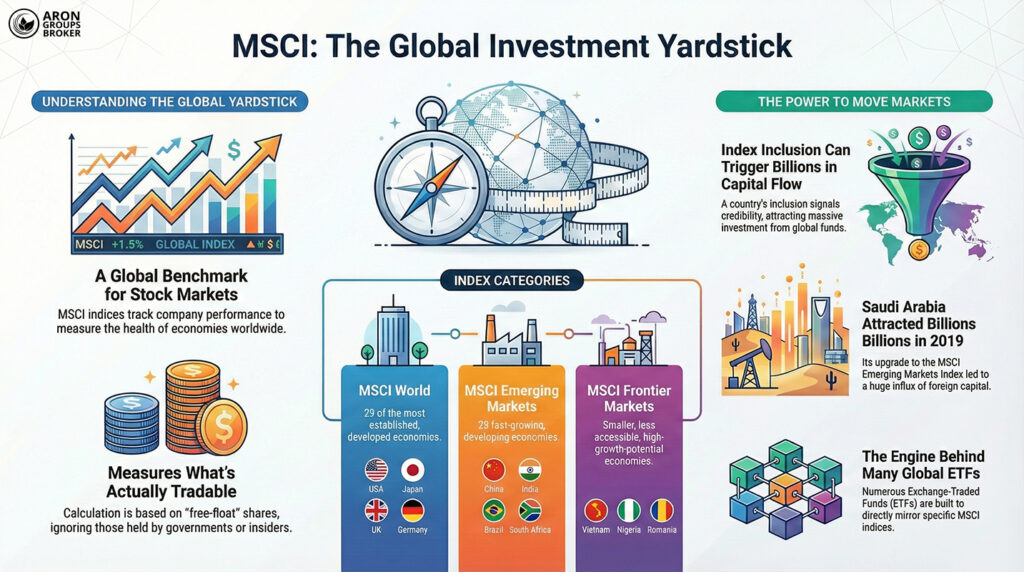
According to Investopedia, the MSCI Index is a group of “stock market trackers.” Investors use them to see how international markets are performing. Think of them as a yardstick for measuring financial success across the globe. A Brief History- 1965: The very first global stock trackers (outside the US) were published by a company called Capital International.
- 1986: Morgan Stanley bought the rights to this data, and the MSCI brand was officially born.
- 2004: The firm grew by acquiring Barra, a company that specialised in managing financial risk.
- 2007: MSCI went public on the New York Stock Exchange.
- 2009: MSCI.com became a fully independent company, separating entirely from Morgan Stanley.
- Portfolio Analytics: Detailed reports on how investments are doing.
- Risk Management: Tools to help protect money from market swings.
- Corporate Governance: Solutions to help businesses run more effectively.
Types of MSCI Indices
MSCI indices are categorised by economic development, market size, and the ease with which foreign investors can access local stock markets.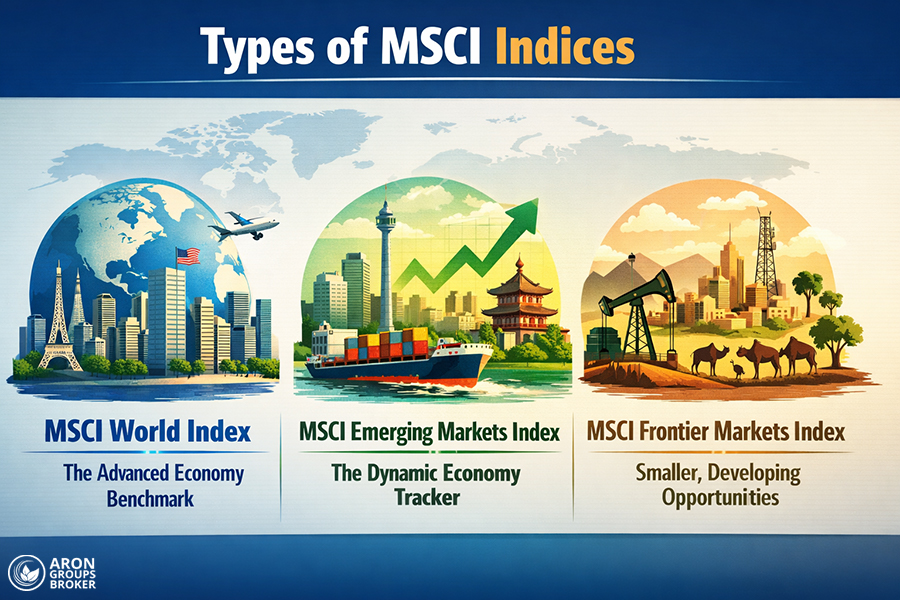
1. MSCI World Index: The Advanced Economy Benchmark
This index tracks over 1,500 large and mid-sized companies across 23 developed nations, representing the world’s most established economies.- Key Members: Countries such as the United States, the United Kingdom, Japan, Germany, and France hold the largest shares.
- Major Companies: The US has a high weighting due to massive corporations like Apple, Microsoft, and Amazon.
- Usage: Investors use this to monitor advanced markets globally without focusing solely on a single region like Europe.
- Example: Global Exchange-Traded Funds (ETFs), such as the iShares MSCI World ETF, directly track this specific index.
2. MSCI Emerging Markets Index: The Dynamic Economy Tracker
This index measures the performance of over 1,400 companies across 25 countries that are considered “emerging” or developing.- Key Members: This group includes fast-growing nations like China, India, Brazil, South Africa, Taiwan, and Turkey.
- Risk and Reward: These nations often provide high economic growth, though they carry higher political and financial risks.
- China’s Impact: In 2018, Chinese “A-shares” joined the index, significantly increasing international investor interest in Shanghai and Shenzhen markets.
- Investment Opportunity: Many ETFs allow investors to indirectly invest in these growing economies by tracking the MSCI benchmark.
3. MSCI Frontier Markets Index: Smaller, Developing Opportunities
Frontier markets are smaller and less established than emerging markets, yet they offer significant potential for long-term growth.- Key Members: This index includes countries such as Vietnam, Nigeria, Jordan, Romania, and previously, Kuwait.
- Market Traits: These markets typically have lower liquidity and higher risk than the larger emerging market group.
- Growth Potential: This index helps identify “undiscovered” opportunities. For instance, Kuwait’s 2018 inclusion led to a surge of new capital.
4. Regional and Sector Indices
Beyond the broad global categories, MSCI provides specific trackers for some geographical regions or particular industries:- Regional Indices: Examples include MSCI Europe and MSCI Latin America, which track the performance of specific continents.
- Sector Indices: These track specific industries, such as MSCI Technology, MSCI Energy, and MSCI Financials.
- Precision Tools: An investor wanting to study only European tech companies would use the MSCI Europe Information Technology index.
| Index Type | Focus Area 🌍 | Key Countries 🏳️ | Risk Level ⚠️ |
|---|---|---|---|
| MSCI World | Developed Economies. | USA, Japan, UK, Germany. | Low to Moderate. |
| MSCI Emerging Markets | High-growth developing nations. | China, India, Brazil. | Moderate to High. |
| MSCI Frontier Markets | Early-stage, smaller markets. | Vietnam, Nigeria, Romania. | Very High (Volatile). |
How the MSCI Index Is Calculated
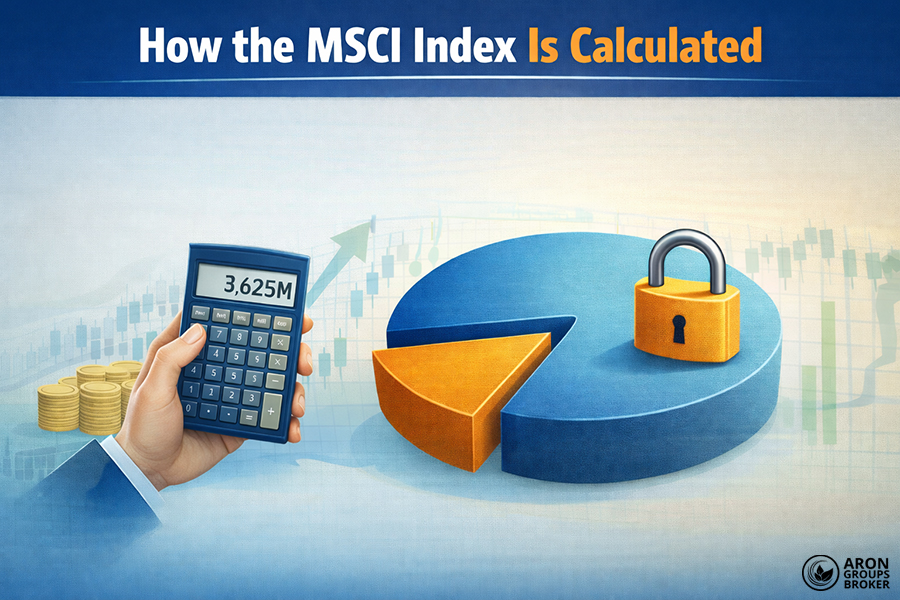
MSCI indices are calculated using free-float market capitalisation, not total market capitalisation of all issued shares. This means only shares available for public trading are counted, excluding holdings locked by governments or controlling shareholders.
Core calculation steps
- Select constituents: Companies are chosen based on criteria such as market size, liquidity, and reliable data availability.
- Calculate free-float market capitalisation: This estimates the tradable value of each company in the market.
Free Float Market Cap = Price per Share × Number of Shares Available for Trading
- Assign each stock’s weight: A stock’s index weight equals its free-float market cap relative to the index total.
Weight of Stock i = Free Float Market Cap of Stock i ÷ Total Free Float Market Cap of Index
- Calculate the index level: Sum the free-float market caps, then divide by a base value set when the index launched.
Simple example
Assume an MSCI country index includes three companies with the following free-float market capitalisations and weights:
| Company | Free-float market cap (USD million) | Weight in index |
|---|---|---|
| Company A | 500 | 50% |
| Company B | 300 | 30% |
| Company C | 200 | 20% |
In this case, Company A’s share price moves the index more because it carries the highest weight.

Note:
MSCI also runs quarterly reviews to keep indices aligned with real market conditions. During these reviews, constituents can be added or removed, and weights may be adjusted accordingly.
Q: Why does MSCI use free-float market capitalisation instead of total market capitalisation?
A: Because it reflects real investability. Free-float weighting ignores locked shares, preventing governments or insiders from distorting index exposure.
Using the MSCI Index in Investment
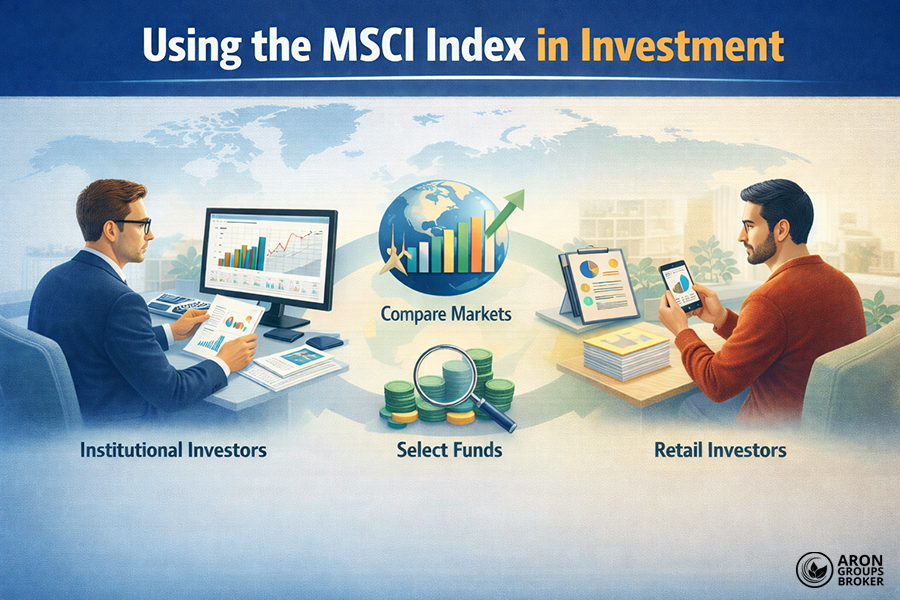
MSCI indices are not just statistical tools; they are practical benchmarks that actively support real-world investment decisions.
Both institutional and retail investors use them to compare markets, select funds, and manage portfolio construction more consistently.
MSCI as a market-performance benchmark for institutional investors
Institutional investors such as pension funds, insurers, and asset managers need credible benchmarks to allocate capital across countries and sectors.- MSCI makes it possible to compare markets on a standardised basis, using consistent rules and transparent methodology.
- For example, a pension fund can assess whether South Korea outperformed Brazil within MSCI Emerging Markets, then adjust allocations.
The role of MSCI in ETFs and mutual funds
A large share of investment funds use MSCI indices as their primary benchmark for performance measurement and portfolio alignment.- Many ETFs aim to replicate MSCI returns as closely as possible, rather than relying on discretionary stock selection decisions. Examples:
- iShares MSCI World ETF, which tracks developed equity markets across multiple countries.
- iShares MSCI Emerging Markets ETF, which tracks equities in emerging-market countries across key regions.
- Mutual funds also use MSCI benchmarks to compare results against global markets and justify strategy choices.
Scenario: The Rebalancing Effect.
Imagine you own an ETF tracking the MSCI Emerging Markets Index.
- Event: MSCI adds “Saudi Arabia” to the index.
- The Mechanism: Your ETF must buy Saudi stocks to match the new index weight.
- The Result: Billions of dollars flow into the Saudi market automatically, pushing up prices. You benefit from this new exposure without clicking a button.
Q: Do MSCI-tracking ETFs always rebalance on the exact MSCI review date?
A: No. Most ETFs rebalance over short windows to reduce market impact, rather than trading all changes in one session.
Using MSCI for portfolio management and investment risk assessment
One of the most important advantages of MSCI is its role in supporting portfolio diversification.
- With the help of MSCI, investment managers can build a balanced mix of developed, emerging, and frontier markets.
- In addition, movements in these indices show investors which parts of a portfolio are facing higher risk.
Example: if MSCI Emerging Markets falls while MSCI World stays stable, a manager may rotate weight towards developed markets.
Key note
When an MSCI index is reviewed and rebalanced, ETFs and mutual funds must adjust their holdings accordingly. These funds are built to mirror the index as closely as possible, so their performance matches its movements.
Why the MSCI Index Matters for Foreign Investors Choosing Emerging Markets
- A country’s inclusion in, or removal from, an MSCI index has a direct impact on how much foreign capital it attracts.
- Being included in MSCI Emerging Markets or Frontier Markets signals greater credibility and stronger transparency in that market.
- Foreign investors often treat a country’s entry or upgrade within MSCI as a green light to deploy capital there.
Advantages and Limitations of the MSCI Index
Like any benchmark, the MSCI Index has clear strengths but also practical limitations and trade-offs. Below, we outline the main advantages and the most common challenges investors should keep in mind.Advantages of the MSCI Index
The main benefits of MSCI indices include:- A trusted international benchmark: MSCI indices are widely accepted by global funds and financial institutions as standard benchmarks.
- Standardised comparison across markets: Unlike domestic indices such as the Nasdaq, MSCI enables cross-country comparisons within one framework.
- Broad global coverage: MSCI spans developed economies as well as emerging and frontier markets, offering wide geographic representation.
- Extensive use in ETFs and funds: Many ETFs and mutual funds are built on MSCI indices, making diversified access simpler.
- Closer reflection of tradable reality: Using free-float market capitalisation helps weights mirror what is actually available to trade.
Limitations of the MSCI Index
The main drawbacks of MSCI indices include:- Dependence on MSCI’s inclusion rules: Some countries or stocks may be excluded due to strict criteria, even if they matter economically.
- Higher risk in emerging and frontier markets: These indices can highlight growth potential, but volatility and political-economic risks are often higher.
- Heavy influence of large companies: In indices like MSCI World, large US weights can overshadow performance from smaller markets.
- Ongoing rebalancing effects: Quarterly reviews can trigger changes that create short-term, sometimes unexpected, market volatility.
- Limited access for some local investors: In countries such as Iran, direct access to MSCI-based ETFs may require foreign intermediaries.
The Impact of the MSCI Index on Emerging Markets and Iranian Investors
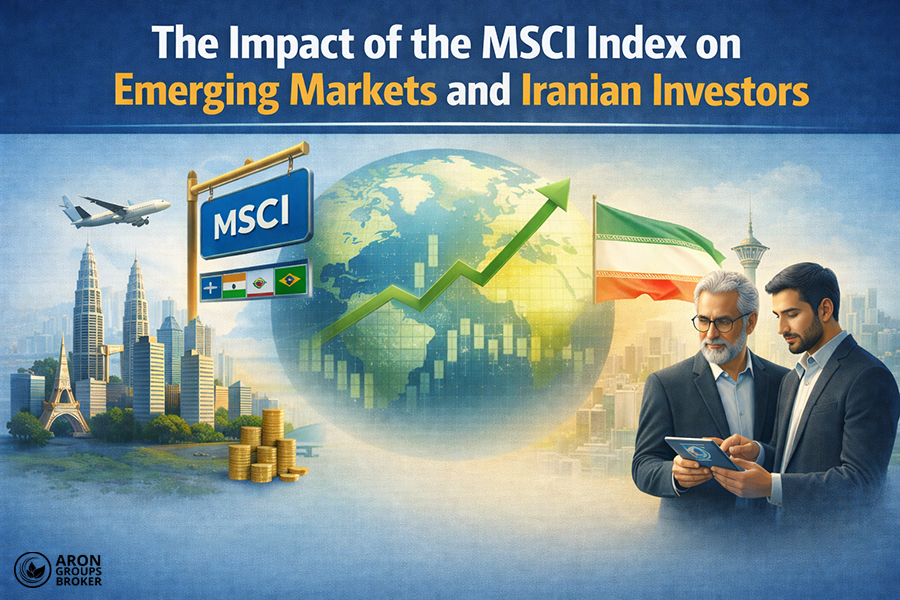
For emerging markets, MSCI acts like a “global shop window”, signalling that a country meets investability standards. Inclusion suggests the market has reached a level of transparency, liquidity, and international alignment that foreign investors can trust.Checklist: Will a Country Join MSCI?
For a market like Iran to join the MSCI club, it must pass these tests:
- Openness: Can foreign investors easily buy/sell without restrictions?
- Liquidity: Is there enough daily trading volume to support big funds?
- Stability: Is the political and economic environment predictable?
How MSCI entry or removal affects investment flows
When a country enters an MSCI index, ETFs and global funds tracking that benchmark often allocate capital to it immediately. This typically increases liquidity and boosts demand for local equities, which can support prices and trading activity.
Conversely, removal from the index can reduce attractiveness and trigger foreign outflows, pressuring prices and confidence. For that reason, MSCI inclusion or exclusion can directly influence the stability and appeal of many emerging markets.
Historical examples of MSCI changes in emerging markets
To better understand MSCI’s impact, here are a few historical examples and their effects on flows and market behaviour.
- China: In June 2017, MSCI announced that China A-shares would be added to MSCI EM, with inclusion implemented in 2018. This move significantly increased foreign attention towards the Shanghai and Shenzhen exchanges and related market access channels.
- Saudi Arabia: In 2019, it was upgraded to MSCI Emerging Markets, drawing billions of dollars into the Tadawul equity market.
- Argentina: In 2019, it joined MSCI EM, but later reverted to Frontier Markets amid economic turmoil and market restrictions.
These cases show that MSCI upgrades can attract large inflows quickly, but staying included depends on domestic stability and reforms.
Qn: Can MSCI inclusion increase volatility instead of stabilising an emerging market?
A: Yes. Short-term volatility often rises due to forced inflows, while long-term stability depends on domestic policy consistency.
Iran’s potential position if it joined MSCI
If Iran were included in MSCI Frontier Markets, or even upgraded to Emerging Markets, its capital market could change materially.
- Higher foreign inflows: Index-tracking funds would automatically allocate a portion of assets to Iran, subject to investability access.
- Improved standards: Meeting MSCI criteria would require better disclosure and foreign access, which can raise overall market quality.
- Lower financing costs: Listed Iranian companies could find it easier to attract external capital and diversify funding sources.
Overall, MSCI membership could put Iran more visibly on the global investment map, but it would require reforms and stability.
Key insight:
MSCI inclusion often creates microstructure stress, not just headlines. Passive rebalancing clusters trades, widening spreads, and straining smaller stocks. Markets cope best with reliable settlement, short-selling depth, and clear FX repatriation rules.
Conclusion
The MSCI Index is more than numbers; it helps investors spot tradable markets with stronger growth potential and liquidity.
It also signals which countries and sectors meet global standards, making them more investable for large institutions. Because MSCI reviews and rebalances regularly, capital flows can shift quickly, creating opportunities while exposing new risks.
For Iran, MSCI inclusion could attract foreign investment and enhance its international credibility, provided that access and transparency standards are met. For serious investors, tracking MSCI supports smarter allocation choices and clearer risk awareness across global markets.