

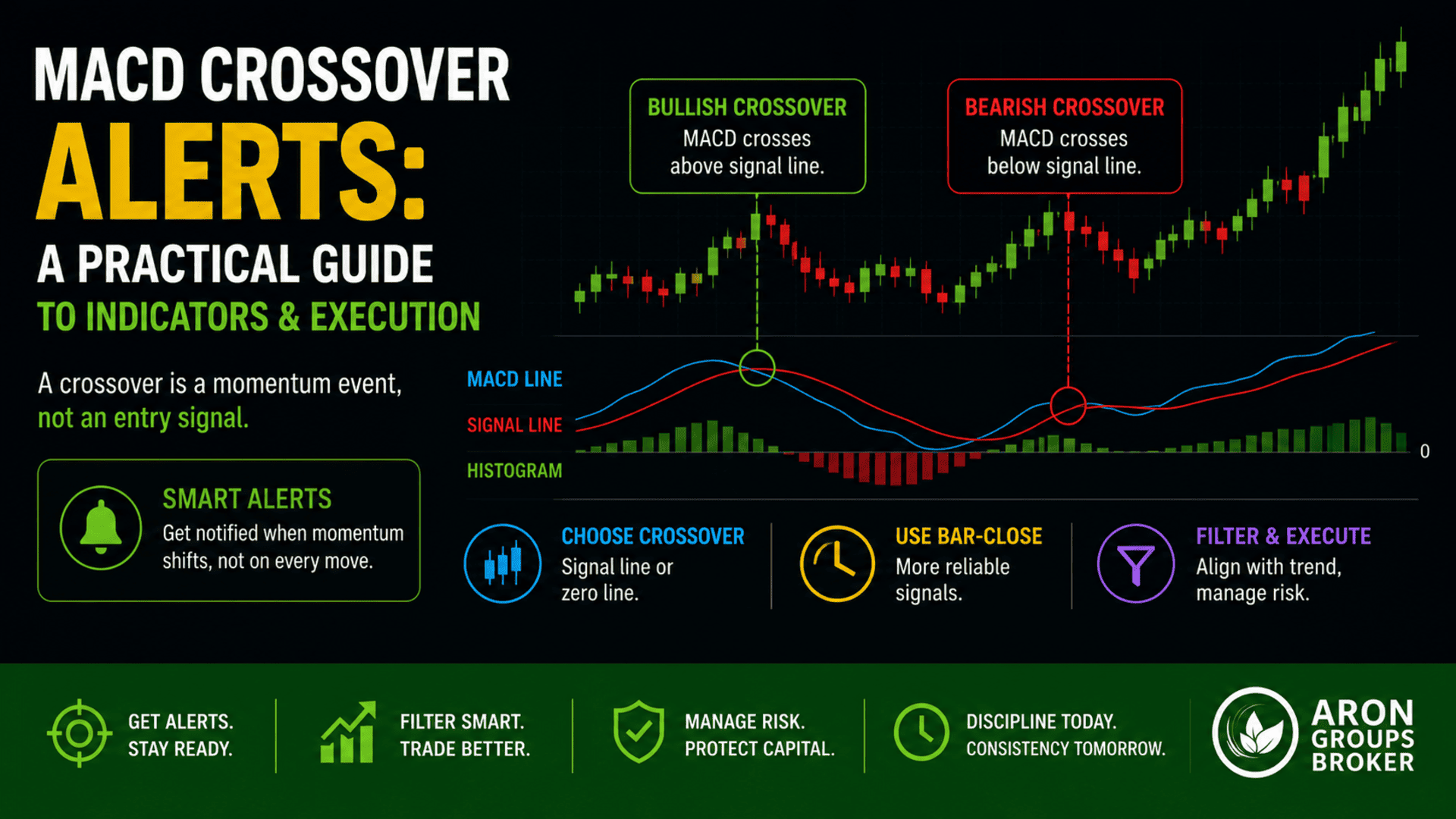




MACD crossover alerts are among the most widely used indicator-based notifications in trading, and also among the most misunderstood. The problem is rarely the indicator itself; it is that traders treat every crossover as an entry signal, then blame MACD when the result is choppy, late, or already extended. A crossover is a momentum event. It tells you that the relationship between two moving averages has changed. It does not tell you whether the trend, the liquidity conditions, or the structural context support the trade.
Used correctly, a MACD crossover alert is an attention tool inside a broader decision process. It directs the trader to inspect the chart at the moment when momentum has measurably shifted, rather than acting as a standalone trigger. With the right configuration — bar-close evaluation, sensible timing filters, and a clear distinction between signal-line and zero-line events — the alert becomes a precision input rather than a noise generator.
This guide explains exactly what a MACD crossover alert is, how signal-line and zero-line crossovers differ, how to configure alerts on the major platforms, and a step-by-step execution model for trading them inside a structured workflow.

- A MACD crossover is a momentum event, not an entry signal — it tells you what changed, not what to do.
- Signal line crossovers are earlier and noisier; zero line crossovers are slower and more confirmatory.
- Bar-close alerts produce more reliable signals than intrabar alerts, but they always arrive later.
- The standard 12-26-9 settings work across most liquid instruments; modifying them rarely improves edge as much as filtering and risk discipline.
- Platform differences in data feed, server time, and bar construction can produce slightly different alert timing for the same MACD settings.
• Risk management, position sizing, and structural context matter more than indicator parameters in deciding whether a trade is worth taking.
What Is a MACD Crossover Alert?
A MACD crossover alert is a notification triggered when the MACD line and the signal line cross, or when the MACD line crosses the zero line. The crossover itself reflects a measurable shift in short-term momentum relative to the underlying moving averages, but it does not validate trend quality, liquidity conditions, or execution risk. Treating the alert as a momentum event, rather than a trade command, is the difference between using MACD as a structured tool and treating it as a black-box signal.
The Mechanics of a MACD Crossover
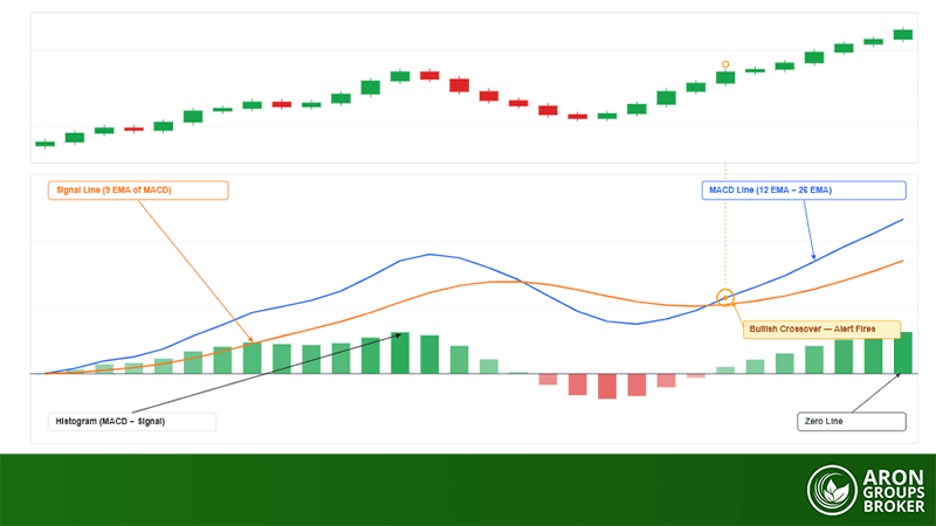
The MACD indicator has three components: the MACD line, calculated as the difference between two exponential moving averages (typically the 12-period and 26-period EMAs); the signal line, a 9-period EMA of the MACD line; and the histogram, which displays the gap between the MACD line and the signal line. A signal-line crossover occurs when the MACD line crosses above or below the signal line, indicating that short-term momentum has shifted relative to the smoothed reading. A zero-line crossover occurs when the MACD line itself crosses zero, marking a broader momentum direction change. Most platforms detect crossovers by comparing the previous bar state with the current bar state; if the relationship has changed from false to true, the alert fires.
Why Bar-Close vs Intrabar Timing Matters
Some alerts evaluate intrabar (while the candle is still forming), while others only confirm at bar close. The same chart can display a visible crossover during candle formation that disappears once the candle closes. Intrabar alerts fire earlier and capture momentum sooner, but they produce more false signals and frequent disappearing notifications. Bar-close alerts confirm only after the candle finishes, reducing false triggers at the cost of some lag. For most discretionary and rule-based trading, bar-close alerts are cleaner and easier to test consistently.
Read More: MACD Indicator Tutorial and Best Settings

Risk Disclosure Trading CFDs and other leveraged instruments involves a high risk of rapid capital loss. You should consider whether you understand how these products work and whether you can afford the high risk of losing your money. Indicator alerts, including MACD crossovers, do not predict price direction and do not protect against slippage, spread expansion, or news-driven volatility. Past performance is not indicative of future results. This content is provided for educational purposes only and does not constitute investment advice.
Signal Line Crossovers vs Zero Line Crossovers
Both crossover types describe momentum events, but they sit at different points in the momentum cycle and serve different purposes inside a workflow.
Signal Line Crossover
A signal-line crossover occurs when the MACD line crosses above or below the 9-period signal line. These crossovers happen frequently because the signal line tracks the MACD line closely. They are typically used for early momentum detection, especially when looking for trend continuation after a pullback or for catching the start of a new leg. The trade-off is noise: signal-line crossovers fire often during sideways and choppy conditions, generating false alerts that need to be filtered with structure or volatility context.
Zero Line Crossover
A zero-line crossover occurs when the MACD line itself crosses above or below the zero line. This event is less frequent and typically appears after the underlying move has already developed. Zero-line crossovers are confirmatory rather than predictive: they signal that momentum has flipped meaningfully relative to the longer-term moving averages, but they tend to lag the price action that produced them. Traders use zero-line crossovers as filters or as confirmation for higher-timeframe positioning, not as standalone entry triggers.
| Signal Line Crossover | Zero Line Crossover |
|---|---|
| Fires when MACD crosses the signal line | Fires when MACD crosses the zero line |
| More frequent and earlier | Less frequent and slower |
| Used for early momentum detection | Used for trend confirmation |
| Higher noise in sideways markets | Stronger context but more lag |
| Best filtered with structure or volatility | Best used as confirmation for HTF bias |
How to Configure a MACD Crossover Alert
Alert quality depends on how you configure the trigger logic, the timing, and the duplicate-handling rules. The same MACD settings can produce very different alert behaviour depending on these choices.
Step-by-Step Setup
- Add the MACD indicator to the chart and confirm the settings (the default 12-26-9 is the standard reference point for most instruments).
- Decide which crossover type you want to be notified of: signal-line crossovers, zero-line crossovers, or both.
- Choose the alert timing — bar close (more reliable, slower) or intrabar (faster, noisier). Bar close is the default recommendation for most workflows.
- Configure the notification channel: pop-up, sound, email, or push notification, depending on the platform and your trading style.
- On platforms that support custom logic (TradingView Pine Script orMQL5 for MT5), add state-tracking so the same crossover does not generate multiple alerts within the same bar.
Distinguishing Quality from Noise
Not every crossover is worth a notification. The same MACD settings produce different signal quality depending on regime, session, and volatility. Crossovers that fire during low-liquidity hours, inside narrow ranges, or against the higher-timeframe trend tend to fail more often than crossovers that fire during active sessions with clean structure. The fix is rarely to change the MACD inputs; it is usually to add a context filter — a higher-timeframe trend filter, a volatility threshold, or a session window — that removes the weakest alerts before they reach you.
Practical Filter A MACD crossover alert that fires during low-volatility chop, against the higher-timeframe trend, or outside major session hours is much less likely to produce a tradable move than one that fires during active sessions with a clean structural backdrop. Filtering by trend, volatility, and session is usually a bigger improvement than retuning the MACD parameters.
Trading a MACD Crossover Signal
Once the alert fires, the execution model follows the same discipline as any indicator-based entry: confirm the bias, check the structural context, and enter only when the surrounding conditions support the trade.
Establishing Directional Bias
The higher-timeframe market structure determines whether a MACD crossover is a continuation signal or a counter-trend warning. If the H4 or daily chart shows a bullish structure with higher highs and higher lows, the trader prioritises bullish signal-line crossovers, especially after pullbacks. If the structure is bearish, bearish crossovers in the direction of the trend are the focus. A MACD crossover against the dominant higher-timeframe direction is treated as a noise signal unless additional confluence is present.
Entry, Stop, and Target
The entry can be placed at market once the bar closes and the crossover is confirmed, or as a limit order at a refined level — for example, the next pullback into a moving average or a structural support level. The stop-loss sits beyond the structural reference that would invalidate the momentum thesis, not at an arbitrary pip distance. Targets align with the next meaningful level — a previous swing high or low, a higher-timeframe support or resistance, or a fixed reward multiple of the risk. Position sizing is calculated from the stop distance and the predefined account risk, not from the indicator value.
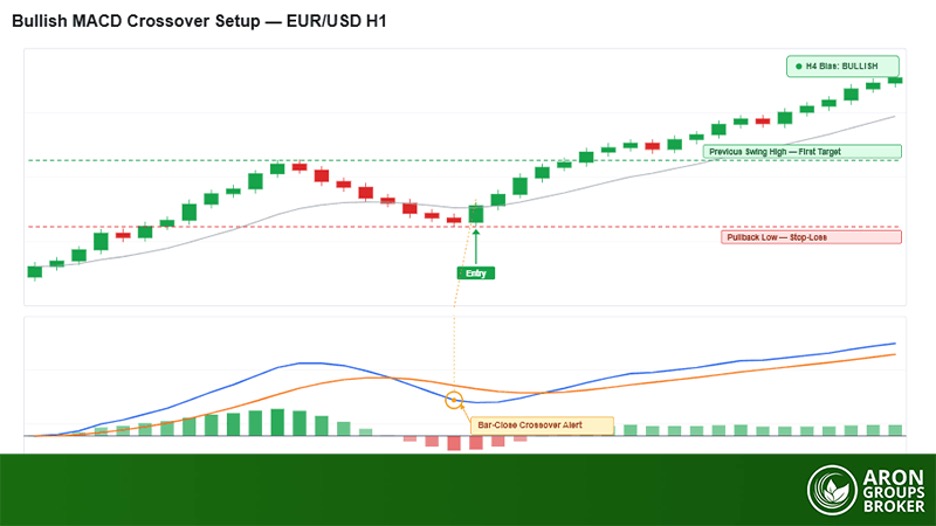
Mini Example: Bullish MACD Crossover on EUR/USD H1
- The H4 chart shows a bullish structure with higher highs and higher lows. EUR/USD is pulling back from a recent swing high.
- During the London session, the H1 MACD line crosses above the signal line at bar close. The alert fires.
- Price is sitting just above the 50-period EMA, and the previous H1 candle closed bullish.
- The trader enters long at the open of the next H1 bar. The stop is placed below the swing low of the pullback.
- The first target is the previous swing high; a portion of the position is held with a trailing stop for an extension toward the next H4 resistance.
Q: Should a MACD crossover alert be combined with price action?
A: Yes. The crossover identifies a momentum shift, but price action confirms whether the shift has structural meaning. A crossover that fires while price is rejecting a key level, breaking structure, or completing a pullback is far more reliable than one that fires inside a range with no confirming price behaviour. Treat the alert as a prompt to inspect the chart, not as a standalone trigger.
MACD Crossover vs Related Momentum Tools
Traders frequently confuse MACD crossovers with other momentum signals. The following comparison clarifies how each tool behaves and when each is most useful.
Common Mistakes When Trading MACD Crossovers
Three errors account for the majority of failed MACD crossover trades.
Trading Crossovers Against the Higher-Timeframe Bias
A bullish MACD crossover on the H1 chart is not a long signal if the daily chart is in a clearly defined downtrend. Counter-trend crossovers can work, but they require additional confluence and tighter risk parameters. Most traders improve their results by simply ignoring crossovers that conflict with the dominant higher-timeframe direction.
Ignoring the Bar-Close Rule
Acting on intrabar crossovers that have not yet confirmed at bar close is one of the fastest ways to accumulate small losses. The candle can move significantly before close, erasing the crossover entirely. Setting alerts to bar-close mode and waiting for confirmation before entry removes a large portion of avoidable false signals at the cost of a small amount of lag.
Treating Every Crossover as a Trade
A MACD alert is a momentum event, not a trade command. Scalpers in particular fall into the trap of acting on every notification, especially during volatile sessions where crossovers cluster. The fix is to treat each alert as a prompt to inspect structure, liquidity, and context — and to skip the trade if those conditions are not aligned. Filtering out the weakest 50–70% of alerts is normal and expected for a disciplined process.
| Concept | Behaviour and Use |
|---|---|
| MACD Signal Line Crossover | Momentum shift relative to the smoothed MACD reading. Earlier but noisier; needs context. |
| MACD Zero Line Crossover | Broader momentum direction change. Slower but more confirmatory. |
| MACD Histogram Divergence | Price makes a new extreme but the histogram does not. Used as an early warning of weakening momentum. |
| Stochastic Crossover | Compares closing price to a recent high-low range. More sensitive in ranges, less reliable in strong trends. |
| RSI Mid-Line Crossover | Tracks momentum strength via gain/loss ratio. Often used as a continuation filter alongside MACD. |
Read More: Top Swing Trading Indicators for Forex & Crypto
Combining MACD Crossovers with Other Tools
A MACD crossover in isolation is a momentum event. Its probability as a tradable setup increases when it aligns with other forms of confluence. Two combinations are particularly useful in practice.
MACD Plus Trend and Volatility Filters
Filtering MACD alerts with a higher-timeframe trend reference and a volatility measure such as ATR (volatility) removes the weakest crossovers before they reach the trader. A bullish crossover that fires while price is above the H4 50-period EMA and ATR is expanding is materially stronger than one that fires inside a compressed, low-ATR range with no higher-timeframe trend support. The filter does not eliminate false signals, but it consistently removes the lowest-quality alerts.
MACD Plus Session and Kill Zone Timing
MACD crossovers that fire during active sessions — the London open or the New York morning — benefit from peak participation and tend to produce cleaner follow-through. Crossovers that fire during the Asian session or in late-afternoon drift are more likely to stall or reverse against the alert direction. Combining the MACD signal with a session filter is one of the simplest and most effective ways to improve hit rate without changing the indicator settings.
Read More: MACD Indicator on TradingView — Setup and Best Practices
Q: Why does the same MACD crossover sometimes appear on TradingView but not on MT4 or MT5?
A: Slightly different alert timing across platforms is usually caused by broker data feed differences, server time and session cut-off variations, candle construction logic, and whether the indicator evaluates intrabar or only at bar close. The MACD formula is identical; the data and the evaluation method are not. Aligning your platform settings — server time, bar-close evaluation, and notification logic — typically resolves most of the apparent mismatches.
Conclusion
A MACD crossover alert is best used as a structured momentum notification, not as an automatic buy or sell command. Its value comes from highlighting a measurable shift in the relationship between two moving averages, then leaving the trader to apply context, structure, and risk discipline before acting. The traders who consistently get value from MACD do not chase a perfect setting; they chase a repeatable process.
Identify the crossover type that fits your style, configure the alert at bar close, filter by trend and session, and act only when the structural context supports the trade. Apply that sequence consistently and the MACD crossover stops being a noisy indicator and starts behaving like a precision attention tool.