

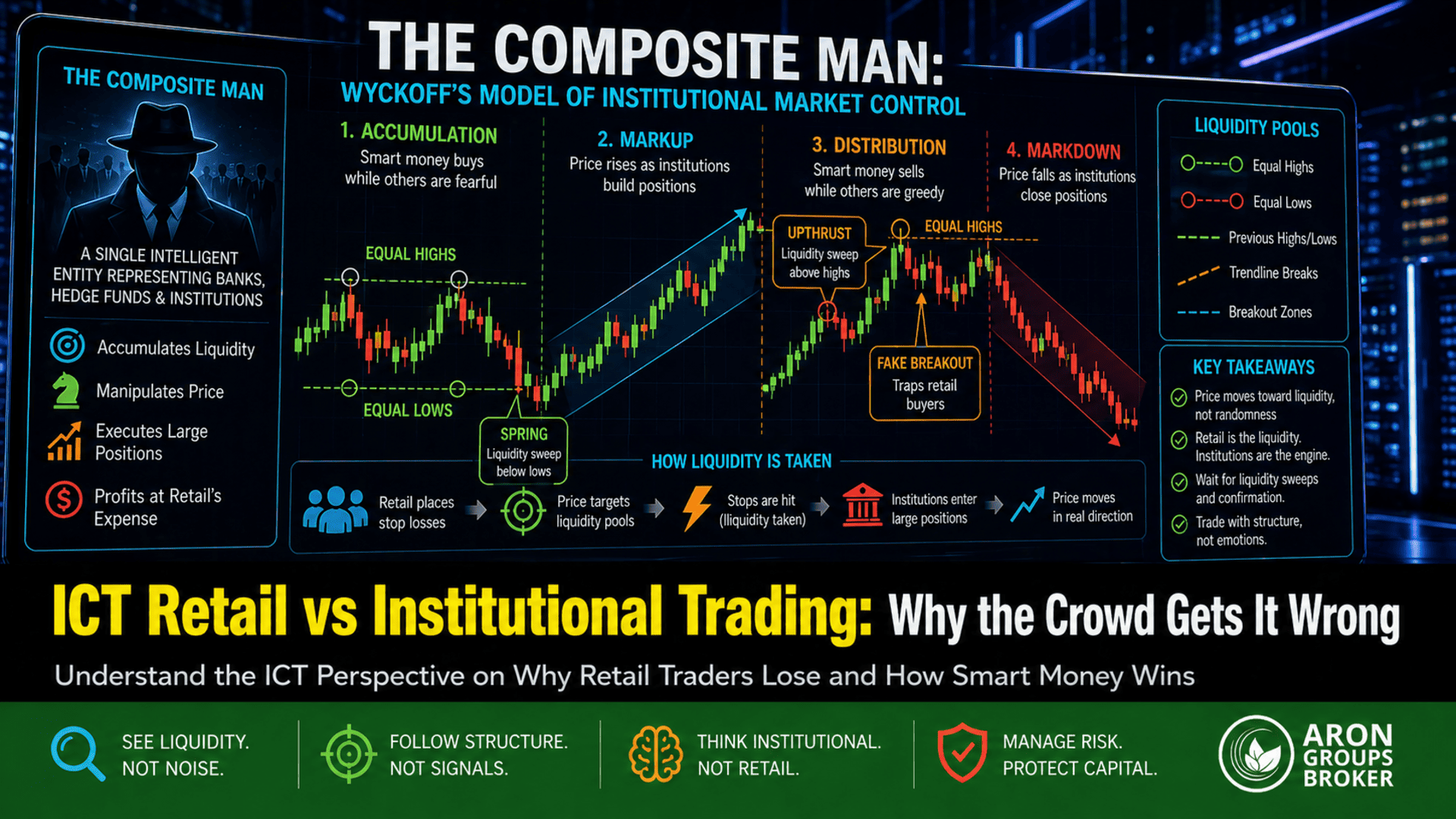




Financial markets rarely move at random. Behind every sharp rally or sudden drop, there is often a structured intention driven by large institutional players. In the Wyckoff methodology, this hidden force is described as the Composite Man—a conceptual operator that represents banks, hedge funds, and smart money as a single entity.
Understanding the Composite Man Wyckoff model allows traders to shift from reactive trading to strategic anticipation. Instead of blindly following indicators, you begin to interpret price action as a deliberate sequence of accumulation, manipulation, and distribution.
In this article, you will learn how to think like the Composite Man and align your trades with institutional intent rather than retail noise.

- The Composite Man Wyckoff model explains that price is driven by institutional players who accumulate, manipulate, and distribute positions using structured strategies within the Wyckoff Price Cycle.
- Understanding Wyckoff Composite Man behaviour helps traders identify key phases, such as accumulation and distribution, rather than blindly reacting to breakouts or indicators.
- The Institutional Operator Wyckoff relies on liquidity pools—such as equal highs and lows—to execute large orders, often triggering stop hunts before the real move begins.
- Most retail traders lose because they trade against Wyckoff Smart Money, entering during distribution highs or selling during accumulation lows, driven by emotion.
- Applying Composite Man Theory effectively requires combining price action, volume, and higher timeframe context to align trades with institutional intent rather than retail sentiment.
What Is the Composite Man in Wyckoff Theory?
The Composite Man concept in Wyckoff methodology is a foundational idea. It suggests that market movements are not random but are driven by a single dominant force—an “invisible operator” representing institutional players such as banks, hedge funds, and large financial entities.
According to Stockchart, Wyckoff advised traders to study the market as if a single intelligent entity were controlling prices. This perspective simplifies complex market behaviour into a structured narrative. Instead of reacting to every price fluctuation, traders begin to interpret intent behind movements.
The Core Idea Behind Composite Man Wyckoff
At its core, the Wyckoff Composite Man operates with a clear objective: buy at low prices, sell at high prices, and maximise profit while misleading the majority of traders.
This process typically involves:
- Accumulating positions quietly when sentiment is bearish
- Creating false moves to trap retail traders
- Driving price aggressively once enough positions are built
Q: Why doesn’t the price move immediately after accumulation?
A: Because institutions need time and liquidity to build large positions without causing slippage.
How Institutional Operator Wyckoff Shapes Price
The Institutional Operator Wyckoff controls prices through supply-and-demand imbalances. This is not done randomly—it follows a structured approach aligned with liquidity.
Key mechanisms include:
- Liquidity targeting: Stops above highs and below lows act as fuel
- Volume manipulation: High volume can signal either absorption or distribution
- False breakouts: Designed to trigger retail entries in the wrong direction
Example:
Gold breaks above a resistance level at $5,000, attracting breakout buyers. Shortly after, the price reverses sharply to $4,980. This is a classic liquidity grab where the Composite Man sells into buying pressure.
The Wyckoff Price Cycle and the Role of the Composite Man
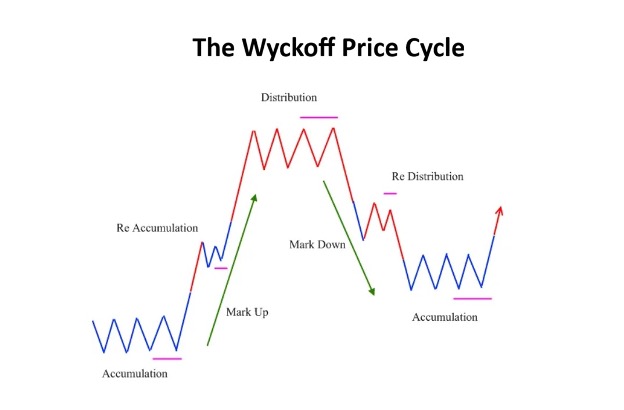
The Wyckoff Price Cycle describes how markets move in repeating phases driven by institutional behaviour. According to XS, these phases—accumulation, markup, distribution, and markdown—reflect the Composite Man’s strategic actions.
Understanding this cycle allows traders to align with Wyckoff Smart Money rather than trading against it. Each phase has a specific purpose, and recognising them improves timing and trade selection.
In simple terms, the Composite Man buys during accumulation, pushes price higher during markup, sells during distribution, and drives price lower during markdown.
Accumulation Phase and Smart Money Behaviour
During the accumulation phase, the Composite Man builds long positions at relatively low prices. This phase often appears as sideways consolidation and is typically misunderstood by retail traders as a “boring” or directionless market.
Characteristics include:
- Tight price ranges
- Decreasing volatility
- Volume spikes during dips (absorption of selling pressure)
Distribution Phase and Market Manipulation
The distribution phase is the opposite of accumulation. Here, the Composite Man offloads positions at higher prices while retail traders continue buying, expecting further upside.
This phase often includes manipulation tactics such as:
- Fake breakouts above resistance
- Increased volatility near highs
- Divergence between price and volume
Example:
NASDAQ continues making higher highs, but volume weakens. Suddenly, a sharp drop follows. This suggests institutions were distributing positions before the decline.
Q: Why is distribution dangerous for retail traders?
A: Because it looks like strength, while smart money is actually exiting positions.
How the Composite Man Uses Liquidity and Retail Psychology
The Composite Man Wyckoff does not simply follow price—it engineers it by exploiting liquidity and predictable retail behaviour. Liquidity, in practical terms, is where orders are clustered. These clusters often sit around obvious levels such as equal highs, equal lows, trendline touches, and breakout zones.
Retail traders tend to place stop losses in these areas. The Composite Man uses this information as fuel. Instead of avoiding these zones, institutions deliberately drive price into them to trigger orders and generate the liquidity needed to enter or exit large positions efficiently.
Stop Hunts and Liquidity Pools Explained
A stop hunt is a deliberate move designed to trigger stop-loss orders and pending orders clustered in a specific area. These zones are called liquidity pools.
Common liquidity zones include:
- Equal highs and equal lows
- Previous day highs/lows
- Key psychological levels
Q: Why are stop hunts necessary?
A: Large players cannot execute big orders without sufficient liquidity, and stop orders provide that liquidity.
Fear, Greed, and Retail Trader Traps
The Composite Man also exploits emotional cycles—mainly fear and greed. These emotions create predictable patterns in retail behaviour.
- Fear: Causes traders to exit early or place tight stops
- Greed: Leads to chasing breakouts and over-leveraging
Reading Charts Through the Eyes of the Composite Man
To trade effectively using Wyckoff Smart Money, you must shift your perspective. Instead of asking “What is price doing?”, ask “Why is price doing this?”
Reading charts through the lens of the Composite Man means analysing intent, not just patterns. This involves combining price action, volume, and structure to decode institutional behaviour.
Identifying Wyckoff Schematics in Real Charts
Wyckoff schematics provide a structured way to identify phases such as accumulation and distribution.
Key elements to look for:
- Selling Climax (SC): Sharp drop with high volume
- Automatic Rally (AR): Quick bounce after SC
- Secondary Test (ST): Retest of lows with lower volume
- Spring or Upthrust: False breakout to trap traders
Q: What confirms the pattern?
A: Reduced selling pressure and stronger bullish reactions.
Volume, Price Spread, and Market Intent
Volume and price spread together reveal the Composite Man’s true intent.
- Wide spread + high volume: Strong participation, possible continuation
- Wide spread + low volume: Weak move, likely manipulation
- Narrow spread + high volume: Absorption (smart money active)
For example, if NASDAQ shows a narrow range candle with high volume near resistance, it often means institutions are selling into buying pressure.
Q: Why is volume critical?
A: Because it shows participation. Price alone can be misleading, but volume exposes the strength behind moves.

The Composite Man Theory is not about predicting price—it is about understanding behaviour. Markets move where liquidity exists, and liquidity exists where traders are most exposed.
Wyckoff Smart Money Concepts vs Retail Trading Strategies
The contrast between Wyckoff Smart Money and retail trading lies in intent, timing, and execution. Retail traders typically react to visible price movements, while the Composite Man Wyckoff anticipates and engineers those movements.
Retail strategies often rely on lagging indicators such as RSI or MACD without understanding the underlying market structure. In contrast, smart money focuses on liquidity, order flow, and positioning within the Wyckoff Price Cycle.
For example, a retail trader may buy a breakout above a resistance level. Meanwhile, the Composite Man may be selling into that breakout after accumulating positions at lower prices earlier. This timing difference explains why many retail trades fail despite “correct” analysis.
Key Differences Between Smart Money and Retail Logic
The gap between smart money and retail logic can be summarised through behaviour and decision-making:
- Retail traders:
- Trade breakouts and obvious patterns
- Place stops in predictable zones
- React to indicators after price moves
- Smart money (Composite Man):
- Accumulates before breakouts
- Targets liquidity pools for entries
- Uses volume and structure, not lagging signals
Q: Who controls the move?
A: The side with capital and liquidity access—smart money.
Why Most Retail Traders Lose in the Wyckoff Context
Most retail traders lose because they operate inside the trap designed by the Composite Man. They enter late, exit early, and place stops where liquidity is obvious.
Common mistakes include:
- Buying at distribution highs
- Selling at accumulation lows
- Ignoring higher timeframe context
- Over-relying on indicators without structure
Practical Trading Strategies Based on Composite Man Theory
Applying the Composite Man Theory requires shifting from reactive execution to structured planning. The goal is not to predict every move but to align trades with institutional intent during key phases of the market cycle.
Effective strategies are built around identifying accumulation and distribution zones, then executing trades when liquidity events confirm direction. This approach improves timing and reduces unnecessary risk.
Entry Models During Accumulation and Distribution
Two primary entry models emerge from Wyckoff logic:
- Accumulation Entry (Long Setup):
- Identify a range after a downtrend
- Wait for a false breakdown (Spring)
- Enter after a strong bullish confirmation
Example:
EUR/USD drops below 1.0800 (spring), quickly reclaims the level, and closes at 1.0830. A long entry targets 1.0950.
- Distribution Entry (Short Setup):
- Identify a range after an uptrend
- Wait for a false breakout (Upthrust)
- Enter after bearish confirmation
Example:
Gold breaks above $5,020, then reverses sharply below $5,000. A short entry targets $4,950.
Before entry, wait for confirmation, because false moves are part of the manipulation phase.
Risk Management Using Wyckoff Principles
Risk management in Wyckoff is based on structure, not arbitrary rules. Stops and targets are placed relative to liquidity zones and market phases.
Key principles:
- Place stop loss beyond liquidity extremes (not inside the range)
- Use a higher timeframe bias to filter trades
- Avoid trading in the middle of ranges (low edge)
Example:
If entering long after a spring at 1.0800, the stop should be below the spring low (e.g., 1.0780), not inside the range.
| Strategy Type | Market Phase | Setup Condition | Entry Trigger | Stop Loss Placement | Target Area |
|---|---|---|---|---|---|
| Accumulation Long | Accumulation | Range after downtrend | Spring + bullish confirmation | Below spring low | Range high / breakout level |
| Distribution Short | Distribution | Range after uptrend | Upthrust + bearish confirmation | Above upthrust high | Range low / breakdown level |
| Breakout Continuation | Markup / Markdown | Strong trend with volume expansion | Retest of breakout level | Below/above breakout structure | Next liquidity zone |
| Liquidity Sweep Reversal | Any phase (key HTF) | Equal highs/lows or key level liquidity | Sweep + sharp rejection | Beyond sweep high/low | Opposite side liquidity |
| Range Trading | Sideways market | Clear support & resistance boundaries | Rejection at range edges | Outside range extremes | Opposite side of range |
| Trend Pullback Entry | Markup / Markdown | Strong trend + pullback to structure | Bullish/bearish confirmation candle | Below/above pullback low/high | Trend continuation zone |
Common Mistakes When Applying Wyckoff Composite Man Concepts
Many traders misuse the Composite Man Wyckoff model by treating it as a fixed pattern system rather than a behavioural framework. The main issue is forcing interpretations without confirmation from price and volume.
For example, not every range is an accumulation, and not every breakout failure is manipulation. Without proper context, traders end up entering too early or trading against institutional intent.
Misinterpreting Market Phases
A frequent mistake is labelling market phases incorrectly.
- Calling consolidation “accumulation” without evidence
- Entering before confirmation (e.g., no spring or upthrust)
- Ignoring volume behaviour
Ignoring Context and Higher Timeframe Analysis
Wyckoff must be aligned with the higher timeframe direction.
- Trading against the daily trend
- Ignoring macro drivers (e.g., USD strength)
- Over-focusing on lower timeframes
Conclusion
The Composite Man Theory helps traders understand how smart money moves the market through liquidity and structure. Instead of reacting to price, you begin to anticipate intent.
The edge comes from aligning with accumulation and distribution phases, not chasing breakouts. With proper context and discipline, this approach improves timing, reduces risk, and increases consistency.