





Most traders fail not because their strategy is wrong, but because they have no reliable record of what they actually did. Without a structured journal, every trade becomes its own isolated event — celebrated when it works, rationalised when it doesn’t, and forgotten by the time the next one arrives. The lessons that should accumulate disappear into noise.
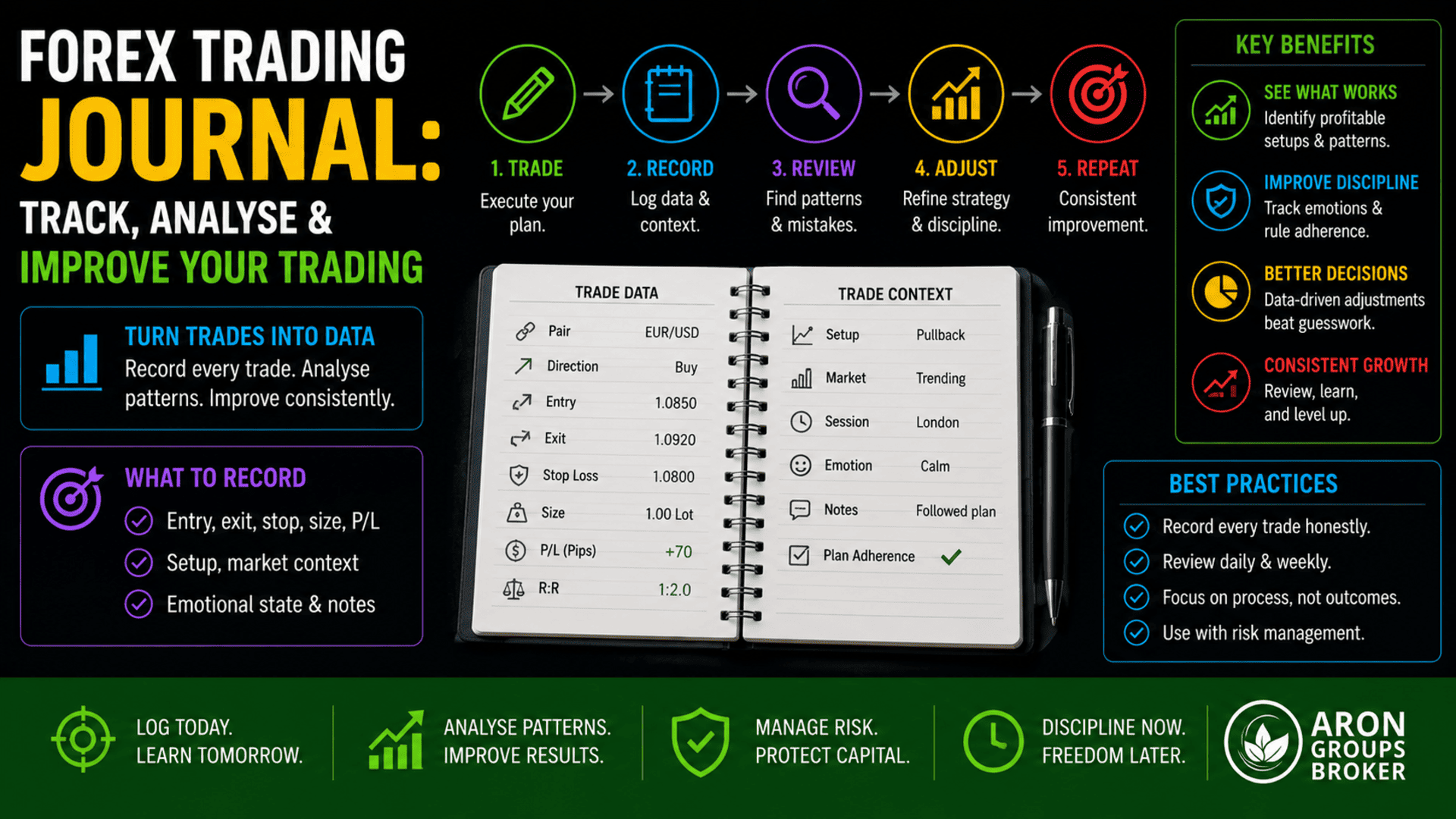
A forex trading journal solves that problem by turning trades into data. It captures both the quantitative side — entry, exit, stop, position size, profit and loss — and the qualitative side — strategy used, market context, emotional state, decisions made under pressure. Together, these two layers form a feedback loop: trade, record, review, adjust, repeat. That loop is the difference between a trader who improves and one who just trades for longer.
This guide explains exactly what a forex trading journal is, what to record, how to analyse the data, how to choose between paper, digital, and hybrid logs, and a step-by-step process for using your journal to refine strategy and discipline over time.

- A trading journal is a feedback system, not a record book — its value is in the review, not the entry.
- Quantitative data (entry, exit, stop, size, P/L) tells you what happened; qualitative data (setup, emotion, market context) tells you why.
- Paper journals build awareness; digital journals scale; the strongest workflow is hybrid — quick paper notes during sessions, structured digital review weekly.
- Win rate alone is misleading — always pair it with average risk-reward ratio and expectancy.
- Reviews should match your trading frequency: daily for scalpers and day traders, weekly for swing traders, monthly for everyone.
- Discipline gains from journaling come from consistent recording of emotional state and rule-following, not from logging more data.
What Is a Forex Trading Journal?
A forex trading journal is a structured record of every trade you execute, designed to be reviewed and acted on rather than just filed away. Each entry combines the precise numbers that define the trade with the context that produced it — the strategy, the market regime, the emotional state at execution, and any deviations from the trading plan. The journal becomes useful only when it is used to find patterns, not just to log activity.
The Mechanics of a Trading Journal
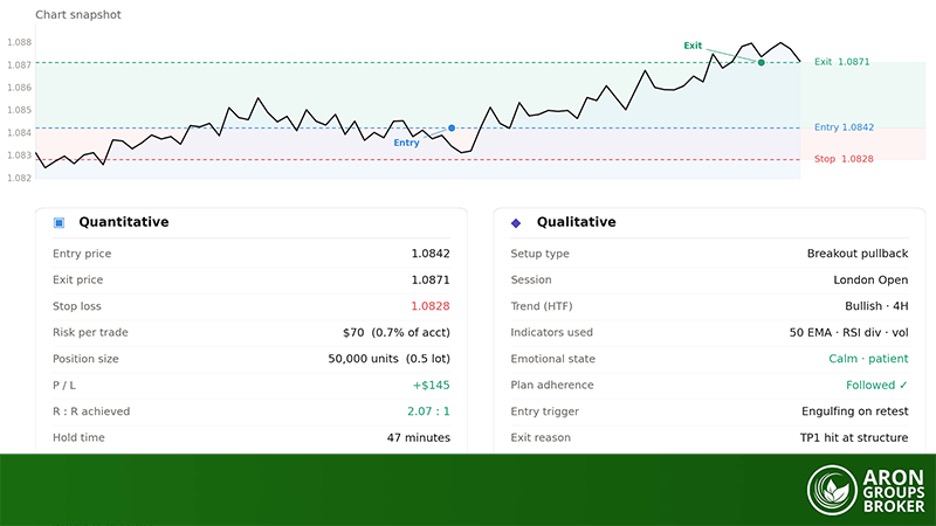
A complete journal entry has two distinct layers. The quantitative layer captures the executable facts: currency pair, direction, entry price, exit price, stop-loss level, take-profit target, position size, realised P/L in pips and percentage, and the resulting risk-reward ratio. The qualitative layer captures the surrounding context: the setup type (breakout, pullback, reversal), the indicators used, the market regime (trending, ranging, news-driven), the trading session, and the emotional state during entry and exit. Both layers are necessary. Numbers without context cannot explain why a strategy fails in some conditions and succeeds in others.
Why Numbers Alone Are Not Enough
A spreadsheet of P/Ls tells you whether you made money over the last 50 trades, but it cannot tell you why you made it, or whether your performance is repeatable. The qualitative layer — strategy, emotion, context — is what reveals the patterns that explain the numbers. A journal showing eight straight losses is a result; a journal showing eight straight losses, all during the Asian session, all on impulsive entries after a missed setup, is a diagnosis. The diagnosis is what allows the trader to actually fix something, rather than just tweak the strategy and hope.
Read More: How to Manage Risk in the Forex Market

Risk Disclosure Trading CFDs and other leveraged forex instruments involves a high risk of rapid capital loss. You should consider whether you understand how these products work and whether you can afford the high risk of losing your money. A trading journal helps you analyse past performance but does not guarantee future results, eliminate execution risk, or protect against slippage, spread expansion, or news-driven volatility. Past performance is not indicative of future results. This content is provided for educational purposes only and does not constitute investment advice.
Paper vs Digital vs Hybrid Trading Logs
Choosing how to record your trades depends on your trading frequency, your discipline level, and the type of analysis you want to perform later. The three common formats — paper, digital, and hybrid — each serve a different purpose, and the strongest workflow usually combines two of them.
Paper Journal
A paper journal is slower to fill in, which is exactly what makes it useful. The act of writing forces reflection: you cannot copy-paste an emotional state. Paper journals build awareness of how you actually felt during the trade, not how you remember feeling afterwards. The trade-off is scale — paper does not handle volume well. A paper journal works best for discretionary traders who execute a small number of trades per week and want to deepen their behavioural awareness. It does not work for scalpers or anyone running 20 trades a day.
Digital Journal
A digital journal — built in Excel, Google Sheets, or a dedicated journaling app — handles volume, automation, and analysis. Trades can be exported directly from MT4, MT5, or TradingView, which removes data-entry errors and saves time. Filters, sorts, and pivot tables turn 200 trades into immediate insights about which setups work, which sessions produce losses, and where the journal is incomplete. The trade-off is reflectiveness: when entry is fast, the qualitative layer is often skipped or auto-filled in a way that loses meaning.
| Paper Journal | Digital Journal |
|---|---|
| Slower entry, deeper reflection | Fast entry, scales to high volume |
| Reinforces emotional awareness | Enables filtering, sorting, dashboards |
| Best for discretionary traders | Best for active or algorithmic traders |
| Limited to small trade counts | Handles unlimited trade history |
| Hard to analyse statistically | Native support for performance metrics |
How to Set Up Your Trading Journal
Setup is where most journals fail. A journal designed without a clear purpose collects data nobody reviews. The fix is to start from what you actually want to learn — and only add fields that support those questions.
Step-by-Step Setup
- Define the questions your journal needs to answer (e.g., “Which setup has the highest expectancy?” or “Which session produces my worst trades?”).
- Build a template with one row per trade, splitting columns into the quantitative layer (numbers) and the qualitative layer (context).
- Add only the fields that map directly to your questions — every extra column is friction that reduces compliance.
- Decide your review cadence: daily quick check, weekly deep review, monthly performance audit.
- Commit to recording every trade for at least 30 entries before drawing any conclusions about strategy quality.
Distinguishing Core Data from Context Data
Core data is what makes the trade reproducible: pair, direction, entry, exit, stop, target, size, P/L, R:R. Context data is what makes the trade explainable: setup type, indicators, session, market regime, news events, and emotional state. Both matter, but they fail differently. Missing core data makes the trade impossible to analyse; missing context data makes patterns impossible to detect. A journal that captures core data without context becomes a P/L statement. A journal that captures both becomes a diagnostic tool.
Practical Filter A trading journal that takes more than 60 seconds per entry to fill in will not be maintained beyond a few weeks. If you find yourself skipping fields, the template is too heavy. Cut it back to the minimum that still answers your review questions, then add fields back only when you have a specific reason.
Recording and Analysing Your Trades
Recording is half the work. The other half — and the part where most journals stop adding value — is the analytical side: turning logged trades into specific, actionable changes to your trading process.
Capturing Market Context and Emotional State
The market context layer covers the regime: trend, range, news event, volatility expansion, session timing. The emotional layer covers your internal state: calm, hesitant, impulsive, pressured, FOMO. Both should be captured at the moment of entry, not reconstructed afterwards — memory of emotional state degrades fast and reconstruction is unreliable. The simplest way to enforce this is to require a one-word emotional tag on every entry, so the field is small enough to always fill in.
Reviewing Risk-Reward and Performance Metrics
Once you have 30+ trades, the journal becomes a dataset. The metrics that matter most are: win rate, average risk-reward ratio, expectancy (average profit per trade), profit factor, and maximum drawdown. Win rate alone is misleading — a 70% win rate with a 1:0.5 R:R ratio loses money over time. The combined view (win rate × average R:R) is what reveals whether the strategy is statistically positive. Expectancy summarises the same information in a single number: positive expectancy means the strategy makes money on average, regardless of any individual trade outcome.
Mini Example: Reviewing 50 Trades on a Breakout Strategy
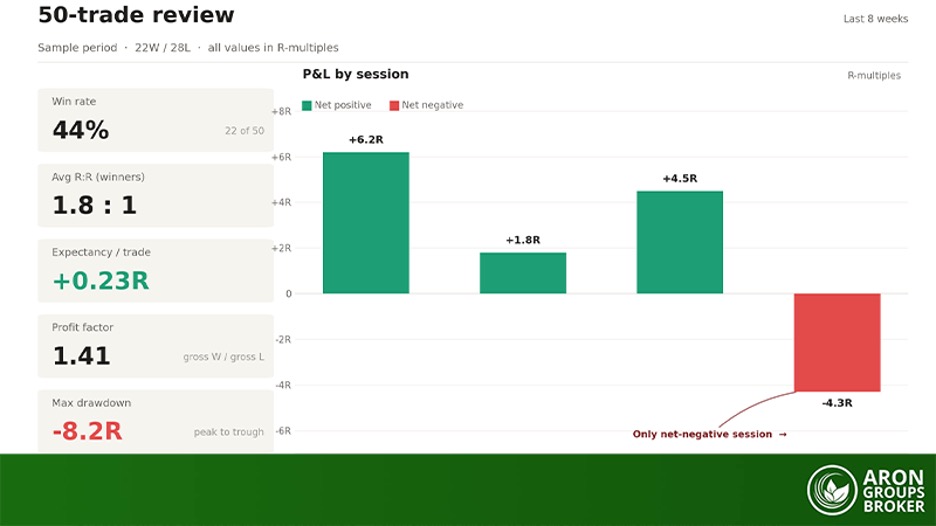
- The trader has logged 50 EUR/USD breakout trades over six weeks across the London and New York sessions.
- The journal shows 22 wins (44% win rate) with an average R:R of 1:1.8 — a positive expectancy.
- Filtering by session reveals that 18 of the 22 wins came during the London open, and 17 of the 28 losses came during the New York afternoon.
- The qualitative notes show “FOMO” or “impulsive” tagged on 12 of the 17 New York afternoon losses.
- The action: stop trading the breakout strategy in the New York afternoon and re-test with stricter entry confirmation. Expected improvement is measured in the following 30 trades, not asserted from the analysis.
Q: How many trades do I need before drawing strategy conclusions?
A: At least 30 trades, ideally 50, before treating any pattern as statistically meaningful. With fewer than 30, what looks like a recurring problem is more often just normal variance. Resist the urge to make rule changes after a small sample.
Trading Journal vs Trade Tracker vs P/L Spreadsheet
Traders often confuse a journal with a tracker or a P/L spreadsheet. Each has a place, but they serve different purposes.
| Concept | Purpose and Use |
|---|---|
| Trading Journal | Combines quantitative + qualitative layers. Designed for review and behavioural change. |
| Trade Tracker | Auto-imports executions from a broker. Tracks P/L over time. No qualitative layer. |
| P/L Spreadsheet | Pure numbers — used for tax, accounting, or performance reporting. Not designed for review. |
| Trade Diary | Free-form narrative without structured fields. Useful for reflection but hard to analyse statistically. |
Combining Your Journal with Other Tools
A journal becomes substantially more useful when it is connected to the systems that generate the data and the rules that govern execution. Two integrations stand out in practice.
Journal Plus Trading Plan
A trading plan defines the rules; a journal records what you actually did. Without the plan, the journal cannot identify rule-breaks, only outcomes. With both in place, every losing trade can be classified as either “followed the plan and lost” (acceptable variance) or “broke the plan and lost” (a discipline problem). This single distinction is one of the most powerful uses of journaling, because it separates strategy issues from behavioural issues — and they require completely different fixes.
Journal Plus Position Sizing
Recording position size for every trade is not just for P/L calculation. Reviewing position size by setup type often reveals that traders unconsciously oversize on familiar setups and undersize on the highest-edge ones. The journal data exposes this immediately when you sort by setup and look at average size. The fix is to formalise sizing rules and check compliance in the weekly review, the same way you check setup adherence.
Read More: RSI Indicator Strategy and Settings
Common Mistakes When Keeping a Trading Journal
Three errors account for the majority of failed journaling attempts.
Logging Outcomes Without Context
A journal that records only entry, exit, and P/L is a P/L statement, not a journal. Without context — setup, session, emotion, deviations — there is nothing to analyse. The most common reason traders abandon journaling is that they look back at three months of P/L data and find it tells them nothing they didn’t already know. The fix is to add context, even minimal context (one tag per category), at the moment of entry.
Reviewing Too Often or Not Often Enough
Reviewing after every single trade produces over-reaction to variance — three losses become a strategy crisis. Reviewing only quarterly produces drift — discipline problems compound silently. The right cadence is matched to trading frequency: scalpers and day traders need a daily review (5–10 minutes), swing traders need a weekly review (30–60 minutes), and every trader benefits from a monthly performance audit covering the metrics that need a 30+ trade sample.
Treating the Journal as a Diary, Not a Tool
A journal that captures feelings without structure produces narrative without insight. Recording that you felt anxious during a trade is useful only if you can later filter trades by anxiety state and see whether outcomes differ. That requires structured fields (a one-word emotional tag, a yes/no on plan adherence) rather than free-form prose. Trading psychology matters, but it has to be measurable to be actionable.
Q: Should I keep one journal per strategy or one combined journal?
A: One combined journal with a “strategy” column. Separate journals fragment the data and make cross-strategy comparisons impossible. The strategy column lets you filter for any individual strategy when needed and review portfolio-level results when you want the bigger picture.
Conclusion
A forex trading journal is best used as a feedback system, not as a record. Its value comes not from the act of logging but from the periodic review that turns logged data into specific changes in how you trade. The traders who get the most from journaling are not the ones with the most elaborate templates — they are the ones who consistently record both the numbers and the context, and who actually sit down to review what they recorded.
Build the lightest template that answers your review questions, commit to capturing both layers on every trade, set a review cadence that matches your trading frequency, and act on what the data shows. Done consistently, the journal stops being a chore and starts behaving like the most reliable improvement tool in your trading process.