

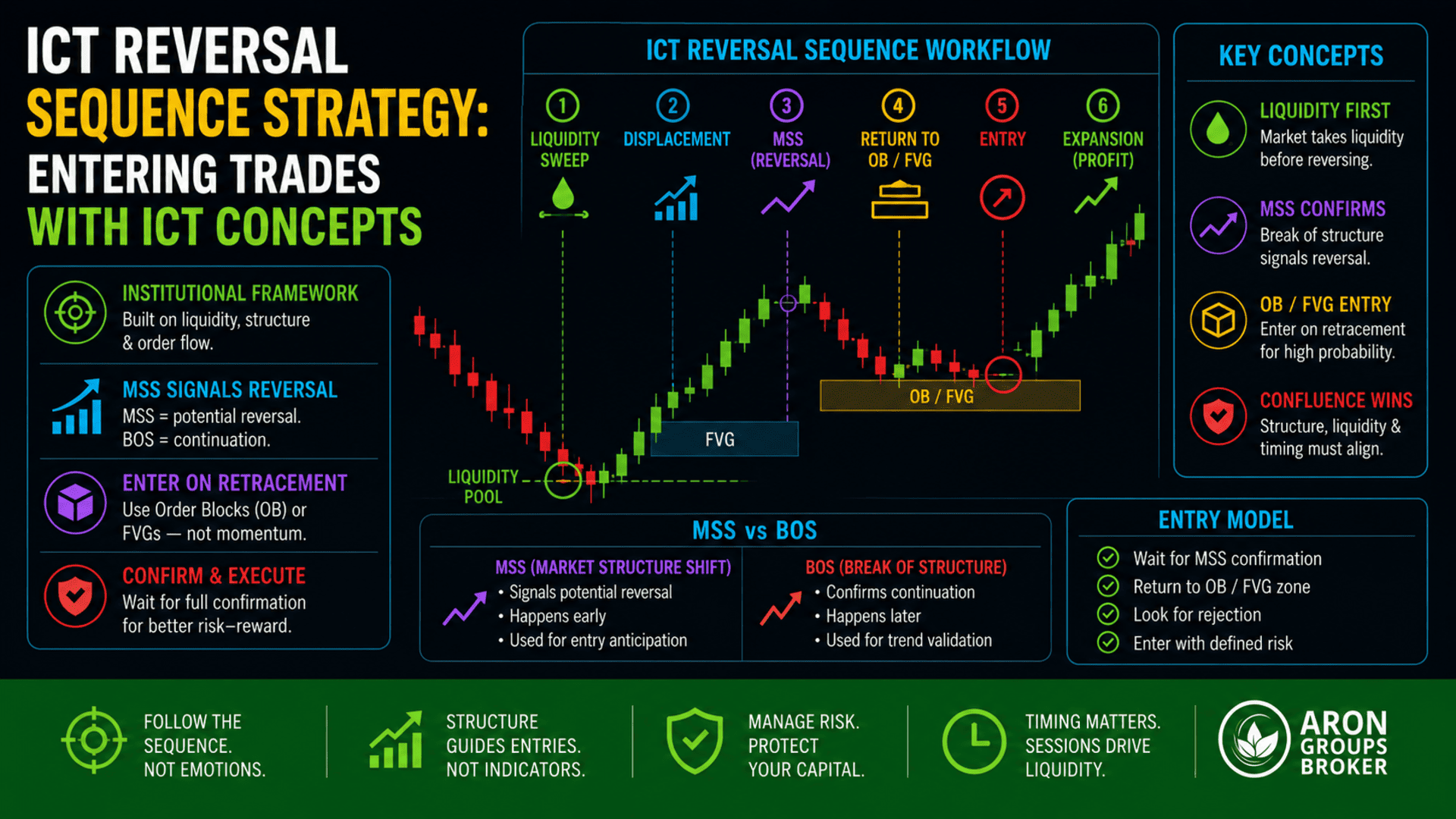




The ICT Reversal Sequence Strategy is a powerful framework used by professional traders to identify high-probability reversal points in the Forex market. Rooted in the Inner Circle Trader (ICT) methodology, this strategy combines market structure analysis, liquidity patterns, and order block identification to anticipate institutional moves before they unfold.
This article will break down the ICT Reversal Sequence step by step, providing clear examples, practical entry models, and actionable insights.

- ICT Reversal Sequence Strategy starts with liquidity, not indicators.
- ICT Reversal Sequence Strategy relies on displacement and MSS for confirmation.
- A core rule of the ICT Reversal Sequence Strategy is entering on retracement into Order Blocks (OB) or Fair Value Gaps (FVG), not chasing momentum.
- Within the ICT Reversal Sequence Strategy, MSS signals a potential reversal, while BOS confirms continuation. Confusing these leads to late or poor entries.
- The ICT Reversal Sequence Strategy works best when structure, liquidity, and timing align. Waiting for full confirmation improves consistency and risk–reward.
ICT Reversal Sequence Strategy Workflow
The ICT Reversal Sequence Strategy workflow is a structured approach that helps traders understand the market’s rhythm, identify potential reversals, and execute precise trades.
The ICT Reversal Sequence Strategy follows a strict, repeatable workflow. Each step builds on the previous one.
A correct workflow looks like this:
- Step 1: Identify External Range & Bias
Start from a higher timeframe (H1–D1). Define whether the price is a premium or a discount. This gives directional bias. - Step 2: Locate Liquidity Pools
Identify equal highs/lows, previous swing points, and obvious stop clusters. These are targets for liquidity sweeps. - Step 3: Wait for Liquidity Sweep
Price must take liquidity first. This is non-negotiable. Without it, there is no reversal model. - Step 4: Observe Displacement
Look for a strong impulsive move away from the liquidity zone. This confirms institutional intent. Typically, this move creates a Fair Value Gap (FVG). - Step 5: Confirm MSS (Market Structure Shift)
MSS is the first sign of reversal. It happens when the price breaks a short-term structure after displacement. - Step 6: Refine Entry Zone (PD Arrays)
Identify:- Order Block (OB)
- Fair Value Gap (FVG)
- 50% equilibrium level
Step 7: Execute Entry
Enter on retracement into OB/FVG with confirmation (lower timeframe MSS or rejection candle).

The ICT Reversal Sequence Strategy workflow works best during the London and New York sessions, when liquidity is sufficient.
Full ICT Reversal Sequence Strategy as a Trading Model
The full ICT Reversal Sequence Strategy integrates market structure, liquidity, and order flow into a coherent model. A typical sequence includes:
- Liquidity Sweep: Price targets liquidity above highs or below lows, triggering stop-losses and breakout orders. This step is essential — without liquidity, there is no valid reversal.
- Displacement: After the sweep, the price moves strongly in the opposite direction. This impulsive move, often leaving a Fair Value Gap (FVG), confirms institutional intent.
- Market Structure Shift (MSS): MSS is the first confirmation of a potential reversal.
- Bullish case → breaks a lower high
- Bearish case → breaks a higher low
- Return to PD Array: Price retraces into a key zone where orders originated: Order Block (OB), Fair Value Gap (FVG) or 50% equilibrium level. This retracement provides the optimal entry area.
- Entry Execution
- In an aggressive entry, a limit order could be at OB/FVG.
- In a conservative entry, wait for confirmation from a lower timeframe.
- Stops are placed beyond the liquidity point. Targets aim for opposing liquidity.
- Expansion: Price moves in the new direction, targeting internal and external liquidity. This phase delivers the trade’s profit.
ICT Reversal Sequence Strategy Workflow
| Step | Phase | Description | Key Confirmation | Practical Notes |
|---|---|---|---|---|
| 1 | Liquidity Sweep | Price takes liquidity above highs or below lows, triggering stop-losses and breakout orders. | Sweep of obvious swing points (equal highs/lows, previous highs/lows) | No sweep = no valid reversal setup |
| 2 | Displacement | Strong impulsive move in the opposite direction after liquidity is taken. Often creates imbalance (FVG). | Large candles, momentum shift, visible imbalance | Confirms institutional intent |
| 3 | Market Structure Shift (MSS) | Break of short-term structure signalling potential reversal. | Break of lower high (bullish) or higher low (bearish) | MSS = reversal signal (not BOS) |
| 4 | Return to PD Array | Price retraces to key institutional zones. | Reaction at OB, FVG, or 50% level | Provides an optimal entry area |
| 5 | Entry Execution | Trade is executed after confirmation. | Rejection candle or lower timeframe MSS | Aggressive: limit / Conservative: confirmation |
| 6 | Expansion | Price moves in a new direction, targeting liquidity. | Continuation toward internal/external liquidity | Defines profit-taking zones |
How Institutions Engineer Reversal Sequences in Price Action
Institutions rarely trade randomly. They engineer reversals to capture liquidity efficiently. Institutions follow a consistent logic:
- Inducement Phase
Price creates a false narrative; for example, forming higher highs to attract buyers.
Retail traders enter breakout positions. - Liquidity Sweep (Stop Hunt)
Price moves beyond a key level:
- Takes buy stops above highs
- Takes sell stops below lows
This creates the liquidity needed for large orders.
- Displacement
After liquidity is collected, the price moves sharply in the opposite direction.
This move (Displacement) is fast, decisive, and leaves an imbalance (FVG) - Controlled Retracement
Price returns to the origin (OB or FVG). This is where institutions re-enter or mitigate positions. - Expansion Phase
Price moves in the intended direction, forming the actual trend.
In this phase:
- Retail traders buy highs → institutions sell into them
- Retail traders sell lows → institutions buy into them
This is why trading without a liquidity context leads to consistent losses.
Price does not move because of indicators. It moves because of liquidity.
Liquidity Manipulation in ICT Reversal Sequence Strategy
Understanding liquidity manipulation is essential to mastering the ICT Reversal Sequence Strategy. Market reversals are engineered by institutional players to efficiently accumulate liquidity.
Liquidity Grabs in ICT Reversal Sequence Strategy Environments
A liquidity grab occurs when the market moves beyond a logical support or resistance level, triggering stop-loss orders or pending entries. These moves are often temporary but provide institutions with the liquidity needed to execute larger trades.
Key points to watch for liquidity grabs are as follows:
- Sharp wicks beyond obvious levels
- Quick reversals after hitting swing points
- High volume spikes in low-liquidity areas
Stop Hunts and Inducements within Reversal Formations
Stop hunts and inducement moves are methods institutions use to manipulate retail participation. A stop hunt triggers stop-loss clusters, while inducement lures traders into poor positions, creating liquidity for institutional entries.
Scenario: EUR/USD is in a downtrend. Retail traders place buy orders above the previous swing high, expecting a breakout. Institutions drive the price above this level, triggering stop orders (a stop hunt), then reverse the market.
To avoid these manipulation tactics:
- Look for false breakouts around key swing levels
- Combine stop hunt signals with order block locations for confirmation
- Wait for price rejection and structure shift before entering
Market Structure Shift in ICT Reversal Sequence Strategy
Market Structure Shift (MSS) is the first technical signal that a reversal may be underway. It appears after liquidity has been taken and displacement has formed. Without MSS, a reversal setup remains incomplete.
In simple terms, an MSS signal indicates that order flow has changed. The market is no longer respecting the previous trend structure.
To identify MSS correctly:
- In a potential bullish reversal, the price must break a recent lower high
- In a potential bearish reversal, the price must break a recent higher low
This break should not be weak or slow. It must follow displacement and show clear intent.
Break of Structure in ICT Reversal Sequence Conditions
In the ICT Reversal Sequence, a Break of Structure (BOS) is one of the most important conditions that signifies the end of a prevailing trend and the potential start of a reversal. A BOS occurs when the price moves beyond a previous swing high or low, often indicating a shift in momentum.
A valid BOS happens when the price breaks a significant swing point in the direction of the new trend. Conditions for BOS:
- Clear break of a major swing level
- Strong momentum (not a weak wick)
- Alignment with a higher timeframe bias
| Feature | MSS (Market Structure Shift) | BOS (Break of Structure) |
|---|---|---|
| Purpose | Signals reversal | Confirms continuation |
| Timing | Early | Later |
| Strength | Initial shift | Strong confirmation |
| Risk | Higher | Lower |
| Use Case | Entry anticipation | Trend validation |
Example:
After a bullish MSS, the price continues upward and breaks a previous major high. This is BOS. It confirms that the market is now in a bullish continuation phase.
Notice that:
- MSS happens first (shift)
- BOS happens later (confirmation of trend continuation)
Q: How do I know if an MSS is real or just a fake breakout?
A: A valid MSS must follow displacement and break structure with momentum. If the break is slow or lacks imbalance (FVG), it is likely a false move.
The BOS represents a key pivot point in the market, and once this level is broken, it marks the beginning of a new phase of price action that could lead to a reversal.
SMC Confirmation of ICT Reversal Direction
Once the MSS has confirmed the direction, Smart Money Concepts (SMC) is used to define the entry location. As noted in the ACY, you should enter “after intent has been proven.” The MSS proves the intent; SMC provides the optimal entry point.
Key SMC tools for confirmation:
- Order Block (OB): The last opposing candle before displacement. Acts as a key entry zone.
- Fair Value Gap (FVG): An imbalance created during displacement. Price often returns to rebalance it.
- Premium / Discount Zones
- Buy in discount (below 50%)
- Sell in premium (above 50%)
Entry logic:
- Wait for the price to return to OB or FVG
- Look for rejection (wick, engulfing candle, or lower timeframe MSS)
- Execute with defined risk
Order Block Formation in ICT Reversal Sequence Strategy
Order blocks (OBs) are core entry zones in the ICT model. According to Tradingfinder, Order blocks represent the points at which institutional orders entered the market before being displaced. In a reversal sequence, an order block becomes valid only after liquidity is taken and a Market Structure Shift (MSS) is confirmed.
A correct interpretation is critical. Not every consolidation or candle cluster is an order block. In ICT terms, an order block is typically the last opposing candle before a strong displacement move. This is where smart money initiated positions.
In practice, traders wait for the price to return to its original level after the shift. That return creates a low-risk, high-precision entry aligned with institutional flow.
Order blocks act as natural support or resistance, making them ideal for entries aligned with Smart Money Concepts (SMC).
Reversal Order Blocks After Liquidity and Structure Shift
A reversal order block forms only after two conditions are met: liquidity sweep and MSS. Without both, the zone is unreliable.
Sequence:
- Price takes liquidity (above or below a key level like a swing high or low)
- Displacement occurs
- MSS confirms direction
- The order block is identified at the origin of the move
These conditions confirm a valid order block and provide a low-risk entry with clear stop placement.
Example:
EUR/USD sweeps a low at 1.0920, then rallies strongly. After breaking a lower high, MSS is confirmed. The last bearish candle before the rally becomes a bullish order block. Price later returns to this zone, offering a long entry.
The key idea is timing. The order block is not traded immediately — it is traded on the return after confirmation.
Valid Order Block Conditions in ICT Reversal Setups
A valid order block must meet strict criteria. Weak zones lead to failed trades.
- Must form before displacement, not after
- Must align with a liquidity sweep and MSS
- Should produce a clear impulsive move (imbalance/FVG)
- Must sit within premium or discount logic
- Should show a clean reaction on retest
If these conditions are missing, the probability drops significantly. Precision in selection is more important than frequency of trades.
ICT Reversal Entry and Execution Model
The ICT Reversal Entry and Execution Model is where strategy turns into actionable trades. After identifying liquidity grabs, market structure shifts, and valid order blocks, the focus shifts to precise entries and timing. Proper execution ensures trades are aligned with institutional flows, minimising risk and maximising potential reward.
ICT Reversal Sequence Strategy Entry Model in Practice
Entering a trade using the ICT Reversal Sequence involves multiple confirmations to avoid false signals:
- Identify Order Block: Spot a valid reversal order block after liquidity has been grabbed.
- Confirm Market Structure: Ensure a break of structure indicates a reversal.
- Observe the price reaction: wait for the price to test the order block and show a rejection candle (e.g., a pin bar or an engulfing candle).
- Enter Trade: Place your trade entry just above (for bullish) or below (for bearish) the order block, keeping stops tight.
Example: EUR/USD breaks the last swing low (liquidity grab). A bullish order block forms near 1.0920. Price tests this block and creates a pin bar at 1.0925. A trader enters long at 1.0927, setting a stop at 1.0915. Target can be set near the previous swing high at 1.0980.
Timing Execution After Structural Confirmation
Timing is critical. Entering too early may result in a false signal, while entering too late can reduce profit potential. The key is structural confirmation:
- After Break of Structure (BoS): Wait for price to retest the broken structure and validate the reversal order block.
- Volume Spike Confirmation: A spike in volume during retest suggests institutional participation.
- Candlestick Rejection Signal: Look for a strong rejection candle at the order block zone before entering.
Q: Why not enter immediately after a liquidity grab?
A: Immediate entry risks being trapped in an incomplete reversal. Waiting for structural confirmation increases the probability of success and aligns with institutional flow.
Table: ICT Reversal Entry and Execution Model
| Step | Description | Key Notes |
|---|---|---|
| 1. Identify Reversal Order Block | Locate a valid order block after liquidity has been collected and the market structure shift is confirmed. | Ensure the order block aligns with previous liquidity pools and shows a clear directional move. |
| 2. Confirm Market Structure | Verify that a break of structure (BoS) signals a potential reversal. | Do not enter before structure confirmation to avoid false signals. |
| 3. Observe Price Reaction | Watch for a retest of the order block and a candlestick reversal pattern (e.g., a pin bar or engulfing candle). | Confirms institutional participation and strengthens entry probability. |
| 4. Enter Trade | Place entry near the order block after confirmation. Set stop-loss just beyond the order block zone. | Entry should minimise risk while maximising reward potential. |
| 5. Set Targets & Risk Management | Determine target levels based on previous swing highs/lows or support/resistance levels. Adjust position size according to the risk-reward ratio. | Always maintain a favourable risk-reward ratio (≥1:2 recommended). |
| 6. Monitor Trade | Track price action for confirmation or signs of reversal against your position. Adjust stop-loss or exit if the market invalidates the order block. | Helps protect capital and maximise profits in volatile markets. |
Conclusion
The ICT Reversal Sequence Strategy provides traders with a professional framework for identifying high-probability reversals in Forex markets. By combining liquidity analysis, market structure shifts, and order block formations, this strategy aligns retail trading decisions with institutional flows.
By consistently applying the ICT Reversal Sequence Strategy, traders can transform their approach from reactive to strategic, entering trades with confidence and precision.