






Financial markets often move with sudden force. A single candle can expand, break structure, and leave traders confused. Many call it “momentum.” In ICT concepts, it is something more precise: displacement in ICT.
Understanding displacement in ICT is not about chasing big candles. It is about reading institutional repricing. When smart money enters the market, the price does not drift slowly.
In this guide, we break down the mechanics of displacement ICT moves, their relationship with MSS and BOS, and how to build high-probability entry models around them with discipline and precision.

- Displacement in ICT trading is institutional repricing, not just a strong momentum candle.
- Liquidity sweep is the fuel behind the displacement ICT moves.
- ICT displacement confirms market structure intent.
- Context determines whether displacement signals continuation or reversal.
What Is Displacement in ICT?
According to Innercircletrder, Displacement in ICT is an aggressive, quick, and strong price move that breaks structure and creates imbalance.
Displacement ICT is a deliberate market repricing that represents institutional intent.
Displacement ICT Meaning Beyond Retail Momentum
Retail traders often label any explosive price move in Forex as “momentum.” That is incomplete. A displacement ICT move has structure and context. Retail momentum:- May occur in the middle of a range
- Does not necessarily take liquidity
- Often lacks imbalance
- Takes liquidity (stops above highs or below lows)
- Breaks market structure (MSS or BOS)
- Leaves a Fair Value Gap (FVG) or market imbalance
For example, if a candle has a 25-pip body and only 2-pip wicks, that reflects aggressive order flow. This is not casual buying or selling. It is repricing.
Question: Is every strong momentum candle a displacement?
Answer: No. Without liquidity being taken and an imbalance being created, it is just volatility.

Key Insight:
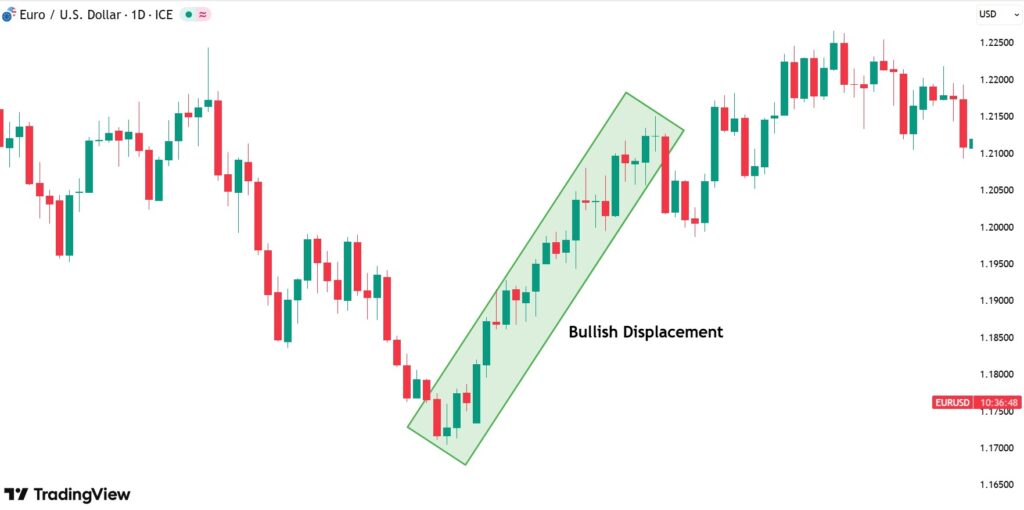
Bullish displacement in ICT is an aggressive upward price expansion that sweeps sell-side liquidity, breaks structure to the upside, and leaves imbalance, signalling institutional buying and repricing higher.
Institutional Repricing and Algorithmic Price Delivery
In the context of ICT displacement, the key idea is repricing. Institutions are not “trading candles.” They are moving the price from one value area to another.
Big players also don’t build positions with slow, obvious entries. They use execution algorithms to fill size fast without advertising it. When they decide the price should be lower (or higher), they force delivery.
Example: EUR/USD is trading at 1.2050, but institutional flow targets 1.1980 as the next value zone. They won’t wait for a neat, gradual drop. They drive the price down hard.
In ICT logic, the sequence is common:
Algorithms first hunt liquidity (trigger stops to generate orders), then the price expands rapidly. That expansion is the ICT displacement.
Key Insight:
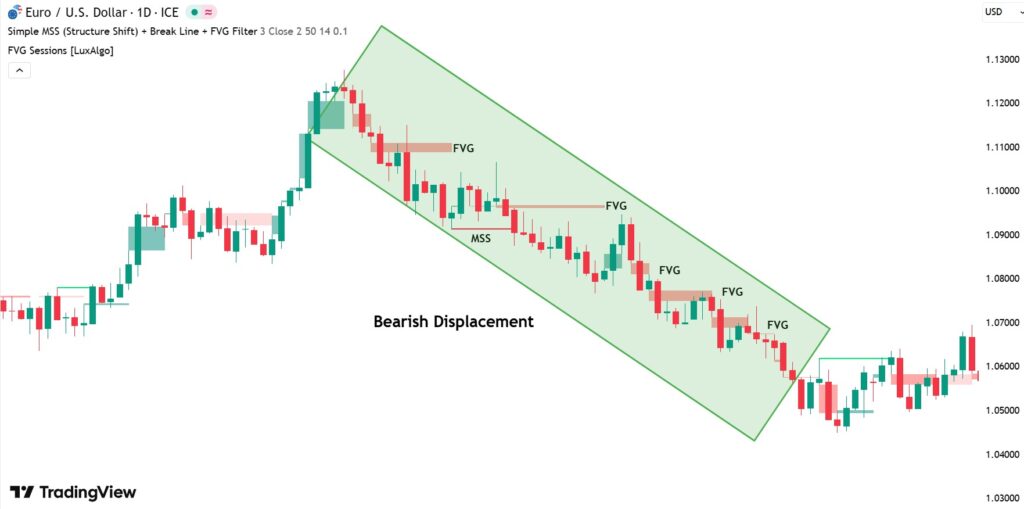
Bearish displacement in ICT is a strong downward expansion that clears buy-side liquidity, breaks structure to the downside, and creates inefficiency, indicating institutional selling and repricing lower.
Why ICT Displacement Signals Smart Money Intent
ICT displacement signals smart money intent by demonstrating commitment. Institutions do not create random spikes. They move the market with force and structure.
A single strong candle means little on its own. But a liquidity grab followed by a 40-pip impulsive move that breaks structure is different. It shows order flow dominance.
Example:
GBP/USD sweeps sell-side liquidity at 1.2500. Within minutes, the price rallies to 1.2555 in two strong bullish candles, breaking a prior high and leaving a visible FVG. That is not retail buying. That is institutional delivery.
Question: Why does ICT Displacement matter?
Answer: Because displacement confirms direction. It tells you the market is not just reacting — it is being repriced.
Conditions Required for a Valid ICT Displacement Move
A valid ICT displacement is subject to strict conditions. Without them, the move is weak or unreliable.
Liquidity Taken Before the Displacement
Liquidity is the fuel. Without it, displacement cannot occur. In ICT logic, price first attacks areas where stops are clustered:
- Equal highs/Equal lows (buy-side/sell-side liquidity)
- Previous session highs/lows
- Obvious swing points
Example:
Gold forms a double bottom at $2,000. Many retail traders place stop losses below that level. Price drops to $1,998, triggering those stops. Immediately after, gold rallies sharply to $2,030 in three strong bullish candles.
That sweep below $2,000 is the liquidity grab. The rally is the displacement.
Question: Can displacement happen without a liquidity sweep?
Answer: Technically, yes, but it is weaker and less reliable. The highest probability setups always clear liquidity first.
Creation of Market Imbalance and Inefficient Delivery
According to Howtotrade, Market imbalance and inefficient delivery in ICT mean prices move so aggressively (usually after institutions step in) that they don’t trade “smoothly”. They skip levels and leave evidence of one-sided order flow.
On the chart, this often shows up as:
- 3+ strong candles in one direction with large bodies and small wicks (lower timeframes), or 1–2 strong candles on higher timeframes.
- Fair Value Gaps (FVGs) left behind; that is helpful confirmation.
- It’s best identified in reaction zones such as order blocks, breaker blocks, mitigation blocks, or supply/demand zones.
For example, on a chart, you might see three strong bullish candles with little overlap between them. That tells you buyers dominated and the market structure is temporarily inefficient — meaning institutions likely drove that move. In ICT logic, this kind of imbalance strengthens signals from Order Blocks, supply/demand zones, and structure breaks later on.
Distinguishing True Displacement from News-Driven Volatility
The most common mistake in displacement move trading is calling every big candle “institutional.” That’s lazy analysis. News can create violent candles too — but that’s often a reaction, not delivery.
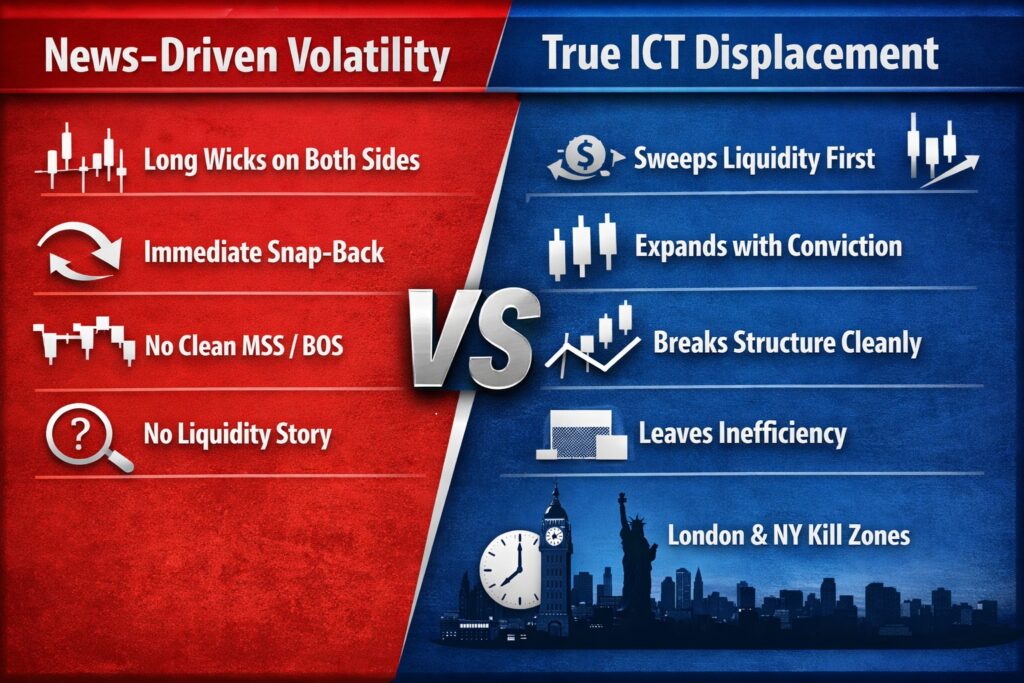
News-driven volatility usually looks like this:
- Long wicks on both sides (indecision and fast stop runs)
- Immediate snap-back (price retraces most of the move quickly)
- No clean MSS/BOS (structure stays messy or flips twice)
- No liquidity story (the move doesn’t clearly sweep a key high/low first)
Example: During NFP, EUR/USD spikes by 60 pips and then dumps by 70 pips within minutes. That’s not clean displacement. That’s a two-way liquidity event.
True ICT displacement is structured and readable. It typically:
- Sweeps liquidity first (session high/low, equal highs/lows, obvious swing)
- Expands with conviction (strong bodies, minimal overlap)
- Breaks structure cleanly (MSS/BOS holds, not instantly undone)
- Leaves inefficiency (often an FVG / imbalance that price respects later)
- Often aligns with timing like London or New York Kill Zones
Q: How do you filter fake displacement fast?
A: Demand context + confirmation. If there’s no clear liquidity sweep and no clean MSS/BOS, treat it as noise. Big candle ≠ smart money.
Table: ict displacement vs news-driven volatility
| Feature | True ICT Displacement (Institutional Delivery) | News-Driven Volatility (Spike/Reversal) |
|---|---|---|
| Main driver | Deliberate repricing / smart money intent | Reaction to headlines/data surprise |
| Precondition | Liquidity is taken first (sweep of highs/lows, equal highs/lows) | Often no clean sweep, or multiple messy sweeps |
| Candle shape | Large bodies, smaller wicks, clean expansion | Long wicks on both sides, “spiky” candles |
| Directional quality | One-directional follow-through | Two-way whipsaw (up then down / down then up) |
| Structure impact | Clear MSS/BOS that holds | Structure breaks are unclear or quickly reversed |
| Imbalance footprint | Often leaves FVG / inefficiency that later gets respected | Gaps/inefficiencies get filled fast or ignored |
| Retracement behavior | Measured pullback into FVG/OB, then continuation | Fast snap-back, deep retrace, erratic chop |
| Context | Fits dealing range logic (premium/discount), aligns with HTF bias | Context often breaks down; HTF alignment is unreliable |
| Timing | Frequently appears around London/NY kill zones with a clean setup | Can happen anytime around releases; timing is “event-driven” |
| How to trade it | Wait for retracement to FVG/OB/breaker + confirmation | Reduce size/avoid chasing; require extra confirmation or skip |
| Biggest trap | Late entry (chasing the move after displacement) | Getting chopped by whipsaw and spread widening |
Displacement and Market Structure Shifts
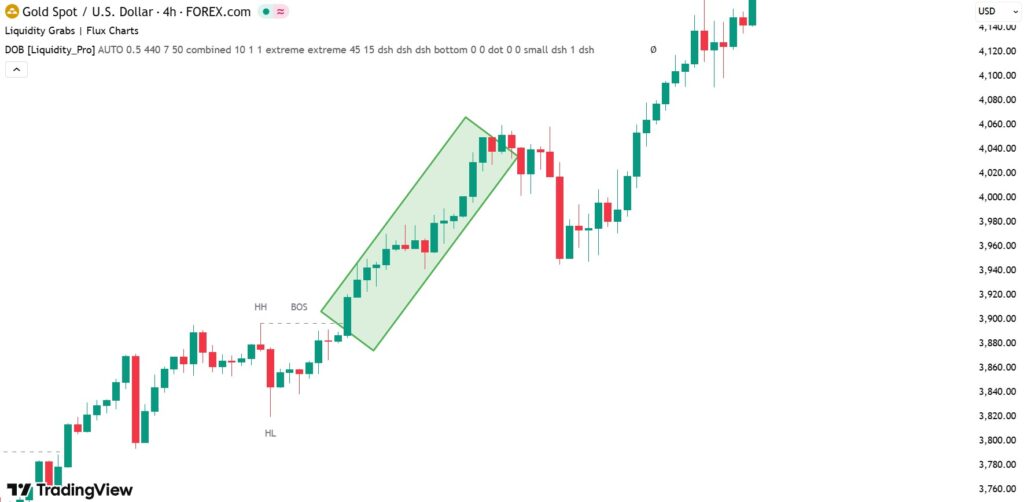
In ICT logic, displacement and structure are inseparable: A strong move without a structure break is noise. A structure break without displacement is weak. When both happen together, the probability increases sharply:- Displacement shows aggression.
- Market Structure Shift (MSS) or Break of Structure (BOS) shows direction.
Displacement as Confirmation of MSS and Break of Structure
A Market Structure Shift (MSS) or Break of Structure (BOS) is only high-quality when it is caused by displacement.
When displacement is present, the structure break is not a cosmetic candle close. It is the result of one-sided execution strong enough to push the price through a key swing and leave the market inefficient behind it. That inefficiency (often visible as an FVG) is important because it shows the price did not trade fairly during the move — it delivered.
Internal vs External Range Displacement
Where displacement happens matters as much as the displacement itself.
- External range displacement occurs when price trades outside the current trading range to capture obvious liquidity (equal highs/lows, session extremes, range boundaries). This type carries more informational value because it often marks a shift in control after a stop run.
- Internal range displacement occurs within the trading range, without clearing major external liquidity. It can still be tradable, but it is usually less “final.” It often represents repositioning or continuation within the existing narrative.
When Displacement Signals Continuation vs Reversal
Displacement does not automatically mean “reversal.” That’s a rookie mistake.
To judge continuation vs reversal, you read context, not hope:
- Liquidity type: Did price take external liquidity (more reversal-prone) or only internal liquidity (more continuation-prone)?
- Location: Is displacement occurring in premium or discount relative to the dealing range? Displacement from premium often supports bearish outcomes; from discount often supports bullish outcomes.
- Structure relationship: Is the displacement breaking major swings (stronger shift) or just minor internal pivots (weaker shift)?
- Follow-through: Does price hold the break and respect the inefficiency on retracement? If it instantly reclaims the broken level, the “signal” was probably noise.
Key Insight:
Displacement tells you the force. Structure tells you direction. Context tells you whether it’s a continuation or a reversal.
The ICT Displacement Sequence in Action
Understanding displacement in ICT is useless if you cannot execute it. The edge is not the candle. The edge is the sequence.
Displacement follows a logical flow. If one part is missing, the setup weakens. When the full sequence appears, you are no longer guessing. You are trading a model.
The ICT Displacement Sequence
A high-quality displacement ICT setup unfolds in four stages:
- Liquidity Grab
- Displacement
- Retracement
- Entry Model
This sequence reflects how institutions accumulate orders, reprice the market, rebalance inefficiencies, and then continue delivery.
Let’s break it down properly.
Liquidity Grab
Every real displacement starts with liquidity.
Price targets obvious stop clusters, such as equal highs or lows, session highs/lows, range boundaries, or prior swing points.
This provides the fuel. Without stops being triggered, there is no opposing order flow for institutions to fill against.
If there is no liquidity event first, the move is weaker by definition.
Displacement
After liquidity is taken, the price expands aggressively. This phase shows:
- Strong momentum candles
- Minimal overlap between candles
- Clean break of structure (MSS/BOS)
- Visible imbalance (often an FVG)
This is the actual institutional price move. It is fast, directional, and decisive. But you do not enter here. Chasing displacement is how traders donate money.
Retracement
Markets rebalance inefficiencies. After displacement, the price typically retraces into FVG, order blocks or breaker blocks.
This retracement is not a weakness. It is rebalancing. Institutions often add positions here.
Note:
If the price fully erases the displacement and reclaims the broken structure, the setup is invalid.
Entry Model
If you enter during expansion, you are paying a premium. If you wait for retracement, you gain precision.
The highest-probability trades in displacement in ICT trading happen after price pulls back into the imbalance created by the move. Expansion shows strength. Retracement offers an opportunity.
A refined entry model focuses on:
- Price returning into the Fair Value Gap or originating Order Block
- Lower timeframe structure shifting in the direction of the displacement
- Clear rejection inside the zone (body close, not just a wick)
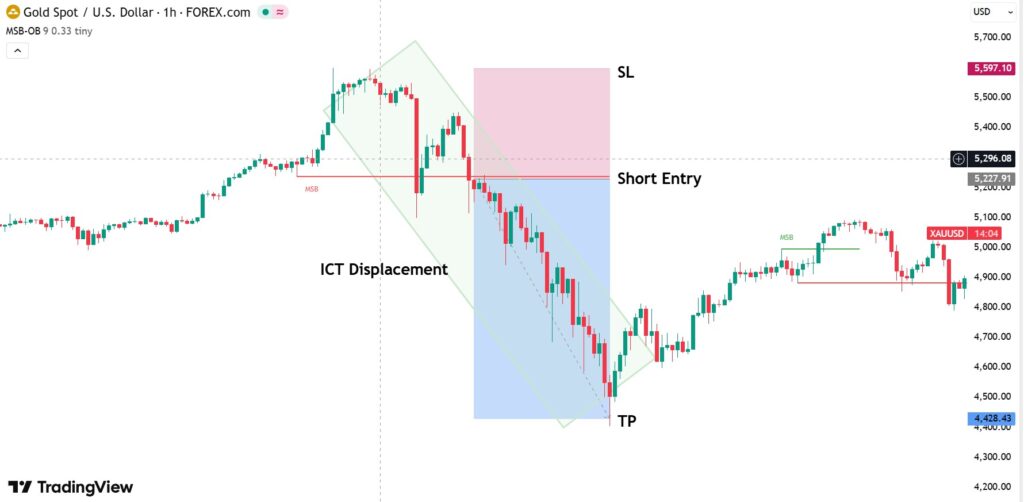
Risk management is structured, not random. Stops are typically placed beyond the liquidity formed during the retracement, not inside the imbalance itself.
High-Probability Entries from Fair Value Gap Returns
A Fair Value Gap that forms during ICT displacement is one of the most practical entry points because it reflects inefficient pricing. The market often returns to rebalance that inefficiency before resuming its original direction.
Conceptually, the model works like this:
- Displacement creates a visible imbalance
- Price retraces into the gap (often toward the midpoint)
- Order flow confirms continuation
- Price resumes in the direction of the original move
However, not every FVG deserves attention. The strongest Fair Value Gaps are formed:
- After external liquidity is cleared
- During active session windows, such as London or New York
- In alignment with the higher timeframe directional bias
Read more: Market session Indicator in Forex
Pro Tip:
An FVG is not a magic zone. It is a reaction area that works only when supported by structure, liquidity, and timing. Context decides probability.
Identifying the Order Block That Originated the Move
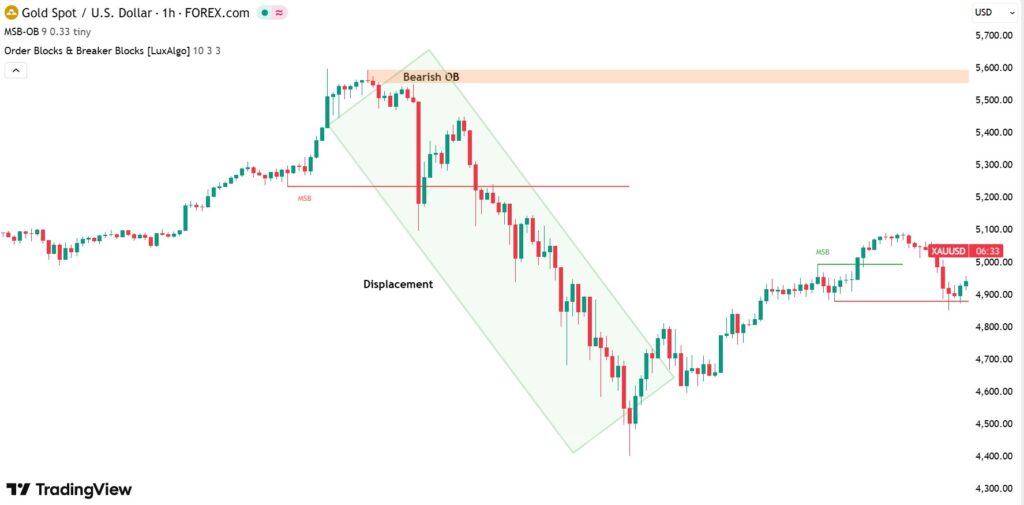
Behind every strong ICT displacement, there is usually an origin. The origin is typically the last opposing candle before the aggressive move. That candle marks the Order Block.
Why does this matter?
Because that zone represents institutional accumulation before repricing.
If a bearish displacement begins after a final bullish candle and then breaks structure aggressively, that last bullish candle becomes the bearish order block. On retracement, price often respects that zone.
The strength of the order block depends on:
- The magnitude of the displacement that followed
- The clarity of the structure break
- Whether liquidity was taken before the move
Displacement Within the Dealing Range Framework
If you ignore the dealing range, you’ll misread displacement. You’ll see a big candle and assume “smart money.” Sometimes that’s true. Often it’s a trash context.
ICT doesn’t treat price as random. It treats price as moving between discount (cheap) and premium (expensive) inside a defined range. Displacement becomes far more useful when you know where it happens inside that range and whether the higher time frame agrees.
Premium and Discount Context of ICT Displacement
Dealing range is a clear swing high to swing low on the time frame that matters (often H1, H4, or Daily). The midpoint is the 50% level. Below is a discount; above is a premium.
According to Forexfactory, the displacement interpretation becomes sharper:
- Bullish displacement from discount has more credibility because the price is expanding away from “cheap” levels after liquidity is engineered.
- Bearish displacement from premium has more credibility because the price is expanding away from “expensive” levels after a stop run.
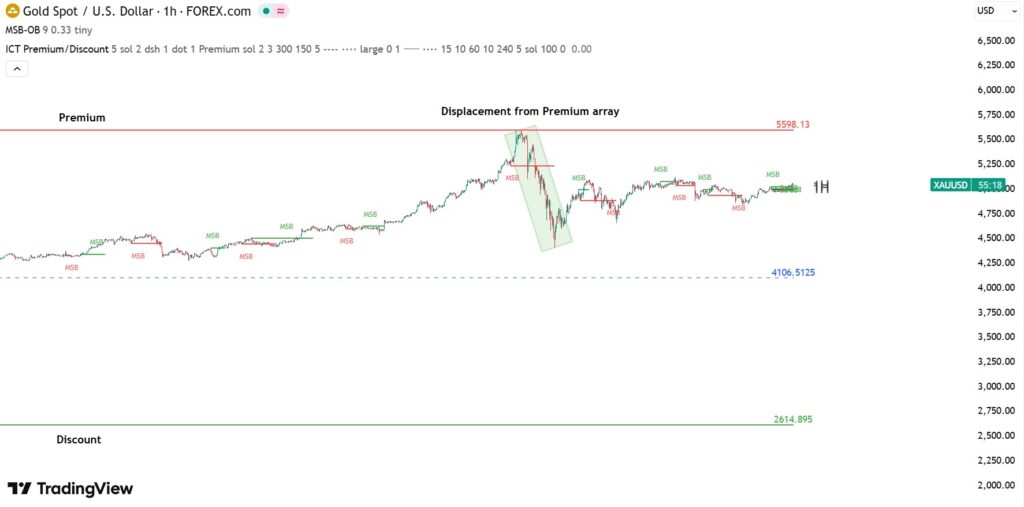
Quick mental model:
Displacement is the “push.” Premium/discount arrays indicate whether a push is occurring from a logical location.
Alignment with Higher Time Frame Bias
Displacement is not a strategy in itself. It is a confirmation tool. The higher time-frame bias tells you which displacement to respect.
A clean approach:
- Use Daily/H4 to define bias (bullish or bearish narrative).
- Use H1/M15 to spot liquidity grabs and displacement in the direction of that bias.
- Use M5/M1 only for execution timing, not for deciding direction.
If the higher time frame is bearish and you take a bullish displacement just because it looks strong, you’re trading against the larger order flow. That’s how traders get trapped in “strong” moves that instantly reverse.
The market can print bullish displacement inside a bearish day. That’s often a pullback, not a trend change.
Multi-Timeframe Confirmation of Institutional Intent
Multi-timeframe work is not about adding indicators. It’s about stacking confirmations so your trade isn’t built on a single candle.
You want to see the displacement line up like this:
- A higher time frame is near a key premium/discount area.
- The intermediate time frame shows a liquidity sweep and a decisive displacement.
- The lower time frame shows a clean reaction to the retracement (FVG/OB return) and a structure agreement.
Timing and Session Considerations in Forex
Not all displacement in ICT trading is equal. Timing matters. A clean setup during active institutional hours carries more weight than the same pattern printed during low liquidity.
Forex is session-driven. Liquidity flows change between Asia, London, and New York. If you ignore session timing, you will confuse random volatility with real institutional delivery.
Displacement that occurs during high-volume windows is more reliable because that is when large players execute size.
Displacement During London and New York Kill Zones
New York and London killzones are the most reliable for ICT displacement because institutional participation and liquidity surge. In these windows, price often uses the earlier session’s range as a target: it grabs a clean liquidity pool first, then delivers the move.
Outside these hours, you can still get displacement—but you should demand stronger confirmation because thin liquidity can create fake strength.
Explosive Price Moves Across Major Forex Sessions
Session context helps you separate true displacement from random volatility. Asia often compresses and forms ranges. London frequently breaks those ranges and sets the day’s direction. The New York session either continues that direction or reverses after the London expansion.
So when you see a fast move, use session logic as a quick sanity check:
- In Asia, explosive moves are more suspicious unless they are clean and contextual
In London/NY, explosive moves are more meaningful if they follow a liquidity event and produce a clean structure shift
Key Insight:
Timing doesn’t create displacement. It tells you whether the displacement is worth trusting—or whether it’s just noise dressed up as momentum.
Risk Management and Execution Discipline
Most losses from ICT displacement do not result from poor analysis. They come from poor execution. Traders see a strong candle, feel urgency, and enter at the worst possible price. Discipline is what separates someone who studies displacement from someone who profits from it.
The Risk of Chasing Strong Momentum Candles
A strong momentum candle and displacement in ICT are not the same thing. This confusion is where many traders lose money.
A strong momentum candle is simply a large candle with a wide body. It tells you the price moved quickly. It does not automatically tell you why it moved or whether the move will continue.
ICT displacement, on the other hand, is contextual. It is a fast movement with a reason and a footprint: it reflects speed supported by liquidity context and a decisive shift in market structure.
If you trade every strong candle as a displacement, you will chase noise.
Positioning Stops Around Institutional Price Moves
Smart stop placement is based on where liquidity would logically be targeted next.
For a bearish displacement setup:
- Entry occurs on retracement into FVG or Order Block
- A stop is placed above the retracement high or above engineered liquidity
For a bullish setup:
- Entry occurs on a pullback
- A stop is placed below the retracement low or below the liquidity sweep
Your stop should sit beyond a level that invalidates the narrative.
Conclusion
Displacement in ICT is not just a flash in the pan. It is institutional repricing with structure, liquidity context, and intent behind it. When price sweeps liquidity, expands aggressively, breaks structure, and leaves imbalance, the market is not reacting randomly — it is delivering to a new value.
The real edge is not spotting displacement. It is understanding where it occurs within the trading range, whether it aligns with higher-timeframe bias, and how to execute the retracement with discipline. Traders who chase expansion donate liquidity. Traders who wait for confirmation trade with it.