






An ICT scalping strategy is a fast intraday entry model built for 1 clean move, not a full session trend. It works when you trade inside Kill Zones, identify a clear liquidity draw (BSL/SSL), then execute the same sequence: Sweep → Displace → Retrace → Enter. The real question is this: are you scalping a structured liquidity event in a high-activity window, or are you just clicking into random 1–5 minute noise?

- Trade Kill Zones only. Outside active windows, signals degrade fast.
- Start with a liquidity target: BSL above highs or SSL below lows.
- Do not enter without a liquidity sweep. That’s a common failure case.
- Use displacement as confirmation. No displacement, no trade.
- Keep the objective small: one impulse into the next liquidity pool.
- Use tight invalidation and respect spread, slippage, and news risk.

Important note:
Scalping is fragile. If spreads widen or news hits, your edge can vanish in seconds.
Core Framework of the ICT Scalping Strategy
The framework is simple on purpose. You want a short checklist you can run quickly. If any key piece is missing, you skip the trade. This is how you keep high probability scalping realistic.
Key Principles and Smart Money Logic Behind ICT Scalping
ICT scalping is built on one idea: price moves to liquidity, then reprices when that liquidity is accessed.
Your core principles:
- Clear liquidity draw: define BSL/SSL first. No draw, no plan.
- Execution model: Sweep → Displace → Retrace → Enter.
- One-impulse objective: you’re not holding for a swing.
- Tight invalidation: your stop belongs where the idea is clearly wrong.
- Premium/discount context: avoid entering mid-range unless you have a strong reason.
Remember:
If you can’t explain the trade in 2 sentences, you’re not scalping — you’re hoping.
Time-of-Day Dependence in High-Probability ICT Scalping
This is strict. Most best ICT scalping strategy examples happen in the same windows because liquidity and participation are higher. The Bank for International Settlements (BIS) maintains that market conditions tend to improve during periods of session overlap.
Now, a practical rule:
- Only hunt setups around major session opens and key overlaps.
- Expect better displacement and cleaner moves.
- Expect less randomness than dead hours.
Simple timing guide (use a session indicator and adjust for DST):
- London open window: first 60–180 minutes after London begins.
- New York open window: first 60–180 minutes after New York begins.
Important note:
If you scalp outside Kill Zones, you will often get the pattern almost right but the move won’t travel.
Session-Specific Scalping Windows
Sessions do not behave the same. London often sets direction. New York often extends or reverses it. Your job is to adapt the same model to the session’s personality.
London Session Scalping Kill Zone Mechanics
London session is where liquidity and intent often show up early.
What you typically want to see:
- A clean liquidity reference from Asia (range high/low).
- A sweep of that reference (BSL or SSL).
- Displacement away from the sweep.
- Retracement into a clean entry zone (often an FVG later in the model).
Practical London notes:
- Be selective in the first few minutes. Spreads can be messy.
- Focus on one clean idea, not constant trading.
New York Session Scalping Strategy and Intraday Volatility
New York brings a different kind of volatility. Moves can be faster and more emotional.
What changes in New York:
- Displacement can be stronger.
- Reversals are more common, especially if London already ran a large move.
- News risk is higher (macro releases, speakers, surprises).
What stays the same:
- You still need a liquidity draw.
- You still need a sweep before entry.
- You still demand displacement as confirmation.
Don't forget:
If a major news event is due, wait. Scalping into news is not high probability.
Timing High-Probability ICT Scalping Trades
Timing is not just what time it is. Its liquidity is present right now.
Use this quick timing filter:
- Is this inside a Kill Zone?
- Is price near a meaningful liquidity pool (high/low, equal highs/lows, range edge)?
- Did you get a sweep and then displacement?
- Is the spread acceptable for your stop size?
If you answer no to any of these, you pass.
Liquidity Mechanics for ICT Scalping
Liquidity is the map. If you don’t understand where the stops cluster, you can’t interpret sweeps. This is where most low-timeframe trading strategies fail.
Buy-Side vs Sell-Side Liquidity Draws & Internal vs External Pools
Definitions you must keep clean:
- BSL (Buy-Side Liquidity): resting stops/entries above highs.
- SSL (Sell-Side Liquidity): resting stops/entries below lows.
Now, split liquidity into two types:
- External liquidity: above a clear swing high or below a clear swing low.
- Internal liquidity: smaller pools inside the current intraday range (minor highs/lows, midpoint reactions).
Scalping logic:
- External pools often create the best sweeps.
- Internal pools often become targets for the first impulse.
Liquidity Sweep vs Liquidity Grab Mechanics
They look similar at first. The difference is what happens after.
- Liquidity sweep: price runs a level and rejects back inside.
- Useful for reversal-style scalps.
- Liquidity grab: price runs a level and continues with acceptance and displacement.
- Useful for continuation-style scalps.
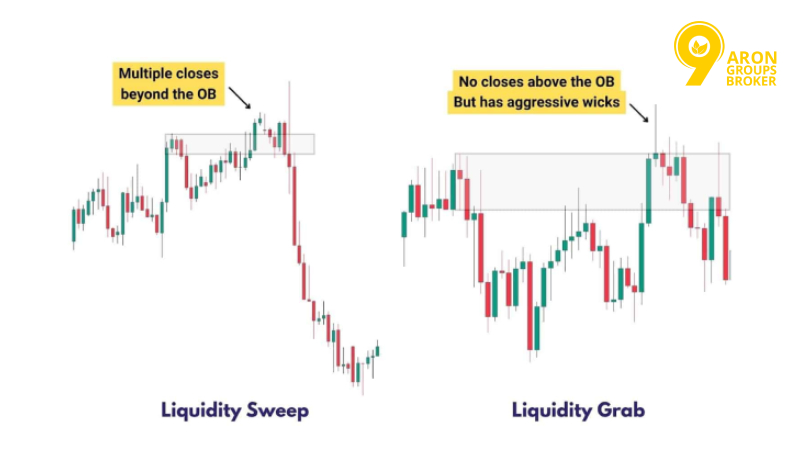
The key is displacement:
- No displacement = no proof.
- Displacement = the market showed intent.
Tip:
A sweep is an event. Displacement is the confirmation.
Stop Hunts and Common Entry Failures
Stop hunts are often just liquidity being accessed. The real danger is your execution mistakes.
Common failure cases:
- No sweep before entry (you entered too early).
- Entering in the middle of the range with no premium/discount edge.
- Treating any candle spike as displacement.
- Ignoring spread and slippage, then using ultra-tight stops anyway.
- Trading during news volatility when your model needs clean delivery.
A simple fix:
- Make the sweep non-negotiable.
- Make displacement non-negotiable.
- Keep the objective to one impulse into the next liquidity pool.
Market Structure and Displacement Confirmation
Liquidity tells you where price is likely to go. Market structure tells you how it is behaving. For ICT scalping, you need both — and you need them fast. Your core job is to wait for the market to show intent via a Lower-Timeframe Market Structure Shift (LTF MSS) and displacement. Without those, you are trading a guess.
Identifying Lower-Timeframe Market Structure Shifts (MSS)
A lower-timeframe MSS is the moment the market stops doing one thing and starts doing the opposite.
Keep it practical. On a 1–5 minute chart, an MSS usually looks like:
- Price sweeps liquidity (BSL/SSL), then
- Breaks a meaningful internal swing in the opposite direction, and
- Holds that break with follow-through.
A simple way to label it:
- Bearish MSS: sweep buy-side liquidity, then break a prior higher low / internal support.
Bullish MSS: sweep sell-side liquidity, then break a prior lower high / internal resistance.
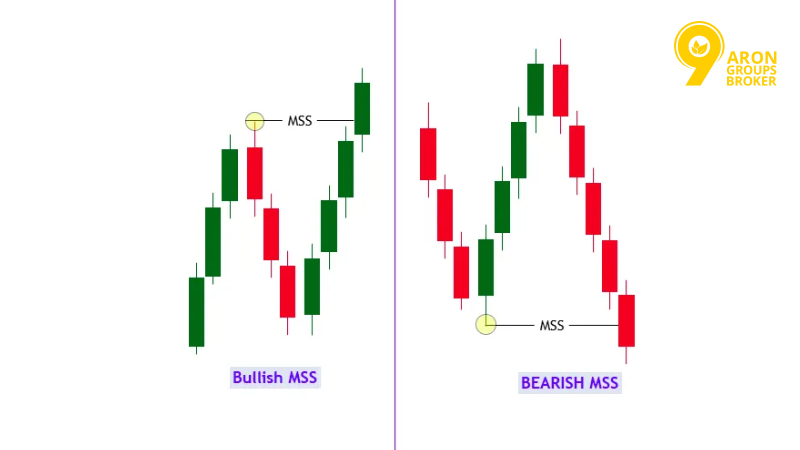
What does meaningful mean in scalping:
- It is not the smallest micro swing.
- It is the swing that actually controlled the last push.
Important note:
If your MSS is just one candle poking through a line, it is usually not a real shift. You want a break plus follow-through.
Displacement Moves and Impulse Strength for ICT Scalping
Displacement is your confirmation. It is the market saying, I am repricing now.
Displacement usually has:
- A fast push away from the sweep level (urgency).
- Cleaner candles (less overlap).
- A visible distance covered in a short time.
How to judge impulse strength quickly:
- Does the move travel far enough to create space for a retracement?
- Does it remove a prior swing cleanly (not just tap it)?
- Does price stop chopping and start trending?
If displacement is weak:
- The setup often becomes a range.
- Your tight stops get clipped.
- Your edge disappears.
Continuation vs Reversal in High-Probability Trades
Both are valid in ICT scalping. The difference is what the sweep is doing.
Reversal model (most common):
- Price sweeps external liquidity (range high/low).
- MSS forms in the opposite direction.
- Displacement confirms the shift.
- You enter on the retracement.
Continuation model (clean on strong days):
- Price sweeps, but accepts and continues.
- You still want displacement, but you trade in the direction of acceptance.
Quick decision rule:
- If price sweeps a key level and then re-accepts back inside the range, reversal setups are cleaner.
- If price sweeps and then holds above/below with strength, continuation setups are cleaner.
Precision Entry Zones Using Fair Value Gaps
Once you have sweep + MSS + displacement, you still need a precise entry location. That is where the Fair Value Gap (FVG) comes in. In scalping, the FVG is not a decoration. It is your where to enter zone.
Formation of FVGs in Displacement Legs
FVGs form most cleanly during displacement because price moves too fast to trade fairly through every level.
What you typically see:
- A sharp impulse leg.
- A three-candle structure where the middle candle creates air (imbalance).
- A gap-like zone you can mark for a later retracement.
Practical rule:
- If the displacement candle is small and choppy, the FVG quality is usually poor.
- If displacement is clean, FVGs are clearer and more usable.
Retracement Entries Within FVG for Scalping Precision
You are not chasing the displacement. You are letting price come back to a fairer price inside the FVG.
A simple entry routine:
- Identify the displacement leg that followed the sweep and MSS.
- Mark the nearest clean FVG created by that displacement.
- Wait for retracement into the FVG.
- Enter only if price reacts and holds direction.
Where inside the FVG?
- You can start conservative (higher probability): nearer the safer side of the gap.
- Or more aggressive (better price): deeper inside, but you need cleaner confirmation.
Tip:
If price returns and trades through the entire FVG with ease, it is telling you the displacement was not as meaningful as it looked.
FVG Confluence With Liquidity Sweeps
This is where ict high probability scalping becomes realistic: the FVG is not random. It is tied to the sweep event.
High-quality confluence looks like:
- Sweep happens at an obvious liquidity pool.
- MSS breaks internal structure.
- Displacement creates an FVG.
- Retracement delivers into that FVG in premium/discount alignment.
- Price then runs towards the next liquidity pool (one-impulse objective).
Remember:
The FVG is not the reason for the trade. The sweep and displacement are. The FVG is the entry location.
Premium and Discount Arrays
Tradingfinder explains that premium/discount keeps you from entering in the middle. Scalping fails most often when traders execute in neutral pricing with no leverage.
Defining Intraday Dealing Ranges
An intraday dealing range is your working box for the session. It gives you:
- High and low boundaries.
- Midpoint (equilibrium).
- Premium (upper half) and discount (lower half).
Practical ways to define it:
- Asia range (common before London).
- Early London range (if London sets the box).
- Pre-NY range (if you’re trading NY).
Pick one range. Do not redraw every five minutes.
Entry Positioning Using Premium vs Discount Arrays
Use premium/discount as a sanity filter:
- Bullish scalps: prefer entries in discount, after SSL sweep and bullish MSS.
- Bearish scalps: prefer entries in premium, after BSL sweep and bearish MSS.
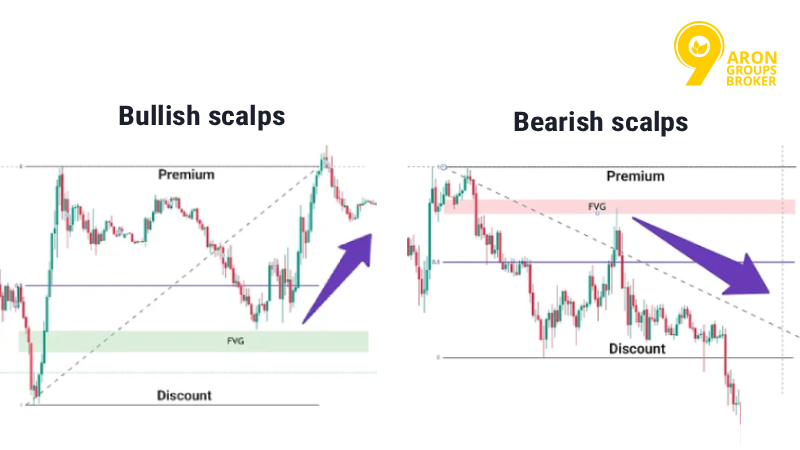
This is not optional if you want consistency.
- Mid-range entries have poor invalidation.
- Edge gets diluted fast.
Important note:
If the best setup happens at the midpoint, you can still trade it — but your stop and expectations must be stricter.
PD Array Integration With ICT High-Probability Setups
PD arrays (like FVGs, order blocks) become higher quality when they sit in the right pricing zone.
A clean PD integration checklist:
- Is the FVG inside premium/discount where it makes sense?
- Did it form from displacement (not chop)?
- Is there a clear liquidity target for the next impulse?
- Is invalidation tight and logical?
This is how you avoid pretty confluence that does not pay.
Higher-Timeframe Bias Alignment
Scalping feels short-term, but the best scalps still respect the bigger story. You are not trading the daily chart, but you are trading inside its gravity.
Establishing Directional Bias Pre-Session
Before the Kill Zone starts, decide bias with a quick routine:
- Identify the higher timeframe swing (1H/4H is usually enough).
- Mark major liquidity pools above and below (clean highs/lows).
- Ask: what is price most likely drawn to next?
Your bias should be a sentence:
- Likely draw is above X high, so I prefer long setups.
Or: - Likely draw is below Y low, so I prefer short setups.
Aligning Trades With HTF Liquidity
The cleanest scalps are those that align with the higher timeframe liquidity objective.
Practical examples:
- If HTF draw is to the upside, you prefer SSL sweeps that lead into bullish MSS and long entries.
- If HTF draw is to the downside, you prefer BSL sweeps that lead into bearish MSS and short entries.
This increases follow-through. That matters in one-impulse scalping.
Avoiding Counter-Bias Scalping Traps
Counter-bias scalps can work, but they are riskier. Most scalping traps happen when traders try to fade a strong HTF draw without strong evidence.
If you insist on counter-bias trades, demand extra proof:
- A clean sweep of external liquidity.
- A strong displacement that breaks meaningful structure.
- A high-quality FVG entry in premium/discount alignment.
- A smaller target (quick one-impulse objective).
Otherwise, you are fighting the larger flow for a few points. That is usually not worth it.
Building a High-Probability ICT Scalping Setup
A best ICT scalping strategy is not one secret pattern. It is a strict selection process. You’re filtering for the few moments where liquidity, timing, and structure align — and you only need one good impulse per session.
Multi-Confluence Entry Criteria for Best ICT Scalping Strategy
Confluence should be functional, not decorative. You want confluence that answers three questions: Where is liquidity? What is the bias? Where is the entry zone?
High-probability entry criteria (keep it tight):
- Kill Zone: you’re inside London or New York scalping window.
- Clear draw: price is targeting BSL/SSL (external liquidity).
- Liquidity event: a sweep occurs (not optional).
- LTF MSS: structure shifts after the sweep.
- Displacement: strong impulse confirms intent.
- FVG entry: displacement creates an FVG you can use as a precision zone.
- PD context: entry sits in premium/discount of the intraday range (not mid-box).
- HTF alignment: the trade does not fight the higher-timeframe draw.
If you only keep 3 must-haves, make them these:
- Sweep
- Displacement
- FVG retracement entry
Timeframe Synchronisation for Precision Entries
Scalping fails when timeframes disagree and you force it on the 1-minute chart.
A clean sync model:
- HTF (1H/4H): define bias + major liquidity pools.
- Intraday (15m/5m): define dealing range + premium/discount.
- Execution (1m/2m/3m): find MSS + displacement + FVG entry.
Rules that protect you:
- If HTF draw is up, don’t spend the session hunting perfect shorts.
- If intraday range is unclear, reduce trades. It means the market is not offering clean delivery.
- If execution timeframe is noisy, step up one timeframe.
Important note:
If you need to zoom in to see the setup, it’s usually not a high-probability setup.
Validation Checklist for Institutional-Grade Setups
Here’s a quick checklist you can run in under 30 seconds.
Institutional-grade scalping checklist
- Trade is inside a Kill Zone
- External liquidity target is clear (BSL/SSL)
- Sweep occurred and is obvious
- MSS is meaningful (not a micro wiggle)
- Displacement is clean (range-to-trend behaviour shift)
- FVG is clear and formed from displacement
- Entry is in premium/discount alignment
- Invalidation is tight and logical
- Target is mapped to the next intraday liquidity pool
- No immediate news/spread risk
If 2 boxes are missing, you skip.
ICT Scalping Strategy Execution Model
According to ForexFactory, this is the execution spine: Sweep → Displace → Retrace → Enter. You do the same thing each time. That’s how you stop improvising.
Liquidity Sweep Identification for Precision Entries
A sweep is not a wick. A sweep is a deliberate run on a known liquidity pool.
What qualifies as a sweep in scalping:
- It takes a clear high/low (BSL/SSL).
- It happens inside an active window (Kill Zone).
- It produces an immediate reaction or sets up displacement.
Two sweep types to label fast:
- External sweep: takes session range high/low or a major swing.
- Internal sweep: takes a smaller pool inside the range (useful, but lower priority).
Common mistake: entering because you expect a sweep.
Correct approach: enter only after the sweep happens and the market shows intent.
Displacement Trigger Confirmation in High-Probability Trades
Displacement is your trigger. It is the confirmation that the sweep was for liquidity, not for continuation without you.
What you want:
- A strong impulse away from the sweep.
- Reduced candle overlap.
- A clear break of a meaningful internal swing (your MSS).
If displacement is weak:
- You often get chop and stop-outs.
- Your FVG is messy or unreliable.
Retracement Entries Within FVG Zones
This is where you get precision. You’re not chasing the impulse. You’re letting price deliver to a defined zone.
Execution steps:
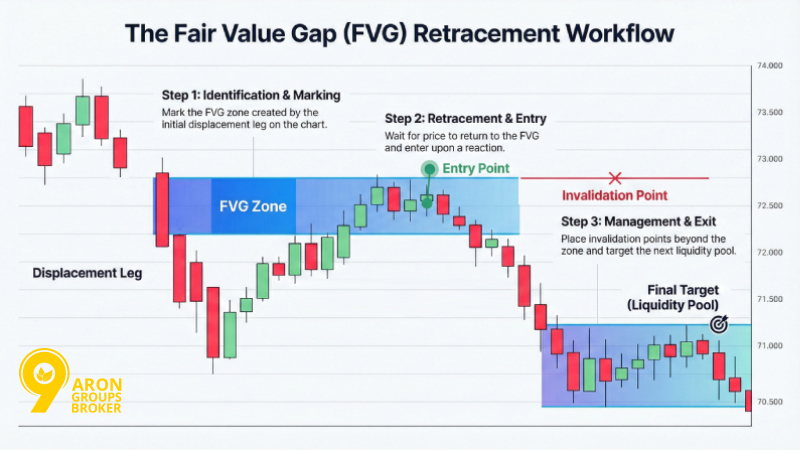
Simple quality checks:
- Clean FVG (formed during displacement).
- Entry aligns with premium/discount logic.
- Your stop is tight but logical (not arbitrary).
Trade Objectives and Profit Targeting
Your objective in ICT scalping is not maximum points. It is a clean, repeatable capture of one intraday impulse, with controlled risk.
One-Impulse Price Move Objective
A good scalping trade usually has one clean impulse:
- Sweep happens
- Displacement starts the move
- You enter on retrace
- Price runs to the next liquidity pool
That’s it. You’re not waiting for a multi-leg trend.
If price stalls and chops after your entry, treat it as information. Scale out or exit.
Intraday Liquidity as Profit Targets
Targets should be liquidity-based and easy to identify.
Common intraday targets:
- The nearest internal swing high/low
- Equal highs/lows inside the range
- The opposite side of the intraday dealing range (only if conditions allow)
- Session high/low
A practical target approach:
- First target = internal liquidity (safer, quicker).
- Runner (optional) = external liquidity if the tape is clean.
Why ICT Scalping Is Not Swing Trading
This matters because expectations kill scalpers.
Key differences:
- Time: scalps are short-lived. Swings take time.
- Objective: scalps capture one impulse. Swings capture multi-phase moves.
- Risk tolerance: scalps need tight invalidation and fast decision-making.
- Execution sensitivity: spread, slippage, and news can ruin scalps quickly.
If you start holding a scalp like a swing:
- Your stop logic breaks.
- Your trade management becomes random.
- Your win-rate drops.
Remember:
If you want to swing trade, build a swing model. Don’t stretch a scalping model until it snaps.
Risk and Trade Management
In scalping, your edge is fragile. That is why risk management is not a nice extra. It is the strategy. You are trading tight windows, tight stops, and fast moves. So you need rules that survive spreads, slippage, and random spikes.
Tight Invalidation and Stop Placement Logic
Tight does not mean tiny. It means logical and close to the idea.
Good invalidation in ICT scalping is usually:
- Beyond the sweep extreme (if you’re trading the reversal model).
- Beyond the FVG/entry zone in a way that proves the displacement idea failed.
- Beyond the post-MSS swing that should not be reclaimed if your read is right.
A practical stop logic you can reuse:
- If price re-enters and holds back through the area that defined your MSS/displacement, the setup is invalid.
- If price trades through your FVG with ease and keeps going, treat the imbalance as filled and the edge as reduced.
Common mistake: placing the stop at a nice round number or the last candle.
Correct approach: place it where your narrative breaks.
Position Sizing for Low Timeframe ICT Trades
Low timeframe trades have higher noise. So your sizing must assume you will take more small losses.
Simple sizing principles:
- Risk a fixed amount per trade (keep it boring).
- Lower timeframe = smaller position size (even if your stop is tight).
- If spreads widen, your size should shrink or the trade should be skipped.
A practical rule:
- If your stop is 6–10 points/pips and spread is 2–3, you’re paying too much for entry. Reduce size or wait for better conditions.
Important note:
If you size up because the stop is tight, one slippage event can wipe out several wins.
Managing Spread, Slippage, and News Volatility
This is where many ICT high probability scalping setups fail in live trading. Not because the model is wrong — because execution conditions change.
Spread
- Avoid trading the first minutes of session opens if spreads are unstable.
- Avoid pairs/instruments with structurally wide spreads for tight-stop scalping.
Slippage
- Assume slippage during fast moves and market orders.
- If you must enter during displacement, expect worse fills.
News volatility
- If high-impact news is near, treat it as a hard filter.
- Either stand down or reduce size and expectations drastically.
A simple safety rule:
- If your trade needs a 1–2 candle precision, do not trade into news. That environment breaks precision.
Tools and Platforms for ICT Scalping
Tools do not create edge. But bad tools can destroy it. You need a clean chart, accurate session timing, and reliable execution.
Charting Platforms for Precision Execution
For ICT scalping, your charting platform must do three things well:
- Smooth multi-timeframe viewing (HTF bias + LTF execution).
- Clean marking (ranges, highs/lows, FVGs).
- Fast interaction (no lag when you zoom or switch timeframes).
What matters most:
- Clear candles and consistent scaling.
- The ability to save templates (Kill Zones, ranges, annotations).
- Stable performance during volatile minutes.
Session Indicators and Kill Zone Timing Tools
Because this strategy is strict time-of-day dependent, you should automate session awareness.
What to use:
- A session indicator that marks London and New York windows clearly.
- A Kill Zone overlay (or manual boxes) for your chosen time range.
- A reminder system for news releases (calendar alerts).
Practical habit:
- Before the Kill Zone begins, mark the likely draw (BSL/SSL) and the intraday dealing range. Don’t do it mid-chaos.
Data Feeds and Execution Speed Considerations
Scalping is sensitive to the quality of your feed and your broker’s execution.
What to watch:
- Pricing stability: sudden spikes can be feed issues, not real liquidity grabs.
- Execution speed: delays can ruin tight invalidations.
- Spread behaviour: some brokers widen spreads aggressively at key moments.
A practical test:
- Record spreads during your Kill Zones for a week.
- If spreads are unpredictable, you either adapt the model (wider stops, fewer trades) or change venue.
Evaluating the Best ICT Scalping Strategy
The best strategy is the one that fits your temperament and your constraints. ICT scalping rewards discipline. It punishes impatience.
Trader Profiles Suited to ICT Scalping Strategy
This model suits you if you:
- Can wait for strict conditions (Kill Zones, sweep, displacement).
- Prefer quick decision cycles and small, repeatable wins.
- Are comfortable taking small losses without revenge trading.
- Can keep rules tighter than your emotions.
It is not ideal if you:
- Hate missing trades.
- Need constant action.
- Struggle to exit quickly when conditions change.
Skill Development and Screen-Time Requirements for High-Probability Trades
High-probability scalping is earned through repetition.
Skills to build:
- Reading clean liquidity pools quickly.
- Identifying real MSS versus micro noise.
- Recognising displacement quality instantly.
- Executing FVG retracements without hesitation.
A realistic development path:
- Start by replaying one session type (London only) until you can spot the same model consistently.
- Log every trade with which step failed (sweep missing, weak displacement, wrong PD zone).
Integrating ICT Scalping Into Broader Trading Systems
Scalping works best as a module inside a bigger process, not as your entire identity.
Practical integration ideas:
- Use scalping for entries aligned with your HTF bias, then manage risk quickly.
- Use it as a cash flow model while you run separate swing positions.
- Use it only when volatility and spreads are favourable.
A key boundary:
- Don’t stretch a scalping trade into a swing because you feel it. That breaks the system.
Conclusion
The ICT scalping strategy is a strict intraday model: trade Kill Zones only, define a clear BSL/SSL liquidity draw, wait for sweep + MSS + displacement, and enter on a FVG retracement with tight invalidation. Keep targets realistic: one impulse into intraday liquidity. Respect friction: spreads, slippage, and news can invalidate your edge. If you execute this like a checklist — not a prediction — you’ll take fewer trades, but the trades you do take will be cleaner, faster, and far more repeatable.