
icon icon Home
icon icon Accounts
icon icon Quick start
icon icon Symbols

Interest Rate Parity Explained: Covered and Uncovered IRP, Forward Rates, and Why the Carry Trade Still Works

Author
Abe Cofnas
Abe Cofnas
calendar Last update: 5 November 2026
watch Reading time: 10 min

Interest rate parity is the no-arbitrage condition that links two currencies’ interest rates to their spot and forward exchange rates. The higher-yielding currency trades at a forward discount just large enough to cancel its yield advantage. Once the exchange rate is locked in, neither deposit earns more.

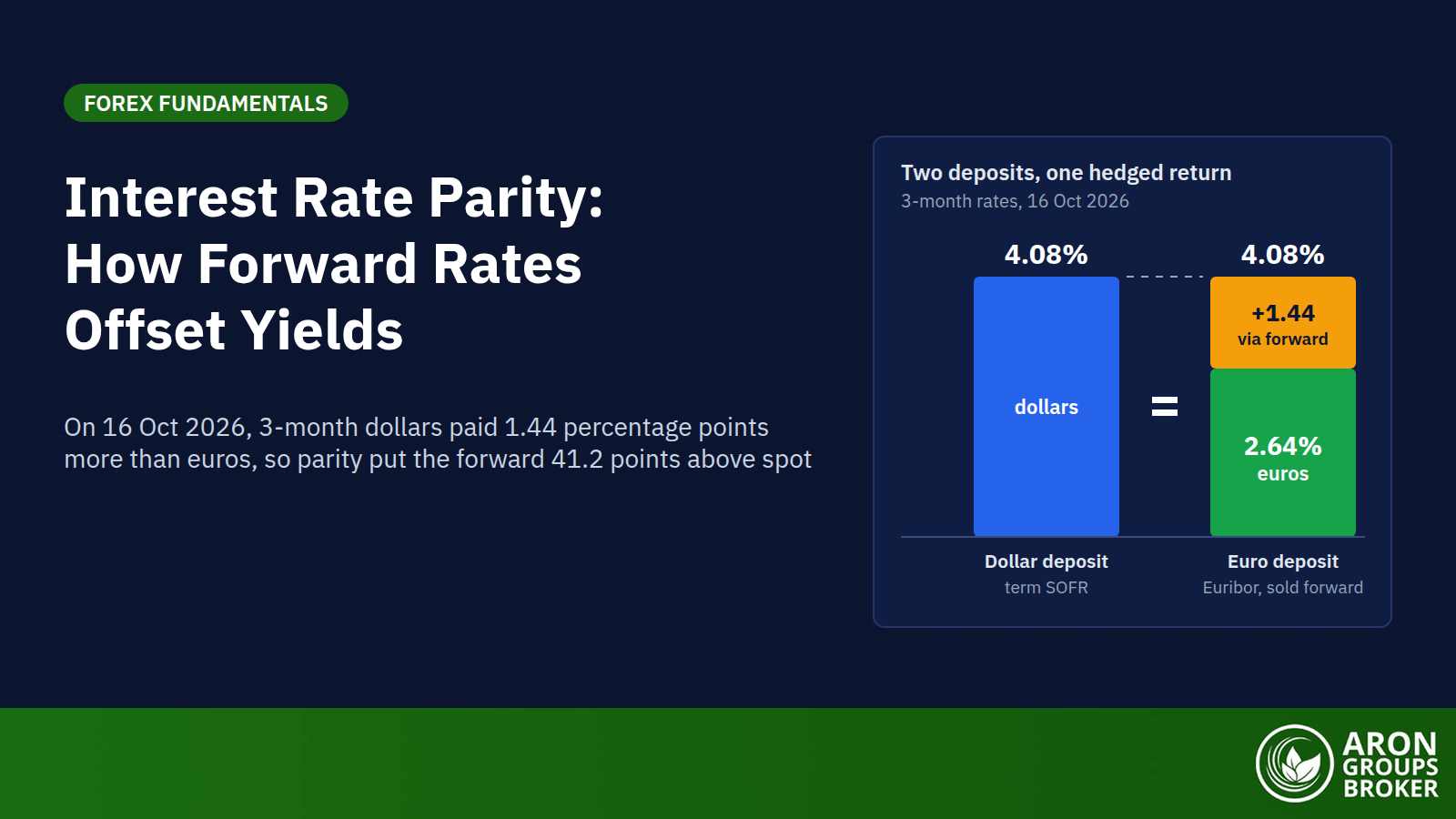
The Fed lifted the federal funds rate to 3.75% to 4.00% in September 2026, and its dot plot signals one more hike this year. The ECB’s deposit rate is 2.50% and the Bank of Japan’s policy rate 1.25%. On 16 October 2026 three-month dollar rates stood at 4.08% against 2.64% for euros.

This guide prices a real EUR/USD forward and runs covered interest arbitrage with costs. It then covers the cross-currency basis, uncovered parity, the carry trade and your overnight swap.

bookmark
Key Takeaways
  • Interest rate parity sets the forward at spot × (1 + quote-currency rate) / (1 + base-currency rate) for the same period. The higher-yielding currency therefore trades at a forward discount.
  • On 16 October 2026 three-month term SOFR was 4.08444% and three-month Euribor 2.642%. Parity put the 92-day EUR/USD forward at 1.12942, 41.2 points above the ECB spot of 1.1253; dealers quoted 44.71 points.
  • Covered parity has not held exactly since 2008, because hedging demand meets bank balance-sheet costs. On 16 October the quoted forward implied a dollar rate 0.12 point above term SOFR. Against Treasury bills the gap almost vanishes, so the measured basis depends on the benchmark.
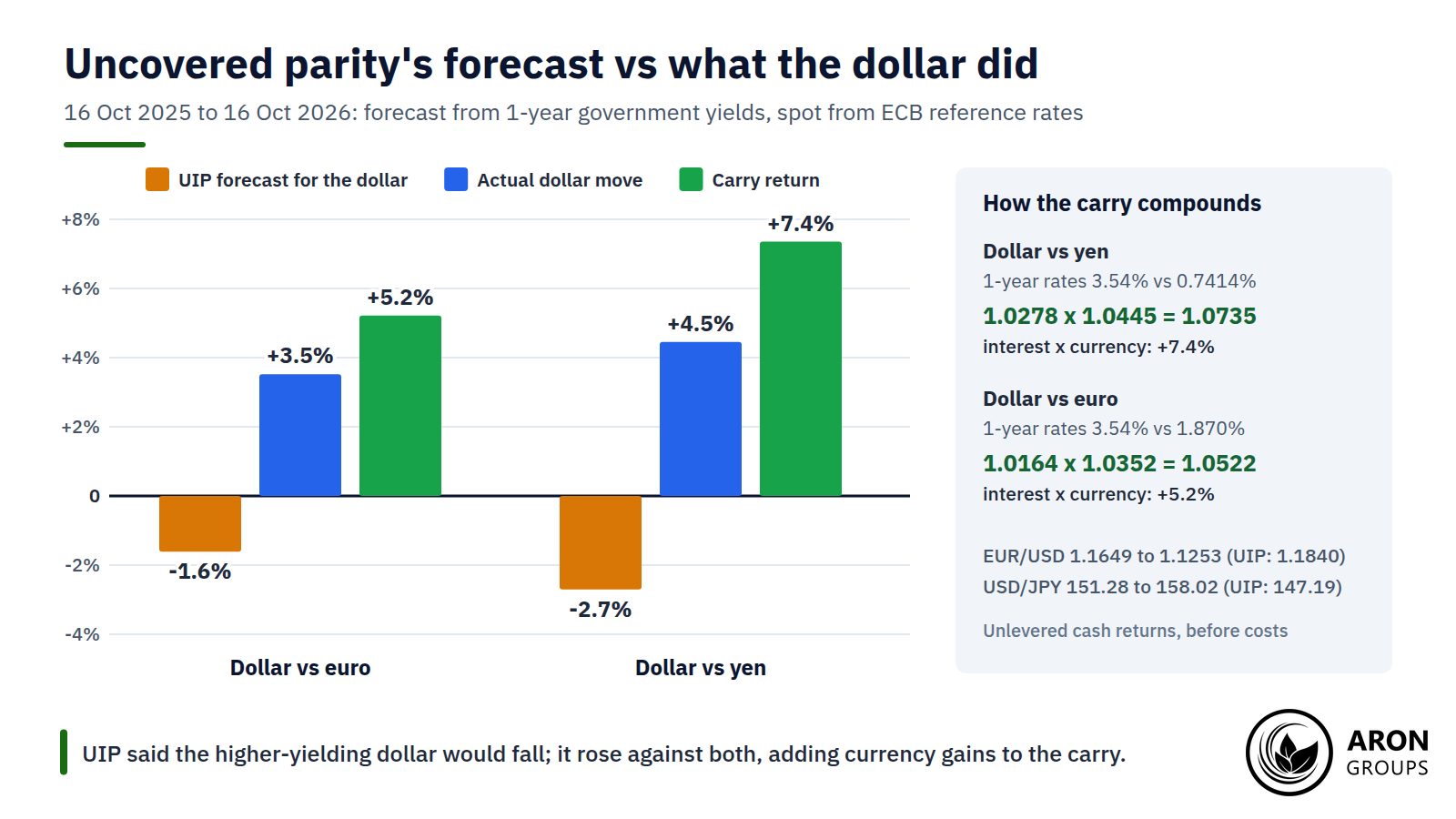
  • Uncovered parity missed badly over the past year. One-year yields in mid-October 2025 implied the dollar would lose 1.6% against the euro and 2.7% against the yen. Instead it gained 3.5% and 4.5%, and dollars funded in yen returned about 7.4% before costs.
  • The interbank overnight roll is covered parity for one night. EUR/USD spot-next points of 0.44175 were worth about $4.42 per lot on 16 October 2026. Broker markups can make both sides of a retail swap negative.

What Is Interest Rate Parity?

Interest rate parity (IRP) says the interest rate differential between two currencies equals the gap between their forward and spot exchange rates. The spot exchange rate is today’s price, usually for delivery in two business days. A forward exchange rate fixes a price today for a later date. A currency that pays more interest must buy less of the other currency forward, so no risk-free profit is left.

sms-star

Risk Disclosure
Trading forex and CFDs carries a high level of risk and can result in the loss of all your capital. This content is educational and is not investment advice. Never risk money you cannot afford to lose.
For the raw gap itself and basic carry mechanics, see the interest rate differential guide. This article covers the interest rate parity theory behind forward prices.

Covered vs Uncovered Interest Rate Parity

Covered interest rate parity (CIRP) removes exchange rate risk with a forward contract, so it is an arbitrage condition that dealers price every day. Uncovered interest rate parity (UIRP, often shortened to UIP) leaves the position open and uses the spot rate investors expect. The first is a pricing rule; the second is a forecast that markets often break.

The Sister Parity: Purchasing Power Parity

Purchasing power parity (PPP) links exchange rates to prices. Over long periods, the currency of the higher-inflation country should weaken by the inflation gap. Covered parity holds almost continuously in money markets, while PPP is a slow anchor measured in years.

The Interest Rate Parity Formula and Forward Points

The interest rate parity formula, or equation, is F = S × (1 + i_quote × n/basis) / (1 + i_base × n/basis). S and F are units of the quote currency per one unit of the base currency, and both rates cover the same n days. Each rate uses its money-market day count: actual/360 for the dollar and the euro, actual/365 for the yen.

In its one-year textbook form, F / S = (1 + i_d) / (1 + i_f), with d the domestic, or quote, currency. For EUR/USD, quoted in dollars per euro, the dollar is domestic, so its rate goes on top.

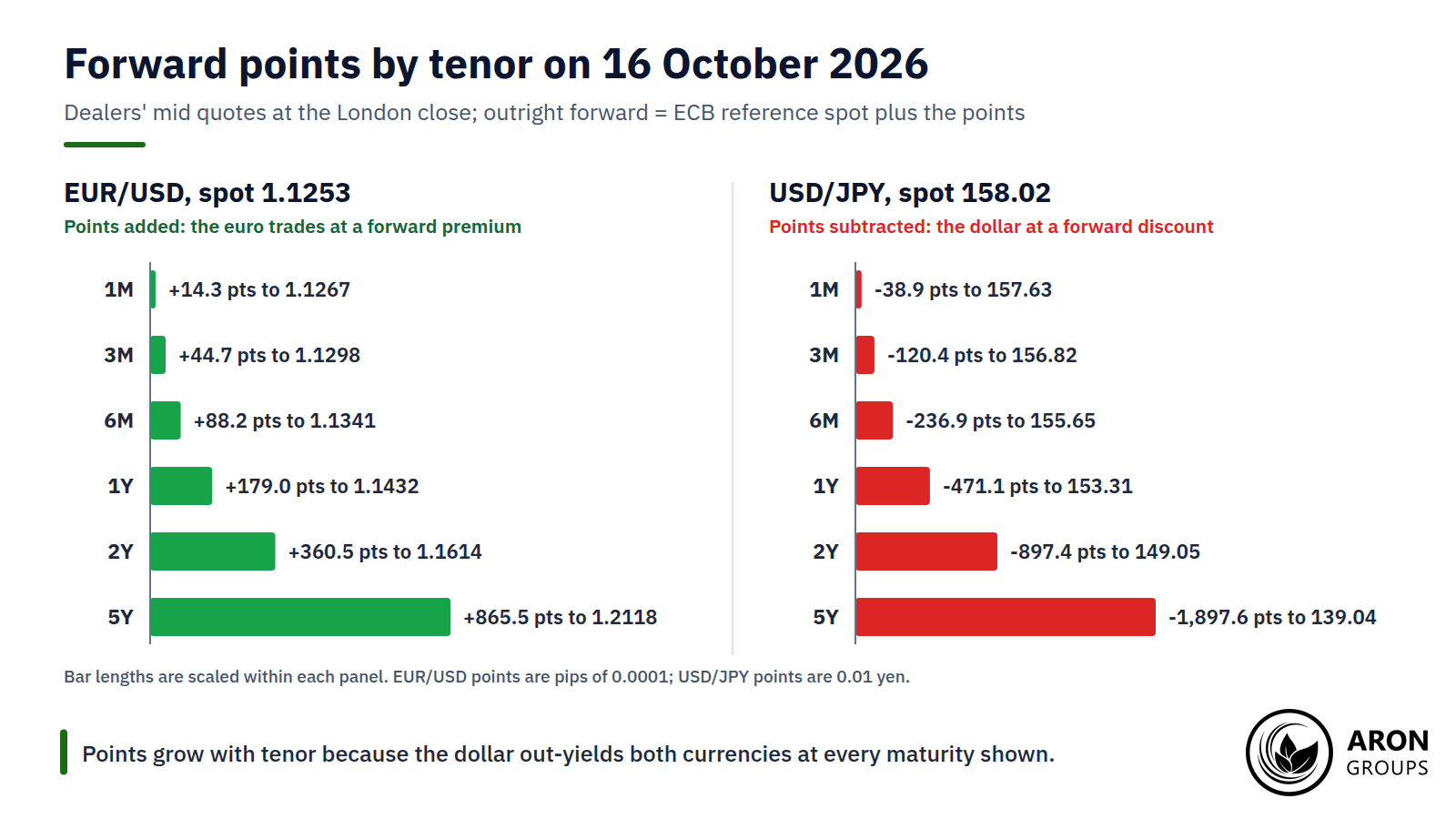
Forward points are F minus S, in pips of 0.0001 for EUR/USD and 0.01 yen for USD/JPY. When the quote currency yields more, points are added and the base currency trades at a forward premium. When it yields less, they are subtracted. The points grow with tenor: for EUR/USD on 16 October 2026, from 14.3 at one month to 865.5 at five years.

On 16 October 2026 forward points grew with every tenor, because dollars out-yield both euros and yen.
sms-star

Key Point
The higher-yielding currency trades at a forward discount. On 16 October 2026 the euro's one-year forward premium against the dollar was 1.59%, and the dollar's one-year discount against the yen was 2.98%.
Mini Example: Pricing a Three-Month EUR/USD Forward on Real Data

This interest rate parity example uses real inputs. On 16 October 2026 the ECB’s reference rate was 1.1253 dollars per euro. Three-month term SOFR was 4.08444% and three-month Euribor 2.642%. Spot settles on 20 October, so a three-month forward runs 92 days to 20 January 2027.

The dollar factor is 1 + 0.0408444 × 92/360 = 1.010438, and the euro factor is 1 + 0.02642 × 92/360 = 1.006752. The forward is 1.1253 × 1.010438 / 1.006752 = 1.12942, or 41.2 points above spot. The euro trades at a forward premium because dollars pay 1.44 percentage points more.

This forward is computed, not quoted. Cbonds’ mid quote at the London close put the three-month points at 44.71. On the same spot, that is a forward of about 1.12977, 3.5 points above the computed one.

Covered Interest Rate Parity (CIRP): How the Hedge Locks the Return

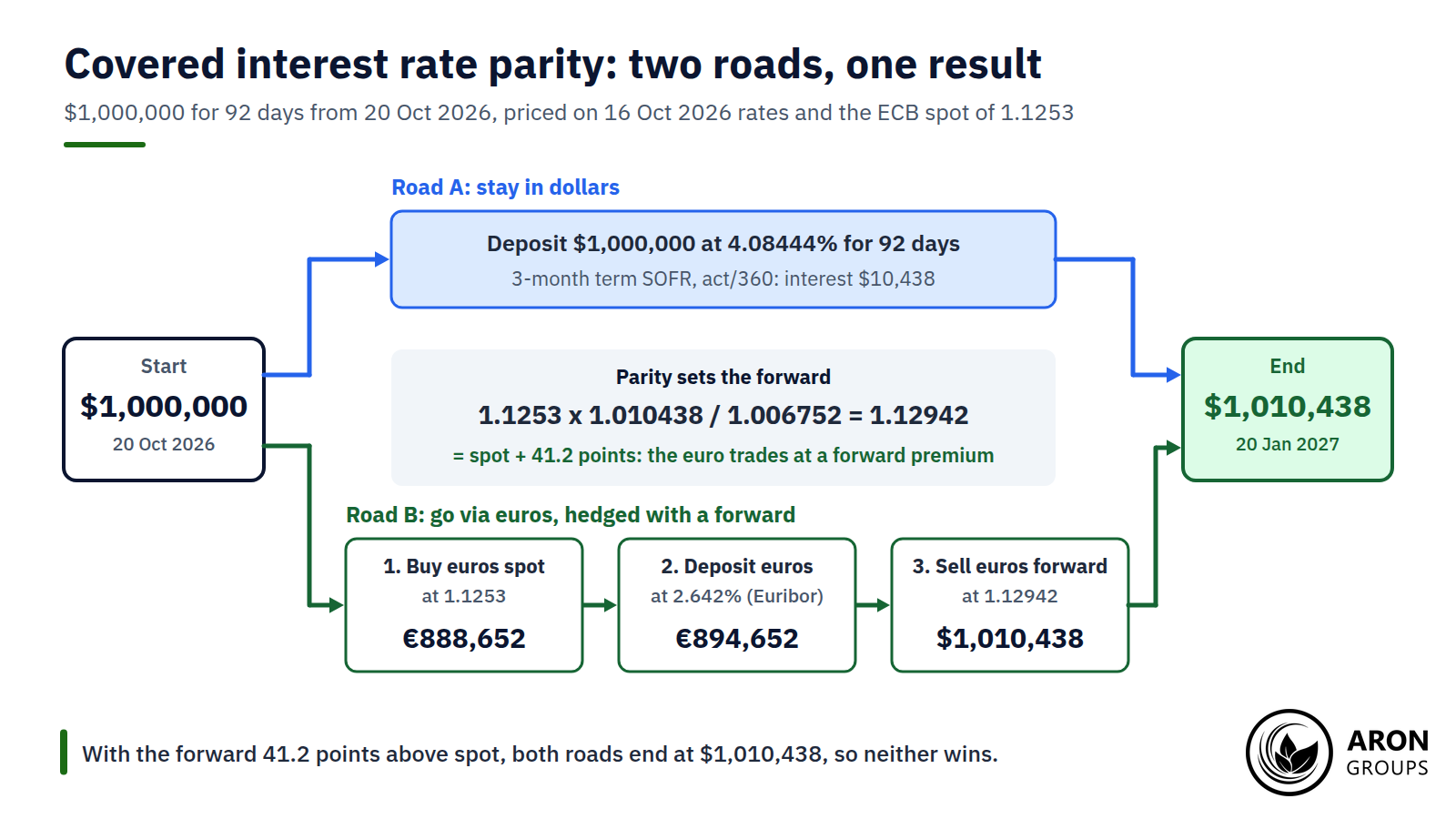
Covered interest rate parity says a foreign deposit with its currency risk covered must earn the same as a home deposit. Take $1,000,000 on 20 October 2026: deposited at term SOFR, it becomes $1,010,438 by 20 January. Buy euros instead, deposit them at Euribor and hedge by selling them forward at 1.12942. You end with the same $1,010,438.

If the two routes ended at different amounts, traders would borrow on the cheap one and invest on the dear one until prices realigned. That trade is covered interest arbitrage. It keeps covered parity close wherever capital mobility is free; capital controls are one reason it can fail.

Covered Interest Arbitrage, Step by Step

Suppose a dealer quoted the three-month forward 10 pips too high, at 1.13042 instead of 1.12942. An arbitrageur would do four things at once:

  • Borrow $1,000,000 for 92 days at term SOFR, owing $1,010,438.
  • Buy €888,652 spot at 1.1253 and deposit them at 2.642%, growing to €894,652.
  • Sell €894,652 forward at 1.13042 for $1,011,332.
  • Repay the loan and keep $894, free of exchange rate risk but still exposed to counterparty risk.

Costs eat much of that. Half a pip of bid-ask spread on the spot and forward deals costs about $45. Borrowing 0.10 point above term SOFR adds $256, leaving about $594. On these illustrative costs, the trade pays only when the mispricing exceeds about 3.4 pips. The 3.5-point gap of 16 October would have netted about $13 on $1 million.

Each step also pushes prices back. Buying euros spot lifts the spot rate, selling forward lowers the forward and borrowing dollars lifts dollar rates.

Both roads turn $1,000,000 into $1,010,438 by 20 January 2027 because the forward absorbs the 1.44-point rate gap.

Why Covered Parity Has Slipped Since 2008: The Cross-Currency Basis

Before the 2008 crisis, covered parity held closely. Since then, borrowing dollars through FX swaps has cost more than borrowing them in the cash market for most currencies. That persistent gap is called the cross-currency basis. A BIS Quarterly Review study called covered parity the closest thing to a physical law in international finance. It then showed the law has been systematically violated since the crisis.

Two forces sustain the gap. One is heavy demand to hedge dollar assets through FX swaps. The other is new limits on the banks that would arbitrage it, because capital rules make balance sheet costly. Du, Tepper and Verdelhan (2018, Journal of Finance) found the deviations large and persistent. They were strongest for contracts that sit on bank balance sheets at quarter-ends.

On 16 October, with Euribor as the euro rate, the quoted forward implied a dollar rate of 4.21%, about 0.12 point above term SOFR. On that measure, dollars raised through the FX market cost a little more than dollar liquidity in the cash market. The comparison is uneven, because term SOFR is a secured rate while Euribor is an unsecured bank rate.

Each 0.01 point on either rate moves the forward by about 0.3 pips. With the three-month Treasury yield of 4.26%, or 4.20% on a 360-day basis, the computed forward lands at 44.6 points, almost on the quote. How big the basis looks depends on which rates you compare.

Q: If covered parity breaks, why don’t banks simply arbitrage the gap away?
A: They do, but only until the profit stops covering their costs. Funding spreads, bid-ask spreads and the capital held against a bigger balance sheet all need paying. Quarter-ends make balance sheet scarcer still, so gaps of a few points can persist without being free money.

Uncovered Interest Rate Parity (UIRP): The Forecast That Keeps Failing

Uncovered interest rate parity drops the forward and uses expectations. If investors cared only about returns, the higher-yielding currency would be expected to depreciate by the rate gap. As an SEC investor bulletin warns, a foreign investment can rise in its home market and still lose value in US dollars.

Testing UIP on the Past 12 Months

On 16 October 2025 the one-year US Treasury yielded 3.54%. Germany’s 12-month bill had been auctioned at 1.870% three days earlier, and Japan’s one-year bill at 0.7414% that day. UIP therefore expected the dollar to lose about 1.6% against the euro and 2.7% against the yen by 16 October 2026.

It did the opposite. On the ECB’s reference rates, EUR/USD fell from 1.1649 to 1.1253 and USD/JPY rose from 151.28 to 158.02. That means the US dollar gained 3.5% against the euro and 4.5% against the yen.

UIP said the higher-yielding dollar would fall; it rose against both, adding currency gains to the carry.

The table compares covered parity, uncovered parity and purchasing power parity.

FeatureCovered IRPUncovered IRPPurchasing power parity
LinksRate gap to the forward premiumRate gap to the expected spot moveInflation gap to the spot move
Currency riskHedged with a forwardLeft openLeft open
Enforced byArbitrageExpectations, if investors ignore riskTrade in goods, slowly
How well it holdsClosely, with a basis since 2008Poorly over months; better over yearsLoosely, over years
Recent evidenceEUR/USD 3-month: 41.2 points computed, 44.71 quoted (16 Oct 2026)Dollar forecast -1.6% against the euro; actual +3.5%Not tested here
What traders use it forPricing forwards and swapsJudging carry and its riskA long-run value anchor

Data: ECB, CME, EMMI, Cbonds, US Treasury, German Finance Agency, Japan’s Ministry of Finance.

The Forward Premium Puzzle and the Carry Trade

Economists call this failure the UIP puzzle, also known as the forward premium puzzle or forward premium anomaly. Eugene Fama’s 1984 study in the Journal of Monetary Economics regressed currency moves on forward premiums. He found the slopes generally negative, not the +1 that UIP needs. Most of the variation in forward rates, he concluded, is a premium that changes over time, usually read as a risk premium.

Chinn and Meredith (2004, IMF Staff Papers) found that UIP fits much better over long horizons, using yields on longer-maturity bonds. Over weeks and months, though, high-yield currencies tend not to fall by the rate gap, and often rise.

The carry trade lives off that gap: borrow the low-yield currency, hold the high-yield one and collect the difference. Over the past year, dollars funded in yen earned about 2.8% in interest and 4.5% from the currency. Those compound to about 7.4% before costs, and funding in euros returned about 5.2%, both measured against the loan plus its interest. Returns arrive as steady interest with occasional sharp losses, and leverage magnifies both.

The August 2024 Carry Unwind

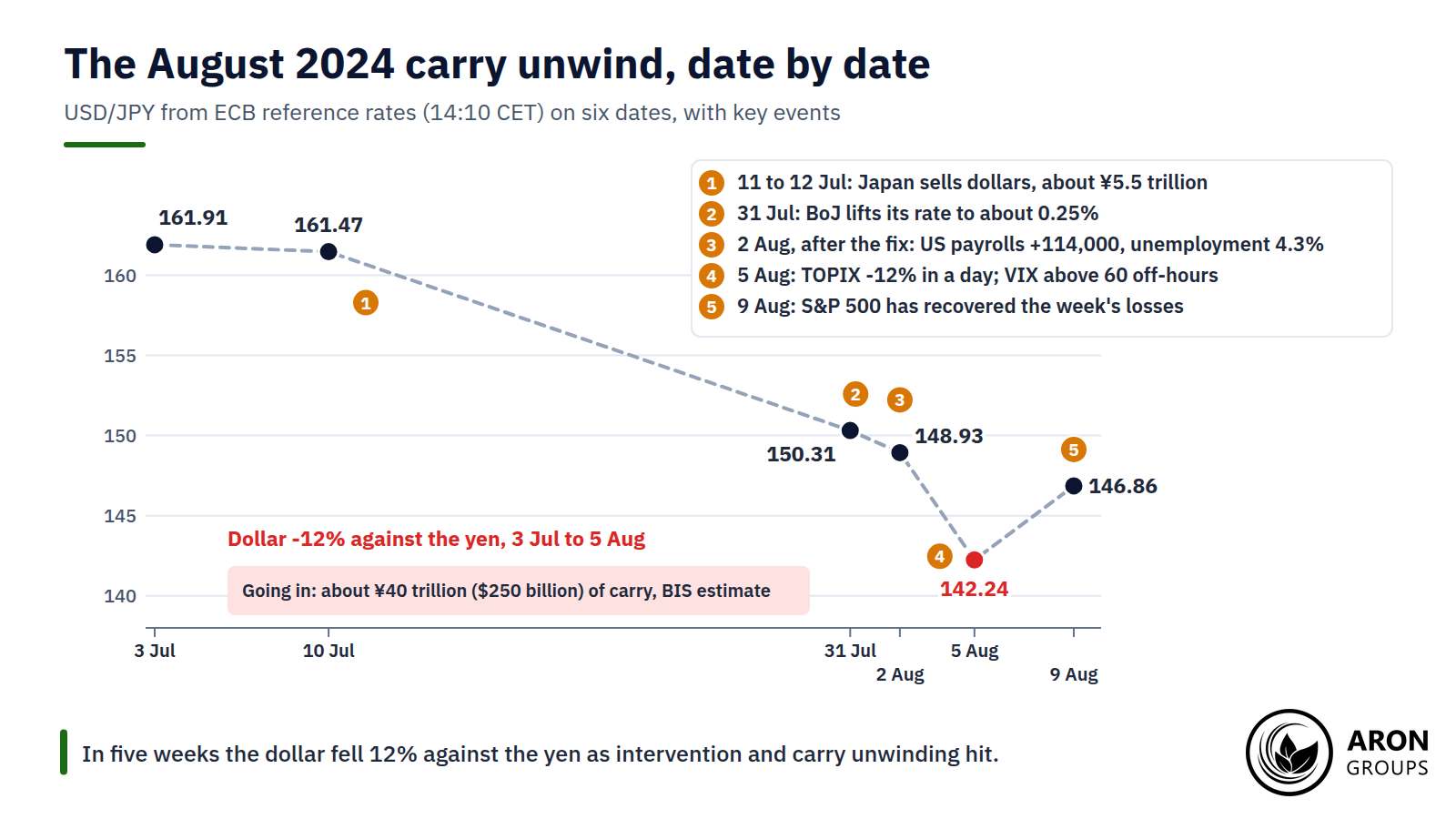
Carry pays until crowded positions are closed together. In early July 2024, with US rates above 5% and Japan’s near zero, the dollar bought 161.91 yen on the ECB’s 3 July reference rate. BIS Bulletin No 90 later put carry trades at a rough middle estimate of ¥40 trillion, or $250 billion, going into the event. The yen’s slide reversed in mid-July, after Japan’s Ministry of Finance sold dollars on 11 and 12 July, about ¥5.5 trillion in all.

The Bank of Japan raised its rate to about 0.25% on 31 July. Weak US jobs data followed on 2 August: payrolls rose 114,000 and unemployment reached 4.3%. On 5 August the TOPIX lost 12% in a single day, and USD/JPY stood at 142.24 at the ECB fix. The VIX briefly topped 60 in off-hours trading.

Between 3 July and 5 August 2024 the dollar fell 12% against the yen, from 161.91 to 142.24, as intervention and carry unwinding hit.

At a rate gap of roughly five points a year, that 12% move erased more than two years of carry in five weeks. Markets steadied quickly: by 9 August the S&P 500 had recovered the week’s losses.

What Parity Means for Your Overnight Swap

In the interbank market, a spot position held past the daily cut-off rolls to the next value date at tom-next or spot-next points. Those points are covered interest rate parity for one night, and a broker’s overnight swap on a CFD starts from them.

On 16 October 2026 EUR/USD spot-next points were 0.44175. That is close to the 0.45 implied by SOFR at 3.89% on 15 October and the euro short-term rate at 2.441%. On one standard lot of €100,000 it is worth about $4.42 a night: longs pay it and shorts receive it, before any markup. For USD/JPY, points of -1.23 put one night on a $100,000 lot near ¥1,230, about $7.78, in favour of dollar longs.

Retail swap rates are not textbook points. Brokers typically start from the tom-next rate and add a markup to each side. Aron’s own guide notes that brokers can adjust the rollover rate in their favour. With an illustrative markup of 1.5% a year, the EUR/USD long would pay about $9.11 a night and the short $0.27. Both sides would be negative.

Because spot settles two business days after the trade, the roll that spans a weekend usually books three nights at once, typically on Wednesday. Check the swap long and swap short in the symbol’s specification first.

The Honest Limits of Interest Rate Parity

Covered parity is close, not exact. The basis, transaction costs, credit limits and balance-sheet charges leave gaps of a few points that only well-funded banks can trade. Those gaps widen at quarter-ends and in stress. The BIS Quarterly Review of March 2019 noted sharp year-end spikes in the cost of dollars against the euro and yen.

Uncovered parity fails often and unpredictably, and parity says nothing reliable about short-term direction. The one-year EUR/USD forward of 1.1432 on 16 October 2026 does not predict where the euro will trade next October.

Carry returns come with crash risk, and leverage turns a currency move into a much larger loss. In 2018 ESMA capped retail leverage on major currency pairs at 30:1. National regulators’ analyses it cited showed that 74% to 89% of retail CFD accounts typically lose money. Broker swaps, finally, usually differ from textbook points by a markup or a discount.

Where Aron Groups Fits

Aron Groups does not offer forwards, NDFs or FX swaps, the institutional contracts where covered parity is priced. It offers spot forex CFDs such as EUR/USD and USD/JPY on MetaTrader 5. A position held overnight earns or pays a swap, which Aron’s trading accounts page describes as a fee added to or deducted from your account.

Swap terms differ by account. Standard ECN and VIP ECN accounts carry swaps. The Nano account and the Islamic account charge discounted swaps, with swap-free periods on listed symbols, currently 14 days for forex. The Fed, ECB and Bank of Japan meet between 27 and 30 October, and the economic calendar tracks such decisions. A demo account shows swaps accruing without risking capital.

Conclusion

Interest rate parity explains why a higher interest rate is not free money. The forward prices the gap away, and on 16 October 2026 it did so for EUR/USD to within 3.5 points.

Uncovered parity keeps missing, and that miss pays the carry trade until a crash such as August 2024 takes it back. For an overnight position, the lesson sits in the swap: the rate gap, adjusted by the broker’s terms.

Frequently Asked Questions

Short answers to common questions about interest rate parity.

What is the difference between covered and uncovered interest rate parity?

Covered parity hedges the currency with a forward, so arbitrage keeps it close. Uncovered parity leaves the currency open and relies on the expected future spot rate. It is a forecast, and it often fails over short horizons.

How do you calculate a forward rate with interest rate parity?

Multiply spot by one plus the quote currency’s rate for the period, then divide by one plus the base currency’s rate. Use each market’s day count. For EUR/USD on 16 October 2026, 1.1253 × 1.010438 / 1.006752 gives 1.12942 for 92 days.

Does interest rate parity predict exchange rates?

No. A forward reflects the interest gap rather than a forecast, and uncovered parity has been wrong for long stretches. In the year to 16 October 2026 it expected the dollar to fall against the yen, and the dollar rose 4.5%.

Why does the carry trade work if parity holds?

Covered parity holds closely for hedged positions, while the carry trade is unhedged. It profits when the high-yield currency fails to fall by the rate gap, which is common. It loses heavily when that currency falls by more than the gap, as in August 2024.

Continue Reading
not-found
calendar 5 November 2026
Rate this article

Leave a Reply

Your email address will not be published. Required fields are marked *

No thanks