
icon icon Home
icon icon Accounts
icon icon Quick start
icon icon Symbols

The Put Credit Spread (Bull Put Spread): Setup, Payoff, and How to Collect Premium with Defined Risk

Author
Abe Cofnas
Abe Cofnas
calendar Last update: 22 October 2026
watch Reading time: 10 min

A put credit spread sells a put at a higher strike and buys a put at a lower strike. It is also called a bull put spread or short put spread. Both puts share one expiry. The trader collects a net credit up front and keeps all of it if the stock finishes above the higher strike.

It matters now because zero-day (0DTE) options made up a record 66.2% of S&P 500 index (SPX) option volume in July 2026, by Cboe’s count. Yet the VIX, a gauge of implied volatility, closed at 14.84 on 9 October 2026, so credits are modest and the arithmetic matters.

This guide builds the spread leg by leg and prices it on a worked stock and a dated SPY chain. It also covers the Greeks, margin, management and the limits most guides skip.

bookmark
Key Takeaways
  • A put credit spread, the classic bull put spread strategy, is a credit spread option position: sell a put at a higher strike and buy a put at a lower strike, same expiry, for a net credit. Maximum profit is the credit, maximum loss is the strike width minus the credit, and breakeven is the short strike minus the credit.
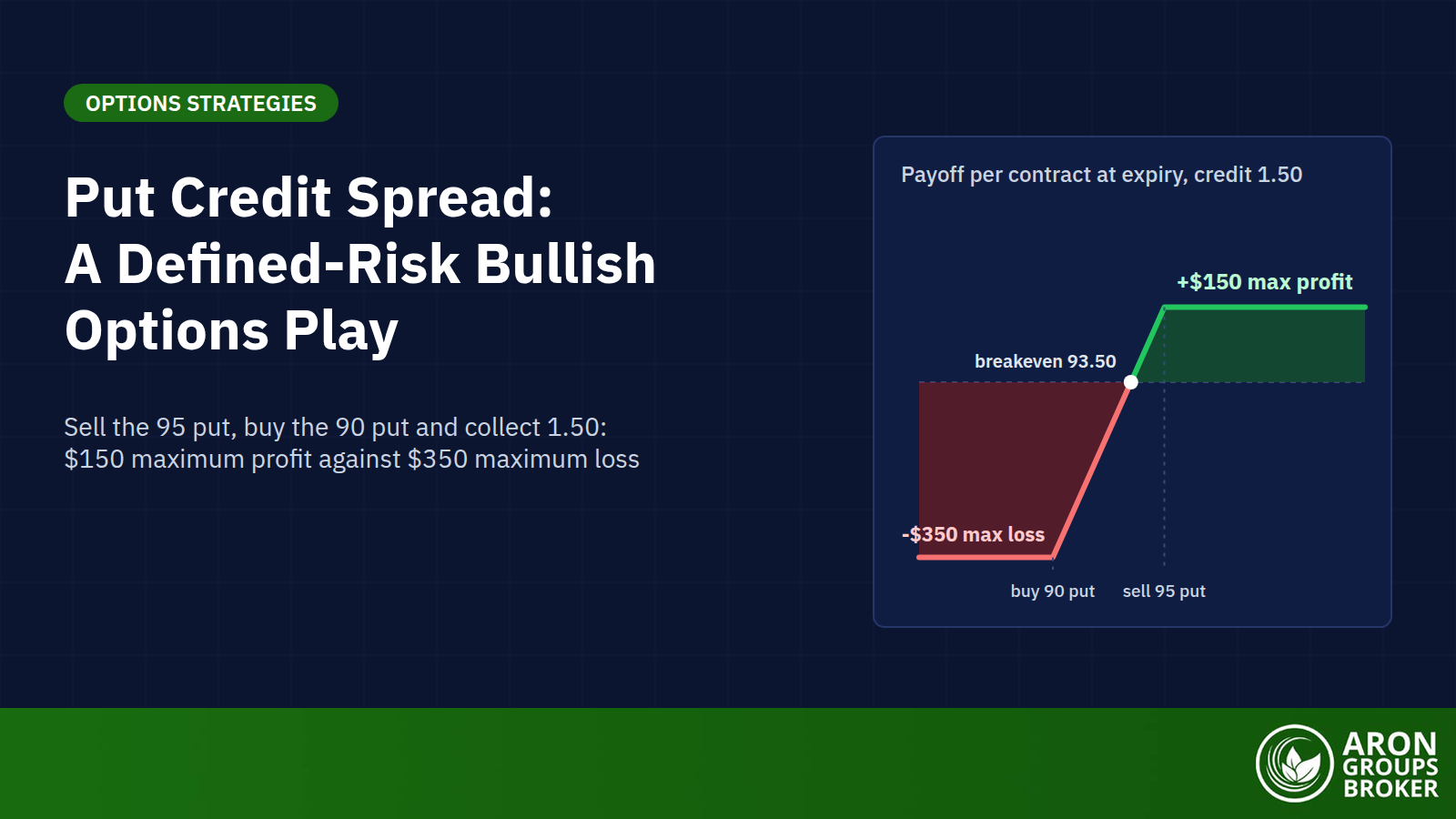
  • Worked example: sell the 95 put, buy the 90 put and collect 1.50. One contract makes at most $150, loses at most $350, breaks even at 93.50 and returns 42.9% on the capital at risk.
  • The credit sets the win rate you need, 1 minus the credit divided by the width. The worked spread must win 70% of the time to break even before costs, and the SPY 750/745 spread priced from 9 October 2026 needs 88.4%.
  • Theta is positive and vega negative, so time and falling implied volatility both help, but theta turns negative once the stock falls to about the strikes' midpoint (92.50 in the example).
  • Defined risk is not small risk: the SPY spread risks $442 to make $58, and its SPX equivalent about ten times that. Aron Groups offers no options; an index CFD with a stop-loss can express the same view.

What Is a Put Credit Spread?

The short put earns the premium, and the long put at the lower strike makes the risk defined. A naked short put can lose almost its full strike price; the long put lets you sell at the lower strike instead. The view is neutral to bullish: the stock need only hold above the short strike.

sms-star

Risk Disclosure
Trading forex and CFDs carries a high level of risk and can result in the loss of all your capital. This content is educational and is not investment advice. Never risk money you cannot afford to lose.
Profit, Loss and Breakeven

Maximum profit is the net credit times the contract multiplier, normally 100 shares, as the SEC’s investor bulletin on options notes. Maximum loss is the strike width minus the credit, times 100. Breakeven is the short strike minus the credit.

Mini Example: The 95/90 Put Credit Spread Step by Step

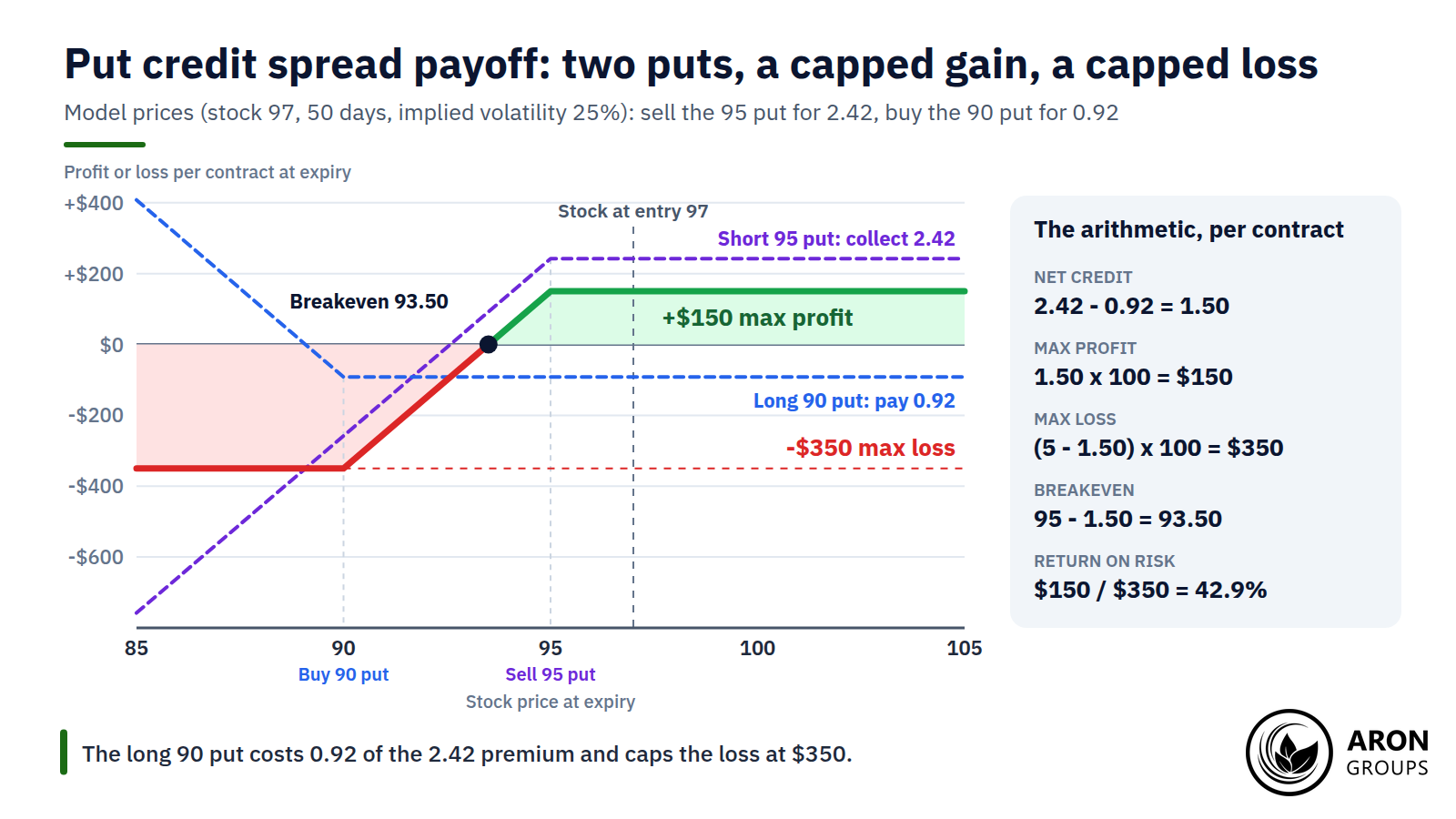
Take a stock at 97 with 50 days to expiry and implied volatility of 25%. At a 4% interest rate, the Black-Scholes pricing model values the 95 put at 2.42 and the 90 put at 0.92. Selling one and buying the other nets 1.50 a share.

Maximum profit is the credit: 1.50 x 100 = $150, kept if the stock closes at or above 95. Maximum loss is the width minus the credit: (5 – 1.50) x 100 = $350, taken at or below 90. Breakeven is 95 – 1.50 = 93.50, and return on risk is $150 / $350 = 42.9%.

At expiry the result per contract is +50 at 94 and zero at 93.50. It is -350 at 90 and 85. On the payoff diagram below the line is flat beyond both strikes and moves $100 per point between them.

Collecting 2.42 on the 95 put and paying 0.92 for the 90 put leaves 1.50: a $150 ceiling, a $350 floor and a 93.50 breakeven.

A Real-Scale Example on SPY

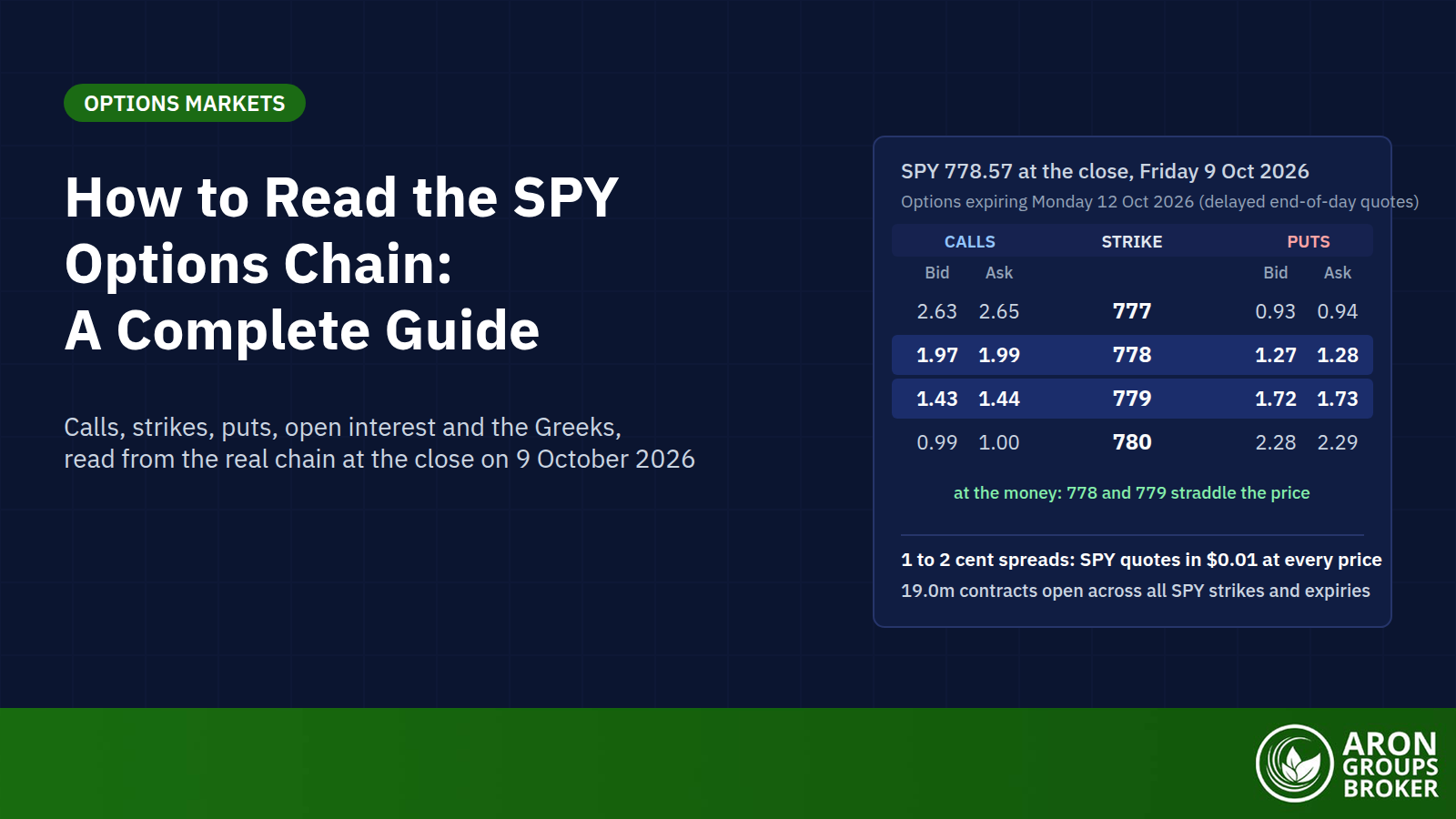
On Friday 9 October 2026 SPY, the S&P 500 ETF, closed at 778.57, the index at 7,811.54 and the VIX at 14.84. For the 20 November 2026 expiry, 42 days away, the 750 put sits 3.7% below the close. Its delta of 0.21 falls inside the 0.20 to 0.30 band often used for short strikes. The 745 put is the protection leg.

Optionistics’ free end-of-day data list last trades of 5.00 for the 750 put and 4.38 for the 745 put. That is a credit of 0.62, the optimistic fill. Selling at the bid and buying at the ask, with each leg assumed four cents wide, is the cautious fill: 0.58.

One contract then makes at most $58 and loses at most (5 – 0.58) x 100 = $442, which is also the margin requirement. Breakeven is 749.42, return on risk 13.1%, and a flat-volatility model puts the probability of profit near 78%, an illustrative figure.

Skew trims the credit. With both legs priced at the 750 put’s volatility the spread would pay 1.02, but the 745 put’s implied volatility (16.3%) exceeds the 750’s (15.7%). A risk reversal measures that skew.

Why the Credit Sets the Win Rate You Need

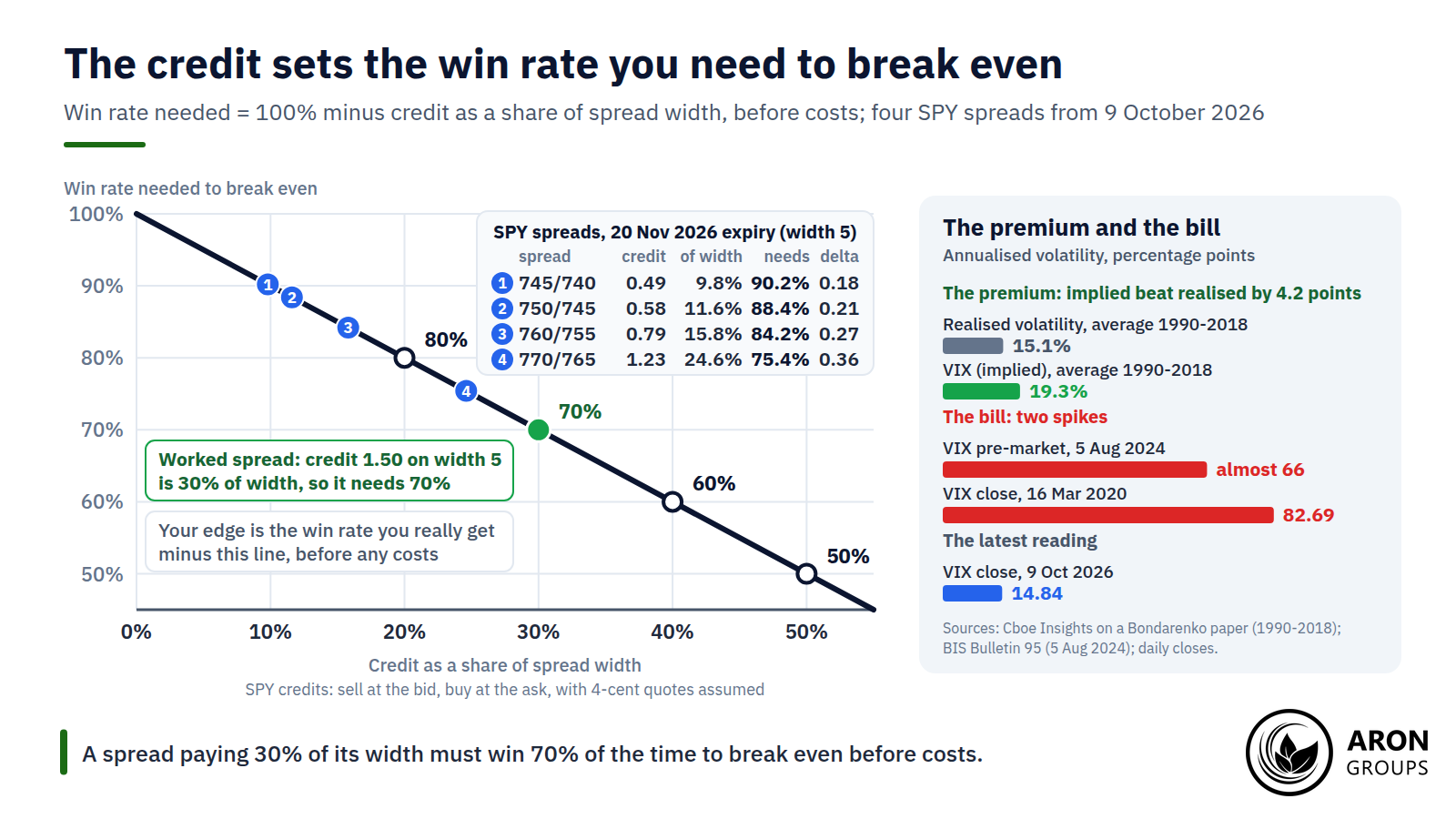
The credit is the market’s price of the risk. A spread risking $350 to make $150 breaks even only if it wins 70% of the time. That is 350 + $150), if every win and loss is the maximum, or 1 minus the credit divided by the width.

Credits of 20%, 30%, 40% and 50% of the width need win rates of 80%, 70%, 60% and 50%. On 9 October 2026, five-point SPY spreads paid 9.8% to 24.6% of their width and needed 90.2% to 75.4%.

A 30% credit needs a 70% win rate; the four SPY spreads priced on 9 October 2026 need 75% to 90%.
sms-star

Key Point
Break-even win rate = max loss / (max loss + max profit) = 1 - credit / width. Winning more often than that, after commissions and slippage, earns money; winning less often loses it, however high the probability of profit looks. Higher implied volatility pays a bigger credit and lowers the bar: at 35% the worked spread would pay 1.82 and need 64%. Divided by the width, the SPY spread's mid credit (0.62 / 5 = 12%) is roughly the market's chance of finishing below the strikes' midpoint.
A delta of 0.21 and a flat-volatility model put the chance of keeping the credit near 78% to 79%, but both ignore skew. The skewed prices pay 0.62 rather than 1.02. Read as probabilities, they imply about 86%, close to the 88% win rate the spread needs. A high probability of profit is therefore bought with a poor risk-reward ratio: $442 at risk for $58.

Where an Edge Could Come From

Any edge has to come from implied volatility exceeding the volatility later realised, the volatility risk premium, and from low costs. Cboe Insights summarised a 2019 white paper by Oleg Bondarenko. From 1990 to 2018 the VIX averaged 19.3% and realised S&P 500 volatility 15.1%, a gap of 4.2 points. The paper studied at-the-money put-writing, not spreads, and its data end in 2018.

The Tail Risk Behind the Premium

The premium pays for rare, violent moves. The S&P 500 fell about 29% between 19 February and 19 March 2020, and the VIX closed at a record 82.69 on 16 March. On 5 August 2024 the VIX jumped 180% to almost 66 pre-market. A BIS bulletin calls it the biggest one-day spike ever and says wider put bid-ask spreads contributed.

The Greeks: Delta, Theta, Vega and Gamma

On the SPY spread, net delta (share-equivalent exposure) is only +0.03 per share, about 2.6 shares a contract. The puts’ deltas of -0.21 and -0.18 nearly cancel. Theta (time decay) is +5.86 per volatility point and gamma (the change in delta) is -0.08 shares per $1.

Theta is positive because the short put decays faster than the long put. Vega is negative, or short: a one-point rise in implied volatility costs 10% of the $58 maximum profit. An IV crush after an event therefore helps the seller, while elevated volatility at entry pays a bigger credit. Gamma is negative: the position grows longer as the stock falls, so losses accelerate, the exposure gamma scalpers trade against.

Why Theta Turns Negative

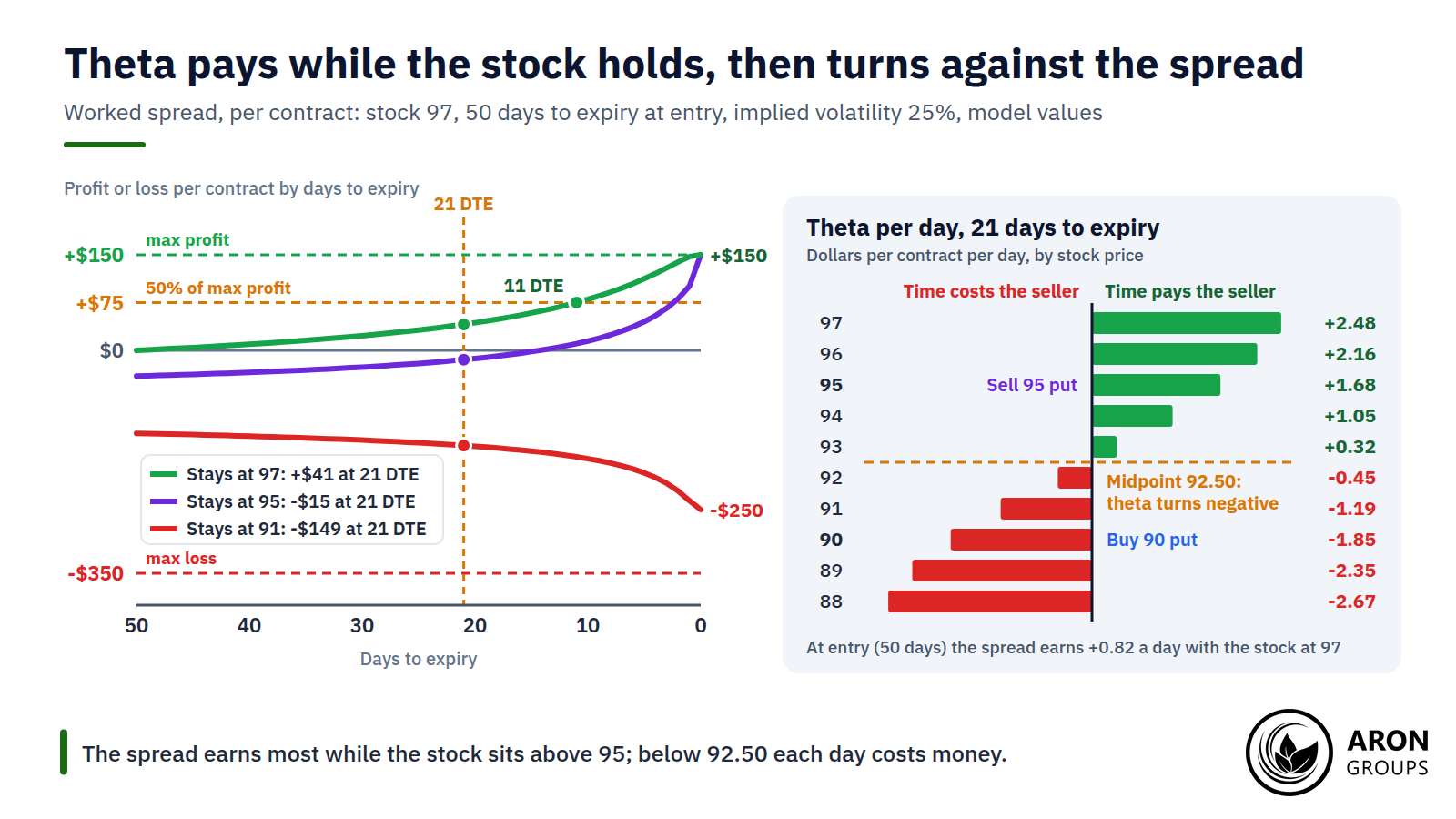
In the worked example, with 21 days left, the spread earns $2.48 a day with the stock at 97 and $1.68 at 95. At 93 it earns only $0.32, and at 92 it loses $0.45. The sign flips near 92.50, the strikes’ midpoint. Below it the spread is likelier to finish at the full $350 loss, and each passing day moves it closer to that outcome.

With 21 days left, the spread earns $2.48 a day at 97 but loses $0.45 at 92, below the 92.50 midpoint.

How the Spread Compares With Its Neighbours

By put-call parity, a put credit spread and a bull call spread on the same strikes and expiry have the same profit and loss at expiry. Buying the 90 call and selling the 95 call costs about 3.50, the 5-point width minus the 1.50 credit. The profit (350) and breakeven (93.50) then match, ignoring interest and dividends.

The difference lies in placement: a put credit spread usually sits out of the money and wins if the stock merely avoids falling. A call debit spread usually starts at or near the money and needs the stock to rise. Its short call can also be assigned early before a dividend, which matters little for puts. Mind the naming trap: a bull put spread is the credit spread, but a bear put spread is a debit spread.

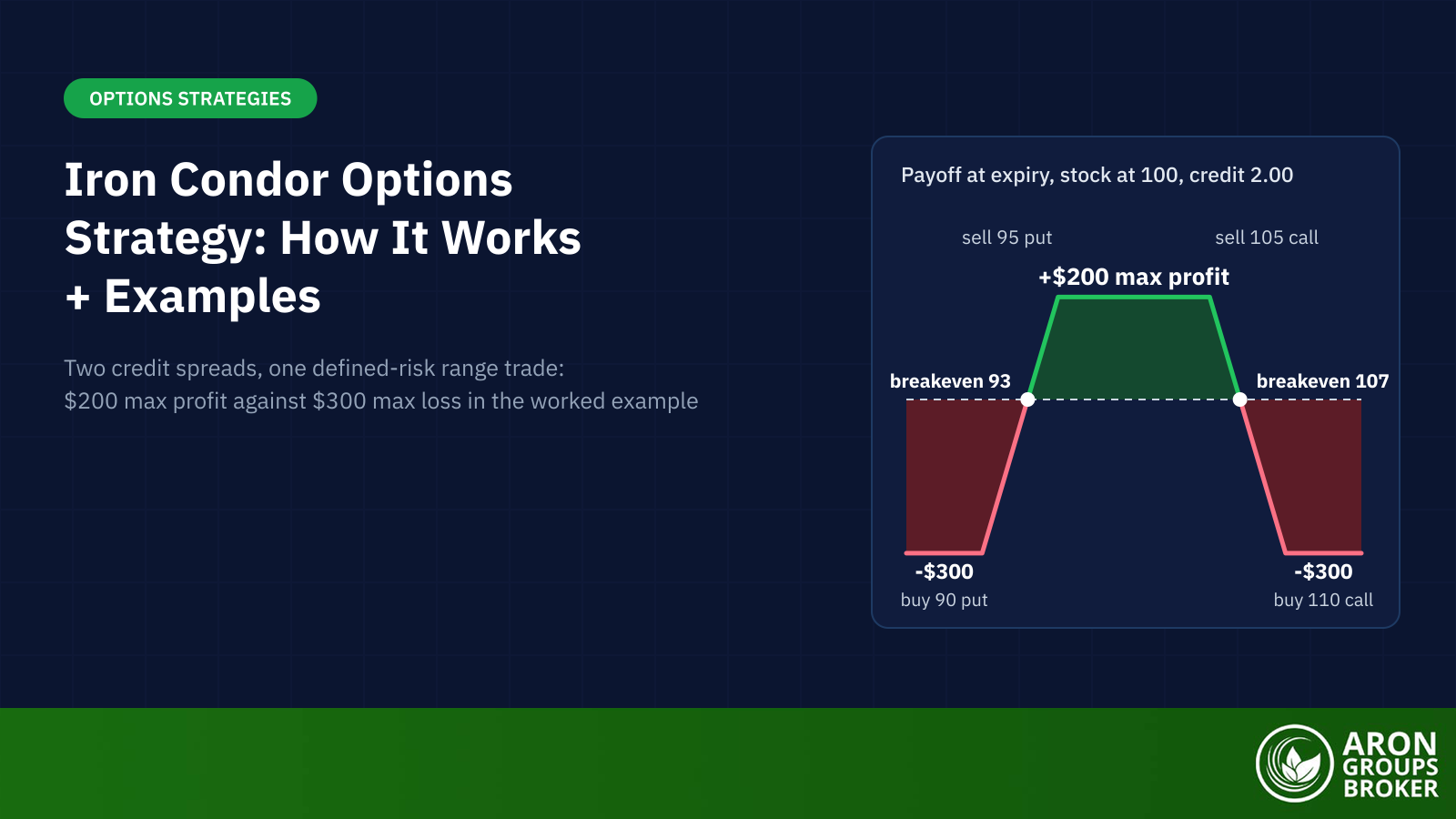
The put credit spread is the bullish half of an iron condor, and a trader who leans bullish rather than neutral can run it alone. The bearish half, the call credit spread or bear call spread, profits if the stock stays below its short call. On the worked stock, selling the 100 call and buying the 105 call pays 1.40. The pair collects 2.90 and risks $210, because only one side can lose.

Remove the long options from an iron condor and a short strangle remains. The table sets the five related positions side by side.

StrategyViewLegsNet at entryMax profit / max lossBreakevenCapital held
Put credit spreadNeutral to bullishSell 95 put, buy 90 putCredit 1.50$150 / $35093.50$350
Call credit spreadNeutral to bearishSell 100 call, buy 105 callCredit 1.40$140 / $360101.40$360
Iron condorRange-boundBoth credit spreadsCredit 2.90$290 / $21092.10 and 102.90$210
Cash-secured putNeutral to bullishSell 95 put, hold cashCredit 2.42$242 / $9,25892.58$9,500 in cash
Bull call spreadBullishBuy 90 call, sell 95 callDebit 3.50$150 / $35093.50$350

Worked stock at 97, 50 days, volatility 25%; model prices per 100-share contract. The bull call spread debit is the parity value, ignoring interest and dividends.

Margin, Assignment and Settlement Rules

Both legs go in as one multi-leg order for a net credit. Cboe’s margin overview requires cash equal to the maximum risk, less the net credit. An SEC order approving Cboe’s spread margin rules sets the margin requirement at maximum risk before premiums, with the net credit applied. Here that is $500 less $150, or $350.

SPY and single-stock options are American-style, so FINRA warns that a short put can be assigned on any day the market is open. Assignment obliges you to buy 100 shares at the short strike. FINRA adds that exercising a long option that limits the spread’s risk is up to the investor.

At expiry, equity options at least $0.01 in the money are exercised unless the holder says otherwise, under the Options Clearing Corporation’s exercise-by-exception rule. One cent of intrinsic value can therefore trigger assignment. Pin risk follows a close near the short strike: you may not know until the next morning whether you hold 100 shares.

SPX options are European-style and cash-settled, so there is no early exercise and no shares change hands. US tax treatment also differs under Section 1256, though this is not tax advice.

Capital Compared With a Cash-Secured Put

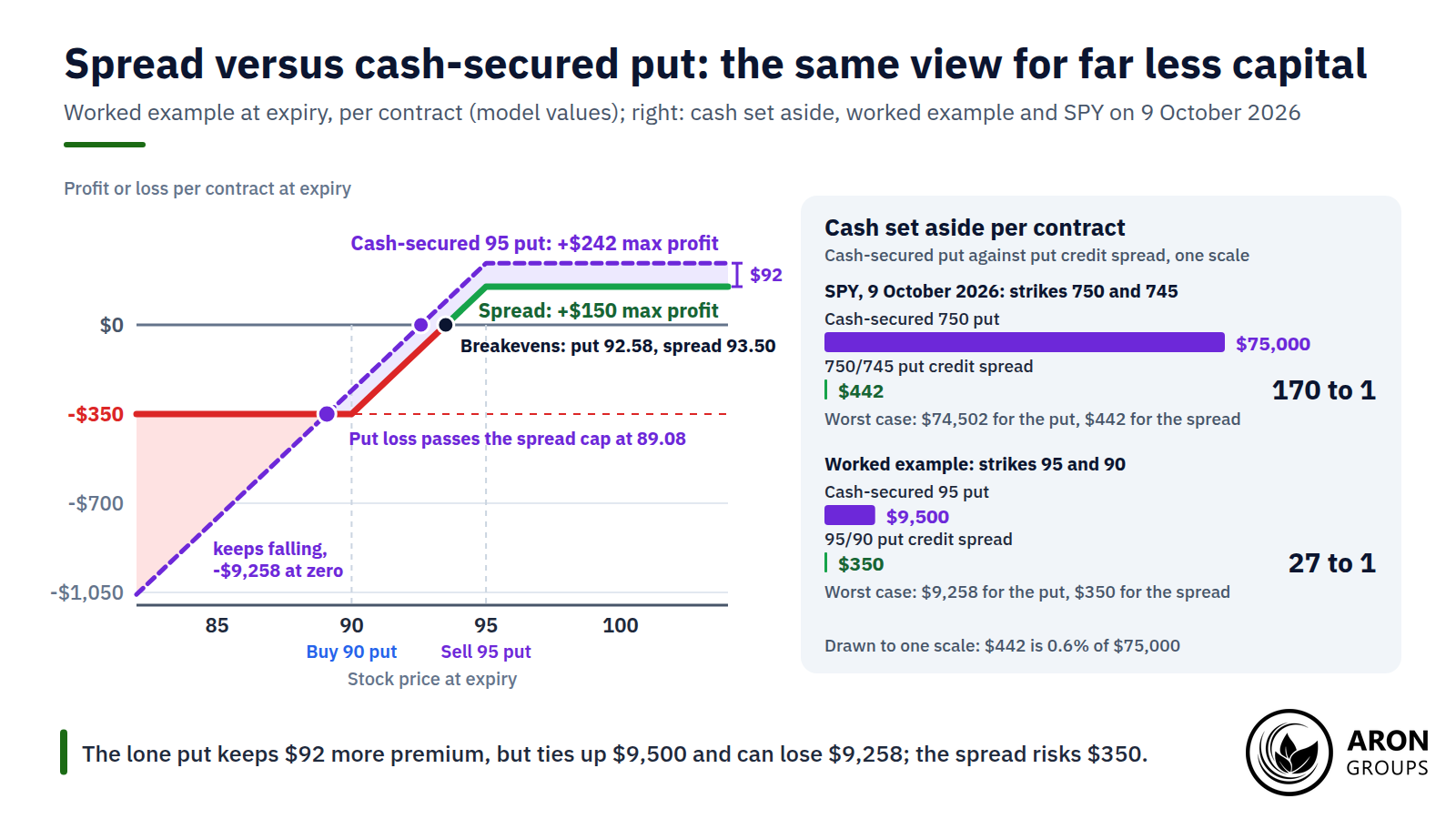
The spread is the defined-risk version of a cash-secured put, which sets aside cash for the whole purchase. Selling the SPY 750 put alone brings in $498 at the assumed bid. It needs $75,000 in cash and can lose $74,502 if SPY goes to zero. The 750/745 spread risks $442, so the put ties up about 170 times the capital. In the worked example the ratio is 27 to 1.

The lone put keeps $92 more premium but ties up 27 times the capital, and its loss passes the spread's $350 floor below 89.08.

How to Manage a Put Credit Spread

A tastylive guide to short vertical spreads (11 July 2023) says to take profit at 50% of the maximum and roll at 21 days to expiration. A separate tastylive study of 45-day SPY iron condors (29 August 2023) tested both rules. These are historical practices, not guarantees, and the study covered condors, not put credit spreads.

In the worked example the 50% target is $75: a good-till-cancelled order to buy the spread back at 0.75, placed when the trade opens. If the stock never leaves 97, the order fills with 11 days left. At 21 days the spread is up only $41, so the target means holding past the 21-day mark. Banking only $75 a win lifts the break-even win rate from 70% to 82.4% if losses stay at $350. If the stock nears the short strike instead, traders roll, as the box below shows.

Q: Can I roll a put credit spread that is being tested?
A: Traders usually roll only for a net credit. A roll closes the spread and opens another, later (rolling out), at lower strikes (rolling down) or both. With 21 days left and the stock at 94, closing the 95/90 spread costs 1.96. Reopening the same strikes 49 days out nets a credit of about 0.15. Rolling down and out to the 92/87 strikes needs a debit of about 0.50. At 91 even the same-strike roll needs a debit of about 0.19. A roll postpones a loss rather than removing it, and a debit roll widens the maximum loss. If the thesis has broken, many traders take the defined loss instead.

If a roll needs a debit or the stock closes below a support level chosen in advance, traders usually take the defined loss. The long put already capped it. Position sizing starts there. A common rule of thumb risks 1% to 2% of the account per trade. A $350 loss is 1.4% of a $25,000 account, and the SPY spread’s $442 is 1.8%.

The Honest Limits of the Put Credit Spread

Defined risk is not small risk. The SPY spread risks $442 to make $58, so 7.6 wins repay one loss, more than ten months of 42-day cycles. One move can erase many months of credits. On SPX the same index move costs ten times as much, about $4,420 per spread.

A stock can gap below both strikes overnight, so the full loss can arrive before you can act, and early assignment can leave you holding shares. Commissions weigh on thin credits. At an illustrative $0.65 per contract per leg, a round trip costs $2.60, or 4.5% of the $58 profit, before slippage on wide markets.

Probability-of-profit figures assume lognormal prices, which understate fat tails. Correlation hides risk too: ten spreads on ten technology stocks are one bet. Same-day expiries are harsher: with hours left, gamma is large and a small index move can erase the credit.

You also need an options-enabled broker account. Your broker must give you the Options Clearing Corporation’s Characteristics and Risks of Standardized Options. The SEC says there are generally five approval levels, which vary by firm. Access to US-listed options also varies by country, and users in restricted regions face added legal, access and custody risk.

Where Aron Groups Fits

Aron Groups does not offer options, so there is no put credit spread to trade. The same view, neutral to bullish on an index, can be expressed on MetaTrader 5 with a buy position on SPXUSD, NDXUSD or DJIUSD. A trader would place a stop-loss below support and size the position from the stop distance. Risking $350 with a stop 35 points away means $10 a point.

A CFD has no built-in maximum loss, and a gap can fill a stop below its level, so stop and size replace the long put. It also has no time decay to collect, and long positions can pay overnight swaps. A margin call comes at a 100% margin level and a stop-out at 50%, or 40% on Islamic and VIP accounts. A demo account or a Nano account, from 0.01 nano lots, lets you test the approach first.

Conclusion

A put credit spread turns a neutral-to-bullish view into a bounded trade: $150 to gain against $350 at risk in the worked example. The credit is the market’s price of that risk.

Any edge comes from implied volatility exceeding what is later realised, not from a high win rate. Many traders close near half the credit and size for the maximum loss, but defined risk is a limit, not a small number.

Frequently Asked Questions

Four short answers to common put credit spread questions.

Is a put credit spread bullish or bearish?

Neutral to bullish. It earns its maximum profit above the short strike (95 in the worked example) and still profits down to the breakeven, 93.50.

What is the maximum loss on a put credit spread?

The strike width minus the credit, times 100: (5 – 1.50) x 100 = $350 in the worked example, reached at or below the long strike. It is also the margin requirement.

How much money do you need for a put credit spread?

About the maximum loss, because the margin requirement equals it: $350 in the worked example and $442 on the SPY spread. A broker may ask for more, and which approval level covers spreads varies by firm.

Can the short put be assigned early?

Yes, on American-style options such as SPY and single stocks, especially when the put is deep in the money. SPX options are European-style, so they cannot be assigned early.

Continue Reading
not-found
calendar 22 October 2026
Rate this article

Leave a Reply

Your email address will not be published. Required fields are marked *

No thanks