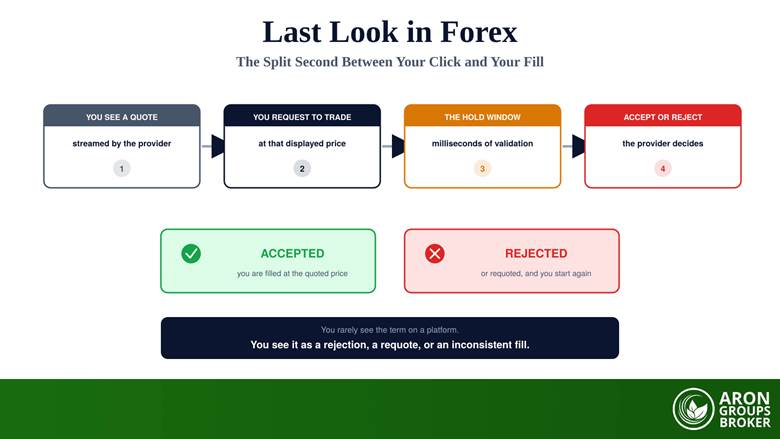

Last look is a practice in foreign exchange where a liquidity provider that streamed you a price gets a brief final window, measured in milliseconds, to accept or reject your trade request at that price after you have asked to trade on it. You clicked a price you could see. The provider then checks whether it still wants to honour it.
Most retail traders have experienced last look without ever hearing the term. It arrives as an order rejection, a requote, or a fill that seems inconsistent with what was on screen, and it becomes far more visible during news releases. Understanding the mechanism will not remove it, but it explains a category of frustration that otherwise looks like a broken platform, and it gives you specific questions to ask about execution rather than vague suspicion, which is a genuine part of building a trading edge.
Below: how the window works and what is checked inside it, the case liquidity providers make for it, the asymmetry question that sits at the centre of the controversy, what the FX Global Code says in Principle 17, the difference between firm and last-look liquidity, how all of this reaches a retail account, and how to evaluate execution using numbers rather than marketing.
- Last look gives a liquidity provider a final window of milliseconds to accept or reject your trade request at its own quoted price.
- Providers argue it protects them from stale-quote and latency arbitrage, which lets them stream tighter prices than they otherwise could.
- Asymmetric last look, rejecting only trades that moved against the provider, is the central criticism, alongside excessive hold times and pre-hedging.
- The FX Global Code’s Principle 17 frames last look as a risk control for price and validity checks only, and disallows using the window to gather information.
- It reaches retail traders as rejections and requotes rather than as slippage, and reject rates jump during news.
What Is Last Look?
The sequence has four steps. A liquidity provider streams you an indicative price. You send a request to trade at that price. The provider runs a check inside a short hold window. It then accepts, filling you at the quoted price, or rejects, often returning a requote. The word indicative is doing quiet work in that first step: on a last-look venue, the streamed price is an invitation rather than a commitment. This structure exists because foreign exchange is a decentralised over-the-counter market spread across many dealers and venues, as the BIS triennial survey documents, rather than a single exchange where a match is final by definition.
Risk Disclosure
CFDs are complex instruments and come with a high risk of losing money rapidly due to leverage. You should consider whether you understand how CFDs work and whether you can afford to take the high risk of losing your money. Past performance is not indicative of future results. This content is provided for educational purposes only and does not constitute investment advice.
What Is Actually Checked
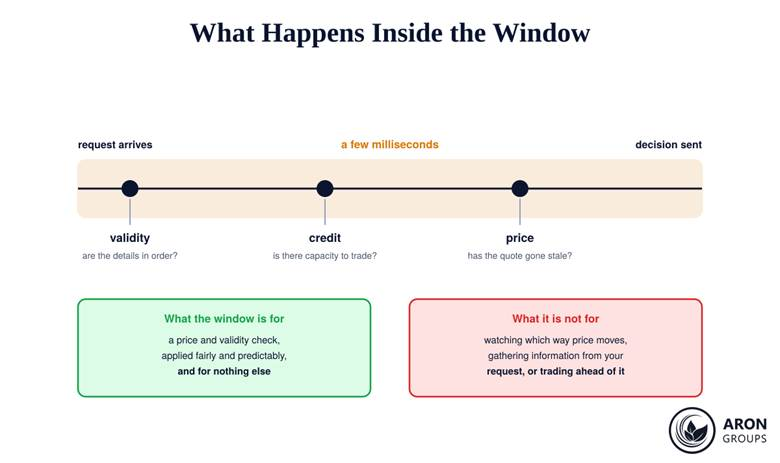
Three checks are legitimate under industry guidance. Validity confirms the request’s details are operationally sound. A credit check confirms there is capacity to enter the trade. And the price check asks whether the streamed quote has gone stale in the milliseconds since it was sent. That third check is the whole point of the practice and also the source of every argument about it, because deciding whether a quote is stale requires comparing it with a newer price, and once you are comparing prices you are, in effect, deciding whether the trade would be profitable for you.
Three checks inside a window of milliseconds, and a clear line between what the window is for and what it is not.
The Case Liquidity Providers Make
The argument in favour is coherent and worth stating fairly. In a fragmented market, a provider streams prices to many clients simultaneously across multiple venues, and it takes measurable time for a request to travel from a client’s system to the provider’s. In that interval the market can move. Without a final check, a fast participant with better connectivity could systematically pick off quotes that are already out of date, a practice known as latency arbitrage, and the provider would lose money on precisely the trades it was least able to refuse.
Providers therefore argue that last look is what allows them to stream tight prices at all. Remove it, they say, and the same firm must widen its spreads to cover the risk of being arbitraged, so clients pay for certainty of execution in the spread instead. That trade-off is real, and it is the reason the practice survived reform rather than being banned.
The Asymmetry Question
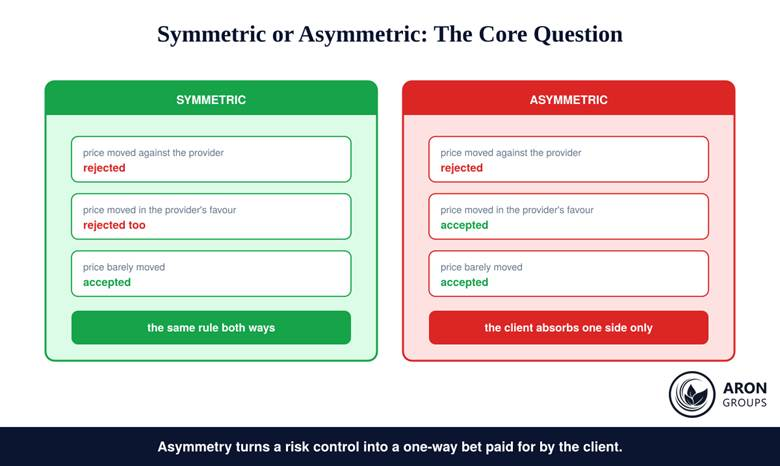
Here is where a defensible risk control becomes a live controversy. A symmetric last look rejects trades whenever price has moved beyond a tolerance, in either direction, so the client is treated the same whether the move helped or hurt the provider. An asymmetric last look rejects only when the move went against the provider, and accepts when it went in the provider’s favour. The provider keeps the good outcomes and declines the bad ones, and the client absorbs one side of a two-sided risk.
The same three scenarios under two rules: symmetry treats both directions alike, asymmetry does not.
| Practice | What it looks like | Why it is criticised |
|---|---|---|
| Symmetric checks | Rejections in both directions on the same tolerance | Generally accepted as a genuine risk control |
| Asymmetric checks | Rejections only when price moved against the provider | The client bears one-sided risk for the provider’s benefit |
| Extended hold time | A longer window before the accept or reject decision | Functions as a free option on the market at your expense |
| Pre-hedging on your request | Trading on the information in your pending order | Uses confidential information from a request not yet accepted |
One row is a control; the other three are the practices reform has been aimed at.
Q: Is asymmetric last look illegal?
A: It is not a criminal matter in itself, and the position varies by jurisdiction and by what was disclosed. What is clear is that conduct around currency benchmarks and execution has drawn substantial regulatory action historically, and that the industry’s own code now pushes firmly toward symmetric application and full disclosure. The practical question for a client is not legality but whether the provider tells you which approach it uses.
What the FX Global Code Says
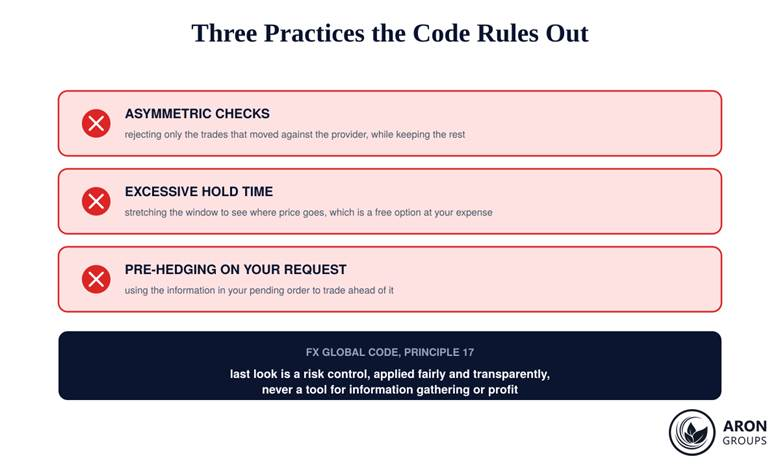
The FX Global Code, maintained by the Global Foreign Exchange Committee, addresses last look directly in Principle 17, and its framing is the single most useful reference point in this whole subject. The Code treats last look as a risk-control mechanism, to be used for verifying validity and price and for no other purpose. It states that the participant has sole discretion over acceptance based on those checks, which leaves the client carrying market risk if the request is declined, and it therefore insists the practice be applied fairly, predictably, and transparently.
Three practices the Code rules out, and the single sentence that defines what last look is for.
Two specifics are worth knowing. Principle 17 explicitly disallows using last look for information gathering with no intention of accepting the request. And following a market consultation, the Code was revised in December 2017 to state that participants should not undertake trading activity that uses information from the client’s trade request during the last look window, with narrow clarifications for certain arrangements sometimes called cover and deal. Providers are also expected to disclose how price movements in either direction affect their decision, and the typical duration of that decision.
Did You Know?
The Code is voluntary rather than law, which matters. Adherence is a public commitment a firm chooses to make, so the useful question is not whether the Code exists but whether your provider says it follows it and publishes the disclosures the Code asks for.
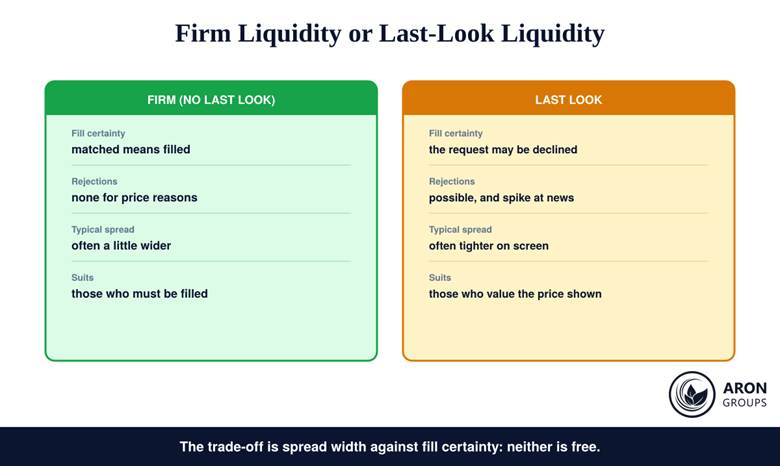
Firm Liquidity and Last-Look Liquidity
The alternative model is firm liquidity, sometimes marketed as no last look. On a firm venue the displayed price is a commitment: once your order is matched, it is filled, with no final discretion and no price-based rejection. Some venues built their entire proposition on this, and for participants who must be filled, the certainty is worth paying for.
Certainty of fill or tightness of quote: the two models sell different things.
The trade-off is usually spread width against fill certainty. Firm liquidity carries no rejection risk but often shows a slightly wider price, because the provider cannot decline the trades that hurt it and must price that in. Last-look liquidity often shows tighter, but part of what you see is conditional. Neither is a free lunch, and a screen price alone cannot tell you which you are looking at.
How Last Look Reaches a Retail Account
Retail platforms do not display a last-look field, so the practice surfaces indirectly. It appears as rejected orders, as requotes on instant-execution setups, and as inconsistent fills during volatile moments, and reject rates typically climb during major releases when quotes go stale fastest. One clarification matters here, because the two get conflated constantly: last look does not directly cause slippage. Slippage happens when price genuinely moves between your request and your execution. In a last-look arrangement, that same movement tends to produce a rejection or a requote instead, which is why disciplined position sizing and a realistic risk-to-reward ratio have to allow for the possibility that an entry simply does not happen.
Mini Example: Two Ways the Same Move Reaches You
A trader clicks to buy just as a data release lands. On a firm, market-execution route the order is filled, but two pips worse than displayed because the book moved while the order travelled. The trader is in the market at a worse price: that is slippage.
On a last-look route the provider’s price check sees that the quote is now stale against it and declines the request. The trader is not in the market at all, and sees a rejection or a requote. Same market movement, two entirely different outcomes, and only one of them is slippage.
How to Evaluate Execution Properly
Judge execution by numbers rather than by labels, and ask your broker directly. Four questions cover most of it: what is the rejection rate on my account type, what is the typical hold time before an accept or reject decision, is price movement treated symmetrically in both directions, and is slippage reported alongside price improvement rather than only when it costs me. A firm that can answer those plainly is telling you something; one that answers with marketing language is also telling you something. Regulators’ advisories on retail forex trading make the same general point, that knowing who you are dealing with and on what terms is a trader’s first line of defence.
Then measure your own experience rather than relying on answers. Log your rejections, note the sessions and events they cluster around, and compare fills against displayed prices over a few hundred trades. That is the kind of record a systematic process can actually use, and it is more informative than any single dramatic rejection you remember. European product intervention rules standardise several protections across execution models, but they do not measure your fills for you.
Where Aron Groups Fits
Aron Groups’ ECN accounts run market execution on the MetaTrader 5 platform, which means orders are filled at the next available price rather than returned as requotes, and spreads float with the underlying market. What market execution does not by itself tell you, at any broker, is whether the liquidity providers behind that pricing apply last look on their side, since that sits upstream of the platform you see.
So use the four questions above on us as readily as on anyone else, through the support channels or the FAQ, and get the answer in writing for the account type you intend to open. Then verify it yourself: run your strategy on a demo account through a couple of news releases, move to a small account for live measurement, and judge the result by a steadier equity curve and a rejection log rather than by any claim, including ours.
Conclusion
Last look is a short window in which the provider that quoted you decides whether to stand behind that quote. Defended as protection against stale-quote arbitrage, it is genuinely that when applied symmetrically, briefly, and with disclosure. Applied asymmetrically, stretched out, or used to read your intentions, it becomes something else, which is why Principle 17 of the FX Global Code confines it to price and validity checks and rules out trading on information from the window.
For a retail trader the practical takeaway is narrow but useful. Rejections and requotes are not always platform faults; they can be a market structure you were never shown. Ask about reject rates, hold times, and symmetry, keep your own log, and let sound risk management and capital preservation carry the weight that certainty of execution never will. That is how a professional trader treats execution: as a measurable cost, not an article of faith. The mechanics underneath it all are covered in our guide on how to trade forex.
Frequently Asked Questions
Quick answers to the questions traders ask most about last look and order rejections.
What is last look in forex?
It is a practice where a liquidity provider that streamed you a price has a final window of milliseconds to accept or reject your trade request at that price. The provider checks validity, credit, and whether its quote has gone stale before confirming the trade.
What is asymmetric last look?
It is applying the price check in only one direction: rejecting requests when the market has moved against the provider while accepting those that moved in its favour. Symmetric application treats both directions the same way, and industry guidance pushes strongly toward symmetry and disclosure.
Does last look cause slippage?
Not directly. Slippage comes from price moving between your request and your fill. In a last-look arrangement the same movement usually produces a rejection or a requote rather than a worse fill, so last look shows up as orders that do not happen rather than orders that fill badly.
What does no last look mean?
It describes firm liquidity, where the displayed price is a commitment and a matched order is filled without a final discretionary check. The usual trade-off is a slightly wider quoted spread in exchange for certainty that a matched trade will not be declined.