
icon icon Home
icon icon Accounts
icon icon Quick start
icon icon Symbols

Forex Fixing and the London 4pm Fix: Benchmark Rates, Volatility, and How to Trade the Fix

Author
Abe Cofnas
Abe Cofnas
calendar Last update: 15 August 2026
watch Reading time: 9 min

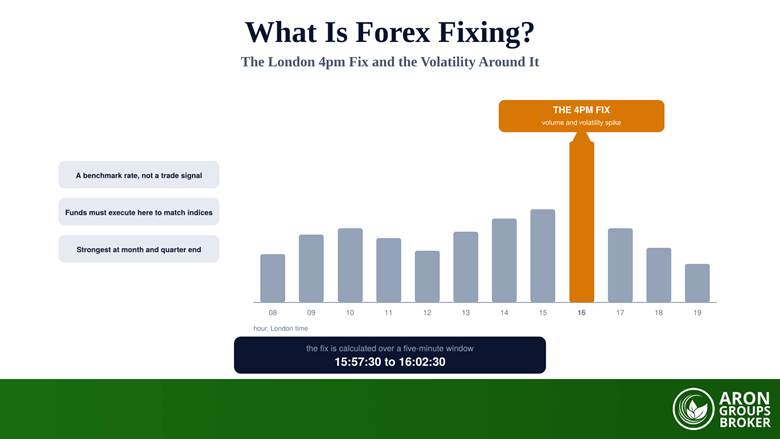
A forex fixing is a benchmark exchange rate captured at a set time each day and used as a common reference: to value portfolios, to settle contracts, and to execute large orders at a rate everyone agrees on afterwards. The most important one is the London 4pm Fix, and it matters to retail traders for a reason that has nothing to do with valuation. Enormous flows concentrate into a few minutes, so volume and volatility spike at a time you can predict to the second.

That predictability is the whole point of this article. You cannot know which way the fix will push price, but you can know exactly when the push is coming, and knowing when is enough to stop donating stops to it. In a market whose daily turnover the BIS measures in trillions of dollars, the busiest five minutes of the London afternoon deserve a place in your routine rather than a surprise on your chart.

Below: what the fix is and how the London 4pm calculation actually works, who trades at it and why they have no choice, why month-end and quarter-end are the strongest, how to handle the window without getting hurt, the other fixings spread across the trading day, and a plain account of the 2014 scandal and the reform it produced.

bookmark
Key Takeaways
  • A fixing is a benchmark exchange rate set at a fixed time each day; the London 4pm Fix, run by WM/Refinitiv, is the most widely used.
  • It is calculated from actual market activity over a five-minute window running from 15:57:30 to 16:02:30 London time.
  • Index funds, pension funds, and asset managers execute at the fix so their fills match the benchmark their performance is measured against.
  • Volume and volatility spike predictably in the window, and month-end and quarter-end rebalancing makes the effect much larger.
  • The practical rule is defensive: do not run tight stops through the window, and reduce size or stand aside until the volatility settles.

What Is Forex Fixing?

Currencies trade continuously across a decentralised market, which creates an awkward problem: at any instant there is no single official price for a currency pair, only many slightly different quotes from many venues. Yet pension funds must value holdings, auditors must sign off statements, and contracts must settle at a number both sides accept. A fixing solves that by declaring one rate, captured at one agreed moment, as the reference. It is a valuation and settlement tool first, and the trading consequences are a side effect of everyone needing to use it.

sms-star

Risk Disclosure
CFDs are complex instruments and come with a high risk of losing money rapidly due to leverage. You should consider whether you understand how CFDs work and whether you can afford to take the high risk of losing your money. Past performance is not indicative of future results. This content is provided for educational purposes only and does not constitute investment advice.
Who Runs the London Fix

The benchmark most people mean is the WM/Reuters closing spot rate, now published as WM/Refinitiv after Refinitiv became part of the London Stock Exchange Group. Rates are produced through the day, hourly and half-hourly for the busiest pairs, but the 16:00 London rate is the one that dominates, because it coincides with the London close and with the overlap that makes London the deepest currency centre in the world.

How the London 4pm Fix Is Calculated

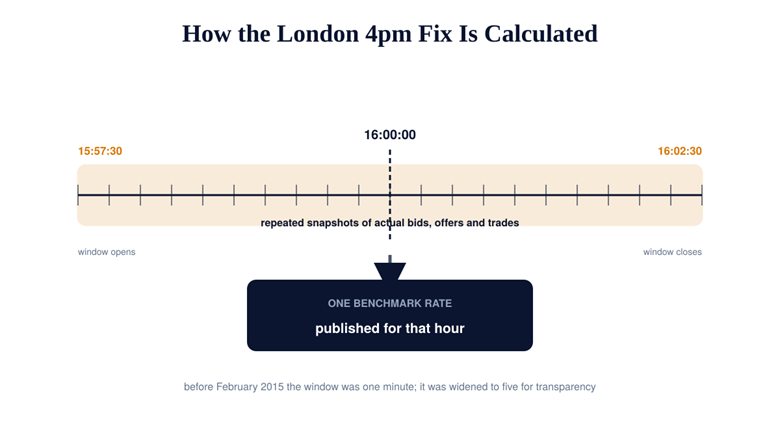
The calculation is not a snapshot of one price at one instant. Over a five-minute window running from 15:57:30 to 16:02:30 London time, the administrator repeatedly samples actual bids, offers, and trades from multiple venues, then derives the published rate from that sample. Using real activity over minutes rather than a single tick makes the result far harder to nudge, which is precisely why the window is that length.

The five-minute London 4pm fix window from 15:57:30 to 16:02:30

Two and a half minutes either side of four o’clock, sampled repeatedly, condensed into one published rate.

That window is itself a reform. Until February 2015 the calculation used a one-minute window, thirty seconds either side of the hour, which compressed vast order flow into a very short space and made the benchmark easier to influence. Following recommendations from the Financial Stability Board in 2014, the window was widened to five minutes to spread execution out and improve transparency. Knowing that history explains the odd-looking timestamps, and it is also a reminder that benchmarks are infrastructure that gets repaired rather than laws of nature, a distinction that any systematic process built on them should respect.

Why Funds Trade at the Fix

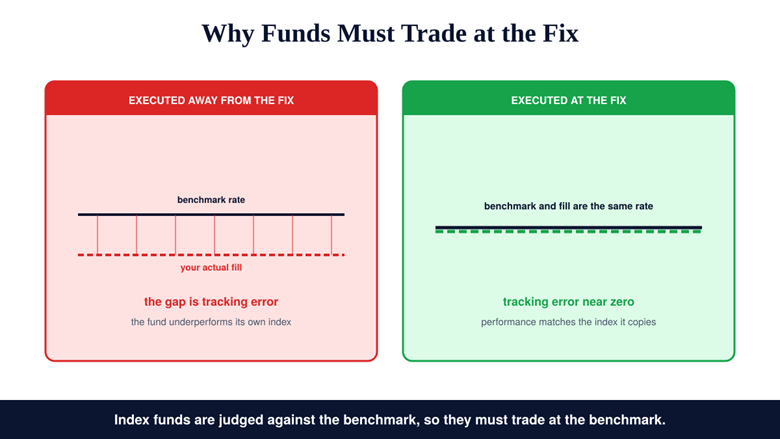
This is the part that explains the volume, and it is not speculation. An index fund tracking a global equity benchmark is measured on how closely it matches that benchmark, and the benchmark values its currency exposure at the fix. If the fund converts currency at any other rate, its return drifts away from the index it is supposed to copy, and that drift is called tracking error. The fund manager is not trying to profit from the fix; they are trying to eliminate a difference they are penalised for.

Why index funds execute at the fix to avoid tracking error

Execute at the benchmark and tracking error nearly vanishes; execute anywhere else and it accumulates.

The same logic pulls in pension funds rebalancing international allocations, corporates valuing and hedging currency exposure, and custodians converting dividends and coupons for clients. All of them arrive with orders that must be executed at one specific rate, which means arriving in one specific window. That is how a valuation convention turns into the busiest few minutes of the afternoon.

Q: Does the fix set the market price for the rest of the day?

A: No. The fix is a published reference taken from the market, not a price the market must then respect. Once the window closes, price continues wherever supply and demand take it, and it frequently retraces part of the move that the fix flows caused.

Why Month-End and Quarter-End Are Bigger

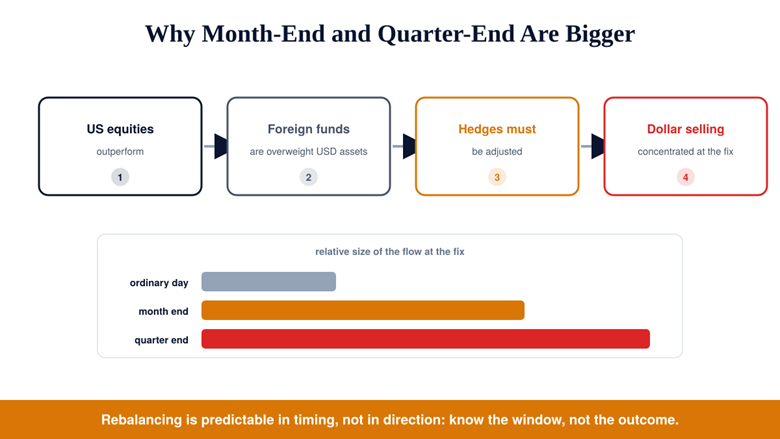
Rebalancing is calendar-driven, so the fix has a rhythm. At the end of a month, and more strongly at the end of a quarter, funds adjust allocations and currency hedges back to target weights, and those adjustments land at the fix together. The chain is mechanical: if one region’s equities have outperformed, foreign investors are left overweight that region’s assets and currency exposure, their hedges no longer match, and the correction becomes a large one-directional order at 4pm London.

Month-end and quarter-end rebalancing flows landing on the 4pm fix

The same mechanism every month, amplified at quarter end: predictable timing, and only sometimes predictable direction.

OccasionWhat is happeningWhat a trader should expect
Ordinary dayRoutine valuation and client flowA modest, brief volume and volatility bump
Month endFunds rebalance allocations and hedgesA larger spike, often with a partial retrace after
Quarter endRebalancing plus reporting requirementsThe strongest flows of the cycle; widest spreads
Public holiday nearbyThinner liquidity into the same flowExaggerated moves on less depth

Timing is the reliable part of this table; direction is not, which is why the guidance below is defensive.

Mini Example: A Quarter-End Afternoon

Through a strong quarter for US equities, foreign funds holding those shares end up overweight both the assets and the dollar exposure attached to them. To return to target and re-strike their hedges, many need to sell dollars.

Those orders converge on the 4pm window on the final business day of the quarter. Dollar pairs move sharply for a few minutes, spreads widen, and a portion of the move unwinds afterwards because the flow was mechanical rather than directional conviction. A trader who happened to hold a tight stop just beyond the noise is taken out by an order flow that had no opinion about their trade.

How to Handle the Fix Window

The honest advice here is protective rather than clever. Do not run tight stops through the window, because volatility can spike and then reverse, and a stop placed inside normal noise becomes a stop placed inside abnormal noise for five minutes. If you want to fade an extreme fix move, wait for exhaustion and confirmation after the window closes rather than during it. And most of the time the best available choice is the dullest: reduce size or stand aside until the fix-related volatility subsides, which is ordinary risk management applied to a known calendar event rather than a special technique.

sms-star

Rule
Put 16:00 London in your trading plan the way you would put a central bank decision in it. You do not need a view on the fix to benefit from knowing it exists; you only need to stop being surprised by it.

For traders who do want to engage, two disciplines matter more than any pattern. Size from the stop distance using deliberate position sizing, allowing for spreads that widen in the window, and demand a defined risk-to-reward ratio before entry, since a wider stop needs a proportionally larger target to remain worth taking. Volatility context from tools such as Keltner Bands helps distinguish a fix move that is genuinely outsized from one that only feels dramatic.

Other Fixings Worth Knowing

London 4pm is the largest but not the only one, and the others explain small pockets of activity that otherwise look random on a chart.

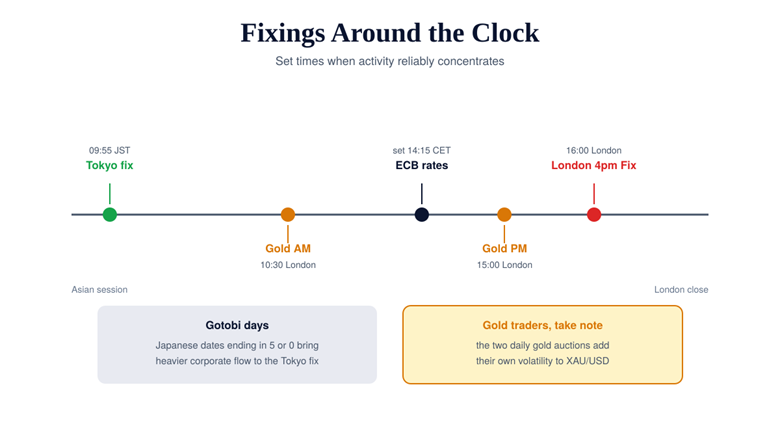
Daily FX fixing times from the Tokyo morning fix to the London close

Set times across the trading day where activity reliably concentrates, from the Tokyo morning to the London close.

  • The Tokyo fix, at 09:55 Japan time, gathers Japanese corporate flow. It is heavier on so-called Gotobi days, dates ending in five or zero, when settlement activity clusters.
  • The European Central Bank’s euro reference rates are determined at 14:15 CET and published around 16:00 CET. Note the important distinction: the ECB states these are for information only and discourages their use in transactions, so they are a reference rather than an execution benchmark.
  • Gold has two daily London auctions, at 10:30 and 15:00 London time, now run electronically as the LBMA Gold Price. If you trade XAU/USD, these are your equivalent of the 4pm fix.

Q: Is the Bloomberg FX fixing the same as the London 4pm Fix?

A: No. Bloomberg publishes its own benchmark rates, and other providers and central banks do too. They are calculated from their own methodologies at their own times. When someone refers to the fix without qualification in a currency context, they almost always mean the WM/Refinitiv 16:00 London rate.

The 2014 Fixing Scandal and What Changed

The fix acquired its reputation for a reason, and the facts are settled and public. In November 2014, regulators concluded a coordinated set of actions over conduct in currency benchmark trading: the UK Financial Conduct Authority fined five banks about 1.1 billion pounds, the US Commodity Futures Trading Commission imposed penalties of more than 1.4 billion dollars on the same firms, and the Swiss regulator FINMA ordered a disgorgement from one of them, bringing the combined total to roughly 3.4 billion dollars. The US Office of the Comptroller of the Currency imposed further penalties separately. The findings concerned inadequate controls and attempts to manipulate benchmark rates, including trading ahead of client orders around the fix. Regulators’ own advisories on currency trading remain the best primary reading on how the market is supervised now.

The reform that followed is the reason the window looks the way it does today. Widening the calculation from one minute to five spread execution over a longer period and made the benchmark harder to influence, and the industry adopted a global code of conduct covering behaviour around benchmarks. It is worth stating plainly that the episode was about institutional conduct in the interbank market, not about retail brokers or retail order flow.

What This Means for Retail Traders

Strip out the history and the practical residue is small but genuinely useful. There is one hour of the London afternoon when order flow is heavier than conviction warrants, its timing is published, and its effects often partly unwind. That is a real piece of market structure to build around, and building around it is a modest edge of the ordinary kind: knowing when not to be exposed. The base rates deserve their usual mention, since European regulators found the large majority of retail accounts lose money on leveraged products, and volatility events are where a great deal of that happens.

Where Aron Groups Fits

The tooling for this is simple and already on your platform. Mark 16:00 London on your charts, note the final business day of each month and quarter, and set alerts rather than watching, then execute on the MetaTrader 5 platform with stops placed outside the window’s noise rather than inside it.

If you have never traded through a quarter-end fix, watch one on a demo account before you hold a position through the next. When you do go live, a small account keeps the first lesson affordable.

The test of whether the fix belongs in your rules is whether it smooths your equity curve over months, ideally verified through out-of-sample backtesting rather than judged on one memorable afternoon. The underlying mechanics of entries and exits are covered in our guide on how to trade forex.

Conclusion

Forex fixing exists because a continuous, decentralised market still needs one agreed number. The London 4pm Fix is the number that matters most, calculated from real activity over five minutes either side of four o’clock, and the flows that must execute there make it the most predictable volatility event of the London afternoon.

You do not need to predict the fix to use it. Know the window, widen or move your stops away from it, respect month-end and quarter-end, and treat any fade as a post-window decision rather than an in-window reflex. That is how a professional trader treats every scheduled event: as a reason to manage exposure, with capital preservation ahead of curiosity.

Frequently Asked Questions

Quick answers to the questions traders ask most about forex fixing and the London 4pm Fix.

What is FX fixing?

FX fixing is the process of setting a benchmark exchange rate at a fixed time each day, based on market activity around that time. The resulting rate is used to value portfolios, settle contracts, and execute large orders at a common reference price.

What time is the London 4pm Fix?

The rate is struck for 16:00 London time and calculated over a five-minute window from 15:57:30 to 16:02:30. Because it is London time, its position in your own time zone shifts when British clocks change in spring and autumn.

Why does volatility spike at the fix?

Because a great many large orders must be executed at that specific rate, so they all arrive in the same few minutes. The concentration of one-directional flow moves price and widens spreads, and part of the move often unwinds afterwards because the flow was mechanical rather than a view on value.

Should I trade the London fix?

Most traders are better served by defending against it than by trading it: avoid tight stops in the window and consider reducing size. If you do trade it, wait for the window to close and for signs of exhaustion, and size for spreads that are temporarily wider than normal.

Continue Reading
not-found
calendar 15 August 2026
Rate this article

Leave a Reply

Your email address will not be published. Required fields are marked *

No thanks