





Successful trading is not only about good entries but also about strong risk management. A stop loss protects capital by limiting losses when the market moves unexpectedly.
The best stop loss strategy relies on tools such as volatility indicators, market structure, and risk-to-reward analysis rather than arbitrary price levels. This guide explains practical stop-loss methods and examples across Forex, crypto, stocks, and options.

- A stop loss protects capital and prevents uncontrolled losses.
- Use volatility tools like ATR; Dynamic stops based on market volatility reduce the chance of premature exits.
- Different trading styles and markets require different stop-loss approaches.
- Automated orders and trailing stops help remove emotions and protect profits as market conditions evolve.
Why Stop Loss Matters in Trading
A stop loss is one of the most important risk management tools in trading. It automatically closes a trade when the price reaches a predefined level. This simple mechanism protects trading capital and prevents emotional decision-making during volatile market moves.
Professional traders rarely enter a trade without a stop loss. Their goal is not only to make profits but also to control downside risk. In fact, many trading strategies are built around capital protection first, then profit generation.
A strong best stop loss strategy provides several advantages:
- Protects your trading account from unexpected market shocks
- Keeps losses small and predictable
- Improves long-term Risk-to-Reward ratio (R: R)
- Removes emotional hesitation when the market moves quickly
Understanding Stop Loss to Protect Your Capital
Capital protection is the first rule of trading. Once capital is lost, recovering it becomes mathematically difficult. A 50% loss requires a 100% gain just to break even.
A stop loss acts as a financial safety barrier. It limits the amount of money you lose on a single trade. Most experienced traders risk only 1–2% of their account per trade.
Example:
- Trading account: $10,000
- Maximum risk per trade: 1% = $100
If a trader enters a Gold trade at $2,000 with a stop loss at $1,990, the risk per ounce is $10. To keep risk at $100, the trader can trade 10 ounces.
Q: Why do professional traders care so much about stop loss placement?
A: Because trading success depends more on risk control than on perfect entries.

Pro tip:
Platforms like MetaTrader and TradingView allow traders to set stop losses instantly when opening a position. This automation prevents hesitation during fast market moves.
Using Stop Loss to Prevent Large Losses
Markets can move quickly due to economic news, interest rate decisions, or sudden liquidity changes. Without a stop loss, a losing position can expand rapidly.
A classic example occurs during high-impact news events. Imagine a trader buys Bitcoin at $85,000, expecting a breakout. Suddenly, negative regulatory news appears, and the price drops to $82,000 within minutes:
- With a stop loss at $84,200, the loss remains controlled.
- Without a stop loss, the trader could lose thousands of dollars.
Stop losses also protect traders in whipsaw markets, where prices move sharply in both directions. In these conditions, predefined exits prevent emotional reactions, such as holding a losing trade in the hope of a recovery.
Key insight:
Your stop loss is the price at which your trading idea becomes invalid. Once that level is hit, the market has proven the trade wrong. The disciplined decision is to exit and preserve capital for the next opportunity.
Core Principles of the Best Stop Loss Strategy
A well-placed stop should protect capital while allowing the trade enough room to move naturally.
Many beginners place stops too close to the entry. As a result, normal price fluctuations trigger the stop even when the trade direction was correct. Skilled traders avoid this by using risk management rules and market context.
Applying Risk-to-Reward Ratio (R: R) in Stop Placement
According to FBS, the Risk-to-Reward ratio (R: R) measures how much a trader is willing to risk on a trade compared to the potential profit.
The formula is straightforward:
Risk-to-Reward Ratio (R:R) = Potential Loss ÷ Potential Profit
For example:
- Entry price: EUR/USD at 1.1000
- Stop loss: 1.0970 → risk = 1.1000 -1.0970 = 30 pips
- Take profit: 1.1060 → reward = 1.1060 – 1.1000 = 60 pips
R:R = 30 ÷ 60 = 1:2
This means the trader risks 1 unit to potentially gain 2 units.
Since the stop loss determines the risk side of the ratio:
- If the stop is too wide, the trade may require an unrealistic profit target.
- If it is too tight, normal market noise may trigger it early.
Professional traders often follow these R: R guidelines:
- Minimum R: R = 1:2 for most swing and trend trades
- 1:1.5 to 1:2 for intraday setups
- Higher ratios for breakout trades in volatile markets
Preventing Whipsaw Market Losses with Smart Stops
A whipsaw market occurs when the price moves quickly in one direction, then reverses sharply. This is common during periods of low liquidity or major economic news releases.
In these situations, tight stops are often triggered even though the overall trend remains valid.
Smart stop placement helps reduce this problem. Traders often use technical structure instead of fixed numbers, such as:
- Beyond recent swing Highs/ lows
- Beyond support and Resistance levels
- Outside the Average True Range (ATR) volatility zone
Implementing Break-even Stops Effectively
A Break-even stop moves the stop loss to the entry price after the trade becomes profitable. This eliminates risk while keeping the position open for further gains.
However, break-even stops must be used carefully. Moving them too early can close trades prematurely during normal market pullbacks.
Pro Tip:
Professional traders usually wait for a break-even stop move until the trade reaches 1R profit.
Technical Methods for Stop Loss
Technical analysis offers several precise methods for placing stop losses. Below are four practical stop-loss techniques widely used across Forex, crypto, stocks, and options trading.
Setting Dynamic Stops with Average True Range (ATR)
The Average True Range (ATR) measures market volatility. It calculates the average price movement over a set number of periods, usually 14 candles.
Unlike fixed stops, ATR-based stops adjust automatically when markets become more volatile.
Example:
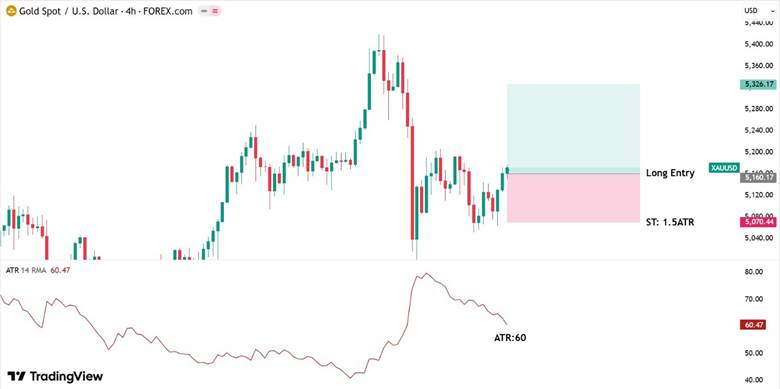
Suppose the ATR on Gold (XAU/USD) is $60. A trader may place the stop using a volatility multiplier:
- 1 × ATR stop → $60 distance
- 1.5 × ATR stop → $90 distance
- 2 × ATR stop → $120 distance
Trade example:
- Entry: Gold at $5160
- ATR = $ 60
- Stop using 1.5 ATR
Calculation: Stop loss = 5160 − (1.5 × 60) = 5070
Q: Why do traders prefer ATR stops in volatile markets?
A: Because ATR reflects real market movement, making stop placement adaptive rather than arbitrary.
Using Swing Highs and Lows as Stop Points
According to Investopedia, using swing highs and swing lows as stop-loss levels is also a widely used method among traders. This method relies on the idea that if price breaks a recent structural level, the original trading setup may no longer be valid.
A common technique is the multiple-day high/low stop method. In this approach, the stop loss is placed at the lowest price over a predetermined number of days during an uptrend, or at the highest price over recent days during a short trade.
Applying Moving Averages for Support and Resistance
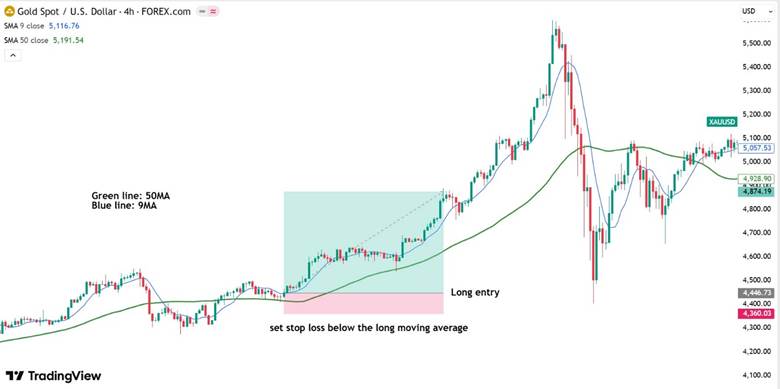
Another widely used stop-loss technique is the moving average method, in which traders place stops relative to a longer-term moving average that serves as dynamic support or resistance.
In this method, traders avoid using short-term price noise as a reference. Instead, they place stop losses slightly beyond a longer-term moving average, allowing the trade to remain active as long as the broader trend remains intact.
Using moving averages in this way allows traders to align their stop placement with the prevailing trend structure. If price breaks decisively through the moving average, it may signal that the trend is weakening or reversing, making it a logical point to exit the trade.
Managing Fixed Percentage Risk for Consistency
One of the simplest and most disciplined stop-loss methods is the fixed percentage risk method. Instead of focusing solely on price distance, traders define the maximum percentage of capital they are willing to risk per trade.
Most professional traders risk:
- 0.5% to 1% per trade for conservative strategies
- 1–2% per trade for active trading strategies
When applied consistently, this technique becomes a core component of the best stop-loss strategy for long-term trading success.
Tailoring Stop Loss for Different Markets
A stop loss must match the market behaviour you trade. Forex pairs often move with moderate volatility, stocks can trend with earnings cycles, and cryptocurrencies frequently experience sharp price swings.
When the stop distance aligns with volatility and market structure, traders reduce random stop-outs and improve overall trade stability.
Professional traders usually consider three factors before setting stops in different markets:
- Market volatility
- Trading timeframe
- Liquidity and spread conditions
Applying the Best Stop Loss Strategy for Intraday Trading
Intraday trading requires faster decisions and tighter stop placement because trades typically last minutes or hours rather than days.
Day traders often combine technical levels and volatility indicators to determine stop distance. Popular tools include:
- Average True Range (ATR) for measuring intraday volatility
- VWAP or moving averages as dynamic support/resistance
- Recent swing highs or lows
Intraday traders must also consider spreads and market noise. Placing stops too close can trigger premature exits, especially during high-liquidity periods like the London–New York overlap.
Applying the Best Stop Loss Strategy for Options Trading
According to Walletinvestor, the price of an option does not depend only on the movement of the underlying asset. It is also affected by time decay (Theta). As expiration approaches, the option’s value can decline gradually—even if the underlying asset moves in the expected direction.
Because of this, placing a stop-loss directly on the option premium can result in early exits.
On the other hand, options are often more volatile than the underlying asset. Sudden price swings may trigger stops unexpectedly.
To reduce these risks, traders commonly combine several elements to apply the best stop loss strategy for options trading:
- Technical levels from the underlying asset
- A predefined percentage risk per trade
- Awareness of time decay (Theta)
Applying the Best Stop Loss Strategy for Crypto Markets
Cryptocurrency markets are known for high volatility and rapid price movements. Daily swings of 5–10% are common, especially in assets like Bitcoin, Ethereum, or smaller altcoins.
Because of this volatility, crypto traders usually place wider stops compared to Forex or stock markets. This wider stop helps avoid premature exits caused by normal crypto price swings.
Pro Tip:
Because crypto markets operate 24/7, automated stop-loss orders are particularly important. They protect positions even when traders are not actively monitoring the market.
Adjusting Stops for Volatile and Stable Market Conditions
Market conditions constantly change. Some periods show strong trends with smooth price movement, while others produce choppy or whipsaw markets.
Experienced traders constantly monitor volatility indicators such as ATR, Bollinger Bands, or market range. When volatility expands, stops are widened, and position size is reduced. When markets calm down, stops can be tightened to improve the Risk-to-Reward ratio (R: R).
adjusting stop-loss placement depending on market volatility
| Market Condition | Stop-Loss Adjustment | Practical Explanation |
|---|---|---|
| Volatile Markets | Use wider stops | Large price swings can trigger tight stops quickly, so wider stops allow trades to survive normal volatility. |
| Consider ATR-based volatility stops | Using Average True Range (ATR) helps match the stop distance to the market’s actual volatility. | |
| Reduce position size | A wider stop increases potential loss, so traders lower their position size to keep risk within limits. | |
| Stable Markets | Use tighter stops | When price moves slowly, smaller stops can protect capital without risking premature exits. |
| Focus on support and resistance levels | Key technical levels become more reliable reference points for stop placement. | |
| Maintain closer trade management | Traders can adjust stops more actively because price movements are smaller and more predictable. |
Enhancing Stop Loss Efficiency
Placing a stop loss is only the first step in risk management. To build the best stop-loss strategy, traders must also learn to manage and adjust their stops as the trade evolves. Efficient stop management protects profits while still allowing trades enough room to develop.
Using Trailing Stops vs Fixed Stops Strategically
Two common types of stop-loss management are fixed stops and trailing stops. Each has a different role depending on the trading strategy.
A fixed stop remains at the same price level from entry until the trade closes. It is usually placed at a logical technical level, such as:
- Below a support level
- Above a resistance level
- Beyond a swing high or swing low
In contrast, a trailing stop moves automatically as the price moves in the trader’s favour. This helps lock in profits while keeping the position open during strong trends.
Trailing stops are especially useful in trend-following strategies, where traders aim to capture large price movements.
Quick comparison: fixed stops Vs trailing stops
| Stop Type | Main Purpose |
|---|---|
| Fixed Stop | Define maximum risk |
| Trailing Stop | Protect and lock in profits |
Combining Multiple Indicators for Accurate Stop Placement
Relying on a single indicator for stop placement can sometimes lead to inaccurate exits. Many traders improve accuracy by combining multiple technical indicators.
This approach helps confirm whether a stop level aligns with both market structure and volatility conditions.
For example, a trader might combine:
- Average True Range (ATR) to measure volatility
- Swing highs and lows to identify structural levels
- Moving averages for dynamic support or resistance
Example setup:
- Entry: Bitcoin at $85,500
- ATR (14) = $900
- Recent swing low = $84,600
Instead of choosing only one reference point, the trader places the stop slightly below the swing low and outside the ATR range, for example, at $84,400.
Adjusting Stops for Swing and Trend Trades
Different trading styles require different stop-loss strategies. Swing and trend traders often use wider stops than intraday traders.
Swing traders typically hold positions for several days or weeks. Because price movements can fluctuate during this period, stops are often placed beyond major support or resistance levels.
Trend traders, on the other hand, often adjust stops gradually as the trend develops. One common method is moving the stop below each new higher low in an uptrend.
Reducing Emotional Decisions with Automated Stops
Emotions can strongly influence trading decisions. Fear may cause traders to exit too early, while hope can lead to holding losing trades for too long.
Automated stop-loss orders help eliminate these emotional reactions.
Benefits of automated stops include:
- Consistent risk management
- Faster execution during sudden price movements
- Protection during unexpected news events
- Reduced emotional interference
Avoiding Common Stop Loss Mistakes
While the best stop-loss strategy protects capital and improves risk management, poorly placed stop-losses can lead to frequent losses or missed opportunities. Many trading mistakes occur not because the strategy is wrong, but because the stop-loss level is poorly chosen.
Preventing Over-tight Stops That Trigger Early Exits
One of the most common trading mistakes is placing a stop loss too close to the entry price. While tight stops reduce potential loss, they also increase the probability of being stopped out by normal market noise.
For example, if the pair typically fluctuates 20–30 pips during a session, a 10-pip stop is likely to be triggered quickly—even if the market later moves higher.
Considering Market Structure in Stop Placement
Effective stop placement should reflect the market structure rather than arbitrary price distances.
Market structure refers to the pattern of support, resistance, swing highs, and swing lows that define price movement. These levels represent areas where buyers and sellers previously reacted strongly.
For example, in a bullish trend, instead of placing the stop randomly, place it slightly below the swing low. If the price falls below that level, the bullish structure is broken, and the trade idea is no longer valid.
Aligning Stops with Your Trading Strategy
Different trading styles require different stop-loss approaches. A stop suitable for intraday trading may not work for swing trading or long-term trend strategies.
For example:
| Trading Style | Typical Stop Approach |
|---|---|
| Intraday trading | Smaller stops based on short-term levels |
| Swing trading | Wider stops beyond key support or resistance |
| Trend trading | Trailing stops following higher lows or lower highs |
Updating Stops as Market Conditions Evolve
Markets are dynamic. Volatility, liquidity, and trend strength can change quickly. A stop-loss level that made sense at trade entry may become outdated as new price information appears.
By updating stops as conditions evolve, traders maintain disciplined risk control while maximising the potential of profitable trades.
Conclusion
Profitable trading depends not only on good entries but also on protecting capital when trades go wrong. A well-planned stop loss helps keep losses in check and helps traders stay consistent over time.
The best stop loss strategy combines market structure, volatility analysis, and disciplined risk management. Tools like ATR, swing highs and lows, moving averages, and fixed percentage risk help traders place logical stops instead of emotional ones.