

icon icon Home
icon icon Accounts
icon icon Quick start
icon icon Symbols

ICT Swing Failure Pattern (SFP): How to Trade Failed Highs and Lows in Forex

Author
Abe Cofnas
Abe Cofnas
calendar Last update: 18 May 2026
watch Reading time: 6 min

In modern Forex trading, price does not move randomly. It moves toward liquidity. The ICT Swing Failure Pattern (SFP) is one of the clearest ways to see this behaviour in action. It shows how price breaks a previous high or low, triggers stop losses, and then reverses sharply. This is not a coincidence—it is a liquidity-driven move.

In this guide, you will learn how SFP ICT, liquidity failure, and failed swing highs and lows work, along with practical entry techniques and real trading examples.

bookmark
Key Takeaways
  • ICT Swing Failure Pattern (SFP) is a liquidity-based pattern, not just a price reversal signal.
  • A valid setup requires breakout + rejection, not breakout alone.
  • Previous highs and lows act as liquidity targets for smart money.
  • Confirmation (such as MSS) improves entry accuracy and reduces risk.
  • Always combine SFP with proper risk management and structure analysis.


What is the ICT Swing Failure Pattern (SFP) and How It Works

The ICT Swing Failure Pattern (SFP) shows a false breakout driven by liquidity collection rather than genuine trend continuation. It is widely used in Forex, Gold, and crypto markets to identify high-probability reversal points.

Definition of ICT Swing Failure Pattern

According to TradingView, the ICT Swing Failure Pattern (SFP) is a price action setup that occurs when the market breaks a previous high or low but fails to continue in that direction. Instead, price quickly reverses, trapping breakout traders and targeting liquidity. This behaviour reflects how institutional players operate—seeking liquidity at highs and lows before moving the price in the opposite direction.

Key characteristics of SFP are as follows:

  • Break of a previous high or low
  • Failure to hold beyond that level
  • Strong rejection (fast move in the opposite direction)

This pattern, also known as SFP ICT or liquidity sweep, highlights where retail traders are trapped.

Why SFP ICT Signals Liquidity Manipulation

The core idea behind SFP is liquidity manipulation. Markets move toward areas where orders are concentrated, especially stop-losses placed above highs and below lows.

When price breaks a swing high, it triggers:

  • Buy stop orders from breakout traders
  • Stop losses from short positions

This creates a pool of liquidity. Once this liquidity is filled, institutions often reverse the price.

Understanding Market Structure Behind SFP ICT

To trade the Swing Failure Pattern effectively, traders must understand basic market structure. SFP does not occur randomly; it forms around key swing points where liquidity is concentrated. Recognising these levels helps identify where false breakouts are likely to happen.

Swing Highs and Swing Lows Explained

A swing high is a peak where price stops rising and begins to fall, while a swing low is a bottom where price stops falling and begins to rise. Swing highs/lows are important because they represent areas where traders place stop-loss orders.

For example:

  • Traders shorting near a high place stop above it
  • Traders buying near a low price stop below it

These stop orders create liquidity zones.

sms-star

Key idea:
Swing highs and lows are not just technical levels—they are liquidity targets.

How Failed Swing High/Low ICT Forms

A failed swing high or low forms when the price breaks one of these key levels but cannot sustain the move.

Step-by-step process:

  • Price approaches a previous swing high (e.g., 1.1000)
  • Price breaks above it (e.g., 1.1015) → liquidity is triggered
  • Price fails to hold and quickly returns below 1.1000

This creates a bearish SFP.

The same logic applies in reverse for a bullish setup.

ICT Liquidity Failure: The Core Idea Behind SFP

At the heart of the ICT Swing Failure Pattern (SFP) lies the concept of liquidity failure. This occurs when price moves into a liquidity zone—typically above highs or below lows—collects orders, and then fails to continue in that direction. Instead, the market reverses sharply, revealing that the move was not driven by genuine demand or supply, but by the need to access liquidity.

Liquidity Pools and Stop Hunts in ICT

Within the ICT Swing Failure Pattern (SFP), liquidity pools are the primary targets that price seeks before a reversal occurs. These pools are typically located above swing highs and below swing lows, where retail traders place stop-losses and breakout orders. When price approaches these zones, it often accelerates, not because of genuine buying or selling strength, but because it is moving toward available liquidity.

In the context of SFP, stop-hunting is the trigger phase. Price breaks a key level—such as a previous high—to activate stop orders and breakout entries. This creates a temporary surge in volume and momentum. However, once this liquidity is collected, the market loses its driving force and reverses.

sms-star

Key Insight:
Liquidity pools define where the pattern forms, and stop hunts define when it is triggered.

Why Smart Money Targets Previous Highs and Lows

In the SFP framework, previous highs and lows are not just structural levels—they are liquidity magnets. Institutional traders, or smart money, target these levels because they contain concentrated orders that allow large positions to be executed efficiently.

For an SFP to form, the price must first reach these liquidity zones. Breaking a previous high attracts breakout buyers and triggers stop-losses from short sellers. This creates the necessary liquidity for institutions to enter short positions. The same logic applies in reverse for bullish setups.

Types of Swing Failure Pattern in ICT Trading

According to Coinmarketcap, the ICT Swing Failure Pattern (SFP) appears in two primary forms: bearish and bullish. Both follow the same core logic—price targets liquidity beyond a key level, fails to continue, and reverses. The only difference is direction.

Bearish SFP (Failed High Setup)

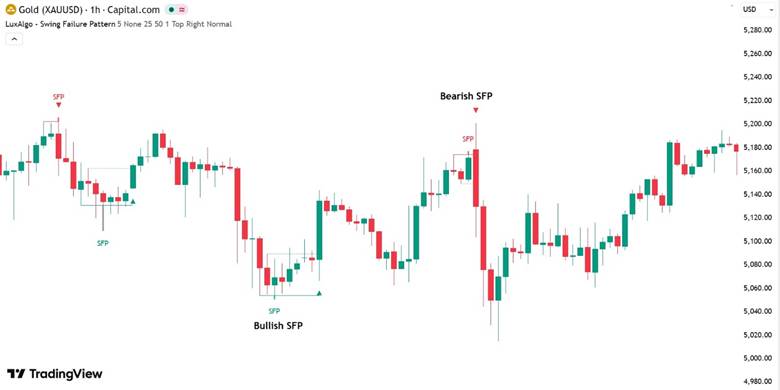
A bearish SFP occurs when the price breaks above a previous high, triggers buy-side liquidity, and then reverses downward. This setup traps breakout buyers and signals that the upward move lacked real strength.

A failed swing high, indicating potential bearish continuation.

Key characteristics of Bearish SFP are as follows:

  • Break above a significant high
  • Strong rejection and fast downside movement
  • Failure to close above the level
sms-star

Trading insight:
This setup suggests that smart money used the breakout to sell, not to continue higher.

Bullish SFP (Failed Low Setup)

A bullish SFP is the opposite scenario. Price breaks below a previous low, triggers sell-side liquidity, and then reverses upward. This traps sellers and signals potential bullish movement.

A  failed swing low, indicating a potential bullish reversal.

Key characteristics of Bullish SFP are as follows:

  • Break a key low below
  • Strong upward rejection
  • Failure to sustain below the level
sms-star

Trading insight:
Bullish SFP shows that liquidity below the low has been collected, and the market is likely to move higher.
Comparison table of Bullish and Bearish SFP

Pattern TypeLiquidity TargetDirection After FailureMarket Signal
Bearish SFPAbove highsDownwardReversal to sell
Bullish SFPBelow lowsUpwardReversal to buy
Bullish SFP (Failed Low Setup)

SFP Entry and Risk Management in ICT Trading

Successful trading of the ICT Swing Failure Pattern (SFP) depends on two elements:

  •  precise entry 
  • controlled risk.

After a liquidity sweep, traders should avoid entering immediately and instead wait for confirmation. This confirmation typically comes from lower timeframe behaviour and a clear shift in market structure. At the same time, proper stop placement and risk-to-reward planning ensure that even if the setup fails, losses remain limited.

Entry Confirmation and Market Structure Shift (MSS)

The most reliable SFP entries occur after confirmation on lower timeframes, such as 5M or 15M. Traders should look for strong rejection from the swept level and a Market Structure Shift (MSS), where price breaks a key level in the opposite direction.

This approach ensures the trade aligns with real momentum, not just the initial liquidity sweep.

Stop Loss Placement and Risk-to-Reward Optimisation

Risk management in SFP trading is based on market structure. Stop-loss should be placed beyond the liquidity sweep—above the high in bearish setups and below the low in bullish setups. This protects the trade from normal market fluctuations.

At the same time, traders should aim for a minimum risk-to-reward ratio of 1:2 or 1:3. Targets are typically set at the next liquidity zone or opposing structure level.

SFP Indicator in TradingView and MetaTrader

While the ICT Swing Failure Pattern (SFP) is primarily a price-action concept, many traders use indicators to identify potential setups more efficiently. These indicators do not replace analysis, but they can highlight key levels where a Swing Failure Pattern may occur.

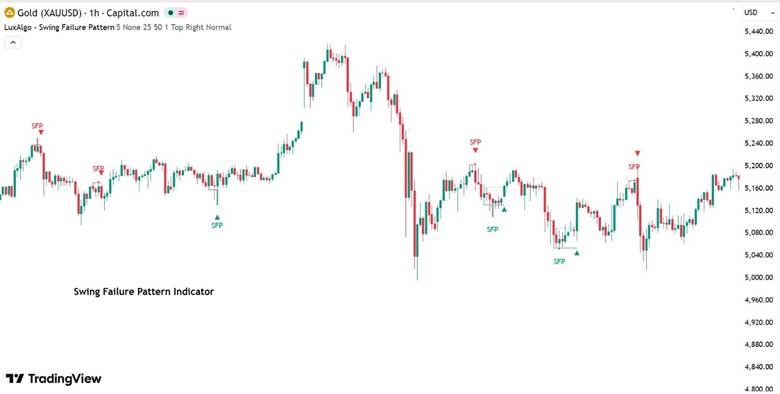
SFP Indicator in TradingView

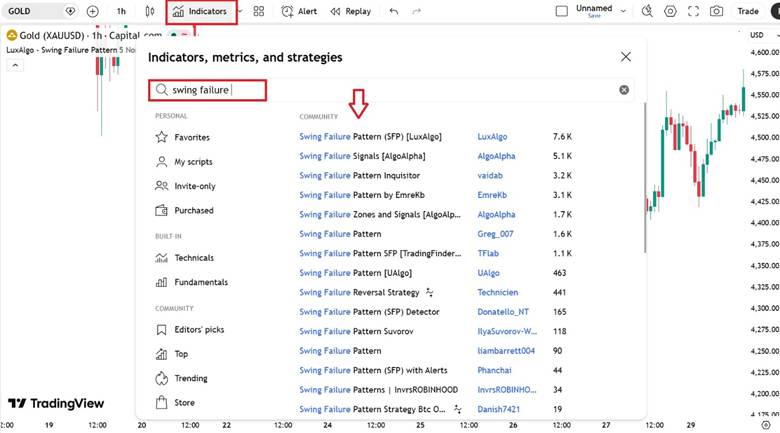
On TradingView, several custom indicators automatically detect failed swing highs and lows. These tools scan price action and identify potential SFP zones using predefined rules.

ICT Swing Failure Pattern (SFP): How to Trade Failed Highs and Lows in Forex

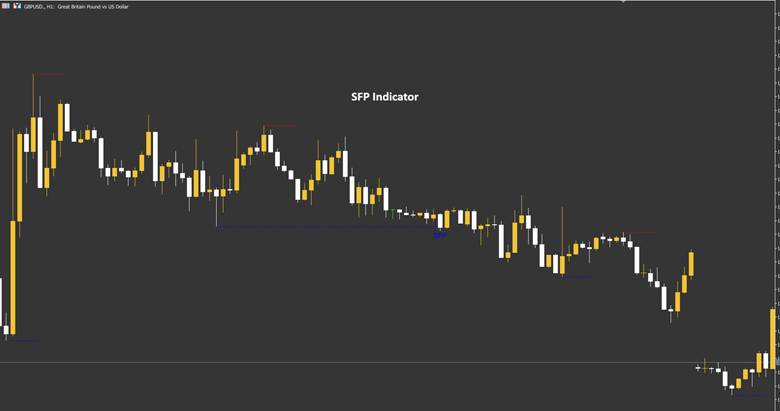
SFP Indicator in MetaTrader (MT4/MT5)

In MetaTrader platforms (MT4/MT5), SFP indicators are usually available as custom scripts or expert advisors. These tools function similarly to TradingView indicators but may offer greater flexibility in settings.

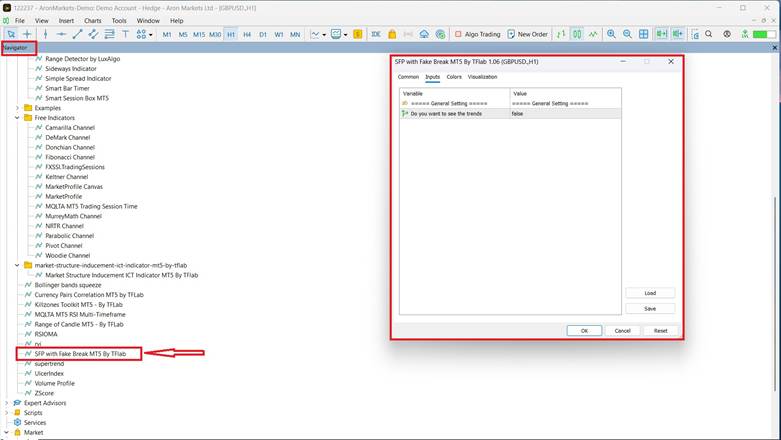
Installing a Swing Failure Pattern (SFP) indicator in MetaTrader is straightforward. Follow these steps to correctly download and set it up:

  • Step 1: Download the SFP Indicator file from a reliable source such as Forexfactory
  • Step 2: Launch MetaTrader
  •  Step 3: Click on File → Open Data Folder
  •  Step 4: Open the folder MQL4 → Indicators (for MT4) or MQL5 → Indicators (for MT5)
  •  Step 5: Copy the Indicator File and paste it into the Indicators folder.
  • Step 6: Restart MetaTrader
  • Step 7: Add the Indicator to the Chart

o   Go to Navigator → Indicators

o   Find your SFP indicator

o   Drag and drop it onto your chart

SFP Indicator in MetaTrader (MT4/MT5)
sms-star

Key Note:
Use the indicator to highlight potential SFP zones, but always confirm trades based on market structure shifts (MSS) and liquidity behaviour.


Common Mistakes in Trading Swing Failure Pattern ICT

Trading the ICT Swing Failure Pattern (SFP) requires a clear understanding of liquidity, structure, and confirmation. Many traders make the mistake of treating SFP as a simple reversal signal, which leads to poor entries and unnecessary losses. In reality, SFP is not just about a breakout—it is about a failed breakout driven by liquidity dynamics.

A common error is confusing a valid breakout with an SFP. When price breaks a key level and continues with strong momentum, it reflects genuine market strength, not failure. Entering against such moves without evidence of rejection often results in being trapped on the wrong side of the market. 

Another frequent mistake is entering too early, immediately after a liquidity sweep. The sweep alone is not enough. Traders must wait for confirmation, such as price closing back inside the range or a Market Structure Shift. 

Conclusion

The ICT Swing Failure Pattern (SFP) provides a structured way to trade false breakouts by focusing on liquidity rather than just price. It reveals how the market targets stop-loss clusters, triggers them, and then reverses. When combined with market structure and proper confirmation, SFP becomes a precise tool for identifying high-probability reversals. The key is patience—waiting for the failure, not reacting to the breakout.

Continue Reading
not-found
calendar 18 May 2026
Rate this article

Leave a Reply

Your email address will not be published. Required fields are marked *

No thanks