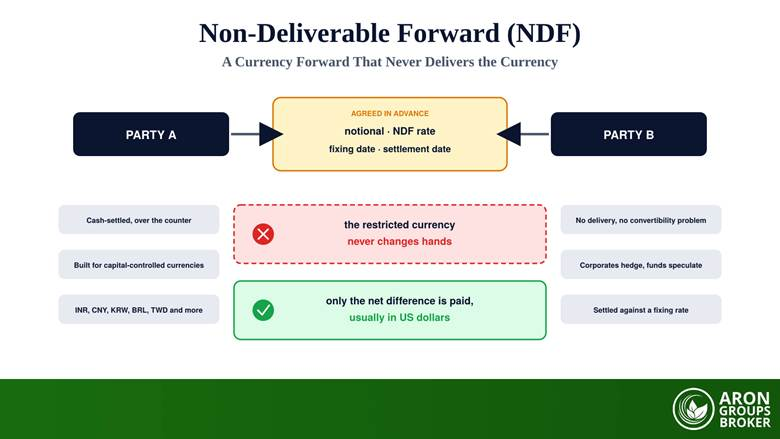

A non-deliverable forward, or NDF, is a cash-settled currency forward. Two parties lock in a forward rate for a currency pair, but at maturity they do not exchange the actual currencies. Instead they settle only the difference between the agreed rate and a reference rate, and they pay it in a freely traded currency, almost always the US dollar. The restricted currency never moves.
That design exists for one reason: some currencies cannot legally or practically be delivered offshore. Where capital controls restrict convertibility, a conventional forward is impossible, and an NDF reproduces the economics without the delivery. These contracts trade over the counter, mostly between banks and their clients, in a foreign exchange market whose scale the BIS triennial survey measures in trillions of dollars a day.
Below: why NDFs exist, the mechanics from trade date to settlement, a worked rupee example, how an NDF differs from a deliverable forward, which currencies have active NDF markets, who uses them, and how the same cash-settlement logic appears in the products most readers actually trade.
- An NDF is a cash-settled currency forward: no physical exchange, only the net difference paid in a freely traded currency, usually the US dollar.
- It exists because capital controls make offshore delivery of some currencies impossible, so the economics are settled without moving the currency.
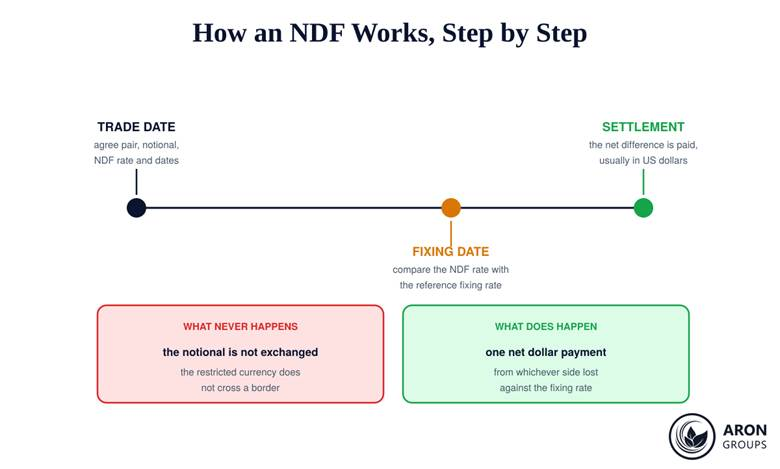
- You agree a notional, an NDF rate, a fixing date, and a settlement date; on the fixing date the contract rate is compared with a reference rate.
- The reference rate is often published by the local central bank, and only the resulting difference changes hands.
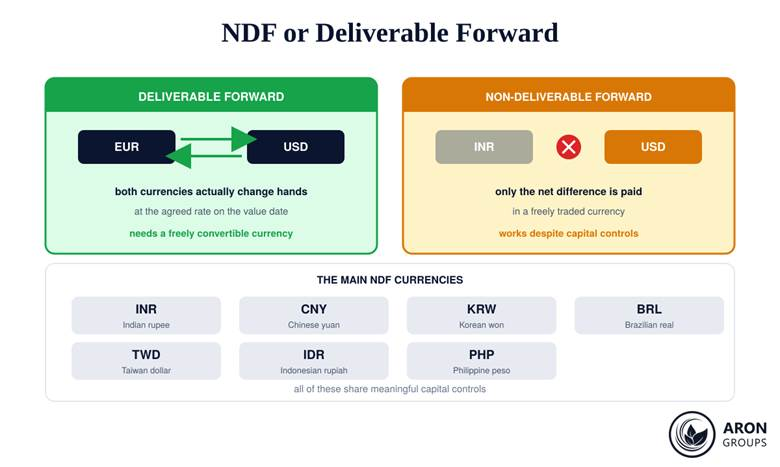
- Active NDF markets include the Indian rupee, Chinese yuan, Korean won, Brazilian real, Taiwan dollar, Indonesian rupiah, and Philippine peso.
What Is a Non-Deliverable Forward?
Start with the ordinary version. A deliverable forward is an agreement to exchange one currency for another on a future date at a rate fixed today, and at maturity both currencies genuinely change hands. An NDF keeps the first half of that sentence and deletes the second. The rate is fixed today, the maturity is agreed, and the notional amount defines the size of the exposure, but on the settlement date nobody delivers anything. One party simply pays the other the difference between the agreed rate and the market rate, calculated on the notional and paid in dollars.
Risk Disclosure
CFDs are complex instruments and come with a high risk of losing money rapidly due to leverage. You should consider whether you understand how CFDs work and whether you can afford to take the high risk of losing your money. Past performance is not indicative of future results. This content is provided for educational purposes only and does not constitute investment advice.
Why the Notional Is Not the Payment
This distinction confuses newcomers, so it is worth stating twice. The notional is a reference quantity used to size the calculation, not an amount anyone hands over. A one-million-rupee NDF does not involve a million rupees; it involves whatever dollar figure the rate difference on a million rupees produces, which is typically a small fraction of the notional. That is exactly why these contracts work where delivery is blocked.
Explore Consumer and Producer Surplus.
Why NDFs Exist
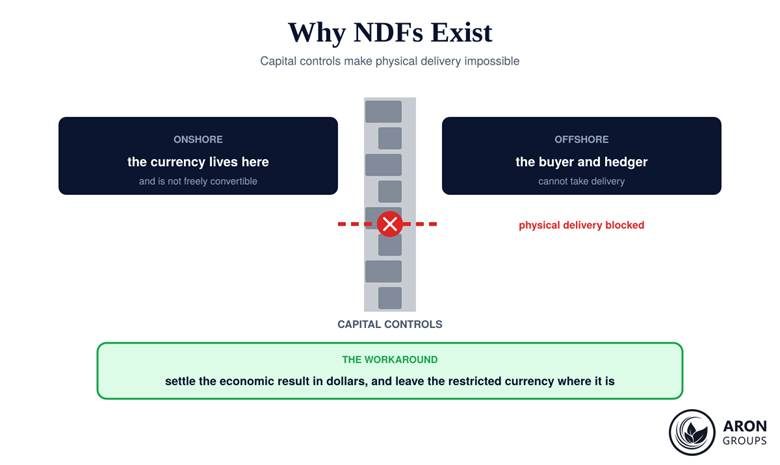
Several governments, mostly in emerging markets, limit or prohibit the free convertibility of their currency and restrict offshore trading in it. The policy goals vary, from managing volatility to controlling capital flight, but the practical consequence for a foreign business is identical: you cannot simply buy the currency abroad, hold it, and deliver it later. A company with real exposure to that currency still needs to manage the risk, which is a straightforward matter of risk management rather than speculation, and the NDF is the instrument that makes it possible.
Capital controls block delivery across the border, so the contract settles the economics and leaves the currency at home.
The workaround is elegant. If the problem is moving the currency, then do not move it. Agree the rate, observe what the market rate turned out to be, and transfer the resulting gain or loss in a currency that moves freely. Both parties end up with the same economic outcome a deliverable forward would have produced, and no restricted currency crosses a border.
How an NDF Works, Step by Step
Four elements are agreed at the outset and two dates matter afterwards. The parties fix the currency pair, the notional amount, the NDF rate, and the fixing and settlement dates. On the fixing date, usually one or two business days before settlement, the agreed rate is compared with a reference spot rate for that pair. That reference is commonly a rate published by the local central bank or another agreed benchmark, which is what makes the comparison objective rather than negotiable.
Learn more about Opportunity Cost.
Trade date, fixing date, settlement: the contract’s whole life is three moments and one payment.
| Element | What it means | Why it matters |
|---|---|---|
| Notional | The reference quantity of the restricted currency | Sizes the calculation; it is never exchanged |
| NDF rate | The forward rate the parties agree today | The benchmark the outcome is measured against |
| Fixing date | The day the reference rate is observed | Determines the profit or loss on the contract |
| Fixing rate | The reference spot rate, often central-bank published | Makes settlement objective for both sides |
| Settlement date | The day the net amount is paid | Only the difference moves, usually in US dollars |
Five terms define the contract, and only the last one involves money changing hands.
A Worked Example
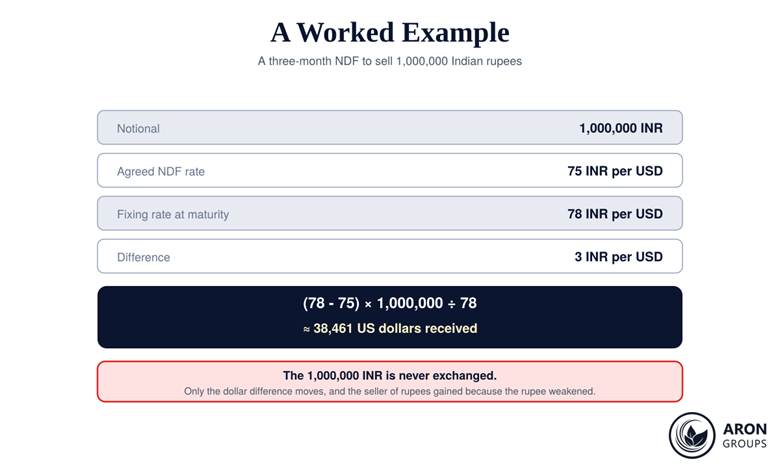
Numbers make this concrete. Suppose you enter a three-month NDF to sell 1,000,000 Indian rupees at an agreed rate of 75 rupees per dollar. Three months later, on the fixing date, the reference rate is 78 rupees per dollar, meaning the rupee has weakened. You agreed to sell rupees at a stronger rate than the market now offers, so the contract is in your favour by 3 rupees per dollar.
Explore Multi Factor Models in Finance.
The arithmetic in full: the difference is converted at the fixing rate and paid in dollars.
The settlement is the difference multiplied by the notional and converted at the fixing rate: three rupees times one million, divided by 78, which is roughly 38,461 US dollars paid to you. No rupees were bought, sold, or transferred. Had the rupee strengthened to 72 instead, the calculation would have run the other way and you would have paid the difference; the contract is symmetric, and only the direction of the fixing decides who pays.
Q: Why is the difference divided by the fixing rate rather than the agreed rate?
A: Because the payment is made in dollars and must reflect the value of the rupee difference at settlement, not at inception. Converting at the fixing rate is the market convention, and it means the dollar amount you receive depends slightly on the level of the rate as well as on the size of the move.
NDF or Deliverable Forward
The choice is rarely a preference; the currency dictates it. If the currency is freely convertible, a deliverable forward is the natural instrument, and a business that needs the currency to pay a supplier will want delivery. If the currency is restricted, the deliverable version is unavailable and the NDF is the only route. Where both are possible, cash settlement has a secondary attraction: no foreign-currency account to fund and no delivery to reconcile.
Delivery versus difference, and the currencies where the NDF market actually lives.
The Chinese yuan illustrates the nuance nicely. The onshore currency, quoted as CNY, sits behind capital controls and has historically been an NDF market, while the offshore version quoted as CNH trades and delivers freely. Same country, two quoting conventions, and the choice of instrument follows which one you are dealing in rather than which you prefer.
Which Currencies and Who Uses Them
Active NDF markets cluster where capital controls are meaningful: the Indian rupee, the Chinese yuan onshore, the Korean won, the Brazilian real, the Taiwan dollar, the Indonesian rupiah, and the Philippine peso, among others. The list shifts over time, because it tracks policy rather than economics, and a currency can leave the NDF world as it liberalises.
The users fall into three groups. Corporates come first and dominate the honest use case: a manufacturer with rupee receivables or a retailer with won payables needs to know its costs in its home currency, and an NDF fixes them. Funds and asset managers use NDFs to take or hedge views on emerging-market currencies they have no onshore access to, which for them is a question of finding an edge rather than protecting a budget. Banks stand in the middle providing liquidity and warehousing the risk, all of it over the counter rather than on an exchange, so terms are negotiated and counterparty risk is real.
Mini Example: An Importer’s Problem
A European electronics firm agrees to pay an Indian supplier 50 million rupees in six months. Its costs are budgeted in euros, so a rupee that strengthens over those six months makes the purchase more expensive than planned, and it cannot simply buy and hold rupees offshore to protect itself.
It enters a six-month NDF fixing the rate today. If the rupee strengthens, the NDF pays the firm roughly what the extra cost amounts to; if the rupee weakens, the firm pays away part of the saving. Either way the budget holds, which is the entire point of hedging: the aim is predictability rather than profit.
Cash Settlement Is Not Exotic
The mechanism at the heart of an NDF is far more familiar than the name suggests, because cash settlement is the norm in most of what retail traders touch. A contract for difference settles the difference between opening and closing prices and never delivers the asset. A spot forex position held on a retail platform rolls over rather than delivering currency on the value date. In each case the economics are transferred while the underlying stays put, exactly as in an NDF. Recognising the shared logic makes both easier to reason about, and it is why the mechanics in our guide on how to trade forex transfer across instruments.
The differences matter too. NDFs are institutional, negotiated bilaterally, and sized in notionals far beyond retail scale, and they carry counterparty risk that an exchange-cleared or well-regulated retail product handles differently. European product intervention rules, for instance, impose leverage caps and negative balance protection on retail CFDs that have no equivalent in an over-the-counter forward between two banks. Anyone modelling currency exposure systematically will also find the same validation discipline applies: a hedging rule deserves out-of-sample backtesting just as much as a trading rule does.
Risks Worth Naming
Three risks deserve explicit mention. Counterparty risk comes first: an NDF is a bilateral promise, so the other side’s ability to pay matters, which is why these contracts live between institutions with credit lines rather than on retail platforms. Basis risk follows: the fixing rate may not match the rate at which you could actually have transacted onshore, so a hedge can be imperfect even when the contract performs exactly as written. And ordinary market risk remains, because a hedge that protects a budget also forfeits a favourable move, which is a trade every hedger accepts knowingly. Regulators’ advisories on off-exchange currency trading are worth reading on the general point that negotiated contracts require knowing your counterparty.
The same discipline applies at any scale. A hedger decides how much exposure to cover before entering, not after the currency has moved, which is the institutional version of deliberate position sizing, and a speculator using NDFs still needs a defined risk-to-reward ratio for the same reason anyone else does.
Rule
A hedge is not a bet you expect to win. If your NDF loses money because the currency moved your way, the underlying exposure gained, and the pair of them together did the job you paid for. Judging a hedge on its own profit and loss is the most common way to misread one.

A Note on Non-Convertible Currencies
It is worth being precise here, because the category is broader than the tradable market. A currency can be non-convertible and capital-controlled, which is conceptually the situation NDFs were designed for, without there being an active, accessible NDF market in it. The Iranian rial is one such case: the mechanics described in this article explain the kind of problem restricted currencies create, but sanctions and access restrictions mean rial NDFs are not a mainstream instrument and are not something available through retail brokers. Treat this section as background on how restricted currency mechanics work, not as a description of a product anyone is offering.
Where Aron Groups Fits
To be direct: NDFs are institutional over-the-counter instruments and are not part of a retail offering, here or generally. What is available on the MetaTrader 5 platform is the deliverable and freely traded end of the market, the major and minor pairs alongside metals, energy, and indices, and the account types are set out on the trading accounts page.
The transferable lesson is the cash-settlement logic itself, which explains why your spot positions roll rather than deliver and why your profit and loss is a difference rather than an exchange of assets. If that is new to you, watch a rollover happen on a demo account, then apply the same attention to costs and sizing on a small account, judged as always by a steadier equity curve rather than a single good week.
Conclusion
A non-deliverable forward solves a narrow problem well. Where capital controls stop a currency from being delivered offshore, an NDF fixes a rate today, compares it with a reference rate on the fixing date, and settles the difference in dollars, leaving the restricted currency untouched. The notional sizes the calculation and never changes hands, which is the single fact that makes the whole structure possible.
For most readers the value is conceptual rather than practical: NDFs are institutional, but the cash settlement at their core is the same mechanism operating in the products you already trade. Understanding it sharpens how you think about exposure, hedging, and what a position actually is, which is the kind of foundation a professional trader builds on before worrying about instruments they cannot access. Keep capital preservation ahead of curiosity, and the concepts remain useful whatever you end up trading.
Frequently Asked Questions
Quick answers to the questions readers ask most about non-deliverable forwards.
What is a non-deliverable forward?
It is a cash-settled currency forward. Two parties agree a rate and a notional amount, and at maturity they settle only the difference between that rate and a reference fixing rate, paid in a freely traded currency such as the US dollar. The underlying currency is never exchanged.
Which currencies are traded as NDFs?
Mainly currencies with meaningful capital controls: the Indian rupee, the onshore Chinese yuan, the Korean won, the Brazilian real, the Taiwan dollar, the Indonesian rupiah, and the Philippine peso, among others. The list changes as countries liberalise or tighten their currency regimes.
What is the difference between an NDF and a forward?
A standard, deliverable forward physically exchanges the two currencies at maturity. An NDF never delivers; it pays only the net difference in cash. That is what allows it to work for currencies that cannot legally or practically be delivered offshore.
Can retail traders trade NDFs?
Generally no. NDFs are negotiated over the counter between banks, corporates, and funds, in sizes and with credit arrangements that sit outside retail platforms. Retail traders access currency exposure through spot and CFD products instead, which use the same cash-settlement principle at a very different scale.