
icon icon Home
icon icon Accounts
icon icon Quick start
icon icon Symbols

Perpetual DEXs: How On-Chain Perpetual Futures Work, the Order-Book vs Pool Models, and the Risks of Self-Custody Trading

Author
Abe Cofnas
Abe Cofnas
calendar Last update: 16 October 2026
watch Reading time: 10 min

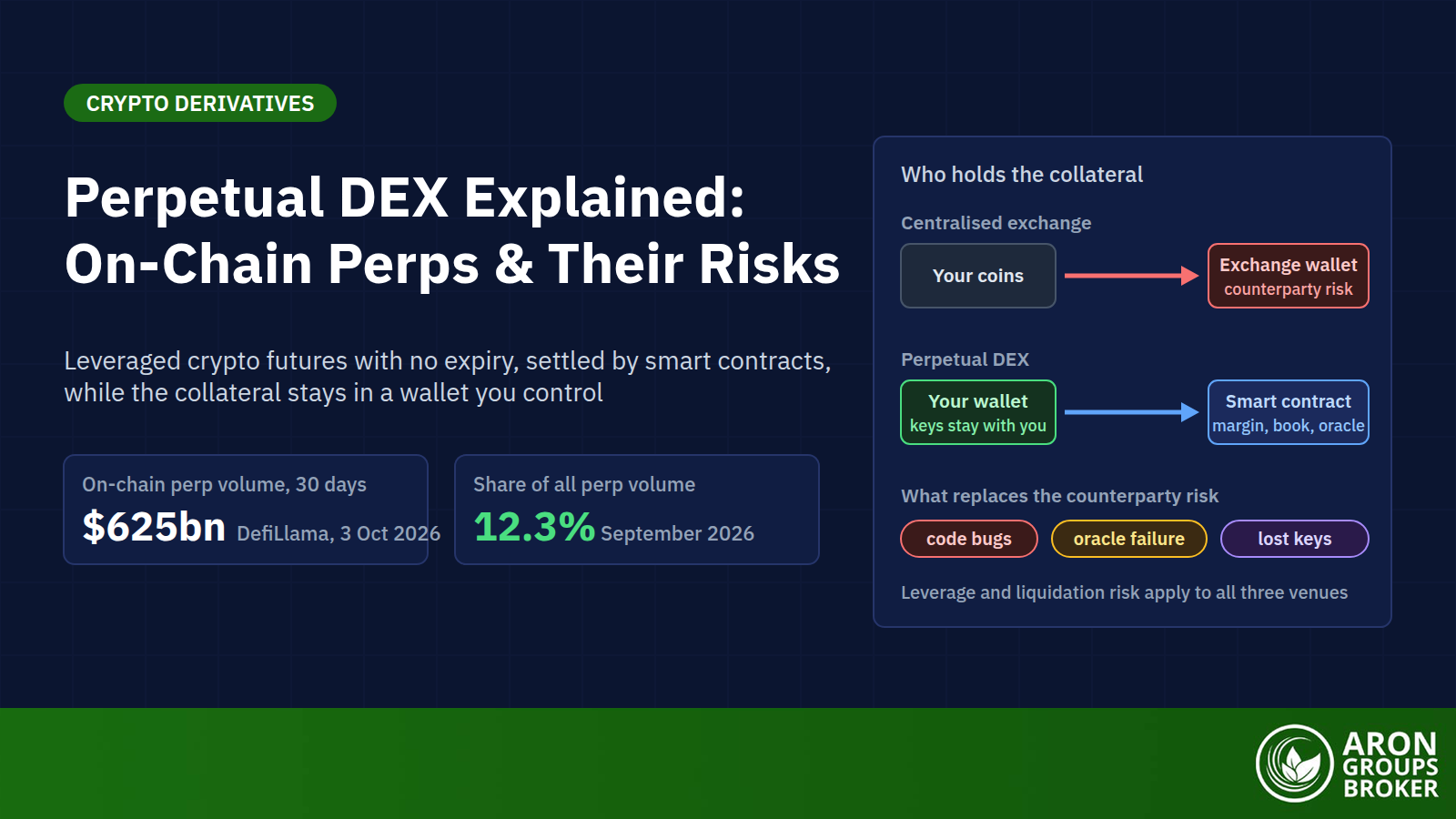
A perpetual DEX is a decentralised exchange for trading perpetual futures, leveraged crypto contracts with no expiry date, through smart contracts on a blockchain. Your collateral stays in a wallet you control rather than in an exchange account. There is no company holding your coins, and no company to call when something goes wrong.

It matters now because the on-chain share is no longer trivial. Castle Labs put perpetual DEXs at 12.3% of all perpetual volume in September 2026. DefiLlama counted $624.6 billion of on-chain perp volume in the 30 days to 3 October 2026. A perp DEX carries the same leverage and liquidation mechanics as any perpetual, so custody comes with margin maths attached.

This guide explains the two ways a perpetual DEX finds a price and how funding and liquidation work on-chain. It then sizes the market, compares the model with a centralised exchange and a crypto CFD, and prices what self-custody costs.

bookmark
Key Takeaways
  • A perpetual DEX combines a perpetual futures contract with a non-custodial venue: the smart contract holds the margin and matches or prices the trades, while the keys stay with the trader.
  • Order-book venues such as Hyperliquid and dYdX match traders against each other; pool venues such as GMX fill trades at an oracle price against liquidity providers who take the other side.
  • Funding uses the same formula as centralised perps: on Hyperliquid a 0.10% premium gives a 0.05% eight-hour rate, paid hourly, or about $127 a day on a 1 BTC long at $84,672.
  • Perp DEXs handled about 12.3% of all perpetual volume in September 2026 (Castle Labs); Hyperliquid alone was 33.3% of the $624.6 billion traded on-chain in the 30 days to 3 October 2026 (DefiLlama).
  • Self-custody removes exchange counterparty risk but adds code, oracle and key risk: GMX v1 lost $42 million to a bug on 9 July 2025, and Hyperliquid's HLP vault carried a $13.5 million paper loss in the JELLY squeeze of 26 March 2025.

What Is a Perpetual DEX?

A perpetual DEX (perp DEX) is a decentralised exchange whose product is perpetual futures: leveraged contracts that track a crypto price and never expire. Smart contracts execute and settle the trades, and margin is posted from your own wallet. The venue is a protocol, not a company that holds client accounts.

sms-star

Risk Disclosure
Trading forex and CFDs carries a high level of risk and can result in the loss of all your capital. This content is educational and is not investment advice. Never risk money you cannot afford to lose.
Two ideas in one product

The first idea is the perpetual contract: long or short, with leverage, no delivery date, and a funding payment that keeps its price near spot. The second is the decentralised exchange, where trades settle on a blockchain instead of inside a company’s database. Together they sit in decentralised finance, protocols that replace intermediaries with code.

In practice you connect a wallet and post a stablecoin such as USDC as collateral. The contract then margins and liquidates the position under its own rules. There is usually no identity check.

Why self-custody became the selling point

Demand for non-custodial trading jumped after FTX. The exchange filed for bankruptcy on 11 November 2022. The SEC later alleged that customer funds had been diverted to Alameda Research through a line of credit “funded by the platform’s customers”. Custody, traders learned, is counterparty risk. CoinGecko puts the DEX share of perp volume at 2.0% in January 2024 and 10.2% two years later.

The Two Models: On-Chain Order Book vs Liquidity Pool

A perpetual DEX needs a way to find a price without a company’s matching engine, and two designs dominate. One replicates an order book on-chain. The other fills trades against a shared pool at a price supplied by an oracle.

The order-book model: Hyperliquid and dYdX

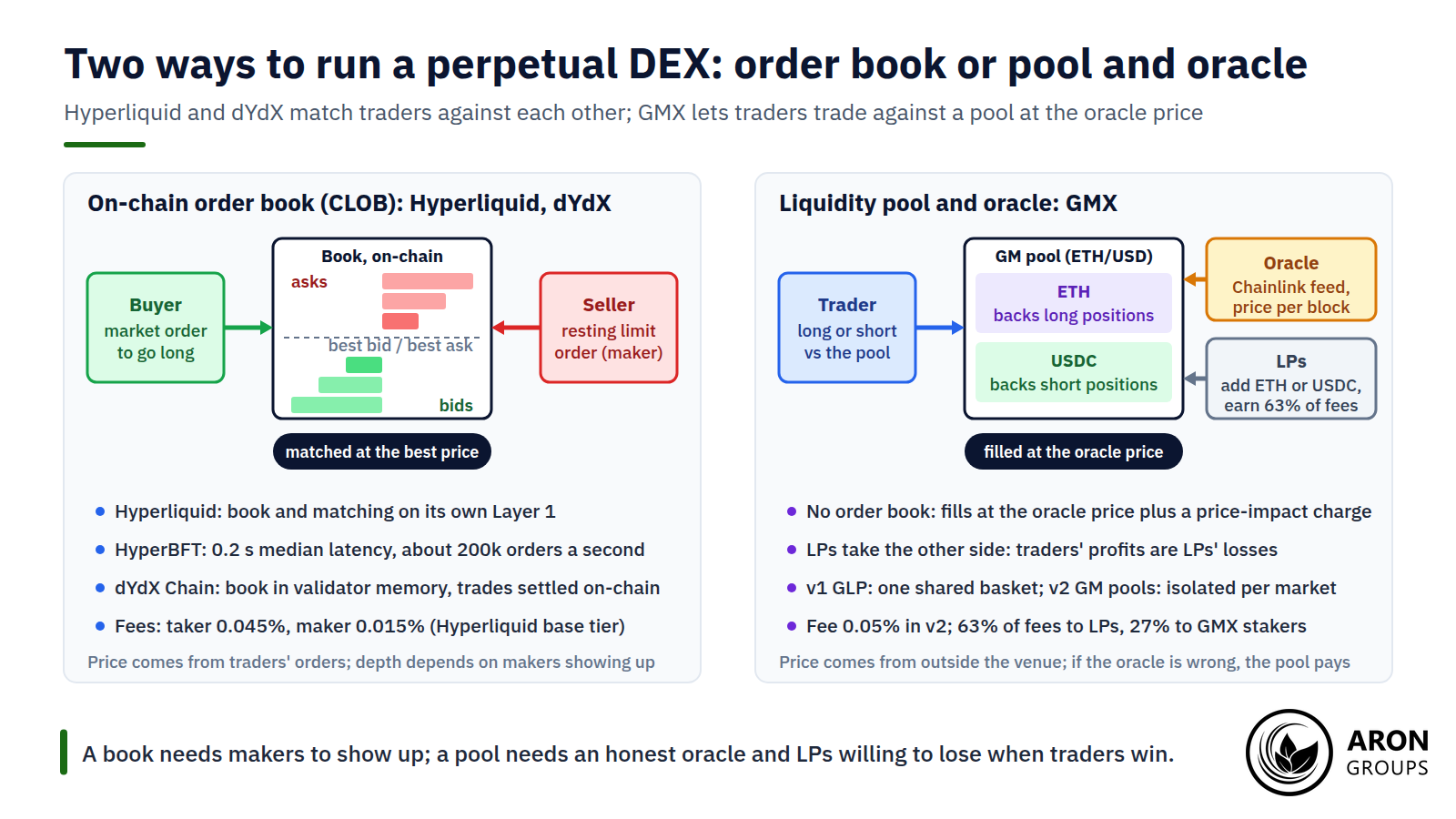
An on-chain central limit order book (CLOB) works like the book on any exchange. Market makers post limit orders, takers hit them, and the best bid and ask set the price. Hyperliquid runs its book on its own Layer 1 blockchain under a consensus called HyperBFT. Its documentation claims a median latency of 0.2 seconds and about 200,000 orders a second.

dYdX took a different route. Version 3 ran on StarkEx, an Ethereum Layer 2, and on 26 October 2023 it launched its own Cosmos chain. There, validators keep the book in memory and only matched trades reach a block. Depth depends on makers showing up, so fees reward them: Hyperliquid charges takers 0.045% and makers 0.015%, and its documentation says trading itself is gas-free.

The pool-and-oracle model: GMX

GMX has no order book. Traders open positions against a liquidity pool at a price from a Chainlink oracle. In GMX v1 that pool was GLP, one basket backing every market. Since 10 August 2023, v2 has used isolated GM pools: the ETH/USD pool holds ETH to back longs and USDC to back shorts.

Liquidity providers are the counterparty to every trade, so traders’ profits are LPs’ losses. v2 charges 0.05% a trade and pays 63% of fees to LPs and 27% to GMX stakers. The design needs an honest oracle and LPs who accept that risk.

A book prices from traders' own orders and lives on maker depth; a pool imports an oracle price and makes liquidity providers the counterparty.

Funding Rate, Mark Price and Liquidation on a Perpetual DEX

A perpetual DEX uses the same three mechanisms as any perpetual. A funding rate ties the contract to spot, a mark price decides liquidation, and margin rules close a position when collateral runs out.

How the funding rate works

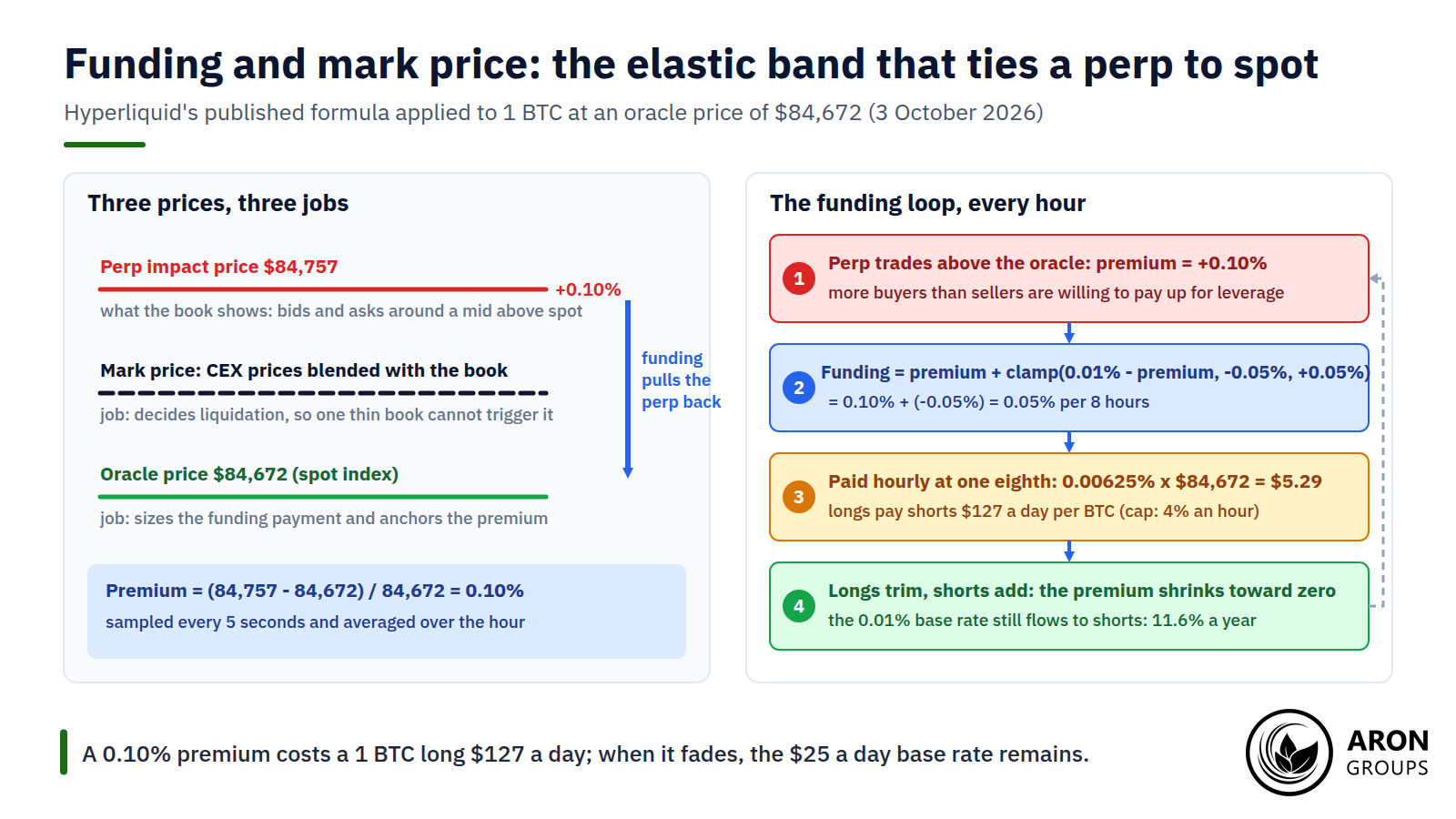
Hyperliquid’s published formula mirrors the one centralised exchanges use. The premium is the gap between the contract’s impact price and the oracle price, sampled every five seconds and averaged hourly. The eight-hour rate is that premium plus a clamp term, bounded at plus or minus 0.05%, that pulls it toward a fixed 0.01% interest rate. Payment is hourly, at one eighth of the rate.

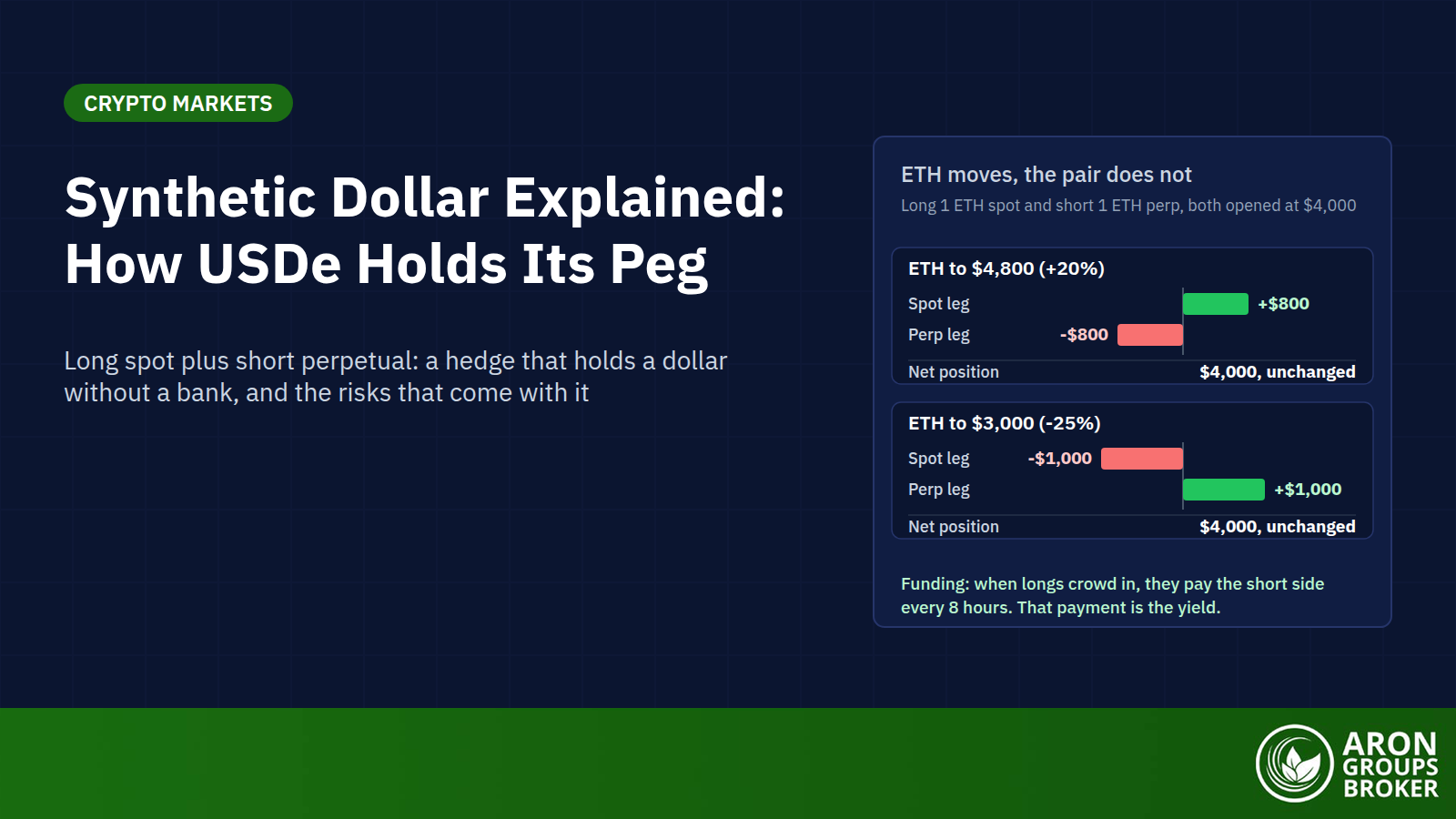
Take 1 BTC at an oracle price of $84,672, CoinGecko’s quote on 3 October 2026. If the contract trades 0.10% above it, the rate is 0.10% minus 0.05%, or 0.05% per eight hours. Hourly that is 0.00625% of notional, or $5.29, so a long pays about $127 a day to shorts. When the premium fades the 0.01% base rate remains, 11.6% a year by the documentation.

At a 0.10% premium a 1 BTC long pays $127 a day in funding; when it fades, the 0.01% base rate still costs $25.

Mark price and liquidation tiers

Liquidation is triggered by the mark price, not the last trade. Hyperliquid’s mark blends centralised exchange prices with its own book, so one thin book cannot liquidate you alone. The maintenance margin is half the initial margin at each asset’s maximum leverage. BTC allows 40x up to $150 million of notional, so maintenance is 1.25%; ETH allows 25x.

Below maintenance, the contract first sends market orders to the book, cutting positions above 100,000 USDC by 20% at a time. If equity drops below two thirds of maintenance first, the HLP vault takes the position over as backstop liquidator and keeps the maintenance margin. The fill carries slippage either way.

Mini Example: A 10x BTC Long on a Perp DEX vs a Crypto CFD

Say you go long 1 BTC at $84,672 with 10x leverage on a perp DEX, posting $8,467.20 of USDC. Maintenance margin is 1.25% of notional, or $1,058.40. Liquidation triggers once losses reach $8,467.20 minus $1,058.40, which is $7,408.80, a fall of 8.75% to about $77,263. If the book cannot absorb it, the backstop takes over below two thirds of maintenance, a 9.17% fall to about $76,910. Base-rate funding adds $25.40 a day; the taker fee to open is $38.10.

A crypto CFD with the same $8,467.20 as the whole account behaves differently. At 1:10 leverage the margin equals the balance, so the margin level starts at 100%, the margin call threshold. A stop-out at 50% closes the position at $4,233.60 of equity, a 5.0% loss at about $80,438. The CFD trader is closed sooner but keeps $4,233.60; the perp trader runs further but keeps at most $1,058.40.

How Big Is the Perpetual DEX Market?

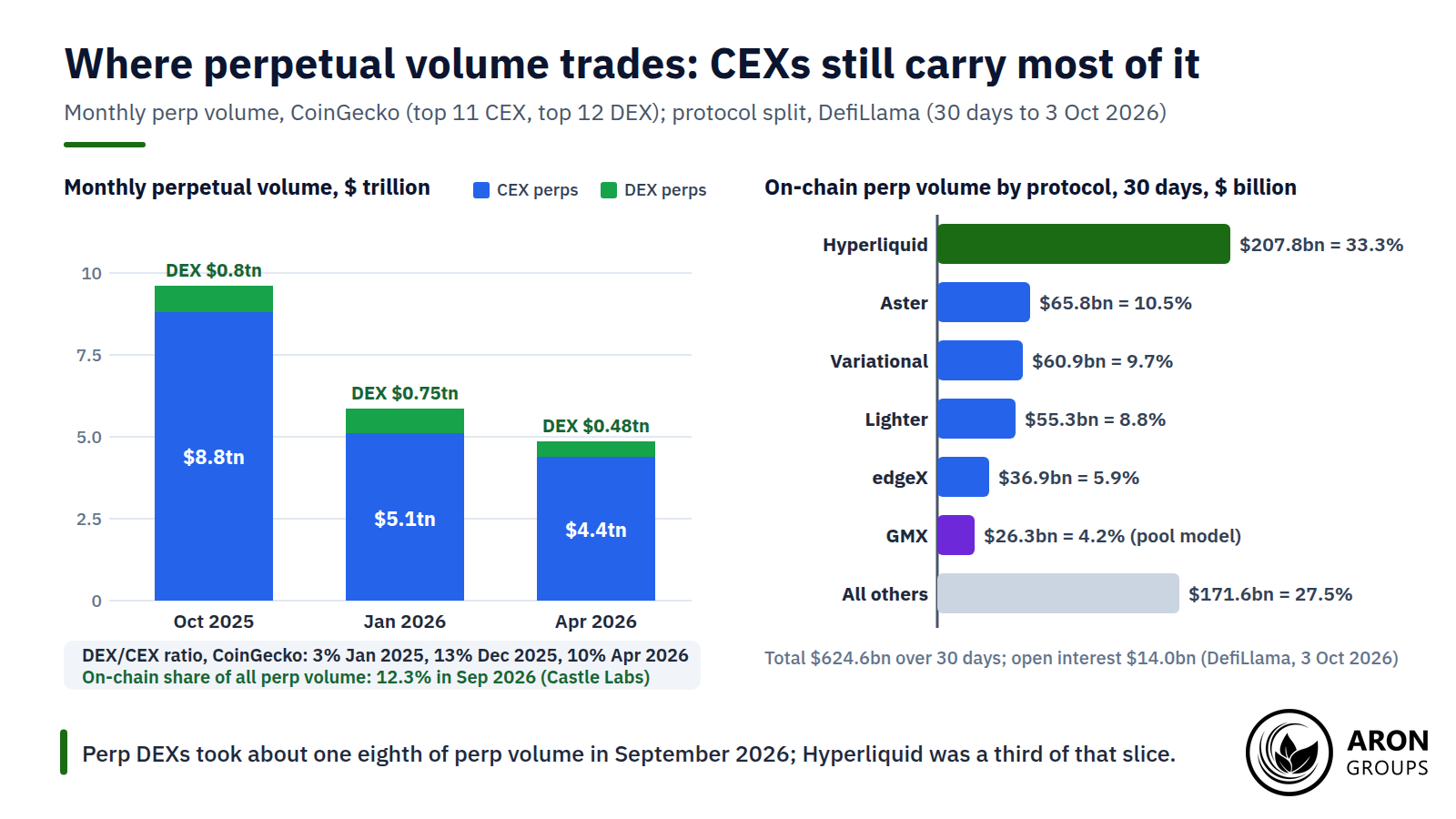
Perpetuals dominate both kinds of venue. CoinGecko counted $85.3 trillion of perp volume on the top 11 centralised exchanges in 2025 and $6.38 trillion on the top 12 perp DEXs. On CEXs, perps were 82% of all trading in February 2026, up from 74% in January 2024. On-chain, DefiLlama’s 30-day totals on 3 October 2026 were $624.6 billion for perps against $279.4 billion for spot: about 69%.

The DEX slice has grown faster than the whole. CoinGecko’s DEX-to-CEX ratio went from 3% in January 2025 to a 13% peak in December 2025, then eased to 10% in April 2026.

Hyperliquid's own Layer 1

Hyperliquid leads because it built an exchange-grade chain rather than deploying on someone else’s. In April 2026 CoinGecko ranked it ninth among all perpetual exchanges, CEXs included, with $190.28 billion of monthly volume and 39.5% of the DEX total. In the 30 days to 3 October 2026 DefiLlama recorded $207.8 billion, a 33.3% share. Castle Labs put its open interest at 56.8% of the perp DEX total.

Two features explain the loyalty. HLP, a community-owned vault, market makes, runs the backstop liquidations and shares its profit and loss with depositors after a four-day lock-up. Fees go to the community: by 26 September 2026 the Assistance Fund had turned them into about 47.5 million HYPE, bought for roughly $1.32 billion.

The challengers: Aster, Lighter, Variational and edgeX

Hyperliquid’s share has fallen from about 70% at its 2025 peak. On 3 October 2026 Aster, a multi-chain venue that lists stock perps, had 10.5% of 30-day volume and Variational 9.7%. Lighter, a zero-fee zk-rollup order book live since 2 October 2025, had 8.8%, and edgeX, built on StarkEx, 5.9%. GMX, the largest pool venue, had 4.2%.

Centralised venues still carried about seven eighths of perp volume in September 2026; Hyperliquid was a third of the on-chain rest.

Perpetual DEX vs Centralised Exchange vs Crypto CFD

The three routes to leveraged crypto exposure differ most in who holds the money and who stands on the other side. The table compares them on the points that decide your risk.

FeaturePerpetual DEXCEX perpetualCrypto CFD (MT5 broker)
CustodyYour wallet; the smart contract holds only the posted marginThe exchange holds your coins and marginThe broker holds client funds; no coin, no wallet
CounterpartyOther traders on the book, or the liquidity poolThe exchange, backed by its insurance fundThe broker
IdentityUsually no KYC; a wallet address is the accountKYC requiredKYC required
Price and carryOn-chain book or oracle price; funding paid hourly or every 8 hoursExchange book; funding every 8 hoursBroker quote with a floating spread; overnight swap instead of funding
MarketsCrypto pairs, plus newer stock and commodity perpsCrypto pairs and some tokenised stocksBTCUSD and ETHUSD alongside forex, gold and indices
Leverage and close-outUp to 40x on BTC at Hyperliquid; liquidation at maintenance margin, then a backstop vaultCommonly 100x or more on BTC; liquidation, auto-deleveraging in a crisisMargin call at 100% margin level, stop-out at 50% (40% on Islamic and VIP)
Support and recourseNone; code plus governance votesSupport desk under the exchange's termsSupport desk under the broker's terms
Added risksCode bugs, oracle failure, lost keys, public orders and MEVExchange insolvency, internal pricing, frozen accountsBroker counterparty risk, spread widening, swap cost

Three routes to leveraged crypto exposure, from protocol documentation, CoinGecko’s 2026 perpetuals report and Aron Groups’ account terms.

What a centralised exchange gives you and takes away

A CEX offers fiat on-ramps, deep books and a support desk. The price is trust: your coins sit in its wallets and in a crisis its internal prices decide your fate. On 10 October 2025 more than $19 billion was liquidated in a day. USDe traded at $0.65 on Binance alone, because its pricing used internal books rather than external oracles.

The Risks of Self-Custody Trading

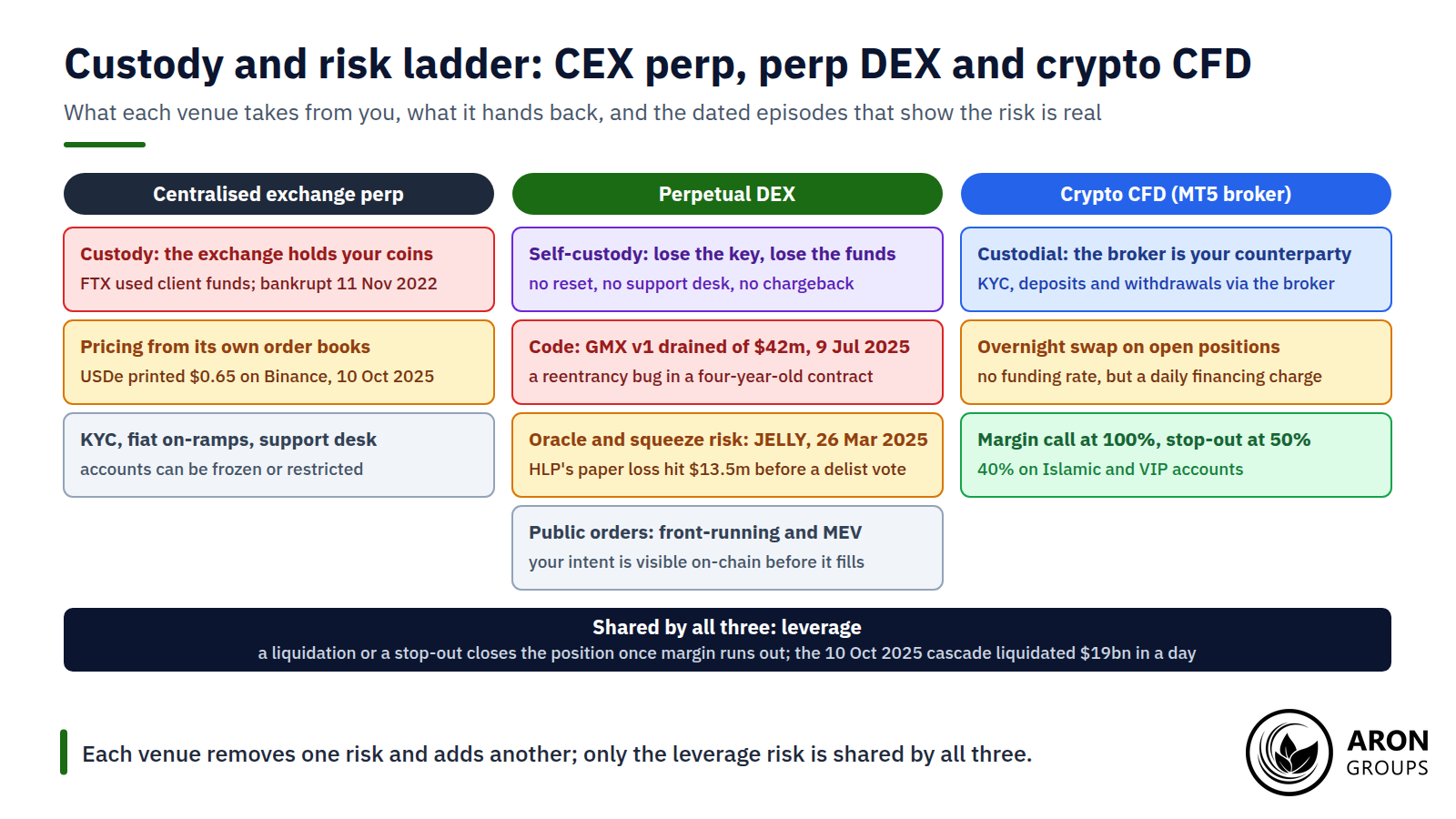
Self-custody moves every failure onto you. Exchange counterparty risk is replaced by four others: the contract code, the oracle, your own keys and the public nature of your orders. Each has a dated example.

Smart contract and oracle failures

On 9 July 2025 an attacker used a reentrancy bug in GMX v1 to distort the value of GLP. About $42 million was drained from the Arbitrum pool. The attacker returned 90% for a bounty; GMX approved a $44 million compensation plan five weeks later.

Oracles fail in subtler ways. On 18 September 2022 a trader exploited GMX’s zero-slippage oracle pricing. Positions of $4 million to $5 million were opened on GMX while the AVAX price was pushed on centralised exchanges. Five rounds netted about $565,000 from GLP holders, and GMX capped AVAX open interest in response.

Liquidation cascades and the HLP backstop

On 26 March 2025 a trader opened a large JELLY short on Hyperliquid. The trader then pumped the illiquid token elsewhere until the short was liquidated into HLP, whose unrealised loss reached $12 million to $13.5 million. Validators voted to delist the market and settle at $0.0095, far below the roughly $0.50 the oracle showed. HLP closed the day about $703,000 up.

The episode showed both sides of a backstop vault. It absorbs bankrupt positions so a liquidation cascade does not start. On 10 October 2025 HLP earned about $40 million while Hyperliquid processed more than $10 billion of liquidations. It also showed that validators can override the oracle, which is governance, not code.

Q: If the DEX is non-custodial, how can anyone freeze or change my position?
A: Through governance. Hyperliquid’s validators voted to delist JELLY and set its settlement price in March 2025, and GMX’s team capped AVAX open interest in 2022. The contract holds your margin, but the people who can upgrade, pause or vote on the contract still exist. Read who controls the admin keys and the validator set before you deposit.

Public orders, front-running and MEV

On a public chain your order can be visible before it fills. A BIS study of DeFi warned that large orders can become public before their price impact has materialised. Validators can then place a buy and an offsetting sell around them, a profit the paper calls miner extractable value. Fast sequencing shrinks the window; nothing removes it.

Keys, regulation and access

Lose your private key and the funds are gone: no reset, no support desk, no chargeback. On 7 September 2023 the CFTC charged three DeFi operators with offering leveraged retail commodity transactions without registration. Its enforcement director said that unlawful transactions do not become lawful when facilitated by smart contracts.

Platform access varies by country, and users in restricted regions face added legal, access and custody risk on top of the trading risks above.

Each venue removes one risk and adds another; only leverage is shared by all three.

The Honest Limits of a Perpetual DEX

Non-custodial does not mean low risk. It removes the risk that an exchange loses your coins. It adds the risk that code, oracles or your own keys lose them, on top of the leverage. Even the backstop bleeds: HLP lost about $4 million on a forced ETH liquidation on 12 March 2025 and took $4.9 million of bad debt in November 2025.

The decentralisation is partial. The BIS paper argued in 2021 that some centralisation is inevitable in DeFi, and the JELLY vote proved it. Regulators are unsettled too: the UK’s FCA has banned the sale of crypto derivatives, including CFDs, to retail consumers since 6 January 2021.

The sector also moves fast. New venues, points programmes and airdrops launch monthly, and headline volume often measures incentives rather than demand. Treat any claim of risk-free yield with scepticism.

Where Aron Groups Fits

Aron Groups does not offer perpetual futures or any form of decentralised exchange trading. It offers crypto CFDs such as BTCUSD and ETHUSD on MetaTrader 5, alongside forex, gold and indices. These are custodial and off-chain: you pass KYC and the broker is the counterparty. Positions held overnight carry an overnight swap rather than funding, and the price carries a floating spread on ECN accounts.

Risk is handled by margin level rather than by a liquidation engine. A margin call is raised at 100%, and a stop-out closes positions at 50%, or 40% on Islamic and VIP accounts. A demo account lets you test how BTCUSD behaves around funding-driven moves. The Nano account, commission-free with volumes from 0.0001 lots, keeps the first live trades small.

Conclusion

A perpetual DEX is a perpetual futures market run by a smart contract instead of a company. Order-book venues such as Hyperliquid match traders against each other; pool venues such as GMX fill them at an oracle price against liquidity providers. Funding, mark price and liquidation work as they do everywhere else.

What changes is who can lose your money. An exchange’s insolvency is swapped for a contract bug, an oracle failure, a governance vote or a lost key. The model is established, at about 12% of perpetual volume in September 2026; it is not yet safe.

A crypto CFD is the custodial alternative, with its own counterparty, swap and stop-out rules. Either way, size the position for the liquidation maths first.

Frequently Asked Questions

Short answers to the questions people ask most about perpetual DEXs.

Is a perpetual DEX safer than a centralised exchange?

It is safer against one risk and more exposed to others. You avoid exchange insolvency, as at FTX in November 2022, but take on smart-contract bugs, oracle failures and the loss of your own keys.

Which is the biggest perpetual DEX?

Hyperliquid. It handled $207.8 billion of perp volume in the 30 days to 3 October 2026, 33.3% of the on-chain total on DefiLlama. CoinGecko ranked it ninth among all perpetual exchanges in April 2026.

Do perpetual DEXs require KYC?

Most do not; you connect a wallet and trade crypto pairs against USDC collateral. That is also why they offer no fiat on-ramps, no support desk and no recourse.

What is the difference between a perpetual DEX and a crypto CFD?

Both give leveraged exposure without owning the coin. A perp DEX is on-chain and self-custodial, with funding and liquidation by contract. A crypto CFD is off-chain and custodial: the broker is the counterparty, swap replaces funding, and a margin call and stop-out replace liquidation.

Continue Reading
not-found
calendar 16 October 2026
Rate this article

Leave a Reply

Your email address will not be published. Required fields are marked *

No thanks