
icon icon Home
icon icon Accounts
icon icon Quick start
icon icon Symbols

Impermanent Loss Explained: Why Liquidity Providers Can Lose Value, the Math Behind It, and How to Reduce It

Author
Abe Cofnas
Abe Cofnas
calendar Last update: 3 November 2026
watch Reading time: 9 min

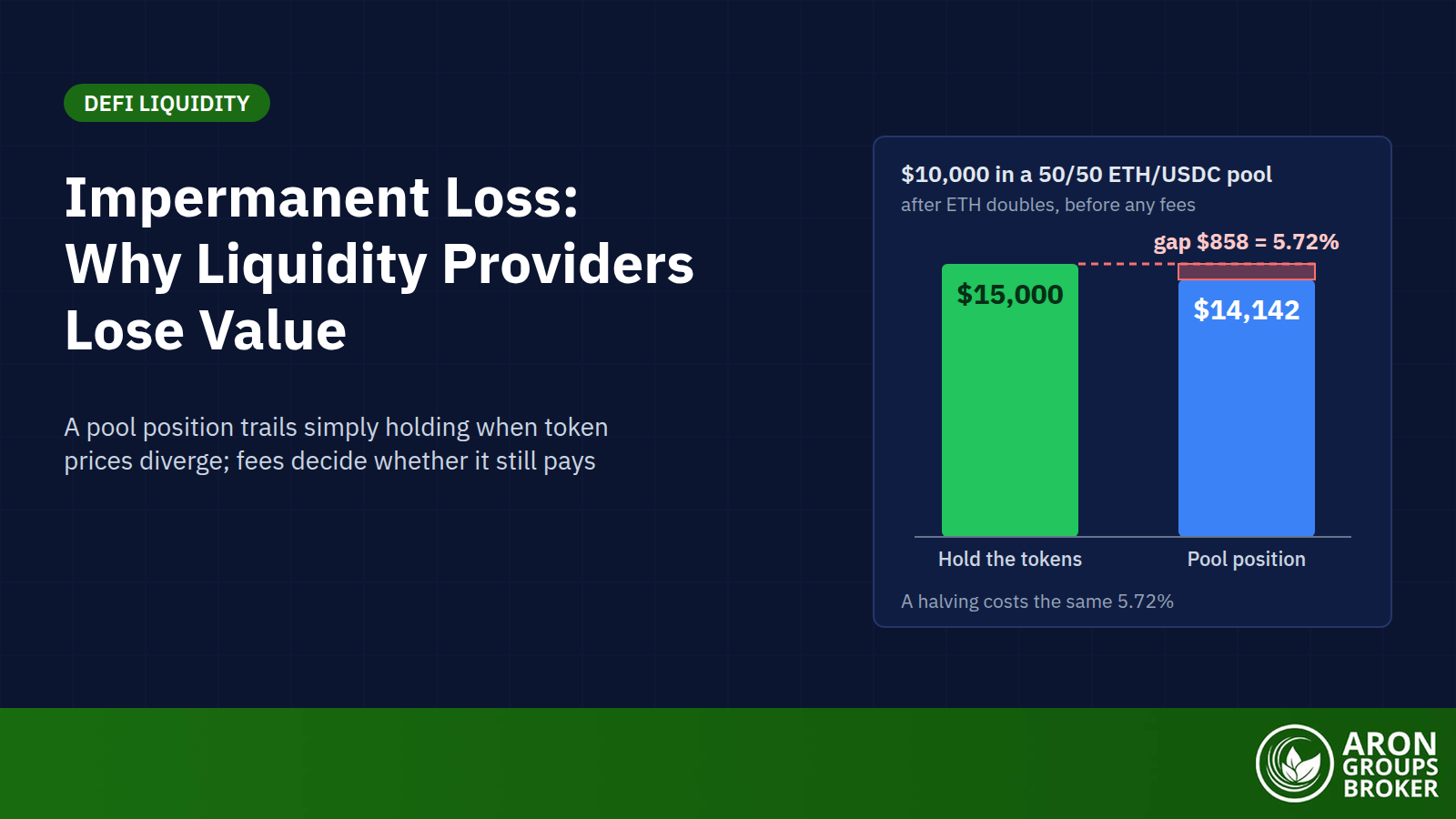
Impermanent loss is what a liquidity provider loses against simply holding the same tokens when the price ratio of a pool’s two tokens changes. It is measured before fees. It is called impermanent because it shrinks if prices return to where they started, and it only becomes real when you withdraw.

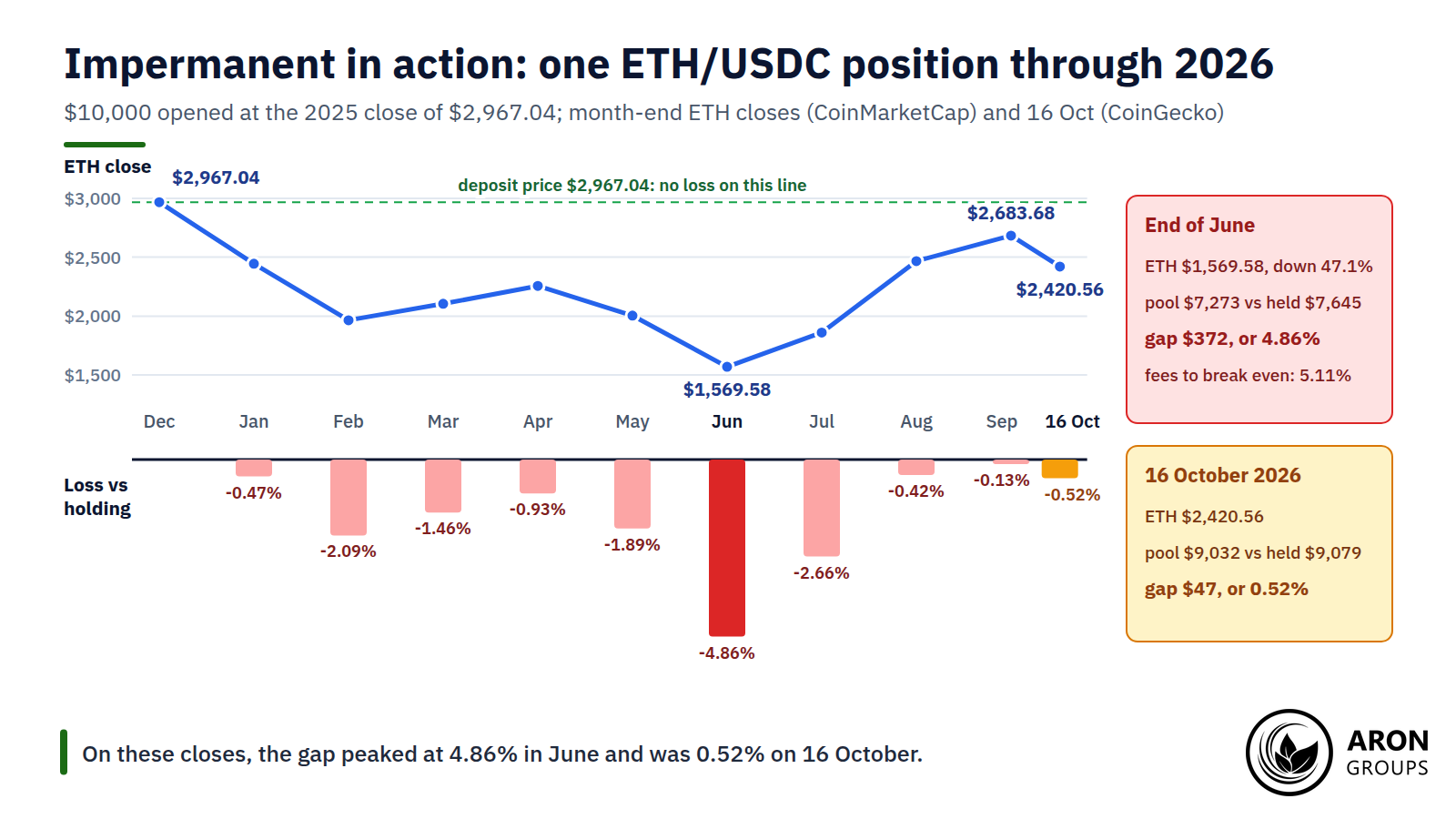
It matters now because volatile crypto prices have tested pools hard in 2026. On CoinMarketCap data, ETH closed 2025 at $2,967.04 and June 2026 at $1,569.58; CoinGecko had it at $2,420.56 at the close on 16 October. Decentralised exchanges traded $233.5 billion in the 30 days to 19 October 2026, according to DefiLlama, almost a third of it on Uniswap.

This guide explains how automated market makers create the loss, then gives the formula, a calculator table, a worked 2026 example and break-even fees. It also corrects three popular claims about concentrated liquidity, stablecoin pairs and loss protection.

bookmark
Key Takeaways
  • Impermanent loss compares a pool position with holding the same tokens. For a 50/50 constant-product pool it is 2 × √r ÷ (1 + r) − 1, so a doubling or a halving costs 5.72%.
  • $10,000 put into ETH/USDC at ETH's 2025 close of $2,967.04 trailed holding by $372 (4.86%) at the end of June 2026. By 16 October the gap was $47 (0.52%).
  • After a 2x move an LP needs fees of 6.07% of the position. That takes pool volume of about 20 times its liquidity at a 0.30% fee, or 121 times at 0.05%, before protocol fees.
  • Concentrated liquidity magnifies the loss. A range from 20% below to 25% above the price earns 9.47 times the fees in range, but loses 5.87% at its edges, not 0.62%.
  • Stablecoin pairs avoid impermanent loss only while pegs hold: USDC fell to about $0.88 on 11 March 2023. Protection can vanish too: Bancor paused its scheme on 19 June 2022.

What Is Impermanent Loss?

Impermanent loss, also called divergence loss, is the gap between your pool share and the same tokens kept in a wallet. On this standard impermanent loss definition, a gap appears whichever way the two prices diverge. It is a cost of providing liquidity in decentralised finance (DeFi), not of buying a token.

sms-star

Risk Disclosure
Trading forex and CFDs carries a high level of risk and can result in the loss of all your capital. This content is educational and is not investment advice. Never risk money you cannot afford to lose.
The Benchmark Is Holding, Not Cash

Impermanent loss is often confused with total loss, but most of an LP’s result still comes from prices. Between ETH’s 2025 close and 16 October 2026, ETH fell 18.4%. A 50/50 ETH/USDC position lost $968 of $10,000. Holding the tokens, or HODLing, lost $921, so impermanent loss explained only $47 of the damage.

Why It Is Called Impermanent

If prices return to your entry ratio, the pool hands back the tokens you put in, plus fees, and the loss disappears. It becomes permanent only if you withdraw while prices are still apart.

How Liquidity Pools and AMMs Create the Loss

A liquidity pool is a smart contract, usually holding two tokens, that anyone can trade against. On many decentralised exchanges it replaces the market makers who quote prices on an order book. An automated market maker (AMM) sets the price from the pool’s own balances. Liquidity providers (LPs) deposit both tokens, often a volatile coin and a stablecoin, and share the fees.

The Constant Product Formula

Most AMMs use the constant product formula, x × y = k, where x and y are the pool’s balances of the two tokens. A trade can change the balances but not their product, so the price, y divided by x, moves with every trade. Buying ETH leaves less ETH and more USDC in the pool, which raises its ETH price.

How Arbitrageurs Rebalance the Pool

A pool does not watch other markets, so when ETH moves on a centralised exchange its price is stale until someone trades against it. Arbitrageurs buy whichever token is cheap in the pool and sell it elsewhere until the prices match, and the LPs pay for their profit.

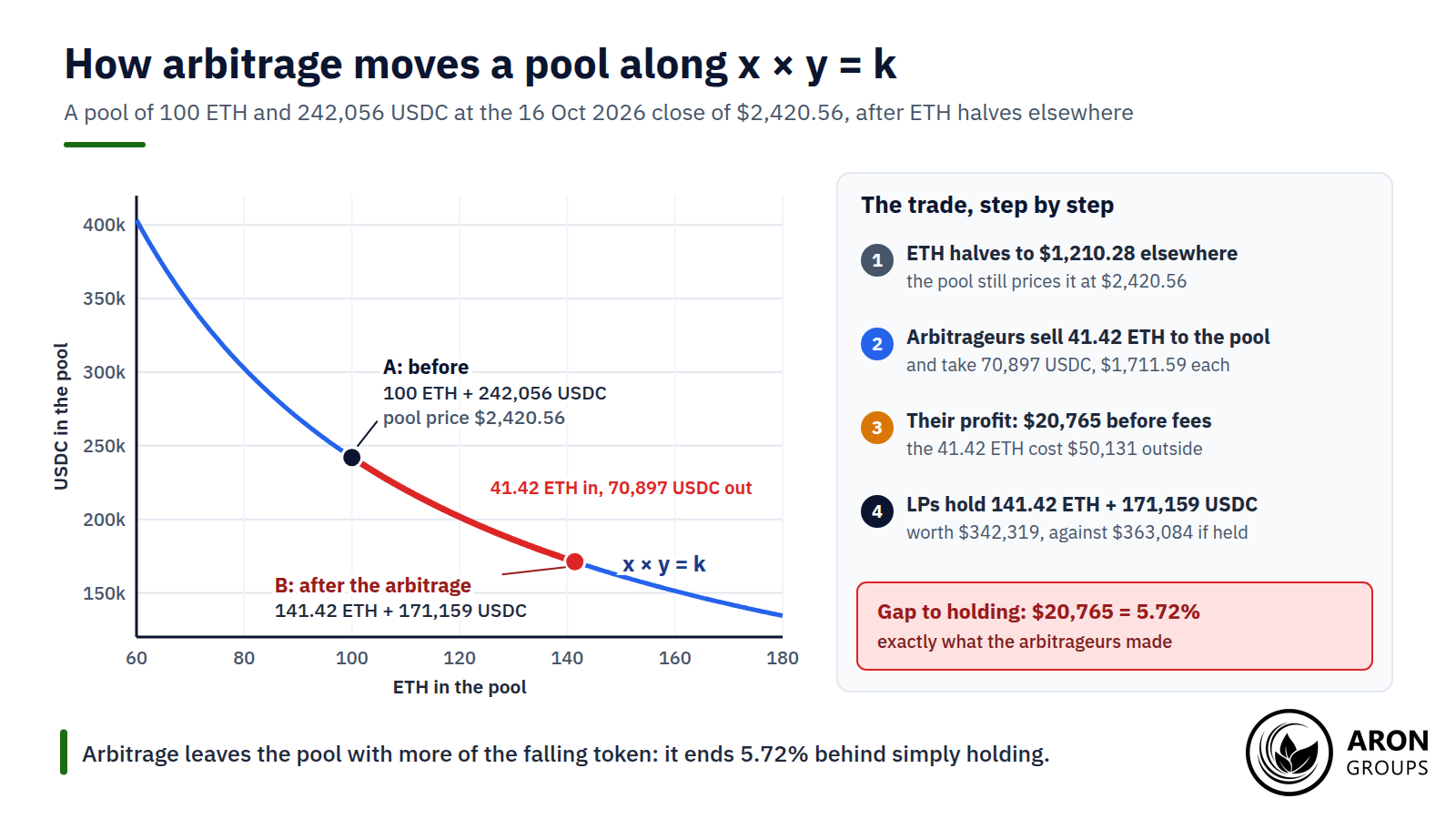
Take a pool of 100 ETH and 242,056 USDC, priced at ETH’s 16 October close. If ETH halves elsewhere, arbitrageurs sell 41.42 ETH into the pool for 70,897 USDC and make $20,765. The LPs are left with more of the falling token: 141.42 ETH and 171,159 USDC, worth $342,319 against $363,084 for holding.

After ETH halves, arbitrage moves the pool along its curve and leaves LPs 5.72% behind holding, a gap equal to the arbitrageurs' profit.

Impermanent vs Permanent Loss

Impermanent loss is a paper loss until you withdraw. Take $10,000 split equally between ETH and USDC at ETH’s 2025 close of $2,967.04: 1.6852 ETH and 5,000 USDC.

By the end of June 2026 ETH had fallen 47.1% to $1,569.58. The pool had bought ETH on the way down, so the position held 2.3169 ETH and 3,636.64 USDC. It was worth $7,273 against $7,645 for holding, a gap of $372, or 4.86%. By 16 October ETH was back at $2,420.56 and the gap had shrunk to $47.

Withdrawing in June would have locked in the $372. Staying in let the gap narrow only because ETH recovered; had it kept falling, the loss would have grown. Impermanent describes the arithmetic, not a promise that prices come back.

The Impermanent Loss Formula and Calculator

In a 50/50 constant-product pool, impermanent loss depends on one number, r: the new price ratio divided by the ratio when you deposited. With USDC on one side, r is simply ETH’s new price over its old one.

The Formula

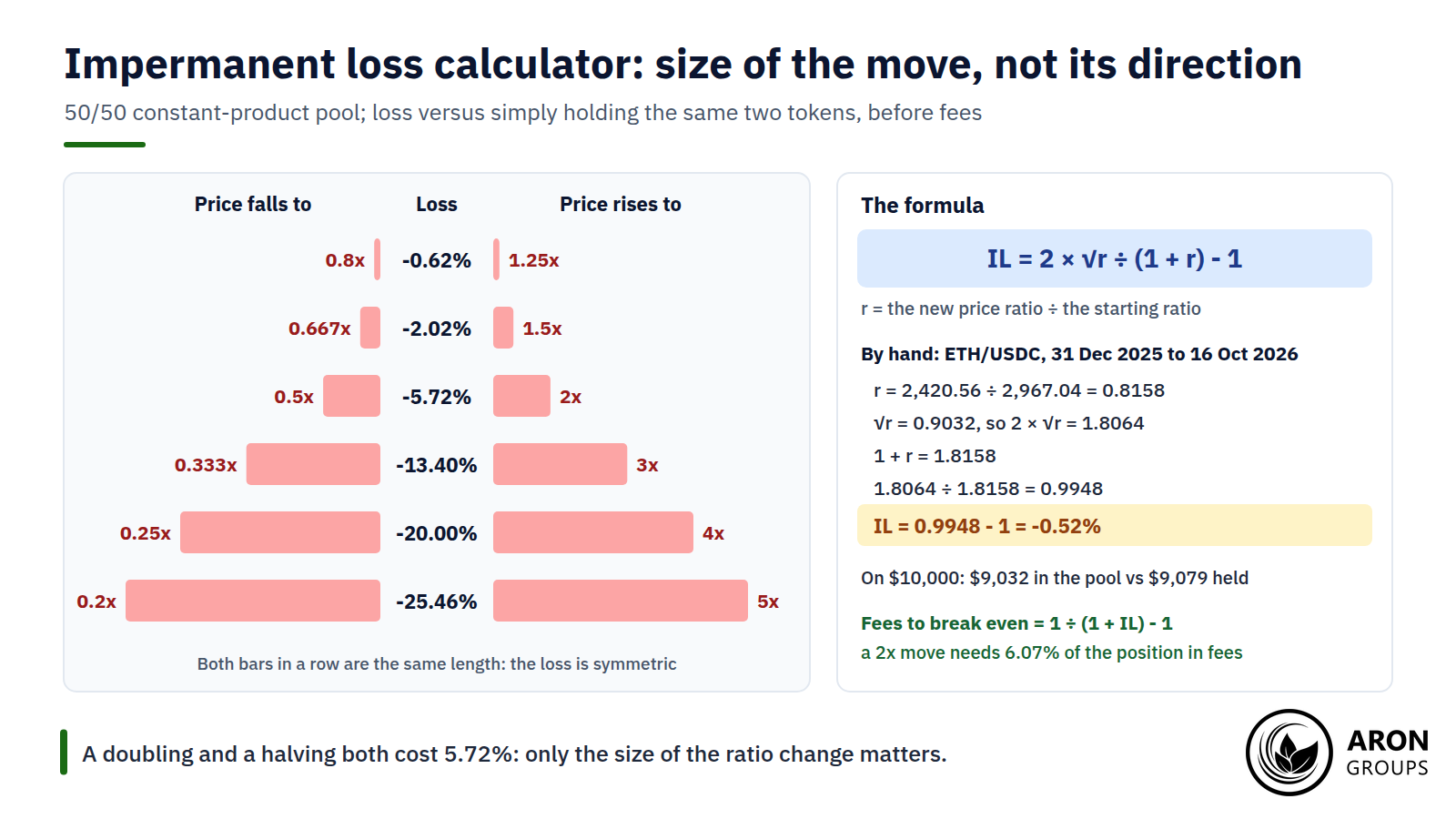
Impermanent loss (IL) = 2 × √r ÷ (1 + r) − 1. The result is never positive, and r and 1/r give the same answer, so a doubling and a halving both cost 5.72%. The bigger the price divergence, the larger the loss: it grows slowly for small moves and quickly for large ones.

sms-star

Key Point
Impermanent loss depends on how far the price ratio moves, not on which way, and it is measured before fees. A 2x move costs 5.72% whether ETH doubles or halves.
Calculator Table: Loss and Break-Even Fees

The table applies the formula to common moves and adds the fees needed to match holding. That is 1 ÷ (1 + IL) − 1 of the position’s value at exit, a little more than the loss itself.

Price moveImpermanent lossFees needed to break evenVolume ÷ liquidity at 0.30% feeVolume ÷ liquidity at 0.05% fee
1.25x or 0.8x-0.62%0.62%2x12x
1.5x or 0.667x-2.02%2.06%7x41x
2x or 0.5x-5.72%6.07%20x121x
3x or 0.333x-13.40%15.47%52x309x
4x or 0.25x-20.00%25.00%83x500x
5x or 0.2x-25.46%34.16%114x683x

Impermanent loss and break-even fees for a 50/50 constant-product pool; each fall is the exact reciprocal of its rise. Volume is the total traded while you are in the pool, as a multiple of liquidity, before protocol fees.

Mini Example: Working Out the 2026 Position by Hand

For the position above, ETH closed at $2,967.04 on 31 December 2025 and $2,420.56 on 16 October 2026, so r = 2,420.56 ÷ 2,967.04 = 0.8158.

Next, √r = 0.9032, so 2 × √r = 1.8064. Divide by 1 + r = 1.8158 to get 0.9948, then subtract 1: impermanent loss is -0.52%. The position is worth $10,000 × 0.9032 = $9,032, against $9,079 for the original tokens held.

Break-even fees are therefore $47, or 0.52% of the position. At the end of June the same sums gave $372, so the LP then needed fees of 5.11%.

A halving costs the same as a doubling, and the real 2026 example works out at -0.52% by hand.

The Fee Income Needed to Break Even

Fees are a share of volume, so break-even depends on how much a pool trades relative to its size. At a 0.30% fee, a 2x move needs volume of about 20 times the pool’s liquidity; at 0.05%, about 121 times. After governance votes in December 2025 and March 2026, Uniswap charges a protocol fee on v2 and v3 pools on Ethereum and several other networks.

There, LPs keep 0.25% of a 0.30% fee and 0.0375% of a 0.05% fee, lifting the 2x multiples to about 24 and 162 times. On 19 October 2026 the same tracker listed Uniswap v3’s USDC-WETH 0.05% pool on Ethereum with $82.3 million of liquidity. Its 30-day average yield of 8.55% implies volume of roughly 170 to 230 times its liquidity a year, depending on the protocol fee. That is an average: positions near the price earn more and full-range ones less.

Fees Are the Other Side of the Bet

Providing liquidity is a bet that trading fees, and any rewards, will outweigh impermanent loss. Fees arrive steadily with volume, while impermanent loss arrives with large price moves. A busy pool in a sideways market suits LPs; a strongly trending one does not.

Who Earns the Fees

Fees are not shared evenly. A BIS working paper of November 2024 found that sophisticated participants supplied 65% to 85% of Uniswap v3 liquidity. Retail LPs captured only 10% to 25% of fees and lost money on a risk-adjusted basis on more than half the days studied.

Sophisticated LPs place narrow ranges close to the market price, where most trading happens. The busiest pool, ETH/USDC at 0.05%, saw almost 40% of the study’s just-in-time liquidity trades: positions added for one large swap and removed straight after.

Liquidity Pool vs Staking

Staking and liquidity provision both put tokens to work for a yield, but the risks differ. Staking ETH earns protocol rewards for helping secure the network, with full exposure to one token and no impermanent loss. The FCA’s July 2026 description of the UK crypto market put those rewards at about 1.5% to 4% a year in August 2025.

A pool pays trading fees, sometimes topped up with newly issued tokens. The FCA calls this liquidity mining, also known as yield farming, and flags risks including token price volatility and smart contract vulnerabilities.

FeatureProviding liquidityStaking ETH
What you earnA share of trading fees, sometimes reward tokensProtocol rewards, about 1.5% to 4% a year
Price exposureTwo tokens, rebalanced by the poolOne token, held in full
Impermanent lossYes, measured before feesNone
Extra risksArbitrage losses, depegs, smart contract bugsExit queues that can last weeks, slashing, smart contract bugs
When it beats holdingWhen fees and rewards beat the divergence lossWhen rewards beat provider fees and slashing losses

Liquidity pool vs staking; staking yield from the FCA (Ethereum, August 2025 data).

Concentrated Liquidity: More Fees, Bigger Losses

Concentrated liquidity does not reduce impermanent loss; it magnifies it. Since Uniswap v3 launched in 2021, LPs can confine capital to a price range, where it acts like a far larger pool. Uniswap’s own launch post said the higher capital efficiency means taking on more price risk.

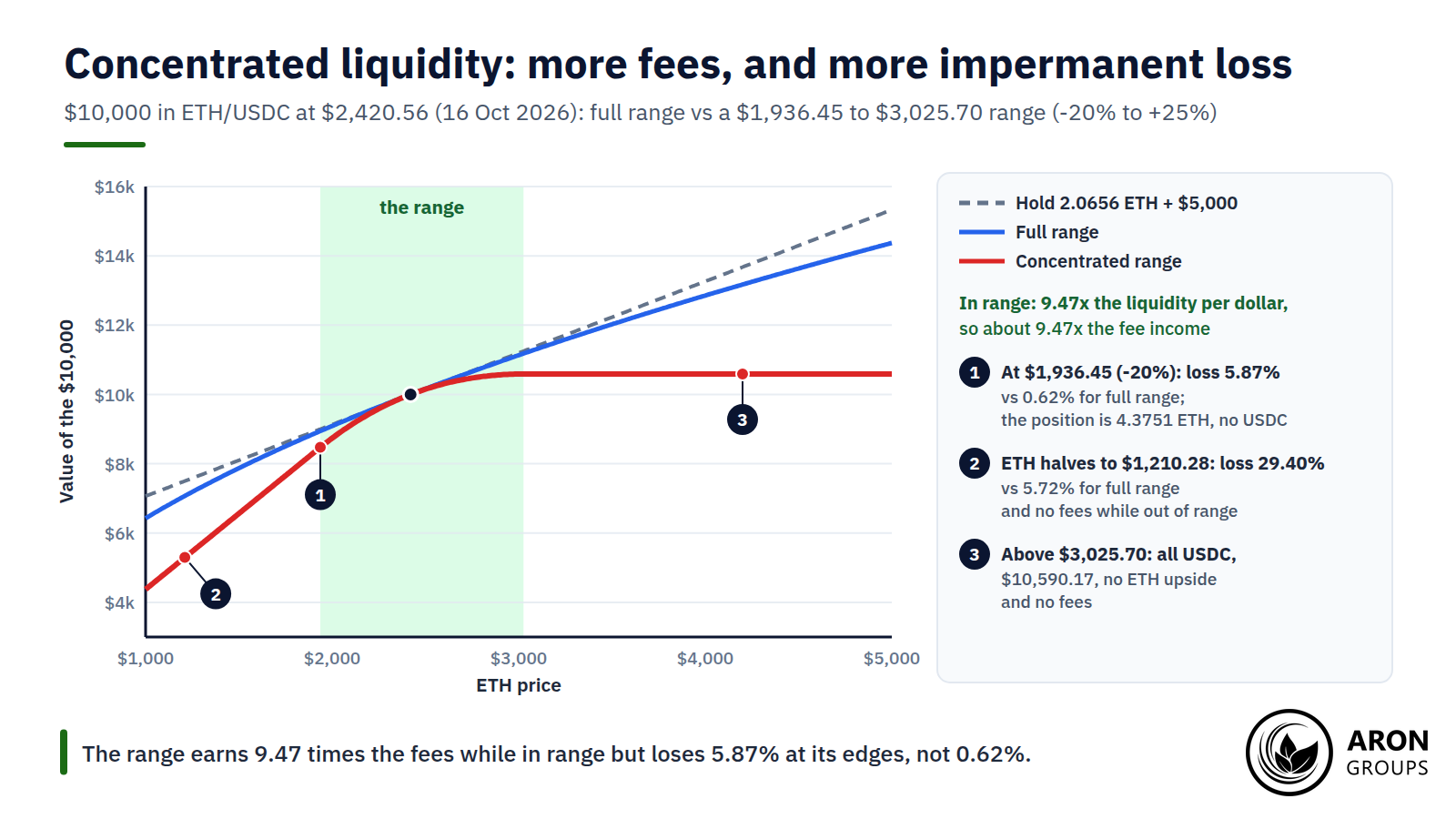
Take $10,000 at ETH’s 16 October close in a range from $1,936.45 to $3,025.70, 20% below and 25% above. It holds 9.47 times the liquidity of a full-range position, so it earns about 9.47 times the fees while ETH stays inside. At either edge it is 5.87% behind holding, against 0.62% for full range.

Outside the range the position earns nothing and holds a single token. Below $1,936.45 it is 4.3751 ETH, the falling asset; above $3,025.70 it is $10,590.17 of USDC and misses the rally. After a halving the loss is 29.40%, against 5.72% for full range.

A narrow range earns 9.47 times the fees in range, but loses 5.87% at its edges rather than 0.62%.

What the Evidence Shows

An early study of Uniswap v3 found that losses beat fees. Loesch, Hindman, Richardson and Welch, working with Bancor, examined 17 pools holding 43% of its deposits from May to September 2021. LPs earned $199.3 million in fees but suffered $260.1 million of impermanent loss, and 49.5% of them had negative returns.

ESMA’s 2023 review of decentralised finance cites that study and warns that LPs may not understand the opportunity costs. In certain pools, it reports, as many as 70% to 75% of users lost more to impermanent loss than they gained in fees.

How to Reduce Impermanent Loss

Impermanent loss in DeFi liquidity pools cannot be removed, but the divergence can be limited and weighed against fees. Volatile pairs need higher fees to compensate: Uniswap expected like-kind pairs to use its 0.05% tier, ETH/DAI 0.30% and exotic tokens 1%. Each method below trades one risk for another.

Stablecoin Pairs and Depeg Risk

Pairs of dollar stablecoins, such as USDT and USDC, have almost no impermanent loss while both hold $1. The real risk is a depeg. On 11 March 2023 USDC fell to about $0.88, and below $0.87 on some trackers. Circle had disclosed $3.3 billion of its $40 billion reserves at Silicon Valley Bank.

Stable pools then fill up with whichever coin traders are dumping, so LPs end up holding it. In Curve’s three-stablecoin pool, USDC and DAI, a decentralised stablecoin partly backed by USDC, each rose above 45% of the balance that March. In June 2023 USDT rose above 70% of it.

Correlated Pairs

Tokens that move together diverge less. Between the 2025 close and the end of June 2026, ETH fell 47.1% while bitcoin’s price fell 33.1%, from $87,508.83 to $58,558.86. An ETH/USDC position was 4.86% behind holding. A pool pairing ETH with wrapped bitcoin (WBTC) trailed holding by just 0.69%, since its loss depends only on the ETH to bitcoin ratio.

The trade-off is price risk. The WBTC pool still lost 40.5% of its dollar value, against 27.3% for ETH/USDC, because both tokens fell.

Protection Schemes and Single-Sided Deposits

Protection schemes are promises funded by someone else. Bancor paid LPs impermanent loss protection in its own BNT token, then paused it on 19 June 2022, citing hostile market conditions. In May 2023 US investors sued in Texas, alleging the scheme had run at a deficit.

Single-sided deposits do not remove the exposure either. A position inside the current price range must hold both tokens, so a one-token deposit is swapped into the pair on entry. A Uniswap v3 range order sits above or below the price instead, and converts as the price crosses it.

Q: Can I avoid impermanent loss by depositing only one token?
A: Not really. The pool still needs both tokens, so a single-sided deposit is either swapped on entry or converted as the price moves through your range. The exposure to price divergence remains; only the timing of the swap changes.

The Honest Limits of Impermanent Loss

Impermanent loss is a snapshot against holding. It flatters or punishes a position depending on the day you check.

The position's shortfall against holding rose to 4.86% at the June close of $1,569.58, then fell to 0.52% by 16 October 2026.

Researchers increasingly use loss-versus-rebalancing (LVR), set out by Milionis, Moallemi, Roughgarden and Zhang in 2022. It measures the steady loss to arbitrageurs trading against a pool’s stale prices, and unlike impermanent loss it only accumulates.

For a constant-product pool, LVR per unit of time is one eighth of the variance of returns, as a share of the pool’s value. ETH’s daily moves from 31 August to 17 October 2026 had a standard deviation of about 2.2%. That is roughly 0.6 basis points of the pool a day, or 2.2% a year before fees, as an estimate.

Hedging the ETH side with short perpetual futures, resized as the pool’s ETH balance changes, leaves roughly fees minus LVR. Funding payments and trading costs come on top. Gas costs, sandwich attacks on deposits and withdrawals, and smart contract bugs sit outside both measures. Deposits, withdrawals and rewards can also be taxable events in many countries.

Where Aron Groups Fits

Aron Groups does not offer liquidity pools, decentralised exchange trading or stablecoins, so there is no impermanent loss to manage. It offers crypto CFDs such as BTCUSD and ETHUSD on MetaTrader 5, alongside forex, gold and indices. A CFD tracks the price with no pool to rebalance. Understanding impermanent loss helps weigh pool yields, which are not free money, against simply trading the price.

Removing impermanent loss does not remove risk. A CFD carries full, leveraged price exposure, overnight swaps and gap risk: prices can jump past a stop-out level. Margin calls come at 100% margin level and stop-outs at 50%, or 40% on Islamic and VIP accounts. A demo account lets you test ETHUSD first, and the Nano account keeps live sizes small.

Conclusion

Impermanent loss is the cost of being the market’s counterparty: the pool sells the rising token and buys the falling one, at stale prices. A doubling or halving costs 5.72% before fees.

Whether liquidity provision pays depends on fees beating that loss, and on risks the formula leaves out: depegs, withdrawn protection, narrow ranges and code failures.

A sensible check before any deposit is the impermanent loss calculation on plausible moves, set against realistic fee income rather than headline yields.

Frequently Asked Questions

Short answers to common questions about impermanent loss.

Is impermanent loss a real loss?

It is a real shortfall against holding, but it stays unrealised while you remain in the pool. It becomes permanent if you withdraw before the price ratio returns to its starting level.

How do you calculate impermanent loss?

Divide the new price ratio by the starting one to get r, then work out 2 × √r ÷ (1 + r) − 1. A 25% rise gives -0.62%, a doubling -5.72% and a fivefold move -25.46%.

Do stablecoin pairs have impermanent loss?

Very little while both coins hold their peg, because their prices barely diverge. If one depegs, as USDC did on 11 March 2023, the pool fills with the weaker coin and LPs absorb the loss.

Is there impermanent loss in CFD trading?

No. A CFD has no liquidity pool, so there is nothing to rebalance. You carry the full price movement instead, with leverage, swaps and margin rules.

Continue Reading
not-found
calendar 3 November 2026
Rate this article

Leave a Reply

Your email address will not be published. Required fields are marked *

No thanks