
Currency intervention is when a central bank or monetary authority buys or sells its own currency in the foreign exchange market to influence the exchange rate. The usual aims are to calm disorderly volatility, correct a rate that has drifted far from fundamentals, or defend a peg or band. Sometimes the trade is real, and sometimes a well-aimed sentence from an official does the work on its own.
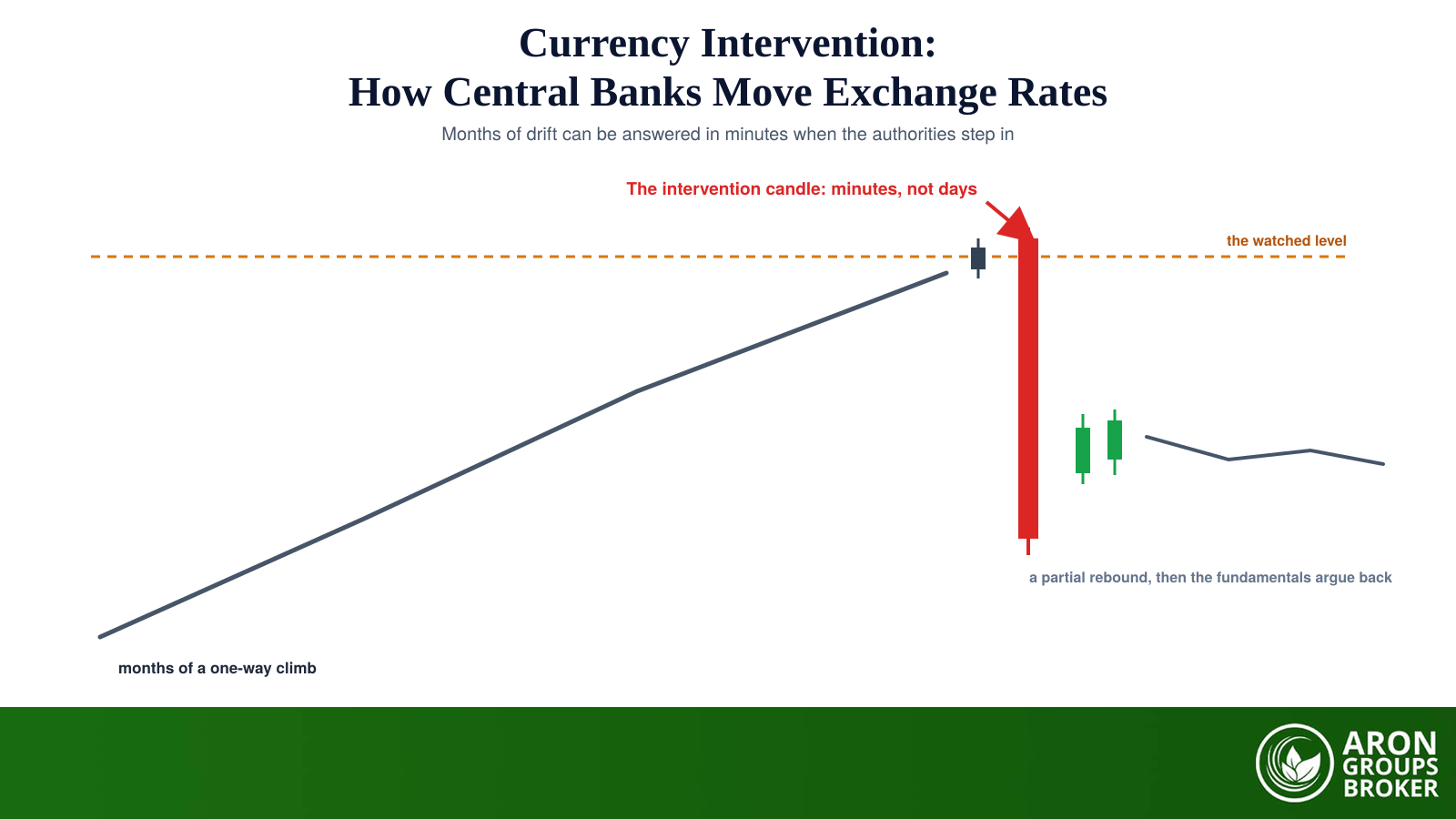
For anyone trading forex, intervention is not an abstract policy topic. It produces some of the sharpest moves the market ever prints: a pair that ground higher for months can drop several per cent in minutes, gap through resting orders and reverse a crowded trade before a human can react. Knowing who intervenes, how, and under what pressure is part of reading the chart.
This guide explains what central bank intervention in the foreign exchange market actually involves, the asymmetry that decides how long a campaign can last, the main types, the episodes from the Plaza Accord to Japan’s record 2026 operation, and the honest evidence on whether intervention works.
- Currency intervention is a central bank or finance ministry buying or selling its own currency to steer the exchange rate or curb volatility.
- Weakening a currency is close to unlimited because the bank issues the money it sells; defending one spends finite foreign exchange reserves.
- Operations differ on three axes: direct or verbal, sterilised or unsterilised, unilateral or coordinated.
- The defining episodes, the 1985 Plaza Accord, Black Wednesday 1992, the 2015 Frankenshock and Japan's yen-buying from 2022 to 2026, all repriced markets in minutes.
- Effects usually fade unless the intervention shifts expectations and is backed by interest rate policy, so it buys time rather than setting regimes.
What Is Currency Intervention?
Currency intervention, also called foreign exchange intervention, is an official transaction in the currency market carried out to move or stabilise an exchange rate rather than to make a profit. The actor is usually the central bank, but not always the decision maker: in Japan the Ministry of Finance decides and the Bank of Japan executes as its agent, a split that matters when you parse official comments. The tool sits apart from interest rate policy, although the two work best when they point the same way.
Risk Disclosure
Trading forex and CFDs carries a high level of risk and can result in the loss of all your capital. This content is educational and is not investment advice. Never risk money you cannot afford to lose.
Why Central Banks Step In
The motives come in pairs. A currency that appreciates too fast crushes export competitiveness, which is why Switzerland capped the franc in 2011 and why Japan sold yen for decades. A currency that depreciates too fast imports inflation through fuel and food bills, which is why Japan has been buying yen since 2022. Beyond direction, authorities also act against disorder itself: one-way speculative moves, evaporating liquidity, or a rate gapping so fast that hedging breaks down. Intervention is the emergency brake, not the steering wheel.
The Asymmetry: Weakening Is Cheap, Defending Is Finite
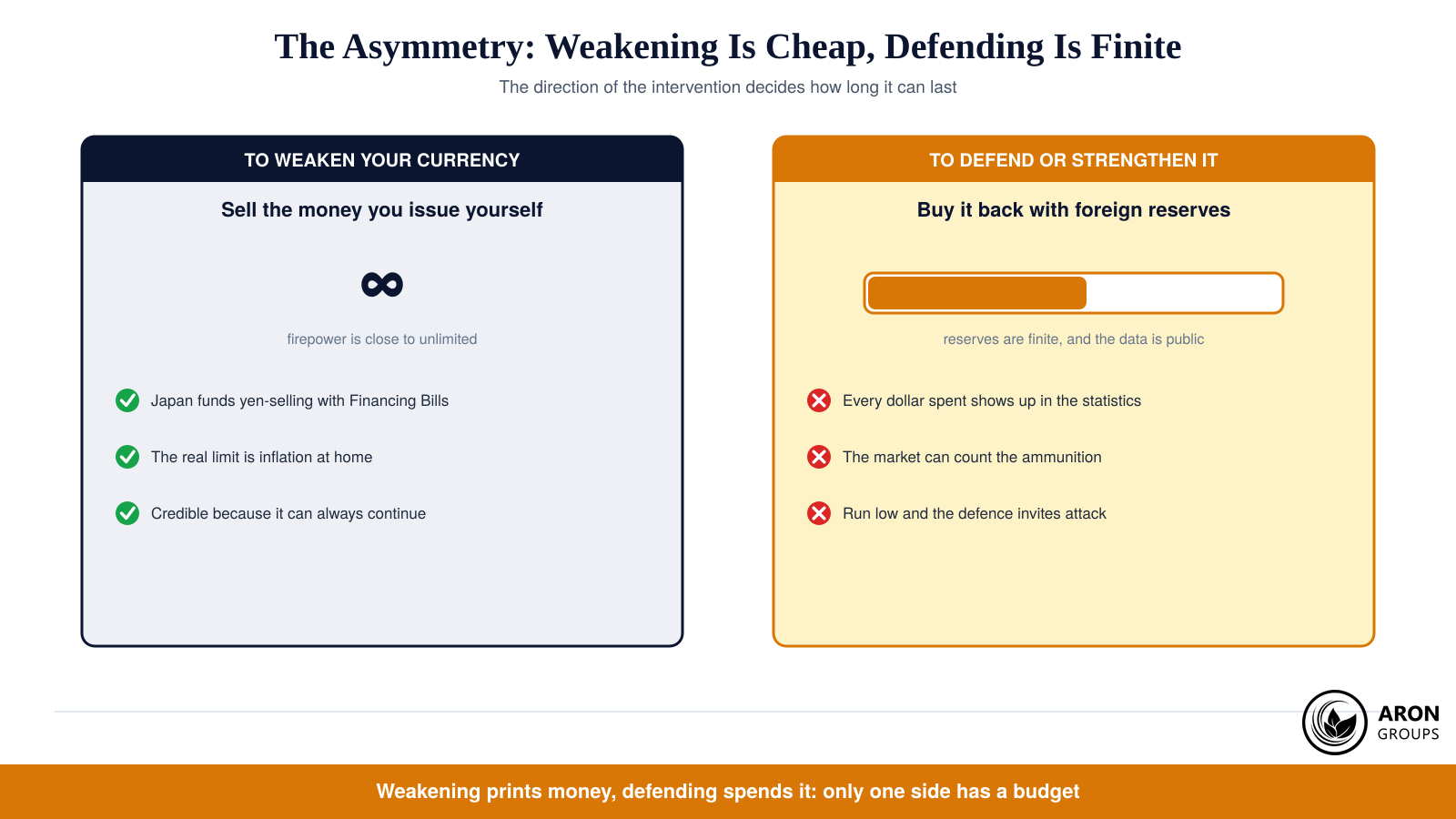
The single most useful mechanic in this topic is the asymmetry of ammunition. To weaken its own currency, a central bank sells money it can create, so the firepower is close to unlimited; Japan funds yen-selling by issuing short-term Financing Bills rather than by spending anything scarce. The true limits on that side are inflation and credibility, not ammunition. To strengthen or defend a currency, the authority must buy it back with foreign exchange reserves, and reserves are finite, public and countable.
That is why defences fail more often than devaluations. Speculators attacking a peg can see the reserve data shrinking month by month, and even a large war chest is small against a market whose global FX turnover reached 9.6 trillion dollars a day in the 2025 BIS survey. The asymmetry has a sting in its tail, though: Switzerland sat on the unlimited side, printing francs to hold its ceiling, and still walked away in 2015 once its balance sheet had swollen past 80 per cent of GDP. Unlimited in theory is not unlimited in politics.
The Types of Intervention
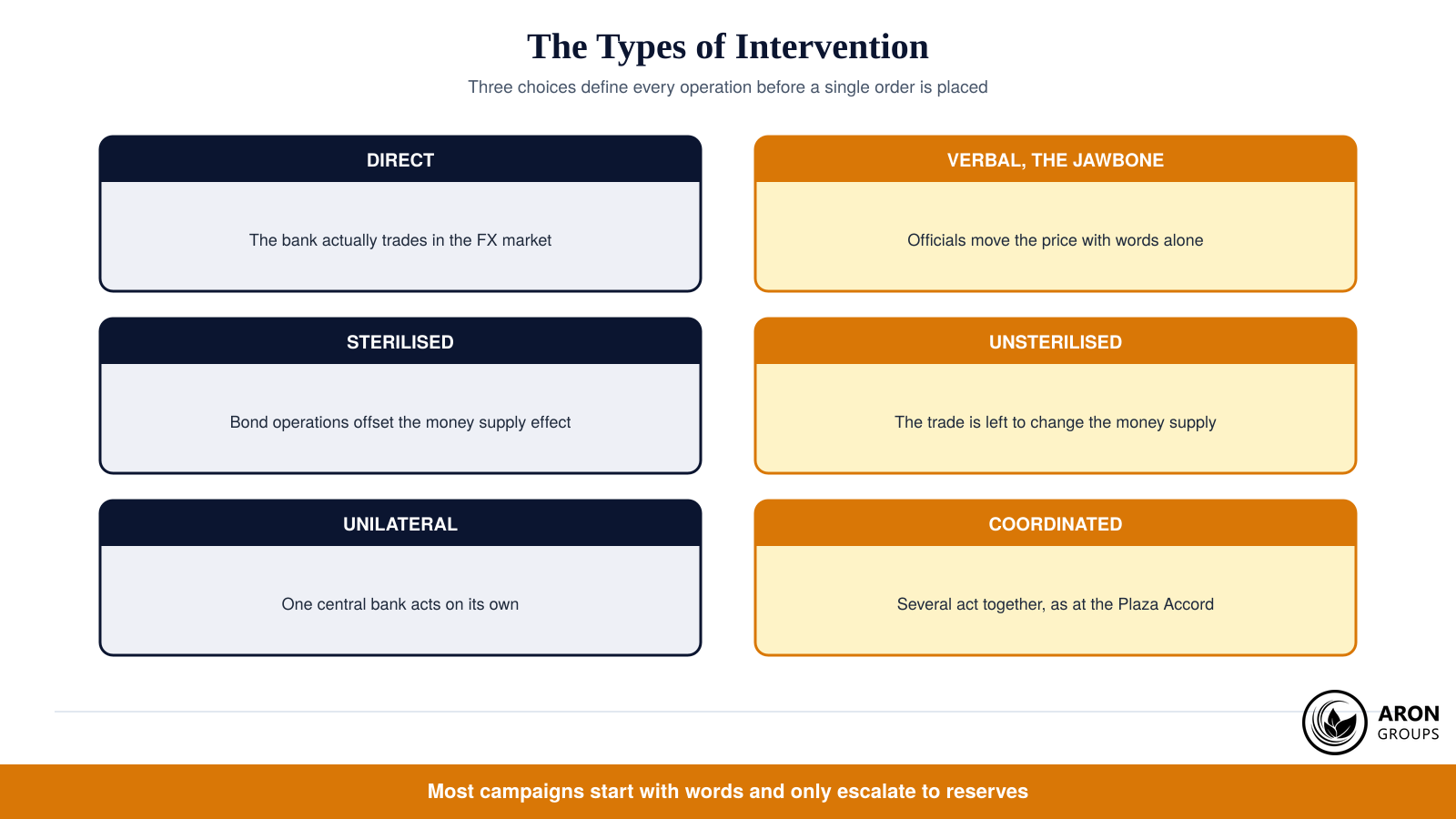
Every operation can be classified along three axes before a single order is placed: whether the authority actually trades or merely talks, whether the domestic money supply is allowed to change, and whether it acts alone or with others. The combinations behave differently, and markets price them differently.
Verbal intervention, the jawbone, usually comes first because it is free. Officials warn about speculative, one-sided moves and markets adjust to the threat of real orders. Japan’s escalating language through 2022, 2024 and again in 2026, ending with a top currency official calling one statement a final evacuation warning to markets, is the modern template: words, then reserves.
| Type | What happens | The catch |
|---|---|---|
| Direct | The authority transacts in the FX market itself | Spends reserves or expands the money supply |
| Verbal (jawboning) | Officials signal intent without trading | Works only while the threat stays credible |
| Sterilised | Bond operations offset the money supply change | Weaker: the effect rides on signalling |
| Unsterilised | The money supply is allowed to change | Stronger, but entangles rate policy |
| Unilateral | One authority acts alone | Easier for the market to fade |
| Coordinated | Several authorities act together | Rare, and far harder to fight |
Table 1: The main types of currency intervention and the cost each one carries.
Famous Interventions, 1985 to 2026
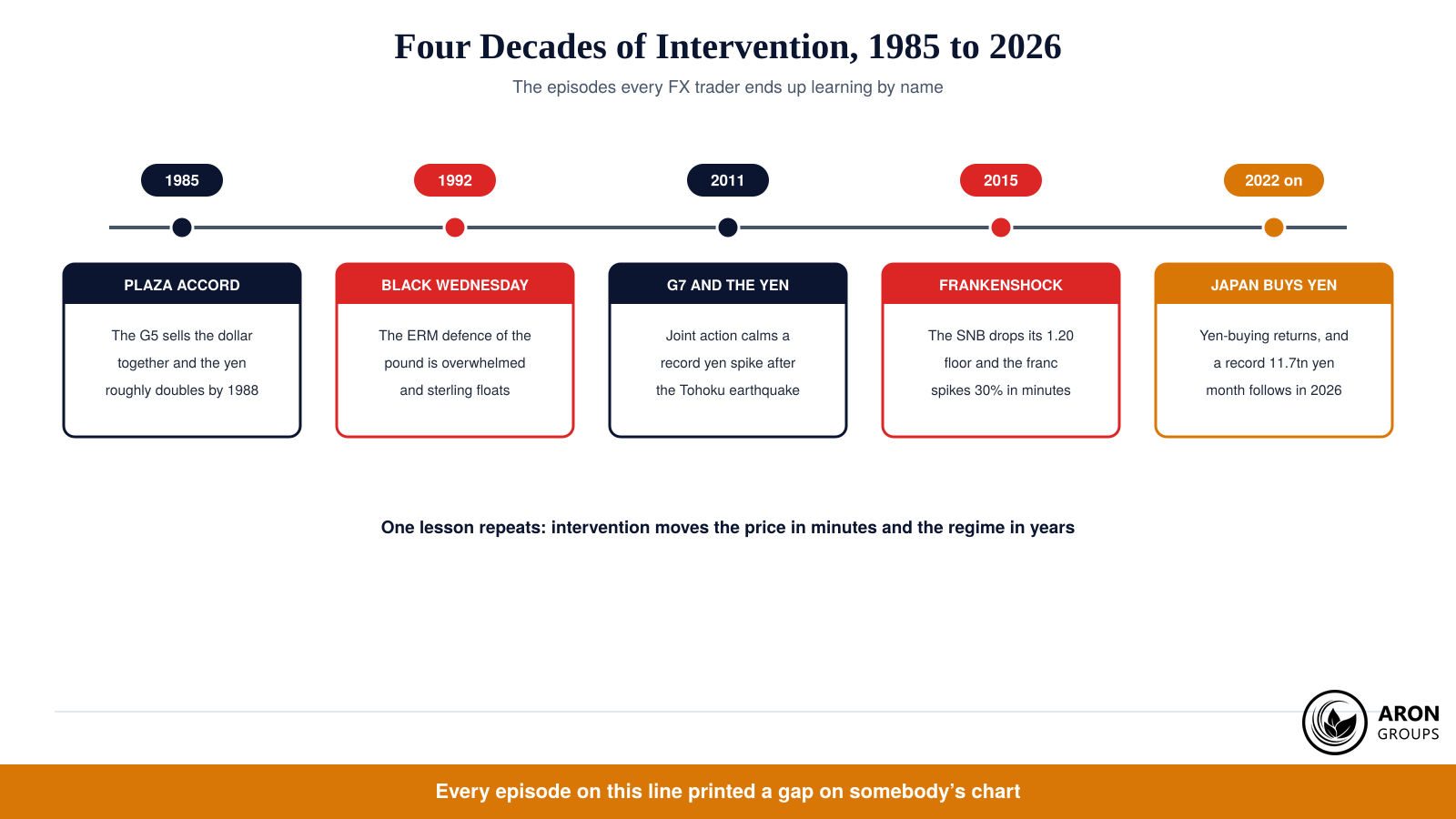
The modern playbook was written by a handful of episodes. In September 1985 the G5 economies met at the Plaza Hotel in New York and agreed to sell the overvalued dollar together; the yen, near 240 per dollar beforehand, roughly doubled in value to the 120s by 1988, and the Louvre Accord of February 1987 was needed to stop the slide they had started. The episode proved coordinated intervention can move a major currency for years, and its aftermath, a super-strong yen feeding Japan’s bubble economy, proved the side effects can outlast the policy.
The failures taught just as much. On Black Wednesday in 1992 the Bank of England spent reserves and raised rates twice in a day, yet sterling still left the ERM by evening. In March 2011 the G7 intervened jointly to weaken a yen that had spiked to a record after the Tohoku earthquake, the first coordinated action since 2000, and it worked precisely because it was collective. And in January 2015 the Swiss National Bank abandoned the 1.20 franc ceiling it had defended since 2011; EUR/CHF collapsed around 30 per cent within minutes before settling, several retail brokers failed, and the Frankenshock became the standing lesson that even a central bank promise can end without warning.
| Episode | Year | Action | Outcome |
|---|---|---|---|
| Plaza Accord | 1985 | G5 jointly sells the dollar | Yen roughly doubles by 1988 |
| Black Wednesday | 1992 | UK defends sterling's ERM band | Defence fails, the pound floats |
| G7 yen action | 2011 | Joint yen-selling after a record spike | The spike is calmed |
| Frankenshock | 2015 | SNB abandons its 1.20 EUR/CHF floor | Franc spikes about 30% in minutes |
| Japan yen-buying | 2022 to 2026 | MoF-ordered yen purchases | Slides slowed, trend set by rates |
Table 2: The defining intervention episodes and how each one resolved.
Mini Example: Japan's Yen Defence, 2022 to 2026
In September 2022, with the yen sliding past 145 per dollar, Japan bought yen for the first time since 1998, spending 2.8 trillion yen in a day and a further 6.3 trillion in October as the pair broke above 151. The 2024 round was bigger: a record 5.9 trillion yen on 29 April after the pair touched 160.245, 9.8 trillion across that window, and 5.5 trillion more in July once 161.76 printed.
In 2026 the ceiling was tested again. After the yen slid to 160.72 and the finance minister promised decisive action, Japan spent a record 11.7 trillion yen, roughly 73 billion dollars, between late April and late May, its largest monthly operation on record. Each round followed the same script: escalating warnings, a sudden multi-percent reversal in Tokyo hours, then a slow drift back as the rate gap reasserted itself.
Who actually orders an intervention in Japan?
The Ministry of Finance decides and the finance minister authorises; the Bank of Japan only executes the trades as the government’s agent. That is why yen intervention can arrive even when the BoJ itself is easing, and why comments from MoF currency officials often matter more for USD/JPY than remarks from the central bank.
Does It Work? The Expectations Channel
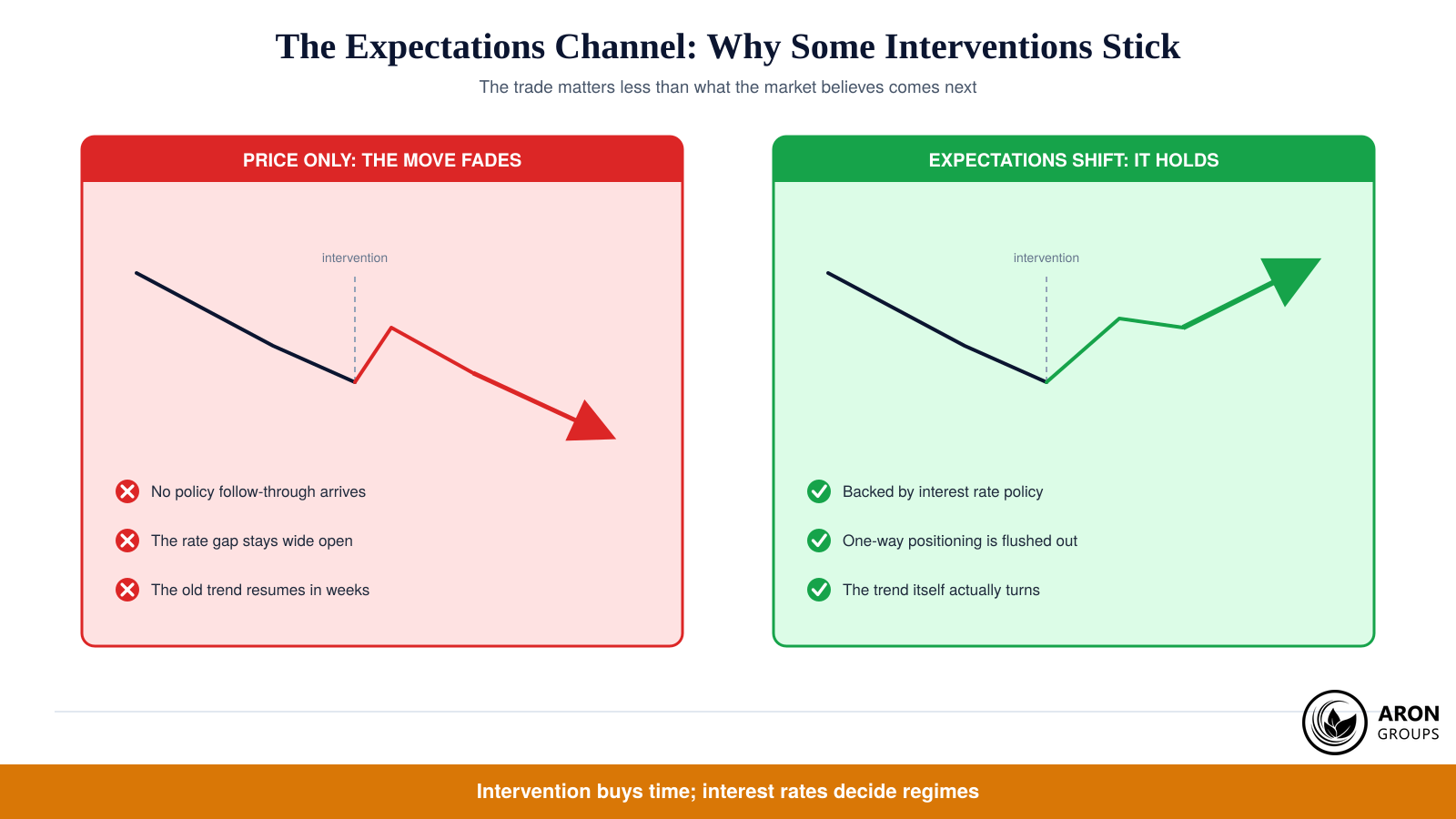
The consistent finding is that intervention works through expectations more than through the orders themselves. A one-off trade, however large, is a drop in daily turnover and fades within weeks; a credible signal that policy itself is turning can end a trend. Japan’s record 2024 operations lifted the yen about five per cent and then watched it slide to a fresh low within two months, because the interest rate gap that caused the weakness had not moved. The durable yen rallies came when United States rate expectations finally shifted. No trading edge built on fighting that hierarchy survives long.
Honest Limits: What Intervention Cannot Do
Intervention cannot beat fundamentals for long, and the record is blunt about it. Britain could not hold sterling against the logic of recession-era rates in 1992, and Switzerland chose to abandon its own ceiling in 2015 rather than absorb the euro flows that quantitative easing was about to unleash. Sterilised operations, the most common kind, leave rates and money supply unchanged by design, which is exactly why their effects decay. The fair summary traders should carry: intervention buys time and punishes crowded positioning, while interest rates decide regimes.
What Intervention Means for Traders
Intervention is a scheduled surprise: the pressure points are public, the timing is not. From 2022 to 2026 the yen’s lines in the sand climbed from the mid-140s to the low 160s, and every round produced multi-percent reversals inside Tokyo hours, often during thin holiday liquidity. CHF pairs carry the same event risk around SNB meetings, and the US Dollar Index is the quickest gauge of whether a move is a yen story or a dollar story. Around these windows an effective risk management strategy matters more than any directional view, because the damage arrives as gaps rather than trends on the equity curve.
The practical adjustments are unglamorous. Cut position sizing around watched levels and scheduled currency-official commentary, since leverage magnifies a gap that skips over a stop, a risk US regulators spell out for leveraged products generally. Accept that the win rate against risk-reward of holding short-yen carry through an intervention window is worse than the daily drift makes it look; the July 2024 carry unwind punished exactly that trade.
It is also worth remembering why leveraged FX products are restricted for retail clients in many jurisdictions: conduct authorities documented heavy retail CFD losses precisely in fast-gapping conditions. Stress-test your strategy against a three per cent adverse gap on the pairs you hold, and check that the resulting drawdown is one your account and your nerves can actually absorb.
Rule
The level is public, the timing is not. If a position cannot survive a sudden three per cent gap against it, it is too large to carry into an intervention window.

Where Aron Groups Fits
Intervention risk is a fill-quality problem as much as a forecasting one. Aron Groups runs ECN accounts on MetaTrader 5 with market execution and floating spreads, so orders around a fast repricing fill at the next available price without requotes, and JPY and CHF pairs trade alongside gold, indices and the majors on the same platform.
If you want to learn these events without paying tuition to the market, a demo evaluation costs nothing and replays the same conditions, while the commission-free Nano account trades from 0.0001 lots, small enough that a surprise gap is a lesson rather than a loss. Build the habit of trading intervention season small before you ever trade it seriously.
Conclusion
Currency intervention is the moment the referee steps onto the pitch. A central bank or ministry trades, or merely threatens to, in order to steer its exchange rate, and the asymmetry at the heart of it decides the odds: weakening rests on money the authority can create, while defending spends reserves the market can count. Words come first, reserves second, and coordination is the rare move that almost always lands.
For traders the lesson is double. Respect the event, because gaps through watched levels are where accounts break and capital preservation is decided in advance, not during. And respect the hierarchy, because from the Plaza Accord to Japan’s record 2026 operation, intervention has moved prices in minutes while interest rates moved regimes, and a professional trader positions for both clocks rather than either alone.
Frequently Asked Questions
Quick answers to the questions traders ask most about currency intervention.
What is sterilised currency intervention?
An intervention whose effect on the domestic money supply is offset with bond operations. The central bank buys or sells currency, then conducts opposite transactions in government securities so overall liquidity is unchanged. It avoids disturbing interest rate policy, which is exactly why its market effect is weaker and relies mostly on the signal it sends.
Why is defending a currency harder than weakening it?
Because of what each side spends. Weakening means selling your own currency, which the central bank can issue in nearly unlimited amounts. Defending means buying your currency back with foreign exchange reserves, which are finite and publicly reported, so speculators can literally watch the ammunition run down, as they did before Black Wednesday in 1992.
What was the Plaza Accord?
A September 1985 agreement at New York’s Plaza Hotel in which the United States, Japan, West Germany, France and the United Kingdom coordinated to push down an overvalued dollar. It worked: the yen roughly doubled in value by 1988, and the 1987 Louvre Accord was needed to halt the dollar’s fall. It remains the benchmark for coordinated intervention.
How often does Japan intervene in the yen?
Rarely but heavily. After nothing since 1998, Japan bought yen in September and October 2022 for about 9.2 trillion yen, spent 9.8 trillion in April and May 2024 plus 5.5 trillion that July, and set a monthly record near 11.7 trillion yen in April and May 2026. The Ministry of Finance orders each operation and the Bank of Japan executes it.