
icon icon Home
icon icon Accounts
icon icon Quick start
icon icon Symbols

Floating Spread vs Fixed Spread: How Each Model Prices Your Trades and Which One Costs Less

Author
Abe Cofnas
Abe Cofnas
calendar Last update: 15 August 2026
watch Reading time: 8 min

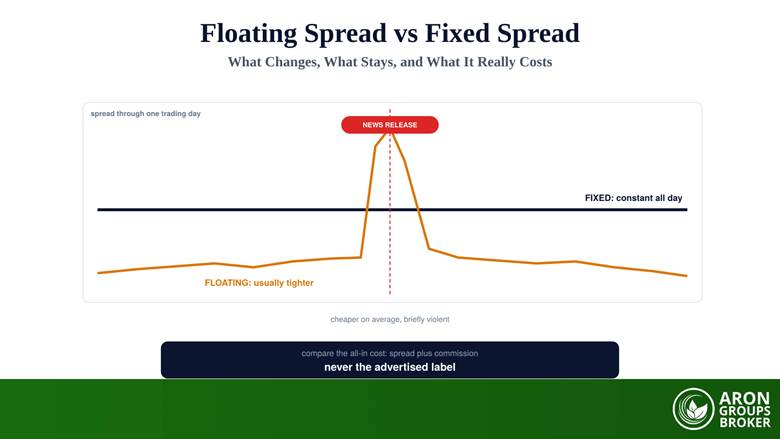
A floating spread, also called a variable spread, is a bid-ask spread that changes continuously with market liquidity and volatility. It tightens when the market is calm and deep, and widens during news releases or thin conditions. A fixed spread does the opposite: the broker quotes the same number regardless of what the market is doing, and absorbs the variation itself.

Neither model is a trick, and neither is free. The choice is between a cost that is usually lower but occasionally spikes, and a cost that is always the same but always includes a margin for that uncertainty. Which one is cheaper for you depends on when you trade and how often, and answering it properly means comparing all-in cost rather than the number in the advertisement, which is the same arithmetic discipline that underpins any serious approach to how to trade forex.

Below: what a floating spread actually is, who sets the price under each model, the total-cost comparison that settles the argument, exactly when floating spreads widen, the requotes-versus-slippage trade-off that comes with each execution type, and which model suits which trading style.

bookmark
Key Takeaways
  • A floating spread moves with real market liquidity and volatility; a fixed spread stays constant because the broker holds it steady.
  • Floating spreads are typical of ECN and STP accounts with market execution; fixed spreads are typical of dealing-desk market makers with instant execution.
  • Floating is usually cheaper on average, because a fixed spread bakes in a higher baseline to cover the risk of not moving.
  • Compare spread plus commission against the wider fixed spread; a zero-pip or zero-commission label tells you almost nothing on its own.
  • Market execution means no requotes but possible slippage, and floating spreads widen at news, at rollover, around session boundaries, and on illiquid pairs.

What Is a Floating Spread?

The spread is the gap between the price you can sell at and the price you can buy at, and in a real market that gap is not a constant. It reflects how many participants are willing to quote, in what size, at that moment. Currency markets are decentralised, as the BIS triennial survey describes in detail, so during the London and New York overlap the majors are quoted by many banks at once and the underlying spread on EURUSD can sit near zero. In the quiet hours, or thirty seconds after a surprising inflation print, far fewer participants want to quote and the same spread can be many times wider. A floating spread simply shows you that reality as it happens.

sms-star

Risk Disclosure
CFDs are complex instruments and come with a high risk of losing money rapidly due to leverage. You should consider whether you understand how CFDs work and whether you can afford to take the high risk of losing your money. Past performance is not indicative of future results. This content is provided for educational purposes only and does not constitute investment advice.
And What a Fixed Spread Is

A fixed spread is a commercial promise rather than a market measurement. The broker undertakes to quote, say, 1.8 pips on EURUSD whatever the conditions, which means it takes on the risk of the underlying spread widening beyond that. No firm accepts that risk for nothing, so the promised number sits above the average of what the market would have charged. You are buying predictability, and the premium for it is built into every trade, including the hundreds where nothing dramatic happened.

Who Sets the Price You See

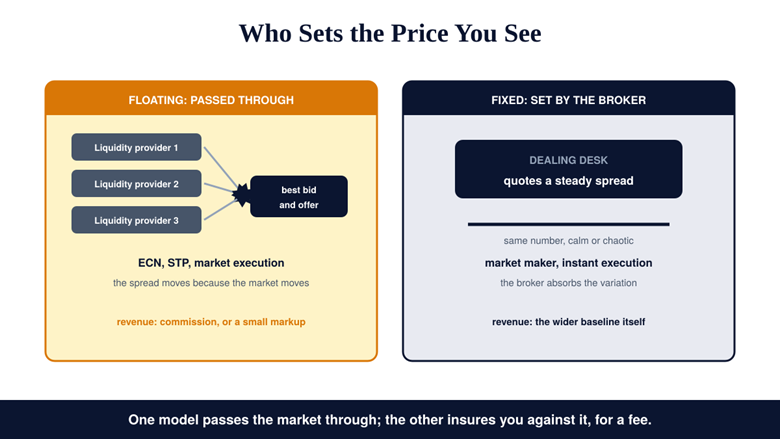
The two models come from two different execution structures, and knowing which one you are on explains most of what you will experience. Floating spreads belong to pass-through models, described as ECN or STP and often labelled A-book, where the broker assembles the best available bid and offer from its liquidity providers and adds no markup, earning a disclosed commission instead. Fixed spreads belong to dealing-desk market makers, often labelled B-book, where the broker is the counterparty quoting a steady price and its revenue is the wider baseline itself.

Pass-through ECN pricing compared with a dealing desk quoting a fixed spread

One model passes the market through and charges a fee; the other insures you against the market and prices the insurance in.

It is worth saying plainly that neither structure is illegitimate. Hybrid arrangements are normal and regulated markets contain both, which is precisely why European product intervention rules exist to standardise protections such as leverage caps and negative balance protection across models. What matters is disclosure: a broker that explains where its prices come from, and publishes its fees per account type, has told you what you need to know.

The Comparison That Actually Settles It

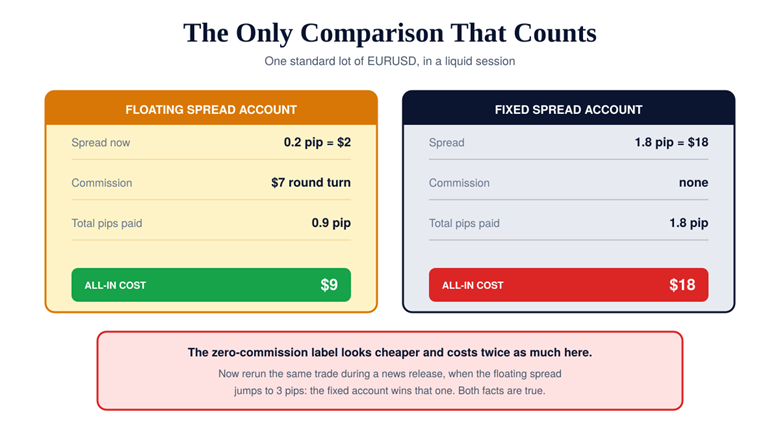
Every spread debate reduces to one line: total cost equals spread cost plus commission plus swap if you hold overnight. Run it on the instrument you trade, at the hour you trade it, and multiply by your monthly trade count. A floating account showing 0.2 pips on EURUSD with a $7 round-turn commission costs $9 on a standard lot, which is 0.9 pips all in. A fixed account at 1.8 pips with no commission costs $18 on the same trade. The commission-free label is the more expensive option here by a factor of two, and no amount of marketing changes that. Fold the figure into expectancy the way a systematic trader folds in every other cost.

All-in cost of one EURUSD standard lot on a floating spread account versus a fixed spread account

The same trade, two receipts: the zero-commission account is twice the price in a liquid session.

Now run it again during a major release, when the floating spread jumps to 3 pips. The floating account costs $37 and the fixed account still costs $18. Both results are real, and the honest conclusion is not that one model wins but that the clock decides. Traders who work liquid sessions are usually better off floating; traders whose activity clusters around scheduled events may genuinely prefer a fixed cost they can plan around.

sms-star

Rule
Treat a zero-pip claim as a claim about one moment, not the trading day. Open the platform at the hours you actually trade, watch the live spread on your instruments for a week, and write the numbers down. That log is worth more than every comparison table on the internet, including this one.
DimensionFloating spreadFixed spread
BehaviourChanges continuously with liquidityConstant regardless of conditions
Typical modelECN or STP, market executionDealing desk market maker, instant execution
Average costUsually lower, near zero on majors in deep hoursHigher baseline to cover the promise
Cost predictabilityLower: you cannot know the spread in advanceHighest: the number is the number
At major newsWidens sharply, sometimes many times overHolds, subject to the broker's own terms
Execution frictionSlippage possible, no requotesRequotes possible on instant execution
Best suited toScalping and active day trading in liquid sessionsPredictable costs, news-heavy or slower styles

Read this as a profile of trade-offs, not a scoreboard: the deciding row is whichever one describes your week.

When a Floating Spread Widens

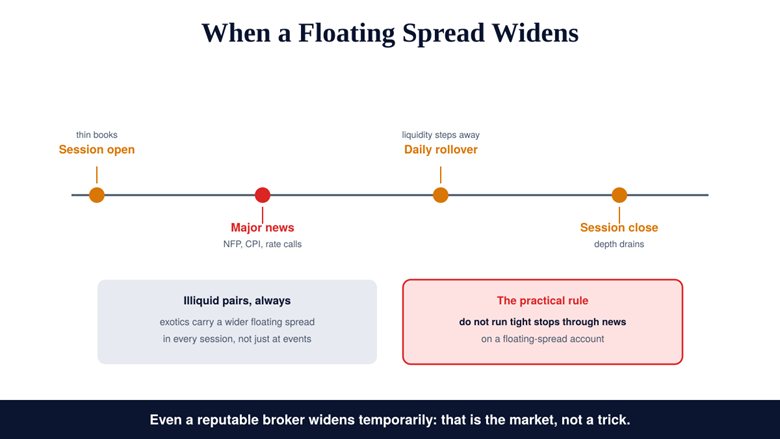
The widening is predictable in timing even when it is not predictable in size, which makes it manageable. Four situations account for almost all of it: major economic releases such as employment and inflation data or central bank decisions; the daily rollover, when liquidity providers step back briefly; session opens and closes, where books are thin before depth arrives or after it drains; and illiquid pairs, where exotics carry a wider floating spread in every session rather than only at events.

When a floating spread widens: major news, daily rollover, session open and session close

Four predictable moments plus one permanent condition: the calendar tells you most of what you need.

The practical consequence is a rule rather than a strategy: do not run tight stops through news on a floating-spread account. A stop placed just beyond normal noise sits inside abnormal noise for a few seconds, and it will be taken out by a spread rather than by a move. Size from the stop distance with deliberate position sizing, allow for the wider spread when you calculate your risk-to-reward ratio, and remember that a temporary widening at a reputable broker is the market showing through, not misconduct. Regulators’ advisories on retail forex trading are a useful primer on what to expect from execution generally.

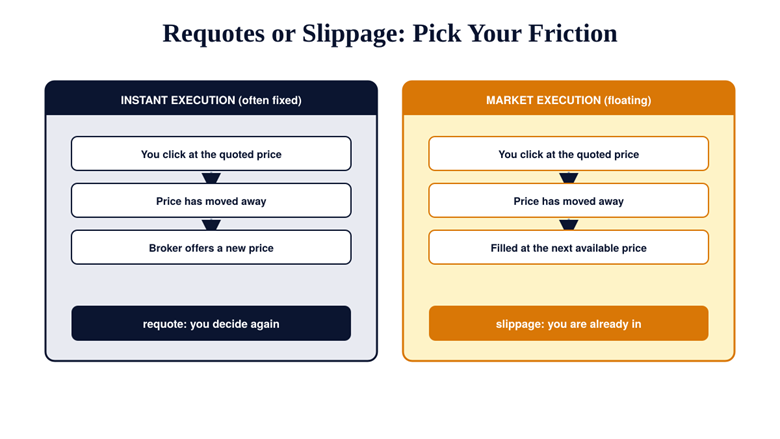
Requotes or Slippage: The Friction You Choose

Execution type travels with spread type, and each brings its own friction. Instant execution, common on fixed-spread accounts, promises the displayed price: if the market has moved by the time your order arrives, the broker cannot fill you there, so it returns a requote and asks you to accept a new price. Market execution, standard on floating-spread accounts, does not requote at all; it fills you at the next available price, which may be better or worse than the one you clicked. That difference is slippage.

Instant execution requotes compared with market execution slippage

Instant execution hands the decision back to you; market execution fills you and tells you afterwards.

Q: Which is worse, a requote or slippage?

A: It depends on what you were doing. A requote is safer for a passive entry, since nothing happens without your consent, but it is useless when you are trying to exit a fast market and need to be out now. Slippage is the price of certainty of execution, which is why active traders generally prefer market execution and accept that a fill can come in a little worse than expected.

Which Model Suits Which Trader

Frequency and timing decide this, not experience level. Floating suits scalpers and active day traders, because when you pay the spread many times a day, the near-zero readings in deep sessions compound into a real saving and the occasional news spike is avoidable by simply not trading through it. Fixed suits traders who value a predictable cost line: those who deliberately trade around releases, those who want the arithmetic settled before entry, and swing or position traders holding for days, where the spread is a rounding error against the size of the move and swap matters far more.

One further nuance separates the two groups. Because a floating spread is only wide for the moments it is wide, its cost is highly sensitive to when you press the button, which rewards traders with a fixed routine and punishes opportunistic clicking at random hours. A fixed spread is indifferent to your timing, which is genuinely valuable if your schedule is not your own: a trader who can only reach a chart late at night in a thin session may pay less on fixed pricing than on floating, despite floating being cheaper on paper.

How the Aron Groups Accounts Are Priced

Aron Groups runs floating spreads with market execution across its ECN account line-up, which means real pass-through pricing and no requotes, with the honest caveat that spreads widen at news like any floating model. The commission structure is not uniform, and it is worth reading before you choose. The Nano account is commission-free on all symbols, with the cost carried in the spread and micro volumes from 0.0001 lots, which makes it the natural place to measure real costs with real money at minimal stakes. The Islamic ECN account is also commission-free as well as swap-free.

The Standard and VIP ECN accounts charge commission in the classic ECN shape, with certain special symbols that periodically waive commission and swap under published conditions. Current figures per account live on the trading accounts page, and the ten-minute exercise worth doing is to open the MetaTrader 5 platform, watch the live spread on your instruments through your own trading hours, and run the total-cost formula from this article against the numbers you see.

If the spread model is new to you, do that measurement on a demo account first, then move to live trading with a cost figure you calculated rather than one you were quoted. Sound risk management matters more than either spread model, and a stable equity curve over months is the only verdict that counts.

Conclusion

A floating spread shows you the market’s own cost of doing business, which is usually small and occasionally not. A fixed spread hides that variation behind a steady number and charges you a premium for the service. Floating belongs to ECN and STP pass-through models with market execution; fixed belongs to dealing-desk market making with instant execution and the possibility of requotes.

The label on the account tells you nothing useful. Spread plus commission, computed on your instruments at your hours and multiplied by your monthly volume, tells you everything, and it is worth verifying against your own logs the way you would verify any assumption through out-of-sample backtesting. Do that, keep tight stops away from scheduled news, and let capital preservation outrank the pursuit of a tenth of a pip, which is how a professional trader treats costs: seriously, and second to survival.

Frequently Asked Questions

Quick answers to the questions traders ask most about floating and fixed spread accounts.

What is a floating spread account?

It is an account where the bid-ask spread changes continuously with market liquidity and volatility rather than being held at a set number. Floating spreads are standard on ECN and STP accounts with market execution, and they usually sit tighter than fixed spreads in liquid sessions.

What is the difference between fixed and variable spread?

A variable, or floating, spread passes through real market pricing and moves all day; a fixed spread is set by the broker and stays constant. Fixed pricing costs more on average because the broker prices in the risk of holding it steady, while floating costs less on average but can spike at news.

Is ECN the same as a variable spread account?

Closely related but not identical. ECN describes the execution model, where orders meet external liquidity, and floating spreads are its natural consequence. In practice almost every ECN account has a floating spread and charges commission, but the terms describe different things: one is how you are filled, the other is how the price is quoted.

Which spread type is better for scalping?

Usually floating. Scalpers pay the spread many times a day and trade the liquid hours where floating spreads are tightest, so the all-in cost is normally lower even after commission. The exception is a scalper who deliberately trades news releases, where a fixed spread protects against event-time widening.

Continue Reading
not-found
calendar 15 August 2026
Rate this article

Leave a Reply

Your email address will not be published. Required fields are marked *

No thanks