
icon icon Home
icon icon Accounts
icon icon Quick start
icon icon Symbols

Market Microstructure: How Order Books, Spreads, and Order Flow Shape Every Fill

Author
Abe Cofnas
Abe Cofnas
calendar Last update: 17 August 2026
watch Reading time: 9 min

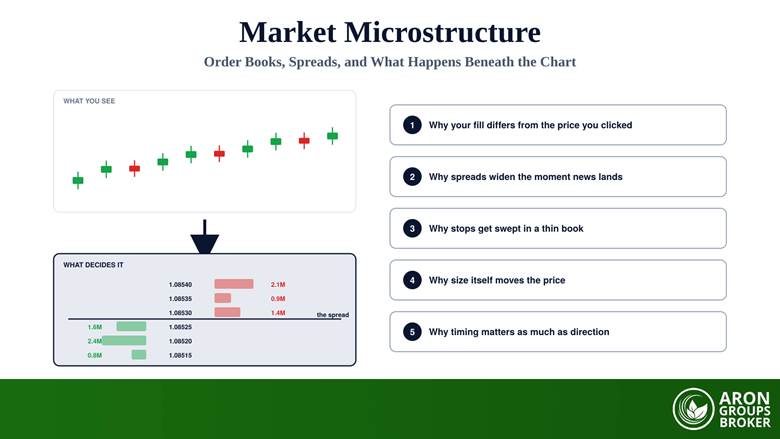
Market microstructure is the study of how trades actually happen and how prices form beneath the chart: the order book, the bid-ask spread, liquidity, order flow, the market makers who quote, and the mechanics of execution. Where conventional analysis asks whether supply exceeds demand, microstructure asks the narrower and more useful question of how a specific order meets a specific counterparty at a specific price.

For a retail trader, that shift of question pays off in a very concrete way. Almost every frustrating experience on a platform, a fill worse than the price you clicked, a spread that trebles the instant data lands, a stop taken out by a wick that reversed immediately, is a microstructure event with a mechanism behind it. Understanding the mechanism will not make you money on its own, but it turns those events from bad luck into things you can anticipate, which is the beginning of a real edge.

Below: the disambiguation from ICT market structure, the building blocks of the book and the spread, the three dimensions of liquidity, how prices form, market impact and order slicing, the two market designs behind your account, and what retail traders can and cannot actually see.

bookmark
Key Takeaways
  • Market microstructure studies the mechanics of trading: order books, spreads, liquidity, order flow, and execution, rather than broad supply and demand.
  • It is not the same as ICT market structure, which is about reading swing highs and lows, breaks of structure, and trend on a chart.
  • Market orders consume liquidity and move price; limit orders supply it, and the imbalance between them drives short-term moves.
  • Liquidity has three dimensions: tightness of the spread, depth of size at each price, and resiliency, meaning how quickly the book refills.
  • Forex is largely over the counter, so no single consolidated order book exists, which makes retail order-flow reads inferences rather than certainty.

What Is Market Microstructure?

The field studies the specific mechanisms, rules, and participants that shape how prices form. Its central claim is deceptively simple: prices move because orders interact, not because time passes. A chart drawn from five-minute candles hides that interaction almost completely, which is why two markets with identical-looking charts can behave utterly differently when you try to trade them. It is a genuine academic discipline, built by researchers including Maureen O’Hara, Larry Harris, whose book Trading and Exchanges remains the standard reference, and Joel Hasbrouck. You need none of the mathematics to use the practical lessons, but knowing the lessons come from measured research rather than trading folklore is worth something when you decide how much weight to give them.

sms-star

Risk Disclosure
CFDs are complex instruments and come with a high risk of losing money rapidly due to leverage. You should consider whether you understand how CFDs work and whether you can afford to take the high risk of losing your money. Past performance is not indicative of future results. This content is provided for educational purposes only and does not constitute investment advice.
Microstructure Is Not the Same as Market Structure

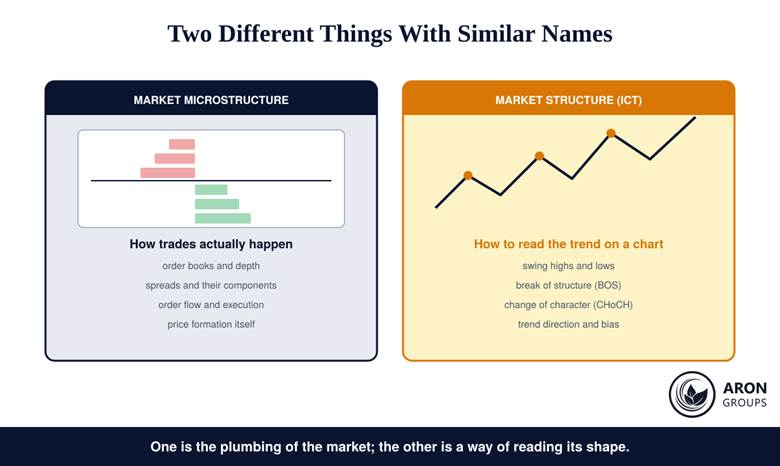
This confusion is common enough to deserve clearing up before anything else. Market microstructure, the subject of this article, is about how the market mechanically works: books, spreads, execution, and price formation. Market structure, in the Smart Money Concepts and ICT sense, is a chart-reading framework about swing highs and lows, breaks of structure, and changes of character used to judge trend and bias. The names nearly rhyme and the subjects barely overlap. One tells you how a fill happens; the other tells you which way you think price is going.

Market microstructure mechanics compared with ICT chart-based market structure

Similar names, different subjects: the plumbing of the market against a way of reading its shape.

The Building Blocks

Four concepts carry almost everything practical in the field, and each one maps directly onto something you have already experienced on a platform.

Building blockWhat it isHow it shows up in your trading
Limit order bookResting bids and offers at each price, visible as Level 2 or depth of marketWhere your stop actually sits relative to real size
Bid-ask spreadThe gap between best bid and best offerThe unavoidable cost of trading right now
LiquidityTightness, depth, and resiliency togetherWhether your size moves price or disappears into the book
Order flowMarket orders consuming liquidity, limit orders supplying itThe imbalance that drives short-term direction

Four ideas, one theme: everything you pay and everything that surprises you comes from the interaction of orders.

Why the Spread Exists at All

The spread is not an arbitrary charge; it compensates the market maker for three distinct things. There are order-processing costs, the mundane expense of running the operation. There is inventory risk, because a dealer who buys from you now holds a position they did not want and must offload. And there is adverse selection, the risk that the person selling to them knows something they do not. Those three components explain the behaviour you actually observe: spreads are narrow when many participants compete and inventory is easy to recycle, and they widen the moment either condition fails.

The Three Dimensions of Liquidity

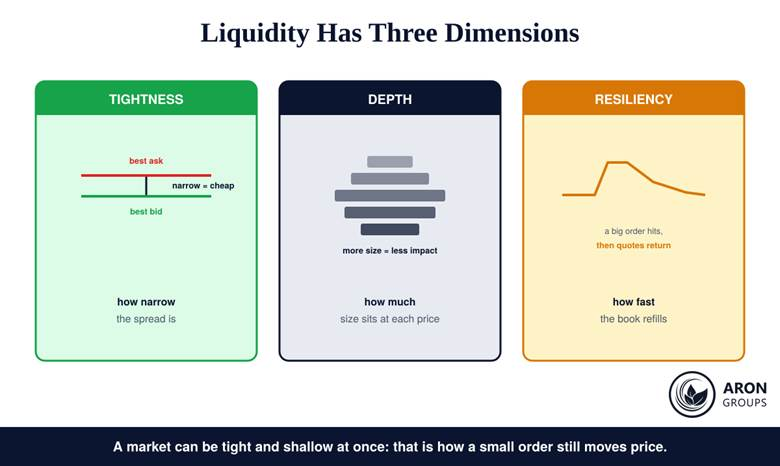
Traders often use liquidity as a single word for a single quality, which causes real errors. It has three separate dimensions, and a market can score well on one while failing on another. Tightness is how narrow the spread is. Depth is how much size rests at each price level. Resiliency is how quickly the book refills after a large order has consumed it. A market that is tight but shallow looks cheap and behaves expensively, because the advertised spread applies only to the first small slice of your order.

The three dimensions of liquidity: tightness, depth and resiliency of the order book

Tightness, depth, and resiliency are independent: scoring well on one says nothing about the others.

How Prices Actually Form

Here is the intuition behind the field’s classic models, stated without the mathematics. Some traders have information others do not. A market maker quoting both sides cannot tell, at the moment of execution, whether the person hitting their offer knows the next move. Every fill therefore carries the risk of being on the wrong side of information, and the market maker protects itself the only way it can: by widening the spread enough that profits from uninformed flow cover losses to informed flow.

That single insight, formalised in the 1980s by Kyle and by Glosten and Milgrom, explains a great deal. It explains why spreads widen before and during major data releases, when the proportion of informed flow spikes. It explains why illiquid instruments are permanently more expensive to trade. And it explains why price adjusts as orders arrive rather than waiting for news to be interpreted: each order is itself a signal about what someone believes. Traders building a systematic process on order-flow readings are, whether they know it or not, working inside that framework.

Q: If order flow drives price, can I just follow the order flow?

A: Not straightforwardly, and especially not in spot forex. Following flow requires seeing it, and there is no single consolidated book to see. What retail platforms show is a partial view assembled from one broker’s liquidity providers, which is useful context but not the whole picture. Treat flow reads as evidence with error bars, not as a feed of the market’s intentions.

Market Impact and Why Your Fill Differs

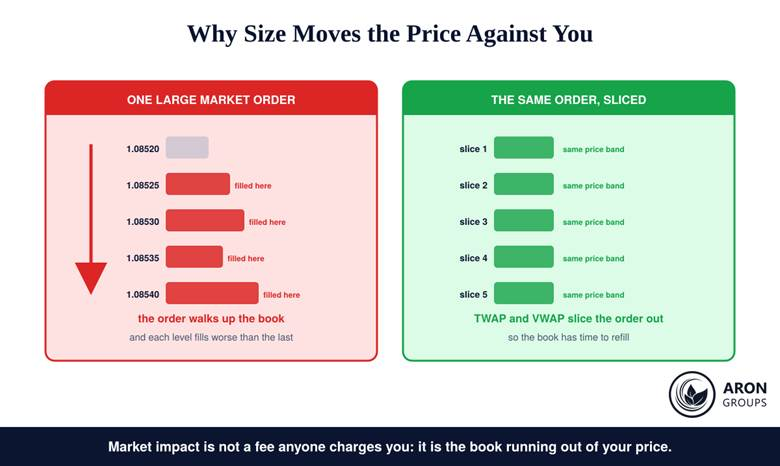
A market order does not execute at one price; it executes against whatever is resting in the book. If your order is larger than the size available at the best offer, it consumes that level and moves to the next, and the next, filling progressively worse. That is market impact, and it is not a fee anyone charged you: it is the book running out of your price. Combined with spread widening in fast markets, it accounts for nearly every gap between the price on your screen and the price on your confirmation, which is exactly why disciplined position sizing has to allow for it rather than assume a perfect fill.

A large market order walking up the order book compared with a sliced order

A large order walks up the book; a sliced order lets the book refill between fills.

This is why institutions do not simply press the button. Execution algorithms such as TWAP, which spreads an order evenly across time, and VWAP, which weights it toward periods of higher volume, exist to break a large order into pieces small enough to be absorbed without walking the book. The retail version is unglamorous but real: size that is comfortable in the London session may be too large for the same instrument at three in the morning.

Mini Example: Two Identical Orders, Two Different Nights

A trader buys two lots of a minor pair during the London and New York overlap. Several banks are quoting, the top of the book holds more than two lots, and the fill comes in at the displayed offer. The confirmation matches the screen and the trader concludes execution is fine.

The same trader places the same order at 02:00, when two providers are quoting and the top level holds half a lot. The order consumes three price levels and fills a full pip worse than displayed. Nothing changed about the strategy, the broker, or the instrument. Only the depth of the book changed, and the book is where the cost lives.

Two Market Designs Behind Your Account

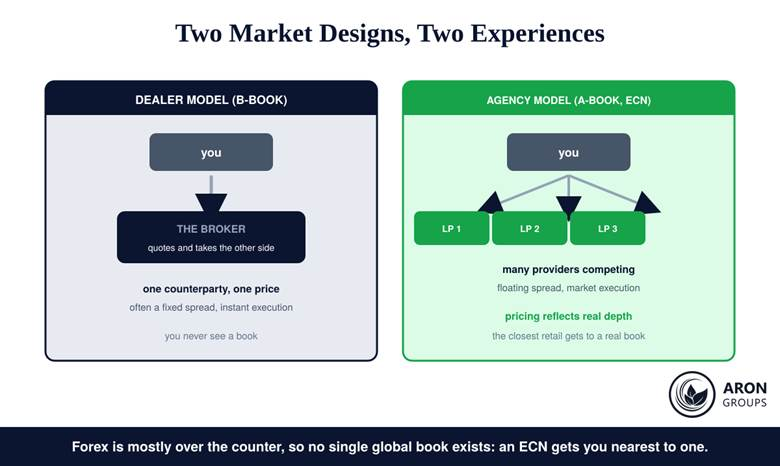
Microstructure also explains why two brokers can feel so different. In a dealer or market-maker model, often labelled B-book, your broker quotes the price and takes the other side of your trade, so there is one counterparty and no order book for you to see. In an agency or ECN model, often labelled A-book, your order is routed to a book assembled from many competing liquidity providers, which is why ECN pricing reflects real depth and why its spreads float rather than sitting still. Neither design is illegitimate, and hybrids are normal; what matters is that you know which one you are on, because it determines whether you experience requotes or slippage and whether the spread you see is a market measurement or a commercial promise.

A single dealer quoting a price compared with many liquidity providers competing on an ECN

One counterparty quoting a price, or many competing to fill you: the design decides your experience.

The deeper point is structural. Foreign exchange is largely an over-the-counter market spread across dealers and venues, as the BIS triennial survey documents, rather than a single exchange with one consolidated tape. There is no global order book for EURUSD in the way there is for a listed share. An ECN account gets a retail trader as close to a real book as the market allows, and regulators’ own advisories on retail forex trading are worth reading on what to expect from execution in that structure.

Why Retail Traders Should Care

The payoff is a set of specific explanations that replace a set of vague complaints. Spreads widen at news because adverse selection risk spikes, so plan entries and stops around the calendar. Stops get swept in thin books because a modest order reaches a long way when nothing rests nearby, so place them by structure rather than by a tidy pip count. Slippage rises in fast markets because the book is consumed faster than it refills, so build it into your risk-to-reward ratio rather than discovering it afterwards. Liquidity and timing end up mattering as much as direction.

sms-star

Rule
The single most useful habit from this field costs nothing: before you size a trade, ask what the book probably looks like right now. Which session is it, is data due, is this a major or an exotic? The answer should change your size, and often your decision to trade at all.


Honest Limits

Two limits belong in plain sight. First, full microstructure is a deep, data-heavy academic field built on tick-level datasets and formal models; what a retail trader can apply is a set of well-grounded intuitions, not the discipline itself. Second, and more practically, in over-the-counter forex you cannot see one consolidated order book, so any retail order-flow read is an inference from a partial view rather than x-ray vision into the market. Nothing here is a profit guarantee, and European regulators’ finding that the majority of retail accounts lose money on leveraged products still sets the backdrop. Use microstructure as context that improves decisions, and let effective risk management do the work of keeping you solvent.

Where Aron Groups Fits

You can observe most of this directly rather than take it on trust. On the MetaTrader 5 platform, open depth of market on a major and on an exotic side by side, then watch both through a data release and again in the quiet hours. The differences in tightness, depth, and how quickly quotes return are the three dimensions of liquidity made visible on your own screen.

Do that on a demo account first, then keep a small account for live measurement, because the only honest test of execution quality is your own filled orders logged over time.

Compare those logs the way you would validate anything else, through out-of-sample backtesting and a steadier equity curve rather than a memorable anecdote.

Conclusion

Market microstructure is the layer beneath the chart where trading actually happens. Orders rest in a book, market orders consume them, spreads compensate for processing, inventory, and the risk of trading against someone better informed, and price moves because that interaction happens rather than because a candle closed. Liquidity is three qualities pretending to be one, and size itself is a cost when the book is thin.

None of it predicts direction, and it is not the same thing as chart-based market structure. What it does is explain your real costs and fills, and give you reasons to adjust size and timing rather than explanations after the fact. Combine it with the foundations in our guide on how to trade forex, keep capital preservation ahead of curiosity, and you will read your own confirmations the way a professional trader does: as information about the market, not as bad luck.

Frequently Asked Questions

Quick answers to the questions traders ask most about market microstructure and order books.

What is market microstructure in simple terms?

It is the study of how trades actually happen: how orders rest in a book, how market orders consume them, why the bid-ask spread exists, and how those mechanics determine the price you get. It looks at the machinery of each fill rather than at broad supply and demand.

What is the difference between market structure and market microstructure?

Market microstructure is about mechanics: order books, spreads, liquidity, and execution. Market structure, in the ICT and Smart Money Concepts sense, is a chart-reading method based on swing highs and lows, breaks of structure, and changes of character. The names are similar; the subjects are not.

What is a central limit order book?

It is a single consolidated list of all resting buy and sell limit orders for an instrument, ranked by price, where every participant’s orders meet. Exchanges run them for listed instruments. Spot forex has no single global one because it trades over the counter, which is why an ECN account is the closest retail equivalent.

Can retail traders really see order flow in forex?

Only partially. What you see is depth assembled from your broker’s own liquidity providers, not the whole market. That view is genuinely useful for judging tightness and depth at the moment you trade, but any conclusion about what the wider market is doing is an inference, so treat it as context rather than certainty.

Continue Reading
not-found
calendar 17 August 2026
Rate this article

Leave a Reply

Your email address will not be published. Required fields are marked *

No thanks