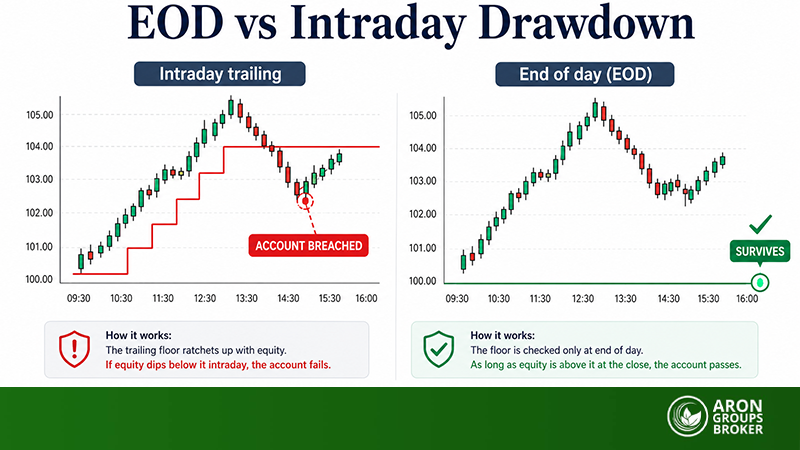

In futures prop trading, the drawdown rule decides who keeps a funded account and who loses it, and the single most important detail is when that rule is measured. Two accounts can run the exact same trade, on the same day, and reach opposite outcomes: one breached, one intact. The difference is not the trade. It is whether the firm tracks your loss limit tick by tick or only once a day at the close.
Proprietary trading firms fund traders with the firm’s capital and enforce strict loss limits to protect it. Most futures firms now use a trailing drawdown, and the biggest source of failed accounts is the give-back trap: letting a winning trade retrace after the floor has already ratcheted up behind it. Understanding that one mechanic separates a payout from a blown account.
This guide explains what a prop firm drawdown is, then breaks down the three models you will meet, intraday trailing, end-of-day trailing, and static, with worked examples. It covers the lock point that quietly turns a trailing limit into a static one, warns about rule changes between the evaluation and funded stages, and helps you match the right drawdown type to your trading style.
- A prop firm drawdown is a hard loss limit; breaching it closes the account, so how and when it is calculated matters more than its headline size.
- Intraday trailing drawdown moves in real time with your peak equity, including unrealised profit, which suits disciplined scalpers but punishes give-back.
- End-of-day (EOD) trailing drawdown updates only at the session close, giving intraday breathing room and suiting traders who hold through pullbacks.
- Static drawdown is fixed to the starting balance and never trails, so your safety buffer grows with profit; it is now common in forex prop and rare among futures firms.
- Trailing drawdowns usually stop trailing near your starting balance (the lock point) and become static, and rules can change between the evaluation and funded stages.
What Is a Prop Firm Drawdown?
A prop firm drawdown is the maximum loss your account may fall from its high-water mark before the firm closes it. Unlike drawdown as a performance statistic, here it is a hard rule with an instant consequence: cross it by a single tick and the account is terminated, funded or not. If you are new to the concept, our primer on what is drawdown covers the basics; this article focuses on how prop firms enforce it.
Risk Disclosure
CFDs are complex instruments and come with a high risk of losing money rapidly due to leverage. You should consider whether you understand how CFDs work and whether you can afford to take the high risk of losing your money. Past performance is not indicative of future results. This content is provided for educational purposes only and does not constitute investment advice.
Why Firms Impose Drawdown Limits
Most retail futures prop accounts are simulated during the evaluation and early funded stages, so the firm’s real exposure is the payouts it makes and the traders it filters. Drawdown limits are that filter. They force the habits a professional needs, effective risk management and disciplined position sizing, and they weed out gamblers. Regulatory research on day trading has long cautioned that few retail day traders are consistently profitable, and commonly cited figures put prop evaluation failure rates near the ninety percent mark, with drawdown breaches the leading cause.
Two Numbers to Watch: Daily Loss Limit and Maximum Drawdown
Many accounts enforce two separate limits. The daily loss limit (DLL) is a circuit breaker: hit it and trading pauses until the next session, but the account survives. The maximum drawdown is the account-ending line. The three models below all describe how that maximum drawdown line is calculated and, crucially, how often it moves. A drawdown calculator helps translate a percentage limit into the dollar risk you can take per trade.
Intraday Trailing Drawdown: The Real-Time Watchdog
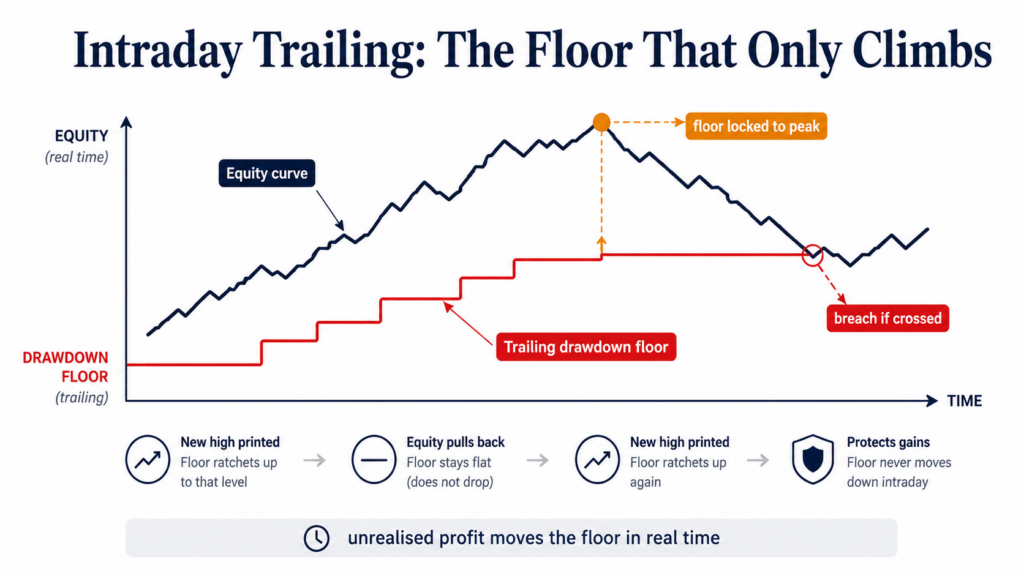
Intraday trailing drawdown recalculates in real time, tick by tick, based on your peak live equity, and it counts unrealised (floating) profit. The moment your open trade prints a new high, your loss floor ratchets up by the same amount, and it never moves back down. Because futures are leveraged instruments, that floor can climb fast, so the model rewards traders who lock in gains and punishes those who let winners round-trip.
This is the give-back risk in a sentence: a trade that goes your way and then retraces can breach the account even though you are still in profit, because the floor has already followed the peak. It is best suited to active scalpers who take quick profits and use tight, dynamic trailing stops, and it is the most dangerous model for anyone who likes to hold a runner.
Mini Example: The $2,000 Give-Back (text-only scenario)
Take a $50,000 account with a $2,500 trailing drawdown, so the floor starts at $47,500. Mid-session your trade runs to $2,000 of open profit, lifting equity to a $52,000 peak. Under intraday trailing, the floor instantly ratchets up by $2,000 to $49,500.
You then let the trade retrace and close it at $500 of profit, equity $50,500. You are still up on the day, but your floor now sits at $49,500, leaving barely $1,000 of room. Under an EOD model the floor would have stayed at $47,500 all day. The trade was fine; the timing of the measurement was not.
Rule: Under intraday trailing, every dollar of open profit you let slip away has already tightened your loss limit. Treat unrealised gains as real when they move your floor, and set stops inside the room you have left, not the room you started with. |
End-of-Day (EOD) Trailing Drawdown: The Nightly Check-In
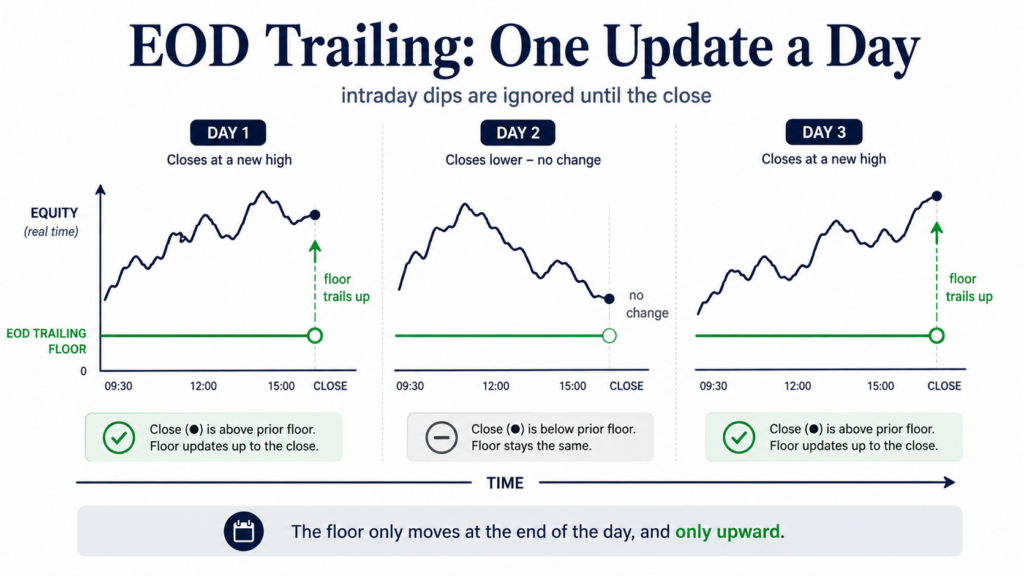
End-of-day trailing drawdown updates only once, at the daily session close, based on your closing balance rather than your intraday peak. During the session the floor is completely fixed: it does not chase your floating gains, so normal intraday dips and round-trips cannot breach it as long as you recover before the close. At the close, if you finished at a new high-water mark, the floor trails up to that new closing balance; if you gave profit back, it simply stays where it was.
That daily reset is the whole advantage. It gives trades room to breathe, so you can hold a runner or scale out of a position through intraday volatility without the floor tightening under you. The trade-off is that many EOD accounts pair the flexibility with a daily loss limit as a circuit breaker. The model is well suited to traders who hold positions longer within the day, and it has become the 2026 standard that several major firms now offer alongside, or instead of, the intraday version.
Q: Does a floating (unrealised) loss count against my drawdown?
A: It depends on the model. Under intraday trailing, unrealised profit and loss both move your equity in real time, so a floating loss can breach the maximum drawdown before you ever close the trade. Under EOD trailing, the maximum drawdown floor only updates at the close, though many EOD accounts still run a separate daily loss limit that does watch intraday equity.
Static Drawdown: The Fixed Safety Net
Static drawdown is the simplest model: the loss limit is anchored to your initial account balance and never trails upward. On a $100,000 account with a 10% static limit, the account-ending line sits at $90,000 on day one and stays there. The practical consequence is the opposite of trailing: as you book profit, your buffer grows, because the floor stays fixed while your balance rises. It is the most forgiving model for capital preservation, since a good run permanently increases your margin for error.
Static limits are easy to monitor and hard to breach by accident, which is why they have become common in the forex and CFD prop world. Among futures firms they are now rare: most have moved to trailing models, and several that once offered a static option have retired it. If a fixed, predictable floor matters more to you than anything else, you are more likely to find it on the forex side of the industry than in a futures evaluation.
EOD vs Intraday vs Static: Side by Side
The three models differ on one axis above all: how often the floor moves. Everything else, the breathing room, the give-back risk, the best-fit style, follows from that.
| Dimension | Intraday trailing | EOD trailing | Static |
|---|---|---|---|
| Floor updates | Real time, tick by tick | Once, at the session close | Never; fixed at the start |
| Counts floating profit | Yes, moves the floor live | No, only closing balance | No |
| Give-back risk | High | Low intraday | None from trailing |
| Buffer as you profit | Shrinks toward you | Grows only at each close | Grows with every gain |
| Best-suited style | Disciplined scalping | Holding through the day | Longer-hold, forex prop |
| Common daily loss limit | Often none | Often yes | Usually yes |
Pick the row that matches how you trade, then choose the model, not the other way round.
The Lock Point: When a Trailing Drawdown Turns Static
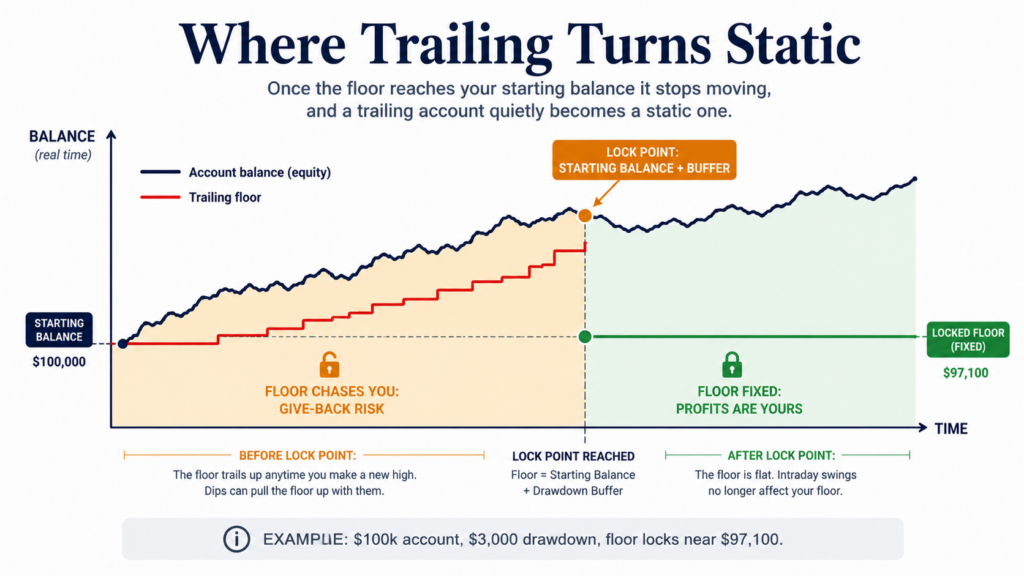
Here is the rule most traders miss. A trailing drawdown does not trail forever. On many futures accounts it stops climbing once it reaches your starting balance, usually plus a small buffer, and from that moment it locks and behaves exactly like a static drawdown. Reaching the lock point is a milestone worth planning for, because it is the point at which your original starting capital becomes protected and every further gain is finally yours to keep without dragging the floor up.
The mechanics are concrete. On a $100,000 account with a $3,000 trailing drawdown, the floor starts at $97,000 and trails up as you profit; once your balance reaches roughly the starting balance plus a small buffer, it locks near $97,100 and never moves again. Before the lock you are managing a moving target with the give-back trap live. After it, you have a fixed floor just below your starting balance.
Did You Know?: Know your lock point before you start trading a new account. The stretch between the first profit and the lock is where most trailing-drawdown accounts are lost, because the floor is chasing you the entire way. |
Evaluation vs Funded: Why the Rules Can Shift
A dangerous assumption is that the drawdown rule you passed on is the rule you keep. Prop firms often change the terms when you move from the evaluation phase to a live funded account: the drawdown type, the daily loss limit, the buffer on the lock point, or the consistency requirement can all differ between stages. Read the funded-account agreement, not just the evaluation page, and treat spotting these differences as part of learning to tell a fair firm from a predatory one.
Risk Warning: Rules are not permanent. Confirm the current drawdown terms for both the evaluation and the funded stage directly on the firm's own site before you buy, because prop firm rules change frequently and third-party summaries go stale fast. |

Matching the Drawdown Type to Your Trading Style
The right question is not which model is best in the abstract, but which fits how you actually trade. The good news for 2026 is that you increasingly get to choose: several leading futures firms now sell intraday and EOD versions of the same account at checkout, so matching the drawdown to your style is a decision you make, not a firm you are stuck with.
| If you trade like this | Lean toward | Because |
|---|---|---|
| Fast scalps, quick profits, tight stops | Intraday trailing | Cheapest room if you never give back peaks |
| Hold runners or scale out within the day | EOD trailing | Intraday dips will not move your floor |
| Fewer, longer holds; value a fixed floor | Static | Buffer grows with profit; easiest to monitor |
Match the model to your real behaviour, not the behaviour you wish you had.
For concrete orientation as of 2026, and always subject to change: firms such as Apex Trader Funding and Bulenox now offer both intraday and EOD versions of their accounts, so the label depends on the option you select rather than the firm; Tradeify runs an EOD trailing model across its plans, with the lock-to-static feature above; and static drawdowns have largely moved to the forex and CFD prop world, where firms like FTMO are known for them. TradeDay, once a static option, retired it in a 2026 relaunch for intraday and EOD choices. These specifics drift constantly, so verify current terms before you commit. Whichever model you pick, the edge that passes evaluations is a systematic approach with a defined risk-to-reward ratio, not the drawdown label on the tin.
Q: Is EOD or intraday drawdown better for beginners?
A: For most newer traders, EOD trailing is more forgiving, because it removes the give-back trap during the session and lets a trade breathe while you are still learning to manage exits. Intraday trailing can be cheaper and is fine for disciplined scalpers, but it is unforgiving of the exact mistakes beginners make most. Static, where available, is the gentlest of all.
Where Aron Groups Broker Fits Best
The drawdown concepts here are universal, but the specific intraday and EOD trailing models above belong to the futures prop world. If you would rather pursue prop trading on forex, indices, gold, and oil, Aron Groups runs its own prop offering, Aron Prop, with a straightforward 10% maximum drawdown rule and a profit target to reach, rather than a tick-trailing floor. It is a cleaner, fixed-percentage model in the spirit of the static approach, which many traders find easier to plan around.
Before risking a paid evaluation, you can pressure-test your discipline for free. The Aron Groups No Deposit PROP Challenge lets you trade a demo account under a 5% drawdown limit toward a profit target, with no deposit required, and our full guide on whether prop trading is for you sets expectations honestly. Practise the exact rules first on the MetaTrader 5 environment, size positions on a small account until the process is automatic, and remember that a smooth equity curve, not a lucky streak, is what a funded account rewards.
Conclusion
Intraday, EOD, and static are not three difficulty settings; they are three ways of answering one question, when is your loss limit measured. Intraday trailing watches you every tick and punishes give-back. EOD trailing checks in once a day and hands you intraday room. Static fixes the floor and lets your buffer grow. None is universally better; the better one is the one that matches your style.
So do the homework the marketing skips: find the drawdown type, find the lock point, and confirm the funded-stage rules before you pay. Then let the drawdown model choose itself from how you actually trade. Passing an evaluation is a survival problem before it is a profit problem, and the traders who clear it are the ones who respect the rules and their own trading discipline.
Frequently Asked Questions
What is the difference between EOD and intraday trailing drawdown?
Intraday trailing drawdown updates in real time and follows your peak equity, including unrealised profit, so a winning trade that retraces can breach it. EOD trailing drawdown updates only at the session close, so intraday swings are ignored as long as you recover before the close. EOD gives more breathing room; intraday demands you lock in gains.
Which prop firm drawdown is easiest to pass?
Static drawdown is generally the most forgiving, because the floor never trails and your buffer grows as you profit. Among trailing models, EOD is easier than intraday for most traders, since it removes the give-back trap during the session. Difficulty also depends on the daily loss limit and consistency rules attached to the account.
What is a drawdown lock point?
The lock point is where a trailing drawdown stops trailing, usually when the floor reaches your starting balance plus a small buffer. From that point it becomes a fixed, static floor, so your starting capital is protected and further profit no longer drags the limit upward.
Does Aron Groups offer futures prop accounts?
Aron Groups offers prop trading on forex, indices, gold, and oil through Aron Prop, using a 10% maximum drawdown rule rather than the intraday or EOD trailing models used by futures firms. There is also a No Deposit PROP Challenge on a demo account with a 5% drawdown limit for practising the rules risk-free.