
Search interest in a BRICS gold-backed currency spikes after every summit, and so do the myths. Here is the short version: as of July 2026, no BRICS gold-backed currency exists, and none has a launch date. What does exist is a small pilot called The Unit, and a very real wave of central bank gold buying.
Most coverage gets the story backwards. It treats the currency as imminent and the gold buying as a footnote. The reality is the opposite. The currency remains a research project, while accumulation by BRICS and other central banks has helped lift gold to roughly 27 percent of global official reserves.
This guide explains what The Unit actually is and why no major currency has been convertible into gold since 1971. It separates the payment projects that are real from the coins that are not. It closes with a scam warning and a practical way to trade the theme through gold itself.
- No BRICS gold-backed currency is live in 2026, and the bloc has announced no launch date.
- "The Unit" is a proposed trade-settlement instrument backed about 40 percent by gold and 60 percent by a basket of BRICS currencies.
- A research institute piloted 100 Units in October 2025, each pegged to one gram of gold. It remains a prototype, not official BRICS policy.
- The substance behind the headlines is gold itself: central banks bought 863 tonnes in 2025 after three straight years above 1,000 tonnes.
- You cannot buy The Unit. Anyone selling a "BRICS gold coin" or "BRICS token" is running a scam.
- Traders access the theme through gold, most directly via the XAU/USD pair.
Is There a BRICS Gold-Backed Currency?
No. As of July 2026 there is no BRICS gold-backed currency in circulation, no agreed design and no launch date. The only tangible artefact is The Unit, a pilot settlement token tested by a Russian research institute in late 2025. Everything else is summit language, payments engineering and speculation.
Risk Disclosure
CFDs are complex instruments and come with a high risk of losing money rapidly due to leverage. You should consider whether you understand how CFDs work and whether you can afford to take the high risk of losing your money. Past performance is not indicative of future results. This content is provided for educational purposes only and does not constitute investment advice.
What Actually Exists in 2026
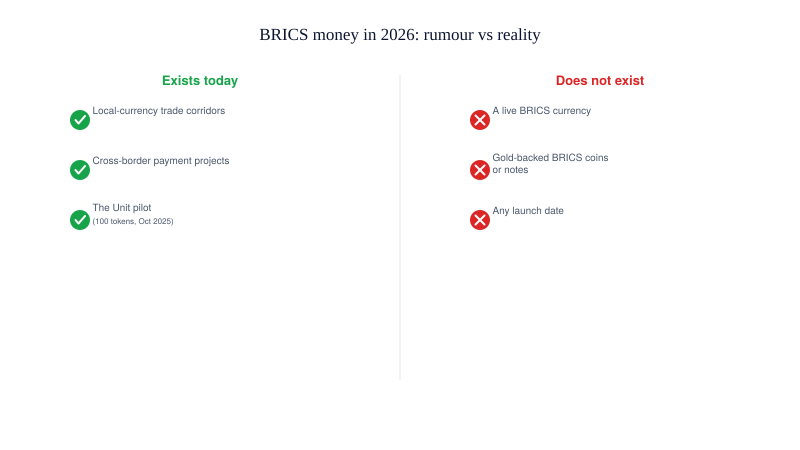
Three things exist today, and none of them is a currency. Understanding the difference stops most of the confusion before it starts.
- Local-currency trade: reportedly around 95 percent of India-Russia trade now settles in national currencies such as the rupee, the ruble and the yuan.
- Payment plumbing: the BRICS Cross-Border Payments Initiative and related work link national systems so members can pay each other without SWIFT.
- One pilot: The Unit, a 100-token settlement experiment run since 31 October 2025, described in detail below.
India, the 2026 chair, has put interoperability between members’ central bank digital currencies on the agenda for the New Delhi summit on 12 and 13 September 2026. That is rail building, not money printing. Brazil shelved the single-currency idea during its 2025 presidency, and India’s foreign minister has said there is no policy to replace the dollar.
Why the Confusion Persists
The confusion comes from compressing three different projects into one headline. Summit statements praise local currencies, commentators shorten that to a BRICS currency, and headlines add gold-backed. US tariff threats against countries pursuing dollar alternatives then amplify every rumour. The scale gap also gets lost: the dollar still sits on one side of almost 90 percent of global foreign exchange trades, according to the Bank for International Settlements. A payments rail moves existing currencies. A settlement unit would be a bookkeeping asset between central banks. Neither is money you could hold in a wallet.
What Is "The Unit"? Inside the BRICS Settlement Proposal
The Unit is the concrete proposal behind the headlines, so it deserves a precise description rather than a slogan.
The 40/60 Design: Gold Plus a Currency Basket
The Unit is designed as a settlement instrument backed about 40 percent by gold and 60 percent by a basket of BRICS member currencies, including the yuan (CNY) and the ruble (RUB). Gold is measured by weight rather than dollar price, which is what gives the anchor its stability. In the pilot, one Unit began as a claim on one gram of gold; basket movements later adjusted that to 0.9823 grams. The design aims at neutrality, so no single member currency dominates the basket.
Blockchain Settlement and the SWIFT Question
The Unit would settle on a blockchain ledger, letting member banks clear trades without touching SWIFT or correspondent accounts in New York. That matters because dollar settlement is the channel through which sanctions bite. Project descriptions place reserves in escrow inside each member country rather than with one central custodian. The concept overlaps with mBridge, the multi-central-bank digital settlement platform now run by participating institutions, including China’s and the UAE’s.
Where the Project Stands in 2026
The Unit remains a prototype with no institutional adoption by any BRICS central bank. The IRIAS research institute in Russia issued 100 pilot Units on 31 October 2025 to test custody, valuation and transfer mechanics. New Development Bank leadership has reportedly described an agreement in principle to explore it, yet no member has committed capital or legislation. Russian officials point to 2030 as a realistic horizon for any operational system, with further small pilots possible before the end of 2026. India’s opposition is the hardest constraint: New Delhi has more to lose from tariff retaliation than it could gain from monetary symbolism.
Rule: Treat The Unit as a settlement experiment to monitor, not an asset to buy. |
Is Any Major Currency Backed by Gold Today?
No. No major currency has been convertible into gold since the United States closed the gold window in 1971, and the last constitutional gold ties, such as Switzerland’s, were removed by 2000. The dollar, the euro and the yuan are all fiat currency, backed by policy credibility rather than metal.
From Bretton Woods to the Nixon Shock
Under the classical gold standard, from roughly the 1870s to 1914, major currencies were convertible into gold at fixed rates. The Bretton Woods system of 1944 rebuilt a softer version: currencies pegged to the US dollar, and the dollar convertible into gold at 35 dollars an ounce. Persistent American deficits drained the arrangement, and in August 1971 President Nixon suspended convertibility. That Nixon shock ended the gold era and created the floating fiat system traders work in today.
Modern Experiments: Zimbabwe's ZiG and US State Laws
Recent experiments show how hard partial gold backing is in practice. Zimbabwe launched the ZiG in April 2024, a national currency backed by gold and foreign exchange reserves; within six months the authorities devalued it by more than 40 percent as confidence failed. In the United States, Texas and Florida have passed laws recognising gold and silver as legal tender for some payments. Florida’s framework is scheduled to take effect in mid-2026, and Texas is building transaction rails around its state bullion depository. These are payment options layered on top of the dollar system, not new currencies.
The table below puts every gold-linked experiment on one line each.
| Experiment | What it really is |
|---|---|
| Classical gold standard (pre-1914) | Full convertibility of major currencies into gold; broken by war finance |
| Bretton Woods (1944 to 1971) | Dollar pegged to gold at 35 dollars an ounce; closed by the Nixon shock |
| Zimbabwe ZiG (2024) | Gold-and-FX-backed national currency; devalued over 40 percent within six months |
| Texas and Florida laws (2025 to 2026) | Gold and silver recognised as legal tender alongside the dollar; not a new currency |
| BRICS "Unit" (pilot, 2025) | Research prototype for trade settlement, about 40 percent gold-anchored; not official |
Q: If gold backing is supposed to bring stability, why has every gold-backed system eventually failed or stalled?
A: Because backing imports a discipline that issuers abandon under stress. War finance broke the classical standard, US deficits broke Bretton Woods, and thin reserves broke confidence in the ZiG. A gold anchor only works while the issuer accepts the constraint, which is exactly when it is least convenient.
The Real Story: BRICS Central Banks Are Buying Gold
While the currency stays theoretical, the gold accumulation is measurable, large and far more important for markets.
Record Official Demand Since 2022
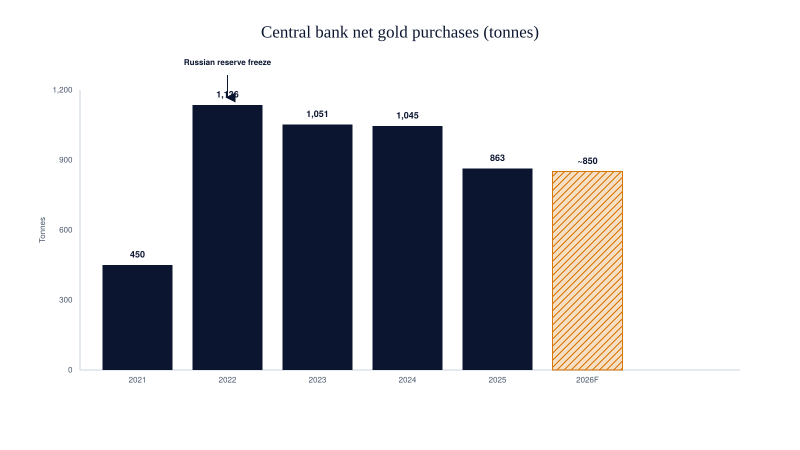
Central banks have been the decisive gold buyers of this cycle. They purchased a record 1,136 tonnes in 2022 and stayed above 1,000 tonnes in 2023 and 2024, according to World Gold Council data. Buying eased to 863 tonnes in 2025 as record prices made reserve managers more selective, yet that was still the fourth largest year ever recorded. Another 244 tonnes were added in the first quarter of 2026 alone, ahead of the five-year average. Much of the flow is opaque: about 57 percent of 2025 purchases were never promptly reported to the IMF. The People’s Bank of China disclosed just 27 tonnes for 2025, while Chinese net gold imports reached 317 tonnes in the first quarter of 2026.
Why Gold: The Sanctions Lesson of 2022
The freezing of roughly 300 billion dollars of Russian reserves in 2022 changed how BRICS reserve managers think. Offshore dollar assets proved conditional; gold vaulted at home cannot be frozen by another government’s decision. Gold also keeps its classic roles as a safe haven and an inflation hedge, but the sanctions logic is what turned steady diversification of foreign exchange reserves into strategic accumulation. ECB researchers have noted that the largest jumps in a country’s gold share often follow sanctions on that country. Intent is now explicit: in the World Gold Council’s 2026 survey, a record 45 percent of central banks plan to add gold within a year, and 74 percent expect the dollar’s reserve share to keep falling over five years.
Did You Know?: The European Central Bank estimates gold reached about 27 percent of global official reserves at market prices by the end of 2025, overtaking US Treasuries for the first time. In 2018 the figure was below 12 percent. |
Can You Buy or Invest in a BRICS Currency?
You cannot buy a BRICS currency, because none exists to buy. Any product marketed as one is either a misunderstanding or a fraud. What you can do is trade the assets the story actually moves, above all gold.
Why You Cannot Buy The Unit
The pilot Units were issued inside a research consortium, not to the public. There is no exchange listing, no retail custodian and no legal framework for private ownership. Even if the project advances, its published design is wholesale: central banks and commercial banks settling trade flows, not households holding savings.
Scam Warning: Fake BRICS Coins and Tokens
Every “BRICS coin”, “BRICS gold token” or “gold-backed BRICS crypto” offered for sale today is fraudulent, and securities regulators have repeatedly warned about them. The pattern rarely changes: manufactured urgency to buy before a fictional launch, fake endorsements from BRICS leaders, and pressure to pay in crypto to an anonymous wallet. The same red flags that expose fake prop firms apply here: guaranteed returns, unverifiable custody and no regulated entity behind the offer.
Risk Warning: No official BRICS currency, coin or token is on sale anywhere. Treat any offer to buy one as fraud and report it to your local securities regulator. |
Real Gold Exposure: XAU/USD CFDs and Gold-Backed Tokens
If the gold story is what attracts you, trade gold itself. The most direct instrument for active positioning is XAU/USD, which prices one troy ounce of gold in US dollars and can be traded long or short as a CFD. Regulated gold-backed tokens such as PAXG and XAUT take a different route: each token is a claim on one vaulted ounce, run like a stablecoin pegged to metal instead of dollars.
Aron Groups offers the trading route: gold and metals CFDs on MetaTrader 5, not physical bullion, gold IRAs or token custody. CFDs suit short-term positioning with leverage; tokens and bullion suit long-term ownership without it.
Q: Are PAXG and XAUT the same idea as a BRICS gold-backed currency?
A: No. They are private, audited claims on specific vaulted bars, redeemable through their issuers today. The Unit is a proposed intergovernmental settlement asset with pooled sovereign reserves and no retail redemption. One is a product you can verify; the other is a policy experiment.
The Trader Takeaway: Trading the Gold and De-Dollarization Theme
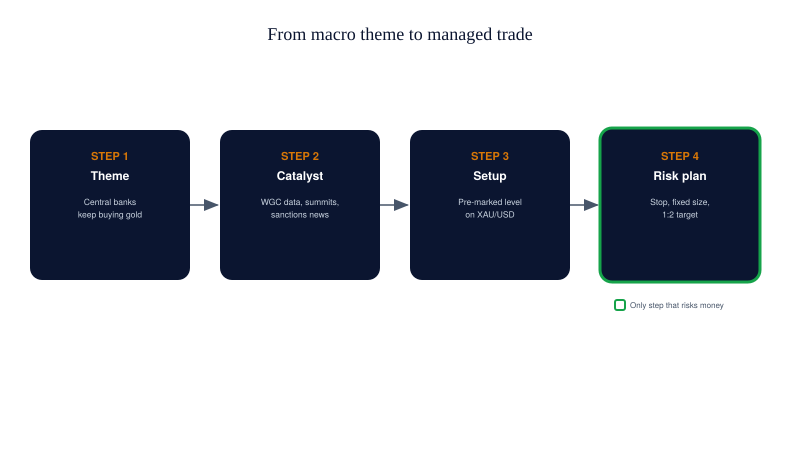
The tradeable content of the BRICS story is gold’s structural bid from central banks, expressed through a disciplined risk management strategy on the XAU/USD chart. Three steps keep it professional.
Step 1: Track the Official-Demand Calendar
Follow the World Gold Council’s quarterly demand reports, its monthly central bank statistics and the IMF’s reserve updates. These releases feed the narrative that supports gold, and the summit calendar adds event risk, starting with New Delhi this September.
Step 2: Define the Setup on the Chart
Decide in advance what you trade: pullbacks into well-tested support within the trend, or breakouts confirmed after consolidation. Gold has swung from a record near 5,600 dollars to below 4,100 during 2026, so structure matters more than conviction. Mark your levels before the session, not during it.
Read More: MetaTrader 5 toolbox training
Step 3: Size and Protect the Position
Risk a fixed fraction of equity per trade and let position sizing, not conviction, set the lot. Place the stop where the idea is wrong and target at least a 1:2 risk-to-reward ratio.
Leverage magnifies both outcomes, a point the CFTC makes bluntly in its retail forex guidance. A losing streak that respects your drawdown plan is survivable; one that ignores it is not. In this theme, capital preservation beats being right about macro.
Mini Example: Trading a Central-Bank Demand Headline (text-only scenario)
A Tuesday in 2026. The World Gold Council posts quarterly data showing official purchases well above the five-year average, while XAU/USD consolidates above 4,100 dollars after a sharp two-week decline.
The trader waits for the London session and watches price reclaim the prior day’s high on rising volume. Entry on the reclaim, stop below the consolidation low, roughly 0.8 percent of equity at risk, target at the prior swing high, just over twice the risk.
If price closes back inside the range, the idea is invalid and the stop does its job. The headline justified attention, never certainty.
New to leveraged metals? Rehearse the workflow with small size on a Nano account before committing meaningful capital, and let position sizing scale only after the routine holds. Set your entries against a written risk-to-reward ratio and log every trade.
Read More: how to trade forex
Conclusion
The honest answer on the BRICS gold-backed currency is that the currency is a pilot and the gold is real. The Unit may or may not graduate from prototype to policy. The tonnes already sitting in central bank vaults, near their 1965 record, are a fact today.
For traders the distinction is everything. You cannot buy The Unit, and anyone selling a BRICS coin is selling fraud. You can trade the force behind the story, official gold demand, through XAU/USD with defined risk and honest position limits.
Watch the New Delhi summit in September 2026 for payment-system news, not a currency launch. If a genuine instrument ever reaches markets, it will arrive through central bank statute, not through a countdown in a Telegram group.
FAQ
Which countries are BRICS members in 2026?
Ten full members: Brazil, Russia, India, China, South Africa, Egypt, Ethiopia, Iran, the United Arab Emirates and Indonesia, plus around ten partner states. Saudi Arabia was invited but has not formalised membership.
When will the BRICS currency launch?
No launch date exists. Russian officials frame any operational settlement system as a 2030-horizon project, and India opposes a common currency altogether. Watch official communiques rather than social media countdowns.
Is the Chinese yuan backed by gold?
No. The yuan is a fiat currency. The People’s Bank of China holds about 2,306 tonnes of gold, under 9 percent of its reserves, which supports confidence but creates no convertibility.
What should traders watch at the September 2026 summit?
Progress on payment interoperability, central bank digital currency links and any new language on local-currency settlement. Concrete gold cooperation would matter more for XAU/USD than currency rhetoric.