
icon icon Home
icon icon Accounts
icon icon Quick start
icon icon Symbols

The Turtle Soup Trade: Fading False Breakouts and Liquidity Sweeps

Author
Abe Cofnas
Abe Cofnas
calendar Last update: 4 August 2026
watch Reading time: 11 min

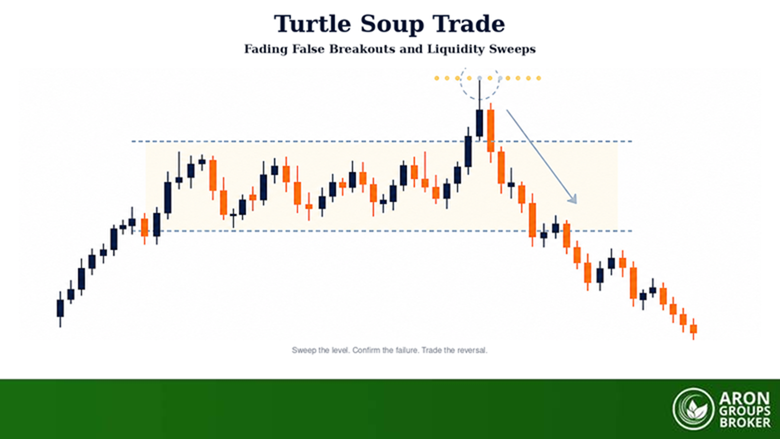
A Turtle Soup trade is a reversal setup that fades a failed breakout. Price trades above a recent high or below a recent low, attracts breakout orders and triggers stops around that obvious level, but cannot continue. When price returns inside the prior range and confirms a reversal, the trader enters against the failed break.

In plain English, breakout traders take the first move. Turtle Soup traders wait to see whether that move survives. A break above resistance is not enough. The setup exists only when the break fails, price reclaims the level, and the market shows evidence that control has shifted.

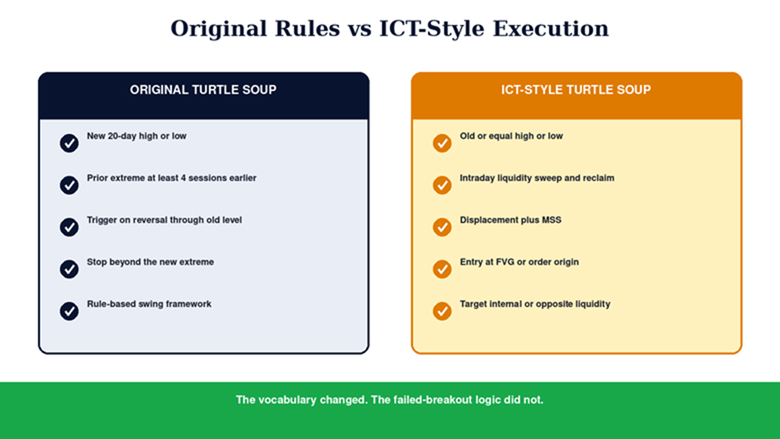
The name has two related lineages that should not be confused. Linda Bradford Raschke and Laurence A. Connors published the original 20-day Turtle Soup rules in Street Smarts in 1995. Current ICT-style trading applies the failed-breakout idea intraday and describes it with liquidity, displacement, market structure shifts, fair value gaps, and order blocks. The later framework is an adaptation and a change of vocabulary, not the origin of the strategy.

bookmark
Key Takeaways
  • Turtle Soup trades a failed breakout, not every wick beyond a high or low.
  • The original method fades a new 20-day high or low after price reverses through the previous extreme.
  • ICT-style execution usually adds higher-timeframe context, a liquidity sweep, displacement, a market structure shift, and a retracement entry.
  • The cleanest conditions are usually balanced or ranging markets. Strong trends are more likely to turn a sweep into genuine continuation.
  • A stop normally belongs beyond the swept extreme, while targets come from internal imbalance or liquidity on the other side of the range.
  • If price holds beyond the level and structure continues in the breakout direction, there is no confirmed Turtle Soup trade.

The Short Answer

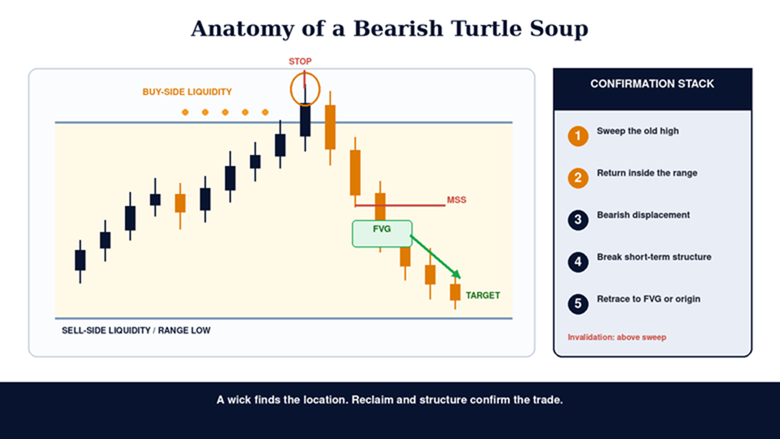
For a bearish Turtle Soup, mark an old or equal high, wait for price to trade above it, and then require price to return below the level. After a clear bearish displacement breaks a meaningful short-term low, look for a retracement into the displacement leg, often a fair value gap or an order block. The stop sits beyond the sweep high. The first target can be internal range liquidity, with a farther target at the opposite side of the range.

For a bullish Turtle Soup, reverse the logic. Price sweeps below an old or equal low, reclaims it, displaces higher, and breaks short-term structure. A retracement can provide the entry, the stop sits below the sweep low, and the target is liquidity above.

The important word is after. Entering before the reclaim and structure shift is simply fading momentum and hoping it stops.

sms-star

Risk Disclosure

Leveraged trading can produce losses rapidly. A chart pattern is not a promise of reversal, and a tight stop does not make a trade low risk if position size is excessive. Use a predefined risk limit, test the rules on historical and demo data, and never trade money needed for living costs or emergencies. This material is educational and is not investment advice.
Where Turtle Soup Came From

The original Turtle traders, trained by Richard Dennis and William Eckhardt, followed systematic breakouts. One well-known entry used new 20-day highs and lows. That approach accepts frequent small losses because a small number of sustained trends can pay for many failed breakouts.

Raschke and Connors turned that observation around. If breakout systems must tolerate false breaks, a short-term trader can study the failure itself. Their Turtle Soup setup looked for a new 20-day extreme, then entered only when price reversed through the previous 20-day high or low.

For a simplified original long setup:

  •   Today makes a new 20-day low.
  •   The previous 20-day low occurred at least four trading sessions earlier.
  •   After price trades below that previous low, a buy stop is placed slightly above the old low and is valid for that session only.
  •   If triggered, the initial protective stop goes just below the new low.

The short setup is the mirror image: a new 20-day high, an older prior high, a reversal back below it, and a stop beyond the new high.

Those details matter. The original pattern was not merely “price wicked through support, so buy.” It used a defined lookback, a minimum separation between extremes, a reclaim-based trigger, and an invalidation point.

Original Turtle Soup Versus Turtle Soup Plus One

The book also describes Turtle Soup Plus One. The variation waits until the session after the new extreme and uses the old breakout level as the next-day trigger. This gives the failed break more time to reveal itself. Traders often blur the two versions together, so the timing rule should be written in the playbook before any test begins.

Why a Failed Breakout Can Reverse

Obvious highs and lows attract activity for several reasons. Breakout traders place stop entries beyond the level. Traders already holding the opposite position may place protective stops there. Limit orders may also be waiting because the level is visible to many participants.

When price crosses the level, those orders create a burst of transactions. If fresh demand or supply cannot sustain the move, breakout traders are left in weak positions. Their exits can add pressure in the opposite direction, while traders who waited for failure begin to participate.

This explanation does not require a claim that one institution deliberately moved price to hunt a particular group of retail stops. The chart can show where price traded, how it reacted, and whether the auction continued. It cannot identify the intention behind every order. “Liquidity sweep” is useful shorthand for the event. “Institutions engineered it” is an interpretation, not a fact proven by the candle.

Why a Failed Breakout Can Reverse

A valid bearish example needs more than a wick: sweep, reclaim, displacement, structure shift, and a defined invalidation point.

The ICT-Style Turtle Soup Setup, Step by Step

The modern ICT-style version replaces the fixed daily 20-day rule with a contextual intraday model. The setup can appear on many timeframes, but the analysis should move from broad context to precise execution.

1. Start With Higher-Timeframe Context

Identify whether the market is balanced, trending, or in transition. Turtle Soup is easier to justify when price is rotating between established boundaries. In a strong trend, a break of the range edge is more likely to continue.

Context does not mean predicting every candle. It means answering three practical questions:

  •   Is price inside a recognisable range?
  •   Which old or equal high or low is the nearest obvious external level?
  •   Is there enough room back through the range for the potential reward to justify the risk?

2. Mark the Draw on Liquidity

In ICT vocabulary, a draw on liquidity is the level price is expected to seek next. Common candidates include:

  •   old swing highs and lows;
  •   equal highs and equal lows;
  •   previous day or session highs and lows;
  •   the edges of a well-defined dealing range.

These are often described as buy-side liquidity above highs and sell-side liquidity below lows. The labels are a map of likely order concentration, not a guarantee that price must visit or reverse from them.

3. Wait for a Decisive Sweep and Reclaim

A bearish candidate trades above the marked high. A bullish candidate trades below the marked low. The size of the wick is less important than what happens next.

For a confirmed failure, price should return through the old level and back inside the prior range. A brief pierce followed by immediate rejection is clearer than several candles accepting value beyond the boundary. If price closes beyond the level and continues to build structure there, treat it as a possible breakout until the market proves otherwise.

4. Require Displacement and a Market Structure Shift

Displacement is a forceful move away from the sweep, usually with wide candle bodies, limited overlap, and visible imbalance. It shows that the reversal has more than a small rejection wick behind it.

A market structure shift, often shortened to MSS, occurs when that displacement breaks a meaningful short-term swing in the reversal direction. Some traders use CHoCH for the first sign that character has changed and BOS for a later break that confirms continuation. The names vary, so define the exact swing rule in advance. Without a clean break of relevant structure, the move may still be noise inside the range.

5. Enter on a Retracement, Not in the Middle of the Impulse

The displacement leg may leave a fair value gap, commonly abbreviated FVG. This is a three-candle imbalance where part of the move traded with little overlap. Some traders instead use the last opposing candle before displacement as an order block.

An entry on a retracement into that area can improve reward to risk, but neither an FVG nor an order block is automatic support or resistance. If price trades through the entire displacement origin and reaccepts the swept side, the setup has weakened.

6. Put the Stop Beyond the Sweep

For a bearish setup, the logical invalidation is above the sweep high. For a bullish setup, it is below the sweep low. Add a small instrument-appropriate buffer if spreads and normal volatility make a one-tick stop unrealistic.

Do not force a tiny stop simply to manufacture an attractive ratio. Position size should follow the real stop distance. If the correct stop makes the trade too large for the risk budget, reduce size or skip the trade.

7. Target Internal and Opposing Liquidity

The nearest target can be an internal imbalance, a prior short-term swing, or another area where price previously moved inefficiently. A larger target may be the opposite external side of the range.

This creates a practical sequence:

  •   external range liquidity is swept;
  •   price returns inside the range;
  •   internal range liquidity becomes the first objective;
  •   the opposite external range liquidity becomes a possible extended objective.
The ICT-Style Turtle Soup Setup, Step by Step

The original setup is a rule-based 20-day fade; the ICT-style version is an intraday execution framework built around the same failed-breakout idea.

IRL, ERL, and the Route Through the Range

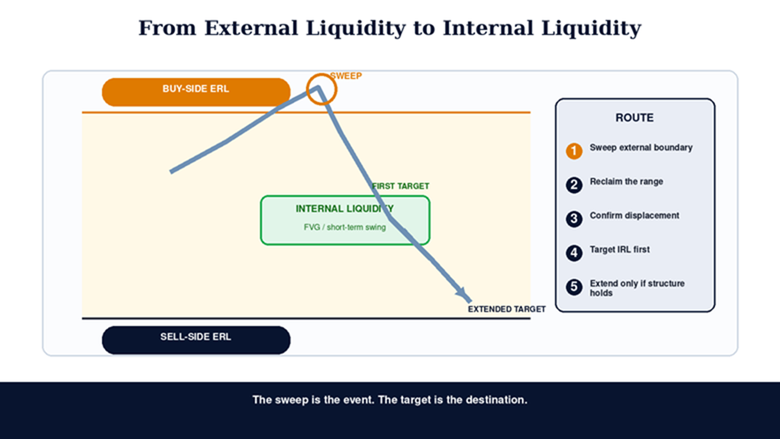
External range liquidity, or ERL, sits beyond the defining high and low of a dealing range. Internal range liquidity, or IRL, sits inside it and may include fair value gaps, short-term swing points, or other imbalances.

In a textbook bearish Turtle Soup, price raids buy-side ERL above the range high, fails, and rotates towards internal liquidity below. If the reversal expands, sell-side ERL under the range low may become the farther target. The bullish version runs from sell-side ERL below the range towards internal liquidity above.

This framing is useful because it separates the event from the destination. The sweep is the event. The nearby FVG, internal swing, or opposite boundary is the destination. A trader still needs evidence that price has turned before assuming it will complete the route.

The Turtle Soup Trade: Fading False Breakouts and Liquidity Sweeps

The ERL-to-IRL model maps the journey: sweep an external boundary, confirm the return, then target internal imbalance before the opposite edge.

Turtle Soup Versus SFP, Judas Swing, and a Plain Liquidity Sweep

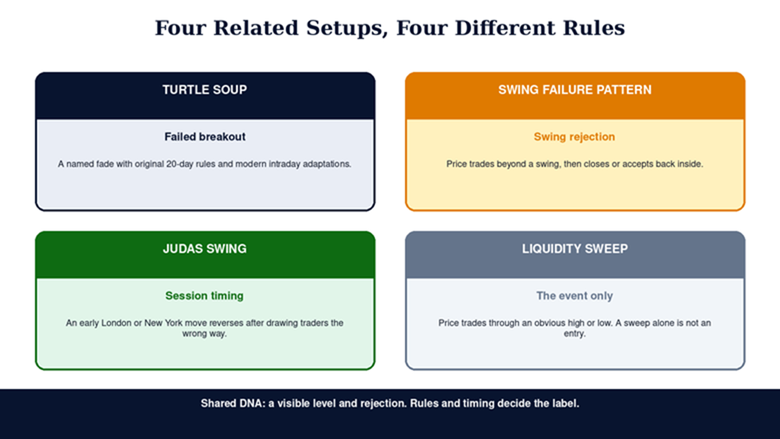
These setups share the same visual DNA, which is why traders often use the names interchangeably. The differences are mainly in rule set, context, and timing.

SetupDefining featureTypical timingWhat makes it distinct
Turtle SoupA failed breakout of a recent extremeOriginal version uses 20-day levels; ICT-style versions can be intradayExplicitly fades breakout failure
Swing Failure Pattern (SFP)Price trades beyond a swing and closes back insideAny timeframeA broad price-action label with fewer required ICT components
Judas SwingAn early-session move in one direction that later reversesUsually discussed around London or New York session timingTime-of-day manipulation narrative is central
Plain liquidity sweepPrice trades through an obvious high or lowAny timeframeDescribes the event only; it is not an entry model by itself

A sweep can become an SFP if it rejects a swing. It can become a Turtle Soup if the trader applies failed-breakout rules. It may be called a Judas Swing when the session timing and early false direction are central. The labels overlap, but a trading plan should state exactly which confirmation is required.

Turtle Soup Versus SFP, Judas Swing, and a Plain Liquidity Sweep

Same family, different rules: Turtle Soup focuses on breakout failure, SFP on swing rejection, Judas Swing on session timing, and a sweep on the event alone.

Turtle Soup Versus a Breakout Strategy

Breakout and Turtle Soup traders are taking opposite sides of the same test.

The breakout trader asks, “Has price left balance with enough momentum to continue?” The Turtle Soup trader asks, “Did price leave balance and then fail to hold outside it?”

Regime often decides which idea has the advantage:

  •   Trending market: continuation has more support, so fading every new high or low is dangerous.
  •   Ranging market: repeated rejection at boundaries makes failed breaks more plausible.
  •   Transition: both sides can be trapped, so waiting for structure confirmation matters most.

The goal is not to label the move before it happens. The goal is to define the evidence that changes the hypothesis from breakout to failed breakout.

A Worked Bearish Example

Assume EUR/USD has ranged between 1.0800 and 1.0850. Equal highs near 1.0850 are visible to many traders.

Price trades to 1.0862, then closes back below 1.0850. A strong bearish candle breaks the most recent five-minute higher low at 1.0838 and leaves an imbalance from 1.0843 to 1.0847. A trader considering the setup waits for price to retrace to 1.0845 rather than selling the bottom of the displacement.

With an illustrative entry at 1.0845 and an invalidation at 1.0865, the stop distance is 20 pips. A target at the range low of 1.0805 offers 40 pips, or 2R before costs. The position size must be calculated from the 20-pip stop and the account’s fixed risk budget.

This is not a signal. It is an example of how the pieces fit together. If price never retraces, there is no entry. If it trades back above the sweep and holds, the setup is invalid. If the nearest realistic target offers less reward than the risk, the trade may not be worth taking.

Common Turtle Soup Mistakes

Fading Every New High or Low

A new extreme is only the location. Failure, reclaim, displacement, and structure provide the evidence. A trader who sells every new high is fighting trends, not trading Turtle Soup.

Calling Any Wick a Liquidity Raid

Small wicks occur constantly. Focus on levels that are obvious in the selected timeframe and on reactions that materially change structure.

Entering Before the Market Returns Inside

While price remains outside the range, the breakout can still be valid. Anticipating the reclaim removes the very confirmation that defines the setup.

Using an FVG Without a Structure Shift

Imbalances appear in ordinary price movement. The FVG is a possible entry location after displacement and MSS, not an independent reason to trade.

Ignoring News and Session Volatility

Major economic releases can push price through several levels before a stable auction forms. A stop just beyond the first wick may be vulnerable to normal release volatility. Check the calendar, spreads, and execution conditions.

Forcing a Fixed 1:3 Target

Reward to risk must come from market structure. If the next opposing liquidity is only 1R away, writing 3R in the plan does not create more room.

How to Test the Pattern Honestly

Write the rules before collecting examples. Record the timeframe, market regime, level type, size of the sweep, reclaim rule, MSS definition, entry location, stop method, target, spread, slippage assumption, and time of day.

Separate the original 20-day method from the ICT-style intraday version. Combining both into one sample hides which rule set produced the result. Test across different instruments and include every qualified setup, not only attractive screenshots.

Use out-of-sample data and a demo account before risking capital. Simulated results have limitations because actual fills, liquidity, spreads, and trader behaviour can differ. A useful journal should therefore measure both pattern performance and execution quality.

Where Aron Groups Fits

The ICT-style version can be marked and tested on MetaTrader 5 using horizontal levels, session markers, and lower-timeframe structure. A risk-to-reward indicator can convert the planned stop distance into a visible ratio before the order is placed.

Start on demo. Use the same symbol, session, spread assumptions, and risk rules you intend to use later. If the setup only looks good when costs are ignored or when losing examples are excluded, it is not ready for live execution.

Conclusion

Turtle Soup is not a prediction that every breakout will fail. It is a framework for waiting until a breakout has already shown evidence of failure.

The original Raschke and Connors method is a precise fade of a 20-day extreme. The ICT-style version adds intraday liquidity language and a more detailed execution sequence: identify external liquidity, wait for the sweep and reclaim, require displacement and MSS, enter on a retracement, place the stop beyond the sweep, and target liquidity inside or across the range.

The edge, if one exists in the market and timeframe being tested, comes from discipline at the boundary. No sweep means no setup. No reclaim means no failure. No structure shift means no confirmation. And no acceptable risk means no trade.

Frequently Asked Questions

What is a Turtle Soup trade?

It is a reversal trade that fades a failed breakout. Price moves beyond a recent high or low, cannot hold there, returns inside the prior range, and reverses. Traders enter in the reversal direction after their chosen confirmation.

Who created the Turtle Soup strategy?

Linda Bradford Raschke and Laurence A. Connors published the original strategy in Street Smarts in 1995. It was designed as a contrarian response to the breakout logic used by the original Turtle traders.

Is ICT Turtle Soup the original strategy?

No. ICT-style teaching applies the failed-breakout idea to intraday liquidity and market-structure concepts. It is a later adaptation of the original setup, not its source.

What is the difference between Turtle Soup and an SFP?

An SFP is a general swing-failure pattern in which price trades beyond a swing and returns inside. Turtle Soup is a named failed-breakout strategy with an original 20-day rule set and, in its ICT-style form, a broader liquidity and confirmation framework.

Does Turtle Soup work best in a range?

It is generally easier to justify in a balanced or ranging market because the boundaries have repeatedly contained price. Strong trends can produce genuine breakouts, so counter-trend fades need more caution.

Where should the stop go?

The logical invalidation is beyond the swept high for a bearish trade or below the swept low for a bullish trade, with enough room for normal spread and volatility. Position size should be reduced to fit that stop, not the other way around.

What invalidates the setup?

Acceptance beyond the swept level, continued structure in the breakout direction, failure of the reversal displacement, or a return through the entry zone that negates the structure shift can all invalidate the idea.

Can the pattern be traded without an FVG?

Yes. The original method does not use fair value gaps. In the ICT-style version, an FVG is one possible retracement area. The failed breakout and reversal evidence matter more than the label attached to the entry zone.

Continue Reading
not-found
calendar 4 August 2026
Rate this article

Leave a Reply

Your email address will not be published. Required fields are marked *

No thanks