
icon icon Home
icon icon Accounts
icon icon Quick start
icon icon Symbols

Displacement in Trading: How the Displacement Candle Creates Fair Value Gaps and Signals Smart Money

Author
Abe Cofnas
Abe Cofnas
calendar Last update: 5 August 2026
watch Reading time: 9 min

Displacement in trading is an aggressive, one-directional price move, built from large-bodied candles with minimal wicks, that breaks market structure and leaves an imbalance behind it. In Smart Money Concepts and ICT vocabulary, that imbalance is a fair value gap, and displacement is the event that creates it. The move is read as institutional order flow rather than retail momentum, because size that must be filled quickly does not have the patience to trade politely through every price level.

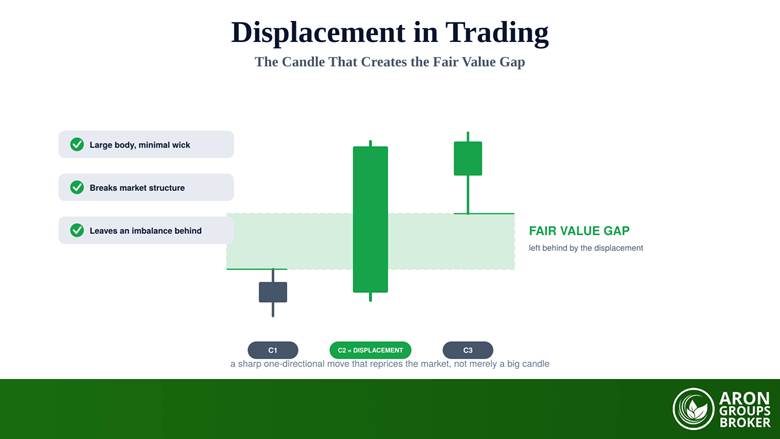
The most useful way to understand displacement is structural rather than descriptive. In the three-candle fair value gap sequence, displacement is the middle candle. Its momentum is so one-sided that the first candle’s wick and the third candle’s wick never overlap, and the untouched space between them is the gap. Everything else traders say about displacement follows from that one mechanical fact, which also makes it a checkable idea rather than a vibe, and therefore something a real trading edge can be built on.

This guide defines displacement, quantifies the three quality criteria that separate it from an ordinary large candle, distinguishes bullish from bearish displacement, places it inside the ICT sequence from liquidity sweep to entry, explains the premium and discount context that makes some displacement legs far better than others, and gives an honest account of what the concept cannot do.

bookmark
Key Takeaways
  • Displacement is a sharp, one-directional move with large candle bodies and minimal wicks that breaks structure and leaves an imbalance behind.
  • It is the middle candle of a three-candle fair value gap: without displacement there is no gap, because the outer wicks would overlap.
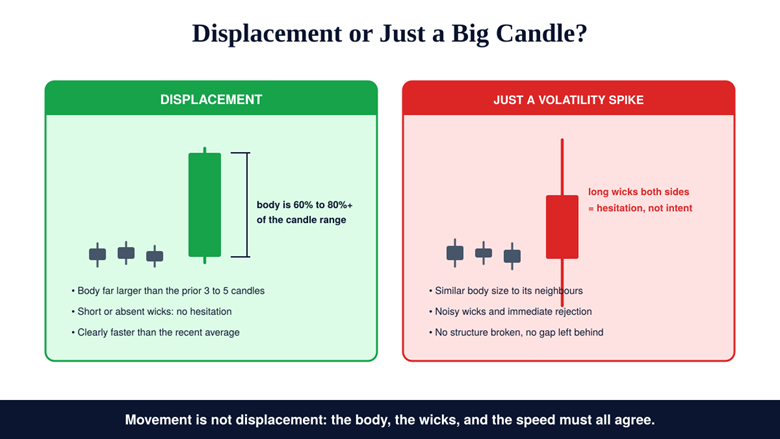
  • Three criteria qualify it: a body clearly larger than the prior three to five candles, roughly 60% to 80% or more of the candle's range, short or absent wicks, and speed above the recent average.
  • It is strongest immediately after a liquidity sweep and when the resulting gap sits inside a higher-timeframe discount for longs or premium for shorts.
  • It is a read on the quality of movement, not a standalone signal: without structure and context, a big candle is just a volatility spike.

What Is Displacement in Trading?

Displacement is the market repricing itself in a hurry. Instead of drifting through a range, price expands decisively in one direction, printing candles whose bodies dominate their ranges, and in doing so it breaks a structural level and skips a band of prices where almost no business was done. Research into foreign exchange market microstructure describes exactly this mechanism from the other side: large orders consume the available liquidity faster than it can be replenished, and price gaps as a consequence. Displacement is what that process looks like drawn as candles.

sms-star

Risk Disclosure

CFDs are complex instruments and come with a high risk of losing money rapidly due to leverage. You should consider whether you understand how CFDs work and whether you can afford to take the high risk of losing your money. Past performance is not indicative of future results. This content is provided for educational purposes only and does not constitute investment advice.
Displacement Is the Candle That Creates the FVG

Take three consecutive candles and label them C1, C2, and C3. When C2 is an ordinary candle, C1’s high and C3’s low overlap, every price in between has traded properly, and there is nothing to draw. When C2 is a displacement candle, its move is large enough that C1’s high sits below C3’s low in a bullish sequence, and the untouched band between those two levels is the fair value gap. Reverse the logic for a bearish sequence, where the gap runs from C1’s low to C3’s high. This is the clearest definition available: every fair value gap requires a displacement candle to create it, so the two concepts are one mechanism described from two angles.

The Three Quality Criteria

A big candle is not automatically displacement, and this is where most misreadings begin. Three measurable criteria separate a repricing leg from a spike. First, body size: the candle’s body should be noticeably larger than the bodies of the prior three to five candles, and as a working guideline the body should occupy roughly 60% to 80% or more of the candle’s total range. Second, wicks: short or absent wicks indicate no hesitation, whereas long wicks on both sides say the move was fought and rejected. Third, speed: the move should be visibly faster than the recent average, covering distance in less time rather than merely covering distance.

The Three Quality Criteria

Body dominance, clean wicks, and unusual speed are what separate a repricing leg from a spike that means nothing.

CriterionDisplacementOrdinary large candle
Body versus rangeRoughly 60% to 80% or moreBody a minor share of a wide range
Body versus neighboursClearly larger than the prior three to fiveSimilar in size to its neighbours
WicksShort or absent: no hesitationLong on one or both sides: rejection
SpeedFaster than the recent averageIn line with recent volatility
StructureBreaks a structural levelBreaks nothing that mattered
AftermathLeaves a clean gap behindLeaves no imbalance to return to

Six checks, one verdict: displacement has to satisfy the movement criteria and the structural ones together.

Bullish and Bearish Displacement

The two directions are mirrors. Bullish displacement appears as a run of strong up candles with little overlap between them, typically three or more on lower timeframes or as few as one or two on higher timeframes, leaving a gap that sits below the current price. Bearish displacement is the same picture inverted, with the gap left above. Direction is all this tells you, and it tells you nothing about where to enter, how much to risk, or when the move is exhausted; those answers come from the sequence and the plan built around it.

Where Displacement Fits in the Sequence

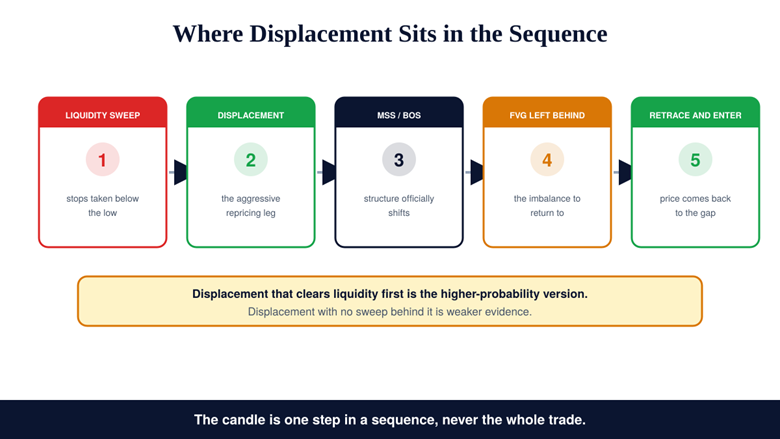
Displacement is one step in a chain, and traders who treat it as the whole setup tend to enter at the worst possible price, chasing the candle itself. The full sequence runs: a liquidity sweep takes stops beyond an obvious level, displacement then reprices the market away from that level, a market structure shift or break of structure confirms the change, the displacement leg leaves a fair value gap behind, and price finally retraces into that gap, which is where the entry lives. Ordering matters more than any single element, and the ordering is exactly the kind of claim that should be checked through out-of-sample backtesting rather than accepted because it sounds coherent.

Where Displacement Fits in the Sequence

Sweep, displace, confirm, leave a gap, retrace: the entry is at the end of the sequence, not at the exciting part.

One refinement is worth memorising: displacement that clears liquidity first is stronger evidence than displacement that arrives out of nowhere. If stops were taken immediately before the leg, the move had fuel and a reason. If price simply expanded without sweeping anything, you are looking at momentum whose origin you cannot explain, which is a thinner basis for risking money. Session context sharpens this further, since these sequences are cleanest during the London and New York killzones when genuine institutional participation is present.

Premium, Discount, and the Draw on Liquidity

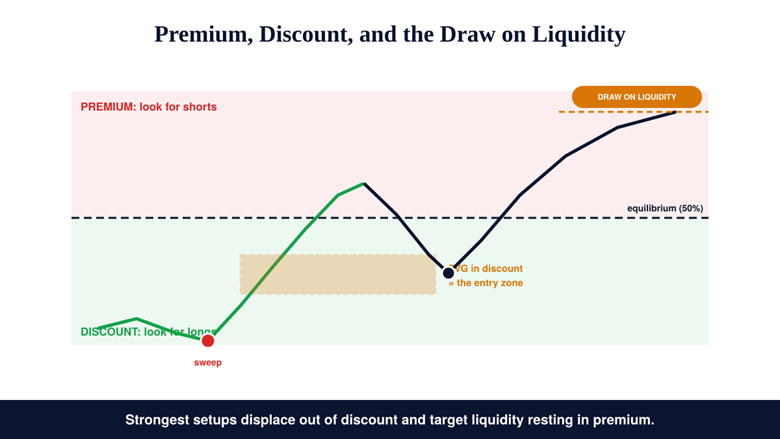
Not every valid displacement leg deserves a trade, and the filter that separates the good ones is location. Split the higher-timeframe range at its midpoint: above equilibrium is premium, where buying is expensive and shorts are favoured, and below it is discount, where longs are favoured. The strongest setups occur when a displacement leg leaves a clean gap inside a discount for a long, or inside a premium for a short, and when there is an identifiable draw on liquidity for the move to target: an old high, an old low, or a pool of equal highs or lows the market has not yet taken.

Displacement in Trading: How the Displacement Candle Creates Fair Value Gaps and Signals Smart Money

Displace out of discount, retrace into the gap, and target the liquidity resting above: location decides quality.

Mini Example: A Discount Long, Step by Step

Gold trades into the lower third of its weekly range and sweeps the previous session’s low, taking stops. Within two candles a strong bullish leg prints: body about three-quarters of the range, almost no upper wick, and clearly faster than the preceding candles. It breaks the most recent lower high, confirming a structure shift, and leaves a clean fair value gap behind.

The trader does not chase. They mark the gap, wait for price to retrace into it, and enter there with the stop beyond the far side of the gap and the low that was swept. The target is the untouched high from the prior session, the nearest draw on liquidity. Whether it wins or loses, every decision was made from the sequence rather than from the excitement of the candle.

How to Trade the Gap It Leaves

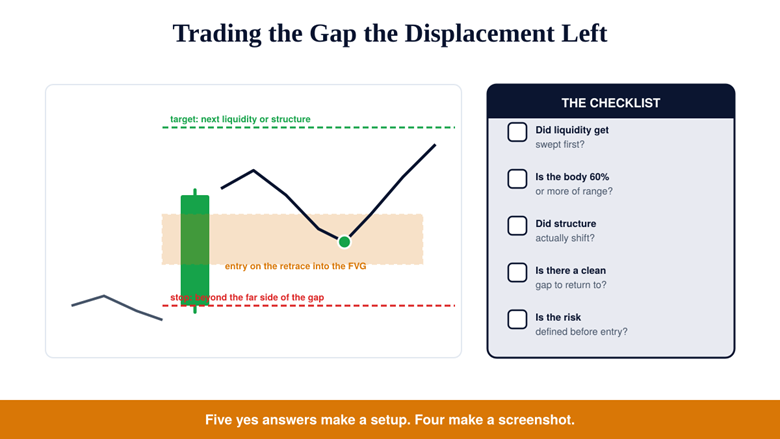
The mechanics are deliberately unexciting. Entry is on the retracement into the fair value gap the displacement created, not on the displacement candle itself, because entering mid-leg means paying the worst price in the move and placing a stop that is either far away or arbitrary. The stop belongs beyond the far side of the gap, or beyond the liquidity that was swept, so that being wrong is defined by structure rather than by a round number. The target is the next liquidity pool or the next structural level, and every one of those distances should clear a fixed risk-to-reward ratio before the trade exists at all.

Displacement in Trading: How the Displacement Candle Creates Fair Value Gaps and Signals Smart Money

Entry in the gap, stop beyond its far side, target the next liquidity, and a checklist that has to pass first.

Two habits keep this honest. Size the position from the stop distance with deliberate position sizing rather than from how convincing the candle looked, and write the trigger before price arrives, because a gap that is being watched live is remarkably persuasive. Volatility context also helps: tools such as Keltner Bands make it obvious when a candle is genuinely outsized for current conditions rather than merely large on the screen.

Q: Should I enter as soon as I see the displacement candle?

A: Usually not. Entering mid-displacement gives you the worst price in the move and no structural place for a stop. The concept’s own logic says to wait for the retracement into the gap the candle created; if price never returns, that trade simply was not available to you.

The Honest Framing: Movement Quality, Not a Signal

Displacement is a read on the quality of a move, not a trade trigger, and the distinction is where money is lost. A large candle with poor follow-through, noisy wicks, or no relevant structure behind it is a volatility spike, and calling it displacement afterwards does not change what it was. A fair value gap is not a magic zone either: plenty go unfilled, and plenty fill and continue straight through. The wider ICT premise that markets are algorithmically engineered to hunt retail orders is a viewpoint rather than an established fact, and it is worth holding loosely, because narratives that explain every outcome after it happens are the easiest kind to believe and the hardest to test.

Treat the concept probabilistically and the base rates stay in view. European regulators found that the large majority of retail accounts lose money on leveraged products, and investor-education guidance on leveraged strategies makes the plainer point that magnified exposure magnifies every misread candle. No pattern vocabulary suspends that arithmetic, which is why risk management outranks any structural read.

Displacement vs Retail Momentum

The practical test for telling institutional displacement from a random explosive candle has three parts, and all three must be present. Structure: did the move break a level that mattered, a swing high or low the market had been respecting? Imbalance: did it leave a clean gap, evidence that prices were skipped rather than traded? Context: did it originate from a liquidity sweep, a premium or discount area, or an active session, rather than from the middle of a quiet range? A candle that satisfies all three is displacement. A candle that satisfies none is a news spike with good marketing.

Where Aron Groups Fits

The concept costs nothing to learn and nothing to mark up by hand, which is the best way to start: no indicator required, just three candles and a ruler. If the underlying mechanics of entries and exits are still new, our guide on how to trade forex is the foundation this sits on. Chart the sequence wherever you analyse, then execute on the MetaTrader 5 platform at Aron Groups, using alerts at your gap levels and hard stops so the plan survives contact with a fast market.

Rehearse the full sequence on a demo account before any capital is exposed, then move to a small account where micro volumes keep the first live lessons affordable. Judge the method the way a professional trader judges any method, by a steadier equity curve over many trades rather than by the one screenshot where the gap filled perfectly.

Conclusion

Displacement is the moment the market stops negotiating and reprices. Mechanically it is the middle candle of a three-candle sequence, the one whose speed leaves a fair value gap between its neighbours, and practically it is qualified by three checks: a dominant body, clean wicks, and speed above the recent average. Read in sequence, after a liquidity sweep and confirmed by a structure shift, it marks where the market moved with intent.

What it never becomes is a signal on its own. Location decides quality, the retracement decides the entry, structure decides the stop, and liquidity decides the target. Build that around a systematic process, keep capital preservation ahead of any single gap, and displacement earns its place as a filter rather than a story.

Frequently Asked Questions

Quick answers to the questions traders ask most about displacement and the gaps it leaves behind.

What is displacement in trading?

Displacement is a sharp, one-directional price move made of large-bodied candles with minimal wicks that breaks market structure and leaves an imbalance, or fair value gap, behind. It is read as a sign of institutional order flow rather than ordinary retail momentum.

How is displacement related to a fair value gap?

Displacement creates it. In the three-candle fair value gap sequence, the displacement candle is the middle one, and its momentum is what stops the first and third candles’ wicks from overlapping. The untouched space between them is the gap, so every fair value gap requires a displacement candle.

How big does a displacement candle need to be?

There is no official threshold, but a workable guideline is a body occupying roughly 60% to 80% or more of the candle’s range, clearly larger than the bodies of the prior three to five candles, with short or absent wicks and visibly faster movement than the recent average.

Is displacement a reliable trading signal on its own?

No. It describes the quality of a move, not a complete setup. Without a liquidity sweep behind it, a structure break to confirm it, a gap to return to, and defined risk, a large candle is simply volatility. Treat displacement as one filter among several.

Continue Reading
not-found
calendar 5 August 2026
Rate this article

Leave a Reply

Your email address will not be published. Required fields are marked *

No thanks