
Gold often moves further in one London afternoon than a major currency pair moves in a week. That is exactly why day trading gold attracts so many traders, and exactly why so many of them fail. XAU/USD combines deep liquidity with sudden, violent expansion, and it punishes anyone who treats it like a slower market.
Most guides stop at buying support and selling resistance. That advice ignores the three variables that actually decide intraday outcomes on gold: when you trade, how the market engineers liquidity, and how much you risk per attempt. Without an edge across all three, leverage simply accelerates an account towards zero.
This guide maps the volatility profile of XAU/USD, the best time to day trade gold, the technical frameworks professionals rely on, and the risk protocol that keeps them in the game. It closes with the execution requirements that separate workable commodity trading strategies from expensive hobbies.
- XAU/USD is a highly liquid but volatile instrument; day trading it requires a tested trading edge, not instinct or leverage.
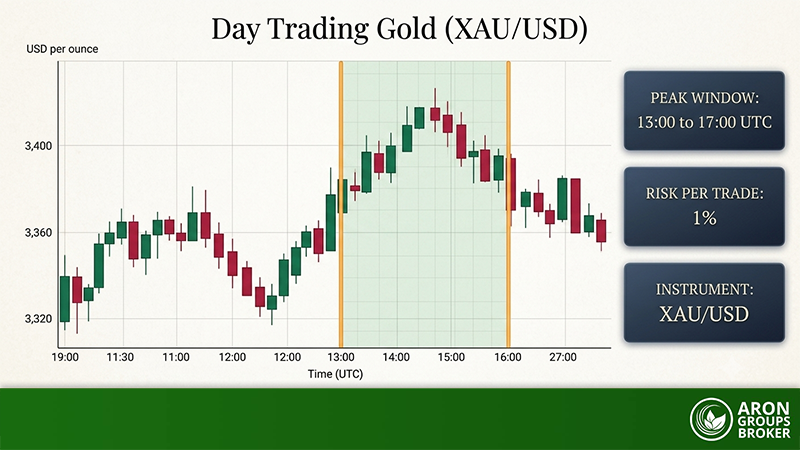
- The London-New York overlap, roughly 13:00 to 17:00 UTC, offers the deepest liquidity and tightest spreads of the trading day.
- Structural frameworks such as the SMC sequence and filtered breakouts outperform reactive, candle-by-candle decision making.
- A fixed 1% risk per trade, sized from the stop distance and protected by automated stops, is the core survival rule on gold.
- Execution quality on an ECN-style MetaTrader 5 environment directly affects spread cost, slippage, and fill speed during news.
What Makes Gold (XAU/USD) a Day Trading Instrument
Before timing or tactics, a day trader needs to understand what this market actually is and how it behaves.
Risk Disclosure
CFDs are complex instruments and come with a high risk of losing money rapidly due to leverage. You should consider whether you understand how CFDs work and whether you can afford to take the high risk of losing your money. Past performance is not indicative of future results. This content is provided for educational purposes only and does not constitute investment advice.
XAU/USD in Plain Terms
XAU/USD is the ticker symbol for spot gold quoted against the US dollar, where one unit represents one troy ounce. It trades almost 24 hours a day, five days a week, across an over-the-counter network of banks and liquidity providers, while futures volume concentrates on COMEX. Because it is priced in dollars, gold behaves like a currency pair with a commodity’s temperament: it responds to the dollar, to real yields, and to fear.
The Volatility Reality
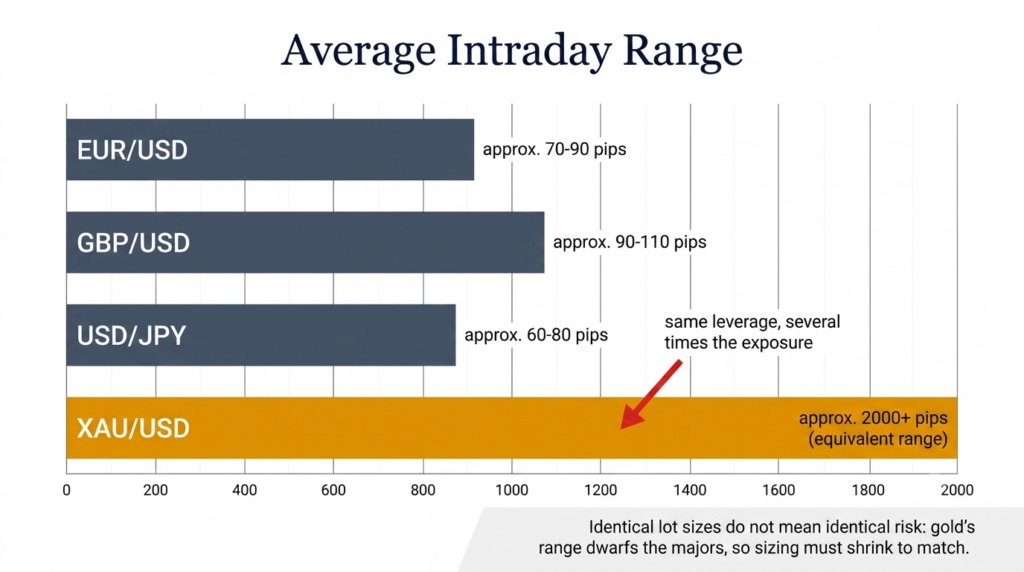
Gold routinely travels 1% to 2% in a single session, several times the typical daily range of major currency pairs. XAU/USD volatility expands sharply around US data because the metal reprices with every shift in the Federal Reserve’s expected path. Safe-haven asset flows during geopolitical stress and inflation hedge demand around hot CPI prints add further fuel. High leverage on such an instrument means small timing errors become large losses, so a durable trading edge, proven on data, is the only honest answer. Day trading gold and silver together compounds the problem: silver shares the drivers but with thinner liquidity and wider spreads, which magnifies every execution mistake.
Did You Know?: Measured in account-currency terms, gold's average intraday range often exceeds that of EUR/USD several times over. Position sizes that feel normal on forex majors are frequently oversized on XAU/USD. |
The Best Time to Day Trade Gold
On gold, the clock is a strategy input as important as any indicator.
The Golden Window: The London-New York Overlap
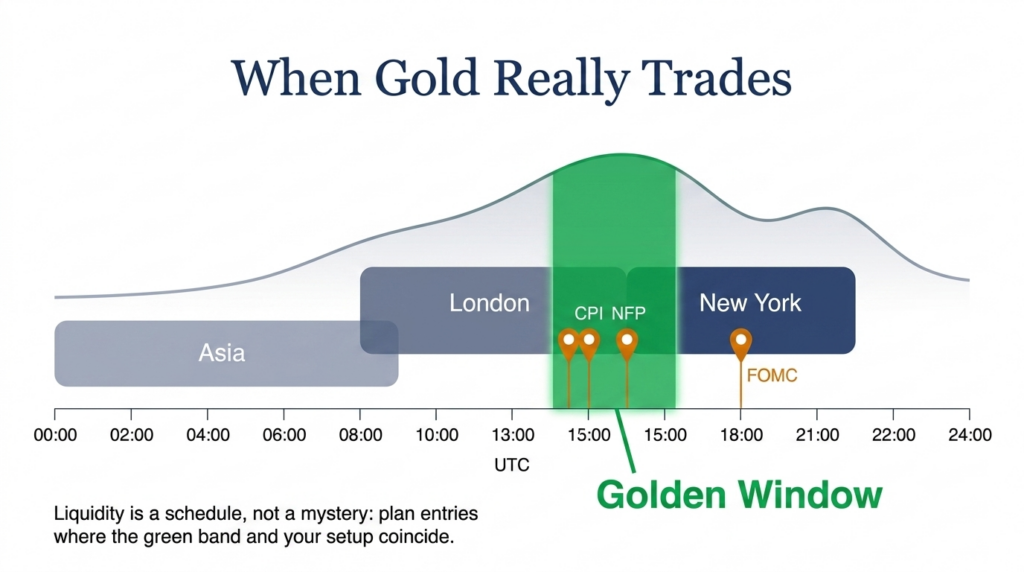
The best time to day trade gold is the London-New York overlap, roughly 13:00 to 17:00 UTC, when both major sessions are active at once. This market session overlap concentrates order flow from European and American desks, so liquidity providers quote tighter spreads and depth improves. The Bank for International Settlements’ triennial survey shows how heavily global turnover clusters in the London and New York trading windows. Tighter spreads reduce the cost of entry on every single trade, and for a high-frequency intraday style that saving compounds into a meaningful share of annual returns.
| Dimension | London-New York overlap | Asian session |
|---|---|---|
| Liquidity | Deepest of the day; both major desks active | Thin books; regional flow only |
| Typical spread | Tightest quotes of the session | Noticeably wider, costlier entries |
| Price behaviour | Directional expansion, cleaner follow-through | Range building, false starts |
| Best suited for | Breakouts, SMC sequences, news frameworks | Marking levels, preparing the plan |
The same setup costs less and travels further inside the overlap than outside it.
The Hours to Respect: CPI, NFP, and FOMC
Three US releases dominate gold’s intraday calendar: the Consumer Price Index (CPI), Non-Farm Payrolls (NFP), and Federal Open Market Committee (FOMC) decisions. Each can reprice XAU/USD by a full percent in minutes, because each resets expectations for Federal Reserve policy. Forex news trading around these events is a specialist discipline with its own tested rules. Most day traders are better served flattening positions ten minutes before the release and re-engaging once spreads normalise.
Reading Intraday Price Action and Liquidity Zones
Charts make more sense once you stop asking where price will go and start asking where the orders are.
Market Liquidity Zones
Market liquidity zones are price areas where resting orders cluster: above equal highs, below equal lows, around the previous day’s extremes, and at session opens. Gold gravitates towards these pools because large participants need opposing volume to fill size. Intraday price action on XAU/USD frequently sweeps a zone first, consumes the resting orders, and only then reveals its true direction. Reading the chart therefore starts with one question: where is the nearest pool of stops, and who benefits from triggering it?
Technical Analysis Patterns That Survive on Gold
Classic technical analysis patterns still work on gold when they align with liquidity rather than stand alone. Range boundaries at session extremes, flags after impulsive legs, and failed breakouts at the prior day’s high or low remain the highest-quality contexts. Volatility envelopes such as Keltner Bands help separate orderly trends from exhaustion moves, which matters on an instrument this fast. What does not survive is indicator stacking: five oscillators agreeing tells you nothing about where the stops sit.
Gold Day Trading Strategies Professionals Use
The best gold day trading strategy is the one whose rules you can execute identically fifty times in a row, because that is what turns discretionary reaction into systematic trading.
The SMC Sequence: Sweep, Displacement, FVG
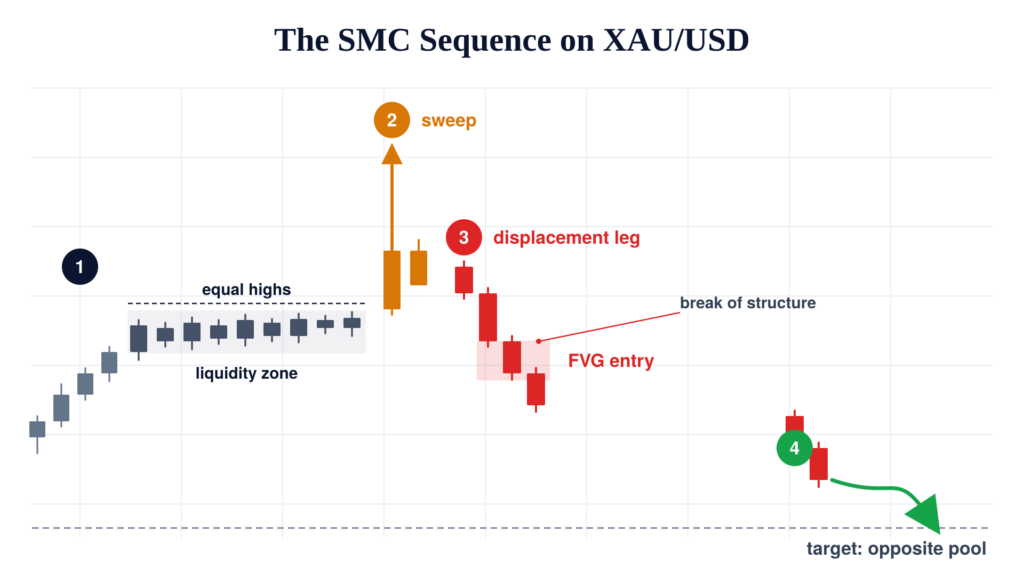
The Smart Money Concepts (SMC) sequence trades the aftermath of a liquidity grab in three stages. First, price sweeps a liquidity zone, taking out equal highs or lows. Second, it displaces: an aggressive structural break in the opposite direction that leaves a fair value gap (FVG), a visible imbalance between candles. Third, the trader enters on the retrace into that FVG, with the stop beyond the sweep extreme and the target at the opposite liquidity pool. The sequence defines entry, invalidation, and objective before the trade exists, which is precisely what a leveraged instrument demands.
Breakout Strategies with Volatility Filters
A breakout strategy on gold trades the escape from a defined pre-session range, most commonly the Asian range, once London or New York opens. Raw breakouts fail often, so professionals add filters: expansion in volatility, a retest that holds, or alignment with the higher-timeframe draw. Whichever variant you choose, the rule set must earn its place through out-of-sample backtesting before it risks a single dollar, because gold’s regime shifts retire strategies without notice.
Rule: If a setup cannot be written as a checklist that two traders would execute identically, it is an opinion, not a gold day trading strategy. |
Mini Example: A New York Sweep on XAU/USD (text-only scenario)
Gold drifts higher through the Asian session and stalls just beneath yesterday’s high, where a pair of equal highs marks an obvious liquidity zone. Early in New York, price spikes eight dollars above those highs, holds for two minutes, then displaces downwards through the session midpoint, leaving a clean fair value gap.
The trader shorts the retrace into the gap. The stop sits three dollars above the sweep high; the target is the Asian session low, roughly 2.5 times the risk. Position size is set so the stop equals 1% of equity. If price closes back above the sweep high, the idea is invalid and the trade is closed without negotiation.
The Risk Management Protocol for XAU/USD
On gold, risk management is not a chapter at the end of the plan. It is the plan.
Fix the Risk Before You Pick the Trade
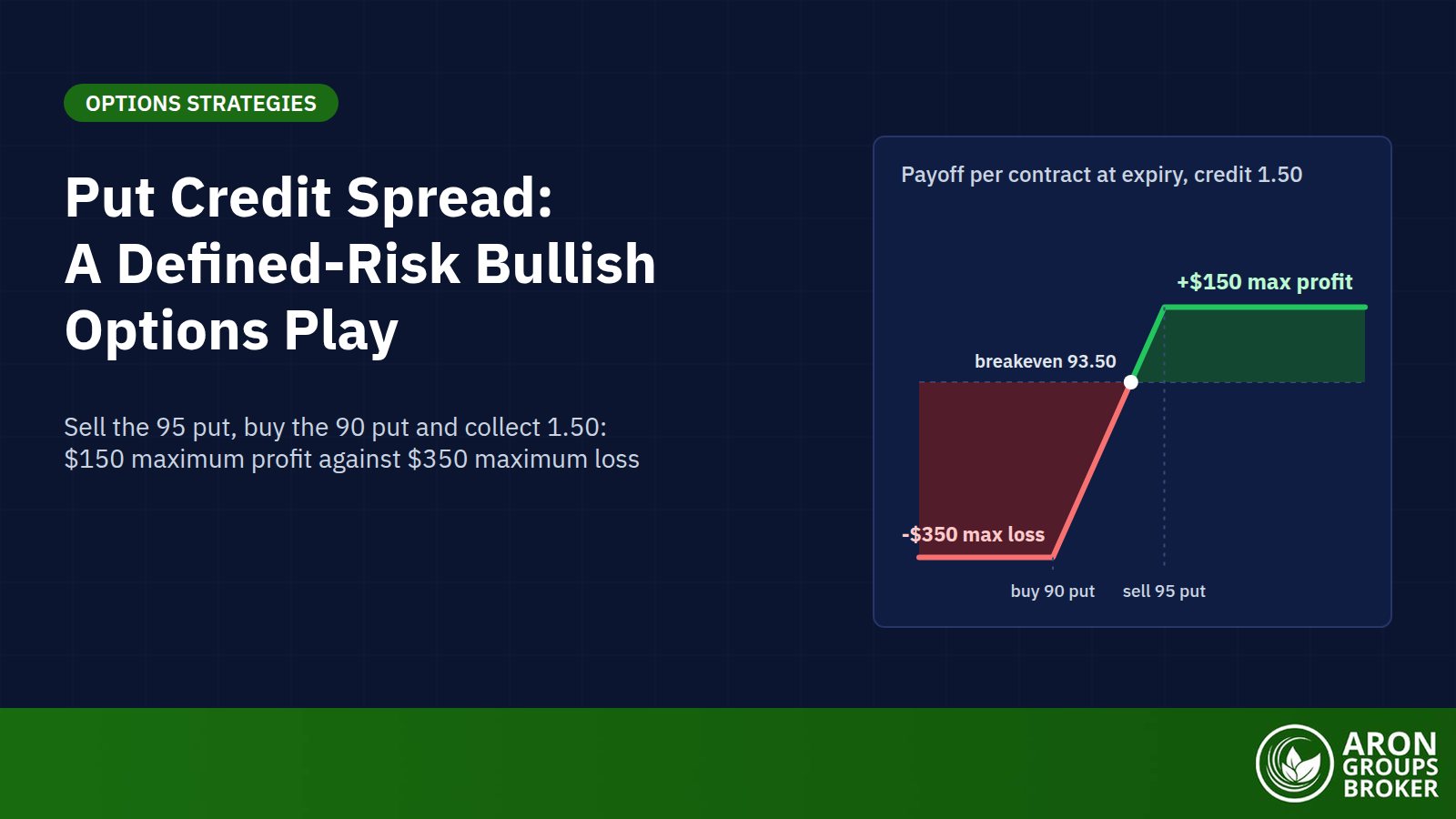
The professional protocol mandates a fixed fraction of equity per trade, typically 1%, translated into lots through position sizing from the stop distance. Because volatility changes by session, the stop distance changes, and the lot size must change with it. Pair that cap with a minimum risk-to-reward ratio of 1:2, so the arithmetic of a normal win rate still produces growth. A losing streak then costs a single-digit drawdown instead of the account, and capital preservation stays intact while the edge does its slow work. A risk-reward indicator on the chart keeps the ratio visible before entry, not after.
Stop-Loss Placement and the Stop-Hunt Problem
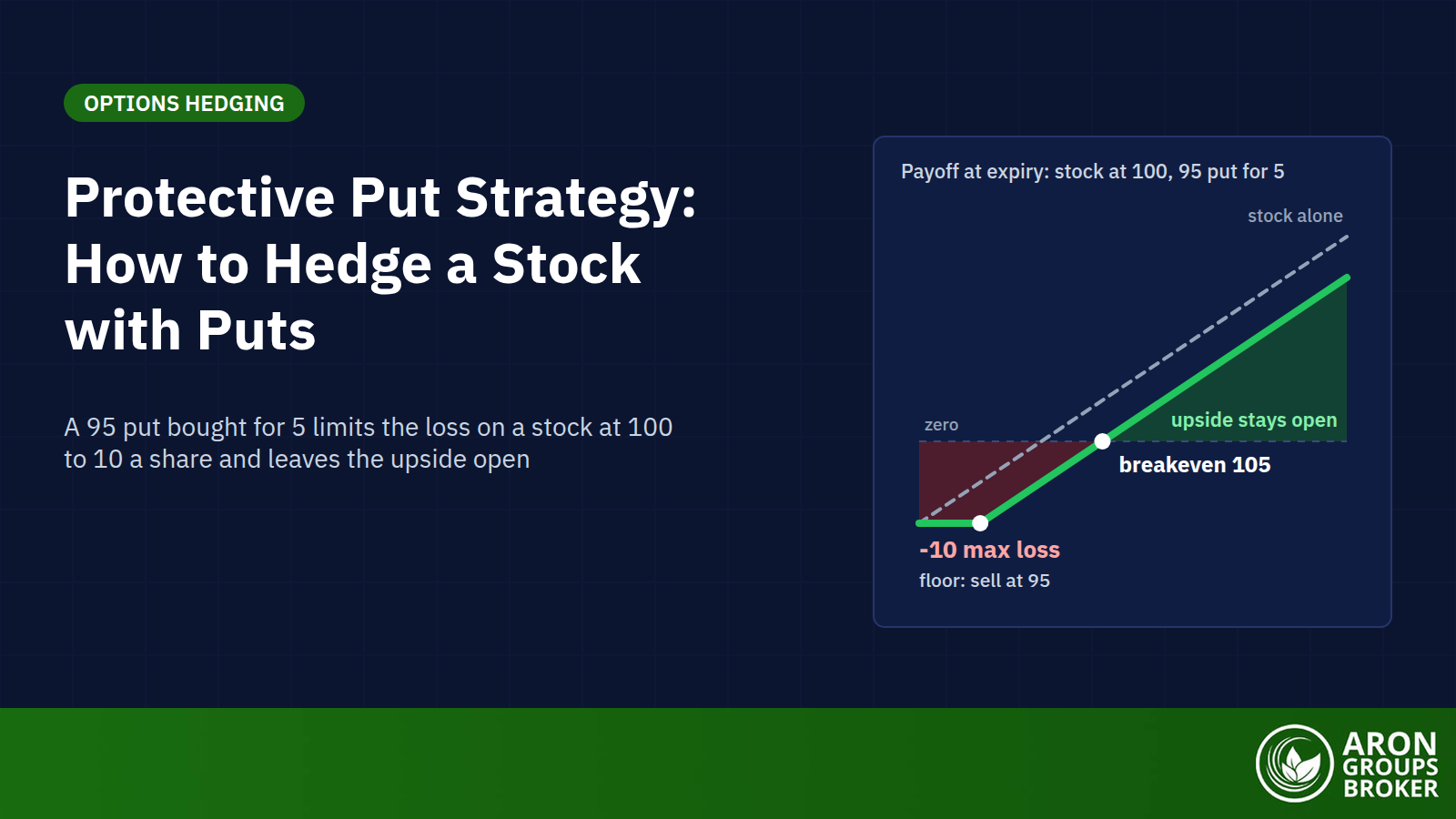
Stop-loss placement on gold must live beyond the structural invalidation point, never at a round number or a fixed pip count. XAU/USD is notorious for violent stop-hunting spikes during CPI, NFP, and FOMC windows: price wicks through obvious levels, triggers clustered stops, then reverses. Automated, server-side stops attached to the order are therefore mandatory, because mental stops fail precisely when spreads widen and prices gap. The CFTC’s advisory on retail off-exchange trading warns that leveraged products can move against customers faster than they can react, and ESMA’s product intervention measures cap retail gold CFD leverage at 20:1 for exactly this reason, alongside margin close-out and negative balance protection.
Risk Warning: News releases can widen spreads and gap prices straight through stop levels; the fill you receive may differ from the level you set. Reduce size or stand aside around CPI, NFP, and FOMC unless your plan has a tested edge in those exact conditions. |
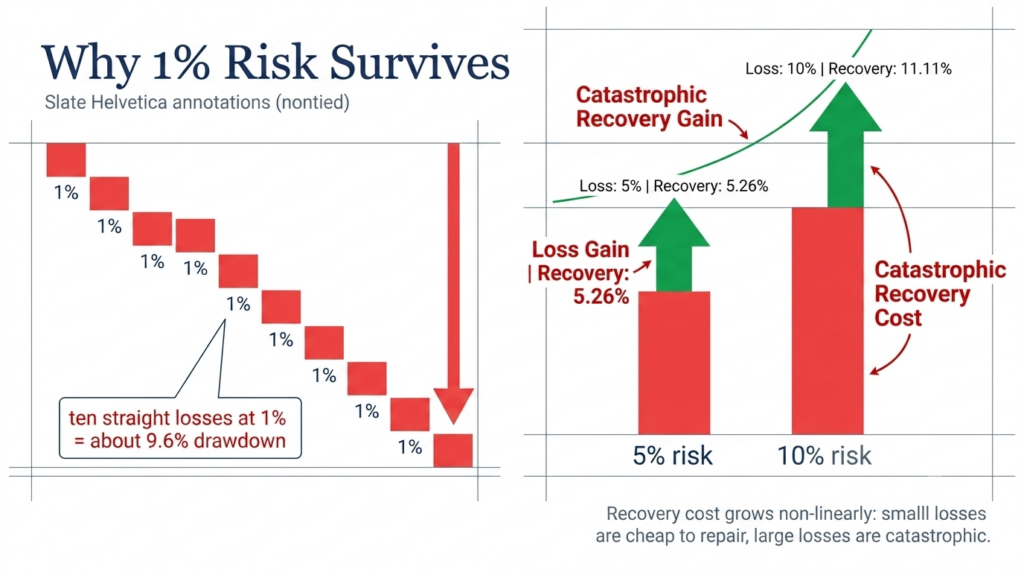
Q: Is 1% risk per trade too conservative for a small account?
A: No, and the maths explains why. Ten consecutive losses at 1% cost roughly 9.6% of equity, a recoverable setback rather than a terminal one. Doubling the risk does not double the edge; it only doubles the speed at which normal variance can remove you from the market. Small accounts grow through consistency and periodic funding, not through oversized bets.
Overnight Gaps and the Weekend Question
Day trading means flat by the close, and gold rewards that discipline more than most markets. The metal trades nearly around the clock during the week, but it still pauses over the weekend, and it reacts hard to headlines that break while the market is thin or shut. A central bank comment on a Sunday, a geopolitical shock, or a surprise policy signal can reopen XAU/USD several dollars away from Friday’s close, straight through any stop left resting in the book.
The practical rule is simple: a genuine intraday trader carries no gold position into the weekend without a deliberate, tested reason. Holding overnight inside the week is a separate decision that demands wider stops, smaller size, and an acceptance that the opening print, not your stop level, sets the loss. Most consistent gold day traders sidestep the question entirely by closing before the New York session winds down, banking the day’s result, and starting the next session with a clean book and a fresh read on liquidity. Gaps are not a risk to be managed so much as a risk to be avoided, and avoidance costs nothing but patience.
Execution: The MT5 and ECN Advantage
Strategy quality caps your potential; execution quality decides how much of that potential you keep.
Why ECN Execution Matters on Gold
ECN execution routes orders into a pool of competing liquidity providers, so the spread reflects the live interbank market rather than a fixed markup. On an instrument as fast as XAU/USD, three execution variables dominate outcomes: the spread at the moment of entry, slippage on stop orders, and fill latency during news. Low-latency servers shave the milliseconds that decide whether a breakout order fills at the level or five ticks worse. Depth-of-market visibility adds a final edge by showing where real size is resting.
Building the Gold Workstation on MetaTrader 5
MetaTrader 5 remains the standard intraday platform for gold because it combines one-click execution, a depth-of-market window, native alerts, and automated order management in one place. Traders at Aron Groups run XAU/USD on an MT5 and ECN environment built for fast execution and deep pricing, which is where the platform advantage becomes measurable. A Nano account lets a new strategy prove itself with minimal capital before real size is committed, and the MetaTrader 5 toolbox tutorial covers the platform mechanics step by step. Beyond the software, trading discipline is the multiplier: one practical XAU/USD day trading tip is to trade the same window, with the same checklist, at the same risk, every single day.
Q: Do I need depth of market to day trade gold?
A: It is not mandatory, but it is a genuine edge in fast conditions. The depth-of-market window shows the size resting at nearby prices, which helps you judge whether a breakout has fuel or is about to stall into a wall of offers. On MT5 it also doubles as a one-click order ticket, which trims precious seconds from execution during the overlap.
Conclusion
Day trading gold rewards structure and punishes improvisation. The traders who last are not the ones with secret indicators; they are the ones who trade the overlap when spreads are thin, frame entries through liquidity sweeps or filtered breakouts, and never let one idea cost more than 1% of equity.
The trap is mistaking volatility for opportunity. XAU/USD offers movement all day, but the edge lives in a narrow window of time, a narrow set of setups, and a fixed unit of risk. The antidote is deliberately boring: same session, same checklist, same size, until the statistics speak.
Prove the process on a demo or a small live account first, measure everything, and only then scale. Gold will still be volatile next quarter; your job is to still be solvent when it is.