





Every candlestick on your chart is the result of orders being placed, filled, and canceled in real time. Most traders never see what happens beneath that candle. The depth of market DOM in forex pulls back the curtain, showing you the live buy and sell orders waiting at each price level before they become part of the printed chart. This guide breaks down how DOM works in forex, how to read it, and how to use it to make sharper trading decisions.

- Forex depth of market (DOM) shows real time data on bids, asks, and volume at each price level for a currency pair, giving you a snapshot of where supply and demand sit right now.
- DOM trading helps anticipate short-term price movement by revealing where large limit orders and pending orders cluster in the order book.
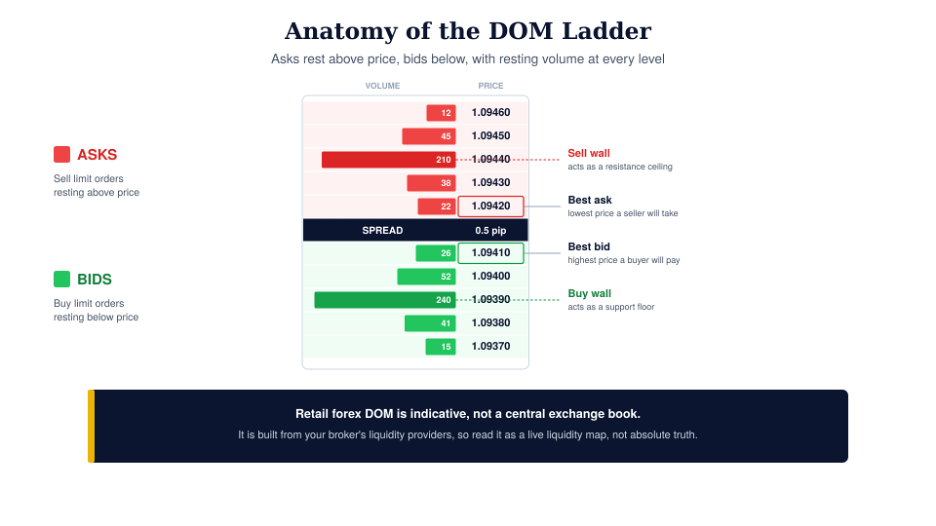
- Retail forex DOM is indicative - built from liquidity provider feeds rather than a single centralized exchange order book - so traders should treat it as a liquidity map, not absolute truth.
- Combining depth of market data with order flow analysis can improve scalping, intraday trading, and risk management on platforms such as MT5 offered by Aron Groups Broker.
DOM is most useful during active sessions (London and New York overlaps) and for major pairs like EURUSD, GBPUSD, and XAUUSD CFDs
What Is Depth of Market (DOM) in Forex?
Depth of market, also known as the order book, is a real-time display of all visible buying and selling interest at different price levels for a particular instrument. It shows you the volume behind the candles – where market supply and demand actually sit before price moves.
- The DOM displays active trade orders at different price levels, organized as a vertical ladder of bid prices (buy orders) on one side and ask prices (sell orders) on the other.
- In forex, DOM is typically built from liquidity provider feeds rather than a single centralized exchange. Unlike equities on NYSE or futures on CME, there is no atomic global limit order book for spot FX.
- The underlying structure is often called the order book. It reveals pending orders, available liquidity, and open interest near the current market price.
- A large number of orders at a given price level indicates higher market liquidity, meaning your trades are more likely to fill without significant slippage.
- Market depth complements your traditional chart by showing where buyers and sellers are stacking orders in advance of price changes.
- Aron Groups Broker provides market depth and Level 2 style market data on MT5 for selected forex, commodities, crypto, and index CFD symbols.
How the Forex DOM Window Works
A typical DOM window is straightforward once you understand its layout. Here is what you see when you open one:
- The DOM window is a vertical ladder with price levels in the center column. Bid volumes (buy orders) appear on one side and ask volumes (sell orders) on the other, giving you a visual snapshot of the current bid and the best ask at the top of each stack.
- Each price level shows the total number of pending buy and sell limit orders resting at that specified price, revealing current liquidity depth around the market price.
- Volume displayed may be in lots, units, or base currency. Traders can toggle this in platforms like MT5 when connected to their broker.
- DOM platforms display real-time supply and demand data, updating tick-by-tick as orders arrive, are modified, or get filled. This allows you to monitor order flow and micro price movement as it happens.
- Visual DOM aids in quick identification of market trends. Some platforms overlay bid/ask curves or a depth histogram next to the ladder, showing where liquidity clusters at key price levels.
- Effective DOM tools visualize liquidity behavior over time, so you can see whether resting orders are growing, shrinking, or being absorbed.
Market Depth, Liquidity, and Price Levels
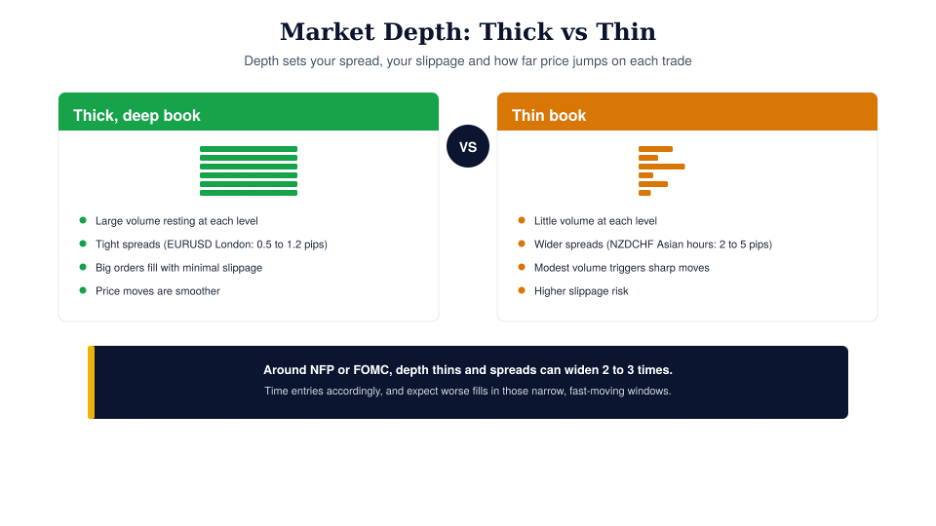
Market liquidity and volatility are directly connected. When market depth is thick, large trades cause minimal price disruption. When it is thin, even modest volume can trigger sharp price moves and wider spreads.
- Market depth refers to the amount of buy and sell volume available at each price level. Higher bid and ask quantities indicate a liquid market, where trade sizes can be filled with smaller price impact.
- For example, during the London trading session, which accounts for roughly 38–43% of global FX turnover, EURUSD spreads on competitive platforms can compress to 0.5–1.2 pips. Compare that with a minor pair like NZDCHF during Asian hours, where spreads may widen to 2–5 pips and depth is significantly thinner (source).
Understand Forex Trading vs Gambling.
- Large buy order concentrations can act as support levels in the market, forming a price floor that holds during pullbacks. Conversely, large sell order concentrations can act as resistance levels, creating a price ceiling that caps upside movement. DOM helps traders identify potential support and resistance levels by making these clusters visible.
- Narrow bid-ask spreads suggest higher market liquidity, and deep markets facilitate large trades with minimal price disruption. A liquid asset allows large orders without significant price changes.
- Sudden disappearance or addition of large orders on the DOM can precede sharp moves, offering clues about institutional activity or news reactions.
- Aron Groups Broker clients can use market depth on MT5 to time entries around major economic releases like Non-Farm Payrolls or FOMC, when liquidity and spreads can change rapidly – with spreads sometimes widening 2–3× during such events.
DOM Trading and Order Flow Analysis in Forex
DOM trading is an active intraday style where decisions are based primarily on what the depth of market ladder and order flow reveal, rather than relying solely on candlestick patterns or lagging indicators.
- In dom trading, traders watch aggressive market buys hitting the ask and aggressive market sells hitting the bid to gauge immediate order flow and short-term momentum. Understanding DOM improves decision-making for traders seeking precision.
- Comparing buy and sell volume at each price level helps to gauge market sentiment. If sell market orders are consistently overwhelming resting bids, sellers are in control.
- Simple order flow analysis techniques include tracking whether price advances into areas of thin liquidity – where few large resting orders exist – or repeatedly fails at thick liquidity walls in the order book.
- For example, scalping EURUSD or XAUUSD on MT5 using small targets of 2–5 pips involves entering when large resting liquidity is about to be broken and exiting near the next visible liquidity pocket. Traders can predict price movements using DOM data when combined with proper context.
- DOM assists in timing trades by showing where liquidity is high or low. Traders use DOM to gauge market liquidity effectively before committing capital.
- Aron Groups Broker’s fast execution and tight spreads are especially important for DOM-based scalpers who send multiple trades during peak sessions.
Using DOM for Market Orders, Limit Orders, and Pending Orders
One of the key differences between DOM and a standard order ticket is speed. The DOM ladder turns order placement into a one-click process, which matters when price moves fast.
- Traders can submit market orders directly from the DOM ladder with one-click buy or sell at the best price and a pre-set volume. Most online brokers offer access to DOM tools for traders on MT5.
- Clicking on a specific price level on the bid side places a Buy Limit (a pending buy order), while clicking on the ask side places a Sell Limit. This turns the DOM into a fast interface for managing pending orders and different order types, including stop order variants.
- Worked example: you open a 2-lot EURUSD long position from DOM. The first lot fills at 1.09420 (the current price), but the remaining lot slips to 1.09423 because there was limited depth at the top of book. The difference between these fills illustrates why understanding depth at each price level matters for large trades.
- A buy wall created by large limit buy orders can prevent price from falling further, which is useful context when deciding where to open buy positions or place a limit order.
- Traders can manage open positions from the DOM by closing at market, modifying stop-loss and take-profit, or scaling out around visible liquidity levels.
- Aron Groups Broker supports common pending order types – Buy Limit, Sell Limit, Buy Stop, Sell Stop, and Stop Limit variants – via the MT5 DOM window and standard ticket windows.
Learn more about the Adam and Eve Pattern.
Interpreting Price Movement from the Order Book
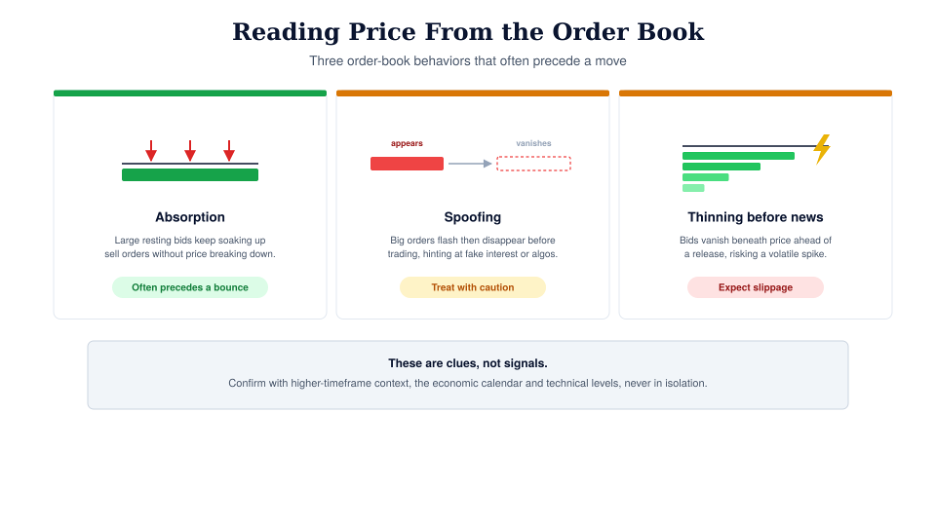
Changes in the order book often telegraph short-term price action before the chart prints a signal. Here are the patterns that matter:
- Absorption occurs when large resting bids repeatedly absorb sell market orders without price breaking lower. This often precedes a bounce or reversal and signals that buyers are defending a resistance level turned support.
- Traders can detect spoofing by observing how orders change in real time. Spoofing-style behavior – where large orders appear then vanish before being traded – can signal fake interest or algorithmic tactics. In OTC forex feeds, rapidly pulled liquidity should always raise caution.
- Rapid thinning of bids beneath the current price before a news release may foreshadow a volatile downward spike and larger slippage on market orders.
- A sudden build-up of limit sell orders just above the current GBPUSD price during a Bank of England speech can cap upside movement until the order wall is traded through. High concentration of sell orders can signal a price ceiling, while a high concentration of buy orders may indicate a price floor.
- DOM shows real-time supply and demand dynamics, but these signals should be combined with higher timeframe context, the economic calendar, and technical levels – never used in isolation. DOM helps traders assess potential price movements when layered into a broader strategy.
Explore the Turnaround Tuesday Strategy.
DOM on MetaTrader 5 with Aron Groups Broker
MT5 provides a built-in Depth of Market window for each symbol. Here is how Aron Groups Broker clients can put it to work:
- Aron Groups Broker streams market data for major forex pairs, gold, oil, indices, and selected crypto CFDs. The DOM is also known as the order book within the platform, and it shows real-time supply and demand for each financial instrument you trade.
- To open the DOM window, right-click on a symbol like EURUSD or XAUUSD in the Market Watch panel and select “Depth of Market.” For a deeper look at MT5 features versus MT4, the platform comparison is worth reviewing.
- Customization options include choosing volume units (lots or currency), adjusting trading volume presets, and enabling One Click Trading directly from the DOM interface.
- Aron Groups Broker’s execution model and liquidity aggregation aim to reduce slippage between the displayed DOM levels and actual fill prices, especially for active intraday traders.
- Test DOM behavior on a demo account first. Once comfortable, apply the same tools on live accounts with appropriate risk controls and proper position sizing.
Risk Management When Using Depth of Market
DOM is a powerful indicator of short-term market conditions, but it is a tool – not a guarantee. Visible liquidity can vanish instantly.
- Always use hard stop-loss orders rather than relying on large resting orders as “guaranteed” support or resistance. Market participants can pull orders at any moment.
- Size positions based on volatility and average spread of the pair. DOM scalping in fast markets like XAUUSD or GBPJPY carries higher slippage risk. A gold scalping strategy can help structure these trades.
- Order flow analysis should refine entries and exits within an existing strategy, not replace a well-defined trading plan and risk rules. Profit depends on discipline, not just data.
- Aron Groups Broker clients can combine DOM with tools like pending orders, partial closes, and copy trading or prop accounts, but should always monitor margin and leverage exposure across all open positions.
- Top-rated DOM platforms evaluate order book visibility and stability, but past DOM patterns from 2022–2025 – for example around major central bank events – are not a guarantee of future behavior in 2026 and beyond. Market conditions, investors, and institutional order flow evolve constantly.
FAQ
Below are common questions about using depth of market in forex trading.
Is forex depth of market data as reliable as DOM on centralized exchanges?
Forex is an over-the-counter market without a single central order book, so DOM reflects liquidity from your broker’s providers rather than the entire global market. Traders use DOM to gauge how many units of a security can be bought or sold without significant price impact. This still offers valuable insight into relative liquidity and order flow, but you should treat it as an indicative map and confirm signals with price action and the spread. The key difference from exchange-traded stock or futures DOM is that forex depth will vary from one broker to another depending on their LP network.
Do I need DOM to trade forex profitably?
Many successful traders use only charts and standard indicators. DOM is primarily an advanced tool for scalpers and intraday traders seeking precision entries. Whether forex trading is profitable depends far more on risk management and strategy than on any single tool. Experiment with DOM on a demo account first and adopt it gradually if it clearly improves your execution quality.
Which forex pairs show the best market depth on DOM?
Major pairs like EURUSD, GBPUSD, USDJPY, and liquid CFDs such as XAUUSD and US30 typically show the deepest and most stable order books during London and New York sessions. More orders at each price level means tighter spreads and smoother fills. Exotic or less traded crosses tend to display thinner depth and more erratic DOM behavior, making them less suitable for fast DOM-based scalping where you need reliable liquidity at every price level.
Can I use DOM and order flow analysis for longer-term swing trades?
DOM is strongest for short-term timing – think entries and exits within minutes or hours. However, swing traders can still use it to fine-tune fills near key technical levels or during major news events, reading where large orders from buyers and sellers cluster. For multi-day positions, higher timeframe analysis, fundamentals, and broader liquidity conditions determine outcomes far more than minute-by-minute order book fluctuations.
How do I access DOM on MT5 with Aron Groups Broker?
Open MT5 and connect to your Aron Groups Broker account. In the Market Watch panel, right-click on a chosen symbol – for example, EURUSD – and select “Depth of Market.” From there, enable one-click trading, set your preferred volume, and start monitoring the ladder of buy and sell orders alongside your traditional charts in the same workspace. The DOM window will update in real time as new market data arrives, letting you access the full depth of each asset you trade.