





Every forex trade starts with a single decision that most traders underestimate: how many lots to trade. Whether you open a position of 0.01 or 1.00, that number determines everything from your profit per pip to your margin call risk. This guide breaks down exactly what forex 1 lot means, how each lot size affects your trading outcomes, and how to align your position size with a sound risk management strategy-especially when trading forex CFDs with Aron Groups Broker on MT5

- One standard lot in forex trading equals 100,000 units of the base currency. For example, 1 lot of EUR/USD at 1.1000 means you control 100,000 EUR with a notional value of approximately $110,000.
- On most USD-quoted currency pairs, each pip movement on one standard lot is worth about $10 per pip.
- Four main lot sizes exist-standard (1.0), mini (0.1), micro (0.01), and nano (0.001)-and lot size affects pip value, required margin, and the risk of a margin call.
- Leverage and lot size together define how much trading capital is needed to open and hold a trading position, directly shaping your risk exposure in both forex and CFD trading.
- Aron Groups Broker offers flexible lot sizes and high leverage on MT5, allowing retail traders to align position size with their personal risk management plan.
What Is a Lot in Forex Trading?
A lot in forex trading is a standardized unit measuring trade size-it defines how many units of a currency pair you buy or sell per trade. On most forex accounts, one standard lot equals 100,000 units of the base currency. For example, 1 lot of EUR/USD means you are trading 100,000 EUR, while 1 lot of GBP/USD means 100,000 GBP.
Forex lots exist because the smallest price movement in most currency pairs is just 0.0001 (the fourth decimal place), making it impractical to trade individual currency units like a single euro or dollar. By grouping units into standardized lots, the forex market makes each pip movement meaningful in dollar terms.
When you see the term “forex 1 lot,” it almost always refers to a standard lot unless otherwise specified. Brokers like Aron Groups Broker also allow fractional lots-0.1, 0.01, and smaller-so traders of all sizes can participate. Profit, loss, required margin, and the risk of a margin call all scale directly with how many lots you trade.
Types of Lot Sizes in Forex Trading
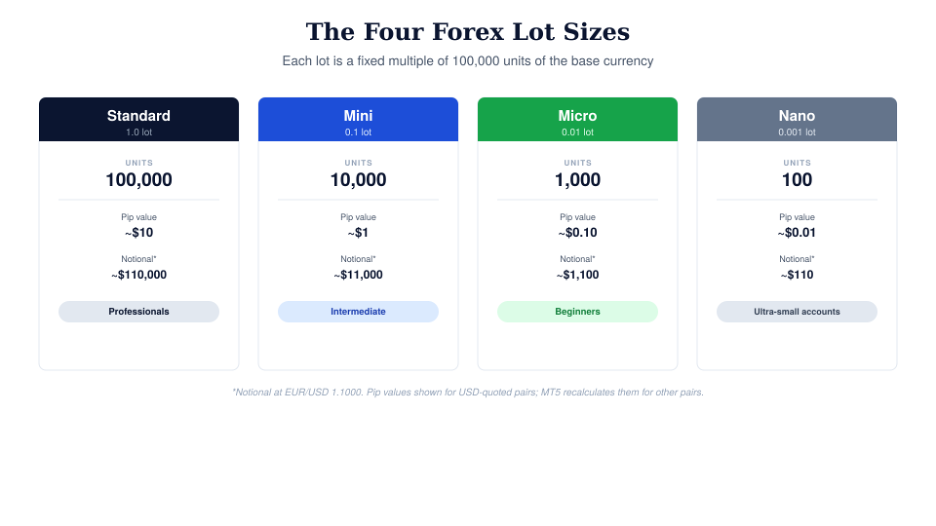
There are four main lot sizes in forex trading: standard, mini, micro, and nano. Each is defined as a fraction or multiple of 100,000 units of the base currency. In EUR/USD, the base currency is EUR; in USD/JPY, the base is USD.
Different lot sizes allow traders with various account balances-from under $100 to over $100,000-to participate in forex trading with appropriate risk. Aron Groups Broker supports all of these lot sizes on MetaTrader 5 for major, minor, and cross currency pairs, as well as CFDs on commodities and indices.
Standard Lot (1.0 Lot)
A standard lot is 100,000 units of currency. At an EUR/USD exchange rate of 1.1000, one standard lot equals 100,000 EUR with a notional trade value of approximately $110,000.
For most pairs where USD is the quote currency (like EUR/USD, GBP/USD, AUD/USD), one pip in a standard lot is worth approximately $10. That means a 20-pip move from 1.1000 to 1.1020 produces roughly $200 in profit or loss. A 50-pip swing in one standard lot results in a $500 gain or loss.
Standard lots are commonly used by professional traders and experienced traders because even small market movements create significant P&L swings. Higher lot sizes often have lower transaction fees and tighter spreads, which benefits high-volume strategies. Trading one standard lot involves high capital and margin requirements, so this lot size demands disciplined risk management.
Mini Lot (0.1 Lot)
A mini lot is 0.1 standard lot-10,000 units of the base currency. At EUR/USD 1.1000, a mini lot represents one tenth the size of a standard lot, with a notional value of approximately $11,000.
One pip in a mini lot is worth approximately $1, so a 30-pip move equals around $30 in potential profit or loss. Mini lots are suitable for intermediate traders or conservative strategies on accounts in the $1,000–$5,000 range. Aron Groups Broker allows trading micro or mini lots on major and minor pairs, letting traders scale in and out more precisely. You can also combine mini lots-for example, 0.3 lots equals 30,000 units-for flexible position sizing while keeping risk smaller than a full standard lot.
Micro Lot (0.01 Lot)
A micro lot is 0.01 lot or 1,000 units of the base currency. At EUR/USD 1.1000, the notional value is about $1,100.
The pip value for a micro lot is usually about $0.10 per pip on USD-quoted pairs, so a 50-pip move equals roughly $5 in gain or loss. Micro lots allow for lower risk with 1,000 units of currency, making them ideal for beginner traders, small accounts ($100–$1,000), and anyone looking to test strategies with live market conditions.
Starting with micro lots is advised for beginners to learn risk management. On Aron Groups Broker, traders can combine multiple micro lots (e.g., 0.07 lots = 7,000 units) for granular control using the position size calculator. This helps novice traders understand how lot size affects pip value and equity without exposing too much capital to large swings.
Nano Lot (0.001 Lot)
A nano lot is 0.001 standard lot, or 100 units of the base currency. At EUR/USD 1.1000, 0.001 lot represents a notional of about $110.
The pip value for a nano lot is about $0.01 per pip, so a 100-pip move equates to only about $1 change in P&L. Nano lots are useful for ultra-small accounts, strict risk management, or fine-tuning new trading systems in real market conditions with almost negligible financial risk.
Availability of nano lots depends on the broker and account type. Aron Groups Broker offers a dedicated Nano Account with cent-style fractional lot trading options-check specific account conditions for details. Educational traders can use nano lots alongside a demo account to bridge the gap between simulated and real-money trading forex.
How Lot Size Affects Pip Value in Forex Trading
A pip is the smallest price movement in most currency pairs-0.0001 for EUR/USD, 0.01 for JPY pairs. The lot size directly determines how much money each pip is worth in your account currency.
Lot size affects pip value differently depending on whether USD is the quote currency, the base currency, or absent entirely (cross currency pairs). For EUR/USD, the relationship is straightforward:
- Standard lot (1.0): approximately $10 per pip
- Mini lot (0.1): approximately $1 per pip
- Micro lot (0.01): approximately $0.10 per pip
- Nano lot (0.001): approximately $0.01 per pip
Because lot size affects pip value, it determines how quickly you reach daily loss limits, take profit targets, or a margin call. On Aron Groups Broker’s MT5, real-time pip value and P&L display per position so you always see the effect of your chosen trade size.
Pip Value Examples on EUR/USD
Using a fixed EURUSD exchange rate of 1.1000, here are concrete examples of how many pips translate to dollars at each lot size:
| Lot Size | Units | Pip Value | 15-Pip Move P&L |
|---|---|---|---|
| 1.0 (Standard) | 100,000 | ~$10 | ~$150 |
| 0.1 (Mini) | 10,000 | ~$1 | ~$15 |
| 0.01 (Micro) | 1,000 | ~$0.10 | ~$1.50 |
| 0.001 (Nano) | 100 | ~$0.01 | ~$0.15 |
Buying 1 lot EUR/USD at 1.1000 and closing at 1.1015 (15 pips) yields about $150. The same move at 0.1 lot yields around $15. For USD-quoted major pairs, pip value stays stable. For cross currency pairs or when the account currency is not USD, the trading platform recalculates pip value automatically. Understanding pip value is mandatory before choosing lot size and setting stop-loss distances.
Pip Value on Cross Currency Pairs
Cross currency pairs are those that do not include the USD, such as EUR/GBP, EUR/JPY, or GBP/JPY. On these pairs, pip value in the trader’s account currency may fluctuate more because it depends on both the traded pair’s price and the account’s base currency exchange rate.
For example, trading 0.1 lot of EUR/GBP with an account denominated in USD means pip value is first calculated in GBP, then converted to USD by MT5. Traders do not need to compute these conversions manually-Aron Groups Broker’s MT5 handles pip value and P&L automatically in the account currency. You can verify exact values using the pip value calculator.
The core principle holds for all pairs: larger lot sizes mean larger pip value, which means bigger profits and losses per one pip movement.
Discover Weekend Stock Trading.
Leverage, Margin, and 1 Lot in Forex
Leverage allows traders to control large positions with a smaller capital amount. For example, 1:100 leverage lets you control a $110,000 position (1 lot EUR/USD) with just $1,100 of your own money.
Leverage does not change the pip value or how many pips the market moves. It only changes how much of the trader’s own money is tied up as margin. Margin is the equity your broker blocks to keep a position open. If your equity drops too low, a margin call or stop-out occurs.
Aron Groups Broker offers high leverage on major pairs, making it possible to trade 1 standard lot with a relatively small account-but this also increases the risk of large drawdowns. Understanding how leverage and lot size interact is critical to avoiding overleveraging.
Margin Example for 1 Lot EUR/USD
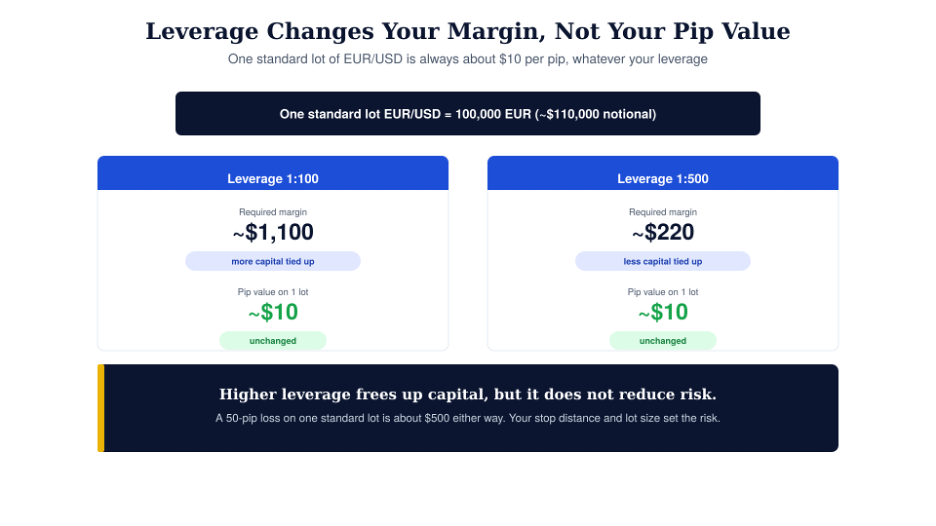
At EUR/USD = 1.1000, one standard lot equals 100,000 EUR, or approximately $110,000 notional value.
| Leverage | Required Margin | Pip Value (1 Lot) |
|---|---|---|
| 1:100 | ~$1,100 | ~$10/pip |
| 1:500 | ~$220 | ~$10/pip |
Notice that although the required margin changes with leverage, the potential profit or loss per pip on 1 lot stays the same at about $10 per pip. Each pip movement in a standard lot is worth $10 regardless of how much margin was required to open it.
Learn more about the Momentum Stock Scanner.
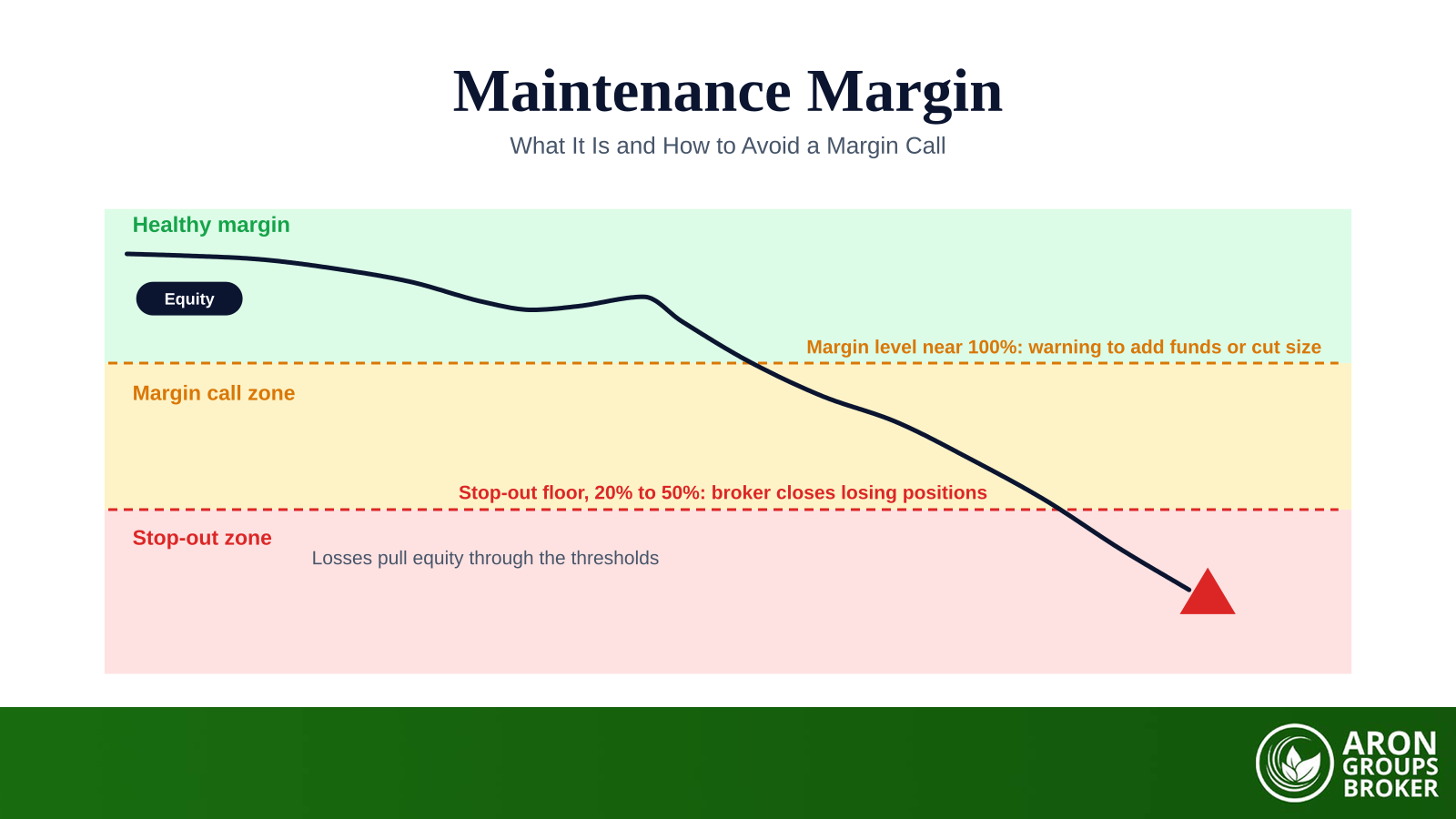
When open losses reduce equity below the broker’s threshold, a margin call triggers. Trading 1 lot with high leverage on a small account (e.g., $500–$1,000) leaves very little room for adverse price movement before that risk appears.
How Lot Size and Leverage Influence Risk
Risk comes from the combination of lot size, pip value, and the distance from entry price to stop-loss-not from leverage alone.
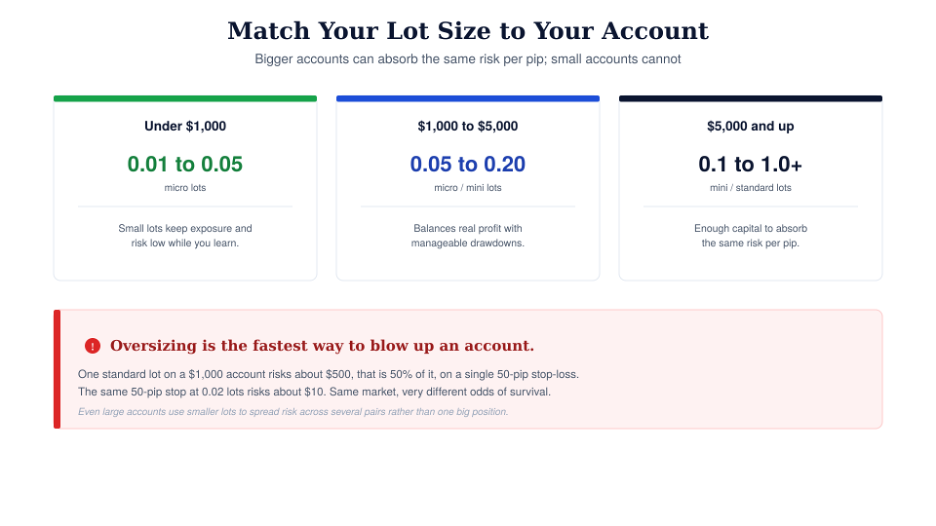
With a $1,000 account, risking 1% ($10) with a 50-pip stop-loss means you need a pip value of about $0.20, which translates to a trade volume of roughly 0.02 lots on EUR/USD. If the trader instead opens 1 standard lot, the same 50-pip stop risks about $500-50% of the account-creating excessive risk and a very high chance of margin call.
Aron Groups Broker provides high leverage as a flexibility tool, but proper risk management and controlled lot size remain entirely the trader’s responsibility. Beginner traders should start with micro lots (0.01) or smaller, even if the platform allows larger positions, to gain experience with how leverage, lot size, and margin interact.
How to Calculate the Correct Lot Size for Your Trade
Choosing lot size based on how much money you are willing to lose keeps every trade within your risk tolerance. Lot size is calculated using account balance and risk percentage, combined with stop-loss distance and pip value.
The formula:
Lot Size = (Amount at Risk) ÷ (Stop-Loss in Pips × Pip Value per 1 Standard Lot)
Many traders follow the 1–2% rule, never risking more than 1–2% of their account balance on a single trade, regardless of leverage. Setting lot size determines risk and reward in trading-get this step right, and the rest of your trading strategy falls into place.
Step-by-Step Lot Size Example
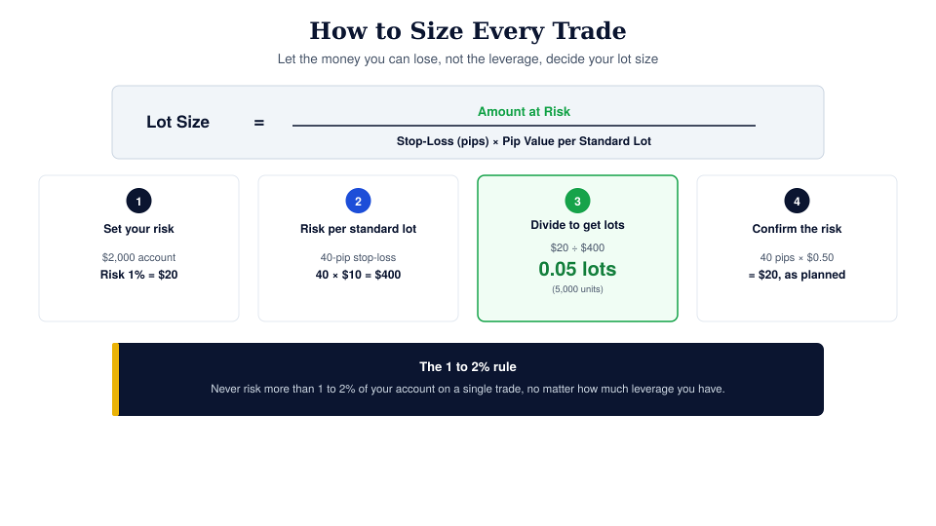
Scenario: You have a $2,000 trading account at Aron Groups Broker, trading EUR/USD with a risk percentage of 1% ($20) and a 40-pip stop-loss.
- Determine risk per 1 standard lot: 40 pips × $10/pip = $400.
- That’s far above your $20 cap. Apply the formula: $20 ÷ $400 = 0.05 lots (5,000 currency units).
- Result: Pip value at 0.05 lots ≈ $0.50/pip. Total risk if stopped out = 40 × $0.50 = $20, matching your plan.
On MT5 with Aron Groups Broker, simply enter 0.05 in the “Volume” field on the EUR/USD order ticket. This process works for any financial instrument-adjust the pip value and stop-loss distance accordingly using the position size calculator indicator.
1 Lot in Forex vs Smaller Lots: Which Should You Use?
Choosing between 1 lot and smaller lots depends on account size, experience level, and trading strategy. While 1 lot can generate meaningful trade sizes and meaningful profits quickly, it also produces large losses and margin calls on undercapitalized accounts.
Rough guidelines based on account size:
| Account Balance | Recommended Lot Range | Why |
|---|---|---|
| Under $1,000 | 0.01–0.05 (micro) | Smaller lot sizes reduce exposure and risk |
| $1,000–$5,000 | 0.05–0.20 (micro/mini) | Balances potential profit with manageable drawdowns |
| $5,000+ | 0.1–1.0+ (mini/standard) | Enough capital to absorb the same risk per pip |
Even large accounts frequently use smaller lot sizes to diversify across multiple currency pairs and manage total portfolio risk. With Aron Groups Broker, traders can combine multiple partial lots (e.g., three positions of 0.33 lots each) to scale in and out rather than opening a single 1-lot position all at once
Risk Management and Lot Size in Practice
Proper lot size in forex is central to risk management, alongside stop-loss placement, take profit levels, and overall trade exposure across all open trades.
Consider a trader holding 0.2 lots on EUR/USD, 0.1 lot on GBP/USD, and 0.1 lot on XAU/USD. The combined risk matters-not each position in isolation. Correlated pairs can amplify losses if market fluctuations hit multiple positions at once.
Lot size in forex trading also affects emotional control. Oversized 1-lot positions on a small account can lead to fear, panic, or revenge trading when volatile markets fluctuate quickly. Aron Groups Broker clients should use demo accounts and very small lot sizes until they can stick to their plan without emotional interference.
Copy trading, prop trading, and other services offered by Aron Groups Broker still require a good understanding of lot sizing to avoid excessive drawdowns. Even when following another trader’s signals, your risk management strategy should dictate how many units of the base currency each copied position controls.
Trading 1 Lot with Aron Groups Broker
Aron Groups Broker offers forex trading, cryptocurrencies, commodities, and CFD trading via MT5, all of which use lot sizing to define trade volume. Clients can choose from different account types-Nano, Standard (ECN), VIP, and Islamic-with varying minimum lot sizes, leverage limits, spreads, and margin requirements suitable for both novice traders and experienced traders.
On the Standard account, the minimum trade volume is 0.01 lots and the maximum per symbol is 10 lots, with a step size of 0.01. For 1.00 lot in forex pairs, leverage can reach up to 1:400, making the required margin for 1 lot EUR/USD at 1.1000 approximately $275. Fast execution and competitive spreads on major pairs like EUR/USD matter when managing larger positions in volatile markets.
Traders can also benefit from copy trading, prop trading programs, and savings products, but should always respect position sizing principles when scaling strategies with larger lot sizes.
Placing a 1-Lot Trade on MT5
Here is the straightforward process:
- Log in to Aron Groups Broker MT5 and select a currency pair (e.g., EUR/USD).
- Open the order window and set “Volume” to 1.00 for a standard 1-lot position.
- Set a stop-loss and take profit in pips or price levels based on your pre-calculated risk per trade.
- Review the required margin displayed by MT5-it reflects your account leverage and confirms whether a 1-lot position fits your equity.
- Execute the trade.
If the margin requirement or risk of a 1-lot trade is too high for your plan, use a smaller volume like 0.05 or 0.2. You can always check how many units a given volume represents by viewing the “Symbol Properties” in MT5, which shows contract size, tick size, and more. Aron Groups Broker’s customer support can also help clients understand lot steps and margin rules for each financial instrument.
FAQ about Forex 1 Lot and Lot Size in Forex Trading
How many dollars is 1 lot in forex on major USD pairs?
For most major pairs, a standard lot equals 100,000 units of the base currency. At EUR/USD 1.1000, 1 forex lot equals 100,000 EUR, which is approximately $110,000 in notional value. At USD/JPY 160.00, 1 lot equals 100,000 USD (approximately ¥16,000,000). The actual dollar value shifts as the exchange rate changes, but the standard unit count-100,000-stays fixed.
Is trading 1 lot suitable for a $1,000 forex trading account?
Generally, trading a full 1 lot on a $1,000 account is very aggressive. Since each pip is worth about $10, even a 30-pip adverse move would cost $300-30% of the account. With a $1,000 balance, lot size in forex is better kept at micro or small mini lots (0.01–0.05), especially for beginners looking to manage risk. While Aron Groups Broker leverage may technically allow 1-lot positions, responsible risk management is more important than maximizing trade size.
What is the difference between 1 lot in forex and 1 lot in CFD trading on commodities or indices?
In forex, 1 lot typically equals 100,000 units of one currency (the base). In CFD trading, 1 lot corresponds to a contract size defined by the broker-for example, 1 lot of gold (XAU/USD) might represent 100 troy ounces, while 1 lot of oil could represent a different number of barrels. Pip or tick value, margin requirements, and overall risk depend on both the contract size and the chosen lot size. Always check the contract specifications in MT5 to know exactly what 1 lot means for each instrument.
Can I change my lot size after opening a forex trade?
You cannot directly edit the lot size of an open position. However, you can partially close part of the position-for example, close 0.3 lots out of 1.0-to reduce your trade exposure. A better approach is to plan ahead by opening multiple smaller positions instead of a single large one, giving you more control to adjust total lot size while the trade is open. Adding new trades in the same direction increases total trade volume and must be factored into overall risk calculations.
How can I avoid a margin call when trading larger lot sizes?
Size your positions so that expected losses at the stop-loss level remain a small risk percentage of your account-usually 1–2%. Use smaller lot sizes, wider but logical stop-loss levels, and avoid over-leveraging with too many simultaneous positions across correlated pairs. On Aron Groups Broker MT5, monitoring free margin, margin level, and open P&L helps you spot when you are approaching a potential margin call so you can adjust lot sizes or close positions early. For more on setting appropriate risk limits, review your account’s margin call (100%) and stop-out (50%) thresholds.
Explore the Lorentzian Classification Indicator.